Home Blog Page 4232

Packworks seeks to link up retailer network of 270,000 with microlenders

BW FILE PHOTO

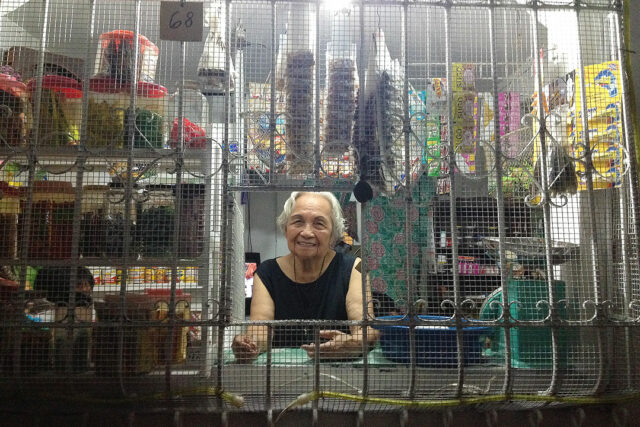
PACKWORKS, a business-to-business consumer goods marketplace, has entered into a tie-up with microlenders seeking to reach its network of over 270,000 mom-and-pop retailers, which are known in the Philippines as sari-sari stores.

“Our objective is to enhance financial inclusion, tap into untapped growth potential, and fortify the foundation of our retail industry,” Packworks Co-Founder and Chief Executive Officer Bing Tan said in a statement on Tuesday.

“We are actively pursuing these goals through strategic partnerships aimed at providing accessible and affordable financial services to empower the sari-sari store sector,” he said.

Packworks said its microlending partners are Cebuana Lhuillier and 1Sari Financing Corp.

“The lack of access to regulated credit and financing programs also forces them to live cash-in-hand, unable to get loans when they need them, which limits their growth potential,” it added.

The micro-, small- and medium-sized enterprise sector is considered highly underbanked, according to the Bangko Sentral ng Pilipinas.

“Enabling sari-sari stores to access essential financial services allows them to efficiently replenish their inventory, ensuring they are well-prepared to meet the heightened demand for various items during this festive period,” it said.

Aside from partnerships with financial service providers, Packworks will also be partnering with Bayan Academy to provide sari-sari stores owners access to learning modules on micro-entrepreneurship.

In the next two years, the company is hoping to expand its network to 500,000 sari-sari stores. — Justine Irish D. Tabile

BFAR makes play for confidential funds, cites need to upgrade fishery surveillance

SCREENGRAB FROM CCG.GOV.CN

THE Bureau of Fisheries and Aquatic Resources (BFAR) urged Congress to reallocate confidential funds towards fisheries surveillance projects.

“This initiative would empower our agency to strengthen and enhance our existing monitoring, control, and surveillance activities in the WPS (West Philippine Sea) and other fishing grounds to ensure the sustainable use of our marine resources and safeguard the livelihoods of our fisherfolk,” BFAR National Director Demosthenes R. Escoto said in a statement.

The BFAR is one of the 10 agencies affected by budget realignment after the House of Representatives stripped the confidential and intelligence funds of the Office of the Vice-President and the Department of Education amounting to P650 million.

The House said that funds will be given to agencies tasked in protecting national security.

Legislators last week approved the National Government’s P5.786-trillion budget for 2024, which is 9.5% larger than this year’s budget.

“The BFAR respects the wisdom of our lawmakers in determining the need for budget augmentation,” Mr. Escoto added.

BFAR is seeking to eradicate illegal, unregulated, and unreported fishing, a condition for the Philippines to access various trade agreements.

It added that it conducts resupply missions in collaboration with other government agencies, particularly the Philippine Coast Guard, to Philippine outposts in disputed waters.

The BFAR launched an P80-million livelihood project aimed at providing essential equipment, gear, and post-harvest training for efficient fishing in the WPS and reduce post-harvest losses. — Adrian H. Halili

Philippines to set up more bases to protect territory; navy drills kick off

A LANDSAT 7 image of Scarborough Shoal in the West Philippine Sea. — WIKIPEDIA

THE PHILIPPINES will set up more military bases to protect its territory, its defense chief said on Tuesday, amid rising tensions with China.

The locations of the new bases are not yet known, but they are likely to be built along the coast, Defense Secretary Gilbert C. Teodoro, Jr. told GMA Network news. “These will be joint sites of the Coast Guard, Philippine Navy, Philippine Air Force and civilian agencies.”

The groundwork for the new Philippine bases will start next year, he added.

Tensions between the Philippines and China have worsened in recent weeks amid rising encounters between their coast guards in the South China Sea, which China claims almost in its entirety. The Philippines has vowed to stand up to any incursions.

President Ferdinand R. Marcos, Jr. last week defended the Philippine Coast Guard’s removal of a floating barrier installed by China at Scarborough Shoal, which is within the Philippines’ 200-nautical mile exclusive economic zone (EEZ).

The Scarborough Shoal, a prime fishing spot about 200 kilometers (124 miles) off the Philippines, has been the site of decades of on-off disputes over sovereignty.

China, which calls the rocky outcrop Huangyan Island, has accused the Philippines of “intruding” in Chinese waters. Last month, it warned Manila to steer clear of provocations.

“China firmly upholds the sovereignty and maritime rights of Huangyan Island, and we advise the Philippine side not to provoke and cause trouble,” Foreign Ministry spokesperson Wang Wenbin told a news briefing.

The shoal is a traditional fishing ground that should be open to Filipino, Vietnamese and Chinese fishermen, according to a 2016 arbitral ruling by a United Nations-backed tribunal that voided China’s sea claims.

Forces from Manila, Britain, Canada, Japan and the United States kicked off on Monday two weeks of joint naval exercises in Philippine waters as a “show of force” amid flaring regional tension.

With more than 1,800 participants, the drills follow last week’s move by China to block Philippine fishermen from Asia’s most contested maritime feature, the Scarborough Shoal, held by China in the South China Sea.

This year’s “Sama-Sama” drills are being held in the southern part of the island of Luzon, featuring naval exercises in areas such as anti-submarine warfare, air defense and search and rescue, the Philippine navy said.

“With this show of force and active engagement of our allies and partners, ‘Sama-Sama’ transcends mere military exercises,” Philippine navy chief Rear Admiral Toribio Adaci said at the opening event.

“It is a symbol of our enduring partnerships and our shared commitment to security and stability in the Asia-Pacific region.”

In his remarks, Vice Admiral Karl Thomas, the commander of the US Navy’s Seventh Fleet, said, “It is important that all nations have a right to sail and operate in the West Philippine Sea, free from… being coerced, free from being intimidated.”

The West Philippine Sea refers to the portion of the South China Sea claimed by the Philippines.

Five vessels, two from the United States, and one each from Britain, Canada and Japan, joined the Philippine-hosted drills that will run until Oct. 13.

The navies of Australia, France, Indonesia and New Zealand also joined in by sending observers and experts.

“I am confident that no potential aggressor should be under any illusion other than this is a strong team of nations, a strong team of navies… one navy sailing and operating together,” Mr. Thomas added.

The Philippines and China have repeatedly sparred over the Scarborough, but tensions had ebbed under the previous pro-China administration in Manila.

Ties have soured this year, however, as President Ferdinand R. Marcos, Jr., who authorized the cutting of the cordon, seeks to strengthen relations with the United States.

Such efforts included giving the US expanded military access to Philippine bases, a move criticized by China as provocative and liable to stoke regional tension.

Vessels of the two countries have faced off several times this year elsewhere in Philippine EEZ.

Manila has accused Beijing’s coast guard of dangerous and aggressive acts such as using a military-grade laser to deter a resupply mission to troops stationed on a rusty, grounded warship.

China says that occupation is illegal. — Kyle Aristophere T. Atienza with Reuters

ADB eyes $300-M loan to boost Philippine tech adoption

STOCK PHOTO | Image by Rawpixel.Com from Freepik

By John Victor D. Ordoñez, Reporter

THE ASIAN Development Bank (ADB) is considering lending at least $300 million to the Philippines as it tries to adopt new technologies by 2025, the Department of Trade and Industry (DTI) said on Tuesday, adding that it could develop local artificial intelligence (AI) research.

“We are thinking of incorporating this into our planned Center for Artificial Intelligence Research, which the ADB is encouraging us to create in the Philippines,” Trade Secretary Alfredo E. Pascual told senators during a hearing on its 2024 budget. “Counterpart funding from the Philippines would be required.”

Mr. Pascual said the AI research center is meant to help micro, small and medium enterprises (MSMEs) implement AI solutions in their operations since larger companies are already hiring foreign consultants to guide their AI adoption.

Senator Lorna Regina “Loren” B. Legarda told the hearing the Trade department should fast-track efforts to develop AI research in the country.

“Let’s not wait for the infrastructure to be set up before we start building the capacity of our people to AI,” she said.

Senator Mark A. Villar backed the push for more AI research since the AI center’s construction would likely take two years to complete.

“Other countries are very concerned also about what AI might mean for labor and what the implications are,” he said. “I think it’s important that we learn how we can leverage it to help our industries.”

Trade Undersecretary Rafaelita M. Aldaba said the agency had been seeking P200 million for the center’s construction for the past two years but has failed to get funding.

“AI can also be used to promote bad things, but what we’re promoting really is good AI, responsible AI, and hence the need for a governance framework,” she said.

In a July report, ADB said 20% of Philippine workers face a high risk of losing their jobs due to automation.

Ms. Aldaba said DTI would need funding to buy supercomputers and hire AI experts for the research center.

“It’s going to house our data scientists, researchers and engineers who will be conducting AI research and development,” she said.

The committee submitted the DTI’s proposed P7.9-billion budget to the Senate plenary for further debates.

In June, DTI said the AI research hub would cost about $20 million (P1.1 billion) to build, which would also have funding from the private sector.

Opportunities presented by AI could contribute as much as $90 billion to the Philippine economy in the next seven years, Peter Maquera, Microsoft Asia Pacific chief executive officer for the Philippines, said during the BusinessWorld Economic Forum 2023 on May 25.

Senator seeks probe of possible murder of OFW in Saudi Arabia

BW FILE PHOTO

A PHILIPPINE senator has filed a resolution seeking to investigate the death of an overseas Filipino worker (OFW) based in Saudi Arabia who might have been murdered by her employer.

“An inquiry must be conducted to bring justice to Marjorette Garcia’s family, with the objective of ensuring that women migrant workers, who are often subjected to extensive violence, are protected and safeguarded,” Senator Ana Theresia “Risa” Hontiveros-Baraquel said in Senate Resolution 817, which was filed on Monday and sent to reporters on Tuesday.

The Department of Migrant Workers (DMW) on Monday confirmed the death of the 32-year-old domestic worker as it said it was working with the Overseas Workers Welfare Administration (OWWA) to repatriate her remains and probe her death.

OWWA said in a separate statement she might have been murdered because she had stab wounds. Ms. Garcia’s body is expected to return to the Philippines this month.

Citing 2021 data from OWWA, Ms. Hontiveros said 60% of OFWs were women, with 75% of 23,986 cases of abuse being against women.

DMW officer-in-charge Hans Leo J. Cacdac told the ABS-CBN News Channel on Monday his agency was waiting for the results of a probe by Saudi authorities on the domestic worker’s death.

He said Saudi police reported that Ms. Garcia had been working “at least very well and smoothly” with her last employer.

In January, a Filipina domestic worker’s charred body was found in a desert in Kuwait. Kuwaiti police arrested her employer and 17-year-old son on murder charges.

The International Labor Organization has said only 6% of domestic workers worldwide have access to comprehensive protection including medical care and unemployment benefits.

Last year, the Saudi government promised President Ferdinand R. Marcos, Jr. it would settle the unpaid wages and other benefits of OFWs who had been laid off by private employers from 2015 to 2016.

Migrant Workers Undersecretary Bernard P. Olalia said in August a Saudi minister would visit the country later this year to coordinate with state officials about the settlement.

In March, the late and former Migrant Workers Secretary Maria Susanna V. Ople said Saudi Arabia would hire about a million skilled Filipino workers in the next 18 to 24 months through a special employment program.

“There must be stronger mechanisms to provide comprehensive assistance and sustainable protection to OFWs, particularly women migrant workers throughout the whole process from recruitment to repatriation,” Ms. Hontiveros said. — John Victor D. Ordoñez

Leave intel to military, not fishermen — group

By Beatriz Marie D. Cruz, Reporter

A MILITANT fisherfolk group known as PAMALAKAYA said on Tuesday that surveillance and other intelligence gathering are roles for the military and should not be assigned to fishermen in the South China Sea as it opens them to risks.

“While it is every Filipino’s patriotic duty to defend our sovereignty, we are opposed to involving our fishers into military duties, particularly intelligence gathering and surveillance,” PAMALAKAYA national chairperson Fernando L. Hicap said in a Twitter message. “This proposal will further make Filipino fishers vulnerable to China’s hostile behaviors in our waters.”

Stressing that it is the military and uniformed personnel who are more apt to safeguard Philippine waters, Mr. Hicap added: “Filipino fishers will ensure stable fish production as long as the mandated authorities are out there to protect our waters from any foreign aggressors.”

Last week, the House of Representatives approved the P5.768-trillion national budget for next year without any changes, but congressmen committed to realign the combined P650-million confidential and intelligence funds of the Office of the Vice President (OVP) and Department of Education (DepEd) to intelligence and security offices.

Among the agencies that will benefit from the intelligence funds are the National Intelligence Coordinating Agency (NICA), National Security Council (NSC), Philippine Coast Guard (PCG) and Bureau of Fisheries and Aquatic Resources.

“We stand by our call that the Philippine Coast Guard and Navy should be more proactive in defense of the West Philippine Sea, and to secure the fishing activities of Filipino fishers in our territorial waters,” Mr. Hicap said.

While PAMALAKAYA opposes giving security and intelligence roles to fishermen, it said that the government should help modernize fishing technology in the country.

“Chinese fishing vessels equipped with relatively sophisticated fishing technology can easily overwhelm the backward fishing capabilities of Filipino fishers, so to be able to exercise our fishing rights in our traditional fishing waters, the government should invest in strengthening the fishing capability of fisherfolk through modernization,” Mr. Hicap said.

Data from the Philippine Statistics Authority reported that fisheries output in areas the country claims in the South China Sea dropped by 7% to 275,872 metric tons of fish in 2022.

Anti-terror task force launched

COTABATO CITY — The anti-terror task forces in Basilan and Sulu that neutralized more than 500 Abu Sayyaf terrorists in the past seven years has been deactivated and replaced with a single but bigger peacekeeping contingent that covers both provinces plus Tawi-Tawi.

Lt. General Steve D. Crespillo, commander of the military’s Western Mindanao Command (WestMinCom) and Brig. Gen. Alvin V. Luzon, who heads the Army’s 101st Infantry Brigade, separately announced on Tuesday the activation of the new Task Force Orion.

The anti-terror and other security missions of Task Force Orion, composed of military units under WestMinCom, are aimed at sustaining the peace, Mr. Crespillo said.

Reacting to the formation of the new task force, Mayor Roderick H. Furigay of Lamitan City, also in Basilan, said: “It is our duty, as elected government officials, to flex our authority in enforcing law and order in our communities.”

Last Monday, Mr. Luzon led the folding of the Task Force Basilan banner in a symbolic rite that ended its stint at their headquarters in Isabela City, Basilan.

Records from the Police Regional Office-Bangsamoro Autonomous Region and the WestMinCom in Zamboanga City indicate that the now defunct Task Force Basilan had secured the surrender of 393 Abu Sayyaf members and supporters since 2018 with the help of Basilan Gov. Jim H. Salliman and other local officials.

BARMM Local Government Minister Naguib G. Sinarimbo, who is chairperson of PRO-BAR’s multi-sector Regional Advisory Group, said he will compel his subordinate provincial officials to help connect the newly organized Task Force to local executives in Basilan, Sulu and Tawi-Tawi. — John Felix M. Unson

Jeepney fare hiked by P1

PHILIPPINE STAR/WALTER BOLLOZOS

THE LAND Transportation Franchising and Regulatory Board (LTFRB) has approved the P1 provisional jeepney fare increases nationwide, raising the minimum fare to P13 starting Sunday, Oct. 8. For modern jeepneys, the new minimum fare would be P15 from the current P14.

“P1 provisional fare increase was approved for the first four kilometers but we did not grant any increase for the succeeding kilometers yet,” said LTFRB Chairman Teofilo E. Guadiz III.

He added that the increase is likely temporary since LTFRB will still conduct another hearing for the P5 fare increase appeal of Pasang Masda, Alliance of Concerned Transport Organization, and Alliance of Transport Operators and Drivers Association of the Philippines.

The three transportation groups are also appealing a P1 hike for every additional kilometer after the initial four kilometers. The hearing will be conducted on Nov. 7, said Mr. Guadiz.

The petition for fare increase stemmed from rising fuel costs; in September alone pump price adjustments stood at a net increase of P2.80 per liter for gasoline, P3.90 per liter for diesel, and P2.80 per liter for kerosene.— Ashley Erika O. Jose

Typhoon ‘Jenny’ weakening

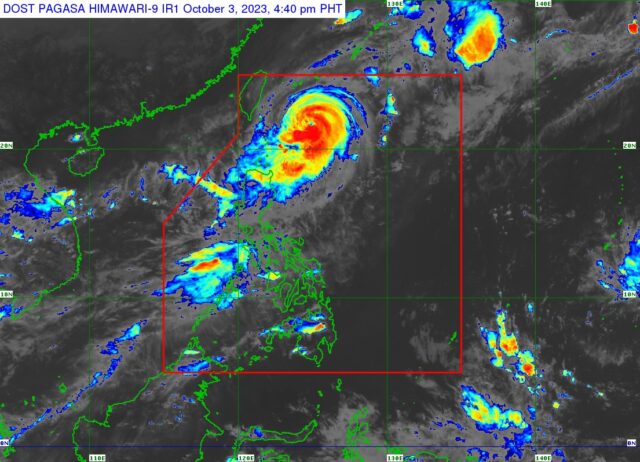
TYPHOON “JENNY” (International name: “Koinu”) has weakened as it passed through the northwestern part of the country on Tuesday, the Philippine Atmospheric, Geophysical and Astronomical Services Administration (PAGASA) said.

In its 5 p.m. bulletin, PAGASA said the typhoon was last seen 325 kilometers east-northeast of Itbayat, Batanes, but that wind Signal No. 2 remained over Batanes.

Its maximum sustained winds fell to 155 kilometers per hour (kph) near the center with gusts of up to 190 kph as it moved northwestward at 10 kph. PAGASA said that Jenny would continue to weaken due to the increasing dry air entrainment and vertical wind shear.

“Land interaction during its passage over the rugged terrain of southern Taiwan will further weaken the tropical cyclone,” PAGASA added.

As of early Tuesday evening, typhoon Signal No. 1 was retained in Cagayan including Babuyan Islands, the northern and eastern portions of Isabela, Apayao, the northeastern portion of Abra, the northern portion of Kalinga, and Ilocos Norte.

PAGASA said that the typhoon would enhance the Southwest Monsoon and bring occasional rains over the western portions of Central Luzon, Southern Luzon, the Visayas, and Mindanao in the next three days.

At its current speed, Jenny is expected to exit the Philippine Area of Responsibility (PAR) by Oct. 5.

The state weather agency also issued a gale warning along the seaboards of northern Luzon. This would bring moderate to rough seas over the coastal waters of northern Aurora.

It warned operators of motor bancas and similarly sized vessels to take precautionary measures while venturing out to sea. — Adrian H. Halili

Vaccine hesitancy prevails

THE PHILIPPINES continues to lag in reaching its target vaccination rate due to public fear stoked by misleading information on immunization, public health advocates said on Tuesday.

“We need to educate parents on the safety of vaccines… and avoid vaccine misinformation,” Vicente Y. Belizario, Jr., former dean of the University of the Philippines Manila College of Public Health, said in a media forum.

Mr. Belizario said that one of the most misleading pieces of information on immunization is that vaccines are used for “experimenting [on] children.” Debunking this, he said that vaccines undergo phases of assessments and are endorsed by the World Health Organization (WHO).

“The WHO makes pronouncements based on evidence reviewed by experts who advise them,” he said.

“Delay in acceptance or refusal of vaccines despite availability of vaccine services becomes the end result of such negative information,” he said, citing the WHO.

He added that vaccine hesitancy in the Philippines is mostly rooted in the Dengvaxia controversy. The government suspended the distribution of the anti-dengue vaccine in 2017 after French pharmaceutical company Sanofi Pasteur said that Dengvaxia can cause severe dengue if it is given to those without prior exposure to dengue.

The country has a 95% target for immunization coverage, citing House Bill No. 4483 or the proposed Mandatory Immunization Program Act.

The Philippines is ranked 5th globally for the most number of zero-vaccine children or children who have not received a single vaccine, the United Nations Children’s Fund (UNICEF) reported in 2021.

“The Philippines as a whole is not doing nicely in terms of childhood mortality,” Mr. Belizario said, noting that an infant’s first 1,000 days are crucial in protecting the child from pneumonia. “There are more deaths that should be expected.”

With local government units (LGUs) at the forefront of distributing vaccines to the public, many struggle to have access to immunization.

“Access is challenging in many instances.” Mr. Belizario said. “In many settings in the PHL, health workers will need to cross rivers…[or are] coming down from the mountain or coming from remote areas.”

Fatima Ignacio-Jimenez, who heads the Immunization Committee of the Philippine Pediatric Society, said LGUs should prioritize its health programs as it “dominoes into the productivity of the country as a whole.”

“We have not actually penetrated the grassroots or the masses because the messages, even though they’re simple, they’re mixed,” she told the forum.

Data from the Philippine Statistics Authority (PSA) said that only 48% of Filipino infants have been vaccinated, with pneumonia causing approximately 31,000 deaths among children under five years old in 2022.

Mr. Belizario noted that childhood vaccination is still the best way to combat childhood pneumonia, as well as improved access to water, sanitation and hygiene.

Ms. Gimenez emphasized that protecting an infant from diseases like pneumonia starts in the mother’s womb.

“Your child’s [health] depends on what protection you give to yourself,” she said, citing how breastfeeding helps the mother pass on anti-bodies to give her child temporary protection.

“There is no vaccine that is 100% effective but if you have anti-bodies, when the natural disease comes to you, then at least you have a form of defense,” Ms. Gimenez said. — Beatriz Marie D. Cruz

BI records 8 million arrivals

BUREAU OF IMMIGRATION FACEBOOK PAGE

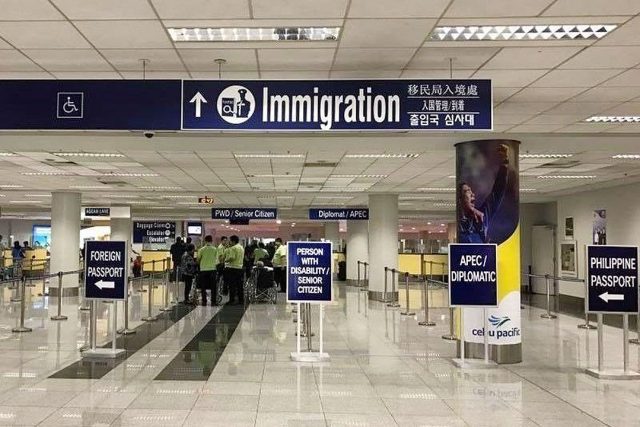
THE PHILIPPINES has recorded more than 8.1 million Filipino and foreign passenger arrivals from January to August 2023, the Bureau of Immigration (BI) said on Tuesday, noting a rebound in visits to the country from last year.

“We are getting there,” Immigration Commissioner Norman G. Tansingco said as he noted an expected 4 million more arrivals in the last quarter of the year. “The significant increase in arriving passengers shows that tourism and international travel are already on the rebound,” he added.

In the same period last year, the BI processed only 2.87 million passengers.

In preparation for the influx, Mr. Tansingco said the BI intends to purchase more electronic gates to speed up immigration processing and make requirements more convenient for passengers.

Earlier, Tourism Secretary Christina Garcia Frasco said that the country has recorded more than 4 million foreign visitors from January to September 2023. — John Victor D. Ordoñez

DBM suspends Cagayan’s 2023 budget

BW FILE PHOTO

BAGUIO CITY — Cagayan province’s budget has been suspended by the Department of Budget and Management (DBM), declaring it inoperative.

As a result, programs and projects of the Cagayan Provincial Local Government Unit (PLGU) are also left hanging after the Sangguniang Panlalawigan (SP) cut a large chunk prompting the DBM to rule it could not become operational.

Cagayan Provincial Board Member Rodrigo C. de Asis claimed the DBM also saw that the SP committed violations in slashing Cagayan’s budget with P21 million from the 20% development fund of Cagayan, which accordingly, He is in contrary to the provisions of the Local Government Code (LGC).

Mr. De Asis said that even the programs of the PLGU as part of its “No barangay/town left behind” which he claimed the SP has no jurisdiction, was slashed.

The provincial legislator stressed that the social protection program “No barangay/town left behind” initiative is under the executive branch of yhe provincial government.

Thus prompting Cagayan governor Manuel N. Mamba to blame “too much politicking,” he claimed, “were the handiwork of (Vice Governor Melvin K. Vargas, Jr.) and majority of the Sangunniang Panlalawigan of Cagayan.”

“They should explain that (budget problem) to the Cagayanos after delaying the passage of the annual budget deliberately for 6 consecutive years. What a waste!” Gov. Mamba blurted out.

The “No Barangay Left Behind” (NBLB), a flagship program of the Cagayan provincial government, has been recognized as one of the top 5 performing institutionalized programs in the country. It provides financial capability to all Cagayan villages and seeks to capacitate the grassroots level by providing them the means in the barangay level development.

According to Gov. Mamba, 820 villages have benefiting from the program since 2016 that emphasizes collaborative leadership and community empowerment at the village level.   

Each village in Cagayan has formed an institutionalized Agkaykaysa, “to unite” in Ilokano, which resulted in 5,720 self-reliant organizations.

“It invests on people-decided village-level infrastructure, it invests in education to address poverty, and it funds the development of leadership among the Cagayan youth,” Mr. Mamba had cited.

Vice Governor Vargas Jr. could not be reached for comment. — Artemio A. Dumlao

ADVERTISEMENT
ADVERTISEMENT