Home Blog Page 422

Smart partners with Lynk Global to expand satellite connectivity in remote areas

PHILSTAR FILE PHOTO

PLDT INC., through its wireless subsidiary Smart Communications, Inc., has partnered with US-based Lynk Global, Inc. to provide mobile connectivity in areas without network coverage through satellite technology.

“When it’s fully rolled out, we think this will transform rural and remote connectivity in the Philippines,” PLDT Chief Operating Officer and Head of Network Menardo G. Jimenez said in a statement on Tuesday.

Smart said the partnership will enable mobile communications in areas with no signal by directly connecting ordinary mobile phones to satellites. The company said it will start by integrating its core systems with Lynk’s satellite-to-mobile network before conducting live field tests using Smart’s existing spectrum.

The initiative will prioritize coastal and mountain barangays and key maritime routes while ensuring secure, reliable, and stable connections, Smart said.

Once the Lynk satellite direct-to-device network is fully operational in the next few years, Smart said it expects to offer full mobile voice and data connectivity.

The initial rollout will cover basic text messaging and mobile applications over LTE (Long Term Evolution), designed to help maintain communications during typhoons, earthquakes, and other emergencies.

Lynk Global develops satellite-to-mobile-phone constellation technology designed to enhance mobile service coverage worldwide.

“We are more than excited to work with Smart to deliver reliable satellite connectivity directly to mobile phones in the Philippines,” Lynk Global Vice-President for Asia Pacific James Alderdice said.

Smart is the wireless arm of PLDT. Hastings Holdings, Inc., a unit of the PLDT Beneficial Trust Fund’s MediaQuest Holdings, Inc., holds a majority stake in BusinessWorld through the Philippine Star Group, which it controls.

At the local bourse on Thursday, shares in PLDT gained P6 or 0.54% to close at P1,110 apiece. — Ashley Erika O. Jose

Napoleon’s diamond brooch heads to auction for the first time

SOTHEBYS.COM

A UNIQUE diamond brooch once owned by Napoleon Bonaparte — and said to have been retrieved from the chaos of the Battle of Waterloo — will go under the hammer for the first time this November.

No, it’s not those French crown jewels, the ones stolen from the Louvre museum this week in a brazen heist. The brooch, reportedly abandoned by Napoleon himself as he fled the battlefield after his crushing defeat in 1815 and owned for centuries by descendants of the victorious King of Prussia, will be auctioned at Sotheby’s Royal & Noble Jewels sale in Geneva on Nov. 12.

The circular brooch has an oval diamond of over 13 carats in weight at its center and is surrounded by nearly 100 old mine cut diamonds of varying shapes and sizes. Created in a Parisian atelier around 1810, the brooch, which most likely adorned Napoleon’s bicorne on special occasions, is expected to fetch between $150,000 and $250,000, Sotheby’s told Bloomberg.

Offered as a spoil of war only three days after Napoleon’s defeat, the brooch remained in the House of Hohenzollern — the former German imperial dynasty — for centuries. It was passed down from King Friedrich Wilhelm III to the last German emperor, Queen Victoria’s grandson Kaiser Wilhelm II, and eventually to his grandson Louis Ferdinand, Prince of Prussia. It has been part of a different private collection for the last few years.

In an uncertain global market, collectors are increasingly turning to rare, storied pieces as tangible stores of value. Sotheby’s Royal & Noble auction is an annual sale dedicated to showcasing illustrious jewels with provenance. In previous auctions, Sotheby’s sold a diamond necklace with possible links to a scandal that led to the downfall of Marie Antoinette for $4.8 million. One of the most famous sales was in 1987 when a collection of jewels owned by the late Duchess of Windsor was sold for $50 million, more than six times the expected figure.

Napoleon’s brooch is the showpiece of the upcoming auction, which will also feature a diamond ring that once belonged to one of the last Ottoman princesses, Neslishah Sultan. — Bloomberg

Bataan: The emerging tech capital of the Philippines

BATAAN GOVERNOR Joet Garcia at the Global Emerging Tech Summit. — FACEBOOK.COM/DICTIIDB

It is rare to find a province that thinks and moves like a startup, driven by innovation, guided by data, and built on the belief that technology can make life better for its citizens. Yet that is exactly what is happening in Bataan, a province that has quietly and consistently positioned itself as the emerging technology capital of the Philippines.

Under the visionary leadership of Governor Joet Garcia, Bataan has embraced digital transformation not as a slogan but as a governance philosophy. While other provinces are still talking about modernization, Bataan is already doing it, building the foundations of a truly digital local government that leverages technology to promote transparency, inclusivity, and economic growth.

Mr. Garcia’s vision for Bataan has always been clear: to use technology as an equalizer. His administration recognizes that progress begins with systems that are smart, transparent, and citizen-centered. From digitized public services and e-governance platforms, to open data and blockchain-based systems, Bataan has taken the bold step of reimagining how local governments can operate in the digital age.

Bataan’s digital roadmap focuses on three pillars: efficient governance, empowered citizens, and a sustainable innovation ecosystem. The province has introduced digital platforms that allow residents to access public services online, from business permits and social services to health consultations, reducing bureaucracy, and eliminating red tape. These initiatives are not only improving service delivery but also restoring public trust in government efficiency.

Mr. Garcia’s leadership has not gone unnoticed. Over the past few years, he has graciously opened the doors of Bataan to the country’s and the world’s leading digital minds. For two consecutive years, he hosted the Global Blockchain Summit, bringing together government officials, technology leaders, developers, and entrepreneurs to explore how blockchain can drive transparency, innovation, and inclusion. This week, he once again welcomed the nation’s digital pioneers to the People’s Center for the Global Emerging Tech Summit, a gathering of forward thinkers and innovators discussing the future of artificial intelligence, blockchain, and cybersecurity, the ABC of digital transformation.

Mr. Garcia’s commitment was evident throughout the two-day summit. He was present from start to finish, personally opening each day’s session, and presenting data-driven dashboards that showcased Bataan’s governance in action. In one of his talks, he even gave a “Blockchain 101” session to over a thousand students in attendance, many of whom were experiencing the technology for the first time. Beyond the podium, the governor spent time engaging with global speakers, innovators, and guests, embodying the province’s spirit of collaboration and learning. He capped the event by hosting the Governor’s Night at the newly opened Tourism Pavilion, where local officials joined him in welcoming delegates, reflecting Bataan’s warmth, pride, and forward-looking vision.

These summits are more than conferences; they are statements of intent. By hosting them, Bataan declared that it is ready to lead the Philippines into the next frontier of technology. They have made the province a magnet for innovators, investors, and policymakers who see Bataan as the ideal environment to test and scale emerging technologies.

The Global Blockchain Summit, in particular, helped establish Bataan’s reputation as a hub for digital governance. While blockchain has often been associated with cryptocurrencies, Bataan’s approach was more visionary. The summit focused on blockchain as a tool for public trust, showing how immutable, transparent ledgers could be used for government procurement, land registration, logistics, and healthcare. It was in Bataan where early discussions about Integrity Chain, the Philippines’ first blockchain initiative for government transparency, first took shape.

This week’s Global Emerging Tech Summit expanded that conversation even further. For two days, Bataan became the center of digital discourse in the country, as experts shared ideas on how emerging technologies can help drive inclusive progress. Artificial intelligence can enhance efficiency and predict public needs before they arise. Blockchain can guarantee transparency and accountability in government transactions. Cybersecurity ensures that digital transformation is safe, resilient, and trustworthy. Together, these technologies form the backbone of good governance in the digital age.

What sets Bataan apart is that it doesn’t just talk about innovation; it practices it. The provincial government has implemented e-governance systems that connect local offices, improve coordination, and eliminate duplication. Through the 1Bataan platform, citizens can now access a one-stop digital ecosystem that integrates various government services, from document requests to feedback channels, all in one place. Internally, the government is adopting data-driven decision-making systems to ensure that policies are based on evidence, not instinct.

Bataan’s rise as a tech hub is also a story of collaboration. The province has worked closely with the Department of Information and Communications Technology (DICT), the Department of Trade and Industry (DTI), and various private-sector partners to accelerate digital adoption. Universities and training institutions are developing programs focused on AI, blockchain, data analytics, and cybersecurity to prepare a future-ready workforce. This alignment between government, industry, and education is one of the key reasons Bataan has managed to sustain its momentum as a digital leader.

The economic ripple effects are starting to show. By branding itself as a digital-first province, Bataan is attracting investors in data centers, fintech firms, and cloud technology companies. Its strategic location, strong governance, and growing tech ecosystem make it one of the most attractive regions for high-value industries seeking a base in the Philippines. In the long run, this shift will not only create jobs but also redefine Bataan’s identity, from an industrial hub to an innovation hub.

What Bataan has achieved under Governor Garcia’s leadership should serve as a model for other provinces. It proves that digital transformation doesn’t need to wait for national directives; it can start from local initiative. Technology, when embraced by visionary leaders, becomes more than an administrative tool. It becomes a means to empower citizens, fight inefficiency, and build trust.

As the curtains close on the Global Emerging Tech Summit, Bataan stands as a symbol of what the Philippine digital future can look like: forward-thinking, inclusive, and fearless in its embrace of change. The challenge now is to sustain the momentum, continue investing in infrastructure and talent, and keep forging partnerships that push innovation even further.

Bataan’s journey shows us that progress is not just measured by roads and bridges, but by systems that make government smarter, citizens stronger, and communities more connected. It is no exaggeration to say that Bataan is building not just a digital province, but the blueprint for a digital nation. And if the rest of the country follows its lead, the Philippines’ emerging tech capital might just become the spark that lights the way for a smarter, more transparent, and more connected future.


Dr. Donald Patrick Lim is the founding president of the Global AI Council Philippines and the Blockchain Council of the Philippines, and the founding chair of the Cybersecurity Council, whose mission is to advocate the right use of emerging technologies to propel business organizations forward. He is currently the president and COO of DITO CME Holdings Corp.

GSIS earnings hit P112B

THE GOVERNMENT Service Insurance System (GSIS) booked a net income of P112 billion in the nine months through September.

This was up from the P100 billion recorded as of August and surpassed its P76.6-billion income goal for the period, it said in a statement on Tuesday.

Revenues reached P260 billion, also above the state pension fund’s target of P241.8 billion.

Meanwhile, total expenses reached P148 billion, below the P165-billion target. Administrative costs stood at 2.5%, well below the 12% cap under the GSIS Charter.

“This low ratio ensures that the fund’s resources are primarily allocated to its core mission of serving its members,” it said.

GSIS’ total assets stood at P1.93 trillion at end-September, up by 5.7% from the end-2024 level.

“The numbers reflect the current state of our financial health. Our P112-billion net income is a clear indicator of our consistent growth and stability,” GSIS President and General Manager Jose Arnulfo “Wick” A. Veloso said.

“Our financial health is robust. Our focus is on building a resilient institution that delivers for its members, and these results confirm we are on the right track.” — A.M.C. Sy

Philippine Startup Week 2025 to spotlight global expansion of Filipino innovators

FREEPIK/ATLASCOMPANY

PHILIPPINE STARTUP WEEK 2025 will return on Nov. 10–14 to champion Filipino innovation and help startups expand beyond local borders, organizers said.

The event will carry the theme “Scaling Filipino Innovation: Start Local, Go Global,” highlighting how homegrown startups can build on their global competitiveness and seize opportunities to broaden their reach, according to an e-mailed statement.

Organized by the Department of Science and Technology, Department of Trade and Industry and Department of Information and Communications Technology, the event has been the flagship gathering for the Philippine startup ecosystem in the past six years.

After the formation of the Innovation Startup Act Steering Committee last year, the three agencies are intensifying support for local innovation through closer coordination.

This year’s edition, co-organized by the National Development Co. in partnership with the Strategic and Collaborative Alliance for Leveraging Ecosystems of Startups–National Capital Region, will adopt a bolder approach to help Filipino startups compete globally.

The main conference will be held at the newly opened Philippine Innovation Hub in Marikina City, which will feature multiple stages, community events, a startup expo and partner booths across its five floors.

The event will let participants explore technopreneurship, the local startup ecosystem and how to launch a venture; connect with key stakeholders to amplify innovation and growth; and strengthen ideas through mentorship and scaling support.

It will also feature tech startups through nationwide pitching opportunities and drive funding and partnerships for breakthrough ventures.

Attendees will also gain insights from the Steering Committee on upcoming initiatives to strengthen the national startup ecosystem, while engaging with venture capital firms, startup enablers and leading founders. — NPA

Piano stool maker to the stars rebounds from deadly Valencia floods

HIDRAU.COM

ALGEMESÍ, Spain — The makers of piano stools for stars such as Lady Gaga and Elton John are back in business after losing everything during the deadly floods that ravaged Spain’s southeastern Valencia region one year ago, killing 229 people.

Family company Hidrau Model had been going for 50 years but incurred losses of around 1.5 million ($1.75 million) in stock, materials and machinery when the floods swept through Algemesí, 35 kilometers south of Valencia city.

“I didn’t know how we were going to do it, but I knew I wanted to move forward after this,” General Manager Raul Romera said.

With the help of volunteers and peer companies, Hidrau has been able to fulfill orders and gradually reopen with all 35 employees. They are still waiting for the insurance money to come through to cover their costs.

Among their former clients are Lady Gaga, who performed with one of their stools at the 2017 Super Bowl half-time show. — Reuters

Metro Retail expands urban retail strategy with Metro Corner launch in Mandaue City

THE METRO STORES FACEBOOK PAGE

METRO RETAIL STORES Group, Inc. (MRSGI) has opened its first Metro Corner at Mandani Bay Suites in Mandaue City, a store concept intended to provide convenient access to goods for condominium residents and nearby workers.

“Metro Corner represents the next chapter of Metro Retail’s innovation in serving our customers,” MRSGI President and Chief Operating Officer Joel Orense said in a statement on Tuesday.

He said the new store format reflects the changing nature of shopping in urban communities — “compact and closer, designed around convenience without losing the warmth and quality Metro is known for.”

The new store features everyday essentials, artisan items, organic products, and international specialties in a modern layout that highlights fresh goods, friendly service, and quick checkout.

Located on the ground floor of Tower 1, Mandani Bay Suites, Metro Corner caters to residents, workers, and property owners seeking easy access to quality products within their community.

The company said the launch marks its first Metro Corner store within Mandani Bay, a developing mixed-use community in Mandaue City with a growing residential and business population.

“As more communities embrace urban living, we see an opportunity to reimagine convenience through well-designed, right-sized stores that bring essentials and lifestyle selections closer to home,” Mr. Orense said. “Metro Corner allows us to serve residents more efficiently while maintaining the same quality, service, and trust that define the Metro brand.”

Metro Retail operates 79 stores across Luzon and the Visayas, including Metro Supermarket, Metro Department Store, Super Metro Hypermarket, Metro Value Mart, and Metro Home Improvement and Lifestyle formats.

Shares of MRSGI rose by 0.88% or one centavo to close at P1.14 each on Tuesday. — Alexandria Grace C. Magno

Raising digitally mature children: Data privacy for the next generation

STOCK PHOTO | Image by Pressfoto from Freepik

The toothpaste is out of the tube. Once personal data hits the internet, there is no going back. Children today grow up leaving permanent traces with every like, post, and DM, often unaware of how much of themselves they have exposed. To shield children, lawmakers have taken decision-making out of their hands and placed them in the care of adults. The assumption is that children lack the understanding to have a say.

However, we often underestimate them. Children’s abilities are constantly evolving, and today’s average 10-year-old knows Instagram and TikTok like the palm of their hand. Children nowadays possess the knowledge and more; what they need is guidance so that they can develop the judgment to make informed decisions about data privacy matters.

The foundation of these protections is the principle of transparency. As data subjects and rights holders, children are entitled to information on how their personal data is collected, processed, and used.1

PHL DATA PRIVACY LAWS FOR CHILDREN
In December 2024, the National Privacy Commission took a leap forward by issuing Advisory No. 2024-03, also known as Guidelines on Child-Oriented Transparency.

The Guidelines emphasize the vulnerability of children, while also acknowledging their rights as primary data subjects and their increasing ability to understand how their personal data is used. They require children to be informed, through age-appropriate privacy notices, regarding the nature, purpose and extent of the processing of their personal data, even in cases where the product or service is intended for adults.2 They also require that children must be notified if their personal information is affected by a data breach.3

However, transparency does not necessarily equate to autonomy. While the Guidelines call for data processors to be open towards children, the accountability and responsibility of providing consent still rests on those exercising parental authority.4

The Guidelines themselves require data processors to conduct Child Privacy Impact Assessments before launching products or services, and, whenever necessary, secure the involvement of parents or guardians in deciding whether children should participate in a specific processing activity.5

GLOBAL APPROACHES TO PARENTAL CONSENT
This crucial role of parents and guardians is reflected in international laws, although the age threshold for parental consent varies across jurisdictions.

In the United States, consent must be obtained before processing data of children under 13.6 South Korea sets this age at 14,7 whereas India enforces a stricter rule, requiring verifiable parental consent for individuals younger than 18.8

In Europe, countries find guidance in the General Data Protection Regulation (GDPR).9 which requires parental consent for children below 16. However, the GDPR allows Member States to set a lower age limit by law, provided it is not below 13.10 In Italy, parental consent is required for processing the personal data of children under 14.11

Certain jurisdictions are more progressive in terms of giving children decision-making rights once they reach a certain age. For instance, in Vietnam12 and Thailand13, as young as the ages of seven and 10, respectively, a child must give their consent alongside that of their parents.

In the Philippines, parental consent is required for children who are below 18 or those over 18 with disabilities.14 Currently, there is a pending house bill proposing to lower this age to 15.15

EMPOWERING THE NEXT GENERATION
There is no doubt that today’s children are adept with technology and the internet. However, they have yet to fully grasp the long-term impact of sharing their personal information. The onus, therefore, also falls on data processors, especially social media platforms, to inform them about all matters affecting their data.

In fact, the Guidelines recommend specific strategies in crafting child-specific and age-appropriate privacy notices that consider the readability, comprehension, and granularity of the information while keeping in mind the best interests and evolving capacities of children. In any case, the information must be presented in a manner that is simple and easily understandable for children using videos, infographics, animation, and audio recordings.16

The growing digital maturity of children highlights not only their adaptability but also their potential as informed digital citizens. By empowering them through education, transparent policies, and supportive parental guidance, we can shift the narrative — from seeing them as mere vulnerable subjects to recognizing them as active participants in protecting their own personal data.

Ultimately, protecting children’s data privacy implores us to “prepare the child for the road, not the road for the child.” In this age of open information, keeping children safe requires more than shielding them from the digital world. It entails empowering them to thrive within it.

(This article is for general informational and educational purposes only and not offered as, and does not constitute, legal advice or legal opinion.)

1UN Committee on the Rights of the Child, General Comment No. 25 (2021) on Children’s Rights in Relation to the Digital Environment, CRC/C/GC/25 (March 2, 2021).

2Section 3, NPC Advisory No. 2024-03 entitled “Guidelines on Child-Oriented Transparency.”

3Section 4, NPC Advisory No. 2024-03 entitled “Guidelines on Child-Oriented Transparency.”

4Title IX, New Civil Code.

5Section 2(A), NPC Advisory No. 2024-03 entitled “Guidelines on Child-Oriented Transparency.”

6Section 312.4(a), Children’s Online Privacy Protection Rule.

7Article 22(6), Personal Information Protection Act 2011.

8Section 9, Chapter 2, Digital Personal Data Protection Act (2023).

9Regulation (EU) 2016/679 of the European Parliament and of the Council of April 27, 2016.

10Article 8, Regulation (EU) 2016/679 of the European Parliament and of the Council of April 27, 2016.

11Section 2-d, Personal Data Protection Code containing provisions to adapt the national legislation to Regulation (EU) 2016/679 of the European Parliament and of the Council of April 27, 2016 on the protection of natural persons with regard to the processing of personal data and on the free movement of such data, and repealing Directive 95/46/EC.

12Clause 2, Article 20(2), Vietnam’s Decree on Personal Data Protection (Decree No. 13/2023/ND-CP).

13Section 20, Part I, Chapter II, Thailand’s Personal Data Protection Act 2019.

14Section 3(a), Republic Act No. 7610 (1992). An Act Providing for Stronger Deterrence and Special Protection Against Child Abuse, Exploitation and Discrimination, and for Other Purposes [Special Protection of Children Against Abuse, Exploitation and Discrimination Act of 1992].

15HB 898

16Section 3, NPC Advisory No. 2024-03 entitled “Guidelines on Child-Oriented Transparency” (Guidelines).


Clarisse Paulina M. Valdecantos-Javelosa is a senior associate of the Intellectual Property Department and a member of the Data Privacy and Security Group of the Angara Abello Concepcion Regala & Cruz Law Offices (ACCRALAW).

cmvaldecantos@accralaw.com

+632-8830-8000

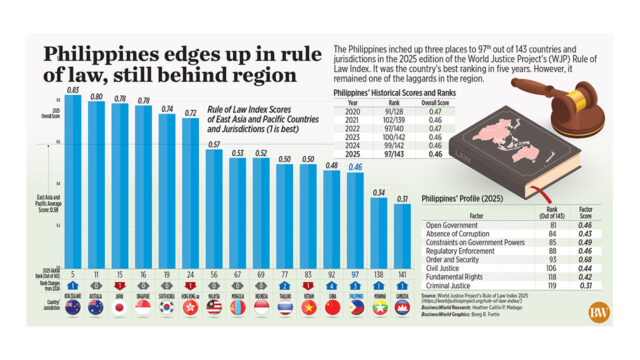
Philippines edges up in rule of law, still behind region

The Philippines inched up three places to 97th out of 143 countries and jurisdictions in the 2025 edition of the World Justice Project’s (WJP) Rule of Law Index. It was the country’s best ranking in five years. However, it remained one of the laggards in the region.

Philippines edges up in rule of law, still behind region

How PSEi member stocks performed — October 28, 2025

Here’s a quick glance at how PSEi stocks fared on Tuesday, October 28, 2025.


Shares rise on bargain-hunting before Fed move

REUTERS

PHILIPPINE STOCKS closed higher on Tuesday as players picked up cheap stocks following the market’s two-day slide, but sentiment remained cautious before the US Federal Reserve’s policy decision.

The benchmark Philippine Stock Exchange index (PSEi) went up by 0.32% or 19.40 points to close at 5,953.16, while the broader all shares index rose by 0.21% or 7.78 points to 3,589.51.

“The Philippine market ended higher, driven by bargain-hunting after two consecutive days of strong selling. Investors remained cautious, closely monitoring upcoming earnings reports and the anticipated next move by the US Federal Reserve, which could influence market direction,” Regina Capital Development Corp. Head of Sales Luis A. Limlingan said in a Viber message.

“The market snapped its losing streak, but the rebound of a third of a percent was unconvincing as investors await the Fed’s rate cut decision,” AP Securities, Inc. Research Head Alfred Benjamin R. Garcia said in a Viber message.

Fed policymakers are widely expected to reduce US short-term borrowing costs this week by a quarter of a percentage point for the second time this year as they look to prevent further slowing in the labor market, Reuters reported.

Odds are it won’t be the last of the series.

Climbing unemployment insurance claims suggest that labor market demand continues to cool, even as the government shutdown delays publication of most official economic statistics, including the unemployment rate, last estimated at 4.3% in August.

Milder-than-expected inflation readings, including last week’s report that the consumer price index rose 3% in the 12 months through September, have put worries of tariff-driven price pressures on the back burner.

A quarter-point rate cut on Wednesday at the close of the Fed’s two-day meeting would put the policy rate in the 3.75%-4% range. Financial markets are betting heavily on further rate cuts in both December and January.

Back home, sectoral indices closed mixed on Tuesday. Mining and oil slumped by 4.42% or 565.68 points to 12,230.69; industrials dropped by 0.27% or 24.08 points to 8,772.47; and property slipped by 0.01% or 0.39 point to 2,198.54.

“The mining sector counter was the biggest loser with a decline of 4.4% as gold prices continue to slump,” Mr. Garcia said.

Meanwhile, financials rose by 1.15% or 22.44 points to 1,970.64; services increased by 0.42% or 9.76 points to 2,282.42; and holding firms edged up by 0.05% or 2.43 points to 4,807.25.

Advancers narrowly beat decliners, 95 to 94, while 62 names closed unchanged.

Value turnover went down to P4.64 billion on Tuesday with 1.18 billion shares changing hands from Monday’s P18.77 billion with 11.82 billion issues traded.

Net foreign selling increased to P432.57 million from P313.66 million. — Alexandria Grace C. Magno with Reuters

Marcos to push Philippine trade, tech agenda at APEC Summit in South Korea

MALAYSIAN Prime Minister Anwar Ibrahim handed over the gavel to Philippine President Ferdinand R. Marcos, Jr., symbolizing the turnover of the Association of Southeast Asian Nations (ASEAN) chairmanship at the closing ceremony of the 47th ASEAN Summit and Related Summits in Kuala Lumpur on Oct. 28. — PPA POOL/MARK BALMORES

By Erika Mae P. Sinaking and Chloe Mari A. Hufana, Reporter

PHILIPPINE President Ferdinand R. Marcos, Jr. will promote Philippine economic interests and push deeper regional cooperation at the 32nd Asia-Pacific Economic Cooperation (APEC) Economic Leaders’ Meeting in Gyeongju, South Korea later this month, the Department of Foreign Affairs (DFA) said on Tuesday.

Mr. Marcos will attend the summit from Oct. 30 to Nov. 2 at the invitation of South Korean President Lee Jae Myung, joining leaders from all 21 APEC member economies, DFA spokesperson Angelica C. Escalona told a livestreamed news briefing in Malacañang.

“The President’s participation is centered on advancing the Philippines’ economic interests, forging deeper ties with APEC members, and reaffirming our commitment to APEC’s vision of a more open, prosperous, and dynamic Asia-Pacific,” she added.

The two-day leaders’ meeting is expected to produce four key outcome documents — a Leaders’ Declaration and three statements focusing on artificial intelligence, demographic change and the cultural and creative industries.

“These topics reflect the priorities set by Korea as this year’s APEC host and tackle trends that impact economic growth across the region,” Ms. Escalona said.

Mr. Marcos will also join a leaders’ dialogue with the APEC Business Advisory Council (ABAC) and deliver remarks at the APEC Chief Executive Officer Summit, where he is expected to discuss technology, innovation and regional economic integration with top business executives.

“The President is expected to highlight new technologies and economic integration,” Ms. Escalona added.

The DFA said Mr. Marcos’ visit aims to attract investments and strengthen trade cooperation, particularly with South Korea, one of the Philippines’ major economic partners.

The President is scheduled to meet with business leaders from key sectors and the Filipino community in Busan, home to more than 70,000 Filipinos, including more than 42,000 overseas workers employed in manufacturing, agriculture, fishing, professional services, entertainment and domestic work.

The trip follows clarification from the Department of Finance (DoF) that a previously reported P28-billion official development assistance (ODA) loan from South Korea “does not exist.”

Ms. Escalona said the matter is “considered closed,” adding that “the Korean government has already reassured us of its continued support for advancing development cooperation with the Philippines.”

Asked whether Mr. Marcos would bring up the South China Sea dispute amid tensions with China, Ms. Escalona said the issue falls outside APEC’s mandate, which is to “facilitate trade and investments and promotes sustainable development.”

Bilateral meetings with other leaders were still being finalized, she added.

Mr. Marcos was in Kuala Lumpur for the 47th Association of Southeast Asian Nations (ASEAN) Summit and Related Summits from Oct. 26 to 28. He will be accompanied to APEC by Foreign Affairs Secretary Maria Theresa P. Lazaro, Trade Secretary Maria Cristina A. Roque, Migrant Workers Secretary Hans Leo J. Cacdac, Acting Communications Secretary Dave M. Gomez and Special Assistant for Investment and Economic Affairs Frederick D. Go.

The 32nd APEC Summit will serve as a key platform for Manila to emphasize its innovation agenda, expand trade opportunities, and align with regional efforts toward sustainable, technology-driven growth.

ASEAN CHAIRMANSIP
Meanwhile, the Philippines has officially assumed the chairmanship of the ASEAN. Manila’s term will begin on Jan. 1, 2026. It last hosted the regional bloc in 2017.

“We are committed to carrying forward [Malaysia’s] momentum and to implement in its first year the ASEAN Community Vision 2045 with purpose and resolve,” Mr. Marcos said during the turnover ceremony. “We likewise remain dedicated to facilitating the further integration of Timor-Leste into the ASEAN family.”

“The Philippines will continue to fortify our peace and security anchors, strengthen our prosperity corridors and advance people empowerment,” he added.

The regional bloc is composed of 11 member states, making up the world’s fifth-largest economy. It welcomed Timor-Leste as the newest member on Sunday.

The ASEAN chairman acts as the facilitator and spokesperson of the bloc, sets the agenda and leads the discussions on regional priorities. The chairmanship has a one-year tenure and goes by alphabetically each year.

Mr. Marcos earlier said one of the Philippines’ priorities for its chairmanship is the enactment of a legally binding Code of Conduct in the South China Sea as tensions with Beijing continue.

Meanwhile, in separate meetings with Australia and New Zealand, Mr. Marcos called for stronger cooperation in the areas of peace, prosperity, people-to-people exchange and environmental protection.

At the ASEAN-New Zealand Commemorative Summit, he lauded New Zealand’s “consistent recognition of ASEAN centrality” over the past 50 years and said the elevation of their relationship to a comprehensive strategic partnership would open new avenues for cooperation under peace, prosperity, people and planet.

The President highlighted in his intervention speech maritime cooperation initiatives, including New Zealand’s involvement in the ASEAN Regional Forum Workshops on Implementing United Nations Convention of the Law of the Sea (UNCLOS) and the ASEAN Indo-Pacific Marine Debris Workshop, which he said helped build regional capacity to tackle maritime challenges.

He also welcomed the entry into force of the Second Protocol to Amend the ASEAN-Australia-New Zealand Free Trade Area, expressing optimism that it would expand market access and promote e-commerce and sustainable trade and empower micro, small and medium enterprises.

Mr. Marcos urged closer collaboration on sustainable agriculture and fisheries, citing New Zealand’s expertise in agritech and value-chain integration.

During the 5th ASEAN-Australian Summit, he reaffirmed the Philippines’ commitment to fully implement the ASEAN-Australia Plan of Action 2025-2029, calling it “a roadmap that embodies the trust and shared resolve that underpin our comprehensive strategic partnership.”