Home Blog Page 4169

ERC rejects NGCP petition to amend rules on transmission wheeling rates
FREEPIK

THE Energy Regulatory Commission (ERC) said it rejected a petition by the National Grid Corp. of the Philippines (NGCP) to revise the 2022 Amended Rules for Setting Transmission Wheeling Rates (RTWR).

The NGCP had sought to include “grass fires” as events qualifying for force majeure treatment.

The ERC said in a statement it issued an order dated Sept. 5 outlining its ruling on the NGCP petition which the company filed on Dec. 22.

In its petition, NGCP proposed to consider grassfires as a force majeure event (FME), saying such fires had taken place “on multiple instances in several provinces,” which caused power interruptions and significant damage to transmission facilities.

The ERC said any grass fire incident — to be considered “unforeseen” and “extenuating” — must satisfy the conditions of an FME under the 2022 amended RTWR.

The 2022 Amended RTWR includes “all events occurring in the Philippines which result in an increase in the costs incurred by the Regulated Entity in the transmission of electricity.”

“More importantly, such incident must not have been caused by or attributed to NGCP, willfully or through its neglect,” the ERC said in the statement.

The ERC also denied an NGCP appeal to limit the coverage of the fourth regulatory period (RP) to the years 2016 to 2020, instead of 2016 to 2022.

The NGCP said that it remains faithful to the original five-year period based on the Transmission Wheeling Rates Guidelines issued in 2003 and 2009.

It also said the only exception to the five-year RP “or any subsequent RP should have been upon the request of NGCP in compliance with the requirements of the 2009 RTWR which was the applicable Rules when the 4th RP commenced in 2016,” the company said.

“Absent any request from NGCP for the extension of the 4th RP from five years to seven years, the 4th RP remains at five years or from 2016 to 2020,” the NGCP said.

“Considering that five years has long been determined to be the appropriate coverage for each RP, the Honorable Commission should be consistent in applying the same to the 4th RP,” it added.

In its refusal, the ERC said it has exercised its “rule-making authority to promote the interests of the public” to cover the entire lapsed period under the 4th RP, according to the authority it holds under the Electric Power Industry Reform Act and the amended Public Service Act.

“The Commission was deliberate in its decision to cover the years 2016 to 2022 under the 4th RP as this period had already lapsed by the time the 2022 RTWR was adopted by the Commission,” the ERC said.

The ERC also rejected the NGCP’s proposal to remove a provision allowing the National Transmission Commission (TransCo) to participate in rate-setting applications.

The Commission said that TransCo’s participation is “necessary for complete relief for any rate-setting application,” considering that it is still the owner of transmission assets and holds interests in the outcome of such rate-setting applications.

“As for NGCP’s proposal to include explicit provisions on reopening of events, the Order reiterated that the 2022 Amended RTWR already includes sufficient mechanisms and safeguards governing rate adjustments for the regulated entity,” the ERC said.

The proposed amendment to use a lock-in weighted average cost of capital (WACC), instead of the classic WACC, was also rejected by the ERC, which ruled that this contradicts the “spirit of performance-based regulation and the consumers’ interests.”

“The ERC reminded NGCP that the 2022 Amended RTWR, which already details the procedure for the setting of the WACC, among others, was subjected to public consultation in which NGCP itself participated,” the Commission said.

BusinessWorld asked NGCP Spokesperson Cynthia P. Alabanza to comment but she had not replied at the deadline. — Sheldeen Joy Talavera

DTI cites need to make workforce, students ready for AI introduction

REUTERS

TRADE Undersecretary Rafaelita M. Aldaba said workers and students must be prepared for the looming introduction of artificial intelligence (AI), particularly generative AI.

Ms. Aldaba, who heads the Competitiveness and Innovation Group at the Department of Trade and Industry (DTI), said that according to a study by EDBI and Kearney, the successful implementation of AI in the Philippines could contribute $92 billion to the economy, equivalent to around 12% of gross domestic product.

“But we all know that in order for us to be able to take full advantage of these opportunities, it is important to equip our workforce. We need to have future-ready skills in an AI-powered future,” said Ms. Aldaba, who was speaking at the Asian Development Bank’s 10th International Skills Forum.

She said the digital divide, lack of regulation, and unresolved ethical issues continue to hinder AI progress.

“On the digital divide, not all students have equal access to technology and the internet. Some lack the necessary devices or internet connectivity, creating disparities in their ability to benefit from AI-powered educational resources,” she said.

Anant Agarwal, founder and chief executive officer of online learning platform EdX, said at a panel discussion at the ADB forum that AI can help both learners and teachers.

In particular, he said that learners can make use of AI tutors which allow students, wherever they are in the world, to ask questions in the language they speak.

“The tutor is available at all times, understands all languages, and can explain things to you in a way that can really help you understand the material,” Mr. Agarwal said.

He said that when the AI tutor was introduced in the EdX platform, the volume of student questions rose by a factor of six.

Mr. Agarwal said teachers can use AI as a co-pilot that can translate video transcripts and create summaries, among others.

Ms. Aldaba said students and educators have varying levels of digital literacy and proficiency which can affect their ability to effectively use AI tools.

“AI should be used to bridge educational disparities, not exacerbate them. Ensuring that AI tools are accessible and beneficial to all students, including those with disabilities and for out of school youth, is going to be crucial,” she said.

She added that the use of AI raises privacy concerns as it collects and analyzes student data for personalized learning.

“For us to be able to build this AI ecosystem, trust is a fundamental element and ethical AI in education should provide clear explanations of how decisions are being made,” she said.

Ms. Aldaba said that AI algorithms can inherit biases from the training which could potentially disadvantage certain student groups.

“Ensuring fairness and mitigating bias in AI systems is a critical ethical concern,” she added.

Yaacob bin Ibrahim, professor-in-practice at the Lee Kuan Yew School of Public Policy at the National University of Singapore, said there is a need to look at how AI can be used in an ethical manner.

“Like all tools, it is designed around data, which is not perfect. And so, you have the problem of discrimination and bias,” he said.

“Most legislations have guidelines in place to make sure your data is clean, fidelity is good, and integrity is good,” he added.

He also added that AI should not be seen as something that can replace educators, instead calling it a means of heightening human interaction.

“It is merely a tool … It is supposed to be supplementing education, not replacing it,” he added.

He said that the relationship between the teacher and the student is a “human enterprise that can never be replaced.”

Ms. Aldaba said that to address these challenges, the government must have in place data privacy regulation, ethical guidelines for AI usage in education, equity policies that address the digital divide, and policies that support teacher training in AI literacy.

“We need to implement accountability frameworks that hold educational institutions and AI providers responsible for the ethical and effective use of AI in education. We also need to create mechanisms for regular oversight and auditing of AI systems in education to identify and rectify the ethical issues,” she added.

She said that international collaboration and standards should be encouraged to ensure consistency and ethical best practices in AI-powered education.

“AI in education holds the promise of personalized learning and improved outcomes, but it must be implemented responsibly with careful consideration of the digital divide, ethical issues and appropriate policies that would safeguard our students and educators,” she added. — Justine Irish D. Tabile

Marcos vows to upgrade coast guard vessels amid elevated China tensions

PRESIDENT FERDINAND R. MARCOS, JR.

By John Victor D. Ordoñez, Reporter

PHILIPPINE President Ferdinand R. Marcos, Jr. on Tuesday vowed to upgrade coast guard vessels and other equipment amid rising tensions with China. 

“We can see that our capability is increasing so we can defend the maritime territory of the Philippines,” he told reporters in Filipino, as he led the inspection of a Philippine Coast Guard vessel that was water cannoned by the Chinese Coast Guard near Second Thomas Shoal in August.

He said the coast guard would soon have 40 40-foot vessels that would help boost the country’s maritime capability.

The upgrade is needed not just because they are on the frontline of maritime defense but also because of the function they play in search and rescue and disaster response, the President told reporters on the sidelines of the celebration of the 122nd founding anniversary of the Philippine Coast Guard in Manila.

“They do many things,” he said in Filipino.

Mr. Marcos said the country has “many friends around the world” who are helping to strengthen the coast guard.

In his speech at the event, he said the coast guard had “unwaveringly answered the call of duty.” “Your accomplishments in the performance of your duty have consistently championed our country and our people’s rights and welfare in the face of daunting adversity and difficulties.”

Meanwhile, senators backed a budget increase for the refleeting program of the Bureau of Fisheries and Aquatic Resources (BFAR) that seeks to buy ships for Filipino fishermen who will serve as sea patrols in the South China Sea.

“We cannot just let the militia vessels of China take advantage of our exclusive economic zone,” Senator Joseph Victor G. Estrada told a hearing on BFAR’s proposed 2024 budget.

“Our fishermen should be the ones taking advantage of the vast marine resources in the West Philippine Sea,” he added, referring to areas of the South China within the country’s exclusive economic zone.

BFAR Director Demosthenes R. Escoto said the agency has two multi-mission, one research, 12 marine and 12 surveillance patrol vessels used for supply and rescue missions during calamities.

Most of the boats are more than 15 years old and are due for repairs, he added.

Mr. Escoto said BFAR needs at least P450 million next year to buy three surveillance patrol ships for fishermen in the South China Sea. Each ship will cost as much as P200 million.

“We are proposing to purchase about three vessels, at least every other two years, so that probably in around 10 years, we will be able to complete a new set,” he added.

Senator Aquilino L. Pimentel III said it is crucial for fishermen to have enough equipment for patrol operations amid China’s aggression in the disputed waterway.

“Be aware of your very critical role, not only with your mandate, but even with [protecting] our exclusive economic zone,” he told BFAR officials at the hearing.

Senator Francis N. Tolentino said BFAR should also give fishermen upgraded fishing and communication equipment.

“This is what they are asking for,” he said in Filipino. “They usually only use compasses, which makes it difficult for them to communicate.”

The Philippine Coast Guard earlier asked senators for about P90 billion to buy 30 flag-bearing ships to boost patrols in the South China Sea.

‘GUARDIANS OF OUR SEAS’
Senators have been pushing to increase the budget of defense agencies to boost Philippine maritime security.

Senator Ana Theresia N. Hontiveros-Baraquel earlier said the Philippine Coast Guard should get as much as P600 million in intelligence funds.

Senate President Juan Miguel F. Zubiri vowed to back funding requirements for the coast guard and Armed Forces of the Philippines “whether it be confidential, intelligence funds or funding that will give you proper equipment for your needs in the West Philippine Sea.”

Also on Tuesday, Senator Jose “Jinggoy” P. Estrada condemned a recent incident involving a Chinese navy ship that allegedly shadowed and tried to cut off a Philippine navy vessel during a resupply mission, saying it violated international law.

“We must continue to uphold our rights, protect our territories and assert our sovereignty through peaceful and legal means,” he said in a statement. “The incident highlights the ongoing challenges and complexities that our nation faces in this region.”

Armed Forces chief Romeo S. Brawner, Jr. on Sunday said a Chinese People’s Liberation Army Navy vessel came as close as 350 yards as it tried to cut off a Philippine navy vessel near Thitu Island, which Filipinos call Pag-asa.

Chinese Foreign Ministry spokesperson Mao Ning told a news briefing on Oct. 16 the Philippines violated China’s sovereignty by occupying the island.

Mr. Estrada said similar incidents in the future would risk the lives of Filipino sailors and navy officers.

“They are the guardians of our seas, and it is our duty to show them utmost gratitude and support,” he said. “Ensuring their safety is paramount, and we will safeguard our nation’s rights by doing so.”

Tensions between the Philippines and China have worsened after the Chinese Coast Guard fired water cannons to block Manila’s attempt to deliver food and other supplies to a grounded ship at Second Thomas Shoal on Aug. 5.

A United Nations-backed tribunal in 2016 voided China’s claim to more than 80% of the South China Sea based on a 1940s map. China has ignored the ruling. — with Kyle Aristophere T. Atienza

Rights advocate criticizes Duterte for threatening lawmaker

RODRIGO DUTERTE — PRESIDENTIAL PHOTO/ ROBINSON NIÑAL

A SOUTHEAST Asian human rights group sounded the alarm over ex-President Rodrigo R. Duterte’s remarks against a congresswoman after the House of Representatives scrapped his daughter Vice-President Sara Duterte-Carpio’s 2024 confidential funds.

“Asian Parliamentarians for Human Rights stands in solidarity with our member Rep. France Castro, and with all other parliamentarians in the Philippines that have been the target of unwarranted threats and harassment simply for carrying out their mandates,” Syerleena Abdul Rashid, a member of Parliament for Bukit Bendera in Malaysia, said in a statement posted on the group’s X account.

In an SMNI interview last week, Mr. Duterte said he had told his daughter to say that she would use her proposed intelligence funds to kill Maoists in Congress including Ms. Castro, a party-list lawmaker.

“Your first target in your intelligence fund is France, the communists, whom you want to kill,” he said. “Tell her now.”

He also said Ms. Duterte-Carpio’s secret funds would be used to revive citizen’s army training, which youth groups have opposed due to corruption and human rights violations in the past.

Ms. Syerleena said Mr. Duterte’s remarks “have no place in a democracy or, indeed, any civilized society.”

Ms. Castro, a member of the minority at the House, had opposed P650 million in confidential funds of Ms. Carpio as vice president and Education secretary, noting that these agencies do not have intelligence and security mandates.

Ms. Carpio had sought P500 million in confidential funds for her office and another P150 million for the Education department.

Ms. Castro also questioned Ms. Carpio’s confidential funds worth P125 million that she allegedly spent in less than a month last year.

“One of the mandates of parliamentarians is to act as a check and balance for other branches of governments, including overseeing the state budget,” Ms. Syerleena said. “How can parliamentarians do this effectively if they are threatened with violence for simply questioning the use of state funds?”

Philippine congressmen last week stripped several agencies including the Office of the Vice President and Education department of their confidential funds, transferring P1.23 billion worth of these budgets to security agencies amid worsening tensions with China.

In response, Mr. Duterte described the chamber as the “most rotten institution” in the country.

Ms. Syerleena called on Mr. Duterte to apologize to Ms. Castro and the entire House.

In a joint statement, several congressmen also asked Mr. Duterte to “avoid making threats or insinuating harm against any member of the House or the institution itself.” “Dialogue and understanding should always be at the forefront, superseding divisive rhetoric.”

Ms. Syerleena also called on Philippine politicians and government officials to refrain from using ‘red-tagging’ and other similar tactics to vilify and demonize their political opponents. — Beatriz Marie D. Cruz

Intel funds sought to boost Philippine internet security

A screenshot of the webpage of the House of Representatives, which was hacked on Oct. 15, 2023. — PHILSTAR FILE PHOTO

PHILIPPINE state agencies involved in cybersecurity should be given more intelligence funds so they can hire more experts, a senator said on Tuesday.

At a Senate hearing on the recent cyberattack on the Philippine Health Insurance Corp.’s (PhilHealth) website, Senator Alan Peter S. Cayetano said the Department of Information and Communications Technology (DICT) could hire black-hat hackers to boost the country’s capacity to prevent future attacks.

He said the Philippines should upgrade its cybersecurity in a way that hackers would feel that it’s not worth their time trying to break into the system.

The DICT earlier reported a Medusa ransomware attack on PhilHealth by encrypting files and demanding payment in exchange for the data. It said a “very professional international cybercriminal syndicate” was behind the hacking.

The agency earlier said the hackers had published the personal information of some PhilHealth members on the dark web after the government failed to pay the $300,000 (P17 million) ransom.

The Philippine National Police Anti-Cybercrime Group has said there were 16,297 reports of cyber-crime in the first quarter.

PhilHealth production servers were intact, PhilHealth Chief Executive Officer Emmanuel R. Ledesma, Jr. told senators at the hearing.

Mr. Cayetano said the DICT could also enforce a reward system that would pay anyone who could provide information about hackers.

There should also be stiffer penalties against hacking. “It will prevent major breaches in our cybersecurity and it’s worth it.”

On Sunday, the House of Representatives website was hacked by a group that called itself the 3musketeerz.

DICT Assistant Secretary Renato A. Paraiso told reporters on Monday local hackers were likely behind it, as well as the data breach at the Philippines Statistics Authority.

The Philippines topped the list of countries affected by cyberattacks in Southeast Asia this year, according to a Sept. 20 report by cybersecurity firm Palo Alto Networks.

The country ranked 42nd out of 250 countries that were most affected by data breaches in the first quarter, with 48,747 leaked accounts, virtual private network service provider Surfshark said in a May report. This was down by 78.5% from 226,970 in the fourth quarter of last year.

Global cyber-security firm Kaspersky said in a report on April 17 that web attacks targeting entities in the Philippines rose to 492,567 in 2022 from 382,940 a year earlier.

Senate President Juan Miguel F. Zubiri last month said the Senate would hike the intelligence funds of the National Intelligence Coordinating Agency (NICA) and National Security Agency (NSA), citing the need to protect the country from cyberattacks. — John Victor D. Ordoñez

Trade official links President’s trips to new foreign investors

PRESIDENT Ferdinand R. Marcos, Jr. has earned the trust of European investors, the Trade department said on Tuesday as it linked the increase in foreign investments to the Philippine leader’s foreign trips.

The Board of Investments (BoI) recorded P427 billion in foreign investment approvals from January to September 2023, a 4,150-percentage-point increase from the same period last year, Trade Undersecretary Ceferino S. Rodolfo said at a Palace briefing.

Many of them came from Germany (80%) and were for renewable energy projects, he added at the briefing, two days before Mr. Marcos’ scheduled trip to Saudi Arabia for the summit between Southeast Asian and Gulf leaders.

“If we look at it, the presidential visits have a direct impact on the foreign investments portion of the approvals of the Board of Investments,” Mr. Rodolfo said. “This is a big deal… there is direct linkage to presidential visits.”

He also cited the removal of foreign equity restrictions on renewable energy that took effect in December last year as a contributing factor for the German investments.

“He didn’t go to Germany, but he went to Brussels, where he had roundtable discussions and fora. We had separate roundtable discussions on renewable energy projects,” he said. The Philippine leader visited Brussels, Belgium, in December 2022 for the Asean-European Union (EU) Commemorative Summit.

“In the past, we were not a darling of EU countries because of some reasons. But now, when the President said we are open for business, and they see policy reforms in the Philippines, they come in,” Mr. Rodolfo said.

Japan, which Mr. Marcos visited in February, and South Korea also accounted for many of the investment approvals, the trade official said.

However, the central bank had reported that the Philippines’ net foreign direct investments (FDI) declined by 14.7% year on year in end-July.

Mr. Marcos will leave the country on Oct. 19 for the first-ever summit of the Association of Southeast Asian Nations (ASEAN) and the Gulf Cooperation Council (GCC) on Oct. 20, over a decade after the first ministerial meetings between the two organizations in Bahrain in 2009.

Mr. Marcos’ visit to Saudi Arabia will be his ninth foreign trip this year, and the 15th since he assumed office in June 2022.

He has visited China, Switzerland, Japan, the US, the UK, Indonesia, Malaysia, and Singapore this year.

He is set to fly to the US again in November for the Asia-Pacific Economic Cooperation Economic Leaders’ Meeting, and to the United Arab Emirates in December for the United Nations Climate Change Conference.

Mr. Marcos spent over P392.3 million last year on his foreign trips. His office is seeking P1.408 billion to fund foreign travel next year. — Kyle Aristophere T. Atienza

Gov’t told to hire int’l internet gurus

PIXABAY

ALARMED by the frequency of cyberattacks in the country, a congresswoman said it may be time for the Philippines to consult leading cybersecurity experts in Southeast Asia, Japan and the United States to protect government databases.

Mentioning that there are only 200 certified cybersecurity specialists in the country, Bohol Rep. Kristine Alexie B. Tutor said, “it may be necessary to bring in experts from Interpol (International Police), our ASEAN neighbors, and maybe from the United States and Japan.”

In doing so, she said existing international bilateral and multilateral anti-crime agreements could be activated and, for funding, a $600-million loan approved by the World Bank to help increase the Philippines’ digital technology could be tapped.

Ms. Tutor made the suggestion in the wake of Sunday’s cyberattack on the House of Representatives (HoR) website, the latest in a series of hacking incidents of government digital systems.

Also hacked recently were the systems of the Department of Science and Technology (DoST), the Philippine National Police (PNP), the Philippine Statistics Authority (PSA), the Philippine Health Insurance Corp. (PhilHealth), and the Department of Science and Technology (DoST).

Last month, the National Association of Data Protection Officers of the Philippines (NADPOP) said the country needs about 180,000 cybersecurity professionals to cover 10% of digitalized companies in healthcare, finance business process outsourcing (BPOs), and utilities like water, telecommunications and electricity.

Meanwhile, Party-list Rep. Raoul Danniel A. Manuel called for the suspension of the government’s Subscriber Identity Module (SIM)

“As long as the Marcos Jr. administration cannot show its ability to ensure cybersecurity in the country, they should not be trusted with any form of the public’s data,” he said in a statement. — Beatriz Marie D. Cruz

Bautista files cyber-libel case

TRANSPORTATION Secretary Jaime J. Bautista has filed a cyber-libel complaint against the chairman of a transport group and a journalist over reports that linked him to corruption.

According to the Department of Transportation (DoTr), the secretary filed the complaint against Mar S. Valbuena, chairman of the Malayang Alyansa ng Bus Employees at Laborers (Manibela), and journalist Ira Panganiban.

“I cannot allow myself to be the subject of another’s desperate attempt to attain fame, especially when malicious, baseless, and untruthful statements are hurled against me,” Mr. Bautista said in a statement on Tuesday. “For the record, I have never received any bribe of some sort, much less used any amount of money to maintain my position as Secretary of the DoTr.”

In a Viber message, Mr. Panganiban said: “I have no idea what this is all about. I have simply been reporting the news just like everyone else has.”

Earlier, Mr. Valbuena expressed dismay at some officials of the Land Transportation, Franchising and Regulatory Board (LTFRB) and the DoTr for their alleged involvement in corruption.

To recall, Jeffrey G. Tumbado, a former executive assistant to LTFRB chairman Teofilo E. Guadiz III said Mr. Guadiz and other transportation officials received money in exchange for franchises, routes, special permits and other documents from the agency. Mr. Tumbado has since recanted his statement.

President Ferdinand R. Marcos, Jr. ordered the relief of Mr. Guadiz III as LTFRB chairman. The DoTr has confirmed the appointment of Mercy P. Leynes as officer-in-charge of LTFRB. — Ashley Erika O. Jose

Teachers’ tax exemption pushed

DEPED.GOV.PH

TAX EXEMPTIONS are a viable non-wage benefit that must be afforded to public school teachers, a congressman said on Tuesday as he pushed for his bill that he believes would attract more talent in the public school system.

Under House Bill No. 9106, filed by Cagayan de Oro Rep. Rufus B. Rodriguez, all salaries, wages, allowances, and benefits granted to public school teachers, including those in state universities and colleges (SUC), will “be exempted from the withholding taxes.”

The bill cites public school teachers as the most underpaid government workers and there are 800,000 of them in the country’s basic education system based on Department of Education (DepEd) data.

At present, the teacher-to-student/pupil radio is 1:29 in the elementary level, 1:25 in high school and 1:29 in senior high school. In pushing for the tax exemption, Mr. Rodriguez said such benefits would be vital in attracting “the most competent and efficient teachers for the benefit of our students.”

A separate House bill proposing an increase in salary-grade of public elementary and high school teachers to level 19 or P49,835 a month from the current grade level 11 (P25,439) is pending at the committee level.

In May, the Senate approved a bill seeking to increase the yearly supplies allowance for public school teachers receiving only P24 a day under the current P5,000 allowance for the whole school year.

Last month, the DepEd said public school teachers would be given a 30-day rest period with no voluntary work when this academic year ends.Beatriz Marie D. Cruz

ASF breaks out in Tabuk City

BAGUIO CITY — An outbreak of the African Swine Fever (ASF) in several barangays of Tabuk City has forced the declaration a State of Animal Health Emergency in the capital of Kalinga province.

Carmen D. Wanas, who heads the City Veterinary Services Office (CVSO), confirmed on Tuesday that the outbreak was declared in a special meeting with members of the city’s ASF task force.

Based on CVSO data, 267 hogs have died of ASF in the 13 barangays of Tabuk City and that, at present, 46 hogs are stricken with ASF.

Ms. Wanas said a total of 209 hog raisers are affected as a result of the ASF outbreak in the following villages: Dagupan West, New Tanglag, Bulanao Centro, Bulanao Norte, Bulo, Ipil, Gobgob, Naneng, Bagumbayan, Cabaruan, Appas, San Juan, and Agbannawag.

The ASF task force has called for stronger efforts from the local government to address the situation and stressed the need for more checkpoints to prevent the transport of hogs in and out of the city.

Also, officials of the different barangays affected must report new cases of ASF infections, the CVSO said. Meantime, the public was reminded to be cautious in buying fresh pork and pork products. Artemio A. Dumlao

Retailers educated on LPG safety

LIQUEFIED petroleum gas (LPG) Solane, through a partnership with the Department of Energy (DoE), conducted an information campaign to reach over 3,000 LPG retailers and distributors nationwide on their compliance to the LPG Industry Regulation Act (LIRA).

In a statement on Tuesday, Tonito Gonzalez, chief executive officer of Isla LPG Corp., said the series of Solane Retailer Trade Outlets Symposium was done in 20 key areas nationwide with LPG retailers, dealers, and stakeholders.

“DoE assured it will continue to accept and process applicants for the issuance of permits to qualified LPG participants even after the deadline,” the statement said.

Under the law, LPG industry players initially have until July 7 to convert their Standard Compliance Certificate (SCC) to License to Operate (LTO) which means any existing SCC will be considered void.

The DoE noted, however, that they could still continue to apply for an LTO after July 7.

During the symposium, Solane’s government partners had been able to assess the common concerns of LPG players per region.

“Unfair trade practices remain a challenge as illegal refilling plants are rampant. This is supported by Solane LPG’s brand protection activities, wherein as of July 2023, we have already confiscated PHP 338,300 worth of counterfeit and illegally refilled Solane LPG products and paraphernalia in 10 raids nationwide,” Solane LPG Liaison Officer Marvin Castor said.

Mr. Castor noted that in Cagayan alone, authorities from the Philippine National Police, in collaboration with Solane LPG and Petron, were able to seize P1.5 million worth of fake and illegally produced LPG tanks, seals, and paraphernalia.

“Consumers are expected to benefit when LIRA takes full effect by having safe, legitimate, and properly filled LPG cylinders in their kitchens,” said Mr. Castor. “They are hoping that LIRA will not make LPG more expensive with the reduction of substandard LPG products in the market.” — Sheldeen Joy Talavera

P30-M drugs kept as evidence incinerated

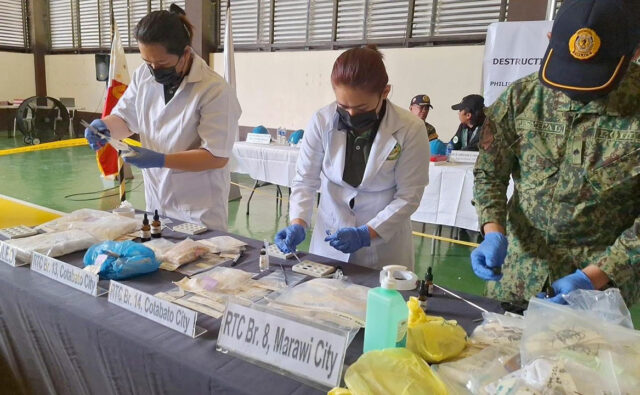
VARIOUS addictive substances, amounting to P30.2 million, are first examined by chemists prior to their incineration at a thermal power plant in Sultan Kudarat, Maguindanao del Norte. — PHILIPPINE STAR/JOHN FELIX M. UNSON

COTABATO CITY — A total of P30.2 million worth of narcotics that had been preserved as evidence for the courts over several years were finally destroyed on Monday at a private thermal power plant’s incinerator in Sultan Kudarat, Maguindanao del Norte.

Philippine Drug Enforcement Agency-Bangsamoro Autonomous Region in Muslim Mindanao (PDEA-BARMM) Director Christian O. Frivaldo said on Tuesday that officials joined a symbolic destruction of the illegal substances which had been seized from drug traffickers.

The drug haul comprised of P24.3 million worth of “shabu,” P813,740 worth of dried marijuana, and P5 million worth of cocaine, along with three boxes of expired medical grade barbiturates and tranquilizers surrendered by legitimate drug stores in the region.

“All of the shabu, cocaine and marijuana that we burned in that incinerator were seized in operations supported by the National Bureau of Investigation, units of PRO-BAR, the Army’s 6th ID and Army brigades and battalions in BARMM and the Philippine Coast Guard,” Mr. Frivaldo said. — John Felix M. Unson

ADVERTISEMENT
ADVERTISEMENT