Home Blog Page 4160

ICTSI unit starts building Indonesia terminal

A UNIT of International Container Terminal Services, Inc. (ICTSI) has started the construction of a multipurpose terminal in East Java, Indonesia, the listed port operator said on Wednesday.

“We are very excited with this new terminal development as it will provide a new and more accessible gateway for our hinterland customers in Lamongan, Tuban and up to central Java,” Patrick Chan, chief executive officer of East Java Multipurpose Terminal (EJMT), said in a media release.

The ICTSI unit broke ground last week for the terminal’s development, which is scheduled to be operational by September next year.

“Catering to an already thriving industry with this new investment, EJMT is well-positioned to support the growing economy of East Java and Indonesia,” Mr. Chan said.

The terminal will include a 300-meter quay line, breakwater, super-heavy lift breakbulk deck, and dredging of the navigational channel to -13.5 meters,” ICTSI said.

It said the construction will be supported by two mobile harbor cranes and cargo handling equipment.

EJMT is an international gateway in Lamongan Regency of East Java province, ICTSI said, adding that the multipurpose terminal facility will be located in the 80-hectare Lamongan Shorebase complex, which caters to the specialized offshore oil and gas industry.

“The development of EJMT will provide domestic and international access to our existing and new customers, who will also benefit from the reduced overall supply chain costs,” David Lim, CEO of PT Eastern Logistics, the operator of Lamongan Shorebase.

EJMT is ICTSI’s joint venture with Indonesian oil and gas company East Log Holdings.

At the local bourse on Wednesday, shares in ICTSI fell by 80 centavos or 0.37% to end at P214.20 apiece. — Ashley Erika O. Jose

Xi and Putin think they’re winning — and maybe they are

COMMONS.WIKIMEDIA.ORG -WWW.KREMLIN.RU

WITH hindsight, the last time Vladimir Putin visited Xi Jinping in China, just three weeks before Russia invaded Ukraine, was a moment of hubris — two supremely confident leaders marking their bid to shake up a world organized by and for the US and its allies. Well, they certainly shook it up, even if not in the way they intended.

Putin’s catastrophic error in attempting to invade a neighbor the size of France as though it were a glorified training exercise has, by some estimates, resulted in halving Russia’s military strength. The supercar that was China’s economy, meanwhile, has sputtered into the slow lane, with forecasts of when it will overtake the US in current dollar terms pushed into the future. So, it’s tempting to imagine Xi and an increasingly dependent Putin humbled at their reunion, the sinews of their “unlimited’’ bond already tearing. But that, to borrow a wonderful phrase from Sarah Paine, a professor of history and grand strategy at the US Naval War College, would be playing “half-court tennis” — the kind where you never see the next ball coming because you aren’t paying attention to the other side’s game.

Paine says that to understand why China and Russia do what they do, you need to see them for what they are: continental powers in a global order that was organized over centuries by successive maritime powers, first British and then American. The difference is big. Maritime nations ultimately are about trade, and that in turn tends to attract allies and encourage the development of international rules because they enable wealth creation. The territorial wars that a continental world order based on spheres of influence implies are, by contrast, huge destroyers of wealth and value. Ukraine is a clear example.

Sea powers do attack and subdue other countries, as the US did in Iraq and the British Empire in its many colonies. They also break the rules when it suits them. Yet the expeditionary wars they fight are necessarily smaller and overseas, taking a far lower toll on lives and wealth at home. Rarely do they conquer territory for its own sake, focusing more on containment and regime change to assert their interests. They also prefer stable to unstable neighbors because failed states tend not to do much trade.

Continental powers, by contrast, care a lot about territory and will, at times, pursue its acquisition to their own economic detriment. Historically, continental powers also are prone to destabilizing neighbors if they can, either to later absorb them or ensure that no powerful threat emerges on their doorstep. That habitual, sometimes justified and, at other times, self-fulfilling paranoia also weakens their most likely trading partners.

“It’s what Putin is doing now” in Ukraine, says Paine, who in her book The Wars for Asia describes this process of neighborhood destabilization, followed by conquest and absorption as the Russian Empire’s successful MO over a period of centuries. It’s possible for a country to change from continental mode to join the maritime order, she says — the US did it — but that must come from within.

China operates a little differently, and with its massive exports is very deliberately acquiring aspects of a maritime power that Russia hasn’t. Yet Xi and Putin are drawn together by an even more potent force than their geopolitical positions: self-preservation.

The Communist Party of China can’t afford to have Taiwan remain an offshore model of a successful democracy that creates better outcomes for a mainly Han Chinese population than does the Party. Nor could Putin afford to allow Ukraine to become the European success story that Ukrainians demanded during the so-called Maidan protests of 2014. These priorities are non-negotiable for Putin and Xi, and therefore dangerous. They already led to one war and could produce a second.

Both men believe they are being squeezed by the West, which is trying to contain ambitions they consider vital interests. Xi and Putin will endure economic opportunity costs and suppress any domestic opposition to achieve them. The result is an emerging form of Cold War that aligns Eurasia’s continental powers — including China, Russia, Iran and North Korea — against the US and its allies in Europe and Asia, including Australia, Japan, South Korea, the UK and most of the European Union.

Whether or not Putin gave Xi details of his imminent plans to invade Ukraine at their 2022 meeting, the common goal outlined in their joint statement was clear: the “redistribution of power in the world,” an end to US dominance and the redefinition of democracy and human rights as whatever a given government says they are.

For sure, Xi didn’t anticipate any more than Putin that Russia’s war machine would be humiliated in Ukraine or that the West would respond not by imploding but also uniting and expanding. In the same way, it’s doubtful that when the two leaders met in February 2022, Xi expected the current conflagration in the Middle East.

But in terms of a zero-sum geopolitical confrontation with the US, trouble in Ukraine or the Middle East is a win for China. Both draw on US resources and attention. Both upset the status quo. As the US becomes embroiled in Israel’s revenge against Hamas in Gaza, its alliances with the Gulf Arab states will be strained, creating opportunities for Xi.

So, just as Putin immediately laid the blame for Hamas’ horrific attack on Israeli civilians at the door of the US, China has avoided any public condemnation of Hamas, while criticizing Israel for its collective punishment of Palestinians in response.

By courting the Muslim world in this way, Putin and Xi are doubling down on their success in persuading the so-called Global South that the problem isn’t Russian aggression in Ukraine or Hamas’ grotesque terrorist acts in Israel, but rather the continued colonialism of the US and Europe. Never mind Russian suppression of Muslim Tatars in occupied Crimea or Chinese internment of Uyghur Muslims in Xinjiang province. The narrative works because the Palestinian injustice, with its colonial overtones and deep history in centuries of struggle over control of the Holy Land, can enrage the Arab Street like no other.

So get ready for more tenacious anti-Western messaging from Xi and Putin this week. They may have suffered some economic setbacks, and in Russia’s case, military, but when it comes to rallying other nations to their cause, they’re making good progress.

BLOOMBERG OPINION

Dining In/Out (10/19/23)


Discovery Primea presents special Colombian dinner

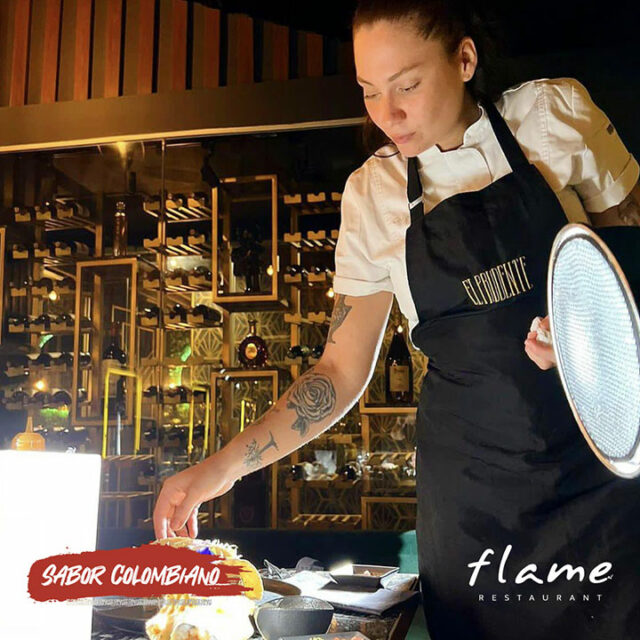
THE LATEST in Discovery Primea’s Elements of Flavor collaboration series at Flame Restaurant is “Sabor Colombiano,” which will be held on Friday, Oct. 20. It will feature the vibrant and authentic flavors of Colombia in a menu developed by guest chef Carolina Asmar. Seating times for the dinner that day will be 6:30, 7:30, and 8:30 p.m. at the hotel’s Flame Restaurant. The price is P4,800++ per person. The multi-course menu starts with Pasabocas and ends with Dulces Tropicales. The centerpiece are the main dishes: Seafood & Lychee Ceviche, with grilled lobster, octopus, prawns, and Lapu-Lapu; Pescado a la Criolla which is Chilean sea bass, accompanied by shrimp-infused Arroz Caldoso; Costillas a la Cartagenera, slow-cooked US beef short ribs with a velvety green plantain purée, Salsa de Panela, and creamy avocado. To complement the dishes, Flame Restaurant has selected Spanish wines to pair with the dishes. To learn more about the event, visit https://bit.ly/SaborColombianoAtFlame. Reserve a spot at the dinner by contacting Discovery Primea at 7955-8888 or primea.restaurants@discovery.com.ph.


Oktoberfest at Newport World Resorts

AT NEWPORT World Resorts’ first authentic German celebration of Oktoberfest, German sausage is a focus. The annual beer festival makes its debut in the country’s pioneer integrated resort with a platter of the best German sausages and other festive fare. For three nights from Oct. 19 to 21 at the Ballroom, 3F Hilton Manila, Newport World Resorts’s own culinary team sets forth a premium German feast. The sausage platter features five varieties: bratwurst, bockwurst, weisswurst or white sausage, nurnberger, and Hungarian sausage. Served alongside the sausage platter is a full spread of German dishes, from appetizers to desserts: fresh pretzels and rolls; potato and Munich salads; a charcuterie board; chicken schnitzel and pork knuckles; German egg noodles; and baked apple strudel, among many others. The Weihenstephan Brewery will bring in premium bottomless Bavarian beers. The festival also spotlights live entertainment from the AnTon Showband, fun drinking games, and major prizes. For P5,200 nett per head, join the party of free-flowing food and beer on Oct. 19 to 21. Doors open at 6 p.m. For tickets and inquiries, contact the Hilton Manila Sales Team at 0917-848-6404 and 0917-811-0731, or e-mail hiltonmanila_events@hilton.com, or the Newport World Resorts Sales Team at 0917-872-8734 and 0917-878-8568.


Oktoberfest and a spooky cake of the month

CROWNE PLAZA Manila Galleria is celebrating both Oktoberfest and Halloween this month. There is an October-feast ongoing at Seven Corners until Oct. 21, with a special German food station serving soft pretzels, pork knuckles, sausages, and more. The buffet lunch is P2,700 net while the buffet dinner is P2,900 net. Reserve seats through 0916-631-7523 or e-mail fandb.reservations@ihg.com. Meanwhile, Agenda’s cake of the month is Ghosted, a coconut dacquoise cake layered with sweet cream cheese frosting, strawberry filling covered with spooky mallows, chocolate and crushed Oreo cookies. It is available at the Lobby Level of the Crowne Plaza Manila Galleria for P2,260 net. Order ahead by calling 8790-3100 or e-mailing fandb.reservations@ihg.com. One can also shop at https://tinyurl.com/ywujzjrj.   


Crimson Hotel Filinvest City goes pink

CRIMSON HOTEL Filinvest City goes pink this October with a month-long commitment to breast cancer awareness and support. In support of National Breast Cancer Awareness Month, the hotel has a range of special promotions, events, and activities, all dedicated to raising funds for StageZero by Project Pink Support Group Inc. There is the Uncork Hope Wine Festival hosted in the Lobby Lounge of Crimson Hotel on Oct. 20, 6 p.m. It serves as a fundraising initiative to support the advocacy of StageZero. Featuring a selection of fine Chilean (Montes) and Argentinian (Kaiken) wines, tickets for this wine festival can be purchased at https://bit.ly/UncorkHopeWineFestival. Crimson’s Pink Punch Refreshers — pink cocktails and mocktails —are available in all the hotel’s restaurants. Café Eight has a Pink Corner on all Fridays and Saturdays of October at 6 p.m., which is a boutique dinner buffet featuring pink-inspired items. Feast on the Pinktober Bundle at Firehouse Pizza throughout October, offering a variety of pink-themed dishes for four. Baker J offers the Strawberry Pomelos Cake featuring sweet strawberries and zesty pomelo. And at the Lobby Lounge, there are perfect pair offers featuring the Baby Pink Chino or the Rose Boba Bubble Tea. There is the Bloom in Pink Room Package, where a portion of the proceeds from every booking goes towards supporting StageZero. Get a 15% discount on website rates and enjoy an overnight stay for two with a pink surprise room amenity, buffet breakfast, and access to the swimming pool and fitness center. Additionally, it comes with a 20% discount in all restaurants. For those seeking a more extended escape, there is the Weekend Stay & Dine Special. With a minimum two-night stay, one gets accommodations for two, a pink surprise room amenity, buffet breakfast, and a boutique buffet dinner. Take advantage of the facilities, including the swimming pool and fitness center, and cap off the experience with a 20% discount in all restaurants. The Pop of Pink: Art and Fashion Exhibit is ongoing throughout October. It is a collaboration between the artists from the South Arts Festival, featuring creations by Amoire.MNL, Arby Barroso, Beatriz Art & Accessories, Janddie Castillo, Jaque Borges, Jliane Perdiguez, Markus Jentes, Mia Antonio, Nikki Vasallo, and Rachel Le Roux. A portion of the proceeds from purchases of the items will also benefit StageZero’s breast cancer initiatives. For more information, call 8863-2222 or visit www.crimsonhotel.com/manila.


Sheraton Manila Bay holds coffee festival

SHERATON MANILA Bay presents Kapestahan, a weeklong coffee festival in celebration of Coffee Month, which is also one of the four events commemorating Sheraton Manila Bay’s 4th Hotel Anniversary. The event kicked off on Oct. 15 at &More by Sheraton, aiming to showcase the rich coffee culture in the Philippines. The Kapestahan features local beans from Sultan Kudarat, Benguet, Sagada, and Kalinga, heralded by Hasiera Lagom Coffee. Allegro Beverage offers an array of coffee essentials for both seasoned coffee connoisseurs and budding baristas. Kapestahan will culminate on Oct. 21 with the 2nd Latte Art Throwdown Competition, in partnership with Pukaw, MilkLab, Allegro Beverage, and Barhead Solutions. It is a latte art competition that is open to aspiring barista students. Participants have the chance to win the Manila Latte Art Championship Trophy and other prizes. The participation fee is P1,500 net. To join, call 5318-0788 or e-mail sh.mnlsb.fnb@sheraton.com. Sheraton Manila Bay is located at M. Adriatico corner Gen. Malvar Sts., Malate, Manila.


MESA reopens in Greenbelt

MESA Philippines announced the reopening of its flagship restaurant in Greenbelt 5, Makati City. After undergoing renovations, the restaurant opened on Oct. 15 with new dishes added to the menu. Pampano fish is the highlight of these dishes: Pampano Dayap Chili, where the pampano is simmered in dayap (a local citrus) chili sauce and served with a lime wheel, wansoy and siling labuyo (cilantro and birds eye chili); Pampano Ginger Soya, where the fish is simmered in ginger soya sauce served with fresh onion leeks; and Pampano with Latik, where the fish is pan fried and simmered in butter, then topped with latik (caramelized coconut cream), fried garlic, and fresh onion leeks. MESA also has a new pork dish, Grilled Spareribs, and a new noodle dish, Locanton. To commemorate the reopening of the Greenbelt 5 restaurant and the launch of the new menu items, there will be special promotions and discounts which will be announced on its social media channels and official website.


Kenny Rogers presents the new Great Garlic Roast

KENNY Rogers Roasters is highlighting the aroma, depth, and complexity of garlic as it introduces its newest offering, The Great Garlic Roast, which is now available in all Kenny Rogers Roasters restaurants. For customers who want to enjoy it solo, there’s The Great Garlic Roast Solo B (P305) consisting of a quarter roast chicken marinated in a special blend of herbs and spices, served with two side dishes including the new Roasted Garlic Carrots, one rice, one Great Garlic Sauce, and the signature corn muffin. There is also The Great Garlic Burger Steak (P305) with the restaurant’s signature 1/3-pound beef patty covered with The Great Garlic Sauce and topped with roasted garlic cloves, served with two side dishes including the new Roasted Garlic Carrots, one rice, and a corn muffin. The Great Garlic Roast is available for dine-in, take-out or delivery through www.kennyrogersdelivery.com.ph, hotline: 8-555-9000, or via Grab Food and Food Panda.


Lemon-Dou holds food and fun fest

LEMON-DOU will be holding the Lemon-Dou: Discover Izakaya food and fun fest on Oct. 21 at Burgos Park in Bonifacio Global City, Taguig. Introduced in 2021 as Coca-Cola Philippines’ first foray into the alcoholic drinks segment, Lemon-Dou is a full-bodied chūhai (a canned alcoholic drink) featuring the zest of whole crushed lemons, infused in alcohol, and mixed with fizzy bubbles. It has three variants which come in 320ml cans: Honey Lemon (3% ABV), Signature Lemon (5% ABV), and Devil Lemon (9% ABV). So, for those legally allowed to drink, the Lemon-Dou: Discover Izakaya festival will feature oishi bar chow and dishes, and Japanese art, music, and entertainment, from kawaii fashion and arts and crafts to cultural performances and dances. Lemon-Dou ambassador and food influencer Erwan Heussaff and internet chef Ninong Ry will share their passion for Japanese cuisine.


New Popeyes pies come straight from the US

KNOWN for its fried chicken goodness, Popeyes also has sweet meal enders, its Dessert Pies. The brand is introducing its latest dessert addition, the new Strawberry Cheesecake Pie and is bringing back the classic Cinnamon Apple Pie. With their deep-fried turnover-style pie crust, what makes their pie more special is the cinnamon sugar coating to give it a distinct flavor and sweetness. The Strawberry Cheesecake Pie is a combination of sweet fruity strawberry sauce and cream cheese filling. The Cinnamon Apple Pie has a tarty fruity flavor from the cinnamon-enriched apple filling. Both pies come in a bigger serving size at P65 per piece. With the Snack Duo promo, diners can combine a pie with a sundae or other beverages for P99. The new Dessert Pies are available at any Popeyes branch nationwide as well as for delivery via GrabFood, Foodpanda and www.central.ph.


Krispy Kreme’s Halloween doughnuts go nostalgic

HALLOWEEN is set to be a nostalgic one as Krispy Kreme Philippines turns the spotlight on Scooby-doo, the cartoon Great Dane and the gang which have been part of many a childhood since 1969. This Halloween, Krispy Kreme is offering two exclusive doughnuts: the Scooby-doo doughnut, a ring doughnut dipped in blue chocolate coating, topped with orange kreme and lime green icing and decorated with an Scooby-doo candy topper; and the Mystery Machine doughnut, a ring doughnut dipped in dark choco, sprinkled with choco sprinkles, and topped with lime green icing and a Mystery Machine candy topper. There is also the Midnight Mallow Kreme Soda, a cauldron-inspired drink made with Mug Root Beer, toasted mallow flavor, topped with sea salt kreme and finished off with dark chocolate sprinkles. The Scooby-doo Halloween doughnuts start at P70 and the Midnight Mallow Kreme Soda at P135 for 20 oz. They are a limited offer, available until Oct. 31 only. They can be bought at Krispy Kreme branches, delivered by calling 888-79000 or ordering online through now.krispykreme.com.ph, GrabFood, Foodpanda, Pick.a.Roo, OrderMo, and Groover. Meanwhile, BPI Debit cardholders can get three free Original Glazed doughnuts from Krispy Kreme when they spend at least P3,000 in any in-store merchants, anywhere from Oct. 1 to Nov. 30. This promo is open to BPI Debit Mastercard, BPI Debit Cirrus, and BPI Debit Cirrus Gold cardholders. To avail, simply present a BPI Debit Card transaction slip dated Oct. 1 to Nov. 30. Online transactions are excluded, and cardholders may avail of the promo only once per redemption day, and per store. The free box of three Krispy Kreme Original Glazed Donuts can be redeemed at participating Krispy Kreme stores on the following dates: Oct. 19 and 26, and Nov. 16, 23, and 30. To learn more, visit www.bpi.com.ph.


7-Eleven and Fuwa Fuwa introduces Cheezy Pizza Bread

NEIGHBORHOOD store chain 7-Eleven is collaborating for the third time with Fuwa Fuwa, a manufacturer and retailer of Japanese baked products in the Philippines, this time on a Cheezy Pizza Bread. It is a blend of tomato sauce, two types of cheese, and Japanese mayo generously layered on top of Fuwa Fuwa’s signature fluffy bread. It can be savored as is or popped in the microwave for five seconds. It is available for P39. The previous collaborations between 7-Eleven Soft Bites and Fuwa Fuwa  were the cheesy and creamy Ensaymada Bun (P40) and Loaf Slices (P40) which hit the shelves in 2021. Fuwa Fuwa Cheezy Pizza Bread is now available in all 7-Eleven stores in Luzon.


Frotea announces its sweet rebrand

AFTER expanding its footprint beyond the shores of Palawan, with branches in Batangas, Laguna, Bataan, and South Cotabato, Frotea rebrands from “Froyo + Milktea” with their previous tagline “For You and Me,” to now being the country’s number one “Milktea Dessert Brand’, serving “Summer in Every Cup.” The rebrand was driven by a commitment to innovating and expanding Frotea according to the trends, its consumers, and the times. “At Frotea, we understand that preferences are not static; they evolve with time. That’s why we regularly engage with our valued customers through surveys and conduct rigorous product testing to ensure that our offerings align perfectly with their changing tastes,” said Ana Lustre-Malijan, founder and owner of Frotea, in a press release. To celebrate its 11th anniversary and rebranding, Frotea has added three new menu items: Dark chocolate Ice cream, Panda Ice Cream, and Fish Waffles. To stay up to date with Frotea, its products, branches, and future events, visit its official website and social media pages.


Manila Water service connections hit 1.16 million

MANILA WATER Co., Inc. has tallied service connections in its east zone network at 1.16 million as of the second quarter, it said on Wednesday.

In a media release, the water concessionaire said it had installed 16,728 new water connections as of July. Of the latest count, 16,175 are domestic connections, which is already 81% of the company’s 2023 target.

A total of 553 new commercial and industrial connections were turned on during the period, it said.

According to Manila Water, the steady increase in water connections enabled it to cover more than 7.63 million customers in the east zone of Metro Manila and parts of Rizal.

“Service improvements for our customers are paramount. For the past 26 years, the company has been working closely with the Metropolitan Waterworks and Sewerage System (MWSS) Regulatory Office, the national government, and local government units on service expansion projects,” said Nestor Jeric T. Sevilla, Jr., Manila Water’s corporate strategic affairs group head.

“The company has invested heavily in augmenting the water sources, upgrading its systems, and maintaining the water network,” he added.

The company also reported that 98.35% of the total water service connections ran 24/7 at an average water pressure of 7 psi (pounds per square inch) at ground level.

It attributed the steady flow to its efforts in lowering nonrevenue water, or water wasted due to leaks and illegal connections in the water network, which is below 15%.

Manila Water said it has maintained 100% monthly compliance with the Philippine National Standards for Drinking Water, guaranteeing that water up to the customers’ meters is safe to drink.

The company is set to inaugurate the first phase of its East Bay water treatment plant designed to provide 50 million liters per day of treated water to 300,000 residents in the towns of Jalajala, Pililla, Baras, Cardona, Morong, and Binangonan in Rizal province.

In August, Manila Water applied to extend its revised concession agreement with the MWSS.

Along with this, the company has committed to allocate P1.15 trillion for investments. The move is primarily meant to ensure the continuous provision of water and wastewater services to its customers in the east zone.

At the local bourse on Monday, shares of Manila Water went down by P0.10 or 0.55% to close at P18.20 apiece.

The water concessionaire serves the east zone network of Metro Manila, covering parts of Marikina, Pasig, Makati, Taguig, Pateros, Mandaluyong, San Juan, portions of Quezon City and Manila, and several towns in Rizal province. — Sheldeen Joy Talavera

Biometrics and passkeys preferred over passwords in APAC, says study

EVGENIY ALYOSHIN-UNSPLASH

CONSUMERS across the Asia Pacific (APAC) region prefer stronger and user-friendly authentication methods, such as biometrics and passkeys, to secure their online accounts against the rise in phishing attacks in the region, according to a study.

“The persistently high password usage without [two-factor authentication] is a concern, highlighting how little consumers are offered alternatives like biometrics, resulting in lingering usage,” Andrew Shikiar, executive director at FIDO Alliance, said in a statement on Tuesday.

An online authentication barometer from the Fast Identity Online (FIDO) Alliance showed that biometrics was the most secured and preferred authentication method among respondents.

The FIDO Alliance’s Online Authentication Barometer study covered 10,010 global consumers and was conducted by Sapio Research.

“Notably, Singapore leads this trend, with 35% of people indicating biometrics as the most secure and 41% selecting it as their most preferred method,” the study said.

It added that 58% of consumers have seen more online scams, with 56% thinking that such dubious messages have grown in sophistication with artificial intelligence (AI).

“The increased accessibility of generative AI tools is a likely driver of this rise in scams and phishing threats,” it said. “Tools like Fraud-GPT and WormGPT, which have been created and shared on the dark web explicitly for use in cybercrime, have made crafting compelling social engineering attacks far simpler, more sophisticated, and easier to do at scale.”

“With new AI tools that make phishing attacks even more convincing and widespread, it’s crucial for service providers in the Asia-Pacific region to pay attention,” Mr. Shikiar said. “Instead of sticking with old and unreliable methods like passwords and one-time codes, we need to start using stronger and simpler options like passkeys and on-device biometrics.”

Meanwhile, entering a password manually without additional authentication was the most used method across Asia Pacific, the study said.

On average, APAC consumers manually input a password four times a day or 1,200 times a year, the study said.

It also noted that 62% of APAC respondents are giving up on accessing services online and 45% are abandoning purchases due to forgetting their password for an 8% jump from last year.

“Globally, 70% of people have had to reset and recover passwords in the last two months because they’d forgotten them,” the study said.

“Poor online experiences are ultimately hitting businesses’ bottom lines and causing frustration among consumers.”

Passkeys have grown in consumer awareness (58%) from last year (41%) across APAC. Passkeys provide secure, convenient, non-phishable, and passwordless sign-ins to online services, it said.

Tech players such as Google, Apple, and PayPal are seeing opportunities in passkeys as they gear away from password and two-step verification, it added. — Miguel Hanz L. Antivola

Yields on term deposits inch up

YIELDS on the Bangko Sentral ng Pilipinas’ (BSP) term deposits climbed on Wednesday amid hawkish expectations from monetary authorities at home and abroad.

Demand for the BSP’s term deposit facility (TDF) stood at P393.161 billion on Wednesday, higher than the P380-billion offer as well as the P375.538 billion in tenders seen a week earlier for a P400-billion offering.

Broken down, tenders for the seven-day papers amounted to P236.753 billion, higher than the P220 billion auctioned off by the BSP. It was also P17.874 billion above the P218.879 billion in tenders seen last week.

Accepted rates for the tenor ranged from 6.41% to 6.455%, narrower than the 6.4% to 6.465% band logged last week. The average rate of the one-week deposits inched up by 0.45 basis point (bp) to 6.4357% from 6.4312% previously.

Meanwhile, demand for the 16-day deposits amounted to P156.408 billion, below the P160 billion on the auction block and the P156.659 billion in tenders seen in the previous week for a P180-billion offer of 14-day deposits.

The tenor offered this week was adjusted due to holidays in the beginning of November.

Banks asked for yields from 6.4% to 6.48%, slightly wider than the 6.4% to 6.478% range seen the previous week. This caused the average rate of the paper to inch up by 0.25 bp to 6.4483% from the 6.4458% seen on Oct. 11.

The BSP has not auctioned off 28-day term deposits for three years to give way to its weekly offerings of securities with the same tenor.

The term deposits and the 28-day bills are used by the central bank to mop up excess liquidity in the financial system and to better guide market rates.

TDF yields were higher week on week due to hawkish signals from the BSP chief and the possibility of a 25-bp hike from the US Federal Reserve, Rizal Commercial Banking Corp. Chief Economist Michael L. Ricafort said in a Viber message.

The central bank is open to raising its policy rate by 25 bps during their meeting next month after inflation picked up for a second month in a row in September, BSP Governor Eli M. Remolona, Jr. said last week.

Mr. Remolona said he “would not rule out” a 25-bp increase at the Monetary Board’s Nov. 16 meeting, adding there is still room for monetary tightening as the economy remains strong.

The Monetary Board has kept the policy rate at a near 16-year high of 6.25% at its last four meetings. It raised borrowing costs by 425 bps from May 2022 to March 2023 to help bring down inflation.

Headline inflation quickened for a second straight month to 6.1% in September from 5.3% in August. This brought the nine-month inflation average to 6.6%, still higher than the BSP’s 5.8% forecast and 2-4% target for the year.

Meanwhile, the Fed kept its benchmark rate unchanged at the 5.25% to 5.5% range at its Sept. 19-20 meeting. It has hiked rates by a cumulative 525 bps since it began its tightening cycle in March last year.

The Federal Open Market Committee will hold its next policy review from Oct. 31 to Nov. 1.

Global yields have climbed amid the war between Israel and Palestine, Mr. Ricafort added.

A jump in bond yields after a barnstorming report on September US retail sales sent analysts scurrying to revise up forecasts for economic growth for both the third and fourth quarters, Reuters reported.

Markets reacted by pricing in more risk the Federal Reserve will be forced to hike again. A move in November is still seen as just an 11% chance, but January climbed to 50% from 37%.

The market also again scaled back expectations for early rate cuts, with no chance of a move until June and around 54 basis points of easing implied for all of 2024.

Bonds took it badly, with two-year yields surging as much as 14 basis points on Tuesday to a 16-year peak of 5.24%. The two-year was last at 5.2%, while 10-year yields were back near recent highs at 4.84%. — M.J.B. Poliarco with Reuters

On smoking, vaping, consumer choice and life expectancy

NICE, France — The issue of tobacco and vape control, taxation and illicit trade is among the topics in the Tholos Forum 2023 here. And these two recent reports in BusinessWorld caught my attention: “High tobacco taxes encourage smuggling, economist says” (Oct. 12) and “PHL to lose P60B from illicit tobacco” (Oct. 18).

The economist referred to in the first story is Alyssamae A. Nuñez, an Economics lecturer at the University of Asia and the Pacific. The figure of P60 billion/year of tax revenue losses from illicit and smuggled cigarettes came from Congressman Joey Salceda, Chairman of the House Committee on Ways and Means. In March 2021, Mr. Salceda’s estimate was P30 billion/year of foregone revenues from illicit tobacco. In just two years he has doubled his estimate of tax losses.

I have also written in this column several times on illicit tobacco and revenue losses, most recently in May, “The Laffer Curve of Philippine tobacco taxation,” and June, “The law of diminishing marginal utility and public policy.”

People in general are rational. They slowly step back from consuming more tobacco, alcohol, sugar, fatty food, and drinks as they learn more about the harmful effects of high consumption of these products. (Some, however, are hooked and pursue it even while understanding the consequences to their health.) They also step back from legal products when these become more expensive due to rising taxes and they shift to illegal products where prices are much lower than the legal ones.

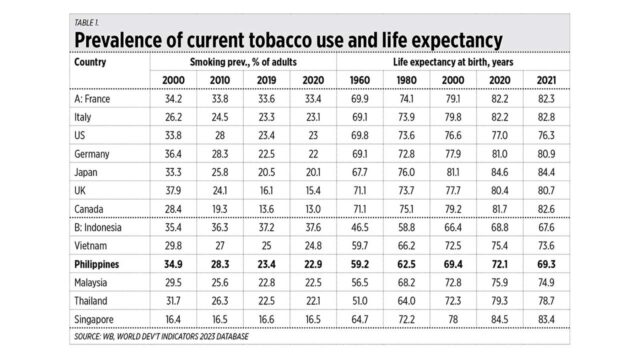
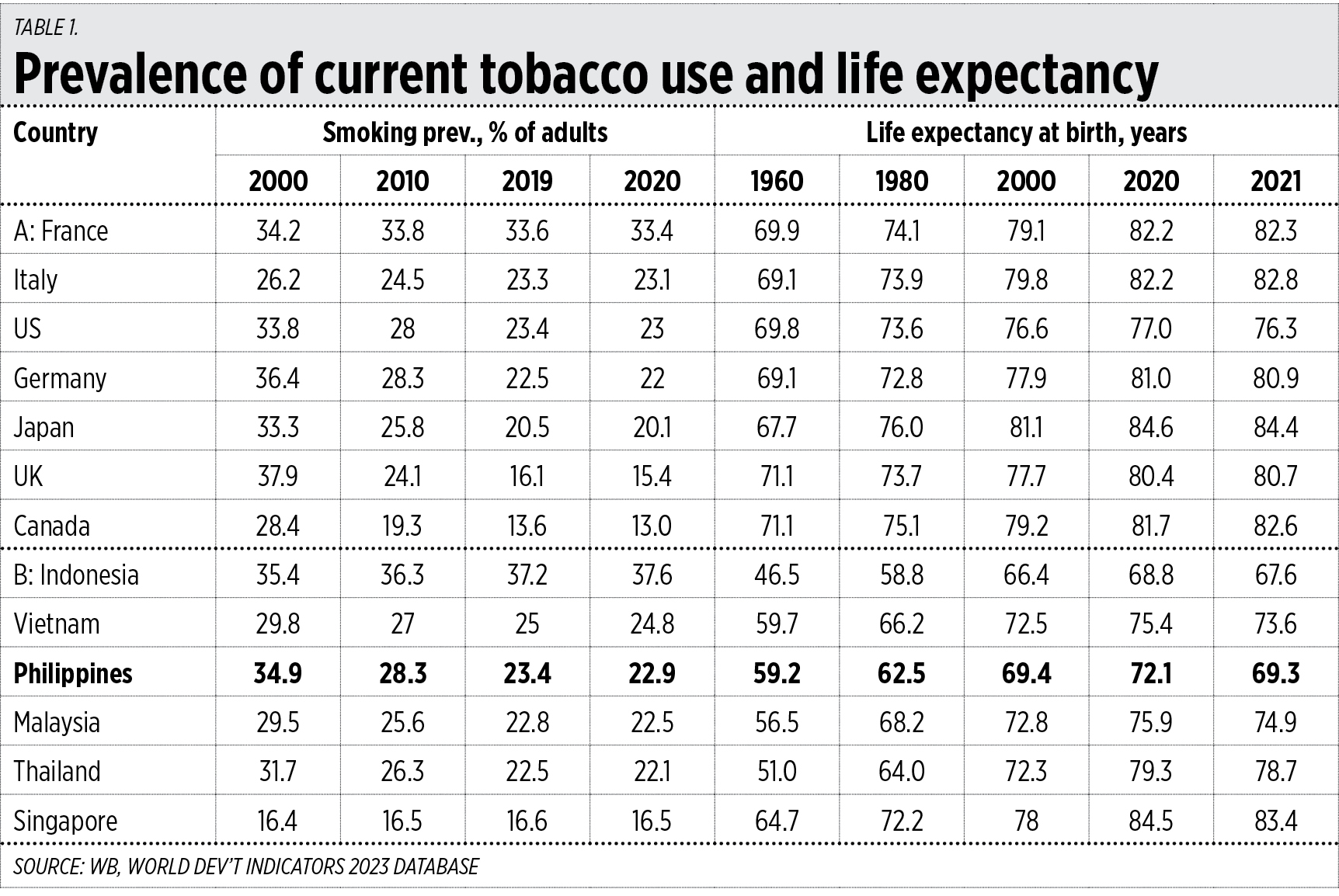
I put together a table about smoking prevalence and life expectancy. Group A is made up of G7 industrial countries, and Group B is made up of the ASEAN-6 countries. Data from the World Bank shows there was a continued decline in smoking prevalence from 2000 to 2020. In the Philippines for instance, 35% of adults were tobacco users in 2000, and this declined to 23% by 2020. But note that these percentages refer to the consumption of legal tobacco and do not include illegal tobacco.

And even if 15% to 33% of adults are smokers in the G7, and 22% to 38% of adults in the ASEAN are smokers, life expectancy keeps rising across many countries. The narrative “more smoking, more drinking = more death” is not really confirmed (see Table 1).

As tobacco and alcohol tax rates keep rising, consumption shifts from legal and taxed products to illegal and untaxed products. And this will have a negative effect not only on government revenues but more importantly on the culture of corruption in government. Smugglers and criminal groups pay off officials from the national down to the barangay level so that they look the other way when the contraband and smuggled products come in and are sold openly.

On Day 2 of the Tholos Forum 2023 here in Nice, France, one panel discussion yesterday was on “Harm Reduction and Consumer Freedom” and the speakers were Anders Ydstedt, Chairman of Svensk Tidskrift, a weekly journal of economics, politics and culture in Sweden; Yuya Watase, Chairman of the Pacific Alliance Institute, a free market think tank in Japan; Luis Loria of IDEASLab, a think tank in Costa Rica; and Leonardo Chagas of Atlantos, a think tank in Brazil. The moderator was Tim Andrews of Tholos.

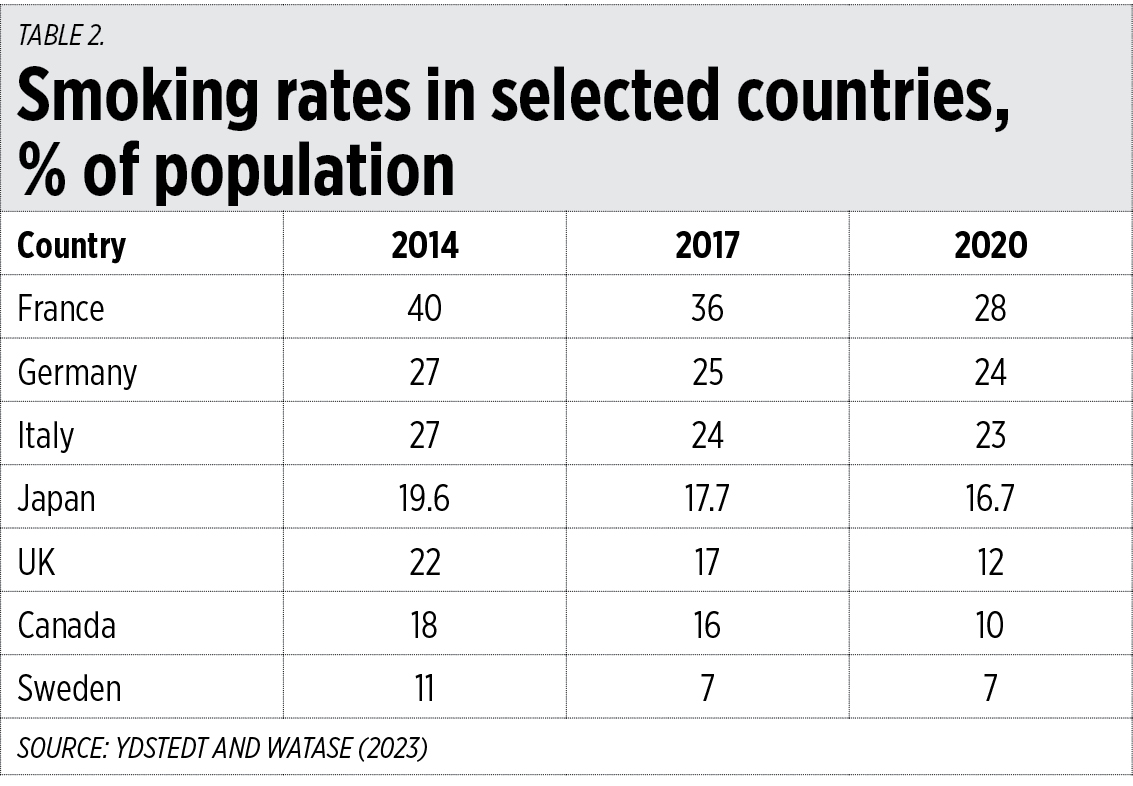
Ydstedt and Watase produced a paper, “Safer Nicotine Works: The Cases of Japan and Sweden,” and they showed this table (Table 2) on declining smoking rates. The primary source of data was not shown (most likely Organisation for Economic Co-operation and Development stats) but nonetheless, the trend is there — declining smoking rates as more people either have quit smoking and/or have shifted to illegal products or shifted to alternatives like vaping and snus (snuff) in Sweden.

Some important points to conclude and ponder.

One, the law of diminishing marginal revenues, the Laffer curve of optimal taxation, is real not fictional and is happening in the Philippines. As tobacco tax rates increase, people shift to illegal products and tax-paying legal products are hit, leading to reduced government tobacco tax revenues in 2022.

Two, people own their body and lives. Not the government, not the NGOs or media or doctors. Individual and consumer freedom means individual and parental responsibility of taking care of one’s body.

Three, harm reduction is a rational act by people. Instead of drinking 40% alcohol content whisky, they shift to 15% alcohol wine, or 5% alcohol beer. Instead of drinking high sugar soda, they shift to low or zero sugar soda. Instead of smoking cigarettes, they shift to vaping heated tobacco products or snus. Government and NGOs should respect those harm reduction acts, not demonize them.

Four, if a nanny state and NGOs really want to take over people’s behavior about their body, then they should be consistent. Regulate smoking, vaping and drinking; regulate sky jumping and deep-sea diving; regulate rock and tall trees climbing; regulate downhill cycling and cliff diving, and so on. Just one major mistake on those hobbies and adventures can lead to serious physical injuries if not death.

Five, government should focus on its basic functions that it was invented for in the first place: to protect the people’s right to life, right to property, and right to liberty. So, government should ban and control murder and killing, abduction and rape, stealing and destruction of property, bullying and killing people’s right to self-expression and mobility. When government is preoccupied with over-regulating smoking, drinking, vaping, gambling, etc., it will have little time to do its basic functions.

Finally, on individual freedom of expression: Among my favorite local rock bands is the Rockitwell band headed by fellow UP School of Economics alumnus Jack Teotico who owns Gallerie Joaquin. Now, Jack — the economist, the gallerist and the rock singer — is setting up a new and completely original musical titled Silver Lining. Producing a musical — whether it is on Broadway, off Broadway, the West End, or in Makati — like Silver Lining takes economic magic to make sense. The resources and talents to be harnessed are gargantuan. The audience will see Silver Lining starting this weekend, Oct. 20 to 22, then Oct. 27 to 29, at the Carlos P. Romulo Auditorium, RCBC Plaza in Makati. It stars Jack and noted thespians Ricky Davao, Raul Mabesa, Joel Nunez, and Starmagic talents like Krystal Brimner.


Bienvenido S. Oplas, Jr. is the president of Bienvenido S. Oplas, Jr. Research Consultancy Services, and Minimal Government Thinkers. He is an international fellow of the Tholos Foundation.

minimalgovernment@gmail.com

Kickstart completes funding round for RuralNet

KICKSTART Ventures, Inc. has completed a fresh round of seed funding for a digital microinsurance distribution platform, RuralNet, Inc.

The corporate venture capital firm said RuralNet has bagged a combined $2.15 million from its investors that will be used for its expansion plans.

The funding round, Kickstart Ventures said, was also participated in by other investors such as Gentree Fund, Foxmont Capital Partners, and Kaya Founders.

“With the backing of Kickstart Ventures, RuralNet is now poised for expansion,” Kickstart Ventures said in a media release.

It added that RuralNet is also aiming to expand CashKo, its brokerage that connects financial and retail partner institutions.

Insurtech RuralNet aims to narrow the low “insurance penetration” in the country by addressing the limited access to financial services. It operates by tapping integrated digital technology to help partner with financial institutions.

Overall, RuralNet has partnered with 25 financial institutions, delivering microinsurance to about two million clients.

It said that with the expansion plans of CashKo, the company is expecting to provide insurance coverage for small and medium enterprises.

Justine Arcenas, founder of RuralNet, said the insurtech start-up company is targeting to help local business owners provide financial security for their employees.

Founded in 2012, Kickstart Ventures is a wholly corporate venture capital firm of listed telecommunications company Globe Telecom, Inc. — Ashley Erika O. Jose

X social media to test $1 annual subscription for basic features

TRUSTPAIR.COM

SOCIAL MEDIA platform X, formerly known as Twitter, said on Tuesday it will test a new subscription model under which it will charge $1 annual fee for basic features.

The new subscription termed as “Not A Bot” will charge users for likes, reposts, or quoting other accounts’ posts, and bookmarking posts on the web version of the platform.

The purpose of introducing the new subscription model is to combat bots and spammers, X said, adding that the fee will vary from country to country based on the exchange rate.

X said the new method will be first available for users in New Zealand and the Philippines.

Within this test, existing users are not affected. But new users who would not wish to subscribe will only be able to view and read posts, watch videos and follow accounts.

Bots have been a contentious issue for Elon Musk who acquired the company last year. In July, X had introduced a limit on viewing tweets, “to ensure the authenticity” of its user base.

Earlier this month, Reuters had reported citing a source that X CEO Linda Yaccarino met with X’s lenders, in which she had said the company would test three tiers of its subscription service based on the number of ads shown to the user. — Reuters

China Bank Savings sees steady loan, income growth

BW FILE PHOTO

CHINA BANK Savings, Inc. (CBS) expects sustained growth in its loans and net income, driven by its focus on the education sector through its partnership with the government.

“We have to acknowledge our partnership with the Department of Education. We have a program called the automatic payroll deduction system (APDS). It’s a system for public school teachers to avail of loans from private banks, including China Bank Savings. This has driven quite a bit of our growth over the years,” CBS President and Chief Executive Officer James Christian T. Dee told BusinessWorld earlier this month.

This will help drive growth along with the bank’s auto, housing, and small and medium enterprises (SME) loans, he said.

“Together with our consumer loans like our auto loans and housing loans, and of course our SME loans, we basically have a full suite that will cater to the retail market. So, we’re supporting both the public and private sectors of the country. This has driven the growth in the last maybe about three years,” Mr. Dee said.

The thrift arm of listed China Banking Corp. expects to reach P120 billion in loans by end-2023, Mr. Dee said.

As of end-September, the bank disbursed P108.1 billion in credit, CBS said in an e-mail.

Loans disbursed through the APDS is expected to make up a large portion of the bank’s total loan portfolio, with P52 billion in loans expected to be disbursed through the system by end-2023, CBS First Vice-President and APD Lending Group Head Niel C. Jumawan said.

“We’ve already overshot our target. Our budget for this year was only P44 billion. We’re forecasting around P51 or P52 billion by end-2023,” he said.

The thrift bank will also continue to increase its network of branches and automated teller machines (ATMs) and boost its digitization initiatives to help onboard more customers into the APDS.

“For the rest of the year, we will be adding about four more ATMs. but for other technology for CBSGo, or for digital onboarding. That is what we will be pushing, for APDS especially,” CBS Digital Business Banking Group Head Adonis C. Yap said.

The lender had 201 ATMs as of this writing.

“So far, China Bank Savings has been growing exponentially. We’ve been opening so many branches. We have about 165 for a total of 257 offices nationwide,” Mr. Dee said.

CBS saw its net income grow by 10.08% year on year to P849.03 million as of end-June. It recorded a net profit of P1.6 billion in 2022.

Meanwhile, its parent bank China Bank saw its attributable net income rise by 11.88% year on year to P5.81 billion in the second quarter.

This brought its first-half attributable net income to P10.83 billion, up by 7% year on year. — A.M.C. Sy

Britney Spears memoir says she had abortion while dating Justin Timberlake

AMAZON.COM
AMAZON.COM

LOS ANGELES — Britney Spears recounts in a forthcoming memoir that she had an abortion to end a pregnancy by fellow pop star Justin Timberlake while the two were dating in the late 1990s and early 2000s, according to excerpts published on Tuesday in People magazine.

Spears, 41, recalled in her autobiography, The Woman in Me, that the pregnancy “was a surprise” but she wanted to have the baby and agreed to an abortion at Timberlake’s insistence.

“I loved Justin so much. I always expected us to have a family together one day,” Spears wrote. “But Justin definitely wasn’t happy about the pregnancy. He said we weren’t ready to have a baby in our lives, that we were way too young.”

Had it been her decision alone, Spears wrote, “I never would have done it. And yet Justin was so sure that he didn’t want to be a father.” She described the episode as “one of the most agonizing things I have ever experienced in my life.”

Representatives for Timberlake, 42, did not immediately respond to Reuters’ request for comment.

Timberlake and Spears, who met as young cast members on television’s The Mickey Mouse Club, dated for about three years in their late teens and early 20s, becoming tabloid sensations, before splitting abruptly in 2002.

Spears was questioned relentlessly in the media about her virginity, while Timberlake said he had slept with her and then wrote a song “Cry Me a River,” in which he implied she had been unfaithful to him in their relationship.

In 2021, following a TV documentary about Spears that included a segment on how she was shamed in the media when their relationship ended, Timberlake publicly apologized to Spears on social media, saying he had “failed” her.

Spears went on to become a mother to two sons, now aged 18 and 17, with her second husband, Kevin Federline, a singer and onetime backup dancer to whom she was married for two years.

In April 2022, Spears said she was expecting a third child with then-fiance Sam Asghari but the following month she said she suffered a miscarriage. She and Asghari wed in June 2022, but he filed for divorce 14 months later, in August of this year.

Spears’ highly anticipated memoir comes nearly two years after she was released from a 13-year court-ordered conservatorship set up and controlled by her father, Jamie Spears. The arrangement had governed Spears’ personal life, career and $60 million estate from 2008 until it was terminated in November 2021.

The memoir’s title apparently was taken from a line in the book in which Spears wrote, “The woman in me was pushed down for a long time. They wanted me to be wild onstage, the way they told me to be, and to be a robot the rest of the time.”

The book is due for release Oct. 24 from Gallery Books, an imprint of Simon and Schuster. — Reuters

Singapore’s central bank to inspect Credit Suisse, others in major scandal

SINGAPORE’S financial regulator will conduct an on-site inspection of Credit Suisse Group AG after at least one of its customers was charged for money laundering in a scandal that has rocked the city-state.

The local unit of Credit Suisse will be among banks the Monetary Authority of Singapore (MAS) plans to examine to determine whether they properly handled the monitoring of wealthy clients, according to people familiar with the matter. Officials from the regulator are set to interview personnel and review documents within weeks, the people said, asking not to be identified as the information isn’t public.

The planned inspection underscores the seriousness of the scandal that has ensnared at least 10 domestic and international banks in the Asian financial hub. More than S$2.8 billion ($2 billion) of assets from cash to jewelry have been seized from a group of alleged money launderers with Chinese origin.

The MAS’s upcoming visit would be outside its regular engagements with banks, and signals potential issues with the lenders’ sizable exposure to the suspects and overall handling of client vetting, the people said. Credit Suisse is among the banks that have relationships with either the accused, or their companies. One of the suspects, Vang Shuiming, held S$92 million at the Swiss lender, the biggest known account so far in the case.   

Credit Suisse declined to comment. An MAS spokesperson referred Bloomberg News to comments made in parliament this month by Minister of State Alvin Tan, who said the regulator is conducting supervisory reviews and inspections of the banks with “a major nexus” to the case. Mr. Tan also said it was concerning that financial assets made up the vast bulk of what was seized so far. 

For Credit Suisse, the review is but one of many headaches its new parent UBS Group AG will have to deal with as it focuses on integrating thousands of employees from its former rival across the world. The MAS did a similar inspection on Credit Suisse in 2017 for its role in the 1MDB saga, Malaysia’s biggest corruption case, and consequently the bank was fined S$700,000. The amount was the smallest penalty the regulator imposed on banks in Singapore at the time.

With 1MDB, MAS’ actions in the aftermath of the scandal also included banning financiers over breaches and shuttering the local units of two Swiss banks.

Besides Credit Suisse, Mr. Vang also had bank accounts with others including Bank Julius Baer where he had S$33 million as well as United Overseas Bank Ltd. and RHB Bank Bhd.’s local unit, according to police affidavits. Mr. Vang’s other charges include forgery of a bank document to trick Citibank Singapore Ltd.

It is not clear which other banks will be subject to MAS inspection, which could look into what red flags were raised internally and when so-called suspicious transaction reports were filed, the people added.

After the case erupted in August, banks in the city-state have further stepped up existing scrutiny on clients especially those of Chinese origins with multiple passports, Bloomberg reported last month. The authorities are also looking into how one or more of the accused may have been linked to single family offices with incentives, and will tighten the rules where necessary.

Investigations of the money-laundering ring date back to 2021 after banks and companies filed suspicious transaction reports, communications minister Josephine Teo told parliament. The MAS earlier said these reports had alerted authorities to suspicious activities attempted through the country’s financial system. — Bloomberg

ADVERTISEMENT
ADVERTISEMENT