Home Blog Page 416

A magical experience at the Grand Hyatt

SCENES from The Magic Table Hong Kong. — THEMAGICTABLE.COM/HONGKONG

MAGIC is coming to the Grand Hyatt Manila via a six-course dinner that premieres in January.

The Grand Hyatt Manila announced the launch of The Magic Table, another video experience with 2Spicy Entertainment GmbH, the same company behind Grand Hyatt’s other interactive dinner program, Le Petit Chef. This time though, the dinner will be accompanied by a magic show, as developed by America’s Got Talent finalists magicians and mentalists The Clairvoyants (Thommy Ten and Amélie van Tass).

This was announced on Sept. 26 at the hotel’s The Peak, where Mr. Ten performed illusions, including producing a bowling ball from seemingly nowhere while showing a picture of one.

Food served during the announcement included potatoes that looked like rocks (served among rocks) solidifying the illusory experience.

Grand Hyatt Manila’s F&B director Mark Hagan described the experience they’re launching next year: “A little bit more mysterious, a little bit something different, a new project to get the whole hotel excited again.” Mr. Hagan emphasized that the project launched globally just in September, with Hong Kong launching its own the week before, and its pilot in Germany launching the week before Hong Kong. “It’s the fastest-selling ticket in the world at the moment,” he said.

It seems that the hotel is centering itself as a dining destination with a bit more to offer than food. To this, Mr. Hagan says, “People like to go for fine dining, or to go for meals. But they also like to have a little bit of a buzz and an experience.”

He said that the dinner would have six courses, and it will be held in an undisclosed location somewhere within the hotel. Asked why the experience would fit in this city, he said, “Manila is magic.” — Joseph L. Garcia

Banks’ outstanding foreign currency loans climb to $15.9B at end-June

EURO, Hong Kong dollar, US dollar, Japanese yen, pound and Chinese 100 yuan banknotes are seen in this picture illustration, Jan. 21, 2016. — REUTERS

OUTSTANDING LOANS released by banks’ foreign currency deposit units (FCDU) increased at end-June, the Bangko Sentral ng Pilipinas (BSP) reported.

FCDU loans inched up by 0.9% to $15.928 billion as of June from $15.782 billion at end-March, the BSP said in a statement late on Tuesday. This was also up by 1.9% from $15.633 billion a year prior.

FCDUs are units of local banks or local branches of foreign banks authorized by the BSP to service transactions involving foreign currencies, including deposits and loans. Resident and nonresident borrowers, including individuals and businesses like importers, use these loans for their foreign currency payables or needs.

The end-June tally reflected $6.76 billion in new loans as well as $6.64 billion in loan payments made in the quarter.

The BSP said that 79% or $12.577 billion of banks’ outstanding FCDU loans in the period was medium- to long-term, or those payable in a year or more. This was lower than the $12.182 billion (77.2% of the total) seen in the previous quarter.

Meanwhile, short-term debt made up the remaining 21% at $3.35 billion, lower than the end-March tally of $3.6 billion (22.8%).

By borrower type, FCDU loans granted to Philippine-based borrowers reached $10.117 billion or 63.5% of the total. The top borrowers based in the Philippines were merchandise and service exporters ($2.52 billion or 24.9%); towing, tanker, trucking, forwarding, personal and other industries ($2.22 billion or 22%); and power generation companies ($1.89 billion or 18.7%).

On the other hand, foreign currency loans extended to nonresidents stood at $5.811 billion, comprising a 36.5% share.

Central bank data also showed that local banks accounted for 85% or $13.54 billion of the total outstanding FCDU loans as of June, and commercial banks extended the most loans at $13.52 billion (84.9%). Meanwhile, foreign banks lent $2.388 billion or 15% of the total.

On the other hand, banks’ FCDU deposit liabilities rose by nearly 3% to $60.669 billion as of June from $58.919 billion the previous quarter and by 10% from $55.156 billion a year prior.

This brought the FCDU loans-to-deposits ratio to 26.3% at end-June, down from 26.8% as of March and 28.3% a year ago. — Katherine K. Chan

Entrepreneurs and business leaders to gather at 17th PHILSME for SME success in 2026

Entrepreneurs, business leaders, and franchise seekers are set to converge at the 17th Philippine SME Business Expo: Entrepreneur & Franchise Edition, happening on Nov. 28-29, 2025, at the World Trade Center in Pasay City, Metro Manila.

This yearend edition of the country’s flagship B2B expo brings together over 10,000 decision-makers, 130+ exhibitors, and 200+ growth solutions and franchise opportunities across industries. The event is a dynamic marketplace for those looking to start a business, expand operations, or invest strategically before 2026.

“This expo is designed for action. Whether you’re launching a franchise or scaling your operations, PHILSME gives you direct access to the right people, the right solutions, and the right timing,” said Trixie Esguerra-Abrenilla, CEO and managing director of PHILSME. “We’re proud to present leading businesses that empower SMEs with the tools, systems, and services they need to grow and thrive.”

Over 30% of the expo floor is dedicated to franchise brands across food, wellness, retail, fitness, education, and services — giving aspiring entrepreneurs a one-stop destination for ready-to-invest business models. The remaining space highlights SME support sectors and business enablers, including tech, finance, logistics, marketing, e-commerce, and more.

Visitors can explore exhibits, attend live demos, join business talks, and access event-only deals on tools, services, and franchise packages. Attendees range from startup founders, SME owners, and professionals to corporate buyers, investors, and industry suppliers.

Meanwhile, exhibitors and sponsors benefit from premium positioning in front of a high-intent audience actively seeking new ventures, upgrades, or strategic collaborations. PHILSME’s on-ground visibility is amplified through a strong digital and media presence, ensuring sustained exposure before, during, and after the expo.

The 17th PHILSME is organized by the same team behind the Entrepreneur and Franchise Expo, which helped grow brands like Master Siomai, Anytime Fitness, and Potato Giant. Today, PHILSME continues that legacy — providing a platform for both modern business solution providers and established franchises to connect with fast-growing SMEs nationwide.

✔️ Franchise and business brands connect with thousands of buyers
✔️ Entrepreneurs and professionals find the right solutions to scale
✔️ Sponsors and partners gain yearend visibility and brand trust

Be part of the country’s most dynamic B2B event for entrepreneurs this 2025.

👉 To exhibit or sponsor, visit philsme.com/franchise-edition or book a slot via philsme.com/booking.
👉 To register as a visitor, claim your free or upgraded ticket at ticket.philsme.com.

For inquiries, email sunshine@philsme.com or call +63 916-642-7813 / Viber-WhatsApp +63 968-569-8358.


Spotlight is BusinessWorld’s sponsored section that allows advertisers to amplify their brand and connect with BusinessWorld’s audience by publishing their stories on the BusinessWorld Web site. For more information, send an email to online@bworldonline.com.

Join us on Viber at https://bit.ly/3hv6bLA to get more updates and subscribe to BusinessWorld’s titles and get exclusive content through www.bworld-x.com.

PHL brands must be wary of ‘AI slops,’ says DoubleVerify

REUTERS FILE PHOTO

PHILIPPINE BRANDS should ensure that their advertisements are not linked to artificial intelligence (AI) “slops” or inaccurate AI-generated content as it can dent consumer trust, according to digital media measurement and analytics platform DoubleVerify.

“If your ad goes beside content like AI slops, and [consumers] associate your brand to those kinds of digital environment, then they can become a little bit more skeptical of your brand,” Tinee Cruz, senior business director at DoubleVerify Philippines, said in a virtual interview last week.

AI slops refer to low- to mid-quality content created using generative AI technology. These can be in the form video, images, audio, or text, and are often inaccurate.

These are widespread on websites and social media pages where brands usually place their advertisements.

Most AI slops focus on evergreen content, or those that remain relevant and interesting to users for longer periods of time, so that they can generate sustained ad clicks.

Ads placed on websites or pages with these fake AI-generated content may influence a brand’s reputation, Ms. Cruz said.

“What we noticed is that when a specific ad is beside or in the context of an online environment wherein it’s a bit harmful, unsafe or unsuitable for that particular brand, it has an effect with the consumer on how they think of that specific messaging,” she said.

This also erodes consumers’ trust in a brand, which will impact their revenues or return on investment, Ms. Cruz said.

“Consumers online are very smart, but they’re also very busy. So, even if the content looks almost real, it can really sway anyone’s opinion if it doesn’t get checked.”

To combat AI slops, DoubleVerify’s Universal Content Intelligence tool provides advertisers with content evaluation on specific websites, the company said. It leverages AI and DoubleVerify’s proprietary content policy to provide advertisers with content evaluation.

About 54% of Filipinos said they would stop using a brand whose ads appear next to false or offensive content, DoubleVerify said in its 2025 Global Insights: APAC Report. — Beatriz Marie D. Cruz

Peso rebounds as dollar weakens due to US government shutdown

PHILIPPINE STAR/ MIGUEL DE GUZMAN

THE PESO rebounded on Wednesday as the dollar was hit by the US government’s shutdown.

The local unit closed at P58.12 versus the greenback, rising by 7.6 centavos from its P58.196 finish on Tuesday, Bankers Association of the Philippines data showed.

The peso opened Wednesday’s session sharply weaker at P58.40 versus the dollar, which was also its worst showing for the day. Meanwhile, its intraday best was at P58.08 against the greenback.

Dollars exchanged went up to $1.72 billion on Wednesday from $1.69 billion on Tuesday.

The peso strengthened as the dollar was dragged by the US government’s shutdown after lawmakers failed to pass a spending plan, Rizal Commercial Banking Corp. Chief Economist Michael L. Ricafort said in a Viber message.

The dollar sank to a one-week low against major currencies on Wednesday as a US government shutdown unsettled markets and threatened to delay key jobs data, seen as crucial for Federal Reserve policy decisions, Reuters reported.

The shutdown commenced hours after the Senate rejected a short-term spending measure that would have kept government operations afloat through Nov. 21.

Senate Republican Leader John Thune said the chamber would vote again on the House-passed measure on Wednesday. The Senate was due to convene at 1400 GMT.

The dollar index, which tracks the US currency against six major peers, slipped 0.2%. The price action across the broader markets bore a few hallmarks of safe-haven buying, giving low-yielding currencies such as the Japanese yen and the Swiss franc a bid, while US Treasuries and gold held firm.

The dollar was down 0.5% against the yen, around its weakest in two weeks, while losing around 0.2% against the Swiss franc, another traditional safe haven.

US President Donald J. Trump warned congressional Democrats on Tuesday that letting the federal government shut down would allow his administration to take “irreversible” actions including closing program important to them.

The US Labor and Commerce departments said their statistics agencies would halt data releases in the event of a partial shutdown. That includes Friday’s scheduled nonfarm payrolls release, considered key in determining whether a Fed rate cut is likely at the end of this month.

On Tuesday, a mixed reading for the Bureau of Labor Statistics’ Job Openings and Labor Turnover Survey, or JOLTS, pressured the dollar. The report showed US job openings increased marginally in August while hiring declined, consistent with a softening labor market.

In the absence of official data, more emphasis will fall on private-sector economic indicators. The ADP employment report was due later on Wednesday.

A trader said in an e-mail that the peso’s rise was also supported by expectations of a “potentially downbeat” private payrolls report from ADP.

For Thursday, the trader said the peso could move between P57.95 and P58.20 per dollar, while Mr. Ricafort said it could range from P58 to P58.25. — Aaron Michael C. Sy with Reuters

Ascott, Gaisano to build first Oakwood hotel in Cebu

STOCK PHOTO | Image by RJ Trazona from Unsplash

THE Ascott Ltd. has partnered with Gaisano-owned Grand Land, Inc. to open the first Oakwood hotel in Cebu.

The 400-room Oakwood IT Park Grand Gateway Cebu is set to become the largest property managed by Ascott in the Philippines, the company said in a statement on Wednesday.

The development will feature upscale amenities and function spaces aimed at Cebu’s growing meetings, incentives, conferences, and exhibitions (MICE) market.

“Surrounded by industry leaders such as Concentrix, Office Partners 360, and Avant, the development is poised to serve a broad spectrum of corporate clients with Oakwood’s signature blend of personalized service and sophisticated hospitality,” Ascott said.

The property will be located near Cebu IT Park and Gov. M. Cuenco Avenue, as well as lifestyle spots such as the Sugbo Mercado food hub, Ayala Center Bloc, and the Park Social Bar.

“Oakwood IT Park Grand Gateway Cebu will serve as an excellent addition to our growing portfolio, joining lyf, Citadines, and Somerset in the Queen City of the South,” The Ascott Ltd. Philippines Country General Manager Patrick Vaysse said.

Ascott said the property “positions itself as a premier destination for those seeking refined, contemporary hospitality experiences — where business meets comfort at the heart of Cebu.”

The company is also set to open its first Citadines property in Mactan, Cebu, by early 2028.

Last year, Ascott opened Oakwood Makati Avenue in partnership with Worldhotel Inc.’s I’M Hotel.

Ascott operates more than 980 properties in 230 cities across Asia Pacific, Central Asia, Europe, the Middle East, Africa, and the United States. Southeast Asia contributes 30% to its total revenue. — Beatriz Marie D. Cruz

Making universal healthcare work

STOCK PHOTO | Image by Atlascompany from Freepik

In 2024, the government swept “idle” balances from government-owned and -controlled corporations, including P60 billion from the Philippine Health Insurance Corp. or PhilHealth. PhilHealth remitted P20 billion in May, P10 billion in August, and P30 billion in October. A planned fourth tranche of roughly P30 billion was stopped by the Supreme Court which issued a temporary restraining order.

More recently, the President ordered that the P60 billion be restored to PhilHealth as “savings” in the 2026 budget. That commitment is welcome but conditional: it depends on the 2026 fiscal program actually generating the savings to fund the return. It also sits alongside petitions pending before the Supreme Court that challenge the original sweep.

Officials argue that the 2024 sweep plugged urgent holes. They say the money paid Health Emergency Allowances long due to COVID-19 frontliners; funded Medical Assistance to Indigent Patients to avoid turn-aways; procured medical equipment for public facilities; built or expanded Department of Health (DoH) hospitals and upgraded sites; and covered counterpart financing for health-related infrastructure and other projects. In short, they maintain that PhilHealth’s P60 billion supported pressing needs elsewhere in the health system and its surrounds.

But even if every peso returns in 2026, frankly, I don’t think cash alone will fix health services delivery. PhilHealth has already expanded benefit packages through larger support for cancer, renal disease, major cardiac procedures, and higher payments for common pediatric and infectious conditions. What we need urgently is the full implementation of the Universal Health Care (UHC) Act.

It has been six years since the law was passed, and its implementation still remains partial. Unless we finish building the province- and city-wide health systems that UHC envisioned, and unless we run a single health wallet (the Special Health Fund or SHF) for each system, pesos will keep stalling in process instead of showing up at the bedside.

UHC’s logic is simple. First pool the money; then organize providers; then pay for results. It starts with each province or highly urbanized city pooling its PhilHealth income, DoH grants, and LGU health budgets into one SHF, managed under one plan and one budget calendar. One wallet replaces many small, disconnected wallets so procurement, staffing, and cash flow line up with clinical needs.

Health facilities in the province or city must also form Health Care Provider Networks to provide primary care (public health centers and accredited private clinics), secondary care (district and level 1 hospitals), and tertiary care (referral and specialty hospitals). People will also enroll with a primary care provider — public or private — that becomes their first stop and care coordinator.

UHC, using LGU health budgets and PhilHealth money, pays primary care through capitation (a per-person prepaid amount) topped up by performance payments tied to health goals or outcomes. Hospitals are paid through case rates or a specific price for every package or procedure or illness.

Obviously, under this setup, richer LGUs will always have more money for health services. UHC corrects for this by allowing PhilHealth income and DoH grants, and revenues from sin taxes, to augment SHFs and by encouraging risk-adjusted allocations for poverty, disease burden, and remoteness so poorer towns can still buy a decent set of services.

More money is not the only answer, though. A new study by the Ateneo Policy Center and the Ateneo School of Government, led by Dr. Maria Eufemia “Marife” C. Yap and commissioned by the Unilab Center for Health Policy, found that while LGU health budgets rose from 2022 to mid-2025, health outcomes did not keep pace.

For one, medicines and supplies arrive late and money sits idle. Weak monitoring and political bottlenecks cause budget approvals to be stalled over partisanship or quorum issues. And then, more spending is skewed to salaries rather than operations and medicines. Poorer LGUs also heavily rely on their share in national taxes to pay for health services.

The fixes are not dramatic but they are crucial: treat the SHF as the single operating wallet, synchronize health planning and procurement, publish monthly or quarterly funds-to-services dashboards for better monitoring of procurement and expenses, and pay for health results. Align the money with health services.

At this point, the National Government can still do a repeat “sweep” of PhilHealth money, because cash largely sits with PhilHealth until it pays claims and reimbursements. In short, funds are idle. This is the vulnerability the 2024 mechanism exploited: idle balances in GOCCs’ corporate accounts.

But we can make a repeat sweep much harder if we move more PhilHealth money into SHFs and obligate them to actual health services. Once PhilHealth reserves are transferred and obligated into SHFs — which are local special funds held in LGU treasuries, governed by Provincial and City Health Boards and Commission on Audit (CoA) rules — those pesos stop remaining PhilHealth idle balances. They sit in a different legal and accounting bucket, with Board-approved purposes tied to local health delivery.

Two points are crucial: a sweep can be harder, but not impossible. Congress can always write a new rule in a future budget, and national agencies can slow future transfers to SHFs if they show large unspent balances. Also, unspent SHF funds remain public funds. So, CoA can insist that LGUs use these first before they ask for more.

At the same time, portions of PhilHealth money that do not flow through SHFs, such as budgets for hospital reimbursements, can also leave temporary cash pools at PhilHealth if claims are slow. These funds can still be targeted for sweeping. But, at least, funds for SHFs can get obligated and locked in.

After all, even with those caveats, the logic holds: the more the SHFs pre-pay to public and private clinics primary care and network services as allowed by UHC, the smaller PhilHealth’s year-end idle base becomes, and the harder it is to justify another sweep under the same mechanism.

I strongly suggest that if the P60 billion actually returns in 2026, then move it, as well as the budget for routine medical reimbursements, into SHFs with enforceable obligations or signed contracts with healthcare provider networks. That is the structural shift we have delaying in the last six years, and which has been keeping a chunk of PhilHealth money idle.

The government claims the 2024 sweep followed the law and plugged urgent holes; it also promises to return P60 billion in 2026, if savings materialize. That promise stands unless the Supreme Court rules otherwise. But even if the money returns, cash without structure is cash at risk. The Ateneo study already shows what happens when bigger budgets meet the same inefficiency: we miss targets and disappoint patients.

If 2026 is to be the turn, match health pesos with political will. Finish organizing province- and city-wide health systems. Fund and enforce SHFs as the single wallet for health procurement and payments. Move PhilHealth funds into SHFs so they stop sitting idle, start buying care, and become far harder to sweep away.

For concerns regarding corruption, SHFs prepaying for services with public and private health clinics can pass audit if we keep the paperwork disciplined: contracts, price lists, schedules, a no-balance clause, and key performance indicators, etc. We can also do quarterly liquidation and year-end reconciliation for over- or under-delivery. CoA also has rules for prepayments and liquidations.

In addition, publish monthly or quarterly funds-to-services dashboards at provincial and city levels and make them publicly available. Track enrollment, utilization, health services, stockouts, referral times, average length of stay, readmissions, and compliance with zero billing for patients. Visibility and vigilance matter, also to make fund diversion difficult.

Do these, and the PhilHealth packages expanded recently, and any restored billions to PhilHealth in 2026 won’t just look good on paper. They will finally show up where they matter: at the bedside, without a bill to patients, and beyond the easy reach of another sweep.


Marvin Tort is a former managing editor of BusinessWorld, and a former chairman of the Philippine Press Council

matort@yahoo.com

Philippine cacao now found in Belgian chocolate

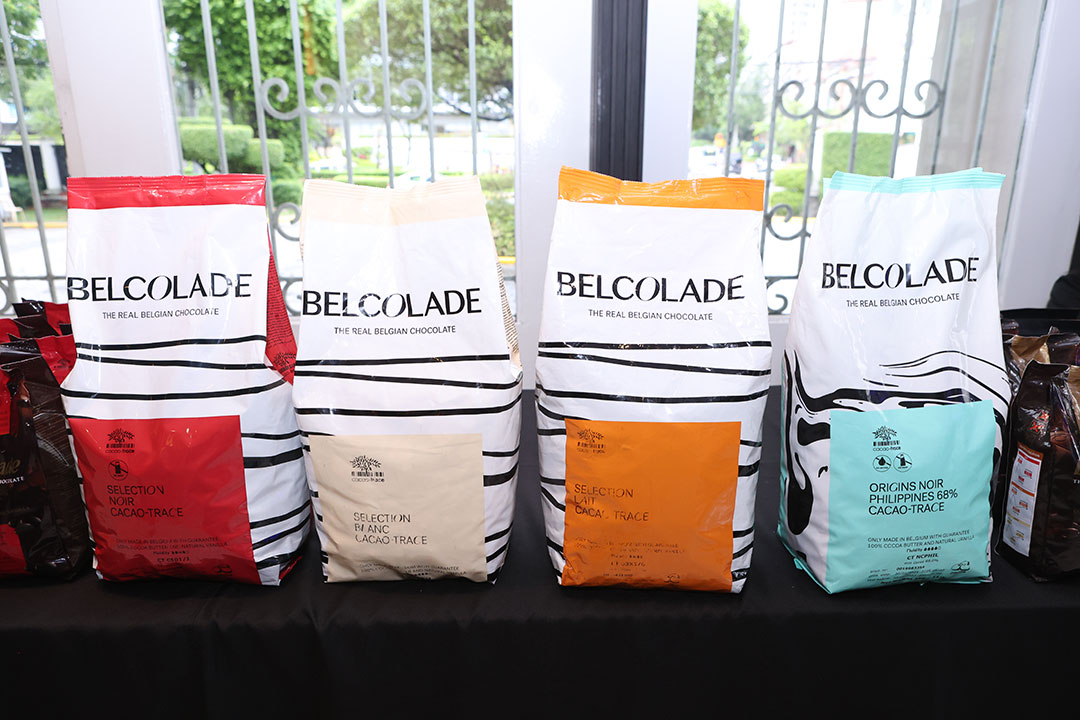
VARIOUS Belcolade Belgian Chocolates.

ENDERUN got a sweet treat on Sept. 25 with the launch of Belcolade Origins Noir Philippines 68% Cacao-Trace.

The beans are from Mindanao (specifically from Calinan, San Isidro, and Mati) but the beans are processed Belgian-style, ensuring the union of two disciplines in one bag. This is one of the first Belgian chocolates in the world to feature Philippine-grown cacao beans.

For the launch, the Belgian brand (from Belgian baking raw materials company Puratos) got chocolatier Christian Valdes of CMV Txokolat (related story: https://tinyurl.com/y86rsew7) to make truffles onstage. Mr. Valdes also concocted samplers — not his usual fare of pralines and bonbons, but savories and desserts, all using the 68% Belcolade Origins Noir Philippines 68% Cacao-Trace.

For the bites, Mr. Valdes made a Chocolate Beef Pares Tart (a beef stew with star anise), taking advantage of some of the spicier notes of the chocolate. This was followed by an Olive Tapenade layered with a dark chocolate ganache, then a Chocolate Tapa Taco (our favorite; reminiscent of Mexican mole sauce).

He also made a Lumpiang Champorado (a spring roll cum fritter filled this time with chocolate porridge with a fish floss) — we told him after the program that he should launch this as a product on its own. “We really wanted to really find these contrasting flavors that work well together,” he told BusinessWorld, though he admitted that in the past, he’d made some mistakes in executing savory chocolate dishes. He did mention a tablea adobo he once made, with the aid of a cacao vinegar. “There aren’t any boundaries. Chocolate can be sweet. It can be sour, spicy, savory. But you have to experiment.”

Bernard Poplimont, president and managing director for Puratos Philippines, described the terroir imparted by the Philippines to their chocolate: “It is a bit more floral than most of the cacao that you find in the area,” he told BusinessWorld. “A bit more hearty also, so through fermentation, we try to get those flavor notes more pronounced.”

Belcolade sources cacao from all over the world, from Latin America, to Africa, and Asia.

Speaking of breaking boundaries, he said that day in a speech, “We believe that chocolate should not only taste good, it should do good.”

On every bag of Belcolade Origins Noir Philippines 68% Cacao-Trace is the promise of the company’s Cacao-Trace program, which ensures that their cacao farmers receive fair compensation, as well as giving back a “chocolate bonus” through 10 euro cents given to the farmers for every kilo sold. Moreover, they have training and support programs for the farmers, and Puratos also has a baking school for the underprivileged.

“Without cacao farmers, we don’t have chocolate. As simple as that,” Mr. Poplimont told BusinessWorld.

He is aware of a video circulating from several years ago, where cacao farmers in the Ivory Coast tasted chocolate for the first time, despite being part of its supply chain for years. Mr. Poplimont doesn’t believe that should happen. Every two years they hold a Cacao Fiesta, where their farmers can partake of the fruits of their work, in the form of chocolate in snacks and drinks. “It doesn’t make sense to us: for farmers to produce cacao and then they don’t know what this product is going into, and why it’s so important for them to make cacao.” — Joseph L. Garcia

Why the Philippines must prepare for AI-driven data breaches

RAWPIXEL.COM-FREEPIK

By Ram Vaidyanathan

FILIPINOS love the internet. With 97.5 million people online, equivalent to 83.8% of the population, the Philippines ranks among the heaviest internet users in the world. Nearly all of these internet users (98.5%) access it through their mobile phones, spending close to nine hours online daily. About five of those hours are spent on mobile devices, with the remainder spent on desktops and tablets.

From social media posts and photos to professional updates, the data trail left behind is enormous. What many do not realize is that these seemingly harmless digital footprints, such as holiday albums, casual social media posts, status updates, or even job profiles, are increasingly being tapped to train artificial intelligence (AI) systems that now power businesses and applications worldwide.

And here lies the problem. Once data enters an AI model, users lose control over how it is used, meaning it can be replicated or even misused.

THE INTERNET NEVER FORGETS
The internet has a long memory, and everything is archived online.

All of this accumulated data, stretching back years, can now be used to train powerful machine-learning models. Disturbingly, the scope of what is being ingested is not always transparent.

Take a recent case uncovered by Proof News, a nonprofit newsroom. Its investigation revealed that some of the world’s largest AI companies had quietly harvested data from over 173,000 YouTube videos across 48,000 channels, despite explicit rules prohibiting this kind of extraction. Tech giants such as Anthropic, Nvidia, Apple, and Salesforce were all named in the report.

The volume of data that companies gather from us, and how they use it, is often buried deep in the fine print. Most people click accept without realizing just how much personal or behavioral information they are handing over.

LOCAL RULES, GLOBAL STAKES
In the Philippines, the Data Privacy Act of 2012 requires organizations to secure informed consent before processing personal data. This law, enforced by the National Privacy Commission (NPC), is clear about transparency, proportionality, and legitimate purpose.

To reinforce this, the NPC issued a 2024 Advisory on AI, clarifying that AI systems must uphold these same principles — data minimization, transparency, human oversight, and respect for user rights. Large-scale data handlers must also register with the NPC and appoint Data Protection Officers, with non-compliance punishable by fines of up to $90,000 per violation, or even imprisonment for serious offences.

Despite this strong regulatory framework, practice on the ground is lagging. A 2024 Cisco study revealed that 85% of Philippine organizations had already experienced AI-related cyber incidents, yet only 6% achieved a mature level of cybersecurity readiness.

EVERYDAY APPS, HIDDEN RISKS
AI training is not limited to obscure datasets in research labs. Many of the platforms Filipinos use daily and sometimes hourly are involved.

• ChatGPT – The Philippines ranks fourth globally in ChatGPT usage, according to the World Bank. But every question, prompt, or idea entered into the chatbot can be retained for model training unless users opt out.

• LinkedIn – With 19 million Filipino members as of 2025, LinkedIn is both a career tool and a data goldmine. The platform trains its AI on user activity to refine recommendations, but users can disable this if they wish.

• Quora and Facebook – Nearly 95% of Filipino internet users are active on Facebook, while Quora is widely used for knowledge sharing. Quora provides an opt-out option for AI training, while Facebook’s policies remain more complex.

• X (formerly Twitter) – With 9.29 million users in the Philippines, X uses data to feed its AI assistant, Grok. Opting out is tricky, requiring users to manually delete conversation histories.

WHY THESE RISKS MATTER FOR ENTERPRISES AND HOW TO RESPOND
As Filipino businesses adopt AI, the risks extend far beyond individual privacy. Sensitive internal information like product designs, client contracts, employee records, or confidential communications can inadvertently enter AI training datasets. Once this happens, data leakage or intellectual property loss becomes almost impossible to reverse.

The risks are serious. Intellectual property can be stolen, regulatory penalties imposed, reputations damaged, and, in extreme cases, national security compromised. At the same time, cybercriminals are becoming adept at targeting AI systems directly, hijacking or manipulating them to unlock access to critical assets.

The first step is awareness. Users should regularly review privacy settings, understand opt-out options, and stay informed about how platforms are handling their data. Simple actions like toggling off training permissions, deleting unnecessary histories, or limiting personal disclosures online go a long way.

For organizations, stronger internal governance is key. Policies should clearly define how employees can engage with AI tools, what data is permitted for use, and how interactions are logged. Cybersecurity teams must enforce identity and access controls, monitor AI-driven activity in real time, and audit compliance with national regulations.

TURNING RISK INTO RESILIENCE
The National Innovation Council’s working group, led by the Department of Science and Technology, is already laying the groundwork for a cohesive national AI strategy. Done right, AI could add P2.8 trillion annually to the economy by 2030.

This future depends on trust. Filipinos must know their data is secure, and enterprises must demonstrate that innovation will not come at the expense of privacy. The internet may never forget, but with vigilance, governance, and responsible AI practices, Philippine organizations can ensure that old or lingering data cannot be exploited by attackers in the future.


Ram Vaidyanathan is the chief IT security evangelist at ManageEngine.

Turkish Airlines widens the world

By Anna Isabel C. Sobrepeña

THE PHILIPPINES became part of the largest network of flight destinations when Turkish Airlines first flew out of Manila in 2015. This wide-reaching global connectivity has been recognized by a certification from the Guinness World Records. Today the Star Alliance member operates flights to 303 international destinations across six continents, the most than any other airline in the world. The domestic reach within the only country that straddles between Asia and Europe reaches 53 points of embarkation.

A decade since that inaugural flight from the Ninoy Aquino International Airport, the national flag carrier of Türkiye marked its anniversary, with Country Manager Huzeyfe Akhan using the occasion to share the strides from their beginnings in 2003 and the strategic plans leading up to their centennial in 2033.

TICKET TO ANYWHERE IN THE WORLD
Ten years after the Republic was declared in October 1923, Turkish Airlines took to the skies with the intent of becoming the most prestigious flag carrier. The strategic plan aimed for growth in capacity, passenger numbers, and destinations. Istanbul’s unique location straddling two continents gave the country a global connectivity advantage. And it grew through the decades.

Then in 2008 came its membership in the Star Alliance, the world’s largest airline network.

Today, Turkish Airlines operates flights to 356 destinations across 131 countries. This includes 53 domestic destinations within Türkiye, besides the 303 international airports across Europe, Asia, Africa, the Americas, Australia, and the Middle East.

GLOBAL AVIATION LEADER
Turkish Airlines, which was founded in 1933, is looking ahead to 2033 when the company will celebrate its centennial year. Sales Manager Joanne Santos provided a glimpse into the expansion developments during the gala celebration at Shangri-La at the Fort. Last year, they opened a route to Melbourne and Sydney, besides new routes to South America covering Santiago in Chile, Säo Paulo in Brazil, Buenos Aires in Argentina, Bogotá in Colombia, and Caracas in Venezuela. Seville in Spain is now also accessible from the Istanbul hub.

Ms. Santos noted that the Istanbul Airport is now operating three independent parallel runways that allow simultaneous takeoffs and landings. It is the first airport in Europe and only the second in the world to operate the groundbreaking infrastructure which significantly increases air traffic capacity, minimizes delays, while enhancing safety and operational efficiency. This facility services their fleet of modern, passenger-friendly aircraft that includes the Boeing 777-300ER, Airbus A350-900 and the Boeing 787-9 Dreamliner among others.

Mr. Akhan reported that from 490 aircraft last year, they are targeting 813 by 2033, Turkish Airlines’ centennial year. The bid to become the leading flight carrier includes increasing carried passenger numbers from 85.2 million to 171 million, international destinations to 345, and increasing their total income from $22.7 billion to $52 billion. “We aim to create $144-billion economic contribution globally with our win-win perspective.”

COMPLIMENTARY INTERNET ACCESS AND CITY TOUR
Enhancing the journey experience is the new Crystal Business Class Suite. Responding to passenger feedback, the onboard experience now includes this enhanced privacy space designed for business class travelers who are also provided unlimited internet access. Meanwhile, Economy class passengers who are members of the Miles&Smiles loyalty program are provided free unlimited messaging.

The airline offers a complimentary city tour for international passengers who have a layover of six to 24 hours in Istanbul. Eligible passengers can opt to experience the culture and history of Türkiye’s capital instead of waiting for their connecting flight at the airport. The program, Touristanbul, affords a visit to landmarks as the Blue Mosque, Hagia Sophia, and the Topkapi Palace free of charge. The service includes transfers to and from the airport, meals, a professional guide, and entrance to museums.

Besides Touristanbul, Turkish Airlines offers transit passengers a complimentary stay. The STOPOVER program provides complimentary accommodation in partner hotels for those who have a minimum 20-hour layover. Passengers flying in economy class can avail themselves of an overnight stay at a four-star hotel. Business class travelers are entitled to a two-night stay at a five-star hotel.

BEST AIRLINE AWARD
Besides the numbers, Mr. Akhan talked about some of their latest awards from Skytrax and the Airline Passenger Experience Association or APEX, mentioning the distinction of being recognized this year as Best Airline in Europe for the 9th time, having the Best Wi-Fi in Europe, Best Inflight Entertainment System in Europe, and a few more.

“We also plan to increase the number of international lounges, carry out cabin transformations and continue our digitalization processes to maintain a high level of customer experience.”

ALI directs P2.7B from AREIT share sale to land, office, residential projects

AYALALAND.COM

AYALA LAND, Inc. (ALI) has earmarked P2.7 billion from last year’s sale of 75 million shares in its real estate investment trust unit AREIT, Inc. for a Metro Manila land acquisition as well as office and residential projects.

“Following current regulations, Ayala Land intends to invest its net proceeds in one land acquisition in Metro Manila, one residential development, and one office development,” ALI said in a reinvestment plan submitted to the local bourse on Tuesday.

The proceeds came from a block sale transaction of 75 million AREIT shares in December last year, which raised about P2.76 billion.

According to the reinvestment plan, ALI is allocating P2.02 billion for the acquisition of a Metro Manila property.

The company has also earmarked P592.85 million for two office buildings in the 29-hectare Vertis North development in Quezon City. The 25- and 26-story buildings are expected to cater to business process outsourcing (BPO) tenants, it said.

Meanwhile, P148.06 million will go to Park Central Towers North & South, a two-tower residential development in Makati City.

“All disbursements for such projects are intended to be distributed within one year upon receipt of the proceeds from the sale of the AREIT shares,” ALI said.

The developer added it will prepare a progress report on the actual disbursements for the covered projects.

Last week, ALI said it had disbursed P2.7 billion raised from another sale of 75 million AREIT shares for separate hotel and residential developments.

ALI posted an 8% increase in first-half net income to P14.2 billion, while property development revenue inched up 0.77% to P52.3 billion.

On Wednesday, ALI shares rose by 0.21% or five centavos to close at P24.40 each, while AREIT shares gained 0.12% or five centavos to P43 apiece. — Beatriz Marie D. Cruz

Controlling a high budget deficit, reducing public debt

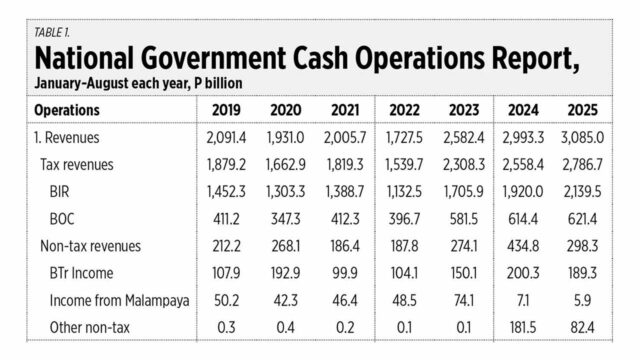
Last week the Bureau of the Treasury (BTr) released the cash operations report (COR) then the outstanding public debt for August. So here I have compared the date from January to August this year with the data in the same months in previous years, 2019 to 2024.

Revenues are slowing this year compared to 2024, with both the Bureau of Internal Revenue (BIR) and Bureau of Customs (BoC) under the Department of Finance (DoF) having marginal increases in collections. Good thing that non-tax revenues like mandatory remittances by government corporations and finance institutions like LandBank have significantly increased, P182 billion in 2024 and P82 billion in 2025, from almost zero in previous years.

Government spending continues to expand, led by the National Government (NG), local government units (LGUs), and interest payments. Our interest payments alone for the first seven months of the year kept rising, from an average of P1.2 billion/day in 2019 to P1.8 billion/day in 2023, to P2.4 billion/day in 2024, and P2.6 billion/day in 2025.

Our budget deficit has also been rising, from an average of P17.1 billion/month in 2019 to P104.6 billion/month in 2023 and P124.1 billion/month in 2025 (see Table 1).

A continued high budget deficit means rising borrowings and high public debt stock. Our outstanding debt has expanded significantly, from P7.94 trillion in August 2019 to P17.47 trillion in August 2025, more than double in just six years.

On top of that, government’s guaranteed debt in August this year was P346 billion. So the total debt — outstanding plus guaranteed — is P17.82 trillion, huge (see Table 2).

We need a vigorous revenue mobilization even without raising any existing tax rates. It is good that the Vice-Chair of the House Committee on Appropriations, Representative Bella Vanessa Suansing, recognized the DoF’s role in advancing economic growth and safeguarding economic security and prosperity during the House plenary for the DoF’s proposed 2026 budget on Sept. 23.

Yes, Finance Secretary Ralph Recto takes seriously the high revenue challenge every year. Among his important initiatives was raising the mandatory remittances of government corporations and finance institutions to the National Treasury, from 50% to 75% of their net earnings the previous year.

Meanwhile government spending must be controlled. Or spending must be as transparent and accountable as possible to minimize waste and corruption as we see in the ongoing flood control scandal involving both the executive branch, especially the Department of Public Works and Highways, and the legislative branch, both the Senate and House of Representatives. Budget Secretary Amenah Pangandaman’s Open Government Partnership (OGP) program, and the recently signed Government Optimization Act of 2025 or RA 12231, are steps in this direction.

Our public debt cannot go on endlessly rising. It has to stabilize sometime, then work a way towards decline. We should aspire to have sustained revenues; creating new taxes can be justified if there is corresponding removal or relaxation of an existing tax somewhere, then control spending.

We should aspire to have a balanced budget if not a budget surplus in years where there is no economic or social crisis. Then we will have the leeway to enter another budget deficit and contract high borrowings on crisis years someday.


Bienvenido S. Oplas, Jr. is the president of Bienvenido S. Oplas, Jr. Research Consultancy Services, and Minimal Government Thinkers. He is an international fellow of the Tholos Foundation.

minimalgovernment@gmail.com