Home Blog Page 4138

Japan’s top court set to rule on sterilization requirement for gender change

 – Japan’s top court is set to rule on Wednesday on the validity of a legal clause that requires people who want to legally change their gender to undergo sterilization surgery.

Several international bodies including the European Court of Human Rights, the World Professional Association for Transgender Health and United Nations experts and have said such requirements are discriminatory and infringe upon human rights.

However, some local lawmakers and women’s rights groups in socially conservative Japan say a ruling that challenges the law would sow confusion and undermine women’s rights.

Japan’s Supreme Court threw out a similar legal challenge in 2019. However, a local family court last week ruled in favor of a man who requested having his gender legally changed without surgery in what rights groups called a landmark case.

“For anyone, having their gender legally recognized is an extremely fundamental human right, so being required to undergo sterilization to enjoy that right is a significant violation of human rights,” said Kanae Doi, Japan Director at Human Rights Watch.

Japan’s existing law states people who want to change gender must present a diagnosis of gender dysphoria and meet five requirements.

Those requirements are: being at least 18 years of age; not being married; not having underage children; having genital organs that resemble those of the opposite gender; and having no reproductive glands or ones that have permanently lost their function.

The case before the Court‘s 15 justices on Wednesday was brought by an unnamed plaintiff, who has been identified only as a transgender woman under the age of 50.

Her lawyers have said that the requirements violate their client’s constitutional right to pursue happiness and live without discrimination, and pose significant physical pain and financial burden to transgender people, according to local media reports.

While many countries have moved to repeal laws requiring mandatory sterilization to legally change gender, transgender rights remain a controversial topic in Japan.

A petition organized by seven pro-surgery requirement groups collected more than 20,000 signatures as of Tuesday.

Protect the Definition of Women, a group that supports upholding the surgery requirement, submitted a separate petition to the Supreme Court last week, saying that dropping the requirement would “significantly violate women’s rights and dignity”.

Last month, a group of lawmakers from the ruling Liberal Democratic Party also issued a statement saying any ruling that deemed the law unconstitutional would sow confusion. – Reuters

Tesla aware of Autopilot steering malfunction before fatal crash -lawyer

MILAN CSIZMADIA-UNSPLASH

An attorney suing Tesla over a fatal accident cited an internal safety analysis conducted by the company that showed it knew about a steering malfunction in its Autopilot driver assistant feature about two years earlier.

The disclosure came during closing arguments on Tuesday in a California state court in the first U.S. trial over allegations that Autopilot led to a death. The plaintiffs are seeking a combined $400 million jury award, excluding punitive damages. The trial’s outcome could help shape similar cases across the country.

The civil lawsuit alleges the Autopilot system caused owner Micah Lee’s Model 3 to suddenly veer off a highway east of Los Angeles at 65 miles per hour (105 km per hour), strike a palm tree and burst into flames, all in the span of seconds.

The 2019 crash killed Lee and seriously injured his two passengers, including a then-8-year-old boy who was disemboweled, court documents show. The lawsuit, filed against Tesla by the passengers, claims that Autopilot was defective.

Tesla has denied liability, saying Lee consumed alcohol before getting behind the wheel. The electric-vehicle maker also claims it was unclear whether Autopilot was engaged at the time of the crash.

Tesla has been testing and rolling out its Autopilot and more advanced Full Self-Driving (FSD) system, which Chief Executive Elon Musk has touted as crucial to his company’s future but which has drawn regulatory and legal scrutiny.

Jonathan Michaels, who represents the passengers, showed jurors a 2017 internal Tesla safety analysis identifying “incorrect steering command” as a defect, involving an “excessive” steering wheel angle.

“They predicted this was going to happen. They knew about it. They named it,” Michaels said. Tesla developed a protocol to deal with customers who experienced it, he said, and instructed employees to accept no liability or responsibility for the problem.

Tesla attorney Michael Carey said the safety analysis did not identify a defect, but rather was intended to help the company address any issue that could theoretically arise with the vehicleThe automaker subsequently engineered a system that prevents Autopilot from executing the turn which caused the crash.

That safety system, Carey said, “is a brick wall standing in the way of plaintiffs’ claim,” noting that no other Tesla car had behaved as the vehicle did in this crash.

Michaels argued Tesla released Autopilot in an experimental stage because the company desperately needed to increase market share.

“They had no regard for the loss of life,” he said.

Carey countered that the simplest explanation for the crash was human error, and asked jurors to resist awarding damages solely because of the victims’ severe injuries.

“Empathy is a real thing, we’re not saying its not,” Carey said. “But it does not make cars defective.” – Reuters

Philippines’ supply-side inflation needs no monetary response — NEDA

OFFICIALGAZETTE.GOV.PH

Inflation in the Philippines is driven by supply-side factors, and does not warrant a monetary policy response, National Economic and Development Authority (NEDA) Secretary Arsenio M. Balisacan said on Wednesday.

“I think that the source of inflation is the supply side and not demand side that requires a monetary policy cure,” Mr. Balisacan told reporters.

Mr. Balisacan said he is hopeful of improving inflation numbers in the coming months, and that third-quarter economic growth was likely better versus a year ago as the government addresses underspending.

Mr. Balisacan, who is not a member of the central bank’s policymaking monetary board, earlier this month said raising interest rates further ” can hurt ” the economy and consumers.

The Philippine central bank is considering an off-cycle hike in its benchmark rate, as early as Thursday, before its regular rate-setting meeting on Nov. 16, to anchor inflation expectations. — Reuters

An exclusive look at Kinetix +, the Philippines’ first luxury boutique gym

Kinetix +’s doors were opened to an invite-only Media and VIP launch on Oct. 18, 2023. Kinetix + is the newest training facility in Makati and the 1st luxury boutique gym in the Philippines, dedicated to those who are serious about keeping their bodies strong. Around noon, guests began to arrive, and they were greeted by the knowledgeable and cordial coaches of Kinetix +. They were given a guided tour of the entire 900-square-meter gym while walking on the extensive artificial grass turf, and they had the privilege to try all of the gym’s equipment and were shown the recovery rooms and services offered.

One of the highlights of the Kinetix + Media and VIP launch is the brief program designed to formally welcome everyone present at the fitness center. Liza Guillon was the emcee for the entire segment held at the center of the gym to formally welcome the visitors. After being introduced, Kinetix + representatives Marlon Lugue, Head Coach and one of the co-founders of Kinetix +; and Luis Gatmaytan, Administrative Director and Head of the Kinetix +’s Recovery Lab, were given the opportunity to answer questions and provide additional information about the fitness facility. Iza Arcilla, the General Manager of Greenbelt and The Shops at the Ayala Triangle Gardens, gave her closing remarks and officially welcomed Kinetix + to The Shops. Abe L. Orobia, an artist who was commissioned to create works that would become permanent fixtures in the gym and perfectly match its overall style, was also recognized in the program. After the brief segment, Kinetix +-supported athletes showcased their years of training and conditioning through a powerlifting exhibition.

The Media and VIP launch of Kinetix + garnered significant attendance from individuals of diverse professional backgrounds, including business professionals, athletes, and personalities who prioritize their holistic well-being. Notable attendees included former basketball player and TV host Chris Tiu accompanied by his wife Clarisse Tiu, TV hosts Paolo Abrera and Lyn Ching, entrepreneur Marco Lobregat, actor Adrian Alandy, athlete and host Vince Velasco, fitness enthusiasts and digital creators Janina Manipol and Joanne Villablanca, architect Jason Buensalido, and UAAP Executive Director Atty. Rebo Saguisag, among others. Attendees were also provided with a diverse selection of nutritious and delicious snacks, courtesy of Nuthera | Nutrition Therapy.

The recent opening of Kinetix + establishes it as a prominent fitness facility, attracting those committed to pursuing a better, stronger, and physically engaged way of life.

ABOUT KINETIX +

Kinetix + (Plus) is the Philippines’ first luxury boutique gym, a new haven for those committed on pursuing a stronger overall self. Located at Level 3, Shops at Ayala Triangle Gardens, Makati. Kinetix +’s goal of providing the best service for its clients will include a strong emphasis on exclusivity. The upscale boutique gym features cutting-edge gym equipment, including the Biostrength line machines, which are AI-driven and patented by NASA. Kinetix + is the first in the Philippines and just the second in Asia to house these Biostrength line machines. Kinetix + also contain bespoke gym equipment, from racks to plates. Kinetix + strictly only takes 250 members so that the client-to-coach ratio would be quite close, allowing for a more focused fitness training program. The gym has over 900 square meters of area, which can easily handle the gym’s select clientele. The fitness facility prides itself on its meticulous attention to detail, including various elements such as lighting, sound, and smells, with the aim of optimizing clients’ workout experience and promoting relaxation throughout their time at the gym. Kinetix + also has its own Recovery Lab that features services like the Exercise with Oxygen Therapy or EWOT, ice bath therapy, infrared and red-light therapy, and infrared dry sauna to name a few. For more information, follow Kinetix + on Facebook (https://www.facebook.com/kinetixplus) and Instagram (https://www.instagram.com/kinetixplus). You can also visit their website at www.kinetixplus.com.


Spotlight is BusinessWorld’s sponsored section that allows advertisers to amplify their brand and connect with BusinessWorld’s audience by enabling them to publish their stories directly on the BusinessWorld website. For more information, send an email to online@bworldonline.com.

Join us on Viber at https://bit.ly/3hv6bLA to get more updates and subscribe to BusinessWorld’s titles and get exclusive content through www.bworld-x.com.

Globe and Fine Dining Club Philippines launch Gourmet Giving Series 

Metro Manila's fine dining restaurants join the call to #UniteForHapag! Globe announces Gourmet Giving Series in partnership with the Fine Dining Club Philippines Facebook community to support the Hapag Movement. Pictured (L-R) are Yoly Crisanto, Globe Chief Sustainability and Corporate Communications Officer; Carlo Lorenzana of La Cabrera Manila; Chef Luis Chikiamco of Flame by Discovery Primea; Chef Albert Mendoza of Tsoko Asador; Chef Patrick Go of Your Local; Chef Josh Boutwood of Bistro Group's premium restaurants (Ember, Helm, and The Test Kitchen); Chef Jorn Fonseca of Tiago's Restaurant; Chef Carlos Garcia of The Black Pig; and Cynthia Mangahas, Globe Director for Customer Growth and Experience.

The culinary world joins the Hapag Movement

Globe, in partnership with Facebook Online Community Fine Dining Club Philippines, proudly introduces the “Gourmet Giving Series: A Fine Dining Thanksgiving Experience for the Hapag Movement.” This culinary venture brings together Metro Manila’s hottest restaurants, each pledging a portion of their proceeds to support supplementary feeding and livelihood training initiatives for Filipino families experiencing involuntary hunger.

As the holiday season approaches, the Gourmet Giving Series taps into the spirit of Thanksgiving, embodying the essence of gourmet as a means of giving back. Chefs and restaurants will bring together their talents and influence for a noble cause, while patrons can enjoy an epicurean culinary journey and support The Hapag Movement fundraiser events.

Participating establishments include A-list Filipino restaurants: Alegria Manila, The Black Pig, Chef Jessie Rockwell Club, Ember, Flame by Discovery Primea, Gallery by Chele, Helm, La Cabrera, The Test Kitchen, Tiago’s Restaurant, Txoko Asador, and Your Local. Every venue promises distinctive offerings, from special Hapag Movement set menus to exclusive holiday previews.

“With the Gourmet Giving Series, we’re channeling Filipinos’ love for food and sharing meals together into meaningful avenues of giving. We are excited and grateful to have some of the best Filipino restaurants and chefs as partners in our endeavor,” shared Yoly Crisanto, Chief Sustainability and Communications Officer at Globe.  “Globe is not only a service provider. We are catalysts for change, forging pathways that seamlessly link our customers to opportunities where they can make a genuine difference and leave a lasting impact.”

RG Orense, Globe Digital and Social Strategy Head, explained, “We are using the power of the social media community to help transform and uplift the lives of The Hapag Movement beneficiaries. We believe that engaging with Facebook’s Fine Dining Club Philippines is leveraging the platform’s passion for food to also make a purposeful difference.”

Globe Platinum customers are in for a treat with exclusive priority booking access through their dedicated lifestyle concierge exclusively for Globe Platinum and Fine Dining Club Philippines members from Oct. 24 to 28. Special treats also await other Globe mobile and broadband customers who avail of the Hapag Movement tasting menus from Nov. 20 to 30.


“Through the Gourmet Series, we hope to unlock meaningful, memorable, and sought-after dining experiences for our customers with this food offering. By partnering with some of Metro Manila’s premier restaurants, Globe delights customers to dine in their favorite establishments while supporting a movement for social good,” said Darius Delgado, Head of Globe’s Consumer Mobile Business.

Fine Dining Club Philippines, a vibrant community of over 23,300 culinary enthusiasts, has been instrumental in fostering unique dining partnerships and events, making this collaboration with Globe a perfect pairing.

The event builds on the momentum of Globe’s Longest Hapag series, which bridged World Hunger Day to World Food Day and has mounted a number of food-driven fundraisers to gain support for the Hapag Movement.

Since its launch in August last year, the Hapag Movement has already raised P21.5 million, impacting close to 70,000 Filipinos through supplemental feeding and livelihood training.

With the Gourmet Giving Series, Globe further widens the ecosystem of support for the Hapag Movement, leveraging fine dining as a focal point to inch closer to its goal of transforming the lives of 500,000 Filipinos facing involuntary hunger.

To learn more about Globe, visit https://www.globe.com.ph/.


Spotlight is BusinessWorld’s sponsored section that allows advertisers to amplify their brand and connect with BusinessWorld’s audience by enabling them to publish their stories directly on the BusinessWorld website. For more information, send an email to online@bworldonline.com.

Join us on Viber at https://bit.ly/3hv6bLA to get more updates and subscribe to BusinessWorld’s titles and get exclusive content through www.bworld-x.com.

Weighing existing risks in the Philippine market

Photo from gloverbh222 / pixabay

Risk management is one of the most basic fundamentals of financial literacy. It means that, no matter the investment, there should always be contingencies for any unforeseen events. No one will ever know what life throws your way, after all.

This goes for both the individual and the enterprise level. Just as any person should have some measure of security to protect against financial emergencies, whether through insurance or otherwise, businesses are expected to take into account potential risks and concerns when devising their strategies.

Doing business in the Philippines is a double-edged sword in that regard. On the one hand, even as the country records the slowest growth it has seen in almost 12 years in the second quarter of 2023, it is still poised to outpace many of its neighbors in Southeast Asia.

According to the World Bank, despite recently lowering its forecast for the Philippines from 6.0% to 5.6%, the Philippine economy is still expected to grow faster than Cambodia (5.5%), Indonesia (5%), Vietnam (4.7%), Malaysia (3.9%), Laos (3.7%), Thailand (3.4%), and Myanmar (3%).

National Economic and Development Authority Secretary Arsenio M. Balisacan is even optimistic the country can achieve the lower end of its 6% to 7% target growth range, provided the government spending ramps up for the rest of the year.

On the other hand, the Philippines is seemingly beset on all sides by risk and conflict. The ASEAN+3 Macroeconomic Research Office (AMRO), an international organization aiming to secure the macroeconomic and financial resilience and stability of the ASEAN+3 region, identified several immediate and long-term risks that may hinder the country’s growth moving forward.

In a preliminary assessment made by AMRO during its Annual Consultation Visit to the Philippines from Aug. 29 to Sept. 8, it found that such risks include: high inflation, especially due to local supply shocks in the food sector; economic slowdown in major trading partners and volatility in the global financial market; the scarring effects of the pandemic; the pace of infrastructure development; geopolitical risks; and the economic losses from natural disasters, which are being exacerbated by climate change.

Data released by the Philippine Statistics Authority put inflation at 6.1% in September, rising for the second month in a row. Inflation was recorded at 5.3% in August, changing course from the downward trend since the start of the year.

Inflation has averaged 6.6% so far this year, well outside the government’s 2%-4% goal range. January’s 8.7% rate is still the highest of the year.

Photo from graphicnode / unsplash

According to the PSA, the rise in September’s inflation was primarily due to food and non-alcoholic beverages, more specifically cereals and cereal goods (14.1%). Because rice is weighed more heavily in the commodities basket, rice’s price volatility has a greater impact on total inflation rates.

Inflation in rice reached a 14-year high of 17.9% in September, despite President Ferdinand Marcos Jr.’s determination to enforce price restrictions on rice. This measure did not make much of an impact as, according to the PSA, most of the regular-milled and well-milled rice varieties observed in September did not adhere to the price limitations.

Fuel price increases also contributed to the inflationary trend. Gas prices have risen steadily throughout the month of September that the government has released P2.95 billion to subsidize fuel for public utility vehicles.

Moreover, jeepney tickets are increasing by P1 across the country. Both the higher rates for commuters and the indirect raising of expenses for Filipinos who utilize jeepneys as a mode of transportation might push inflation higher in the coming months.

Meanwhile, the Philippines continues to suffer from the adverse effects of climate change, the most recent of which was Typhoon Jenny earlier this month, with winds reaching up to 89 to 117 kilometers per hour, and posing significant threat to life and property.

In 2022, worsening tropical cyclones caused around P25.03 billion worth of damages, according to Statista. PAGASA expects four to seven tropical cyclones to form within or enter Philippine territory from October this year to March 2024.

Opportunities amid uncertainty

Yet, as mentioned before, the Philippines is in a much more favorable position to weather risks than others. Finance Secretary Benjamin E. Diokno, for instance, said that the Philippine economy would be less affected by the economic slowdown of China, despite such a slowdown dampening global trade and exerting downward pressure on the country’s goods and service exports.

“The Philippines is expected to be less affected by China’s slower economic growth given that the potential slowdown in exports could be partially mitigated by the demand from our large domestic market,” he said during the ASEAN Roundtable at the World Bank-International Monetary Fund (IMF) Annual Meetings in Marrakech, Morocco on Oct. 11.

Moreover, infrastructure spending is expected to ramp up in the fourth quarter of 2023 to boost the local economy. State spending soared 65.8% in August as the government ramped up the implementation of projects.

In its latest National Government (NG) disbursement report, the Department of Budget and Management (DBM) said infrastructure and other capital outlays jumped to P122.1 billion in August from P73.7 billion in the same month a year ago. Month-on-month, infrastructure spending also rose by 10% from P111 billion in July.

“This was largely attributed to the disbursements made by the Department of Public Works and Highways (DPWH) for its completed projects nationwide, such as national roads and bridges, infrastructure projects, flood control projects, convergence programs, and payment of right-of-way claims,” the DBM said.

Of course, much more needs to be done to secure the Philippines’ economic outlook over the medium to long term. Particularly, as the country recovers from the scars left by the pandemic and moves into a future that is threatened by external risks like climate change and geopolitical conflict, it will be necessary to invest in and create the foundations for sustainable economic growth. — Bjorn Biel M. Beltran

Off-cycle rate hike likely this week

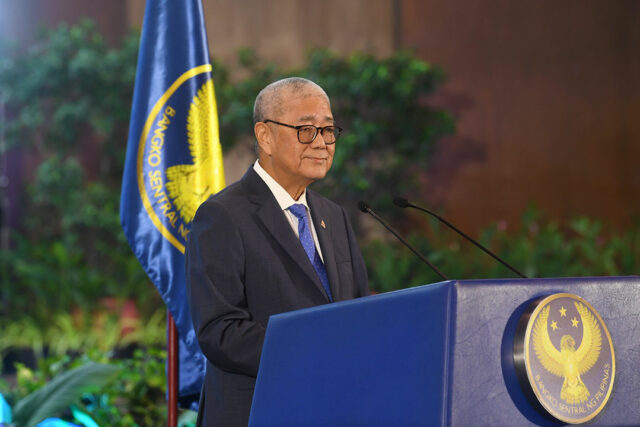
BANGKO SENTRAL ng Pilipinas Governor Eli M. Remolona, Jr. — BANGKO SENTRAL NG PILIPINAS

By Keisha B. Ta-asan, Reporter

THE BANGKO SENTRAL ng Pilipinas (BSP) may deliver an off-cycle rate hike as early as Thursday this week, its governor said on Tuesday.

BSP Governor Eli M. Remolona, Jr. on Tuesday said that an off-cycle interest rate hike is “on the table at the moment.”

“If the data say inflation will go up very significantly and there’s a risk of affecting inflationary expectations, then we may go for an off-cycle hike as early as this Thursday, or maybe next week,” he told reporters on the sidelines of the BSP’s Digital Financial Inclusion Awards.

Earlier this month, Mr. Remolona said he is not ruling out a 25-basis-point (bp) interest rate increase at the Monetary Board’s Nov. 16 policy-setting meeting, after inflation accelerated for a second straight month in September. He also noted that high interest rates have not affected the Philippines’ growth outlook so far.

The Monetary Board has raised borrowing costs by 425 bps from May 2022 to March 2023, bringing the benchmark rate to a near 16-year high of 6.25%.

However, economic managers have warned against further rate hikes, as inflation is being driven by supply-side factors and core inflation has slowed in recent months.

National Economic and Development Authority Secretary Arsenio M. Balisacan earlier this month said further monetary tightening could hurt the economy and consumers who are already struggling with high inflation.

Finance Secretary Benjamin E. Diokno has also said the BSP has “done enough” policy tightening to tame inflation, but future interest rate moves would remain data dependent.

The BSP sees average inflation settling at 5.8% in 2023, before moderating to 3.5% in 2024 and 3.4% in 2025.

However, results of the BSP’s survey of external forecasters in September showed the average inflation forecast of analysts for 2023 went up to 5.9% from just 5.5% in the August survey. Economists’ mean inflation forecast for 2024 and 2025 also climbed to 3.7% (from 3.5% previously) and 3.5% (from 3.4%), respectively.

ING Bank N.V. Manila Senior Economist Nicholas Antonio T. Mapa in an e-mail said it is highly likely that the BSP will raise interest rates this week given Mr. Remolona’s hawkish stance. 

“It appears he is preparing the market for a hike and market participants appear ready for such a move. BSP has reiterated its commitment to combat inflation and we believe a rate hike at this stage would no longer be to quell inflation for 2023 but rather to safeguard the 2024 inflation path,” he said. 

Mr. Mapa said market players are no longer looking at short-term price pressures, but at potential upside risks to the inflation outlook next year.

“Thus, the market is prepared for further tightening, whether it be this Thursday or next. There will be limited reaction to this off-cycle meeting,” he added.

Security Bank Corp. Chief Economist Robert Dan J. Roces in a Viber message said the month-on-month October inflation rate will be crucial. 

“To get above the previous rate of 6.1%, month on month will need to be steady at the last two months’ 1%. What this means is that inflation remains persistent and the base effects from the upticks last year will not be enough to pull the readings down, thus pure inflation uptrend,” he said. 

Mr. Roces added that the BSP would want to get ahead of this, especially amid geopolitical tensions in the Middle East.

Headline inflation rose for a second straight month to 6.1% in September from 5.3% in August. It marked the 18th straight month that inflation exceeded the central bank’s 2-4% target. Year to date, inflation averaged 6.6%.

The local statistics agency will release October inflation data on Nov. 7.

PHL pins hopes on ethanol imports to lower gas prices

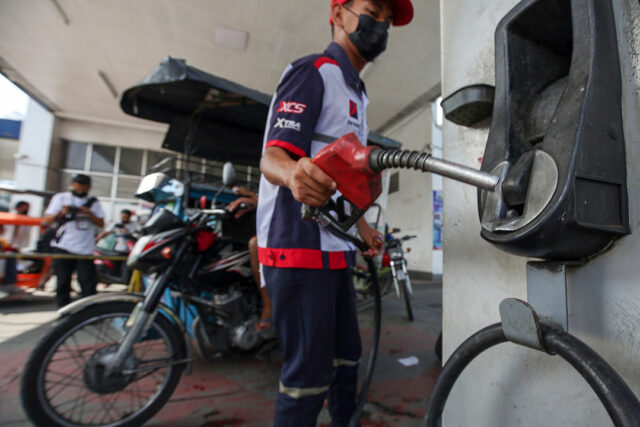
An attendant fills up a motorcycle at a gasoline station in Tondo, Manila. — PHILIPPINE STAR/KRIZ JOHN ROSALES

By Kyle Aristophere T. Atienza, Reporter

THE PHILIPPINE government is looking to lower gasoline prices by urging fuel retailers to increase the ethanol blend to 20% on a voluntary basis, from the current mandatory 10%, the Department of Energy (DoE) said.

Increasing the ethanol blend — which the government considers a “price mitigation measure” — could cut gasoline prices by as much as P1 per liter, Energy Secretary Raphael P.M. Lotilla said at a Palace briefing.

“Right now, the price of gasoline without ethanol is around P56.89, then it will result in a price differential of… 28 centavos or up to even P1, depending on, of course, the prices,” he said.

Mr. Lotilla said the government will focus on ethanol imports, which are “cheaper” than the local ethanol.

“The local ethanol price per liter is currently around P79.49, which is higher than the imported ethanol which is at P41.44,” he said.

Local production of ethanol only supports 48% of the current 10% blend, he added, “therefore, the utilization of the highest share of imported ethanol will result in lower pump prices because of the increased blend.”

Mr. Lotilla said they have discussed the proposal with local oil companies and hopes to get approval from the Bioefuels Board by end-2023.

This comes after fuel retailers on Tuesday raised pump prices by P0.95 for gasoline and diesel by P1.30 per liter.

As of Oct. 24, year-to-date price adjustments stood at P12.25 per liter for gasoline, P11.70 per liter for diesel, and P7.74 per liter for kerosene.

Terry L. Ridon, a public investment analyst, said the impact of a higher ethanol blend on fuel prices will still be dependent on the global prices of molasses and sugarcane, which are among the major components of the Philippines’ bioethanol mix.

“If global prices of these commodities significantly increase in the future, it might still not result in lower fuel prices despite a higher ethanol blend,” he said in a Facebook Messenger chat.

Mr. Ridon said the local bioethanol sector should show that it can deliver supply for the mandated blend at 10% “before any discussions on increasing the percentage are entertained.”

“The sector has recently been calling on the President to allow molasses importation during the non-milling season. It is our position that importing biofuel feedstock contradicts with the objectives of biofuel blending to support our local agricultural sector,” he said.

Mr. Ridon said the move would only benefit biofuel traders “interested in lucrative importation contracts, with no certainty of impact on lowering fuel prices.”

Bienvenido S. Oplas, Jr, president of Minimal Government Thinkers, said wide use of ethanol and other biofuels could lead to higher food inflation by “reducing the supply of food for people and animal feeds, which are also food for people.”

“Overall, I am not in favor of agricultural crops being used to feed cars and trucks, instead of feeding people and livestock,” he said in a Viber message.

Should the government pursue the blend increase, “the mix should be voluntary, not mandatory.”

“If the voluntary 20% will bring down oil prices compared to the mandatory 10%, maybe good. But it will have an indirect effect on food prices,” Mr. Oplas said.

Meanwhile, Mr. Lotilla said the government is also considering increasing the coco methyl ester (CME) or coco biodiesel blend to 3% from 2% — which can be “accommodated by the supply of feed stock given the total coconut production at this time.”

“The entire country is at 15 billion coconuts. For the additional 1% blend, we need only an additional 2.6 billion nuts,” he said.

The possible blend increase could bring down the price of CME because there will be a bigger market for the product, he noted.

The Energy department expects the pure diesel landed price to be at parity with the price of CME per liter, he said.

Jun Lao, managing director at Chemrez, Inc., said the local “capacities” for producing CME — an important content of biodiesel — are “ready to support the increase in mandate.”

“We expect many benefits to come with a B3 mandate: mileage improvement; lower pollution; import substitution and value-adding of coconut oil,” he said. “These benefits will come with no practical cost to the government yet have extensive benefits for the country.”

During the Tuesday meeting, Mr. Marcos also ordered the shortening of the “trigger period” for the provision of fuel subsidies for public utility vehicle drivers to just one month from three months, Mr. Lotilla said.

Under the existing fuel subsidy program, which was included in the 2023 national budget law, funds will be released when the average price of Dubai crude oil for three months reaches $80 per barrel.

The Energy chief said the President also ordered the “simplification” of requirements for accessing the subsidy.

The subsidy program has a budget of P3 billion under the 2023 national budget, which covers an estimated 1.36 million public utility vehicle drivers.

Mr. Marcos has also ordered government agencies to boost efforts for the “electrification” of the transport sector, “particularly mass transport and light cargo vehicles,” Mr. Lotilla added.

The President cited the need to prepare the economy “for the eventual manufacture of electric vehicles,” which will require the participation of the local mining sector, he said.

“[The mining sector] will produce minerals needed for the production of batteries and other components needed for EVs,” Mr. Lotilla said.


Japanese businesses concerned over PHL traffic, logistics issues

Motorists are seen stuck in traffic along the southbound lane of the Southern Luzon Expressway (SLEX) in this file photo. — PHILIPPINE STAR/MIGUEL DE GUZMAN

JAPANESE BUSINESSES are concerned about traffic congestion and inadequate logistics infrastructure in the Philippines, which they say are hampering more investments.

Takashi Ueno, chairman of the board and chief executive officer of Uyeno Transtech Ltd., said the Philippine government should enact policies to improve the business environment, particularly to address traffic congestion.

“Compared to 20 years ago, traffic congestion has not improved much,” he said in a presentation during the Philippine Chamber of Commerce and Industry (PCCI) and Japan Chamber of Commerce and Industry (JCCI) Economic Dialogue on Tuesday.

Mr. Ueno, who spoke through a translator, said the Philippines can address traffic congestion by improving public transportation and implementing “appropriate traffic regulations for private cars.”

He also suggested the introduction of “mechanisms for companies to promote the introduction of renewable energy.”

For his part, PCCI President George T. Barcelon said they are urging the government to consider measures to decongest Metro Manila.

“It’s about time that we move out some of the key sectors outside of Metro Manila. Other countries are doing it (like) Indonesia… We’re not (going to) solve (traffic) in any way, no matter how innovative we are. The more Skyways that we build they’re still landing on the same place, so it doesn’t help,” Mr. Barcelon told reporters on the sidelines of the event.

According to news reports, Indonesia is planning to relocate its capital from Jakarta to Nusantara by 2045

Meanwhile, Hiroshi Oshima, president of Sembikiya Fruit Co. Ltd., said the company has faced logistics problems when importing pineapples and bananas from the Philippines.

“We also need stable supply, so we would like the Philippines to improve logistics infrastructure to help optimize logistics distribution,” he said through a translator at the same event.

Mr. Oshima noted that Philippine bananas are not being “stably imported to Japan,” which is why bananas from Ecuador are getting more market share. He said the Philippines should improve the varieties of fruit that are more resilient to climate change.

Trade Undersecretary and Board of Investments (BoI) Managing Head Ceferino S. Rodolfo said they recognize the need to modernize existing agricultural plantations, particularly for bananas.

“The BoI is now finalizing a policy for modernization of agricultural plantations,” he said, adding it will be out before the end of November.

PCCI’s Mr. Barcelon said the Philippines can potentially increase fruit exports to Japan.

“The agriculture (sector) in Japan has been facing some challenges because of their aging population. It will be good if they look into the Philippines as an investment area wherein through their innovation and farming equipment they can improve our productivity,” he added.

Messrs. Ueno and Oshima are part of the JCCI economic mission to the Philippines, which consists of 70 Japanese businessmen representing the top management of key companies.

The Japanese economic mission led by JCCI Chair Ken Kobayashi paid a courtesy call with President Ferdinand R. Marcos, Jr. on Monday evening.

A Palace statement quoted Mr. Kobayashi as saying the Philippines’ “stable and high-level economic growth in recent years have attracted Japanese investors to develop their operations in anticipation of increased workforce population as well as domestic demand.”

“The Socioeconomic 8-Point Agenda that you have announced, Mr. President, prioritizes social security and the development of human capital. Also, it establishes the investment promotion, strengthening of digital infrastructure, the promotion of the green economy, and so forth, through which you are aiming at expanding and creating jobs,” Mr. Kobayashi said. “And it is expected that in these fields that we can see the further promotion of the cooperation between our two countries.”

JCCI is described as the largest business organization in Japan with 1.25-million member companies. — J.I.D.Tabile

Filipinos with bank accounts rise to 65% of population

THE SHARE of Filipinos with bank accounts reached 65% of the adult population in 2022, the Bangko Sentral ng Pilipinas (BSP) chief said on Tuesday.   

“The share of digital payment transactions reached 42% in 2022; account ownership was 56% in 2021; and 65% of households had accounts in 2022,” BSP Governor Eli M. Remolona, Jr. said in his opening speech during the BSP’s Digital Financial Inclusion Awards.   

“Yes, we are gaining ground, but there is still so much more that we can do,” he added.

Under its Digital Payments Transformation Roadmap, the BSP aims to digitize 50% of total retail transactions and onboard at least 70% of Filipino adults to the financial system by the end of this year. 

In 2022, the share of digital payments in total retail transactions increased to 42.1% from 30.3% in 2021.

Meanwhile, results of the BSP’s 2021 Financial Inclusion Survey showed that the banked population was at about 56% of all adults in 2021, up from just 29% in 2019. This is about 22 million Filipinos who have gained access to formal financial accounts between 2019 and 2021.   

The increase was driven by the accelerated growth in digital payments, the central bank earlier said. Among the banked population, 36% had electronic money accounts in 2021, up from the 8% share in 2019.

According to Mr. Remolona, the central bank supports and promotes microfinance institutions (MFIs) and microentrepreneurs who successfully adopted digitalization to boost efficiencies and scale up customer services.     

On Tuesday, the BSP recognized twenty MFIs and micro firms for their achievements in digitalization during the Digital Financial Inclusions Awards (DFIA).   

Citi Philippines Chief Executive Officer and Country Head Paul A. Favila said the digital revolution is transforming the finance industry and is pushing the microfinance sector to adapt.   

“To foster sustainable financial inclusion, the microfinance community will need to embrace new technologies and reconsider their business models,” Mr. Favila said.   

Mr. Favila said that MFIs have an advantage as they know their clients very well in the regions where they operate. 

“With the use of new digital technology and the ability to rely on their expertise, there is a future where microfinance institution services can be both high tech and high touch. DFIA was developed to encourage and support microfinance institutions and microentrepreneurs to leverage digitalization as a means to grow and enhance their customer base, their sales volume and their profitability,” he said.    

The DFIA is a financial inclusion program funded by Citi Foundation, in partnership with the Microfinance Council of the Philippines, Inc. and supported by the BSP. — Keisha B. Ta-asan

Artistic voices, both his and hers

MALYN BONAYOG-MANGROBANG’S Flowers of Our Memories next to Josue Mangrobang, Jr.’s Guardians of Our Memories.

TWO PEOPLE who create art together are bound to see the similarities and differences with each other’s work, and those around them may be quick to compare. At the Alliance Française de Manille (AFM) Gallery, this tendency to put the works of a couple side by side is put to the test.

Titled “Similar But Not The Same,” husband-and-wife artist duo Malyn Bonayog-Mangrobang and Josue Mangrobang, Jr.’s exhibit explores the affinities between their works.

They do this by displaying their respective takes on an artistic concept next to each other, resulting in a showcase of pairs of paintings that may seem the same but actually have key differences.

Mr. Mangrobang starts with a rough sketch, then the two carry on building the same concept separately.

Titignan na naman nila kung magkamukha ang works natin, sabi niya. Tapos siya rin nakaisip, bakit hindi natin i-embrace? (They’re going to compare our works again, he said. Then he was the one who thought, why don’t we embrace it?),” Ms. Bonyaog-Mangrobang said at the exhibit launch on Oct. 19.

While his style is more realism, hers veers towards optical art. But because they start off with the same concept, their works at first glance appear almost the same.

She said that they would even discover how much they admired each other’s styles during the creative process.

“We used to show more of our differences, when we were first starting out. So, this was something new for us,” said Ms. Bonayog-Mangrobang.

Meanwhile, her husband enjoyed how they each played with what they were given, whether it was centered on a piece of furniture or items found at home. The results would vary in composition or color.

“We managed to intentionally show differences, having the same elements, subject matter, and ideas, but each with our own interpretations,” he said.

The couple met when they were students at the University of the Philippines College of Fine Arts in 2000. After they got married in 2013, they opted to lie low and focus on building a family.

Now, after raising three children (the youngest is four-years-old), the couple are fully back in the art scene.

Ms. Bonayog-Mangrobang said: “We’ll be attending more shows now. We’re happier having achieved both making a family and building careers in art.”

“Similar But Not The Same” is on view at the AFM Gallery at 209 Nicanor Garcia St., Bel-Air II, Makati, until Nov. 4. — Brontë H. Lacsamana

Cebu Pacific works on long-term deal for sustainable aviation fuel

CEBUPACIFICAIR

By Ashley Erika O. Jose, Reporter

NARITA, JAPAN — Cebu Pacific is working to establish a long-term supply agreement with green fuel suppliers as the budget carrier targets to operate more flights powered by sustainable aviation fuel (SAF).

“The first stage is really to try and integrate these into our operations. A lot of the delivery flights have been partly powered by SAF,” Alexander G. Lao, president and chief commercial officer of Cebu Pacific, told reporters in a press briefing here.

On Wednesday, Cebu Pacific will fly its Japan (Narita) to Manila flight powered by blended or around 40% SAF, marking its second commercial flight powered by green fuel after the launch of its Singapore to Manila flight late last year.

“Some of the commercial flights that we’re deploying are using SAF as well. The other thing is can we establish supply agreements with partners like Neste, Itochu as well as Shell,” Mr. Lao said.

Last week, Cebu Pacific said it had partnered with Neste, an oil refining and marketing company, to explore the availability of SAF supply in Asia Pacific.

In 2022, the company signed a memorandum of understanding with Shell Aviation for the supply of SAF between 2026 and 2031.

“In terms of the supply arrangements, [they] are, as of this time, more exploratory by nature. We are looking at sufficient production. We are looking at how both Shell and Neste will ramp up their aviation fuel production,” Mr. Lao said.

SAF can help reduce emissions from air transportation as it is made from nonpetroleum feedstock like agricultural waste and used vegetable oil. Although SAF is seen as a sustainable fuel, it is not a zero carbon but a lower carbon emissions fuel compared with conventional jet fuel.

SAF PRICE STILL AT PREMIUM
At this stage, SAF production remains low and the cost remains at a premium or about three times higher than the cost of traditional jet fuel.

Fuel accounts for 40-50% of Cebu Pacific’s total cost, Mr. Lao said, adding that integrating SAF into its operations will be quite “prohibitive.”

For this year, Cebu Pacific has allocated P42 billion for capital expenditure, the bulk of which is set aside for aircraft-related expenses, the company said in a previous statement.

“We’re hopeful that the cost of SAF would come down as more production facilities come online,” he said.

Cebu Pacific is expecting the cost of green fuel to eventually drop in the coming years as supply will be more available.

“Effectively, there are a couple of things that we need to look at. First, overall production of SAF will increase, which would drive down the cost of SAF,” he said.

WORKING WITH GOVERNMENT AGENCIES
In September, the Department of Energy (DoE) said it was planning to issue guidelines and regulations for the use of SAF to accelerate the decarbonization of commercial aviation in the country.

“[We are] working with many government authorities in particular in trying to increase the supply of raw materials for SAF, making that available,” Mr. Lao said, also citing subsidies or support from government agencies to encourage airlines to move toward SAF.

Meanwhile, the company is currently in talks with Philippine companies for the supply of raw materials for SAF.

“There is no refining capacity in the Philippines. So, we’ve started discussions with the DoE and [the Department of Transportation] with regards to the availability of SAF,” Mr. Lao said.

The International Air Transport Association has estimated that SAF will contribute 65% of carbon emissions reduction.

For this year, Cebu Pacific said that it is targeting to assess market acceptance and engage with stakeholders to develop future SAF supply ahead of its planned integration into regular commercial flights by 2030.

ADVERTISEMENT
ADVERTISEMENT