Home Blog Page 4139

Administrative procedures readied for sanctioning energy efficiency violators

MOREPOWER.COM.PH

THE Department of Energy (DoE) said it is drafting procedures for administratively sanctioning violators of Republic Act No. 11245, or the Energy Efficiency and Conservation (EEC) Act of 2019.

The DoE said its powers under the draft policy include the authority to initiate proceedings motu proprio, or without the need for a complaint to be raised by from a third party, and to impose fines and other penalties that are updated annually or as the need arises.

The draft circular posted on its website cites the need to “protect and promote the public interest” and to assist the parties in obtaining “just, speedy and inexpensive disposition” of administrative cases under the ECC law and related issuances.

The law authorizes EEC programs and encourages the use of energy efficient and renewable energy technologies.

The law penalizes failure to comply with energy labeling rules; providing inaccurate energy consumption information; selling, leasing, or importing energy-consuming products that do not comply with the minimum energy-saving performance; and refusing to submit to on-site inspections, among others.

“In the exercise thereof, the DoE may commence such hearing or inquiry by an order to show cause, setting forth the grounds for such order,” according to the draft circular.

The DoE said that the show cause order should “clearly state the specific provision of law or regulation violated by the respondent and direct the respondent to submit a written explanation/answer within fifteen (15) calendar days from receipt of the order.”

The DoE said that administrative proceedings will be deemed resolved “upon issuance of an order or decision by the Director of the Legal Services or the authorized representatives of the Secretary in case of the field offices.” — Sheldeen Joy Talavera

ICC probe of Duterte war on drugs pushed after admission of killings

PHILIPPINE STAR/ MIGUEL DE GUZMAN

OPPOSITION congressmen on Wednesday urged the government of President Ferdinand R. Marcos, Jr. to cooperate with the International Criminal Court’s (ICC) investigation of ex-President Rodrigo R. Duterte’s war on drugs after he admitted using secret funds to carry out killings in Davao City when he was the mayor.

In a resolution, the lawmakers urged the state to allow the entry of ICC investigators into the Philippines.

“With former President Rodrigo Duterte’s televised admission of ordering extrajudicial killings and financing them with his confidential and intelligence funds, it is imperative that we allow the ICC to investigate his crimes,” Party-list Rep. France L. Castro, one of the resolution authors, said in a statement.

House Resolution 1393 cited an SMNI TV program where the ex-President “publicly admitted that he used intelligence funds to conduct extrajudicial killings on his constituents in Davao City when he was still its mayor.”

“I had them all killed, that’s why Davao is like that,” Mr. Duterte said in Filipino. “That’s the truth.”

“This admission by Duterte himself serves as strong evidence against him,” Party-list Rep. Arlene D. Brosas said in a separate statement.

The ICC Appeals Chamber on July 18 rejected a Philippine government plea in a 3-2 vote to suspend the probe, saying the ICC-Pre-Trial Chamber had correctly allowed its prosecutor to do its mandate.

The Department of Justice in July said the ICC rejection of its appeal was based on a “flawed interpretation of its own jurisdiction,” adding that it had failed to acknowledge that the Philippines has a functioning legal system.

Mr. Duterte ordered Philippine withdrawal from the ICC in 2018 after ICC Prosecutor Fatou Bensouda announced the opening of a preliminary investigation into deaths linked to police anti-drug operations.

“It does not mean that the international court lost jurisdiction on the case filed before such withdrawal,” according to the House of Representatives resolution.

The chamber was also set to probe vigilante-style killings in Davao City during Mr. Duterte’s vice mayoral and mayoral terms.

The government said at least 6,117 suspected drug dealers were killed in police operations under Mr. Duterte. Human rights groups say as many as 30,000 suspects died.

His successor, President Ferdinand R. Marcos, Jr. said his administration would not cooperate with the ICC’s drug war probe.

“We continue to defend the sovereignty of the Philippines and continue to question the jurisdiction of the ICC in their investigations here in the Philippines,” Mr. Marcos said in July.

At least 342 drug-related killings happened under Mr. Marcos’ first year as president, according to the Dahas project under the University of the Philippines Third World Studies Center.

Asian Parliamentarians for Human Rights this week sounded the alarm over Mr. Duterte’s remarks against Ms. Castro after the House scrapped his daughter Vice-President Sara Duterte-Carpio’s 2024 confidential funds.

The group said it stood in solidarity with Ms. Castro and with all other parliamentarians in the Philippines who have been the target of unwarranted threats and harassment simply for carrying out their mandates.

In an SMNI interview last week, Mr. Duterte said he had told his daughter to say that she would use her proposed intelligence funds to kill Maoists in Congress including Ms. Castro, a party-list lawmaker.

“Your first target in your intelligence fund is France, the communists, whom you want to kill,” he said. “Tell her now.”

The House last week stripped several agencies including the Office of the Vice President and Education department, which Ms. Duterte-Carpio heads, of their confidential funds, transferring P1.23 billion worth of these budgets to security agencies amid worsening tensions with China.

In response, Mr. Duterte described the chamber as the “most rotten institution” in the country. — Beatriz Marie D. Cruz


Budget increase for cybercrime body pushed amid hacking

A screenshot of the webpage of the House of Representatives, which was hacked on Oct. 15, 2023. — PHILSTAR FILE PHOTO

CONGRESS should give the Cybercrime Investigation and Coordinating Center (CICC) P3 billion more amid recurring attacks on government websites, a congressman said on Wednesday.

“We must bolster the CICC with all the necessary cutting-edge technologies to swiftly produce actionable intelligence against all types of threat actors — from thrill seekers and hacktivists to cyber-criminals and cyber-terrorists,” Makati Rep. Luis Jose Angel N. Campos, Jr. said in a statement.

Mr. Campos cited the need to strengthen CICC, whose proposed budget for next year was cut by 7.74% to P320.84 million, by creating a data fusion hub and round-the-clock security operation center to prevent, detect and respond to cyberthreats.

“We must also improve the center’s digital forensics and electronic evidence management systems,” said Mr. Campos, who is vice chairman of the House of Representatives committee on appropriations.

CICC is an inter-agency body responsible for all functions relating to government cybersecurity. It was created by the Cybercrime Prevention Act of 2012 and is attached to the Department of Information and Communications Technology (DICT).

The center also integrates the anti-cybercrime units of DICT, the Justice department, National Bureau of Investigation and Philippine National Police.

Senator Alan Peter S. Cayetano earlier said DICT would need confidential funds to fight cyberattacks such as buying information and rewarding people who give leads on hackers.

Cybersecurity company Kaspersky in March said the Philippines ranked second among countries with the most cyberattacks worldwide in 2022.

Information and Communications Secretary Ivan John E. Uy has said the country only had about 200 certified cyber-security experts last year.

The House of Representatives, Philippine Health Insurance Corp., Department of Science and Technology, Philippine National Police and Philippine Statistics Authority were targeted by hackers in the past month.

Meanwhile, former Election and Audit Commissioner Maria Rowena V. Guanzon and ex-Finance Undersecretary Cielo D. Magno have started an online campaign against the government’s confidential funds.

“There is a growing movement called ‘Wag Kang KuCorrupt… to protest confidential funds and put an end to corruption,” Ms. Guanzon told One News PH. 

The group’s Facebook page had more than 300 followers.

Ms. Guanzon said the Facebook page would be used to teach people how to get and understand data about corruption.

“You have the right to know what the government is doing, especially about how they spend our money,” she said in Filipino. “You have the right to protest when you know the system is being abused.”

She added that while a House of Representatives decision to strip Vice-President Sara Duterte-Carpio of P650 million in confidential and secret funds for next year might have been politically motivated, confidential funds must be scrapped for the right reasons.

Civilian agencies should be barred from getting confidential funds and there should be rules on how these are spent, Ms. Guanzon said. — Beatriz Marie D Cruz and Jomel R. Paguian

80 Filipinos in Gaza want to come home

WIKIMEDIA.ORG

AT LEAST 80 Filipinos in Gaza want to come home amid a worsening war between Israeli forces and Palestinian Islamists, the Philippine Foreign Affairs department said on Wednesday.

“The number of Filipinos asking to get repatriated changes, but it never reaches 100,” Foreign Affairs Undersecretary Jose Eduardo A. de Vega told a livestreamed news briefing in Filipino. “At most, there are 92.”

He said it was unclear whether Egypt would allow Filipinos and other foreigners trapped in Gaza cross its border with Israel so they can go home.

He said Egypt would likely allow foreign nationals to enter the country through the Rafah Border Crossing, but not Palestinians. Some Filipinos might decide to stay in Gaza if their Palestinian spouses can’t cross with them, he added.

“They (Egyptian officials) don’t give assurances,” he said. “They always say be prepared at any notice that suddenly it (Rafah Border Crossing) would be open.”

The Department of Foreign Affairs (DFA) on Monday asked Egypt to allow Filipinos and other foreigners caught in the crossfire to pass through the Rafah Border Crossing to move into Egypt so they could return to their homelands.

There were 131 Filipinos in Gaza, with only about half of them actually Filipino nationals and the rest being children with their Palestinian spouses.

Hamas militants backed by a barrage of rockets stormed from the blockaded Gaza Strip into nearby Israeli towns, killing dozens in a surprise attack on Oct. 7.

A stunned Israel launched airstrikes in Gaza, with its prime minister Benjamin Netanyahu vowing to inflict an “unprecedented price.”

DFA on Sunday placed Gaza under Alert Level 4, forcing Filipinos to evacuate and come home amid the worsening war.

Mr. De Vega said there was no repatriation call for Filipinos in Israel, which was still under Alert Level 2.

Seventeen overseas Filipino workers from Israel were set to arrive in the Philippines late Thursday afternoon, he said.

At least three Filipinos have died in the war, all of them caregivers, while three others remained missing, DFA said at the weekend.

About a third of Filipinos in Israel live in Tel Aviv, according to Overseas Workers Welfare Administration (OWWA) chief Arnell A. Ignacio.

A fifth live in the central district, 12% live in Israel’s third-largest city Haifa and 6.4% are from the northern district.

A tenth of the Filipinos live in the capital Jerusalem, while 5.3% live in the southern district, which is near Gaza.

Mr. Ignacio said 90% of Filipinos in Israel work as caregivers, 8% are permanent residents, 497 are student-interns and 19 are tourists. — John Victor D. Ordoñez

Expert: Let firms, not teachers, craft tech-based learning tools

PHILIPPINE STAR/EDD GUMBAN

By Jomel R. Paguian

RATHER THAN lay the burden on teachers to acquire and produce technology-based learning tools, governments should collaborate with tech companies for such tasks in order to encourage younger talents to embrace the teaching profession, an education technology (EdTech) expert said.

Addressing the 10th Asia Development Bank (ADB) Skills Forum on Tuesday, Institution for a Global Society president Masahiro Fukuhara said the convenience of teachers, aside from students, should be considered in adopting web-based learning tools.

Mr. Fukuhara cited how Japan’s government collaborated with about 50 tech companies to provide students and teachers from each school with modern learning tools.

The initiative was a means to lessen teachers’ burden in adopting technology-assisted learning and to solve the country’s shortage of teachers.

“Japanese government cares about how we can reduce teachers’ burden [which is] one of the reasons why now we can see many Japanese graduates [who] don’t want to become a teacher. The application rate [for teachers] has decreased a lot [because there are] too many burdens, too many tasks,” Mr. Fukuhara said.

In the Philippines, the shortage of teachers has been a problem since 2019. Only 11,023 new teaching positions were filled in 2022, more than 4,000 short of the target of 15,365, the latest Commission on Audit Report showed.

Meanwhile in Indonesia, prioritizing teachers in adopting digital transformation in schools is part of their plan, according to ADB Senior Education Specialist Jeffrey Jian Xu.

“A lot of tools they’re [Indonesian government] looking at first try to empower teachers, making sure [an EdTech tool] really solves a lot of burden for teachers,” he said.

Mr. Xu added that even in schools with limited funding, the Indonesian government eyes to “make sure that every teacher has a laptop, has the quality lesson plans, has the quality materials he can use, knows how to use the right technology and the right content in the classroom.”

“Empowerment of faculty members is the first to do in terms of digital transformation,” Paulina Pannen of Indonesia Cyber Education Institute concurred.

Leveraging digital developments is one of the solutions for the learning crisis affecting 70% of 10-year-olds in low and middle-income countries who cannot read a basic statement, said Leotes Lugo Helin of the United Nations Children’s Fund (UNICEF) Learning Innovation Hub.

Coast Guard to buy 2 planes

THE PHILIPPINE Coast Guard (PCG) said on Wednesday that the President has authorized the purchase of two aircraft that would be used by the PCG in monitoring Philippine areas in the South China Sea.

Making the announcement a day after President Ferdinand R. Marcos Jr. graced the 122nd PCG anniversary, Spokesman Armando A. Balilo said the aircraft would be on top of procuring 40 units of 15-meter fast boats.

“The President has also given us the go signal to start the bidding process of two units of 19-seater airplanes that would be used to intensify our maritime domain awareness (MDA) over the West Philippine Sea,” Mr. Balilo told reporters.

He said the PCG is targeting aircraft that would complement the vessels deployed to areas in the South China Sea that fall within the Philippines’ 200-nautical mile exclusive economic zone and “other areas of concern while on patrol operations.” 

The PCG earlier asked senators for about P90 billion to buy 30 flag-bearing ships to boost patrols in the disputed maritime areas.

Last month, Vice Admiral Alberto B. Carlos, Armed Forces of the Philippines-Western Command chief, said a shift in the “allocation of resources and forces to address external security threats” should be expected.

“It’s a normal tweaking of strategy, normal tweaking of the course of action that you will take considering the situation on the ground,” he said following his statement that the government has been shifting its focus to external defense from internal security.

Philippine congressmen recently decided to realign the confidential funds of civilian agencies to agencies that are involved in the protection of the WPS. Kyle Aristophere T. Atienza

‘K-to-10’ bill hurdles panel

PHILIPPINE STAR/ WALTER BOLLOZOS

A HOUSE panel approved on Tuesday a bill proposing that after Grade 10, students can either proceed to senior high school or take a techvoc course as an “educational pathway” to pursuing a college degree.

“Basically, what will happen is basic education will be K-to-10. After [Grade] 10, we can have a graduation for basic education [completers]. But if a learner wishes to proceed to a university or a college then there will be an additional two years: Grades 11 and 12, which will be under the DepEd (Department of Education),” House Basic Education Committee Chairman and Pasig Rep. Roman T. Romulo said.

“But if a learner, after completion of Grade 10, wishes to take the techvoc track… we will have an upgraded TESDA (Technical Education and Skills Development Authority) that will take care of the curriculum together with industry partners,” added Mr. Romulo, who pushed for the proposed Education Pathways Act.

Under the current law, Republic Act No. 10533 (Enhanced Basic Education Act of 2013), it takes two more years of basic education — Grades 11 and 12 — before a student can earn a high school diploma.

When the K-to-12 program was institutionalized, the Philippines was the only Asian country and one of three in the world — the others being Angola and Dijbouti — with a 10-year basic education curriculum.

However, Mr. Romulo noted that under the current K-to-12 basic education curriculum, about 30% to 36% of learners are under the Technical-Vocational-Livelihood track.

“We want Filipinos to understand that techvoc globally is highly competitive now and it is a highly skilled profession already unlike how it is being treated right now,” he said.

For students who will enroll in techvoc, TESDA is mandated to create a diverse techvoc program “designed to equip students with practical skills and competencies for specific industries.

In retaining the K-to-12 program as a requisite for admission to a college or university, the bill cites that the DepEd is mandated to “develop and implement a comprehensive curriculum for Grades 11 and 12 that prepares students for admission to colleges and universities.”

The Philippines scored the lowest in reading comprehension and second-lowest in Mathematics and Science in the 2018 Programme for International Student Assessment (PISA). — Beatriz Marie D. Cruz

Beep cards to be replaced

PHILIPPINE STAR/ MICHAEL VARCAS

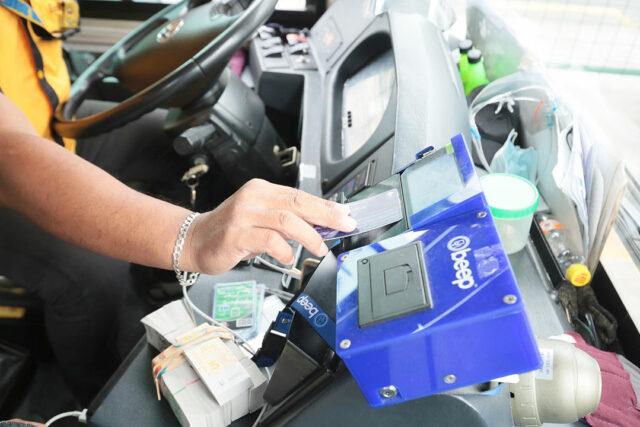
ALL-NEW chips for stored-value cards used in various modes of public transportation will be in use by the third quarter of next year, an official of the Department of Transportation (DoTr) revealed.

Speaking to reporters on the sidelines of Tuesday’s railway conference, Transportation Assistant Secretary Jorjette B. Aquino said old chips used for stored-value or “beep” cards used in rail lines, buses, and modern public utility vehicles will eventually use new chips in line with the development of technology.

“The AFCS (automatic fare collection system) team is preparing for that,” she said, adding that there is a need to shift as the manufacturer of the chips upgraded its production line.

Meanwhile, Ms. Aquino said that while there should be enough stored value cards in circulation for railway commuters, there is an artificial shortage. “We do have supply, but what is happening is instead of one card per passenger, some buy five or six cards,” she said. — Ashley Erika O. Jose

CoA flags Davao City spending

PHILIPPINE STAR/ MICHAEL VARCAS

STATE AUDITORS have flagged the Davao City government for P6.45 million in expenditures in 2022 which are deemed inappropriately charged against its development fund.

“Expenditures totaling P6.45 million were inappropriately charged against the 20% development fund, not in accordance with the guidelines set forth under the DBM-DoF-DILG joint memorandum circular no. 1,” the Commission on Audit (CoA) said in its compliance audit report on local government units (LGUs).

The joint circular issued in 2020 by the Departments of Budget and Management, of Finance, and of the Interior and Local Government contained guidelines and policies in utilizing the development fund.

In the case of Davao City, P6.45 million of the development fund was spent on the following: financial assistance to centenarians (P3.2 million), sports festival prizes and other fees (P1.53 million), basketball venue rental (P128,000), and food and catering services (P125,000).

In response, the city’s budget and accounting offices said their management misinterpreted that the flagged expenses were allowed “since they were not among the expenditure items enumerated in item 3.2.5. of [the] joint memorandum circular and they assumed that those items were for the general welfare.”

“Had the management properly identified the specific projects and carefully evaluated the corresponding expenditure items and ensured that these are allowed to be charged against the 20% development fund, the foregoing ineligible disbursements could have been avoided,” CoA also said in its report.

The management “reassured that they will align the calendar year 2023 and the succeeding budgets in compliance” with existing regulations for the fund. Davao City had a total development fund of P2.13 billion for 2022. — Beatriz Marie D. Cruz

DENR puts land uses on hold

THE DEPARTMENT of Environment and Natural Resources (DENR) told senators on Wednesday that it has put on hold all applications for leases, permits and other agreements on protected lands to give way for a review of how stakeholders and private entities may use these areas. “There are instructions from the Secretary (Maria Antonia Yulo-Loyzaga) that as of yesterday (Oct. 17), we will be issuing a memorandum to all regional directors to suspend, in the meantime, the issuance of the acceptance of all applications for tenurial instruments pending review of this policy,” Environment Undersecretary Jonas R. Leones told a Senate hearing on the DENR’s proposed P24.57-billion budget for next year.

Tenurial instruments are leases, agreements, joint ventures or production sharing agreements, and licenses concerning the development, exploration, and utilization of the country’s natural resources, according to DENR Administrative Order No. 09 published in 2020.

Last month, the DENR suspended an agreement it had with the Socorro Bayanihan Services, Inc. (SBSI) — currently under investigation for alleged illegal cult practices — for the use 300 hectares of protected land in Socorro town, Surigao del Norte.

The Senate is in the middle of investigating the group’s alleged human trafficking, exploitation, forced labor and child sexual abuse activities.

Senator Cynthia A. Villar told DENR officials that the agency should come up with more measures and use its funding to safeguard the country’s protected lands.

Ms. Villar said the government must harness modern technology like drones and satellite imagery to keep an eye on activities being conducted in protected lands.

“You’re supposed to protect the environment; you’re not the Department of Trade and Industry” she said during the hearing. “We’re not supposed to be doing business in our protected areas.” — John Victor D. Ordoñez

Bangsamoro LGUs to go digital

COTABATO CITY — Nine more Bangsamoro local government units (LGUs) will give their constituents electronic access to basic services through the digitalization project of the United Nations Development Programme (UNDP) and the Bangsamoro local government ministry.

The Localizing eGovernance for Accelerated Provision of Services (LeAPS) — bankrolled by the UNDP and first implemented in the municipalities of Butig and Piagapo in Lanao del Sur in 2020 — will soon be launched in Maluso, Basilan; Maimbung and Omar in Sulu; Upi in Maguindanao del Norte; Paglat in Maguindanao del Sur; Wao in Lanao del Sur; Marawi City; and Cotabato City.

Maluso Mayor Hanie A. Bud confirmed on Wednesday having signed the memorandum of agreement for the LeAPS project for the Bangsamoro Autonomous Region in Muslim Mindanao (BARMM) LGUs.

Upi Mayor Rona P. Flores said the digitalization of LGU operations would improve the delivery of health, social welfare and other basic services to the Muslim, Christian and non-Moro ethnic Teduray communities in the municipality.

Upi has thrice been awarded the Seal of Good Local Governance in the last five years for its efficiency in handling public funds and its extensive peace and security and environmental-protection programs.

BARMM Minister of the Interior and Local Government Naguib G. Sinarimbo and the beneficiary-LGUs shall together set up the electronic digitalization of the public service and administration functionaries of the nine municipalities with the support of the UNDP.
Kalma Jikiri-Isnain, director of the Integrated Resource Development for Tri-people, said they are certain that the effort of the MILG-BARMM and UNDP can also boost their anti-child labor programs in the autonomous region that are being implemented along with the International Labour Organization and the office of Bangsamoro Labor Minister Muslimin Sema. — John Felix M. Unson

Cobra sightings in Benguet raise alarm

BAGUIO CITY — As more incidents of cobra sightings are being reported in the Cordillera Region, the private-run wildlife protection advocacy group Northern Exotics and Wildlife (NEWT) has advised the public to learn about how to react and avoid being attacked.
In the past weeks, photos and videos of snakes believed to be of the Philippine Cobra and even King Cobra species in some barangays and towns of Benguet, near Baguio City, surged on social media sites, alarming residents.

NEWT advisor Sean Frederick T. Serrano, a veterinarian, explained that Philippine Cobra is normally around six feet in length while the King Cobra is around 20 feet in length. Both poisonous, he warned that they are quite common in the Cordillera highlands.

Mr. Serrano said these cobras are increasing in number in the region because of a possible breeding season.

He reminded that grabbing or holding these cobras will prompt them to attack, especially if their head or hood is in a “standing position.”

The more appropriate action to take upon spotting a cobra, according to Mr. Serrano, is to stamp one’s feet on the ground, sing or talk noisily to drive them away.

In case of snake bites, the victim should immediately seek medical attention at the hospital.

Mr. Serrano also reminded the public to report any snake sighting to the authorities and avoid killing them, citing that Republic Act 9147 (Wildlife Resources Conservation and Protection Act) which prohibits the killing of wildlife animals. — Artemio A. Dumlao