Home Blog Page 4134

OPPO to launch new flagship foldable phone in the country

OPPO FIND N3 FLIP

OPPO is set to launch in the Philippines its new flagship foldable smartphone on Thursday, the Find N3 Flip.

The OPPO Find N3 Flip aims to elevate the standard in flip phone technology, the company said in a statement this week.

The highlight of the newest OPPO foldable phone is the cover screen display, which introduces a host of more functional enhancements. The OPPO Find N3 Flip’s cover screen will allow users to access and use multiple apps, without having to unfold their smartphone,” OPPO said.

“The improved cover screen can accommodate more popular apps, including third-party apps like Gmail, Spotify, X (formerly Twitter), WhatsApp, and Google Maps. So, whether you need to scroll through your social media timelines, check a map, switch tracks, or write a quick e-mail, it’s all just a tap away on the cover screen,” it added.

The cover screen also allows up to six simultaneous notifications, OPPO said.

“The OPPO Find N3 Flip takes personalization to the next level with over 20 screen styles you can customize, direct cover widgets to add for applications such as Messages, Camera, Battery, Recorder, Timer, and To-dos,” it said.

“It also enhances the user experience by introducing a fresh animated weather wallpaper and a corresponding Always-On Display that provides real-time information. It improves accessibility by enabling users to pin three widgets or apps directly onto the cover screen wallpaper, offering swift, and convenient access with just a tap,” OPPO added.

The Find N3 Flip is powered by a Mediatek Dimensity 9200 chipset and a 4,300 mAh battery that supports 44W fast charging.

It has a glass and metal body with a curved form. It will be available in two colors: Cream Gold and Sleek Black.

OPPO said the Find N3 Flip is the first flip smartphone to feature a triple camera system, which consists of a 50-megapixel (MP) main camera, 48-MP ultra-wide camera, and 32-MP telephoto portrait camera setup powered by Hasselblad.

When operating the camera with the phone closed, the cover screen can be used as a rear camera viewfinder, OPPO said.

When the smartphone is opened, the top half of the screen can be used to preview the image, while the bottom half can display the camera controls setup, it added. — M.H.L. Antivola

Cebu Pacific studies other fuel options

CEBUPACIFICAIR.COM

CEBU PACIFIC is studying the use of other emerging technologies to replace conventional jet fuel, its top official said.

“There are, I guess, other technologies that are being explored, whether it’s SAF (sustainable aviation fuel), hydrogen or electric,” Alexander G. Lao, president and chief commercial officer of Cebu Pacific, told reporters on the sidelines of a press briefing on Tuesday.

Cebu Pacific is further studying how to utilize these emerging technologies for its flights, Mr. Lao said.

Liquid hydrogen is considered a potential low-carbon fuel for aviation and is said to take long-range flights.

“SAF is the linchpin of it all. That is the most developed anyway,” he said.

The International Air Transport Association has estimated that SAF will contribute 65% of carbon emissions reduction.

Mr. Lao said the company is also looking at hydrogen fuel but admitted that Cebu Pacific is still quite far away from using this technology.

For now, the budget carrier is still tied up with the use of SAF as an alternative to traditional jet fuel although the company is also studying how to best produce the green fuel as supply is still limited.

“There are studies on how to best produce it, so those studies are ongoing,” he added.

On Wednesday, the company launched its second commercial flight powered by SAF although SAF blend has already been integrated into some of its delivery flights, Mr. Lao said.

The company targets to integrate SAF blend across its network by 2030 as part of its goal to achieve net-zero emissions by 2050. — Ashley Erika O. Jose

The Hunger Games to be turned into London stage play

JENNIFER LAWRENCE in a scene from the 2012 film The Hunger Games. — IMDB

LONDON — The Hunger Games is set to open at a London theater next year in the first live stage adaptation of Suzanne Collins’ novels and the hugely successful film franchise.

Irish playwright, screenwriter, and director Conor McPherson has adapted for theater the first book in Collins’s young adult dystopian trilogy and the first film from The Hunger Games Lionsgate movie franchise, which starred Oscar winner Jennifer Lawrence as heroine Katniss Everdeen.

Matthew Dunster, playwright, director, and former associate director at Shakespeare’s Globe theater, will direct.

“To receive Suzanne Collins’ blessing to adapt The Hunger Games for the stage is both humbling and inspiring. She has created a classic story which continues to resonate now more than ever,” Mr. McPherson said in a statement on Tuesday.

“In a world where the truth itself seems increasingly up for grabs, The Hunger Games beautifully expresses values of resilience, self-reliance and independent moral inquiry for younger people especially.

“This is turbocharged storytelling of the highest order and I’m hugely excited to bring it to a new generation of theatre goers and to Suzanne Collins’ longstanding and devoted fans.”

Ms. Collins said she was “very excited” to be collaborating with Mr. McPherson and Mr. Dunster “as they bring their dynamic and innovative interpretation of The Hunger Games to the London stage.”

The Lionsgate Hunger Games movies, which brought to the big screen Collins’ tale of the oppressed residents of Panem, forced to compete in an annual televised gladiatorial contest to the death while the wealthy watched on, grossed more than $2 billion at the global box office.

Prequel The Hunger Games: The Ballad of Songbirds & Snakes, set 64 years before the first installment of Collins’ trilogy and starring Rachel Zegler, Tom Blyth, and Viola Davis, is scheduled for release globally in mid-November. — Reuters

Coal and nuclear power as growth drivers

(Part 3 of a series)

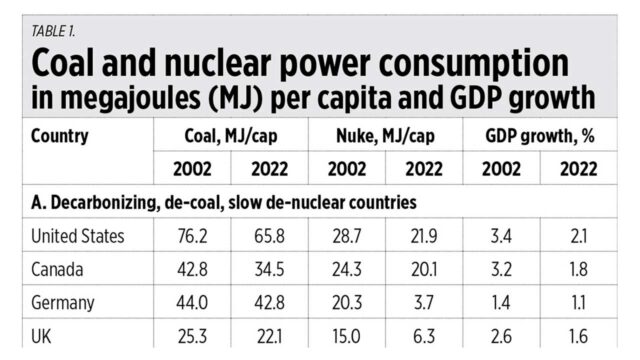
We go straight to the numbers. I construct this table showing the changes in consumption per capita of coal and nuclear power of various countries over two decades, and 2002 and 2022. Data sources are: 1.) Annual data in terawatt-hours (TWH) coal and nuclear consumption from Energy Institute, Statistical Review of World Energy (EI-SRWE) 2023, and, 2.) Population and annual GDP growth from IMF World Economic Outlook (IMF-WEO) 2023. Then I computed the per capita consumption and average GDP growth.

The numbers and trend show that, 1.) decarbonizing, de-coal, de-nuclear power countries have experienced a significant slowdown in GDP growth bordering on degrowth, 2.) carbonizing, high coal and high nuke power consuming countries experienced flat or increased economic growth, and, 3.) India and the Philippines (and other developing countries) still have very low coal use per capita, about 1/20 or less compared to many countries in the table, and yet are being endlessly bullied to cut their coal consumption.

So there. The numbers are actual, straightforward, and clear, not hypothetical or garbled. Of course, there are many other factors why countries have fast or slow growth but since almost everything in modern and developing economies require energy, the high coal and nuclear (and gas) consumption by countries enabled them to grow fast, industrialize, and improve the standard of living of their people. When they reverse track, de-coal and even de-nuke, they grow slowly, bordering on stopping growth which will come soon.

When I was in Nice, France last week for the Tholos Forum 2023, a three-day conference on free markets, consumer freedom, and energy realism, the bright lights of the boulevard in Cote d’Azur alone were a tourist attraction. Strangers and visitors can walk safely under the bright and beautiful lights. France is a powerhouse in nuclear energy generation.

The Philippine government, business and civil society leaders should bear this in mind. Our main priority should be fast growth, creating more jobs and businesses for our people. Not the globalist agenda of ecological central planning and energy rationing.

Meanwhile, many energy issues were recently reported in BusinessWorld.

1. On decarbonization: “ADB pitches farm decarbonization as food security issue” (Oct. 2), “Industry ponders the ‘long road’ before hydrogen becomes viable” (Oct. 15), “‘Smart and green’ infra being readied to serve offshore wind industry” (Oct. 16), “Adjustments to next PHL Energy Plan expected to reflect rapid developments in renewables” (Oct. 19), “World Bank estimates Philippine decarbonization bill at $62 billion” (Oct. 22), and, “China wind power firms may invest $4 billion, BoI says” (Oct. 24).

2. On the rollout of electric vehicles (EV): “EV industry anticipating upside surprise in vehicle penetration over next 5-10 years” (Oct. 18), “Extension of import duty concessions seen as crucial for growing EV adoption” (Oct. 19), and, “DoE sees extent of EV rollout depending on policy coordination with other agencies” (Oct. 22).

3. On the National Grid Corp. of the Philippines (NGCP): “NGCP wins approval for 4 ancillary services contracts” (Oct. 9), “NGCP seeks gov’t support to meet tight deadline for connecting Batangas, Mindoro” (Oct. 11), “Mindanao-Visayas grid link expected to be complete by end of 2023 — NGCP” (Oct. 12), “NGCP asked to submit ECCs, contracts ahead of review” (Oct. 16), and, “ERC rejects NGCP petition to amend rules on transmission wheeling rates” (Oct. 17).

4. On nuclear power development: “APEC councils to conduct roundtable on nuclear power viability” (Oct. 23), and, “Energy dep’t says push to satisfy IAEA nuclear power requirements underway” (Oct. 24).

ABAC FORUM ON NUCLEAR ENERGY
Last Tuesday, Oct. 24, I attended the APEC Business Advisory Council (ABAC) virtual forum, “Fueled by Change: Understanding Nuclear Energy Transition.” The opening messages were given by Energy Secretary Raphael Lotilla, Jan de Silva of the Toronto Region Board of Trade, and Sabin Aboitiz, the President and CEO of Aboitiz Group and also the Lead Strategic Convener of the Private Sector Advisory Council to the Philippine government, Co-Chairman of the ABAC Sustainable Growth Working Group, and Steward of the Council for Inclusive Capitalism.

The program was hosted by smooth-speaking engineer and fellow UP alumnus Suiee Suarez who is the Vice-President for Corporate Affairs of Aboitiz Power. After the three main speakers have spoken, Mr. Suarez turned over the moderation of two panels to Ruth Yu-Owen, President of Upgrade Energy Philippines. There were four speakers (from Canada, the Philippines, Japan, China) each in Session 1, “Collaboration and financing for nuclear energy transition,” and Session 2, “Nuclear energy integration and innovation.” These were financial and technical or engineering discussions.

A summary of the forum was reported by Sheldeen Joy Talavera in her report in BusinessWorld, “Energy dep’t says push to satisfy IAEA nuclear power requirements underway.”

The projected high EV rollout will soon require a huge supply of electricity. From the current average of six terawatt-hours (TWH) annual increase in power generation, we should increase this to nine to 10 TWH annually. This cannot be provided by intermittent wind, solar, and biomass, and even by geothermal or small hydro. It can only be safely and reliably delivered by huge thermal plants (oil, gas, coal) and nuclear power.

SILVER LINING THE MUSICAL
I watched Silver Lining the Musical last Sunday at RCBC Plaza’s Carlos P. Romulo auditorium in Makati. Wonderful acting, dancing, and singing by a big group of talented actors and singers. The auditorium itself is testament to the need for a huge, ample supply of electricity — plenty of lights, a cold big room, good sounds and audio.

The composer and lyricist of Silver Lining, Jack Teotico, a fellow UP School of Economics alumnus, says the musical is the story of the baby boomer generation. It is about brotherhood and fraternities, class parties and ligawan/courtship, triumph in university basketball competitions, falling in love for the first time, old flames and crushes, quo vadis about the world, and so on.

The last shows will be from Friday to Sunday, Oct. 27-29. Then the venue will no longer be available. It is a bright work of art that deserves a re-run in other theaters or auditoriums next year and succeeding years. Good job, Jack, Rockitwell band and studios, the players and singers.


Bienvenido S. Oplas, Jr. is the president of Bienvenido S. Oplas, Jr. Research Consultancy Services, and Minimal Government Thinkers. He is an international fellow of the Tholos Foundation.

minimalgovernment@gmail.com

EU lawmakers struggle to reach agreement on AI rules

TRUSTPAIR.COM

STOCKHOLM/BRUSSELS — European lawmakers are yet to agree on several issues related to new artificial intelligence (AI) rules ahead of a crucial meeting on Tuesday, leaving any deal off the table until December, according to four people familiar with the matter.

The draft AI rules have to be agreed by the European Parliament and European Union (EU) member states. They have so far been discussed three times in trilogues, which are meetings between parliament and EU states to thrash out the final versions of laws.

A fourth trilogue meeting will be held on Tuesday, a day after EU lawmakers are scheduled to discuss their negotiating stance around foundation models and high-risk AI systems, sources said.

Foundation models, such as OpenAI’s ChatGPT, are AI systems that are trained on large sets of data, with the ability to learn from new data to perform a variety of tasks.

Spain, which holds the EU presidency until December, has been pushing for a deal and has proposed compromises in a bid to speed up the process.

These include a tiered approach for regulating foundation models, defined as those with more 45 million users, according to a draft seen by Reuters.

Spain also wants additional obligations for very capable foundation models, such as ChatGPT, including regular vetting to uncover potential vulnerabilities.

Opponents say that smaller platforms can be equally risky.

Spain said it had consulted other EU countries on potential compromises ahead of the fourth trilogue. However, a final agreement is unlikely to be reached in that meeting, the sources said.

A fifth trilogue is due to be held in early December.

Failure to reach a deal then could push negotiations to early next year. Discussions could then be further derailed by the European parliament elections in June.

Several lawmakers, including EU industry chief Thierry Breton and co-rapporteurs for the AI Act, Dragoș Tudorache and Brando Benifei, had expressed hopes that the draft will be approved before the end of the year.

The EU started working on the draft AI Act in 2021. In May this year, the European parliament agreed on draft legislation including new rules around the use of facial recognition, biometric surveillance, and other AI applications.

Under the proposals, AI tools will be classified according to their perceived level of risk, from low to unacceptable. Governments and companies using these tools will have different obligations, depending on the classification. — Reuters

BDO net income climbs by 16.4% in third quarter

BW FILE PHOTO

BDO UNIBANK, Inc. recorded a higher net profit in the third quarter amid growth in its core businesses.

The bank’s attributable net earnings went up by 16.4% to P18.7 billion in the July-to-September period from P16.06 billion a year ago, it said in a disclosure to the local bourse on Wednesday.

This brought its attributable net profit to P53.9 billion in the first nine months of the year, 34.7% higher year on year.

Return on common equity improved to 15.1% as of end-September from 12.4% a year earlier. Return on assets also rose to 1.73% from 1.43%.

“While macroeconomic challenges persist, the bank remains cautiously optimistic and is well-positioned to capitalize on opportunities given its strong balance sheet and diversified business franchise,” the bank said in a statement.

Net interest income increased by 24% to P47.94 billion in the third quarter from P38.64 billion in the same period in 2022.

Interest income on loans and other receivables surged by 40.3% to P50.34 billion in the third quarter from P35.86 billion a year earlier.

Interest earnings from trading and investment securities improved by 53.6% to P10.08 billion from P6.56 billion in the comparable year-ago period.

For the first nine months, net interest income rose by 27% to P137.4 billion amid higher earning assets and interest margins due to the rate hikes of the Bangko Sentral ng Pilipinas.

Net interest margin stood at 4.65% as of end-September from 4.11% a year earlier.

Meanwhile, BDO’s non-interest income in the July-to-September period went up by 3.91% to P19.69 billion from P18.92 billion amid higher commission fees and a lower net loss from trading.

On the other hand, operating expenses rose by 17.6% year on year to P39.51 billion in the third quarter from P33.57 billion, driven by higher compensation and occupancy expenses, as well as the increase in costs related to its insurance business.

Loans stood at P2.7 trillion as of end-September, BDO said. Its gross nonperforming loan (NPL) ratio was at 1.99% and its NPL coverage ratio was at 176% for the period.

On the funding side, total deposits expanded by 12% to P3.4 trillion as of September, the Sy-led bank said.

The bank’s common equity Tier 1 ratio was well above the regulatory requirement at 14.5%. Its capital adequacy ratio was also higher than the regulatory requirement at 15.6%.

Liquidity ratio rose to 35.22% in the first nine months of the year from 32.99% a year ago, as liquid assets grew at a faster pace than total assets.

BDO has over 1,700 branches and 4,700 automated teller machines nationwide. It also has 16 international offices in Asia, Europe, North America and the Middle East.

The Sy-led lender’s shares went up by P1.6 or 1.26% to close at P129 apiece on Wednesday. — Keisha B. Ta-asan

A skilled workforce — a critical component of PH energy transition

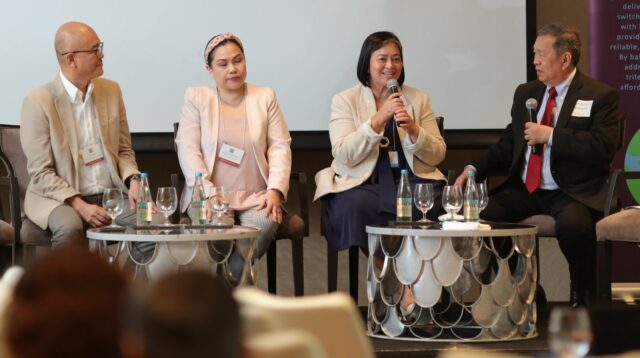
In a panel discussion, AboitizPower Chief People Officer MaLu Inofre (2nd from right) said that the energy industry must come together to craft and implement programs that strengthen the talent pipeline for the Philippine power industry.

Amidst the Philippine energy transition, Aboitiz Power Corporation (AboitizPower) recognized the growing scarcity of skilled power industry workers and, hence, the necessity of developing a workforce that can adapt and willingly carry the important task of ensuring energy security, affordability, and sustainability for today’s and tomorrow’s Filipinos.

“There has to be a workforce now and in the future that will keep our energy system functioning and serve the needs of our country,” said AboitizPower Chief People Officer MaLu Inofre. “However, among our most difficult challenges is building a skilled talent pipeline that can effectively adjust and work with the fast-paced transformation within the industry’s energy mix, digital systems, and regulations.”

“It has become exceedingly vital to ensure that workforce skills align with the changes of the times,” she further explained. “In the same way, attracting talent in a competitive global market is crucial to a sustainable, efficient, and innovative Philippine power sector that meets our country’s growing energy demands and sustainability objectives.”

Inofre made her remarks during the first Philippine Power Industry HR Forum at Shangri-La The Fort, Taguig City. The event was presented by the American Chamber of Commerce of the Philippines, Inc. (AmCham) in partnership with AboitizPower.

AboitizPower encourages its team members to live up to the company’s purpose of “Transforming Energy for a Better World”, which entails delivering long-term equitable and sustainable value to the businesses and communities it serves and works with.

In the Philippines, the Department of Labor and Employment (DOLE) said that an estimated one million skilled workers in engineering, architecture, and construction are lacking. They cited “Power Plant Maintenance Engineer” and “Maintenance/Powerplant Engineers” as among the hard-to-fill occupations in the country. This can be due to a lack of qualified applicants or brain drain (or when better opportunities abroad are taken advantage of by skilled locals).

“Between 2016 and 2021, the employment in the power industry declined by 15,444 individuals,” said DOLE Bureau of Local Employment Director Patrick P. Patriwirawan Jr. during the same event. “The Philippines saw an increase in the employment in the renewable energy industry last year but could have employed more if not for the delays caused by the Covid-19 pandemic on various project developments in the sector.”

Inofre added that a major factor influencing the labor shortage is the shift in the type of skills sought by employers, especially as the sector tries to balance the entry of renewable energy whilst maintaining traditional energy systems.

“Knowing this, upskilling will be key to facilitating a just transition for those who will be affected by the transition to a greener economy, as well as the new generation of workers. It is imperative that we successfully cultivate both thermal and renewable energy, so that we can ensure reliable and affordable energy supply for the country,” she said.

Meralco Power Academy Program Management Director Engr. Marc Lester Malibiran explained that, on top of upskilling the workforce, the industry should also help develop interest for the sector, especially in the youth.

“The Philippines boasts a young and vibrant population, brimming with innovative potential. By investing in talent development, we tap into this dynamic workforce, harnessing their fresh ideas and energy,” he said. “Unfortunately, we are seeing a decline in both take-up and completion of STEM (science, technology, engineering and mathematics), averaging only a 21% completion [rate].”

“Young Filipinos avoid STEM as it is seen to be an intimidating course of study. This is important to know as this signals us to develop programs that remove this preconceived notion,” he added. 

Young academic and professional achievers were recruited and trained by AboitizPower to operate, monitor, and control the company’s National Operations Control Center, which oversees over 20 renewable energy facilities spread across the country all from one central location.

The Philippine Power Industry HR Forum served as an avenue for human resources professionals in the Philippine power industry to connect, collaborate, and communicate ideas, knowledge, and best practices.

Sentiments from the breakout sessions revealed that skills and competency gaps or mismatch, a limited external talent pool, and difficulty in retaining talent due to global and local competition are the most cited challenges in the human resources field of the Philippine energy sector.

A panel discussion moderated by Atty. Jose Layug Jr. of Divina Law saw Michael Page Regional Director & Country Head Albert Perez, Meralco Chief HR Officer Edgardo “Egay” Carasig, Philippine Independent Power Producers Association, Inc. (PIPPA) President Atty. Anne Estorco Montelibano, and ACEN Chief HR Officer John Philip Orbeta discuss the need to calibrate existing government programs to be more in sync with the needs of the energy industry. This includes building competencies within communities to turn locals into more competitive applicants.

Meanwhile, another panel discussion moderated by AmCham Human Capital & Resources Committee Co-Chair Ernie Cecilia had Global Business Power Corporation VP – Human Resources Maria Luz Blanco-Uriarte, One Renewable Energy Enterprise, Inc. Founder & President Erel Narida, and AboitizPower’s Inofre talk about how retaining workers involves investing on their skills, ensuring talent mobility opportunities, and giving them a sense of purpose.

“The energy industry must create an acceptable, progressive plan to resolve the talent crisis. AboitizPower, for one, makes an effort to resolve the shortage of estimated skilled workers in our industry by maintaining academic-industry linkages with universities in the country, providing long-term scholarships, [and] establishing programs with TESDA that help promote electrical engineering skills at the grassroots level, among other initiatives,” Inofre said.

“Through similar initiatives, I believe we can successfully empower a community of like-minded individuals who work towards implementing human resource programs that strengthen the talent pipeline for the Philippine power industry,” she concluded.


Spotlight is BusinessWorld’s sponsored section that allows advertisers to amplify their brand and connect with BusinessWorld’s audience by enabling them to publish their stories directly on the BusinessWorld website. For more information, send an email to online@bworldonline.com.

Join us on Viber at https://bit.ly/3hv6bLA to get more updates and subscribe to BusinessWorld’s titles and get exclusive content through www.bworld-x.com.

Vivaldi’s Four Seasons gets climate change makeover

MADRID — A Spanish music director has adapted Antonio Vivaldi’s The Four Seasons to the grim reality of global warming, adding prominence and drama to the summer concerto while shortening the other three, and he believes the Italian great would not mind.

“I think Vivaldi would have been a lot more aggressive and gritty. If today someone were to compose The Four Seasons from an absolutely realistic perspective, it would be frankly daring,” composer and producer Hache Costa told Reuters.

The original opus was composed exactly 300 years ago. The adapted version will premiere on Tuesday at Madrid’s popular EDP Gran Via venue, coinciding with the global Climate Action Day.

It will be accompanied by projected images of wildfires and other effects of cli mate change, such as drought.

“I would love the audience to feel really bothered at some point by becoming truly aware of what is happening,” added Costa, who has made the sheet music freely available for anyone to play.

Scientists have linked searing temperatures and dry and windy conditions in many parts of the world, including southern Europe, to climate change.

Ernesto Rodriguez Camino, president of the Spanish meteorology association, said the impact of climate change in Spain was evident.

“The trend is for longer, more intense heatwaves, and associated with the heatwaves there can be more violent wildfires, and also stronger rainfall with potentially catastrophic effects,” he said. — Reuters

How to handle stress

SIMRAN SOOD-UNSPLASH

STRESS has become an important area of study especially after the pandemic lockdown raised the number of employees undergoing this psychological affliction. Can this unstable mental state be used as a tool for evaluating an organization’s resilience under different types of challenges?

The original “stress test” referred to a medical procedure. This evaluation deals with a patient’s heart condition. It is an integral part of a medical check-up that the conscientious executive is required to undergo, especially after he turns 50 and the body starts showing signs of aging, like panting heavily when seated — without the sight of a pant-worthy object.

The stress test uses a treadmill and requires the patient to bring a towel and wear shorts and rubber shoes for the session. This is the same machine one finds in fitness centers in front of a TV monitor which may feature a highway or forest path. The gym rat is more relaxed and may even be stepping up with music on his earplugs.

Before he steps on the treadmill, the patient’s bare chest is attached with suction cups wired to a monitoring machine to track heart rate, breathing, and blood pressure as he walks at different speeds, and sometimes an increasing angle, on the treadmill. The doctor puts his patient at ease by asking him soothing questions (Do you have confidential funds you keep from your wife?) mainly to check if he is still capable of speech or breathing as the speed and angle of the treadmill is raised. The numbers go into the chart to determine the patient’s fitness.

The stress test technique can be applied to the economy. Certain scenarios like varying inflation rates which are food-driven, debt levels, GDP growth forecasts are thrown into the stew to see what happens to the economy. Worst case scenarios, like debt delinquencies, may be modified to ensure continued survival under severe stress.

Can we apply the stress test to our lives?

Stress arises from uncertainty regarding the future. (Will I still have my cushy job after the end of the year?) If we use the stress test approach, it is best to look at scenarios while we are enjoying some stability and bliss. The “what if” approach leads only to raising the levels of stress.

Here are some triggers for worries leading to stressful reactions.

When we send out an SMS for lunch and get no reply, should we panic? Are we being ghosted? Does silence mean rejection? Uncertainty of meaning can be stressful. It’s best to wait and see what happens — I was just tending to the orchids, Dear.

What about the little surprises of life? These can range from a flat tire during heavy traffic with motorcycles buzzing around your stationary vehicle or some unexpected medical need requiring a huge amount of money you don’t have. The appeal for financial assistance from colleagues and friends can be mortifying, but necessary. Passing the hat has become too common among Viber groups and organizations. It passes the stress around to family and friends, including those who decide to pass.

Even those involved in wealth management whose minimum portfolio may start at P25 million routinely ask their new clients about their “risk appetite.” This has nothing to do with cuisine and favorite dishes. The appetite involved in this stress test is to gauge the client’s openness to a higher yield that comes with the risk of losing a part of the principal. Is the client “risk averse” and content with fixed income bonds of triple A companies? Or is he willing to get into virtual currency and NFTs (little pictures that can be traded)?

At work, the causes of stress are more jejune.

There’s no need to build scenarios to test the tolerance for pain and anxiety. The daily grind of losing pitches for new business, inability to collect from clients for services rendered, and the turnover of key executives are almost part of “business as usual.” There is always the exit door to alleviate stress. Of course, this can lead to more uncertainty like the possibility of family vacations lasting indefinitely.

It is best to heed the philosophy of the stoics, like Marcus Aurelius — we cannot control what happens to us, only how we react to them. It’s best to live for today… and postpone the stress for tomorrow.


Tony Samson is chairman and CEO of TOUCH xda

ar.samson@yahoo.com

SSS hikes maximum funeral benefit

SSS FACEBOOK PAGE

THE Social Security System (SSS) is increasing the maximum funeral benefit that can be received by beneficiaries to P60,000 from P40,000 previously.

“The new guidelines provided under SSS Circular No. 2023-009 aim to incentivize active membership by raising the maximum amount of funeral benefit to P60,000 and streamline the provision of funeral benefits to claimants, especially for surviving legal spouses,” SSS President and Chief Executive Officer Rolando L. Macasaet said.

If a deceased member or pensioner paid at least 36 months of contributions up to the month of death, the benefit shall range from a variable amount of a minimum of P20,000 to a maximum of P60,000.

Under the circular, the funeral benefit will be computed based on the number of paid contributions and the Average Monthly Salary Credit (AMSC).

The benefit will cover embalming services, burial transfer services and permits, funeral services, and cremation or interment services, among others.

However, members who paid at least one but less than 36 months worth of contributions will have a fixed benefit of P12,000.

The SSS said the order of priority of claimants will be the surviving legal spouse, followed by the children, parents or any other natural person who can present proof of payment.

The circular also noted that the application for benefit claims must be filed within 10 years from the month of death.

From January to November last year, SSS’ benefit disbursements rose by 13.2% to P236.3 billion year on year, it said. — LMJCJ

Smart taps Google Cloud AI for real-time insights from user data

UNSPLASH

SMART COMMUNICATIONS, Inc., the wireless subsidiary of PLDT Inc., said it had partnered with Google Cloud AI to adopt telecom subscriber insights.

“Our collaboration with Google Cloud to be the first communication services provider in Asia Pacific to adopt Telecom Subscriber Insights will empower us to better serve Filipino mobile users whenever and wherever they need,” said Alex O. Caeg, senior vice-president and head of consumer business, in a media release on Wednesday.

Through the partnership, Smart will adopt Google’s artificial intelligence (AI)-powered solution to add more capabilities that will allow its customers to access Google’s generative AI capabilities.

“With real-time insights from customer data, Smart could, for instance, help subscribers optimize their data consumption while streaming content by alerting the user to adjust the resolution of their video,” it said.

To recall, Smart said that it was planning to tap into other technologies to enhance its networks.

Currently, the company has expanded its fiber footprint to more than 1.1 million kilometers, Smart said.

The telecommunications company’s fiber footprint expansion consists of international and domestic fiber, which in turn covers Smart’s mobile network including almost all of its 3G, 4G/LTE, and 5G.

The company earlier said it would continue to enhance its integrated fixed and wireless networks in line with the government’s digitalization target.

Hastings Holdings, Inc., a unit of PLDT Beneficial Trust Fund subsidiary MediaQuest Holdings, Inc., has a majority stake in BusinessWorld through the Philippine Star Group, which it controls. — Ashley Erika O. Jose

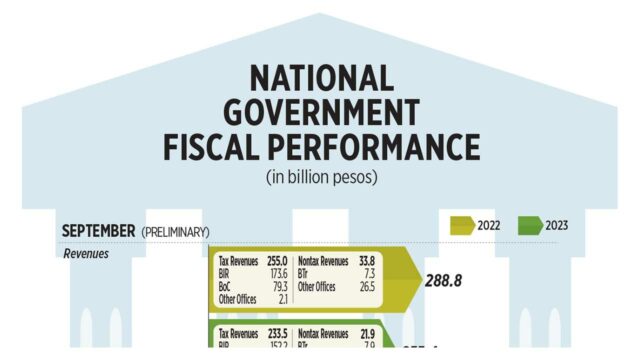
National Government fiscal performance

THE NATIONAL Government’s (NG) budget gap ballooned in September as revenues declined and expenditures rose, the Bureau of the Treasury (BTr) said. Read the full story.

National Government fiscal performance

ADVERTISEMENT
ADVERTISEMENT