Home Blog Page 4132

China rushes to swap Western tech with domestic options as US cracks down
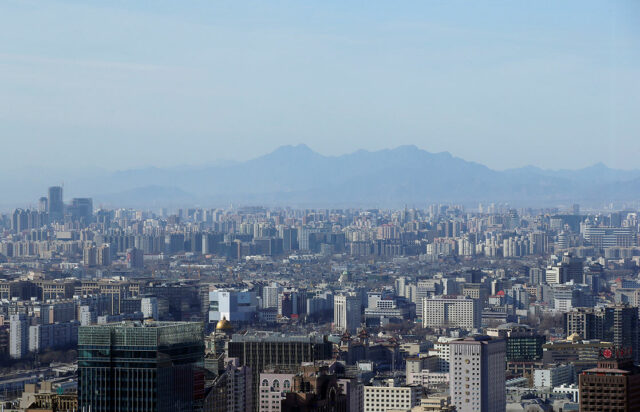
A GENERAL VIEW shows Beijing’s skyline on a sunny day in this file photo. — REUTERS

 – China has stepped up spending to replace Western-made technology with domestic alternatives as Washington tightens curbs on high-tech exports to its rival, according to government tenders, research documents and four people familiar with the matter.

Reuters is reporting for the first time details of tenders from the government, military and state-linked entities, which show an acceleration in domestic substitution since last year.

China has spent heavily on replacing computer equipment, and the telecom and financial sectors are probably the next target, said two people familiar with the industries. State-backed researchers also identified digital payments as particularly vulnerable to possible Western hacking, according to a review of their work, making a push to indigenize such technology likely.

The number of tenders from state-owned enterprises (SOEs), government and military bodies to nationalize equipment doubled to 235 from 119 in the 12 months after September 2022, according to a finance ministry database seen by Reuters.

In the same period, the value of awarded projects listed on the database totaled 156.9 million yuan, or more than triple the previous year.

While the database represents only a fraction of tender bids nationwide, it is the largest collection of state tenders publicly available and mirrors third-party data. China spent 1.4 trillion yuan ($191 billion) replacing foreign hardware and software in 2022, marking a year-on-year increase of 16.2%, according to IT research firm First New Voice.

But Beijing’s lack of advanced chip-manufacturing capabilities prevents it from completely substituting products with alternatives that are entirely locally made, analysts say.

Previous domestic substitution efforts stalled because China did not have the “technical chops to pull off localization until now, and to a certain extent they still kind of don’t,” said Kendra Schaefer, head of tech policy research at Beijing-based consultancy Trivium China.


FEAR OF DEPENDENCE

SOEs were instructed last year to replace office software systems with domestic products by 2027, the first time such specific deadlines were imposed, according to five brokerage firms that cited a September 2022 order from China’s state asset regulator. Reuters could not independently verify the order.

Domestic replacement projects this year have targeted markedly sensitive infrastructure, the tenders show.

One partially redacted tender for a “certain government department in Gansu province” assigned 4.4 million yuan to replace an intelligence-gathering system’s equipment, without providing specifics.

People’s Liberation Army units in the northeastern city of Harbin and Xiamen in the south last December meanwhile issued tenders to replace foreign-made computers.

Tech researchers such as Mo Jianlei of the Chinese Academy of Sciences, the country’s largest state-run research organization, said the Chinese government was increasingly concerned about Western equipment being hacked by foreign powers.

The state asset regulator did not return a request for comment.

Over the past year, state-linked researchers also called on Beijing to strengthen anti-hacking defenses in its financial infrastructure due to geopolitical concerns.

One March research paper highlighted the dependence of China’s UnionPay credit card system on US software firm BMC for settlements.

“Beware of security vulnerabilities in hardware and software set by the U.S. side … build a financial security ‘firewall’,” the researchers wrote.

BMC declined to comment.

An article published this year in the journal Cyberspace Security by researchers from the state-run China Telecommunications Corporation concluded the country was overdependent on chips made by U.S. giant Qualcomm QCOM.O for back-end management, as well as on the iOS and Android systems.

“(They) are all firmly controlled by American companies,” the researchers wrote.

As China has not signed World Trade Organization clauses governing public procurement, the substitution effort does not appear to violate international accords, according to the US Treasury. The US has implemented similar rules barring Chinese companies from public sector bids.

Qualcomm, Google and Apple did not immediately return requests for comment.


WINNERS AND LOSERS

China’s effort to build an independent computing system dates back to at least its 2006 five-year plan for science and technology development, which listed the semiconductor and software systems sectors as national priorities.

This effort spawned state-owned companies that are increasingly winning major contracts. Two firms awarded the Harbin tenders were subsidiaries of China Electronics Corporation and China Electronics Technology Group Corporation – both heavily targeted by US sanctions.

The state regulator’s 2022 order pushed SOEs away from US companies such as Microsoft and Adobe, according to an employee of a Beijing-based firm that develops domestic office-processing software

China Tobacco, for example, in July began switching some subsidiaries from Microsoft Windows to Huawei’s EulerOS, according to an employee of a software vendor that services the state-owned manufacturer.

The people spoke on condition of anonymity because they were not authorized to discuss clients and competitors.

For years, Western tech companies have shared their source code and entered into partnerships with domestic firms to address Beijing’s concerns, but prominent computer scientists such as Ni Guangnan of the Chinese Academy of Engineering have said such measures are not sufficient for China’s security needs.

China Tobacco, Microsoft and Adobe did not respond to requests for comment.

In September, Reuters and other outlets reported that some employees of central government agencies were banned from using iPhones at work.

“In certain sectors, customers … are opting for domestic suppliers, with foreign suppliers frequently facing informal barriers,” the European Union Chamber of Commerce in Beijing said in response to Reuters questions.

In a 2023 American Chamber of Commerce (AmCham) in Shanghai report, 89% of the organization’s tech business members named procurement practices favoring domestic competitors as a regulatory obstacle. It was the highest percentage of any sector.

AmCham Shanghai President Eric Zheng acknowledged China’s national security concerns but said he hoped “normal procurement procedures will not be politicized so that US companies can compete fairly and pursue commercial opportunities … to benefit both countries.”

The US Department of Commerce, China Electronics Corporation and China Electronics Technology Group Corporation did not return requests for comment.


HUAWEI PRIZED

Chinese tech conglomerate Huawei has emerged as the leading firm in this replacement cycle, according to three people familiar with China’s enterprise tech industry, who spoke on condition of anonymity given the sensitivity of the issue.

In 2022, Huawei’s enterprise business, which includes software and cloud computing operations, reported 133 billion yuan in sales, up 30% on the previous year.

One of the people said privately-held Huawei was seen as more nimble than state-owned groups in rolling out products and executing projects.

The other two sources highlighted Huawei’s broad product suite – spanning chips to software – as an advantage.

Clients also prize Huawei for its ability to process data on internal company servers and external cloud networks, as well as its wide offering of cybersecurity products, according to the employee of a China Tobacco tech supplier.

Huawei declined to comment.

The replacement drive has re-drawn entire sub-sectors of the software industry. The combined China market share held by five major foreign makers of database management systems – the majority of which are American – dropped from 57.3% in 2018 to 27.3% by the end of 2022, according to industry group IDC.

Despite heavy spending on domestic substitution, however, foreign firms are still dominant suppliers for banking and telecoms database management. Non-Chinese companies held 90% of market share for banking database systems at the end of 2022, according to EqualOcean, a tech consultancy.

Financial institutions are generally reluctant to switch database systems despite government pressure, said one of the industry sources, adding that they have higher stability requirements than many other sectors and local players cannot yet match their needs.

Even for personal computers, banks that switch from an international brand to China’s dominant supplier Lenovo would still be reliant on critical chip components provided by Western firms, one of the industry sources said. – Reuters


US antisemitic, Islamophobic incidents surge with war, advocates say

STOCK PHOTO | Image by Mohamed Hassan from Pixabay

 – Antisemitic and Islamophobic incidents including violent assaults and online harassment have spiked in the US since the Israel-Hamas conflict erupted on Oct. 7, two advocacy groups said Wednesday.

The Council on American-Islamic Relations (CAIR) said it received 774 complaints of incidents motivated by Islamophobia and bias against Palestinians and Arabs from Oct. 7 to Tuesday. The group said this was the highest level since 2015.

The total was almost triple 2022’s average number of complaints for a period of the same duration.

The Anti-Defamation League (ADL) said its preliminary data showed a 388% rise in antisemitic incidents in the U.S. from Oct. 7 to Monday over the prior year. The group reported 312 incidents including harassment, vandalism and assault. About 190 of those were directly linked to the war between Israel and Hamas, ADL said.

CAIR cited an 18-year-old Palestinian man allegedly assaulted in Brooklyn; death threats against a mosque and a fatal stabbing of a 6-year-old Muslim boy in Illinois, who U.S. authorities said was targeted for being Palestinian American.

ADL said complaints included violent messages, especially on online platform Telegram, and rallies where “ADL found explicit or strong implicit support for Hamas and/or violence against Jews in Israel.”

The US Justice Department has said it is monitoring rising threats against Jews and Muslims amid the conflict. President Joe Biden has condemned antisemitism and Islamophobia.

Palestinian Islamist group Hamas’ Oct. 7 attack killed over 1,400 people, Israel has said. Israel’s air strikes since on Hamas-controlled Gaza have killed over 6,500 as of Wednesday, according to the health ministry in Gaza. Reuters was unable to verify those figures independently. – Reuters

Biden warns China not to attack Philippine ships after incidents

REUTERS

President Joe Biden warned China that the US would be forced to intervene if Beijing attacks Philippine vessels in the South China Sea, after two separate collisions in the disputed waterway over the weekend.

“Just this past week, the PRC vessels acted dangerously and unlawfully as our Philippine friends conducted a routine resupply mission within their own exclusive economic zone in the South China Sea,” Mr. Biden said at the White House on Wednesday during a joint news conference with Australian Prime Minister Anthony Albanese.

“I want to be very clear: The United States’ defense commitment to the Philippines is ironclad,” he said. “Any attack on the Filipino aircraft, vessels, or armed forces will invoke our Mutual Defense Treaty with the Philippines.”

A China Coast Guard vessel collided with a Philippines-contracted resupply boat early Sunday as it made its way to a rusting World War II-era ship grounded in Second Thomas Shoal more than two decades ago. Two hours later, a Chinese maritime militia boat ran into a Philippine coast guard ship during the same operation to deliver supplies.

The remarks from the US president come as Chinese Foreign Minister Wang Yi visits Washington this week for high-level meetings, including one with Biden on Friday. Meetings are also scheduled with Secretary of State Antony Blinken and National Security Advisor Jake Sullivan as the US and China continue a series of diplomatic engagements intended to manage tensions.

Wang’s trip is seen as part of an effort that could lay the groundwork for a Biden-Xi meeting next month in California.

China has repeatedly urged the Philippines to remove the ship known as the BRP Sierra Madre that it said was “illegally” and “deliberately” ran aground at the shoal — a move Manila took in response to China’s occupation of nearby Mischief Reef. Beijing also considers Second Thomas Shoal, which it calls Ren’ai Jiao, as part of its territory. — Bloomberg

September budget gap widens

Public construction works continue as motorists drive through the service road of the Magsaysay Boulevard in Manila in this file photo. — PHILIPPINE STAR/MIGUEL DE GUZMAN

By Luisa Maria Jacinta C. Jocson, Reporter

THE NATIONAL Government’s (NG) budget gap ballooned in September as revenues declined and expenditures rose, the Bureau of the Treasury (BTr) said.

Data from the BTr on Wednesday showed that the fiscal deficit widened by 39.6% to P250.9 billion from P179.8 billion a year ago.

“The fiscal outturn for the period was underpinned by an 8.06% year-over-year acceleration in expenditures coupled with an 11.57% decrease in government receipts,” the Treasury said.

National Government fiscal performanceIn September, revenues fell by 11.57% to P255.4 billion from P288.8 billion a year earlier.

The bulk of revenues came from taxes, which dropped by 8.43% year on year to P233.5 billion.

The Bureau of Internal Revenue (BIR) collected P152.2 billion, slumping by 12.36% from P173.6 billion a year ago. Collections by the Bureau of Customs (BoC) dipped by 0.47% to P78.9 billion.

Meanwhile, nontax revenues fell by 35.22% to P21.9 billion as revenues from other offices plunged by 47.34% to P14 billion.

“The downturn (in revenues from other offices) was due to the base effect of last year’s one-off inflows from the return of P7.3 billion in unutilized funds of the Unconditional Cash Transfer Program and the P2.6-billion Philippine Charity Sweepstakes Office mandatory contribution to the Universal Health Care Program,” the BTr said.

BTr income rose by 8.79% to P7.9 billion from P7.3 billion a year ago due to “higher interest earnings on NG deposits and NG share from Philippine Amusement and Gaming Corp. (PAGCOR) income.”

On the other hand, government expenditures jumped by 8.06% to P506.3 billion in September from P468.8 billion a year ago.

The BTr attributed this to health and social protection programs, as well as public works projects.

Primary spending, which refers to spending net of interest payments, increased by 6.42% to P434.9 billion. Interest payments jumped by 19.28% to P71.4 billion.

“There was a stark pickup in spending versus a steep drop in revenues. Despite the acceleration in spending, we believe the economy is still in much need of support,” ING Bank N.V. Manila Senior Economist Nicholas Antonio T. Mapa said in a Viber message.

Rizal Commercial Banking Corp. Chief Economist Michael L. Ricafort said persistent inflation could have slowed spending. Inflation accelerated for a second straight month in September, rising to 6.1% from 5.3% in August.

“The budget deficit also widened after government expenditures grew faster amid some catch-up spending by the National Government, especially on infrastructure, after some underspending earlier in 2023 that partly slowed down economic growth; as well as higher interest rates and a weaker peso exchange rate since 2022 that increased the debt servicing costs of the National Government,” he added.

NINE-MONTH DEFICIT
In the first nine months, the NG’s budget deficit narrowed by 2.89% to P983.5 billion from P1.01 trillion a year ago. This was 11% lower than the P1.106-trillion program for the January-to-September period.

“The year-to-date NG deficit figure is only 66% of the P1.5-trillion full-year program due to higher revenue and lower expenditure performance than programmed for the period,” the BTr added.

Government revenues rose by 6.79% to P2.84 trillion in the January-to-September period. This was also 2.98% higher than the P2.76-trillion revenue program.

As of end-September, revenue collections already accounted for 76.1% of the P3.7-trillion full-year program.

Tax revenues increased by 6.38% to P2.54 trillion, although 2.09% lower than its P2.6-trillion program for the period.

Collections from the BIR rose by 7.25% to P1.86 trillion, but 3.89% lower than its P1.93-trillion target.

Customs revenues went up by 3.43% to P660.4 billion, also exceeding its P644.2-billion program by 2.52%.

Meanwhile, nontax revenues rose by 10.47% to P296.5 billion, nearly double its P160.1-billion target for the nine-month period.

BTr income climbed by 21.84% to P158 billion, nearly triple its P53.7-billion program due to higher receipts from dividend remittances, interest income from its managed funds, and the NG’s share from profits of PAGCOR and Manila International Airport Authority.

Revenues from other offices slipped by 0.16% to P138.5 billion, but 30% above the P106.5-billion target.

For the nine months ending September, state spending rose by 4.12% to P3.82 trillion from P3.67 trillion a year ago. It missed its nine-month P3.86-trillion target by 1.06%.

“The robust disbursement performance for the third quarter helped trim down government underspending to P40.9 billion or 1.06% of the program for the first nine months of the year. This compares with the P170.5-billion underspending recorded during the first semester, representing 6.6% of the program for the period,” the BTr said.

The weaker-than-expected 4.3% gross domestic product (GDP) growth in the second quarter was partially attributed to the contraction in government spending. This prompted the Finance department to order agencies to come up with catch-up spending plans.

In the third quarter alone, the BTr said disbursements reached P1.4 trillion, up by 11.12% from a year ago. It also exceeded its program for the period by 10.13% “on account of the continued acceleration of infrastructure expenditures.”

For the nine-month period, primary expenditures went up by 2.78% to P3.36 trillion, while interest payments jumped by 15.04% to P460.1 billion.

Mr. Ricafort said the narrower deficit in the nine-month period was due to continued economic reopening and increased business operations, which contributed to higher tax collections.

This year, the government has set a budget deficit ceiling of P1.499 trillion, equivalent to 6.1% of the gross domestic product. The program consists of P3.729 trillion in revenues and P5.228 trillion in disbursements.

‘Monetary policy cure’ not needed to address inflation — Balisacan

PHILIPPINE STAR/KRIZ JOHN ROSALES

FURTHER RATE HIKES may not be necessary to address rising consumer prices, as inflation remains driven by supply-side factors, according to National Economic and Development Authority (NEDA) Secretary Arsenio M. Balisacan.

“I am not a member of the Monetary Board, and I respect their wisdom, but I think the source of inflation is more supply side and not the demand side, which requires a monetary policy cure,” Mr. Balisacan told reporters on the sidelines of the 12th Arangkada Forum on Wednesday.

This was after BSP Governor Eli M. Remolona, Jr. on Tuesday said the Monetary Board was considering an off-cycle rate hike as early as today (Thursday), amid upside risks to inflation. Its regular policy-setting meeting is scheduled for Nov. 16.

The BSP has maintained a hawkish stance in recent months, even as it kept the benchmark interest rate at a near 16-year high of 6.25% at its last four straight meetings.

Mr. Remolona earlier signaled a possible 25-bp rate hike, saying high interest rates have not affected economic growth prospects.

However, Mr. Balisacan said high interest rates could have long-term effects on the economy and discourage new investments. “That’s why we have to be very careful,” he added.

Mr. Balisacan is hopeful that October inflation would ease from the 6.1% print in September.

“I would be very surprised if rice inflation will (still) have (the same) rate that we saw in September, because the harvest season (has started),” he said. “World prices have declined a bit in the past couple of weeks, so that should have tempered the pressure for upward prices.”

Mr. Balisacan also said retail rice prices have adjusted quickly to market conditions following the lifting of the rice price ceiling earlier this month.

“With current availability of supplies and timely arrival of imports, I think that we should see less of those (price) pressures,” he said.

While global rice prices have been declining in recent weeks, prices remain elevated. The impact of the El Niño phenomenon on production is still considered an upside risk to inflation.

“At least for the Philippines, our agriculture people are telling us that there’s good production and recovery from the recent floods and typhoons. (We will) likely have a good harvest, and harvest is now ongoing, so that might reduce the pressure on domestic prices,” he said.

The NEDA chief noted that domestic oil prices are also at risk of rising again.

“We hope that these problems in the Middle East will not spill to the wider areas that could affect supply chain, particularly to the prices of oil. But so far, I think these increases will not be as (bad) hopefully,” he said.

Fuel retailers on Tuesday raised pump prices by P0.95 for gasoline and by P1.30 a liter for diesel. Year-to-date price adjustments as of Oct. 24 stood at P13.75 a liter for gasoline, P11.70 a liter for diesel and P6.24 a liter for kerosene.

But even with further rate hikes, Mr. Balisacan is optimistic that the Philippines can achieve its 6-7% gross domestic product (GDP) growth target.

“We are upbeat in the development community. The multilateral institutions are upbeat on the prospects of the Philippines for 2023 and 2024 and we want to ensure that optimism remains,” he said.

“That’s why we’re saying we have to work harder to get the investment climate as favorable as possible.”

The Philippine economy expanded by 4.3% in the second quarter, its slowest growth in over two years. For the first half, GDP averaged 5.3%, lower than the government’s 6-7% target.

However, Mr. Balisacan said inflation, government underspending and geopolitical conflicts are risks to growth prospects.

“Inflation reduces households’ purchasing power and puts upward pressure on wages and interest rates, potentially dampening investment and growth prospects. Second is public underspending, which leads to gaps or delays in implementing programs and projects,” he said.

“Geopolitical conflicts in many regions are a third factor that may result in supply bottlenecks and financial shocks,” he said.

Mr. Balisacan said that the Development Budget Coordination Committee will hold a special meeting soon, but there would be a regular meeting after the local statistics agency releases the third-quarter GDP data on Nov. 9.

“Then we should be able to examine if our assumptions are on point,” he added.

Meanwhile, Nomura Chief ASEAN (Association of Southeast Asian Nations) Economist Euben Paracuelles said the BSP may hike by 25 bps to 6.5% at its Nov. 16 meeting.

“A weakening in FX (foreign exchange) would only add to the impetus for BSP to hike and raise the risk of further hikes than in our baseline if balance of payments pressures persist due to heightened external risks,” he said in a note.

Mr. Paracuelles noted emerging shocks such as the El Niño weather event and rising oil prices amid geopolitical tensions could add risks to the inflation outlook.

“When these risks materialize, we think BSP will likely tighten further, fearing that absent a decisive response, inflation expectations could become unanchored,” he said. — Keisha B. Ta-asan

Gov’t to borrow P225B from local mart in November

BW FILE PHOTO

By Keisha B. Ta-asan, Reporter

THE NATIONAL Government (NG) plans to borrow P225 billion from the domestic market in November, the Bureau of the Treasury (BTr) said.

The BTr released on Wednesday its borrowing plan for next month which is 50% higher than the P150-billion program in October.

It will also be 58.8% more than the actual P141.641 billion raised by the government this month.

In November, the BTr plans to borrow P75 billion in Treasury bills (T-bills) and P150 billion in Treasury bonds (T-bonds).

The government will offer P5 billion worth of 91-day, 182-day and 364-day T-bills on Oct. 31, Nov. 6, 13, 20, and 28.

For next week, the T-bill auction is scheduled for Oct. 31 (Tuesday) after Oct. 30 (Monday) was declared a holiday for the Barangay and Sangguniang Kabataan Elections.

The T-bill auction will also be held on Nov. 28 (Tuesday), since Nov. 27 (Monday) was declared a holiday. Proclamation No. 90 moved the Bonifacio Day holiday to Nov. 27 from Nov. 30 (Thursday).

For the long-term tenors, the BTr will auction off P30 billion in five-year bonds on Oct. 31, seven-year debt on Nov. 7 and 10-year bonds on Nov. 14.

It will also offer P30 billion in 15-year bonds on Nov. 21 and six-year bonds on Nov. 28.

ING Bank N.V. Manila Senior Economist Nicholas Antonio T. Mapa said there are more planned borrowings in November since there are more auction dates compared with October.

“With the government indicating it would be spending to support sagging economic growth, the BTr appears to be ensuring funding for such spending,” he said in a Viber message.

The BTr scheduled fewer auction dates in October as it also launched its retail dollar bond offer. The government raised $1.26 billion from its first retail dollar bond offer under the Marcos administration.

Rizal Commercial Banking Corp. Chief Economist Michael L. Ricafort said the government had frontloaded the borrowing requirements before the seasonal lull in borrowings in December.

Higher interest rates and bond yields since July would justify the hedging of the government’s borrowing requirements, he said.

The gross domestic borrowing program this year is set at P1.654 trillion, composed of P54.1 billion in T-bills and P1.6 trillion in fixed-rate T-bonds.

The government borrows from local and external sources to help fund a budget deficit capped at 6.1% of the gross domestic product this year.

EU, Philippines ink €60-M financing deal for green economy program

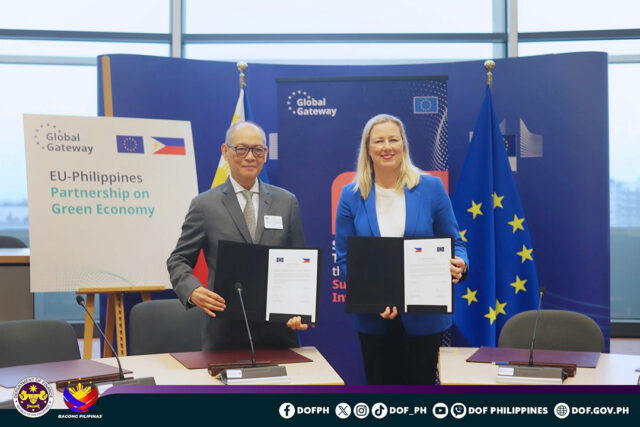
Finance Secretary Benjamin E. Diokno and European Commissioner for International Partnerships Jutta Urpilainen signed the €60 million Green Economy Programme for the Philippines at the Global Gateway Forum in Brussels, Belgium. — HANDOUT

THE PHILIPPINES and the European Union (EU) signed on Wednesday a €60-million financing deal for the Green Economy Programme.

“This program, a key part of the EU’s contribution to the Team Europe Initiative on Green Economy, aims to assist the Philippines in transitioning towards a sustainable economy,” according to a joint release from the Philippines’ Department of Finance and the European Commission.

Finance Secretary Benjamin E. Diokno said that the financing will help the country fulfill its commitment of reducing greenhouse gases by 75% by 2030.

“Through this €60-million grant, the country will benefit from various measures in reducing the production of wastes and plastics, deploying renewable energy, and improving energy efficiency,” he said.

Mr. Diokno and European Commissioner for International Partnerships Jutta Urpilainen signed the agreement at the Global Gateway Forum in Brussels.

Under the agreement, the EU will work with the National Government, local government units and the private sector to promote green investments, bonds and skills, as well as focus on “greener” supply chains and production processes.

“This includes embracing the circular economy, reducing waste and plastic usage, ensuring water supply and wastewater treatment, promoting energy efficiency and deploying renewable energy to address the impacts of the climate crisis,” according to the statement.

The Green Economy Programme will be implemented by the Deutsche Gesellschaft für Internationale Zusammenarbeit and Expertise France.

“Spain, Finland, Germany and France have also made financial contributions to the Team Europe Initiative, further cementing the EU’s commitment to fostering a sustainable green economy in the Philippines.” 

Other European Member States, including Austria, Netherlands, and Sweden, will contribute their expertise to ensure the success of this initiative,” it added.

Meanwhile, the European Commission said it is continuing to explore the possibility of a free trade agreement (FTA) with the Philippines, which could “generate significant growth and job opportunities, as well as diversify and fortify supply chains.”

“The EU is also eager to collaborate on projects aimed at developing the Philippines’ local mining industry, supporting communities, and ensuring a secure global supply of critical raw materials,” it added.

In late July, President Ferdinand R. Marcos, Jr. and European Commission President Ursula von der Leyen announced both parties are exploring the resumption of negotiations for a bilateral FTA.

Since 2017, talks for a FTA have been stalled over issues related to intellectual property rights and data exclusivity, among others. — L.M.J.C.Jocson

Seven groups eye NAIA upgrade

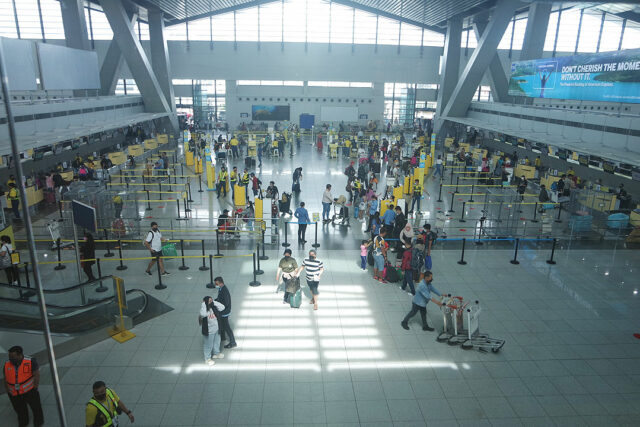
NINOY Aquino International Airport (NAIA) check-in counters. — BW FILE PHOTO

By Revin Mikhael D. Ochave, Reporter

SEVEN GROUPS have so far bought bidding documents for the rehabilitation of the aging Ninoy Aquino International Airport (NAIA), said the Transportation chief, who identified Incheon International Airport Corp. as the latest possible bidder.

“Seven have bought the bidding documents. We have met all of them. As long as there are questions, we will entertain all of the prospective bidders. We have to attend to their queries,” Transportation Secretary Jaime J. Bautista told reporters on the sidelines of the 49th Philippine Business Conference and Expo in Manila City on Wednesday.

The Department of Transportation (DoTr) has conducted one-on-one meetings with four prospective bidders, and is set to schedule similar meetings with the others, Mr. Bautista added. 

Incheon International Airport developed and currently operates the international airport in the South Korean city.

Other companies that bought bidding documents are San Miguel Holdings Corp., Manila International Airport Consortium, Cengiz Insaat Sanayi ve Ticaret A.S., GMR Airports International, Spark 888 Management, and Asia Airport Consortium.

The deadline for bid submission is on Dec. 27.

The NAIA rehabilitation project seeks to improve the airport’s annual passenger capacity to at least 62 million from 35 million.

The government opened the public bidding for the public-private partnership to upgrade and operate NAIA in August.

The contract term up for bidding is 15 years and is extendable by another 10 years.

Meanwhile, Mr. Bautista said the Philippines is in talks with other partners for official development assistance (ODA) as financing from China is no longer being pursued. 

Wala na. (Not anymore). We’re talking to other possible ODA partners,” Mr. Bautista said about funding from China.

In September 2022, the DoTr said the Philippine government would resubmit its loan applications to China for major railway projects consisting of the first phase of the Mindanao railway project or the P83-billion Tagum-Davao-Digos segment, the long-haul south Philippine National Railways, and the Subic-Clark railway project.

CVC to take controlling stake in The Medical City parent firm

GLOBAL private markets manager CVC Capital Partners is set to own 63.94% of The Medical City’s (TMC) parent firm after the completion of a mandatory tender offer.

CVC is set to take the controlling stake in Professional Services Inc. (PSI) as its affiliates Universal Healthcare Services Pte. Ltd. and Kambal Health Services Pte. Ltd. completed the tender offer on Sept. 20.

“The investment alliance between TMC and CVC seeks to expand Philippine health care capacity by augmenting resources for its five Philippine hospitals and 60-strong clinic network, the largest in the country,” TMC said in a statement on Wednesday.

The deal is expected to infuse fresh capital into TMC.

“More than the capital infusion of P12.7 billion, CVC’s global health care partnerships will facilitate TMC’s own aspirations to move the needle globally in precision medicine, while elevating Filipino health care practice as a true patient partner,” TMC Chairman Jose Xavier Gonzales said. 

CVC is focused on private equity, secondaries, and credit. It has $140 billion in assets under management.

“We are partnering with a management team led by TMC President Eugenio Jose F. Ramos that built a well-recognized leading brand in the Philippines across the whole spectrum of health care, from hospitals to clinics to the home, manifesting excellence from primary to subspecialty care practice,” said Brian Hong, CVC managing partner for Southeast Asia.

TMC claims to be the largest healthcare network in the country under a single brand. Its network consists of TMC Ortigas in Pasig, four hospitals in the provinces of Iloilo, Laguna, Pampanga, and Pangasinan, and about 60 standalone clinics nationwide.

The hospital group also has a presence in the United States territory of Guam through PSI’s wholly owned and operated Guam Regional Medical City, which is said to be the first and only private hospital in Guam. — Revin Mikhael D. Ochave

A tale of dining out… a lot

CAFÉ LAGUNA Seafood Platter

Checking out the restaurants in Cebu’s NUSTAR Mall

By Joseph L. Garcia, Senior Reporter

WE’D like to preface this review of the restaurants in NUSTAR Resort and Casino’s adjoining NUSTAR Mall by telling the world of the virtues of the Fili Hotel, the first five-star Filipino-owned hotel, built by Robinsons Land Corp. (RLC) and Universal Hotels and Resorts, Inc. (UHRI). Real natural stone (marble, onyx, and granite), and real flowers one can smell were used in the hotel, making for a truly luxurious experience.

As for the hotel’s all-day dining restaurant, the Fili Cafe, even the breakfast buffet should not be skipped. We can say with all certainty that this was one of the best breakfasts we’ve had in this lifetime. Think of the most obscure dish one can have for breakfast: they’ll probably have it. Seafood? Check. Lechon Cebu sisig? Check. Eggs Benedict? Check. An egg-white-only frittata, served not as a special order but part of the spread? Check. There’s even braised Korean pork belly and Hainanese Chicken (and that’s just one part of the section). They even have multiple kinds of hot chocolate — from sweet Western-style milk chocolate to local sikwate from Cebu.

BusinessWorld was part of a media tour last week to explore the new property’s mall. NUSTAR is the first and only integrated resort property outside Luzon. While today, the Fili hotel stands in Cebu, its five-star concept will be brought to other cities, including Metro Manila (and possibly abroad). Quoting RLC President Frederick Go, Senior Consultant for RLC Winnie Nazareth told BusinessWorld during the tour, “The Philippines has no representation of a five-star hotel, and yet we are known to be a service-oriented culture.” The rest of the complex is beginning to rise: soon there will be a four-star hotel called Grand Summit, and a five-plus-star hotel named NUSTAR.

As for the mall, there’s space for 80 retailers (according to Ms. Nazareth, all the slots all been snapped up), in a space measuring between 18,000 to 20,000 sqm. Luxury brands, some of whom will have their first outposts in Cebu, will open beginning December of this year.

NUSTAR MALL’S RESTAURANTS
After the filling breakfast at Fili, we were all trooped to Cafe Laguna, named after the founders’ home province. We were served familiar Filipino favorites like salmon sinigang (a soup soured with tamarind), deep-fried kangkong and crablets, kare-kare (a peanut-based stew), and cochinillo (suckling pig). While the sun was still up, we were brought to Abaca Baking Company, a well-known Cebu chain serving brunch favorites and baked goods. While already full from both breakfast and lunch, we will say that this is the source of one of the best chocolate-chunk cookies one can have in this country. It’s crispy on the outside and soft and chewy on the inside, sprinkled with salt. The fact that it’s almost as big as a baby’s face and had chocolate chunks and not tiny chips didn’t hurt either.

Kazuwa Prime, which has a less-luxurious branch in Makati, offered up a teppanyaki show with the chefs performing with their food. During the course of the dinner, our chef tried to shoot eggs into our mouth (failing to catch it was this reporter’s deficiency), and made a luxurious beef teppanyaki with A5 Wagyu (the highest grade possible for the Japanese beef). Sadly, it turns out that this should be had in small doses, since the marbled fat of the beef tends to feel like chewing butter after having too much. We will say that the first three bites were heaven, though.

For a late lunch the next day, we headed over to Taiwan Shabu-Shabu. The broth base was mild, and while dipping slices of beef and vegetables into the mild broth was comforting, it provided little excitement. Still, we can imagine winding down after a few rounds in the casino right here. We moved on to Koshima, a more luxurious offering of Nonki, a Japanese chain that operates within the Visayas and Mindanao. We had truffle sushi (with the truffle infused into the rice), and a very thick tonkatsu (pork cutlet), but even then, they pale in comparison to the wagyu hotpot. The beef slices dipped into the soup were some of the softest things one can put in one’s mouth, and the broth, by then absorbing all of the meat juices, was restorative.

The last meal we had at the mall were drinks and a proper cochinillo at familiar Barcino, and this reporter and the other guests used the time to decide which restaurants they would come back to, should they ever find their way to Cebu again. The winners were definitely the Fili Cafe (and the luxury restaurant Mott32, also in the complex), but also Koshima.

Metro Manila’s office vacancy rate seen to have risen in Q3

PHILIPPINE STAR/ MIGUEL DE GUZMAN

By Sheldeen Joy Talavera, Reporter

THE vacancy rate for Metro Manila office property rose by 21.9% in the third quarter (Q3) mainly driven by the completion of new office buildings, Colliers Philippines said.

About 167,000 square meters (sq.m.) of vacant spaces were recorded during the period, higher than the 137,000 sq.m. seen in the same period last year and 78,000 sq.m. in the previous quarter, Colliers Associate Director for Office Services Kevin Jara said during a briefing on Wednesday.

“Metro Manila recorded a marginal rise in office vacancy due to the completion of new office buildings and spike in vacated spaces,” Colliers said in its report.

Colliers said approximately 11.3 million sq.m. of office space were occupied as of September.

“We are now at 502,000 square meters of office space transactions in the first nine months of 2023. That’s marginally better than [493,000] that was done in the first nine months of 2022,” Mr. Jara said.

In the third quarter, traditional offices comprised the majority of office space deals at 98,000 sq.m., including government agencies, telcos, insurance firms, and flexible workspace operators, the property consultancy firm said. The figure has risen from 69,000 sq.m. previously.

The information technology and business process management (IT-BPM) sector recorded 70,000 sq.m. of transacted spaces, lower than the 93,000 sq.m. a year earlier.

Philippine offshore gaming operators (POGOs) reportedly transacted about 29,000 sq.m., which was higher than the 7,000 sq.m. last year, but lower than the 55,000 sq.m. transacted in the second quarter.

“Net demand in this quarter is still positive. However, we did see a slowdown, if you look at quarter-on-quarter figures for net demand, due to some surrendering of leases in non-renewals from some POGOs and BPOs in the quarter,” Mr. Jara said.

During the third quarter, the demand rose by 10.78% to 185,000 sq.m. of office spaces from 167,000 sq.m. in the third quarter last year and 170,000 sq.m. in the second quarter of 2023.

Mr. Jara said that Colliers’ year-end demand forecast of 220,000 sq.m. is still on track.

A total of 202,000 sq.m. of new office space was delivered during the third quarter, contributing to the total office stock of about 14 million sq.m. in Metro Manila.

“We are still expecting significant supply to come online in the remainder of 2023 with the completion of buildings like Megaworld’s International Finance Center in Uptown,” he said.

Pumpkins, Morticia Addams inspire Halloween mocktails and cocktails

THE COMING long weekend ushers in the spooky season. Whether hosting a Halloween get-together with family and friends, or eyeing a much-awaited me-time horror movie marathon, a refreshing drink is the ideal partner.

In a nod to the jack-o-lantern tradition, bar expert Gioseppe Racelis created the Caramel Pumpkin Pietini. A blood curdling fusion of vodka and pumpkin puree, the concoction promises a touch of grim in celebration of the supernatural.

“With vodka, there is the warmth and kick for warding off the cold and the unknown,” he explained. “The cinnamon gives a hint of flavor and aroma, evoking the cozy yet festive mood.”

With over 13 years of experience in the industry and a holder of a Level 2 Certification on Wine & Spirit Education Trust (WSET), the former Assistant Food and Beverage Manager of Discovery Suites Manila understands that grown-ups, too, deserve a treat this All Hallow’s Eve.

“The caramel syrup adds a sweet and sticky twist — reminiscent of candies,” said the De La Salle-College of Saint Benilde (DLS-CSB) School of Hotel, Restaurant, and Institution Management (SHRIM) educator.

Pumpkin Melody, an original mocktail by aspiring bartender and Benilde SHRIM Hospitality Management major Sheila Marie Cervantes Sih, capitalizes on the immunity boost of the same fruit.

“It contains a variety of vitamins that can fend off the common cold,” she explained. “When blended with comforting cinnamon and ginger, we find ourselves savoring a delicious, healthy, and filling delight that everyone can enjoy.”

For those who are looking for more gloom and doom, the two-time champion of the Young Hotelier Exposition’s Creative Cocktail Competition suggests Nightmarish Rose — her personal homage to Morticia Addams of the classic Addams Family.

“I was utterly captivated by her monochromatic elegance,” she shared. “It was this fascination that inspired me to create the mixture.”

The cocktail highlights the sweetness of strawberries, the delicate flavor of roses, and with an added touch of activated charcoal, stands true to the Addams’ signature hue.


Caramel Pumpkin Pietini by Gio Racelis
Ingredients:

45 ml vanilla vodka

30 ml pumpkin puree

30 ml caramel syrup

30 ml full cream milk

Dash of cinnamon for garnish

Procedure:

1. In a shaker, add all the ingredients and shake vigorously without ice.

2. Strain and serve in a martini glass rimmed with caramel syrup.

3. Garnish with a dash of cinnamon on top.

Pumpkin Melody by Sheila Marie Cervantes Sih
Ingredients:

2 tbsp honey

1 tbsp pumpkin puree

½ tsp cinnamon powder

½ tsp ground ginger

2 cups dairy of choice

1 cinnamon stick

Whipped cream for garnish

Procedure:

1. In a pot, heat your dairy. Do not bring it to a boil.

2. Add the pumpkin puree, spices, and honey. Whisk it well.

3. Allow it to simmer to reach a creamy consistency.

4. Pour in your favorite mug.

5. Garnish with whipped cream, cinnamon powder, and a cinnamon stick.

Nightmarish Rose Cocktail by Sheila Marie Cervantes Sih

Rose Simple Syrup Ingredients:

1 cup sugar

1 cup water

½ tsp of rose water

Cocktail Ingredients:

60 ml strawberry-infused gin

15 ml lemon juice

1 egg white

½ tsp of activated charcoal powder

Procedure:

For the rose syrup:

1. Heat the sugar and water in a pot and stir until the sugar dissolves.

2. Turn off the heat.

3. Allow the syrup to slightly cool before adding rose water. Be careful, as rose water is quite strong.

For the cocktail:

1. In a shaker, add all the ingredients and shake vigorously.

2. Add ice and shake it once more.

3. Double strain and serve in a chilled martini glass.

4. Garnish with strawberries.

ADVERTISEMENT
ADVERTISEMENT