Home Blog Page 4109

Simpler tech solutions to boost MSMEs’ digital transformation — expert

TIRACHARDZ-FREEPIK

SMALL BUSINESSES with limited technical expertise can build, customize, and deploy digital solutions tailored to their needs, global software company Kissflow said.

With more micro-, small- and medium-sized enterprises (MSMEs) being urged for digital transformation, easier technology solutions are needed to spur faster adoption, Dinesh Varadharajan, chief product officer at Kissflow, said in an interview with BusinessWorld on Wednesday last week.

“Low-code, no-code platforms” can democratize technology use among small businesses, which can be as simple as drag-and-drop, he noted.

“Business users can’t understand code and programming. We need to create a product that allows businesses to solve their own problems,” he said. “Just drag and drop to create an application for a specific need.”

“For example, if I am from the HR [human resources] function, and I want to automate the performance appraisal application, then I should be able to create it myself,” he added.

With full implementation by 2030, digital technology could create up to P5 trillion in economic value, equivalent to about 27% of the Philippines’ gross domestic product in 2020, according to a study conducted by global tech advisory firm Access Partnership and commissioned by Google.

This requires the Philippines to embrace digital skills training and education, accelerate digital adoption and innovation, and tap opportunities for digital trade, the study said.

“Unless these MSMEs change the way they operate, there is a significant threat to them,” Mr. Varadharajan said regarding more digital native competitors entering the market.

“They need to digitize faster through simpler products, especially those who do not have a huge IT [information technology] function,” he added, commenting on the opportunity Kissflow sees in the country.

With its core value ‘Keeping It Smart and Simple’ as an acronym in its brand name, Kissflow aims to modernize the legacy system of enterprises, small or large, by creating efficient applications around it, said Mark Anthony B. Zaplan, country sales manager for the Philippines at Kissflow.

“Business units, everyone in the organization, can build their own application as soon as they need it,” Mr. Zaplan said. “It is not exclusive to IT and programmers.”

Kissflow has served enterprises in the Philippines for the last seven years, garnering 30 customers to date, with plans to tap business districts outside the capital region, Mr. Zaplan said.

He noted the Philippines as the company’s first leg of expansion in the region.

Mr. Varadharajan said Kissflow is growing its global customer base of 1,600 companies, aiming to be one of the top two low-code industry players in the next few years. — Miguel Hanz L. Antivola

UnionBank posts lower net profit at end-Sept.

BW FILE PHOTO

UNION BANK of the Philippines, Inc. (UnionBank) saw a 19.99% decrease in its net income in the first nine months due to higher expenses following its acquisition of Citigroup, Inc.’s consumer business in the country.

The bank booked a net income of P8.1 billion in the first nine months, down from the P10.13 billion recorded in the same period last year, it said in a disclosure to the local bourse on Tuesday.

Its quarterly report was unavailable as of press time.

“Our diversified consumer business allowed us to cover for the one-time costs that we needed to recognize this year. If we exclude the impact of these non-recurring costs, our RoE (return on equity) would be in double digits. Our topline revenues remain strong. We are confident that once we complete the integration, we can show above-industry profitability we have been known to deliver,” UnionBank President and Chief Executive Officer Edwin R. Bautista said.

The Aboitiz-led bank’s net revenues climbed by 48% year on year to P52.8 billion in the nine-month period.

UnionBank saw its net interest income rise by 34% to P37.31 billion at end-September from P27.78 billion in the same period last year as its loan book grew by 18% to P530.99 billion, driven by the 22% increase in consumer loans.

Interest income climbed to P56.745 billion in the period from P34.631 billion a year prior. Interest expenses surged to P19.438 from P6.856 billion.

“The bank has one of the highest proportions of consumer to total loans in the industry at 56%, resulting in the bank’s above-industry net interest margin of 5.3%,” it said.

UnionBank set aside loan loss provisions worth P9.3 billion in the first nine months, up from P2.33 billion in the same period last year.

Non-interest income surged by 93% to P15.5 billion amid improved fee-based earnings from customer transactions.

Meanwhile, operating expenses jumped by 63% to P33.51 billion from P20.51 billion due to the bank’s acquisition of Citi’s consumer business and as UnionDigital Bank began operating.

“These new businesses were only included as part of the banking group in the second half of 2022. At the same time, the bank has spent a total of P3.6 billion on one-time expenses mainly coming from the integration of the Citi consumer business,” UnionBank said.

“Costs were higher in the third quarter mainly due to integration and other costs that are non-recurring. The integration costs increased since we allocated more time and resources to ensure smooth migration of the acquired Citi consumer business. We also spent on marketing and customer engagement programs to capitalize on the growing consumer segment,” UnionBank Executive Vice-President and Chief Financial Officer Manuel R. Lozano added.

UnionBank’s P55-billion acquisition of Citi’s Philippine consumer banking business was completed in August 2022.

On the other hand, UnionDigital was granted a digital banking license by the Bangko Sentral ng Pilipinas in July 2021. It began operating in July 2022.

Meanwhile, total deposits grew by 6% year on year to P724.7 billion as of September.

UnionBank’s assets climbed by 8% to P1.14 trillion at end-September from a year prior.

The bank’s shares rose by 30 centavos or 0.51% to end at P59.50 apiece on Tuesday. — A.M.C. Sy

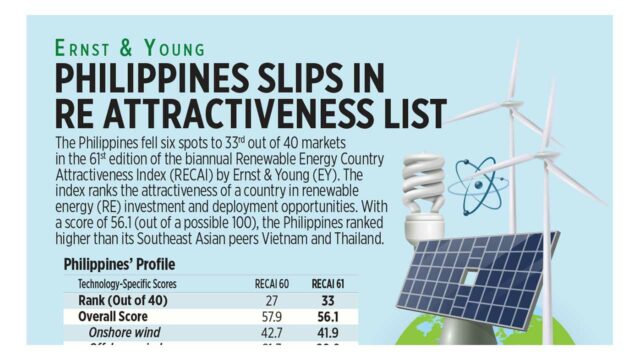
Ernst & Young: Philippines slips in RE attractiveness list

The Philippines fell six spots to 33rd out of 40 markets in the 61st edition of the biannual Renewable Energy Country Attractiveness Index (RECAI) by Ernst & Young (EY). The index ranks the attractiveness of a country in renewable energy (RE) investment and deployment opportunities. With a score of 56.1 (out of a possible 100), the Philippines ranked higher than its Southeast Asian peers Vietnam and Thailand.


Ernst & Young: Philippines slips in re attractiveness list

Arts & Culture (11/01/23)


Nayong Pilipino convenes cultural education research summit

THE NAYONG Pilipino Foundation (NPF) convened its 3rd Research Summit on Cultural Education from Oct. 25 to 27. The summit brought to light the state and condition of cultural heritage education in the Philippines and brought together participants from different sectors to advocate cultural heritage education for lifelong learning. Its various talks and discussions were held at the Philippine Normal University in Manila, the National Commission for Culture and the Arts, and the Ateneo de Zamboanga University over the course of three days.


CCP opens children’s month with art-filled event

THE CULTURAL Center of the Philippines (CCP) will have “Himig Himbing: Isang Araw Para sa Mga Batang Sining,” a whole-day art-filled, child-friendly event, on Nov. 5 at the Tanghalang Ignacio B. Gimenez (CCP Blackbox Theater). The mini children’s festival provides a safe space for children to express themselves through arts and experience Philippine cradle songs and lullabies. With a donate-what-you-can scheme, children and their nurturers can learn to play an indigenous instrument, explore music, dance and theater, learn about the art of coconut frond-folding, design t-shirts, weave dreamcatchers, make mandalas, monoprint on glass, and more. Virtual reality stations, short film and video screenings, and books and merchandise booths will also keep children entertained. CCP will launch its first publication on Philippine lullabies, titled Himig Himbing: Mga Heleng Atin, A Collection of Cradle Songs From the Philippines, as well as premiere eight music videos of the eight selected lullabies for the second edition of Himig Himbing. Finally, there will be live performances by Bituin Escalante, Baihana, Ivar Fojas, Aleron Male Choir, and Lorelie Macaspac.


Instituto Cervantes concert pays tribute to Luis Eduardo Aute

INSTITUTO Cervantes de Manila, in collaboration with the Embassy of Spain in the Philippines, is presenting the concert Born in Manila (A Tribute to Aute), on the occasion of the 80th anniversary of the birth of the Manila-born singer-composer and painter Luis Eduardo Aute. This event will be held on Tuesday, Nov. 7, at the Carlos P. Romulo Auditorium at the RCBC Plaza in Makati. The screening of Con tu latido, filmed in distinct locations in Intramuros and featuring Filipino singers Bituin Escalante and Mark Anthony Carpio performing some of the songs of Luis Eduardo Aute, will open the event. This will be followed by live performances by some of the singers including Sheila Ferrer and Toma Cayabyab. The concert will also include the special participation of Spanish singer Rosa León, who will be arriving from Spain for this occasion. The early years of her career as a singer, in the 70’s, was closely linked to Aute, as she had popularized some of his greatest songs, such as “Las cuatro y diez” and “Al alba.” Entrance is free, on a first come, first served basis.


KCC, NCCA celebrate Filipino and Korean traditional clothing

IN A SPLENDID celebration of cultural diversity and heritage preservation, the Korean Cultural Center in the Philippines (KCC) and the National Commission for Culture and the Arts (NCCA) will present “Threads of Tradition: A Celebration of Korean and Philippine Traditional Attires.” The free event, set for Nov. 8, will take place at the Leandro Locsin Auditorium located at the NCCA Building in Intramuros. The invited speakers will have a discussion on the history and significance of Hanbok and Filipiniana respectively. Following the insightful lectures, attendees will have the exciting opportunity to experience wearing traditional clothing from either country. This interactive session will allow participants to immerse themselves in the rich and vibrant cultures of Korea and the Philippines by donning these beautiful garments. Registration is free and open to everyone interested. To secure a slot, visit https://bit.ly/ThreadsofTradition for more details.


Big Bad Wolf goes to Bacolod for the first time

THE BIG Bad Wolf book sale is going to Bacolod from Nov. 3 to 12, bringing over two million books to residents of Bacolod and nearby cities, who can expect exclusive deals, promos, giveaways, and discounts of up to 95% off on selected books. Big Bad Wolf’s roster will include bestsellers, classics, contemporary fiction, non-fiction, science fiction, cookbooks, design books, architecture books, thrillers, young adult titles, and children’s books. The sale will be at the Ground Floor of SM City Bacolod’s North Wing. For more information regarding Big Bad Wolf’s current and upcoming Book Sales, visit their website or check out their social media accounts on Facebook or Instagram.


CAST PH staged readings return this November

AFTER a long hiatus due to the pandemic, Company of Actors in Streamlined Theatre (CAST) is bringing back its staged reading festival for a fourth season this November. Entitled “‘Tis The Season — In Search of The Christmas Spirit,” the festival will feature three plays that tackle everything we love (and hate) about Christmas. Themes of tradition, reconciliation, and sacrifice, will be shared with audiences with the hope of discovering the true meaning of Christmas. The plays will take place over the course of three weeks (every Monday) starting on Nov. 20 with Play #1 directed by Caisa Borromeo. The cast features Sheila Francisco, Topper Fabregas, Jillian Ita-as, accompanied by Rony Fortich on the piano. On Nov. 27, Play #2 will be directed by Cathy Azanza-Dy. The cast features Jaime Del Mundo, Justine Narciso, and Gabby Padilla. On Dec. 4, Play #3 will be directed by Jaime Del Mundo. The cast features Nelsito Gomez, Mikkie Bradshaw-Volante, Maronne Cruz, Noel Rayos, and Robbie Guevara. All performances will be held in The Mirror Theatre Studio, 5th floor of the SJG building, Kalayaan Ave., in Makati. Each staged reading performance is P400. For ticket inquiries and reservations, contact 09453167768 or email castph20@gmail.com.


CCP holds photography group exhibit

IN THE upcoming featured exhibit organized by the Cultural Center of the Philippines (CCP) Visual Arts and Museum Division, titled “Braille for the Seeing,” participating Filipino contemporary artists aspire to rekindle the profound joy of encountering art directly by delving into the diverse facets of contemporary photography, redefining, re-examining, and reimagining the medium. A CCP Exhibition Venue Grant Program recipient in 2020, the exhibit opens on Nov. 7 at the CCP’s Bulwagang Roberto Chabet, located on the third floor of the Tanghalang Ignacio B. Gimenez (CCP Blackbox Theater). It features works by Poklong Anading, Idan Cruz, Teo Esguerra, Angel Flores, Neo Maestro, Rhaz Oriente, Gary-Ross Pastrana, Angela Silva, Gerome Soriano, Jan Sunday, Stephanie Syjuco, Miguel Lorenzo Uy, and MM Yu. The exhibit highlights photography, as it evolves into different sculptural, physical, and material forms, interplaying with light, space, and scale; becoming interactive, through computer programs, chemical processes, and prompts. It runs until Dec. 10.


Silverlens Manila presents Geraldine Javier solo exhibit

SILVERLENS Gallery in Manila will be displaying a major solo exhibition by Geraldine Javier, opening on Nov. 18. Called “A Tree is Not a Forest,” it will take up three spaces of the gallery, tackling the importance of natural science discoveries and their relation with today’s environmental concerns. As an artist-farmer, Ms. Javier explores the processes of nature every day. Her recent investigations have expanded to contemplate the work of historically significant naturalists David Attenborough, Maria Sibylla Merian, Leonard Co, and Jane Goodall. Through paintings and textile installations, she responds with a plethora of mediums and techniques, and the potential of flora as collaborator in storytelling. A walkthrough with the artist will take place on Nov. 18, followed by an opening reception. The exhibit runs until Dec. 20.


Ballet Philippines brings Filipino Christmas tales to the stage

THE PHILIPPINES’ most beloved myths, legends, lore, and fairytales will come to the stage this December thanks to Ballet Philippines. From Dec. 15 to 17 at the Theatre at Solaire, Christmas Fairytales will be the holiday ballet offering that brings together the most beloved heroes and villains as well as princes and evil queens, from Ali Baba and the thieves to Cinderella, the Nutcracker, Swan Lake and Sleeping Beauty. Tickets are now available at ballet.ph, TicketWorld, and the Solaire Box Office.


If you want more globalization, build better walls

COMMONS.WIKIMEDIA.ORG

THE FALL of the Berlin Wall proved to be one of history’s great misdirections. The world that emerged after the Cold War turned out to be one of fortified walls rather than open borders. And the latest example of the breaching of a wall led to the biggest mass murder of Jews since the Holocaust. “Tear down this wall” may have had a wonderful resonance at a particular place and time. But much to the dismay of globalization’s most ardent champions, “put up this wall and make it impregnable” may well be the way of the future.

Elizabeth Vallet, of the University of Quebec, calculates that the world has 74 border walls, six times the number at the end of the Cold War, extending for more than 20,000 miles. The most sophisticated wall is probably Saudi Arabia’s 560-mile wall on its border with Iraq, along with a similar border fence with Yemen. Another world-class wall is Pakistan’s 2,000-mile wall with India, consisting of a dual chain link fence and barbed wire, reinforced by a 400-mile-long ditch, 14 feet wide and 11 feet deep and 1,000 forts and border posts. Unlike the Great Wall of China, the Great Wall of Pakistan is visible from space thanks to permanent floodlights. Compared with these two goliaths, Israel’s “iron wall” with Gaza is both short and unsophisticated.

In his new book, The Guarded Age: Fortification in the Twenty-First Century, David Betz, a professor at King’s College, London, points out that walls are only part of a mass of fortifications rising across the planet. Some are straight out of sci-fi: Israel’s Iron Dome air defense system is a wall in the sky made of radar beams and interceptor missiles. Some are medieval. The new US Embassy in South London is a postmodern motte and bailey: The 200-foot glass cube is raised up on a hill, set back from the nearest street by more than 100 feet, and protected by a “pond” and a network of hidden ditches.

Some fortifications are ballyhooed: Donald Trump did more crowing than building on the southern border. Others proceed by stealth: Turkey has constructed a 475-mile concrete wall along its border with Syria and Xi Jinping has built a new “Southern” Great Wall as part of his “Covid mitigation” strategy. Some fortifications are deliberately visible: Look at the razor wire that surrounds many public buildings (or private houses in countries such as South Africa). Many are concealed. Major cities are littered with concrete benches and reinforced bollards designed for “hostile vehicle mitigation.”

The fortification of the world is driven by more than national hostilities. Three other forces are at work.

Border fortifications are designed to keep out illegal immigrants as well as foreign foes. Trump might have proclaimed his love of walls to anyone who will listen, but many of the most successful wall-builders signal left while driving right. The US is currently building a 20-mile border fence in Texas’ Rio Grande Valley despite Joe Biden’s declared hostility to Trump’s wall.

The ever-present threat of terrorist attacks is raising up fortifications into the heart of big cities. Urban fortifications are unobtrusive but pervasive: unobtrusive to prevent cities from seeming like war zones, but pervasive enough to deal with the possibility that anybody might turn out to be a terrorist, and ordinary objects, from cars to backpacks, might turn into weapons.

The other thing injecting fortification into everyday life is fear of disorder. Some 17 million Americans live in gated communities. The emerging world is splitting into a world of slums and a world of walled cities: Dainfern, a suburb of Johannesburg, sits behind a 13-foot-high wall topped with an electric fence and equipped with steel rods to detect tunneling and seismic sensors to pick up anybody penetrating the perimeter. The brochures call it a “security village.”

Fortification is big business. One 2021 report calculated that the “global perimeter security market” is worth $59 billion. The US Embassy in London — the castle of Nine Elms — cost more than $1.5 billion. It is also innovative. The UK hard landscaping firm Marshalls produces shallow-mount bollards that can be planted in cities where you can’t dig very deep because of the density of underground utilities but which can nevertheless withstand significant impact. Architectural Armour, another UK company, provides “architecturally sensitive” reinforced glass, panic rooms, garden furniture. Gladiator Solutions, a US firm, specializes in reinforcing schools and their interiors to cope with armed attacks, part of a burgeoning sector that feeds on the fears of American parents and community leaders.

The fortification business is also unusual in that it gets many of its best ideas from the distant past. Several fortifications in Mali are constructed on the “star fortress” pattern first developed by 17th century military engineer Sebastien Le Prestre de Vauban. One of the most versatile “fortification products” is HESCO Bastion, made by a British firm in Bradford, which consists of hinged wire mesh containers, similar to the sort used in medieval times, that can be filled with stone and earth and then assembled into do-it-yourself fortifications: Lego meets IKEA meets the Dark Ages.

Even before the Hamas atrocities on Oct. 7, the fortification business was set to boom thanks to the combination of pressure from illegal immigrants and deteriorating security in emerging countries. In that respect, Oct. 7 will act as another Sept. 11. Not only will the Israelis improve the fortifications which proved to be insufficient against Hamas, but other countries, shaken by mass protests and rising terror threats, will dig in as well.

Which raises some obvious questions: Is this emphasis on wall-building wise? Should the Israelis give in to their instinct to respond to the breach of a wall with better walls? And should other governments follow suit? Or should we perhaps change course before the world becomes fully medieval?

Two very different groups object to the wallification trend: the idealist and the realist. The idealists argue that the way to defuse discontent is to build bridges rather than walls. The realists argue that Hamas’ incursion demonstrates that walls don’t work very well, creating a false sense of security, distracting attention from better use of resources and freezing conflicts in place. Hamas fighters knocked down the Gaza fence with bulldozers, then drove through the gaps, or sailed over it in gliders, or went round it in boats. The favorite example of the realists is the Maginot Line, which absorbed 6% of France’s military budget from 1930 to 1937 but did nothing to stop the German offensive in 1940. The Germans attacked through the sparsely defended Ardennes forest instead.

The idealist argument need hardly detain us in the age of Hamas. Many of the people who are most vociferous in their opposition to walls in theory end up building them in practice: Witness the Europeans, who have been building walls to control the flow of migrants, particularly since the migration surge of 2016, or the pope, who lives in Vatican City surrounded by what Trump called “the biggest wall of them all.” Moreover, there is no contradiction between building walls and building bridges: People are more inclined to engage in generous negotiations if they feel safe.

The realist argument is more serious. The realists are right to point out that you shouldn’t rely purely on a wall: You need to link walls with other strategies, from diplomacy to defensive strikes. But the logic of the realist position can point equally well to building better walls and staffing them better. One cause of the tragedy on Oct. 7 was that the wall was minimally staffed, in part because Israel had fallen into the habit of relying on high-tech gadgets rather than human guards. Walls perform too many functions at once to think of abandoning them rather than supplementing them: They are not only defensive barriers against hostile forces or illegal immigrants but also secure bases for offensive operations.

The dream of a borderless world was always an impossible one. The more mobile the world becomes, the more we need to build safeguards to make sure people are not abusing that mobility. The great challenge of our time is not to get rid of walls. It is how best to mix walls with bridges so that we can maximize the upside of globalization while always being on guard against the downside.

BLOOMBERG OPINION

Aboitiz group’s income down 21% to P7.6 billion

ABOITIZ Equity Ventures, Inc. (AEV) saw a 21% decrease in its net income for the third quarter, primarily due to reduced nonrecurring gains, the listed conglomerate announced on Tuesday.

In a stock exchange disclosure, AEV said that its net income for the third quarter dropped to P7.6 billion from the previous year’s P9.6 billion.

“The company recognized nonrecurring gains of P1.4 billion during the period, primarily due to foreign exchange gains arising from the revaluation of US dollar cash and liquid financial instruments, compared to the P2.6 billion in nonrecurring gains for the corresponding period in 2022,” AEV said.

In the first nine months, AEV said its net income dropped 16% to P18 billion from P21.4 billion net income a year ago.

“The company recognized nonrecurring gains of P738 million, which was lower than the P5.3 billion in nonrecurring gains recorded during the same period in 2022,” AEV said.   

Meanwhile, Aboitiz Power Corp. (AboitizPower), AEV’s power segment, reported a consolidated net income of P8.9 billion for the third quarter, marking a 7% decrease from the P9.6 billion net income achieved in the same period last year.

Its nonrecurring gains were lower at P134 million for the July-to-September period compared to the P325 million last year.

“Without these one-off gains, core net income for the third quarter of 2023, was P8.8 billion, 5% lower year on year,” AboitizPower said in a separate disclosure.

The company attributed the decrease in core net income to its distribution group’s “timing of refunds” following rate adjustments mandated by the Energy Regulatory Commission (ERC) in a resolution issued last year.

The ERC issued Resolution No. 14, Series of 2022, revising the rules for automatic cost adjustments and true-up mechanisms for distribution utilities, aiming to “promote transparency in the detailed calculation of different components of the power bill.” — Revin Mikhael D. Ochave and Sheldeen Joy Talavera

Talino Venture Studios secures $5 million from Chemonics for fintech growth

TALINO VENTURE STUDIOS, a venture studio for financial technology (fintech), announced on Tuesday a $5-million investment from global sustainable development consultancy Chemonics International.

Closing the financial inclusion gap in the Philippines requires inclusive and scalable technology solutions, said Jamey Butcher, Chemonics president and chief executive officer, in an e-mailed press release to reporters.

“We can create groundbreaking, scalable solutions with the potential to help millions,” Mr. Butcher said on combining Talino’s record of developing “high-impact” technology and Chemonics’ access to global expertise.

Based on the 2021 Global Findex Database, more than half (51%) of Filipino adults had accounts with banks or mobile money services, an increase from 34% in 2017.

The Philippine government aims to increase the proportion of Filipinos with bank or financial services accounts to 70% by 2024.

Winston L. Damarillo, chief executive officer of Talino Venture Studios, noted sustainable innovation as a driver for fulfilling the inclusive fintech goals of the partnership among the local unbanked citizens and other low-income economies.

“We want to replicate the innovation we started here in the Philippines to the world, where Chemonics has presence in 98 countries,” Mr. Damarillo told BusinessWorld in a phone message.

Talino has helped build fintech companies such as BayaniPay, a neobank serving the Filipino-American community in the United States; Asenso, which caters loans and tailored funding of small businesses; Earnie, which manages the payments and invoicing of Filipino freelancers with US employers; and Saphron, which uses artificial intelligence to provide microinsurance for small businesses.

“While Talino’s ventures are built on Filipino innovation, our partnership with Chemonics enables us to go beyond the Filipino diaspora and make a positive impact on the lives of many more people,” Mr. Damarillo said on further expanding financial inclusion. — Miguel Hanz L. Antivola

OFCs’ domestic claims rise in Q2

BW FILE PHOTO

DOMESTIC CLAIMS of nonbank financial institutions grew in the second quarter, the Bangko Sentral ng Pilipinas (BSP) said on Tuesday. 

Domestic claims of nonbank financial firms climbed by 19.2% year on year to P8.61 trillion in the second quarter from the P7.22 trillion seen in the comparable year-ago period, data from the BSP’s Other Financial Corporations Survey (OFCS) showed.

The year-on-year growth was faster than the 12.2% expansion in the first quarter of 2023. Quarter on quarter, domestic claims rose by 4.7% from P8.22 trillion previously.

The OFCS analyzes the assets and liabilities of the OFC sector. It uses standardized report forms as required by the International Monetary Fund, including financial statements from insurance firms, holding companies, government financial institutions, investment companies, other financial intermediaries, and trust institutions.

“The year-on-year growth in the other financial corporations’ domestic claims in the second quarter of 2023 was due to higher claims on the depository corporations, the other sectors, and the central government,” the BSP said in a statement.

“In particular, the other financial corporations’ claims on depository corporations expanded significantly owing to the sector’s increased deposits in banks and holdings of bank-issued equity shares,” it said.

Claims on depository corporations surged by 42.2% year on year to P2.16 trillion and went up by 5.5% compared with the first-quarter level.

“Likewise, the other financial corporations’ claims on other sectors, particularly the private sector, grew due to the sector’s higher investments in equity shares and debt securities issued by other nonfinancial corporations as well as the uptick in the loans extended to the households,” the BSP said.

Claim on other sectors rose by 10.1% year on year to P4.35 trillion in the second quarter and was 3.8% higher than the previous quarter’s level. 

“Meanwhile, claims on the central government expanded due to the other financial corporations’ increased holdings of government securities,” the central bank said.

OFCs’ net claims on the central government rose by 23.4% year on year to P2.16 trillion in the second quarter of 2023. This was up by 9.1% from the prior three-month period.

Net foreign assets held by other financial corporations jumped 51% to P348.1 billion from P230.7 billion in the comparable year-ago period, BSP data showed. It rose by 14.5% on a quarterly basis.

Meanwhile, claims of OFCs on nonresidents rose by 12.9% year on year to P519.12 billion from P420.99 billion in the second quarter of 2022.

Liabilities to nonresidents edged up by 1.2% year on year to P170.73 billion. — Keisha B. Ta-asan

Child padlocked in Polish grave reflects ancient supernatural beliefs

ARCHAEOLOGISTS in Poland have uncovered the remains of a 17th-century child padlocked to his grave to stop him rising from the dead, a discovery that turns the spotlight on beliefs in vampires as Halloween approaches.

The bones of the six- or seven-year-old are the most recent find in a cemetery in the northern village of Pien dating from an era that viewed ghosts, zombies and other supernatural apparitions as more than merely fancy-dress options.

“This is a cemetery for rejected people, who were certainly feared after death, and perhaps also during life … who were suspected of having contacts with unclean forces, people who also behaved differently in some way,” said Dariusz Polinski, a researcher on medieval burials at Nicolas Copernicus University in the city of Torun.

The child was buried facedown with a triangular iron padlock under its foot, in a probable effort to keep it from sitting up and leaving the grave to feast on the living, he added.

“These are people who, if it was done intentionally, were afraid of … contact with these people because they might bite, drink blood,” Mr. Polinski said.

The child’s grave was desecrated at some point after burial and all bones removed apart from those in the legs.

Archaeologists have found other methods used to stop the living dead, with Mr. Polinski describing strange practices found in some burials.

“There were also a large number of graves with stones … which were also supposed to protect against the deceased, placed in various places, for example on the elbow, on the larynx or on the neck.” — Reuters

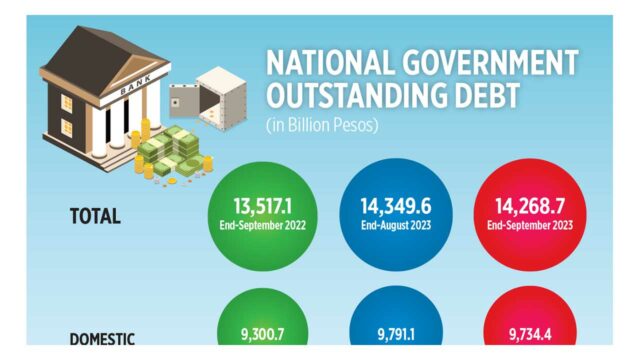
National Government outstanding debt

THE NATIONAL Government’s (NG) outstanding debt slipped to P14.27 trillion as of end-September due to the net redemption of foreign and domestic debt, the Bureau of the Treasury (BTr) said. Read the full story.

National Government outstanding debt

New laws to regulate AI would be premature

FREEPIK

ALL OF A SUDDEN there is a flurry of activity around artificial intelligence (AI) policy. President Joe Biden is scheduled to issue an executive order on the topic today. An AI safety summit is being held in the UK later this week. And last week, the US Senate held a closed-door forum on research and development in AI.

I spoke at the Senate forum, convened by Majority Leader Chuck Schumer. Here’s an outline of what I told the panel about how the US can boost progress in AI and improve its national security.

First, the US should allow in many more high-skilled foreign citizens, most of all those who work in AI and related fields. As you might expect, many of the key contributors to AI progress, such as Geoffrey Hinton (British-Canadian) and Mira Murati (Albanian), come from abroad. Perhaps the US will never be able to compete with China when it comes to assembling raw computing power, but many of the world’s best and brightest would prefer to live in America. The government should make their path as easy as possible.

Artificial intelligence also means that science probably is going to move faster in the future. That applies not only to AI itself, but also to the sciences and practices that will benefit, such as computational biology and green energy. The US cannot afford the luxury of its current slow procurement and funding cycles. Biomedical science funding should be more like the nimble National Science Foundation and less like the bureaucratic National Institutes of Health. Better yet, Darpa models could be applied more broadly to give program managers greater authority to take risks with their grants.

Those changes would make it more likely that new and forthcoming AI tools will translate into better outcomes for ordinary Americans.

The US should also speed up permitting reform. Construction of more and better semiconductor plants is a priority, both for national security and for AI progress more generally, as recognized by the CHIPS Act. Yet the need for multiple layers of permits and environmental review slows down this process and raises costs. There is a general recognition that permitting reform is needed, but it hasn’t happened.

As the rate of scientific progress increases, regulation may need to adapt. Many critics have charged that FDA approval processes are too slow and conservative. That problem could become much worse if the number of new candidate drugs were to increase by two or three times. It is unrealistic to expect the government to become as fast as the AIs, but it can certainly be faster than it is now.

What about the need for more regulation?

In the short run, the US can beef up, reform and reconsider what is sometimes called “modular regulation.” If an AI were to issue health or diagnostic advice, for example, it would be covered by current regulatory bodies — federal, state and local. At all levels, those institutions need to make significant changes. Sometimes that will involve more regulation and sometimes less, but now is the time to start those reappraisals.

What if an AI gives diagnostic advice that is better than that of human doctors — but is still not perfect? Should the AI company be subject to medical malpractice law? I would prefer a “user beware” approach, as currently exists for googling medical advice. But obviously this issue requires deeper consideration. The same concern applies to AI legal advice: Plenty of current laws apply, but they need to be revised to match new technologies.

The US should not, at the moment, regulate or license AI services as entities unto themselves. Obviously current AI services fall under extant laws, including laws against violence and fraud.

Over time, I am confident that people will figure out what exactly AIs, including large language models, are best used for. Industry structure may become relatively stable, and risks will be better known. It will be clear whether the American AI service providers have kept their leads over China’s.

At that point — but not until then — the US might consider more general regulations for AI. Market experimentation has the highest return now, when we are debating the best and most appropriate use cases for AI. It is unrealistic to expect bureaucrats, few of whom have any AI expertise, to figure out answers to these questions.

In the meantime, it does not work to work license AIs on the condition that they prove they will not cause any harm, or are very unlikely to. The technology is very general, its future uses are hard to predict, and some harms could be the fault of the users, not the company behind the service. In similar fashion, it would not have been wise to make similar demands of the printing press, or of automation, in their early days. And licensing regimes have an unfortunate tendency to devolve into bureaucratic or political squabbling.

In any case: The time to act is now. The US needs to get on with it.

BLOOMBERG OPINION

Semirara Mining and Power’s net income falls 66% to P3.4 billion in third quarter

SEMIRARA MINING and Power Corp. (SMPC) on Tuesday reported a 66% plunge in attributable net income to P3.4 billion for the third quarter, dragged down by weak coal selling prices, fewer shipments, and lower foreign exchange gains.

“The third quarter is always a slow period for us in terms of production and demand because of the rainy season,” Maria Cristina C. Gotianun, president and chief operating officer of SMPC, said in a media release. “Last year was an outlier because of high index prices,” she added.

“Our power business really stepped up this year. Their all-time high results offset the sharp earnings drop in our coal business,” she also said.

The Consuji-led company reported that higher power sales, financial income, and lower royalty expenses and income taxes partly offset the decline in net income.

In the July-to-September period, the company saw a 45% revenue decrease, falling to P11.63 billion from P21.16 billion the previous year, due to slower coal sales and weaker selling prices in both coal and power segments.

Coal revenues dropped by 58% to P6.27 billion from the previous P15.04 billion, while the cost of sales decreased by 12% to P4.17 billion.

The average selling price of Semirara coal went down by 36% to P3,315 per metric ton (MT) due to “stabilizing market indices and lower shipments of commercial grade coal.”

Total shipments in the third quarter decreased by 22% to 2.5 million MT amid sluggish exports and limited beginning commercial grade inventory of 1.6 million MT.

Net foreign exchange gain for the third quarter fell by 68% to P246 million on lower export sales and less favorable foreign exchange rates.

Power revenues, on the other hand, sank by 12% to P5.36 billion from P6.12 billion posted in the third quarter of 2022 due to lower spot prices. Overall average selling price went down by 23% to P4.81 per kilowatt hour.

The company’s gross power generation went up by 15% to 1,167 gigawatt hours (GWh) as higher output in its SEM-Calaca Power Corp. offset the weaker performance of Southwest Luzon Power Generation Corp.

Power sales grew by 13% to 1,099 GWh from 970 GWh, the majority of which, or about 68%, was sold to the spot market.

Finance income increased fourfold to P245 million on higher base and prudent treasury management, the company said.

Meanwhile, the company’s operating expenses dropped to P1.78 billion during the period from P4.40 billion previously.

For the first nine months, SMPC recorded an attributable net income of P22.62 billion, down by 37% from P35.95 billion previously, mainly due to “high base effect and stabilizing global coal market.”

Revenues for the January-to-September period fell by 23% to P56.20 billion from P73.17 billion in the same period last year.

Year-to-date operating expenses decreased to P10.34 billion from P16.08 billion a year ago.

At the stock exchange on Wednesday, shares in the company closed 3.49% lower at P29 apiece. — Sheldeen Joy Talavera

ADVERTISEMENT
ADVERTISEMENT