Home Blog Page 4106

Style (11/06/23)


Montblanc pens highlight myths and legends of East Asia

THE MONTBLANC Signs & Symbols collector line highlights the myths and legends of East Asian culture. The line, released annually since 2015, is made up of two collections: “The Legend of Zodiacs,” a writing instrument inspired by the Chinese zodiac sign of the year to come, and “A Journey among Dragons,” a collection that pays homage to the mythical creatures. “The Legend of Zodiacs” edition is dedicated to the dragon, the fifth animal of the Chinese zodiac. The cap of The Dragon Limited Edition 512, made of sterling silver, is decorated with a hand-engraved dragon twisting its body. The abstract pattern on the barrel is decorated with a fine ornamental engraving, inspired by the Chinese symbol for wealth. The cone is set with an amethyst — the birthstone of the dragon sign. The upcoming year of the dragon, 2024, as well as the six previous years of the dragon, are engraved on the cap ring. The cap is crowned with the Montblanc emblem in mother-of-pearl, while the handcrafted rose gold-coated solid gold nib is engraved with the dragon. The special limitation number of The Legend of Zodiacs The Dragon Limited Edition 512 writing instrument is a celebration of the lucky number 8, with 512 being the total of 8x8x8. Meanwhile, The Signs & Symbols A Journey among Dragons The Hovering Dragon Limited Edition 88 features a full-length dragon with blue sapphires for eyes. While its head adorns the hand-engraved sterling silver cap as a raised relief sculpture, its body encircles the writing instrument as an engraving beneath white and light blue lacquer, partly adorned with brilliant cut diamonds. The design is further enriched with fittings made of solid gold and a blue iolite set in the cone. The nib, made of solid gold, has a delicate embossing of auspicious waves for the 9th son of the dragon. The cap is crowned with the Montblanc emblem in mother-of-pearl, inlaid in black onyx, and covered with sapphire glass. Meanwhile, The Hovering Dragon Limited Edition 8 features a hand-engraved dragon on the solid white gold cap and barrel that is embelished with black, grey and blue sapphires. The dragon’s eyes sparkle with blue sapphires, while the fittings in solid gold and iolite in its cone enhance the design. The nib is adorned with a blue sapphire and features an embossing of auspicious waves. The forepart is decorated with an engraving of the dragon’s head while the cap is crowned with a diamond in the shape of the Montblanc emblem, surrounded by brilliant-cut diamonds. Completing the collection are a leather notebook with a drawing of a red dragon, red ink, and sterling silver cufflinks in the shape of a dragon. Montblanc is available at Rustan’s Makati, Rustan’s Shangri-La, Rustan’s Cebu, Greenbelt 5, and Solaire Resort Entertainment City.


Fitflop partners with ICanServe

THE FOOTWEAR company Fitflop has partnered with the non-profit organization ICanServe Foundation, Inc. (ICS) for a fourth year as it promotes early detection of breast cancer. This year, from Oct. 20 until Nov. 15, Fitflop pledges 5% of sales from participating shoe designs to the ICanServe foundation. This collaboration is an opportunity to make a tangible contribution to the breast cancer awareness cause while upgrading their footwear collection. The following designs will be part of the promotions during the campaign period: F-Mode Crochet Flatform Toe-Post Sandals; F-Mode Folded Leather Flatform Toe-Post Sandals; and, Rally Leather/Suede Panel Sneakers. As a way to say thank you, FitFlop is offering all ICanServe volunteers a 20% discount on select FitFlop footwear designs. For more information about FitFlop, its collection of products, and upcoming news, visit their official website, as well as their social media pages (Facebook | Instagram).


JIM Weaver’s 2023 Home Collection of Pinoy flora, fauna

THE SOPHOMORE tablescape collection of silkwear brand JIM Weaver features the flora, fauna, and games of the Philippines. “Like all JIM Weaver pieces, Dagat, Gubat, and Laro, atbp. reflect our desire to make Filipino art accessible through world-class, proudly Pinoy products that easily become part of your day,” said Jenica Siy, one of the four women behind the brand, in a press statement. From silk scarves that became the medium for local artist and JIM Creative Director Isabelle Ocier’s art, the brand expanded to home accessories with the launch of its placemat and coaster sets. Laro, atbp. celebrates childhood games with images of piko, patintero, jackstones, and tumbang preso, in a modern take on the toile de jouy motif. Gubat features trees like the yucca and kalachuchi, with tarsiers perched among the branches. Dagat stars a dugong and a leatherback turtle. JIM Weaver placemats and coasters have a four-layer structure, cork backing, and are lacquer-finished. They are heat resistant for up to 100 degrees Celsius, as well as stain and scuff resistant. Coming in sets of four, they are available at Rustan’s department stores around Metro Manila, Kultura, and online via jimweaverdesigns.com.


Longchamp X Robert Indiana collection out

LONGCHAMP presents Longchamp x Robert Indiana, a tribute to the American artist, featuring Indiana’s evocative LOVE artwork on its iconic Le Pliage bag. Robert Indiana played a central role in the development of assemblage art, hard-edge painting, and Pop Art with work that explores American identity and the power of language. Indiana’s image of the word “love” with its stacked format began its life in 1964 in a series of frottage drawings that Indiana created and sent to friends. The artist further developed his concept through a series of paintings, sculptures, and prints, which made LOVE an icon of 20th-century art and one of the most recognizable works of art in the world. For The Robert Indiana Legacy Initiative, it was important to engage with a brand that respects the integrity of an artist’s work and truly appreciates the impact of Indiana’s genius with color and form. The capsule collection comprises the LOVE image reproduced in three colorways adapted from Indiana’s original artworks, emblazoned across the canvas Le Pliage travel bag, the shoulder bag, and the pouch, as well as two new square iterations of the bag, one tote-sized, the other a mini cross-body style. The leather part of the collection sees the cowhide leather Le Pliage in its XS version embossed with the LOVE image in three monochrome colorways. The emblem also appears as a cowhide leather keychain and printed in red on a white cotton T-shirt and grey cotton sweatshirt, both unisex styles. Meanwhile, a silk scarf pays homage to Indiana’s fascination with numerology, featuring his brightly colored numbers. The collection also features several exclusive bags interpreting additional Indiana artworks. A black cowhide leather Le Pliage XS is available only in the Asia Pacific region and features Indiana’s number eight, a symbol of good luck in Chinese culture, which is embossed in red, the color of celebration and prosperity. A very exclusive edition of a black cowhide leather Le Pliage XS comes embossed with a red LOVE emblem. A yellow Le Pliage tote bag exclusive to the USA features Indiana’s 1963 diptych New Glory Penny, an oil painting based on his design for a new coin commissioned by the magazine Art in America. The partnership is done in collaboration with Artestar, a global licensing agency, and creative consultancy representing high-profile artists, photographers, designers, and creatives. Longchamp is exclusively available at Rustan’s Makati, Rustan’s Shangri-La, Rustan’s Cebu, Greenbelt 5, and Rustans.com.


Seiko marks 55th year with Honda partnership

TO COMMEMORATE its 55th anniversary, Japanese watchmaker Seiko introduces the Seiko 5 Sports 55th Anniversary Super Cub Limited Edition, in a special collaboration with Japanese automobile manufacturer, Honda. This watch is adorned in bold to muted blue colors and orange accents, inspired by the legendary Super Cub, one of the world’s most-produced motorcycles. With a design that marries contemporary aesthetics with the timeless essence of the first-generation Super Cub introduced in 1958, every intricate detail of this watch beckons to the spirit of exploration. The timepiece is powered by Caliber 4R36 automatic movement and is infused with the original bike’s design elements. The dial captures the iconic Super Cub silhouette, while LumiBrite-treated indexes cleverly echo the headlights and blinkers of the motorcycle. Additionally, the Super Cub’s wing mark adorns the watch’s crown. On each case back, the two-wheeler’s emblem and the words “limited edition” are seen. For a modern twist, a two-toned nylon strap was crafted, bearing the Super Cub logo alongside the original Honda emblem. It is presented in a vintage-style exclusive edition box, reminiscent of the first Super Cub instruction manual. There are only 7,500 units of this watch available worldwide, each one boasting a unique serial number, guaranteeing its authenticity.


Ayala Malls presents PHx Fashion Conference

AYALA MALLS’ BRAVO! Filipino presents this year’s PHx Fashion Conference, a designer-led initiative that aims to inspire fledgling Filipino fashion brands to elevate their operations to a global standard. This conference seeks to discover and honor emerging and seasoned artists, with the goal of aiding their rise to international recognition. The PHx Fashion Conference will be held at Ayala Malls Greenbelt and Ayala Museum on Nov. 17 to 19. It opens on Nov. 17 with a reception the Greenbelt 5 Gallery, with Mariana Zobel de Ayala, Ayala Land, Inc. Senior Vice-President and Leasing and Hospitality Group Head, giving the welcoming remarks. The main is on Nov. 18 to 19 at the Ayala Museum. The PHx Group kicks off with a strategic creative business assessment on Nov. 18, followed by the Fashion Designer Conversations with Norman Rene de Vera and Pam Quiñones. The afternoon is divided into three segments hosted by TFC Press: firstly, The Building Blocks of Fashion, secondly, Strategic Communications through PR and Marketing, and thirdly, Sales, Distribution, and Presentations. Nov. 19 starts with a portfolio review by TFC Press and Norman René de Vera, followed by an introduction to financial technology by GCash. Graphic designer Dan Matutina gives a talk on brand identity and intellectual property, followed by a panel discussion led by TFC Press on the journeys of two cutting-edge Filipino contemporary labels with CJ Cruz of Carl Jan Cruz and Dante Dizon and Noli Coronado of 13 Lucky Monkey. Concluding the event is a post-conference assessment. Tickets are available at www.phxfashion.org. Regular passes at P12,500 grant access to the full PHx Fashion Conference 2023 experience. Students get a discount, with tickets at P10,000. Day Passes cost P7,500. For more information, visit Ayala Malls at www.ayalamalls.com.


Nanis Italian Jewels now at Rustan’s Silver Vault

RUSTAN’S Silver Vault now carries Nanis Italian Jewels. For the discerning palate, this new addition is worth celebrating. The meticulously handcrafted pieces feature contemporary twists in traditional designs, with jewelry made by women, for women. Using 18kt gold hand-engraved in the ancient technique of burin, diamonds, and natural stones, Nanis fuses heritage and artisan craftsmanship, and contemporary aesthetics. Nanis iconic design is the Timeless Boule. Each 18kt gold boule is painstakingly hand-engraved with the ancient millerighe burin technique, resulting in gold pearls that exude grit, sensuality, and elegance. These boules are featured in various Nanis pieces, including the IVY, Soffio, and the Ciliegine earrings.


M&S PHL gets ready for Christmas with beauty gift sets

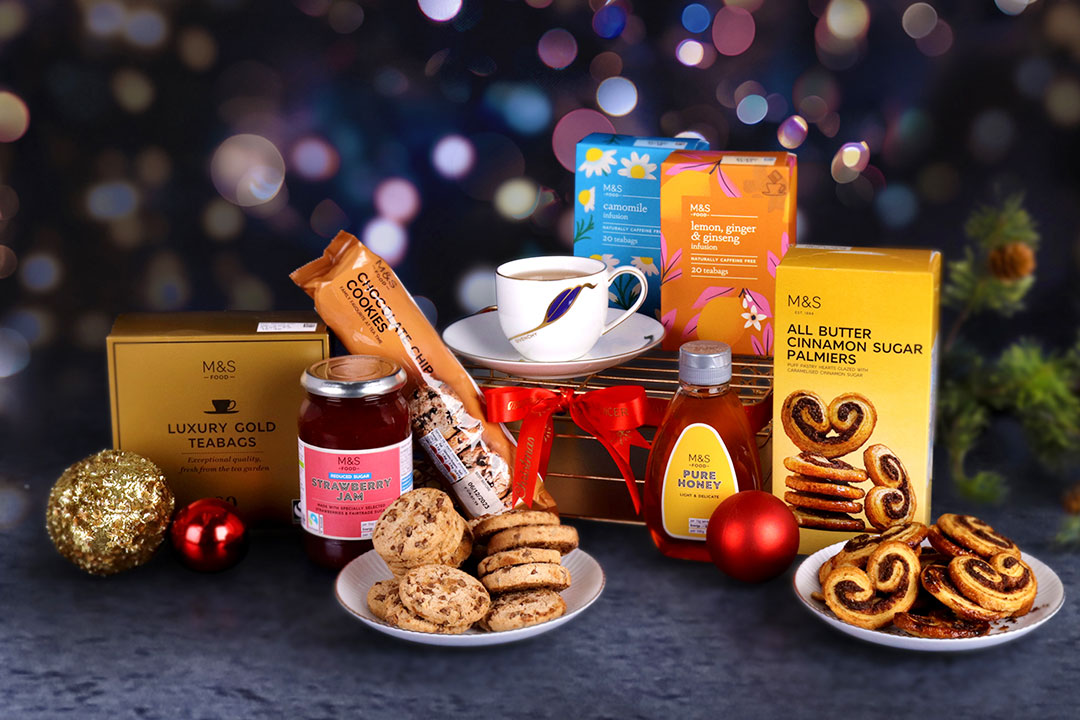
MARKS & SPENCER (M&S) Philippines gets ready for holiday gift giving with its Beauty Christmas Gift Sets (along with food and wine gifts sets). There are more ranges this year for skin and bath care enthusiasts, packaged in a gold metal crown, and with vegan and vegetarian friendly options. In addition to the Floral Collection and Nature’s Ingredients, there are the rejuvenating scents of Fragrance Society and spa-like experience using Apothecary for the ladies. For the men, there is the Fragrance Society duo.  Meanwhile, packaged in a golden metal tray, the food sets come in small, medium and large sizes, with the largest including a bottle or two of wine for the festive occasion. Sets include a variety of pasta for an intimate Italian dinner meal; a coffee, tea or chocolate themed gift; and a confectionery bundle for sweet tooths and more. For wine lovers there are the wine duo trays, packaged in a golden metal basket with three or four chocolate bars around a bottle of wine. The full catalogue can be viewed at bit.ly/MandSChristmasCatalogue2023. Get a P250 gift voucher for every P5,000 purchase of M&S Food and Wine Christmas Gift Sets until Nov. 30, when shopping in stores. Earn Loyalty points by shopping in-store by phone through the M&S Philippines Viber Community at bit.ly/MSPH-VC.


Global leather campaign hails terno as champion

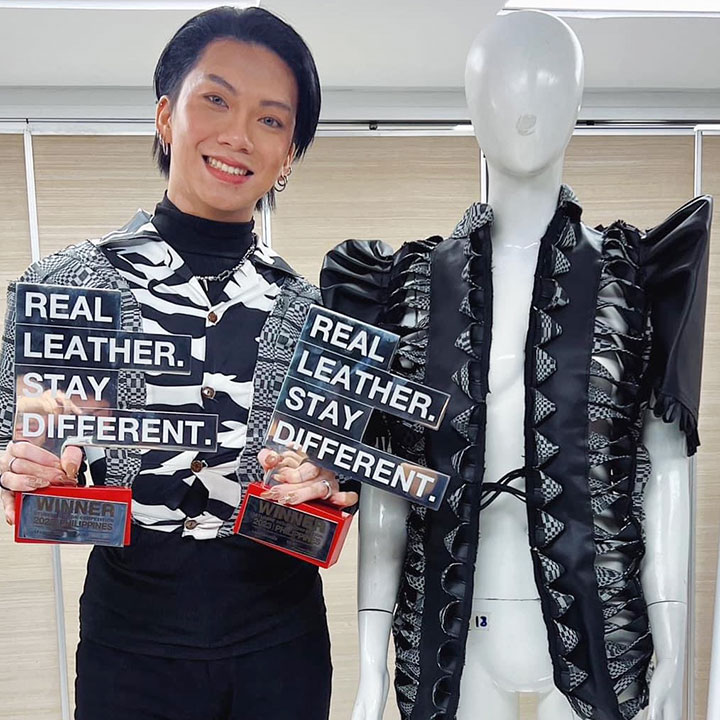
THE LEATHER and Hide Council of America (L&HCA) declared Turn Over, a modern terno of cattle hide and local woven textiles, as the Overall Champion of the 2023 Real Leather, Stay Different Student Design Competition Philippines. The global campaign was organized in partnership with the Philippine Textile Research Institute (PTRI) and the Fashion Accessory Makers of the Philippines (FAMPh). They motivated young creators from across the country to showcase the beauty, durability, and sustainability of leather combined with domestic weaves. Participants were challenged to conceptualize and create original and innovative apparel, accessories, or footwear with 50% genuine leather and 50% natural or indigenous fabric or materials. The top prize went to Andrei Valera, 21, who likewise placed first in the Apparel Category. Inspired by the idea that humans are bound to time, the young artist reimagined the traditional national dress into a modish jacket made from offcuts of cattle hide as well as inabel binakol, a woven textile from Ilocos Sur. Valera is an alumnus of the Fashion Design and Merchandising (FDM) Program of the De La Salle-College of Saint Benilde (DLS-CSB). “The goal is to curate a coat that serves as a time capsule, which lasts a lifetime and is cherished by its potential wearers,” he explained. “It is a quintessential piece that can be passed down through generations.” The Philippine edition of the 2023 Real Leather, Stay Different Student Design Competition was simultaneously conducted alongside regional contests in China, Italy, Taiwan, the United Kingdom, and the nations from the African and Nordic regions. Valera, together with other national winners, will be flown to Milan, Italy at a future date to present their works on the international scene.


Lotus Cars Manila is now Eletre-fied

PHOTO FROM LOTUS CARS MANILA

The 900hp Lotus Eletre R speeds into the local market via the Philippine Electric Vehicle Summit

By Dylan Afuang

THE ELETRE — an EV that heralds the Lotus brand’s entry into electrification, and is its first product to feature four doors — was introduced to the market at the 2023 Philippine Electric Vehicle Summit (PEVS) recently staged in Pasay City.

Lotus Cars Manila, a subsidiary of the Autohub Group, is initially offering the top-of-the-line Eletre R specification at P9.999 million for a limited time, and once that’s passed, the model will be pegged at P10.499 million. Two versions of the EV, the Eletre and Eletre S, could soon follow with prices projected to fall well below the range-topping model.

A 112-kWh lithium-ion battery pack and an 800V design power all Eletre models. A healthy powerful 917ps and 985Nm of torque are produced by the system in the Eletre R, enabling the EV to reach 100kph from standstill in a reported 2.95 seconds.

“Lotus is going through this fascinating transformation, going to a global performance brand from just being a sports car brand,” Lotus Group Head of Southeast Asia Pacific Katya Zavialova, who graced the 11th PEVS, said regarding the timing and rationale behind the Eletre’s entry to the local market.

“This is also the right time to future-proof (Lotus), and we saw the opportunity to expand our model range. We (saw) that a two-seater vehicle isn’t right for everybody, but the fantastic driving that Lotus is famous for should be available to everybody,” Ms. Zavialova continued.

Additional features that guarantee an enjoyable drive include dual-chamber air springs, continually changing dampers, and multi-link suspension, which is present in both the front and back.

The Eletre has 412-mm front disc brakes and 397-mm rear disc brakes because it can accelerate very powerfully. Six-piston calipers are included with the front set, while a sliding caliper is included with the rear set. Pirelli P Zero tires are also installed on all four wheels.

Recharging can be done using a 22-kW AC Wallbox, which will take approximately 5.8 hours to fully power the SUV. If buyers choose the 350-kW DC charger, it will take just 20 minutes to recharge the Eletre from 10% to 80%. The Eletre and Eletre S have a range of up to 600km, while the Eletre R musters a range of 490km.

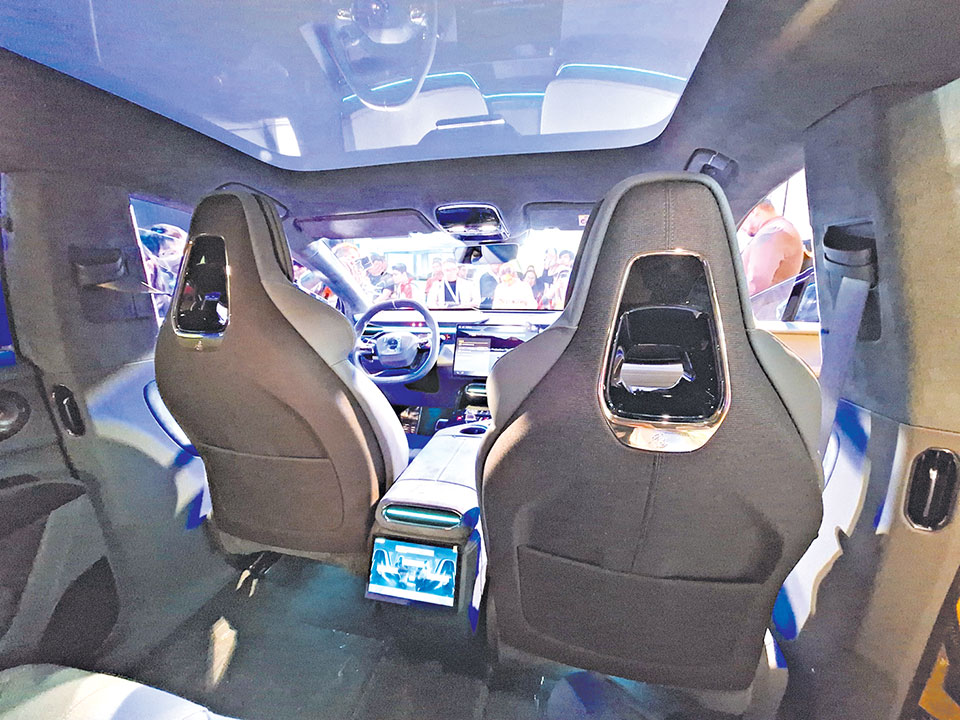
Moving inside, a 15.1-inch touchscreen that’s only 10-mm thick displays over 16 million colors, owing to the Unreal Engine technology (derived from 3D animation and gaming) found in the car’s digital cockpit.

In terms of connectivity, the system works with wireless charging, Apple CarPlay, Android Auto, and intelligent voice control. The infotainment packs 128GB of storage, 12GB of RAM, and features 5G connectivity. Meanwhile, the front passenger is also given a touchscreen.

As for the driver, he or she receives a 12.6-inch OLED display behind the wheel, in addition to a 29-inch head-up display with partially augmented reality. This enables the system to display important information to the driver without the need to take his or her eyes off the road.

Other significant features found with the Eletre include a 15-speaker KEF 1,380-W sound system or a 23-speaker KEF 2,160-W sound system, panoramic glass roof with 10 different light settings, and special smartphone app that enables owners to remotely control specific vehicle functions.

In addition to a cutting-edge interior and powertrain, the EV is complemented by advanced driver assistance systems (ADAS) and Level 4 autonomous driving capabilities.

The company said that the Eletre is covered by a five-year or 150,000-km general warranty, while the vehicle’s battery comes with an eight-year warranty.

Sam Bankman-Fried won’t be the last crypto mogul behind bars

FREEPIK

JUSTICE has been served — and swiftly, too. A jury found fallen crypto mogul Sam Bankman-Fried guilty of seven counts of fraud and conspiracy after just five hours of deliberation, markedly less time than it took for jurors to puzzle over Elizabeth Holmes’ Theranos scandal or Raj Rajaratnam’s insider trading at hedge fund Galleon. And while this is certainly crypto’s biggest case of fraud, it undoubtedly won’t be the last.

If the 31-year-old’s culpability for the “pyramid of deceit” behind FTX’s collapse seemed so obvious, it’s partly because he was prosecutorial gold. You didn’t have to know what a blockchain was to comprehend his former lieutenants saying that the $8 billion of missing customer funds happened on his watch and with his knowledge. Nor did you have to grasp GAAP accounting to see that the frizzy-haired wunderkind’s own testimony contradicted his communications and electronic records. Bankman-Fried had no filter, though his lawyers might wish he had.

Having lost a lot of people a ton of money, Bankman-Fried’s lack of empathy and remorse played a big role in this trial. And that matters when committing corporate crimes: If you don’t care about other people, especially your customers, it becomes very easy to exploit them. Or, as Dan Davies put it on social media, to take a $10 billion account labeled “Not My Money” and re-label it “My Money.” There was a dangerous mindlessness to Bankman-Fried, once worth more than $15 billion, who openly played video games while giving interviews or holding meetings.

Bankman-Fried’s fate looks sealed, with lengthy jail time likely to be ordered when he’s sentenced in March, but I don’t believe for a second that this will be the last crypto fraud. We’ve closed one chapter of COVID-era laser-eyed true believers, yet market prices are stirring once more as TradFi firms see an opening to offer Bitcoin and other products with the potential blessing of regulators. FOMO remains strong. “One camp of people in my group is saying forget it, the value of crypto is zero, there’s nothing behind it,” Bjoern Jesch, the global chief investment officer of $900-billion German asset manager DWS Group, said in an interview with Bloomberg News. “And there’s this other group of people saying like, hmm, I mean at least there’s a price of $35,000 for Bitcoin. Someone is paying $35,000.”

There are other parts to the story of FTX that explain the incentives beyond the individual. The crypto sub-culture, for example, and its overlap with the aggressive quantitative trading culture where Bankman-Fried cut his teeth. Few in crypto-land seemed to blink an eye at the huge amounts of leverage offered by FTX, its lack of a chief financial officer or paucity of experience among its senior managers. The exchange’s raciest growth happened offshore while US regulators focused their attention on TradFi (where everything from public-transit tickets to expenses are scrutinized these days). FTX, along with other market players, even invented its own token, FTT, and used it as cash — Bankman-Fried’s view that “money is fungible anyway” is pure crypto babble, but plenty of people bought into it until the inevitable painful contact with reality.

You only have to read Going Infinite by Michael Lewis to see the cultural overlaps with his earlier book about 1980s Wall Street, Liar’s Poker. While at Jane Street, Bankman-Fried and those he would later hire took full advantage of a culture that encouraged teachable gambling between employees and interns — with a loss limit of $100 per day per intern — and put a rocket under it at Alameda Research and FTX, exploiting market inefficiencies but also settling scores. It may have been this score-settling that saw Bankman-Fried double down on misusing customer funds, for example when buying out rival platform Binance’s stake in FTX.

And then there’s the outer circle of willing enablers. What would Bankman-Fried have been without the long line of venture capitalists throwing more than $27 billion into crypto during 2021’s pandemic-fueled euphoria, clearly without serious due diligence? Or the institutional investors parking their funds at a trading venue in the Bahamas? Or the accounting firm based in the metaverse appointed to audit FTX? It’s easy to talk about “missed” red flags, but there was willful blindness here. In late 2021, I warned readers of the huge legal risk of sending funds to Binance and FTX, and in 2022 of the risk of a crypto exchange collapsing. When I asked one of my investing sources why, despite his own misgivings, he continued to use FTX, his answer was: “Because we can’t afford not to.”

There may be deeper reasons why the risk of fraud remains. In his 1993 book Out of Control, Zbigniew Brzezinski warned that a kind of self-indulgent and permissive attitude to capitalism would break people’s moral compass and simply outsource morality to the courts. He called it “procedural morality” — essentially, see what you can get away with until the law says “stop.” As clear as last week’s trial verdict is, that kind of incentive remains. With every boom-and-bust cycle, standards get lax and exchanges collapse. My own first exposure to crypto was reporting on the 2014 collapse of Mt Gox, helmed by a young geek called Mark Karpeles; he was cleared of embezzlement charges, and SBF’s antics in hindsight make his look positively minor. Even if banks take over more of the industry, I’m not sure the crypto culture around tokens backed by thin air pitched as digital gold will improve.

My other hunch is that FTX’s investment in hotly valued artificial intelligence (AI) startup Anthropic, which may play a big role in making some creditors whole, might have symbolic resonance down the line. In the coming years, the next big corporate scandal may very well have “AI” on its perpetrator’s resume. In the meantime, beware of gurus offering the future of money.

BLOOMBERG OPINION 

FAO calls on PHL to increase investment in resilient agriculture

TWITTER.COM/FAOSOCIOECON

THE Food and Agriculture Organization (FAO) of the United Nations said on Sunday that the Philippines should invest more in resilient agriculture.

“There is a need to increase investment to enhance the country’s resilience and promote a more inclusive and sustainable future for agriculture,” FAO Country Representative to the Philippines Lionel Henri Valentin Dabbadie said in a statement, citing the damage inflicted by Super Typhoon Yolanda (international name: Haiyan) in 2013.

The typhoon on Nov. 8 of that year, affecting 44 provinces across five regions. Total damage was estimated at P95.5 billion.

Mr. Dabbadie added that the Philippines needs to take an anticipatory action (AA) approach and provide readily available support to poor and vulnerable farmers and fisherfolk “ahead of forecast shocks.”

“Anticipatory Action means acting ahead of predicted hazards to prevent or reduce acute humanitarian impacts before they fully unfold, with a window of opportunity set between an early warning trigger and when the actual impact of the hazard is felt on lives and livelihoods,” the FAO said.

In a report, the FAO said AA could be cost-effective by mitigating the impact of disasters.

“An estimated $3.8 trillion worth of crops and livestock production has been lost due to disasters over the last three decades, equivalent to an average loss of $123 billion annually, or 5% of annual global agricultural GDP,” it said.

It had reported that about $23 billion in damage had been inflicted by typhoons and other disasters in the past 30 years.

The FAO said it has been working with humanitarian and development partners to pilot the AA approach with local government units.

It added that the organization has been conducting simulations in disaster-prone regions of the Philippines since 2021, most recently operating in low-lying barangays of Gigaquit, Surigao del Norte and Pigcawayan, North Cotabato.

The simulations tested government protocols, communications flow, and coordination in the delivery of flexible interventions such as multipurpose cash assistance.

“Interventions such as provision of cash aid are critical in purchasing food and other basic commodities before an evacuation to address food insecurity, while the early evacuation of boats, livestock and other assets protect agricultural livelihoods,” Mr. Dabaddie said.

European Union (EU) Programme Officer Arlynn Aquino said that the EU has “stepped up its support” to help mitigate the impacts of disasters on at-risk populations.

“Haiyan has taught us that partnerships with governments at all levels and local communities are critical, so we can optimize existing social protection programs and systems to reach more vulnerable populations with timely interventions,” Ms. Aquino said. “Especially in Mindanao which continues to suffer from socio-political hazards and armed conflict.” — Adrian H. Halili

Company registrations up 13% in 2022

COMPANY registrations rose to a record high in 2022, the Securities and Exchange Commission (SEC) said.

The SEC logged a record-high 42,926 corporate registrations last year, 13% higher than the 38,052 registrations in 2021, it said in a statement over a weekend.

Company registrations grew by 67% in 2021 following the gradual recovery of the business sector from the pandemic in 2020, the SEC said.   

The surge in corporate registrations could be attributed to the launch of the SEC’s digital services, the regulator said.

“The digital transformation of the SEC was inspired by our vision for a company registration process that can be completed with ease and convenience, transactions that are safe and secure, and corporate data that are easily accessible,” SEC Chairperson Emilio B. Aquino said.   

“This vision is slowly becoming a reality, thanks to our stakeholders who have also adapted well and embraced digital transformation as part of their business strategies. The SEC will continue to develop its goals toward digitalization to further push the business sector toward its best,” he added.

Some of the SEC’s digital services include the electronic simplified processing of application for registration of companies (eSPARC), and its subsystem, the one-day submission and electronic registration of companies (OneSEC).

“With eSPARC, the SEC was able to reduce the company registration process from 16 steps in 34 days to three days. The process is even faster with the use of OneSEC, with a record processing time of  one minute and 14 seconds from the start of application to the receipt of a digital certificate of incorporation,” it said.   

Other SEC digital services include the electronic system for payments, online submission of reportorial requirements such as annual financial statements and general information sheets, and the electronic SEC universal registration environment that allows users to manage their SEC accounts and online transactions in one place.   

The rise in business formation is expected to support the economy, the SEC said.

“As more Filipinos realize their entrepreneurial aspirations through the corporate vehicle, we expect more and better employment opportunities for our countrymen across the archipelago and ultimately a more comfortable and secure life for everyone,” Mr. Aquino said. — RMDO

Rates of Treasury bills, bonds may climb

BW FILE PHOTO

YIELDS on Treasury bills (T-bills) and Treasury bonds (T-bonds) to be offered this week could rise after the Bangko Sentral ng Pilipinas (BSP) resumed its tightening cycle and ahead of the release of October consumer price index (CPI) data.

The Bureau of the Treasury (BTr) will auction off P15 billion in T-bills on Monday, or P5 billion each in 91-, 182- and 364-day papers.

On Tuesday, it will offer P30 billion in reissued seven-year Treasury bonds (T-bonds) with a remaining life of six years and eight months.

T-bill and T-bond rates may track the increases seen in secondary market yields after the BSP raised borrowing costs in an off-cycle move last month, Rizal Commercial Banking Corp. Chief Economist Michael L. Ricafort said in a Viber message.

At the secondary market on Friday, the 91-, 182-, and 364-day T-bill rates went up by 6.43 basis points (bps), 14.59 bps, and 7.7 bps week on week to end at 6.171%, 6.3968%, and 6.5828%, respectively, based on PHP Bloomberg Valuation Service Reference Rates data published on the Philippine Dealing System’s website.

The seven-year bond saw its yield rise by 5.84 bps week on week to 6.9131%.

The BSP on Oct. 26 delivered an off-cycle 25-bp hike due to growing inflationary pressures, bringing its policy rate to a 16-year high of 6.5%.

The increase came ahead of the Monetary Board’s scheduled meeting on Nov. 16.

Since May 2022, the central bank has hiked its key rate by a cumulative 450 bps.

Meanwhile, the yield of the seven-year T-bond may range from 6.9% to 7.05%, a trader said in an e-mail.

Investors are awaiting the release of October inflation data on Tuesday as this could affect the BSP’s policy decision this month, the trader said.

A BusinessWorld poll of 13 analysts conducted last week yielded a median estimate of 5.7% for October inflation.

If realized, this would mark the 19th straight month that the CPI exceeded the BSP’s 2-4% target but would be within the BSP’s 5.1-5.9% forecast for the month.

This would be below the 6.1% print in September and 7.7% in the same month last year and be the slowest in two months or since the 5.3% in August.

Last week, the BTr raised just P12.75 billion via the T-bills it auctioned off on Tuesday, short of the P15-billion program, even as total bids for the offer reached P21.941 billion.

Broken down, the Treasury made a full P5-billion award of the 89-day T-bills, with tenders for the tenor reaching P7.836 billion. The average rate of the three-month paper rose by 198.4 bps to 6.343%. Accepted rates ranged from 6.185% to 6.42%.

Meanwhile, the government borrowed only P3.96 billion through the 179-day securities, short of the P5-billion program, despite bids for the paper reaching P6.41 billion. The average rate for the six-month T-bill stood at 6.462%, up by 13.2 bps, with accepted yields ranging from 6.399% to 6.5%.

The government raised just P3.8 billion via the 362-day debt papers, short of the P5-billion plan, despite bids reaching P7.695 billion. The average rate of the one-year T-bill rose by 11.3 bps to 6.592%. Accepted yields were from 6.55% to 6.6%.

The T-bill tenors were adjusted from the usual 91-, 182- and 364-day maturities due to holidays last week.

Meanwhile, the reissued seven-year bonds to be offered on Tuesday were last auctioned off on Oct. 17, where the government raised P30 billion as planned. The papers fetched an average rate of 6.675%.

The government plans to borrow P225 billion from the domestic market this month or P75 billion via T-bills and P150 billion via T-bonds.

The government borrows from local and foreign sources to help fund its budget deficit, which is capped at 6.1% of gross domestic product this year. — A.M.C. Sy

Striking actors reviewing ‘final’ offer from Hollywood studios

AHMET YALÇINKAYA-UNSPLASH

LOS ANGELES — Negotiators representing Hollywood actors are considering a new proposal that major studios described as their “last, best and final offer” to end a four-month-long strike, the American Federation of Television and Radio Artists (SAG-AFTRA) union said on Saturday.

SAG-AFTRA members walked off the job in July to demand higher compensation in the streaming TV era plus protections around the use of artificial intelligence (AI) and other gains.

The Alliance of Motion Picture and Television Producers (AMPTP), which represents Walt Disney, Netflix and other companies, presented its latest offer on Saturday, SAG-AFTRA leadership said in an update to members.

“We are reviewing it and considering our response within the context of the critical issues addressed in our proposals,” the union said.

A representative for the AMPTP did not immediately respond to a request for comment.

Earlier last week, union leaders expressed “cautious optimism” that a deal could be reached soon but also said there were gaps between the two sides on various issues including the use of AI. Actors are seeking assurances that their digital likenesses will not be used without their permission.

The work stoppage, along with a Writers Guild of America strike that ended in September, has cost the California economy at least $6 billion, according to a Milken Institute estimate. Most scripted film and television production remains on hold. — Reuters

Shrewd shifting

Who knows the future of the auto industry? Toyota’s IMV 0 platform on display at the recent Japan Mobility Show in Tokyo highlighted the brand’s push for flexible, more sustainable means of mobility. — PHOTO BY KAP MACEDA AGUILA

With a return to health, the auto industry is also seeing ownership changes and realignments to capitalize on opportunities

THE PHILIPPINE automotive industry is well on its way to recovery. By the end of the first eight months of the year, the market had grown by around 25% and is now back to pre-pandemic levels. A big factor in the growth of sales is the restoration of supply to meet the continued strong demand for vehicles. It will be recalled that the global production of autos was greatly constricted by disruptions in supply chains, particularly for semiconductors.

Additionally, car makers have stepped up the pace of new model introductions in the local market. Filipino motorists have been feted with a slew of brand-spanking-new SUVs, pickups, sedans, minivans, hatchbacks, luxury vehicles, and — the apparent darling of the times — the electric vehicles. The range of new product offerings and upgrades is dizzying.

Beyond the products, there is a bunch of new automotive brands finding their way to Philippine shores, either totally new or returning entrants to the market. Chinese brands seem to be landing at such a rapid pace — Geely, Chery, GAC, MG, Hongqi, Omoda, Jaecoo, Wuling, Foton, GWM, Jetour, and BYD, among others. That’s an even 12 but I’m pretty sure there are others still. Resurgence has also been noted for the Korean brands such as Hyundai and Kia as well as some European brands like Peugeot and luxury make Ferrari.

It seems that the resurrection of the industry is spurring an unprecedented pace of transformation. And one other very significant aspect of this morphing of the auto sector is the profile of players seated in the owners’ box, so to speak.

The most recent shuffle happened with BYD — the second largest global producer of electric vehicles next to Tesla — whose distribution in the Philippines was taken over by the Ayala Group. Hyundai transitioned ownership amid the COVID-19 crisis and is now a wholly owned and operated subsidiary of Hyundai (Korea). The sales and servicing of Ferrari in the country is now handled by Ramon Ang through Velocita Motors. It will be remembered that he also took over the BMW franchise not too long ago under the SMC Asia Car Distributors Corp. Astara — one of the largest European car dealer groups — assumed the distributorship of Peugeot and GAC. While Inchcape PLC acquired control of the Mercedes-Benz operations in the country and the other brands under the Auto Nation Group, it also tucked Chinese brand Changan into its portfolio. A few years back, Hino (Japan) took over the majority of its Philippine operations. MG has also transitioned and is now owned and operated by the Chinese parent, Shanghai Automotive Industry Corp.

All these changes in ownership underscore a seeming consolidation or redirection of the industry from what used to be partnerships with private and independent businessmen to larger corporate players, even wholly owned subsidiaries. On one hand, this trend marginalizes what may have been long-standing relationships, pitting the proverbial David against the Goliaths of business. On the other, it highlights the capital-intensive nature of the auto business that is essential to its sustainable growth. For me, one thing that’s sure is that the shifts in alliances augur well for the Philippine automotive industry. It means that our market is on the radar of the major players. And why not?

The Philippines has one of the lowest motor vehicle densities in the region, topping only Vietnam. We are a developing economy that requires a more mature and robust transport and mobility network. We have a young population and a growing middle class whose spending capacity is expected to rocket. And 99% of the business sector in the country is made up of micro, small, and medium enterprises that rely on a vast vehicle fleet of people and goods movers.

Having noted all these changing of hands, so to speak, there are a number of players that still preserve their original partnerships. Honda Cars Philippines, for example, is one. Ford Philippines was already a wholly owned subsidiary of Ford when it started and it remains so today. Isuzu Philippines Corp. is still — as it has been — owned by its Japan parent. And Mazda Philippines remains owned by Bermaz Auto of Malaysia since after the break in the global alliance between Ford and Mazda.

Among the long-standing players in the country, Mitsubishi also underwent a change in ownership, albeit a good many years ago. From a local joint venture tie-up in its earliest years, Mitsubishi Motors Philippines — formerly Canlubang Automotive Resources — is now wholly owned by Mitsubishi (Japan). Nissan Motor Philippines (now Nissan Philippines) was also taken over by the Japanese parent company where before it was a joint venture first with Universal Motors and then with Yulon of Taiwan.

Then, of course, there is Toyota Motor Philippines Corp. (TMP). It replaced the previous distributor of Toyota in the country — a wholly owned Filipino corporation — when it halted operations in the early ’80s. TMP was established as a joint venture among Toyota Motor Corp. (TMC), Mitsui & Co. Ltd (Japan) and the Metrobank Group — subsequently GT Capital Holdings — as majority owner.

Sometime in 1985, Dr. George SK Ty, then President and owner of Metrobank, was invited by Dr. Shoichiro Toyoda, then President of TMC, to be the sole assembler and distributor of Toyota in the Philippines. Mr. Ty hesitated because although Metrobank was among the leading Philippine banks at the time, it had no experience in the automotive business. He was concerned about what he could contribute to the partnership. Mr. Ty was invited to visit Japan to learn and understand more about Toyota. After several exchanges, the partnership was formed and TMP was incorporated on Aug. 3, 1988.

Fast-forward 35 years and TMP is stronger than ever. Literally, it has grown from strength to strength in line with the growth of the Philippine economy. From 9,000 units sold in its first year of sales, it is on track to achieve a new all-time sales record of close to or over 200,000 units in 2023. In 2022, it posted its highest-ever market share of 50%, the highest for Toyota in the Asia region and, perhaps, the world.

The partnership between GT Capital and Toyota — as well as between the Ty and Toyoda families — is one that was founded on mutual trust and respect. It was the strength of these bonds that allowed TMP to overcome the most serious crises such as the Asian Financial Crisis of 1997, the various political disruptions in the country, the Lehman shock of 2008, the great earthquake of Japan and the floods of Bangkok in 2011, and the aforementioned COVID-19.

TMP has contributed much to building the Philippine nation in terms of job creation, investments, payment of taxes and duties, transfer of technology, promotion of exports, and giving back to society. The way things are looking, it seems that TMP — and the partnership that underlies it — will continue to grow stronger even as the musical chairs in the ownership of other automotive brands rages on.

Have we seen the last of the shifts in alliances? I doubt. As the industry transitions from auto manufacturing to the much broader and complex field of mobility, I expect that the landscape will continue to evolve. The road ahead is wide open.

The author is an automotive executive with extensive experience in the field of marketing and sales. Mr. Socco was significantly involved in the start-up of business operations for Toyota in the Philippines — a brand with which he has more than 40 years of involvement. He also has a broad executive experience in distributor operations as well as regional and global headquarter responsibilities. He is currently Chairman of GT Capital Auto Dealership Holdings, Inc.

Improving psoriasis

FREEPIK

Around 2 million Filipinos are living with psoriasis, according to patient advocacy group Psoriasis Philippines (PsorPhil). Psoriasis is a chronic, non-communicable, painful, disfiguring, and disabling disease for which there is no cure and with great negative impact on patients’ quality of life. Psoriasis commonly affects the skin and nails. Red papules and plaques, usually covered with white or silver scales, develop on the skin. Skin lesions cause itching, stinging, and pain.

Up to a third of patients with psoriasis have, or will develop, psoriatic arthritis, a condition in which the joints are also affected, causing debilitating symptoms including pain, stiffness, and irreversible joint damage. Psoriasis is also associated with other serious health conditions, such as diabetes, heart disease, and depression.

World Psoriasis Day is celebrated in October of every year to raise awareness and call for action in support of people living with psoriatic disease. This year’s theme is “Access for All,” underscoring the message that people with psoriatic disease must have access to the right treatment at the right time.

“Today the treatments for psoriatic disease are better than they have ever been, and research into holistic care is advancing every day. Now we must ensure that good care is reaching the right people,” said the International Federation of Psoriasis Associations (IFPA), a global NGO uniting national and regional psoriasis patient associations around the world that leads the annual celebration of World Psoriasis Day in over 70 countries.

The IFPA urged advocates to leverage the political declaration on Universal Health Coverage (UHC) to improve access to medicines and treatments for psoriatic disease. The first High-level meeting on UHC was held in September 2019 during the General Assembly of the United Nations, where United Nations Member States unanimously approved the political declaration on UHC.

The declaration encourages governments to take action against noncommunicable diseases (NCDs), specifically mentioning cardiovascular diseases and diabetes that are life-threatening psoriasis-comorbidities. Treating psoriasis is an effective measure to address cardiovascular diseases, as evidence shows that systemic therapies and biologic therapies are associated with a reduction in risk for cardiovascular events.

Mental health conditions are increasing the burden of NCDs, including psoriasis. Moreover, evidence shows that there is a link between inflammation and depression, as well as on the benefits of reducing inflammation to improve mental health. An integrated approach to psoriasis care should also include mental health interventions, and proper management of psoriasis will also help achieving the set targets for mental health. Treatment for psoriasis should be provided by public and private facilities, at least the ones included in the World Health Organization Model List of Essential Medicines. Coverage of treatments should progressively expand as resources become available.

Many countries struggle with the lack of dermatologists and family doctors, or their uneven distribution within the territory. The political declaration pushes governments to address these two issues by training more healthcare professionals and creating incentives for them to work in underserved areas. Primary healthcare should be strengthened and adequately financed, as it offers numerous benefits in the management of psoriasis.

In November 2021, the House of Representatives Committee on Health approved House Bill (HB) No. 9821 otherwise known as the National Psoriasis Care Act. HB 9821 seeks to establish a National Psoriasis Care and Control Program (NPCCP) that would serve as the framework for all psoriasis-related activities of the government. The NPCCP aims to improve the quality of life and lessen the impact of psoriasis on patients; prevent and control exacerbations of psoriasis in patients that lead to more serious illnesses; provide timely access to optimal treatment and care for all psoriasis patients; make quality treatment and care more affordable and accessible; and support the recovery and reintegration to society of psoriasis patients, among others.

When enacted into law, the proposed “National Psoriasis Care Act” would create a National Psoriasis Care and Control Council under the Department of Health to serve as the policy making, as well as the planning and coordinating body on psoriasis control. A counterpart bill was filed in September 2022, which is currently being deliberated at the Senate Committee on Health and Demography.


Teodoro B. Padilla is the executive director of Pharmaceutical and Healthcare Association of the Philippines (PHAP). PHAP represents the biopharmaceutical medicines and vaccines industry in the country. Its members are in the forefront of research and development efforts for COVID-19 and other diseases that affect Filipinos.

Seaweed touted as low-cost animal feed

REUTERS

BAGUIO CITY — The Department of Agriculture (DA) is proposing the use of seaweed as an alternative source of animal feed, citing its ready availability and low-cost relative to corn.

Agriculture Undersecretary for Livestock Deogracias Victor B. Savellano said at a briefing, “We are looking at the use of seaweed as feed for our livestock to relieve animal raisers from the high cost of commercial feed.”

Mr. Savellano, also the DA official overseeing the National Tobacco Administration (NTA), and alternate chairperson–designate to the NTA Governing Board, said seaweed is abundant, low-cost, and protein-rich.

“We are tapping the expertise of Lionel Henri Valentin Dabbadie, the country representative of the Food and Agriculture Organization (FAO) of the United Nations, in exploring the production of seaweed as commercial feed for farm animals.”

Seaweed contains antioxidants which can increase animal longevity and may lower the risk of infections. In poultry, it holds the potential to boost immunity and decrease microbial loads in digestive tracts. — Artemio A. Dumlao

Wilcon Depot shares inch higher despite lackluster earnings

SHARES in Wilcon Depot, Inc. went up last week despite its weak third-quarter financial performance due to softer demand for home improvement and construction.

Data from the Philippine Stock Exchange (PSE) showed a total of 6.56 million Wilcon shares worth P130.14 million were traded on Oct. 31 and Nov. 3, making it the 16th most actively traded stock during the two-day trading week.

The market was closed for public holidays on Oct. 30, Nov. 1, and Nov. 2.

Shares of the home improvement and construction supply retailer rose 3% week on week to end at P20.40 apiece on Friday from its P19.80 closing price on Oct. 27.

However, for the year so far, Wilcon’s stock is down by 30.8%.

Wilcon earlier reported that its net income reached P907.98 million in the third quarter, down by 17.8% from P1.10 billion in the same period last year.

For the first nine months, the company’s earnings declined by 7.9% year on year to P2.73 billion from P2.96 billion.

Meanwhile, gross revenues for the quarter inched up by 0.5% to P3.48 billion. For the first nine months, revenues increased by 6.6% to P10.25 billion from P9.62 billion in 2022.

Analysts attributed the “lackluster” earnings of Wilcon to its higher operating expenses compared to its sales in the third quarter.

The jump in operating expenses was mainly due to expansion-related expenses as Wilcon opened eight stores since the fourth quarter of 2022. Lance U. Soledad, research associate at China Bank Securities Corp., said in an e-mail.

Lower advertising and promotions from Wilcon’s suppliers also led to lower rent and other income, I.B Gimenez Securities, Inc. Research Head Joylin F. Telagen said in an e-mail.

Mr. Soledad said the market saw a “substantial selloff” before Wilcon’s reported its third-quarter earnings as investors braced for weak corporate financial results.

Despite Wilcon’s slightly better performance last week, it remained on a downtrend due to the shortened trading period, Ms. Telagen said.

“If there is surprise news that may improve the company’s performance and align to investors’ objectives, then trade,” she said.

“Due to disappointed earnings and trading within the downtrend area, I think it’s better to set an alert. If it exits the downtrend channel with an attractive risk-reward ratio, then trade,” Ms. Telagen added.

She placed Wilcon’s support and resistance levels at P19 and P22.25, respectively.

Meanwhile, China Bank Securities’ Mr. Soledad placed the stock’s support and resistance at P19 and P21.90, respectively.

“We think that the stock price recovery for [Wilcon] may be protracted for so long as… it continues to see elevated costs — especially as expansion-related expenses are likely to continue weighing on profitability — as it targets to continue growing its store network despite prevailing soft demand conditions,” he said. — B.T.M. Gadon

Yields on gov’t debt rise despite dovish central banks

YIELDS on government securities (GS) rose last week even as global central banks kept benchmark rates steady.

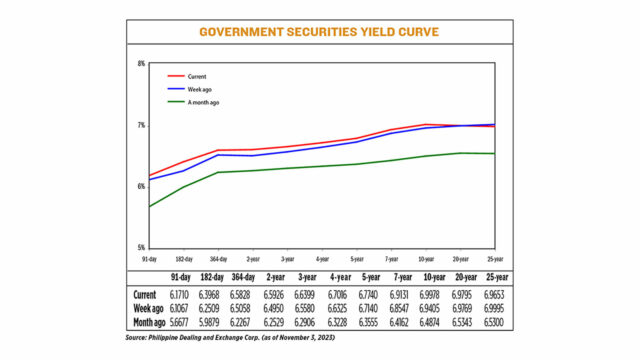
Bond yields, which move opposite to prices, went up by an average of 6.18 basis points (bps) week on week, based on PHP Bloomberg Valuation Service Reference Rates as of Nov. 3 published on the Philippine Dealing System’s website.

Yields on the 91-, 182-, and 364-day Treasury bills (T-bills) rose by 6.43 bps (to 6.171%), 14.59 bps (6.3968%), and 7.7 bps (3.5828%), respectively.

At the belly of the curve, rates of the two-, three-, four-, five-, and seven-year Treasury bonds (T-bonds) increased by 9.76 bps (to 6.5926%), 8.19 bps (6.6399%), 6.91 bps (6.7016%), 6 bps (6.774%), and 5.84 bps (6.9131%), respectively.

At the long end, the 10- and 20-year papers increased by 5.73 bps (to 6.9978%) and 0.26 bp (6.9795%), respectively.

Only the 25-year T-bond declined, with its yield dropping by 3.42 bps to 6.9653%.

Total GS volume traded on Friday climbed to P16.428 billion from P13.694 billion on Oct. 27.

A bond trader said the GS market was generally quiet last week due to the shortened trading week. Financial markets were closed on Oct. 30, Nov. 1 and 2 for public holidays.

On Friday, some bargain hunting occurred for papers with long tenors as yields tracked the overnight movement in US Treasuries, the trader said.

Another bond trader attributed last week’s yield movements to the lower US Treasury rates as the European Central Bank (ECB), US Federal Reserve, and Bank of England (BoE) kept borrowing costs steady in their respective meetings.

“The pause in tightening should relieve the BSP (Bangko Sentral ng Pilipinas) of some pressure to tighten further after its out-of-cycle hike,” the second trader said.

“However, the focus will still be on the inflation print for October and the BSP has put itself in a situation where it can tighten further if necessary,” the trader added.

The Fed last week kept its target rate steady at the 5.25%-5.5% range for a second straight meeting and hinted at a possible end to its tightening campaign.

Meanwhile, the ECB and BoE had also maintained interest rates. ECB has kept its key rate at 4% after 10 straight rate hikes, while BoE paused twice in a row at 5.25% after its 14 back-to-back increases.

For its part, the BSP hiked its policy rate by 25 bps to a 16-year high of 6.5% in an off-cycle move on Oct. 26.

BSP Governor Eli M. Remolona, Jr. said another increase could be on the table at the Monetary Board’s Nov. 16 meeting, depending on upcoming data releases.

For this week, investors will stay cautious before the release of October inflation data on Tuesday, both traders said.

A BusinessWorld poll last week yielded a median estimate of 5.7% for October headline inflation. If realized, this would be slower than the 6.1% in September and the 7.7% in October last year.

“If headline inflation surprises on the upside, bargain hunting will pull back and yields will definitely rise,” the first bond trader said. — A.C. Abestano