The Sierra Madre mountain range is the Philippines’ shield against the worst of typhoons, heavy rains, and flooding that barrel through the country from the Pacific Ocean. Stretching for more than 500 kilometers, the series of mountains serves as a protector for Filipinos from Cagayan in the north to Quezon province in the south, including those in Metro Manila.
However, data from the Haribon Foundation notes that the nearly 1.4-million-hectare forest is disappearing at a rate of 9,000 hectares per year, mostly due to illegal logging, mining, and quarrying, making flash floods and landslides more common. In response, both the private and public sectors have conducted reforestation drives to restore lost forest cover.
One such project is the GCash in-app platform, GForest, which enables users to contribute to various environmental initiatives on their phones. Supported by over 25 million registered users, as of today, the Philippines’ leading finance superapp initiative has led to the planting of more than 4.2 million trees covering more than 18,000 hectares of land, supporting both reforestation and agroforestry projects while providing incremental livelihoods to over 15,000 farmers and foresters, and their families.
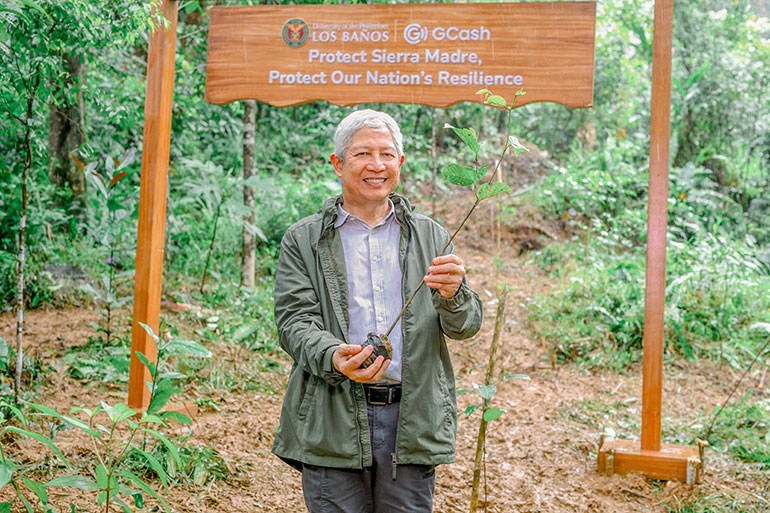 For its latest endeavor, GForest teamed up with the University of the Philippines, Los Baños (UPLB), for a broader collaboration that supports multi-year forest rehabilitation, research, and community-based livelihood development within the Sierra Madre Land Grant.
“We’re very happy whenever people come over and visit the site. It helps create awareness because the people who come here talk about the place. So, it’s easier for us, actually, to promote rehabilitation of the area,” UPLB College of Forestry and Natural Resources Dean Marlo D. Mendoza, who oversees the area, said during the event.
The collaboration aims to plant trees on at least 250 hectares of the land grant using around 135,000 native seedlings, as some species cannot be mixed, along with another 25,000 seedlings for urban greening spanning 10 kilometers of road.
The UPLB dean noted that the project is being tackled from a very practical point of view, with applications in real-life situations. He believes that projects of the same kind must be looked at with the entire value chain in mind, from collecting, planting, maintaining, processing, and then marketing products from the land grant.
 “In terms of impact, we’re looking at communities that will reduce their dependence on forest-based or wood-based illegal activities, because, this time, we’ll have delivery, planting, and processing, and, in all aspects of the value chain, communities will be engaged.” Mr. Mendoza said.
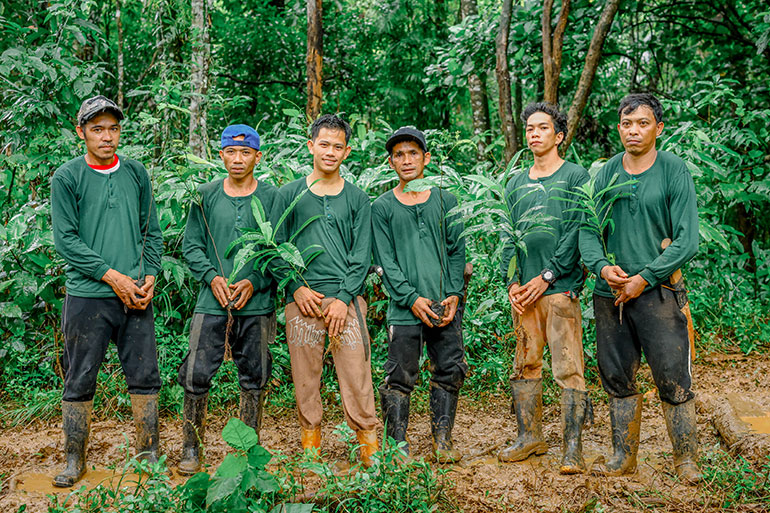
GForest, through its local and international planting partners, has provided incremental livelihoods to over 15,000 farmers and their families across the Philippines. An additional eleven foresters from all walks of life will be working on the Sierra Madre reforestation project, all of them coming from surrounding areas.
One of the workers, Harold Den, has been a forest worker for most of his life, rehabilitating places and planting trees for a living. Another worker, Mark Alex Pacis, a father of two, says that the project has been his family’s main source of income. Coming from the youth, Jack Lawrence Balsindan, 21, has been learning the ropes, having been a forest worker for only a month.
Despite their different backgrounds, the community knows the significance of their work and has even placed an emphasis on the need to plant more trees to avoid natural disasters and reverse the effects of global warming.
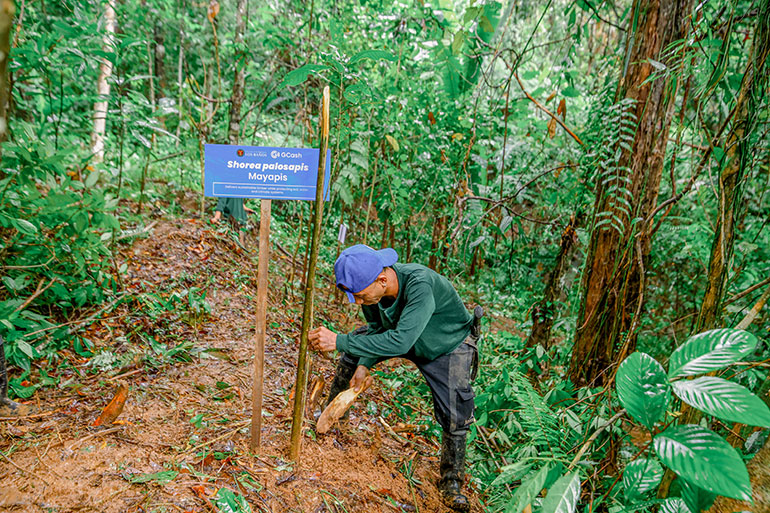 “Mahalaga ang pagtatanim upang maiwasan ang landslide, pagbaha, ‘tsaka ‘yung climate change… Para na rin maprotektahan yung mga endangered species dito(Planting is important to prevent landslides and flooding, and because climate change is already happening. It also helps protect the endangered species here),” Mr. Pasis said.
Beyond its environmental impact, the project also provides a vital source of livelihood for local farmers like the ones mentioned above, who see it as both a means of survival and a long-term opportunity for their families.
“Mahalaga ‘to para sa’kin kasi ito kinakabuhay ko ngayon, para sa pamilya ko, para sa mga katrabaho ko. Ito po ay napakahalaga sakin dahil ito po ay bigay sakin na trabaho para mapakain ko ang aking pamilya, ‘tsaka po pang-matagalan po kasi ito (This is important to me because it’s what I do for a living now — for my family and for my co-workers. It’s very important to me because this job was given to me so I can provide food for my family, and it’s something long-term.),” Mr. Pasis explained.
As local farmers find meaning and livelihood in restoring the Sierra Madre, GCash continues to deepen its commitment to sustainability by recognizing that every tree planted nurtures communities and strengthens the country’s resilience against climate challenges.
“Supporting Sierra Madre is not just a project of GCash; it is a shared responsibility. It protects millions of Filipinos from floods and typhoons, including our users. For us, this is about managing our industries and building national resilience. Through GForest, we turn every digital action into environmental impact,” Moya Ganzon, Head of Impact Innovations, Sustainability at GCash said.
The act of planting trees goes beyond placing seedlings in the soil; it is a journey of growth, where roots take hold to become firm, lasting, and grounded in purpose. Just as trees take root to strengthen Sierra Madre’s landscape, GCash takes root in its advocacy, embedding itself in sustainability, community, and innovation.
Spotlight is BusinessWorld’s sponsored section that allows advertisers to amplify their brand and connect with BusinessWorld’s audience by publishing their stories on the BusinessWorld Web site. For more information, send an email to online@bworldonline.com.
Join us on Viber at https://bit.ly/3hv6bLA to get more updates and subscribe to BusinessWorld’s titles and get exclusive content through www.bworld-x.com.