Home Blog Page 4103

A case for Chilean pork

WHILE Chile is known for its fruit and wine exports, livestock sounds more like the playground of its neighbor, Argentina. However, on Oct. 13, Chile showed off its prowess in pork: several thousand metric tons of it, in fact.

At an event at the Grand Hyatt, the hotel’s executive chef Mark Hagan prepared Chi-Noy Adobo, Stir-fried Pork Liver, and Pork Flower Fat Inasal — all familiar flavors for a Filipino, but made with pork from Chile. Juan Carlos Domínguez, President of the Chilean Meat Exporters Association, ChileCarne, told BusinessWorld that they have only begun exporting pork to the Philippines last year. Last year, Chile exported 4,500 metric tons of pork to the Philippines, and is increasing that number to 6,000 this year. “We’re just starting,” said Mr. Dominguez.

“It’s not a problem of volume, it’s a problem of knowing each other, and know(ing) exactly which product you prefer,” he said. While the sheer weight of what they exported sounds huge, Mr. Domínguez insists that their edge is in quality. “You are looking for quality, not only volume. That is what Chile is offering. We have a really high-quality product.”

Chilean pork production, according to him, relies on three pillars: biosecurity, food safety, and sustainability. By biosecurity, he means that, “Chile has special conditions that we are protected (from) diseases that can affect our animals.” He notes that they were marked safe from the 2019 African swine fever outbreaks. While he credits safeguards from diseases to a “strong local authority,” he points out the country’s geographical destiny as its own protection: the Andes mountains, a desert, the Pacific Ocean, and even glacial ice. As for sustainability, they take water efficiency seriously and their farms are measured against international standards. Finally, Mr. Domínguez discusses other food safety measures they have in place: for example, they haven’t used growth hormones in their pigs since 2006. “We also enrich the environment of the pigs, so they can live and move free(ly) in the farms,” he said.

As he points out, Chile only has a population of 18 million, so a lot of their produce goes towards export. This is why they’ve taken the effort of studying what their export consumers need, tailor-fitting them to preferences in fat content and other such factors. According to him, Filipino consumers like “a little bit of fat, but not inside the muscle.”

As we’ve pointed out, Chile isn’t top of mind in the region when it comes to livestock. Mr. Domínguez said, “We will never compete with Argentina, Brazil, and Spain. They are in the volume business. We are in the quality business. We are not a big producer, we are middle-sized producers, but we are so focused on quality.”

He adds, “Chile is a well-known country of quality food exports. We are well-known for fresh fruit, salmon (it’s the world’s second largest producer after Norway) — and now we want Filipinos to know that we’re also pork producers, poultry producers. Very high quality.”

On that note, Mr. Dominguez shared that perhaps, it’s in shared culture that may be what makes their pork a hit in the country. “I am really surprised that we are very similar,” he said. He says that he has been to some Southeast Asian countries, but, “The first time I was in the Philippines, I think I feel like home.”

“The way that you cook, the way that you eat is very similar to Chile. I think it could be really a win-win situation for both countries.” — Joseph L. Garcia

The few over the many

XIANGKUN ZHU-UNSPLASH

Almost every morning, on weekdays, I pass Valero Street in Salcedo Village in Makati City. At around 7 a.m., there will be two big buses parked near the corner of Valero and Villar streets, unloading their passengers. There are about a hundred people in total from both buses, I reckon, seemingly employees working in the establishment across the street.

Nothing wrong with hiring buses to shuttle employees to work. Many businesses do that. But what I do not get is how these buses are allowed to unload their passengers in a manner that disrupts traffic flow. Worse, the buses and their passengers do not seem to care that they are disruptive to others. Moreover, they unnecessarily put pedestrians and motorists at risk.

Valero is a one-way street, with one-side parking only. Parking slots are on the left side of the road, the driver side. Thus, the buses park on the left. But this also means their passenger doors are on the right — facing the road. As such, their passengers step out into oncoming traffic from their right. The buses are parked no more than 10 meters away from the lighted intersection and pedestrian lane.

The problem every morning is that as the stream of passengers gets off the bus, they just continue to cross the street to their place of work with little regard for oncoming traffic. Often, the bus drivers and conductors bodily block vehicular traffic to let their passengers cross. Valero comes to a standstill just about 10 meters from the intersection, as vehicles are forced to give way to the “crossing” passengers.

Shouldn’t their employer instruct their employees and the shuttle bus operators to make sure that passengers carefully alight from the bus, watch out for oncoming traffic, carefully walk to the curb and the nearby intersection, and then cross the road when the pedestrian light turns green? Why do they have to cross where they alight and disregard their own safety? Laziness?

Rules are in place for the safety of both motorists and pedestrians. Why are the buses allowed to drop off their passengers in a manner that disregards safety? And what gives the bus drivers and passengers the “right” to stop oncoming vehicular traffic just so the bus passengers can “jaywalk” to their place of work?

And vehicular traffic will just have to wait until all the passengers alight from the buses. It might have been okay if the passengers at least waited until the road was clear before crossing, never mind that they are crossing where they should not in the first place. But no, they simply cross at will as they get off the bus. It is simply a case of crossing where they want, when they want.

Many will probably view this as simply a rant, and a petty one at that. Perhaps other motorists, unlike me, do not mind letting the bus passengers cross where and when they want. Why begrudge the bus passengers for crossing to work? Anyway, a lot of other pedestrians cross Valero anytime, anywhere. Many do not use the pedestrian lane, and some even walk on the road instead of the sidewalk.

The thing is, this situation arises not only on Valero every weekday morning but in many other places around the business district. Many motorists and pedestrians choose to ignore traffic safety rules because they are either inconvenient, or observed more in breach, or because they can simply get away with it. On Rufino St., for instance, the stretch between Ayala Avenue and Valero St., many still cross the street despite the “no crossing” sign.

And despite the numerous parking slots on Valero, from Dela Costa all the way to Villar St., many still opt to double park and block traffic flow just to buy from the numerous street vendors found along the stretch of Valero. In short, when they know they can get away with it, people will choose to ignore safety rules for their convenience. And with impunity, at that.

And to me, it all boils down to people’s very poor sense of community. It is every man for himself in the central business district, obviously. There will never be enough regulations, traffic lights, traffic enforcers, pedestrian lanes, and safety signs to beat the ever-growing malaise of “me-first.” Many will continue to act in a manner that benefits them first, with little regard for others.

The Filipino term pasaway comes to mind, which can be translated to disobedient or uncontrollable. But frankly, I do not think the lack of discipline is the issue with many Filipinos. That is, discipline in terms of obediently following rules. Such discipline is usually exacted at the cost of penalty or censure. And people follow mainly because their fear of punishment.

Some people do not observe rules not because they are unafraid of punishment. Or that their need is so urgent that they are willing to risk punishment just to satisfy that need. This requires some actual understanding that one is committing a wrong but willingly does so. This does not seem to be the case.

For some people, they choose to breach rules because (1) they do not see anything wrong with the breach, or that they believe they are not doing anything wrong; (2) they think the rules should not apply to them; (3) others breach the rules and get away with it; and (4) they do not care about the consequences to them or others. For instance, a jaywalker disregards his own safety as he does not care, or realize, how his action affects others.

And this, to me, is the greater challenge. How do we change the way people think about rules and safety? How do we build a greater sense of community and a stronger sense of others? How do we make more people realize how they think and how they act impact not only themselves but others as well?


Marvin Tort is a former managing editor of BusinessWorld, and a former chairman of the Philippine Press Council

matort@yahoo.com

Colliers sees continued rise in office sector transactions in 2024

MARIO GOGH-UNSPLASH

TRANSACTION activity in the local office sector is expected to continue improving next year, driven by potentially sustained demand, real estate consulting firm Colliers said.

“Transactions have been increasing by about 10-15% quarter on quarter. We think this will continue until next year,” Colliers Associate Director for Office Services Kevin Jara said in an interview on the sidelines of a briefing last week.

“We don’t see any regulatory headwinds, political headwinds,” he added.

Mr. Jara said, however, that there might be a slight slowdown in demand during the US elections towards the end of next year, attributed to the significant demand for outsourcing.

“During those months, there’s a slight slowdown but usually recovers after the season,” he noted.

Office space transactions for the third quarter stood at 197,000 square meters (sq.m.), which is 17% higher than the 169,000 sq.m. in the same period last year, data from Colliers showed.

About 167,000 sq.m. of vacant spaces were recorded during the period, higher than the 137,000 sq.m. seen in the previous year, mainly driven by the completion of new office buildings. Occupied office spaces, on the other hand, reached approximately 11.3 million sq.m.

Mr. Jara said that office demand next year is likely to be driven by the business process outsourcing (BPO) sector, especially as companies seek to grow their headcount.

“The BPO industry has a roadmap to double their headcount until 2028. So, it’s just a matter of if those additional head count will translate into office space,” he said. “But regardless, it’s still going up.”

In the third quarter, traditional offices comprised the majority of office space deals at 98,000 sq.m., including government agencies, telcos, insurance firms, and flexible workspace operators, the property consultancy firm said. The figure has risen from 69,000 sq.m. previously.

The information technology and business process management sector recorded 70,000 sq.m. of transacted spaces, lower than the 93,000 sq.m. a year earlier.

Philippine offshore gaming operators reportedly transacted about 29,000 sq.m., an increase from the 7,000 sq.m. last year, but still lower than the 55,000 sq.m. transacted in the second quarter.

During the third quarter, the demand rose by 10.78% to 185,000 sq.m. of office spaces from 167,000 sq.m. in the third quarter last year and 170,000 sq.m. in the second quarter of 2023.

“We’re also expecting more and more companies, not just BPOs, to do a flight-to-quality relocation. Take advantage of the market because you have potentially cost-effective rental costs in a new building versus your current lease which may have pre-pandemic rents pa which are higher,” Mr. Jara said.

In the first nine months, Colliers reported that about 155,000 sq.m. of office space relocations were recorded, of which 69% were flights to quality, while 31% were flights to cost.

Flight-to-quality relocations refer to moves to newer, higher-grade buildings, which are mostly in primary submarkets, while flight-to-cost relocations involve moves to older, lower-grade buildings with lower rents, typically in secondary submarkets. — Sheldeen Joy Talavera

Phenomenal finds at California wine tour

THE CALIFORNIA Wine Institute Vintner’s Tour for 2023 went around Asia last month, rolling from Shanghai, Taipei, and Hongkong, before making a final stop in Manila on Oct. 23. About 30 winemakers were gathered at the Shangri-La The Fort, and we’re listing three that piqued our interest.

CHANEL WINE BY ST. SUPÉRY
In 2015, Chanel joined the American wine game with the purchase of the St. Supéry Vineyards and Winery in the Napa Valley. We had a taste of their Sauvignon Blanc, the only varietal from the winery to survive the California wildfires of 2020 (their Merlots and their Cabernets Sauvignons were either burned, or covered in soot and ash). This particular Sauvignon Blanc had a scent of peaches and pears, and was very crisp and fruit-forward. St. Supéry is distributed in the Philippines by PYC Foods Corp., and is available at One World Deli.

A WINE THAT CHANGED THE WORLD
In 1976, a wine competition was held in Paris that sought to settle a question between the quality of Old World and New World wines, where 11 judges blind-tasted wines from California and France. The competition was called the Judgment of Paris — as in the Greek myth, when the Prince Paris of Troy had to choose who the fairest was between the goddesses Hera, Athena and Aphrodite, and its result sparking the Trojan War. The US won both categories, with their Chardonnays facing against France’s own, and their Cabernet Sauvignons staring down France’s Bordeaux. This modern-day Judgment of Paris, at least, brought only nice memories, and solidified the Napa Valley’s reputation as a contender on the world stage.  The winner for the Chardonnay category was a 1973 Chateau Montelena Chardonnay, and its winemaker was Miljenko “Mike” Grgich. Mr. Grgich, who turned 100 this year, opened his own winery the year after his creation won the Judgment of Paris.

Grgich Hills Estate offered us a taste of its history-changing Chardonnay, from the similarly historical year of 2020: it had a delicate powdery and fruity scent, a nuanced juicy and sharp flavor, and a slow, lingering smoky ending note, like the smoke from a match that had just been put out. In the Philippines, Grgich wines are distributed in the Philippines by The Wine Club.

FROM ENTHUSIAST TO MASTER
Many fans of anything have long dreamed of being the master of the things they love. Our last winemaker on this list, Keith Nichols of Nichols Winery & Cellars, proves to be a great example of someone who made that transition.

The winery was founded in 1991. Before that, Mr. Nichols had been in the navy as an Aviation Electronic Technician. After leaving the navy, Mr. Nichols pursued higher education and earned a Business Management degree from Pepperdine University, an MBA from California Lutheran University, and an MS degree in Telecommunication from Golden Gate University. He first fell in love with wine after joining a small gourmet club, and his friends and he explored food and wine together, traveling across the globe for meals. He had the idea to make his own wine, and learned about it using books about viticulture and oenology from UC Davis, and taking viticulture courses from another institution. He went on to talk to winemakers from France, South Africa, and the Napa Valley, with the whole process of studying taking five years. “After five years, I thought I knew what it took to make a great wine,” he told BusinessWorld. He let us taste a 1997 Reserve Merlot, the color of a pigeon’s blood ruby, with a sharply spicy and aromatic scent (like a whole barrel of spices), and had an elegantly piquant flavor. He said that his wines have appeared in some movies, like in 1996’s The Birdcage. Discussing how he was able to make the transition from enthusiast to master and the role California played in it, the 76-year-old told BusinessWorld, “I’m not sure I could have done it anywhere else. I was living there, but understanding the California weather and the sunshine that we get constantly — it’s the weather that makes great wine, not the winemaker.” — Joseph L. Garcia

FATF ‘gray list’ inclusion seen to hurt PHL

THE LOGO of the Financial Action Task Force (FATF) is seen at the OECD headquarters in Paris, France, Oct. 18, 2019. — REUTERS

THE PHILIPPINES’ continued inclusion in the Financial Action Task Force’s (FATF) “gray list” of jurisdictions under increased monitoring for “dirty money” risks may affect remittance fees, borrowing costs and investments, an official from the Philippine Amusement and Gaming Corp. (PAGCOR) said.

Overseas Filipino workers (OFWs) will be the first to be affected by the country’s continued inclusion in the gray list, Dave Fermin J. Sevilla, assistant vice-president of PAGCOR’s Anti-Money Laundering Supervision and Enforcement Department, said in an interview with One News PH on Wednesday.

“As long as we are in the gray list, banks and other institutions will tighten their (anti-money laundering controls) for Filipinos. Sanctions and transaction fees for OFWs may increase,” he said in mixed English and Filipino. 

“Even in the casino industry, our customers coming from abroad may be reduced because we are still in the gray list,” he added.

The FATF is also an intergovernmental organization that crafts and promotes policies and standards to help combat financial crime.

It said in a report released on Saturday that the Philippines remains part of its gray list of jurisdictions under increased monitoring for dirty money risks after failing to address strategic deficiencies against money laundering, terrorist financing and proliferation financing.

After a three-day plenary session in Singapore, the dirty money watchdog said the Philippines still needs to address five out of the 18 deficiencies in anti-money laundering/combating the financing of terrorism (AML/CFT) controls.

The Philippines should continue to demonstrate effective risk-based supervision of designated nonfinancial business and professions (DNFBPs) and ensure that supervisors are using the proper AML/CFT controls to mitigate risks associated with casino junkets, the FATF said.

It should also enhance and streamline law enforcement agencies’ access to beneficial ownership information and ensure accurate and up-to-date information and increase investigation and prosecution of cases related to money laundering and proliferation financing.

The Philippines has been on the FATF’s gray list since June 2021.

Government officials earlier said they hope the Philippines can exit the gray list by January 2024.

According to Mr. Sevilla, banks are required to do strict customer due diligence on clients from high-risk jurisdictions as identified by the FATF, or those included in its gray and black lists.

“Unfortunately, Filipinos are subjected to that. Banks need to check and monitor our transactions, which leads to higher fees because more resources are being used,” he said. “And as long as we continue in the gray list, the charges for remittances may continue to increase and our OFWs would have a harder time.”

Companies in the Philippines that want to secure foreign loans could also face higher interest rates and charges, Mr. Sevilla said.

The country’s attractiveness as an investment destination will likewise take a hit if it remains on the FATF’s gray list, he added.

“Why would you invest in a country that is gray-listed? The FATF and the APG (Asia-Pacific Group) encourages investors to put their money in safe countries, or countries that has good AML/CTF systems,” he said.

The APG on Money Laundering is an intergovernmental organization with 42 member jurisdictions. It aims to ensure that individual members effectively implement the international standards against money laundering, terrorist financing and proliferation financing. 

For PAGCOR, the FATF and the APG want the Philippines to demonstrate effective and intensive monitoring of covered entities for money laundering risks, he said.

“We are now intensifying the monitoring of all our gaming licenses… We always check our big casinos and we have always had people stationed there. Then we also check the smaller stations. For POGOs (Philippine Offshore Gaming Operators) or internet gaming licenses, we have new rules that require more intensive monitoring of the weaknesses identified by the AMLC,” Mr. Sevilla said.

“We have also identified areas in the sector that can be used for money laundering, and we try to mitigate these weaknesses with new rules and regulations,” he added.

President Ferdinand R. Marcos, Jr. has given government agencies until Nov. 30 to address deficiencies in their anti-money laundering strategies in hopes that the Philippines could exit the FATF’s gray list by January. — K.B. Ta-asan

Expelling Palestinians to the Sinai can’t be Israel’s answer

PEA-UNSPLASH

THE PROBLEM with ignoring dead-end signs is that you eventually end up at the bottom of an alley with nowhere to turn. This is where Israel’s government now finds itself, and a leaked document shows how some in the ruling elite are thinking this lack of options through. It’s not pretty.

The Oct. 13 draft document called “Policy Paper: Options for a Policy Regarding Gaza’s Civilian Population’’ comes from Israel’s Intelligence Ministry. It recommends expelling the strip’s population to Egypt’s Sinai desert and locking the door behind them as the best way to secure Israel’s long-term interests.

Other territorial disputes have been ended by expulsions or exchanges of populations, most recently in Azerbaijan’s Nagorno Karabakh enclave. The practice, sadly, isn’t that uncommon, but it’s called ethnic cleansing and is what the international community fought hard to prevent during the Yugoslav wars of the 1990s. Even to entertain the idea in a policy paper suggests that Israel’s government has not recognized where its zero-sum approach to the Palestinian question went wrong. And that’s worrying because the geopolitical ramifications of this dispute run wide and deep. At some point, either this government or a replacement will have to throw its pre-war policies into reverse.

First, some disclaimers. The Intelligence Ministry in Israel is much, much less important than analogues elsewhere. It is in essence a research center under the prime minister’s office, and very much the runt of the litter among the nation’s fabled, if currently bruised, security organs. So, although the government has confirmed the document’s authenticity to a range of media, it also downplayed its importance, describing it as a concept paper that hadn’t been discussed outside the ministry.

In other words, the Biblical expulsion of more than 2 million people isn’t government policy and is unlikely to happen. But in a world where Russia invades Ukraine against its obvious self-interest, and the US is considering re-electing Donald Trump as president, it’s foolish to count on common sense prevailing. The paper is worth reading mainly because it shows the intellectual bankruptcy of parts of the government and adds to the growing debate within Israel over whether Prime Minister Benjamin Netanyahu and his ultra-right coalition are the best people to deal with the crisis caused by Hamas’ Oct. 7 killing spree, in which more than 1,400 Israelis were butchered.

The paper (a translation is here, on the website that broke the story) outlines three possible scenarios for the day after the war. Option A is to withdraw after dealing with Hamas and install the more moderate Palestinian Authority in its place. Option B would be to withdraw and then ask a coalition of Arab nations to organize a post-Hamas administration in Gaza. Option C would move the civilian population across the border into Egypt for their safety, and then not let them back.

There are obvious reasons why option C is unlikely to happen, beginning with the fact that if there’s one thing Egyptians agree on, it’s that they don’t want to take on millions of Palestinian refugees. A second is that this would in effect repeat Israel’s 1948 expulsion of up to 700,000 Palestinians from their homes, a source of instability ever since. It would serve as a call to arms for Palestinians in the West Bank and Arabs across the region, not to mention Iran and its allies. For that reason, if no other, it is unlikely the US or still less Europe would endorse such a solution, leaving Israel in a very lonely position indeed.

It is the paper’s reasoning that’s of interest. It goes through the obstacles to each scenario and concludes that the first suggestion — putting the Palestinian Authority in charge of Gaza — would be the most dangerous. It would, according to the authors, pose an “existential’’ threat to the state of Israel, because it would be seen as a victory for Hamas and, unlike in Germany after World War II, there would be no moderate opposition to Hamas in Gaza to facilitate the area’s “de-Nazification.’’ A new Hamas generation would take charge and restart attacks on Israel, which would then find it difficult to recruit soldiers from a demoralized population. Option B is ruled out for similar reasons.

The potential downsides to C aren’t discussed, other than to acknowledge that Israel would have to work hard to persuade the US and other allies of the policy’s legitimacy, which is, of course, an understatement. The hope, according to the paper, is that unlike the other options, what amounts to ethnic cleansing would help Israel solve the Gaza problem once and for all and deter Hezbollah from attempting an attack on Israel from the North, given the dire consequences that befell Gaza when Hamas did the same.

I don’t envy Israel’s decision makers. A policy that fed Hamas and encouraged the expansion of Jewish settlements on the West Bank to weaken the more moderate Palestinian Authority has left the government with no good choices. It needs to punish and defeat Hamas, all while preventing the war’s expansion and sparing the civilians Hamas has used as a key part of its defenses, not to mention the 238 hostages still in captivity.

It’s an impossible task — according to Gaza’s health authority the death toll from Israel’s retaliation is already over 8,000 — and it needs a far-sighted strategy to have any chance of success. But a second “Nakba,’’ or catastrophe, as the Palestinians call their 1948 expulsions, is neither an effective nor an acceptable way to ensure Israel’s security.

BLOOMBERG OPINION

NGA 911 seeks to improve LGUs’ emergency response capabilities

NGA911.COM

NEW GENERATION Advanced 911 (NGA 911), a cloud-based technology from the United States, is set to expand its partnerships with local government units (LGUs) in the Philippines to help modernize their emergency response capabilities.

NGA 911 Chief Financial Officer Ishka Villacisneros said the company is inking partnerships with different localities in the Philippines as they aim to help make the country’s emergency response most advanced in the region.

“The goal here is to propagate this technology across all LGUs,” Ms. Villacisneros said in an interview last week.

NGA 911 is expected to deploy its system in Morong, Rizal, its first partner LGU in Asia, before the end of the year.

Aside from Morong, the technology is also expected to be deployed in Alaminos, Pangasinan.

NGA 911 uses Internet Protocol technology to facilitate communication between callers and emergency responders, enabling the transmission of voice, text, and video messages through mobile devices and even via social media applications.

Its services include the training of staff, hardware, and software tools, and maintenance of the system.

The technology will connect fire, police, and medical authorities to enable quicker response time, Ms. Villacisneros said.

“When residents of Morong call 911, they won’t go through the national line anymore —they will be directly connected to Morong emergency response team,” she said.

Extended call wait times on the national 911 hotline are due to the influx of spam calls that are hard to filter, Ms. Villacisneros said, adding this can be done by NGA 911.

Instead of having different emergency hotlines for each locality, there is a need to have a unified emergency number for all LGUs, she said.

“The problem in the Philippines is that when you’re in Quezon City and then move to Makati, the emergency numbers often change… So our main goal is to unify the emergency number with the international standard 911,” she added.

The cost of implementing an advanced 911 system in cities and municipalities is not as expensive as it may sound, Ms. Villacisneros said.

Morong is currently classified as second-class, and we also have a fourth-class municipality in our pipeline. If these LGUs can, highly urbanized cities also can,” she said.

“You don’t really need to construct a large building because all the equipment is in the cloud. If you were to see our setup, it’s just about the size of two DVD players,” Ms. Villacisneros added.

Cloud-based technology allows the system to operate even during a calamity, she said.

“With the Philippines having numerous islands and facing calamities, relying on a single system can be risky. But here, we have a backup system. For instance, if one center gets flooded, all systems remain connected,” she added.

“If the provincial center sees municipal centers go down, they can step in, and if needed, even the national center can step in. The province can monitor all their LGU centers seamlessly,” Ms. Villacisneros said. — Jomel R. Paguian

AyalaLand Logistics says land development for Laguindingan project finished

Laguindingan Technopark is ALLHC’s first industrial park in Mindanao. Phase 1 is registered with the Board of Investments (BOI) as a Domestic Industrial Zone.

AYALALAND Logistics Holdings Corp. (ALLHC) has completed the land development works for the first phase of the company’s Laguindingan Technopark industrial estate in Misamis Oriental, the listed company announced on Wednesday.

Phase 1 of Laguindingan Technopark covers 62 hectares out of the industrial estate’s total land area of 105 hectares, the company said in a statement.

The technopark, catering to light and medium non-polluting industries, is located in Barangays Moog and Tubajon in Laguindingan. It forms part of Ayala Land’s 526-hectare Habini Bay mixed-use development.

The industrial estate is adjacent to the Laguindingan Airport, and is located about 36 kilometers from the Cagayan de Oro port.

“Phase 1, covering 62 hectares, has been fully developed, including the access and road network, creating an ideal environment for businesses seeking a dynamic setting and a strategic location for their operations,” ALLHC said.

ALLHC President and Chief Executive Officer Robert S. Lao said: “The doors of Laguindingan Technopark are wide open for companies that are seeking a well-placed operational base.”

“We invite them to establish their footprints and flourish within the estate’s dynamic environment and strategically advantageous location.”

For the first nine months, ALLHC said its net income fell 37% to P354 million from P565 million a year ago due to lower revenues. The company’s consolidated revenues totaled P2.1 billion, down 25% from P2.8 billion last year.

ALLHC shares were last traded on Oct. 31 at P1.69 apiece. — Revin Mikhael D. Ochave

US military bulk buys Japanese seafood to counter China ban

THE UNITED STATES (US) has started bulk buying Japanese seafood to supply its military there in response to China’s ban on such products imposed after Tokyo released treated water from its crippled Fukushima nuclear plant into the sea.

Unveiling the initiative in a Reuters interview on Monday, US ambassador to Japan Rahm Emanuel said Washington should also look more broadly into how it could help offset China’s ban that he said was part of its “economic wars.”

China, which had been the biggest buyer of Japanese seafood, says its ban is due to food safety fears.

The United Nation’s nuclear watchdog vouched for the safety of the water release that began in August from the plant wrecked by a 2011 tsunami. Group of 7 trade ministers on Sunday called for the immediate repeal of bans on Japanese food.

“It’s going to be a long-term contract between the US armed forces and the fisheries and co-ops here in Japan,” Mr. Emanuel said.

“The best way we have proven in all the instances to kind of wear out China’s economic coercion is come to the aid and assistance of the targeted country or industry,” he said.

Asked about Emanuel’s comments at a press conference on Monday, China’s foreign ministry spokesperson Wang Wenbin said: “the responsibility of diplomats is to promote friendship between countries rather than smearing other countries and stirring up trouble.”

The first purchase of seafood by the US under the scheme involves just shy of a metric ton of scallops, a tiny fraction of more than 100,000 tons of scallops that Japan exported to mainland China last year.

Mr. Emanuel said the purchases — which will feed soldiers in messes and aboard vessels as well as being sold in shops and restaurants on military bases — will increase over time to all types of seafood. The US military had not previously bought local seafood in Japan, he said.

The US could also look at its overall fish imports from Japan and China, he said. The US is also in talks with Japanese authorities to help direct locally-caught scallops to US-registered processors.

‘NOT A CHINA HAWK’
Mr. Emanuel, who was former US President Barack Obama’s White House chief of staff, has in recent months made a series of blunt statements on China, taking aim at various issues including its economic policies, opaque decision-making and treatment of foreign firms.

That has come as top US officials, including Secretary of State Antony Blinken, have visited Beijing in an effort to draw a line under strained ties.

Asked if he considered himself hawkish on China, Mr. Emanuel rejected the term and said he was a “realist.”

“I don’t consider it hawkish but just consider it realist and honest. Maybe the honesty is painful, but it’s honest,” he said.

“I’m all for stability, understanding. That doesn’t mean you’re not honest. They’re not contradictory. One of the ways you establish stability, is that you’re able to be honest with each other.”

He said China faced major economic challenges exacerbated by a leadership intent on turning their backs on international systems.

“The kind of loser in this is the youth of China. You now have a situation where 30% of the Chinese youth, one out of three, are unemployed. You have major cities with unfinished housing … you have major municipalities not able to pay city workers. Why? Because China made a political decision to turn their back on a system in which they were benefiting.”

The most recent official youth unemployment data from China, published in July before Beijing said it was suspending publication of the numbers, showed it jumping to a record high of 21.3%.

Mr. Emanuel said he was also keeping an eye on how China’s leadership responds to the recent death of former Premier Li Keqiang, a reformist who was sidelined by President Xi Jinping.

“What’s … interesting to me, that I think is telltale, is how they will be treating his funeral and how they’ll be treating comments about him,” he said.

“I do think that there’s kind of a section of China that sees what kind of policies he was pursuing as kind of the best of China. But that’s up for China to decide.” — Reuters

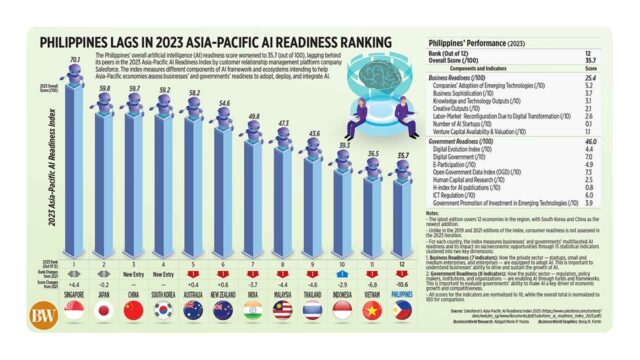
Philippines lags in 2023 Asia-Pacific AI readiness ranking

The Philippines’ overall artificial intelligence (AI) readiness score worsened to 35.7 (out of 100), lagging behind its peers in the 2023 Asia-Pacific AI Readiness Index by customer relationship management platform company Salesforce. The index measures different components of AI framework and ecosystems intending to help Asia-Pacific economies assess businesses’ and governments’ readiness to adopt, deploy, and integrate AI.


Philippines lags in 2023 Asia-Pacific AI readiness ranking

LANDBANK waives fee for small transactions

BW FILE PHOTO

LAND BANK of the Philippines (LANDBANK) has waived the fee charged for fund transfers to other banks worth below P1,000 starting Nov. 1.

“We are thrilled to announce that LANDBANK is waiving transaction fees for small-value online fund transfers to other banks. This is our holiday gift to our valued customers, as we continue to promote safe and convenient digital transactions,” LANDBANK President and Chief Executive Officer Lynette V. Ortiz said in a statement.

The state-run lender will waive fees for customers’ first three online fund transfers or transactions in a day made through the LANDBANK Mobile Banking App (MBA) and its online retail banking channel iAccess.

Meanwhile, fund transfers from and to LANDBANK and Overseas Filipino Bank (OFBank) accounts, regardless of amount, remain free of charge.

For transactions worth P1,000 or above, clients will need to pay the fixed transaction fee of P15, which was previously lowered from P25.

LANDBANK said removing fees for small transactions will help promote financial inclusion and push digitalization in line with the Bangko Sentral ng Pilipinas’ push for both.

In July, LANDBANK removed its daily transaction limit for fund transfers and bills payments.

The bank also increased the daily aggregate amount limit of fund transfers via LANDBANK MBA and iAccess to P100,000 from P50,000 for those made through the InstaPay payment gateway and to P1.5 million from P500,000 for those done via PESONet.

LANDBANK saw its net income rise by 24% to P31.85 billion in the first nine months amid higher loans and yields from its investments. This made up 90.9% of its P35-billion profit target for the year.

This was the highest net income recorded by the bank thus far. It also exceeded LANDBANK’s P26.3-billion earnings target for the first three quarters of the year. — AMCS

Financing growth via more PPP funding

(Part 7)

While the global and regional economic environment this year is worse than last year, there are some emerging opportunities for the Philippines. Among these are rich sovereign wealth funds (SWFs) abroad in search of new investments here because their domestic economies are either crawling or contracting.

Public-private partnership (PPP) investing in the Philippines is one area that many SWFs and big investors abroad find enticing. The Philippine economic team composed of Finance Secretary Benjamin Diokno, Budget Secretary Amenah Pangandaman, National Economic and Development Authority Secretary Arsenio Balisacan and Bangko Sentral officials met with SWFs of Qatar and the United Arab Emirates on Sept. 10-12. President Ferdinand Marcos, Jr. and Diokno met with the SWF of Saudi Arabia plus other investors on Oct. 19.

Last week, Secretary Diokno met with officials of the Federal Holding and Investment Co. (La Société Fédérale de Participations et d’Investissement), Belgium’s SWF on Oct. 28 and he explained the PPP scheme here and co-investment opportunities with the Maharlika Fund in infrastructure and energy. See this BusinessWorld report written by Luisa Jocson, “DoF’s Diokno discusses possible collaboration with Belgian wealth fund” (Oct. 29).

The European Investment Bank (EIB) has also expressed interest to invest in the country’s infrastructure projects when Secretary Diokno visited their headquarters in Luxembourg on Oct. 24. On the same day, the Royal Government of Cambodia-Ministry of Economy and Finance visited the Budget department and Secretary Pangandaman as the Cambodian officials exchanged notes on public financial management.

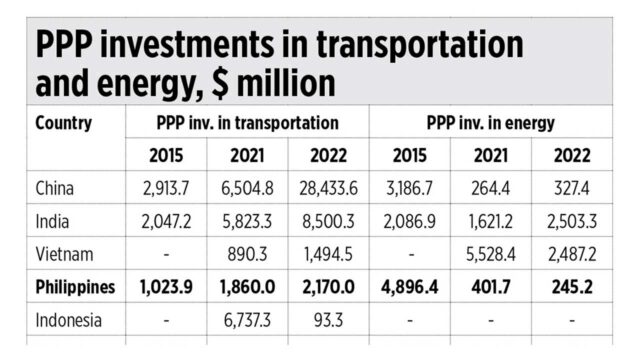
I checked PPP investments by country using the World Bank database. I notice that many countries have zero or small amount of investment, even among the rich and industrial countries. Perhaps they do not call it PPP and just outright private investment with no bidding for solicited projects or “Swiss challenge” for unsolicited projects.

In Asia, the Philippines is among the big recipients of PPP investments in transportation and energy after China, India and Vietnam. In the Americas, Brazil, Mexico, Colombia and Peru lead. In Europe, it is Turkey and in Africa, it is South Africa.

The PPP Code of 2023 (House Bill 6527 and Senate Bill 2233) bicameral committee report was ratified by the Senate on Sept. 27. When this becomes a law, it will help expand infrastructure funding and implementation, update the approval thresholds for PPP projects while offering a consistent legal framework for PPP at the national and local (provincial, city, municipal) levels. There will be clear delineation of risk- and reward-sharing between government agencies and private sector proponents.

The economic and infrastructure teams have identified 197 huge infrastructure flagship projects costing about P8.74 trillion. Forty-nine of those 197 projects will be funded through PPP, and the Maharlika Fund plus partner SWFs from abroad will play an important role in their financing and implementation.

The PPP Center headed by Executive Secretary Cynthia Hernandez has identified 181 PPP projects (121 national plus 60 local) under implementation with an estimated project cost of P2.66 trillion. It is good that more local government units (LGUs) turn to PPP funding for their local projects and not rely on national funding. This will help foster LGU competition to optimize the full implementation of expanded devolution under the Mandanas ruling.

Meanwhile, the Investment Coordination Committee — Cabinet Committee met on Oct. 27 and the economic team approved social infrastructure projects that cover improving agricultural productivity and maritime safety, among other things.

On enhancing agricultural productivity, the Agriculture and Energy departments must compare notes and goals because many ricelands, cornlands, sugarlands and other crops are converted into solar farms. While this will expand renewable energy to “save the planet,” this will also have adverse effects on food production and will not “save the poor and hungry.”

See related “Financing growth” series in this column: Part 6, “Financing growth: Maharlika Fund and SWFs from abroad” (Oct. 24); Part 5, “Financing growth: Reducing interest payments and spending control” (Oct. 5); Part 4, “Financing growth: A rice tariff cut, an MUP pension cut and reforms in excise tax in mining, oil and coal” (Sept. 26).


Bienvenido S. Oplas, Jr. is the president of Bienvenido S. Oplas, Jr. Research Consultancy Services, and Minimal Government Thinkers. He is an international fellow of the Tholos Foundation.

minimalgovernment@gmail.com

ADVERTISEMENT
ADVERTISEMENT