Home Blog Page 408

Philippines sells $2.75 billion dollar bonds amid volatility

JCOMP-FREEPIK

The Philippines sold $2.75 billion of dollar bonds Tuesday, braving rocky markets after fresh tensions between the US and Europe along with a selloff in Japanese bonds and Treasuries.

The country priced notes with tenors of 5.5, 10 and 25 years, according to a person familiar with the matter. The largest tranche — a $1.5 billion 10-year — has a premium of 0.8 percentage point over Treasuries, about 20 basis points tighter than initial price talk, the person added.

The Philippines is one of Asia’s most-active sovereign bond issuers in overseas markets, relying on such funds to help finance a persistent budget deficit. The government is currently grappling with a graft scandal involving billions of dollars meant for flood-control projects in one of the world’s most typhoon-prone countries.

Tuesday’s sale occurred as the Philippine peso has set a series of record lows against the US dollar.

While valuations for the country’s notes are “unexciting,” they should remain reasonably well supported, wrote Nicholas Yap, head of Asia credit desk analysts at Nomura Holdings Inc. Fair value for the 25-year tranche is about 5.65% compared with provided initial guidance of around 5.9%, he added.

The Philippines was among four Asia Pacific borrowers in the dollar-bond market Tuesday — including South Korea’s Woori Bank, which priced a $600 million two-part deal. Yield premiums on the region’s investment-grade bonds have hovered near a record low this month at under 60 basis points on average, helping attract issuers.

The average yield on dollar bonds sold by investment-grade emerging Asian borrowers was about 4.5% on Monday, down from nearly 5.2% when the sovereign last sold dollar debt in the market in January 2025, a Bloomberg index shows. The Philippine government sold a 10-year bond then with a 0.9-percentage-point premium. — Bloomberg

Venezuela has received $300 million in funds from oil sales, acting president says

MODELS of oil barrels and a pump jack are displayed in this illustration photo taken on Feb. 24, 2022. — REUTERS

VENEZUELA’S interim president Delcy Rodriguez said on Tuesday that the country has received $300 million from oil sales, the first proceeds from US President Donald Trump’s announced 50-million-barrel oil supply deal with Caracas, following the capture of President Nicolas Maduro earlier this month.

Mr. Trump said separately on Tuesday his country had taken the 50 million barrels out of Venezuela, and was selling some of it in the open market, though shipping records show that volume has not yet been exported.

Reuters reported last week that four Venezuelan banks had been notified by the country’s government that they would split $300 million of oil revenues deposited in an account in Qatar, enabling them to sell dollars to Venezuelan companies that need foreign exchange to pay for materials.

“We should inform you that we have gotten funds, from the sale of oil, and we have gotten, of the first $500 million, $300 million,” Ms. Rodriguez said at an event in Caracas. “These first funds will be used through the exchange market in Venezuela, by national banks and the central bank, to consolidate and stabilize the market and protect the incomes and purchasing power of our workers.”

Elsewhere on Tuesday, Ms. Rodriguez’s brother, lawmaker Jorge Rodriguez, said a reform of the country’s main oil law expected to be debated for the first time this week will be based on a partnership structure first introduced during President Nicolas Maduro’s administration, though he provided no details.

Interim president Ms. Rodriguez told lawmakers last week that the government supported changes to the hydrocarbons law to boost foreign investment. The law has a single contract model of joint ventures controlled by state company PDVSA, but the country has been introducing so-called ‘productive participation contracts’ for new partnerships in recent years, whose terms have not been fully disclosed.

Those contracts are “a fundamental element to be expressed in the law’s reform,” Jorge Rodriguez told journalists.— Reuters

Empowering content creators, supporting livelihoods at Nestlé Professional’s first-ever TikTok affiliates event

Social commerce has changed the landscape of discovering and purchasing products online. Through live selling and affiliate content creators on social media platforms like TikTok, buying an item is now as easy as scrolling on your feed, clicking the yellow basket and proceeding to checkout. This streamlined process is what brands are leveraging to keep up with today’s dynamic retail space and bring their products directly to consumers.

Nestlé Professional, with its commitment to empower creators and foster collaboration in the food and beverage industry, gathered over 100 affiliates from Metro Manila and nearby cities to join the Nestlé Professional Creator Playground last Nov. 5. Culinary experts conducted hands-on workshops and live demos using Nestlé Professional and Maggi Professional products that served as a guide for attendees to boost their selling potential and further elevate their content on TikTok.

The event also featured informative and inspiring talks about content creation strategies, effective use of social media platforms, and best practices for monetizing content through affiliate marketing.

“We recognize the growing influence of social commerce and the vital role that content creators play in shaping consumer preferences. By bringing together creators, we aim to provide them with the tools, resources, and support they need to thrive in this space,” said Nestlé Professional Business Executive Officer Rica Mier. “This event is just the beginning of our goal to build a community where creators feel valued and empowered to share their experiences with our brand.”

Michelle Mendoza from Antipolo City is one of the content creators who joined the Nestlé Professional Creator Playground. According to her, she gained valuable insights from the event about developing more creative videos for her audience and driving sales. While new to the TikTok affiliate scene, Michelle has a background in business marketing that makes her comfortable in communicating with all types of people through live selling. “Swak kami ni TikTok at ng pag-a-affiliate. Yan ang aking passion. At yung gusto ko sa ganito, sarili mo yung oras mo.”

Just like Michelle, fellow Nestlé Professional affiliate Jenalyn Vicente enjoys the freedom that being an affiliate provides especially to moms like her who are looking for an additional source of income. “’Yung kinikita ko sa dati kong work, kinikita ko na rin ngayon. Sina-sideline ko lang dati itong pag-a-affiliate. Mula pa-isa-isang items, dumami nang dumami dahil ina-approach talaga ng tao,” she shared.

Self-proclaimed rakitero Genesis Quejada added being an affiliate to his long list of side hustles just after graduating college this year. He believes consistency and hard work are key to make it big in this line of work. “’Yung strategy ko ay mag-live for two hours in the morning and two hours at night. ’Yung pagitan ng oras ko na ’yun, I make more content in batches para kung ma-busy man in the next days, may ready-made videos pa rin for posting,” he said.

Because Nestlé products are pantry and kitchen essentials in Filipino homes, Michelle said they’re always in demand. Discounts vouchers and freebies also attract more consumers to their page and to check out the products they’re showcasing. This results in higher sales and bigger commissions for the affiliates.

When asked about their long-term goals as an affiliate, everyone expressed their desire to earn enough to save for the future. Michelle and Genesis both also want to one day establish their own brands and employ affiliates of their own as a way to share their expertise and opportunities to others. Jenalyn, on the other hand, aims for financial security. “Kaya ako nag-affiliate para makatulong sa family ko fully at magkaroon ng extra income. ’Di na ako hihingi sa iba. Lahat ito sarili kong sikap.”

Being an affiliate may seem easy at first look — just promoting products through videos and live selling — but it does come with its own set of challenges such as managing time wisely, coming up with engaging and fresh content ideas, and avoiding violations that may get your account banned, among others. Genesis advises new and aspiring affiliates to familiarize themselves well with the community guidelines and strictly adhere to them in creating content and during lives.

Through the Nestlé Professional Affiliate Program, Nestlé aims to improve the livelihoods of its affiliates and help them maximize their potential as content creators. Check out @barangayNestlé on TikTok to know more and score the best deals on your favorite Nestlé products.


Spotlight is BusinessWorld’s sponsored section that allows advertisers to amplify their brand and connect with BusinessWorld’s audience by publishing their stories on the BusinessWorld Web site. For more information, send an email to online@bworldonline.com.

Join us on Viber at https://bit.ly/3hv6bLA to get more updates and subscribe to BusinessWorld’s titles and get exclusive content through www.bworld-x.com.

SEC studies lifting moratorium on new online lending platforms

BW FILE PHOTO

The Securities and Exchange Commission (SEC) said it is studying a possible lifting of the moratorium on the registration of new online lending platforms.

“The moratorium is already long — it’s already long, so I said it’s about time to study [whether] to lift it,” SEC Chairperson Francisco Ed. Lim told reporters on the sidelines of an event on Monday.

In November 2021, the SEC imposed a moratorium on the registration of new online lending platforms run by financing and lending companies as it worked on rules to curb predatory lending and abusive debt collection practices.

“Liberalizing the rules — that’s my focus this year,” Mr. Lim said.–Alexandria Grace C. Magno

Japan court to rule in trial of man charged with killing ex-PM Abe

Former Prime Minister Shinzo Abe. Image via Chairman of the Joint Chiefs of Staff/Flickr/CC BY 2.0

TOKYO — A Japanese court will on Wednesday deliver its verdict on a man accused of fatally shooting former Prime Minister Shinzo Abe, three and a half years after the assassination of the country’s longest-serving premier stunned the nation.

Tetsuya Yamagami, now 45, was arrested on the spot in July 2022 after fatally firing at Mr. Abe with a homemade gun while the former prime minister was delivering a campaign speech in the western city of Nara. Mr. Abe was 67.

Although he was no longer Japan’s leader at the time, Mr. Abe remained a powerful and binding force within the ruling Liberal Democratic Party. His absence has left a vacuum within the party, which has since seen two leadership races and by extension, a revolving door of prime ministers.

Mr. Abe himself served as prime minister for a total of 3,188 days over two separate terms, stepping down in September 2020 citing health reasons.

His protegee Sanae Takaichi now leads Japan and the LDP, but the party’s grip on power has considerably diminished.

Mr. Abe’s killing also brought to light a deep link between his party and the Unification Church, an organization many consider a cult. An in-party investigation found that more than a hundred lawmakers had dealings with the group, leading many voters to shun the LDP, which has ruled Japan for most of the post-war period.

Media have quoted Mr. Yamagami as telling the court that he held a grudge against the Unification Church after his mother’s large donation to it caused financial hardship for their family, and that he took out his anger on Mr. Abe because the former prime minister had once sent a video message to an event held by a group affiliated with the church.

Founded in South Korea in 1954, the Unification Church is famous for its mass weddings and counts Japanese followers as a key source of income.

A guilty verdict is all but certain after Mr. Yamagami admitted to killing Mr. Abe in the first court hearing at the Nara District Court in October, and attention is on the severity of the sentence.

Prosecutors sought a life sentence last month, calling the act an “extremely grave incident that is unprecedented in post-war history”.

Mr. Yamagami’s lawyers, meanwhile, argued that the family’s misfortune caused by the donation to the Unification Church should be taken into consideration and limit his prison term to 20 years at most.

While Mr. Abe was a divisive figure domestically, he was among the few global leaders to have a strong rapport with US President Donald Trump.

Mr. Abe was the first foreign leader to meet Mr. Trump after his 2016 election victory and the two went on to forge a close bond over rounds of golf in the United States and Japan. Prime Minister Takaichi has repeatedly referenced their friendship in her own dealings with Mr. Trump.—Reuters

Billionaires 4,000 times more likely to hold political office, says Oxfam report

AN ICE CREAM VENDOR passes by a wall covered in campaign posters in Quezon City, May 4. Midterm elections are scheduled for May 12. — PHILIPPINE STAR/MIGUEL DE GUZMAN

Billionaires, whose wealth saw record growth in 2025, are 4,000 times more likely to hold political office than ordinary citizens, according to a global Oxfam report released Tuesday, coinciding with the World Economic Forum in Davos, Switzerland.

In the report titled “Resisting the Rule of the Rich: Protecting Freedom from Billionaire Power,” Oxfam said that 11% of the world’s billionaires had either held or sought political office in 2023, making them 4,000 times more likely to occupy political positions than average citizens.

Oxfam warned that this extreme concentration of political power is “hollowing out democracies, weakening public institutions, and driving growing anger and unrest worldwide, including in the Philippines.”

The organization noted that billionaires’ increased political participation coincides with their record-breaking wealth.

In 2025 alone, the wealth of the world’s billionaires grew by more than 16%, or US $18.3 trillion, Oxfam said, marking a growth rate three times faster than the average of the previous five years. The number of billionaires worldwide also surpassed 3,000 for the first time.

This surge comes amid persistent global inequality, with nearly half of the world’s population living in poverty, Oxfam said.

“The widening gap between the rich and the rest is creating a political deficit that is highly dangerous and unsustainable,” Amitabh Behar, Oxfam International executive director, said in a statement.

“Governments are making wrong choices to pander to the elite, defending wealth while repressing people’s rights and fueling anger as many struggle with unaffordable and unbearable living conditions.”

The report also cited the World Values Survey, which found that almost half of respondents across 66 countries believe that wealthy people often buy elections in their countries.

In the Philippines, Oxfam highlighted that recent corruption in flood control projects has worsened income inequality.

The country remains the 15th most unequal globally and among the Southeast Asian nations with the starkest wealth divide, the report said.

“Filipinos are witnessing inequality become a matter of life and death when corruption diverts billions meant for flood control, while the wealthy amass record fortunes,” Maria Rosario “Lot” Felizco, Oxfam Pilipinas executive director, told BusinessWorld in a text message.

“We cannot let wealth and greed capture our democracy and determine who gets protected and who is abandoned during disasters,” she added.

Oxfam urged governments to control the political power of extreme wealth by implementing realistic, time-bound national inequality reduction plans, effectively taxing the super-rich, enforcing stronger firewalls between wealth and politics, and ensuring accountability for the political empowerment of ordinary citizens.

Oxfam International is a global confederation of over 20 organizations working in over 70 countries to fight poverty, reduce inequality, and promote social justice.— Edg Adrian A. Eva

Thousands protest against Trump immigration policies

Masked law enforcement officers, including Immigration and Customs Enforcement agents, walk into an immigration court in Phoenix, Arizona, US, May 21, 2025. — REUTERS/CAITLIN O’HARA

THOUSANDS of US workers and students marched through cities and university campuses on Tuesday in opposition to the immigration policies of President Donald Trump.

On the first anniversary of Mr. Trump’s second term, protests sprang up across the country against his aggressive immigration crackdown that prompted outrage after federal agents dragged a US citizen from her car and shot dead 37-year-old mother Renee Good in Minneapolis in past weeks.

Hundreds of protesters gathered in Washington and smaller cities like Asheville, North Carolina, where demonstrators marched through the downtown shouting “No ICE, no KKK, no fascist USA,” according to online videos.

The Trump administration says it has a mandate from voters to deport millions of immigrants in the country illegally. Recent polls show most Americans disapprove of the use of force by officers with Immigration and Customs Enforcement and other federal agencies.

University students demonstrated in Cleveland, Ohio, chanting “No hate, no fear, refugees are welcome here” while high schoolers in Santa Fe, New Mexico, left class to attend a “Stop ICE Terror” rally at the state capitol, according to protest organizers and school officials.

The actions were organized by left-leaning groups such as Indivisible and 50501, as well as labor unions and grassroots organizations opposed to immigrant detention camps, like one in El Paso, Texas, where three detainees have died in the last six weeks, according to federal authorities.

The demonstrations were set to roll west to cities such as San Francisco and Seattle, where afternoon and evening protests were planned.— Reuters

Philippines’ BoP position swings to deficit in 2025

US one-hundred-dollar notes are seen in this picture illustration taken in Seoul Feb. 7, 2011. — REUTERS

By Katherine K. Chan, Reporter

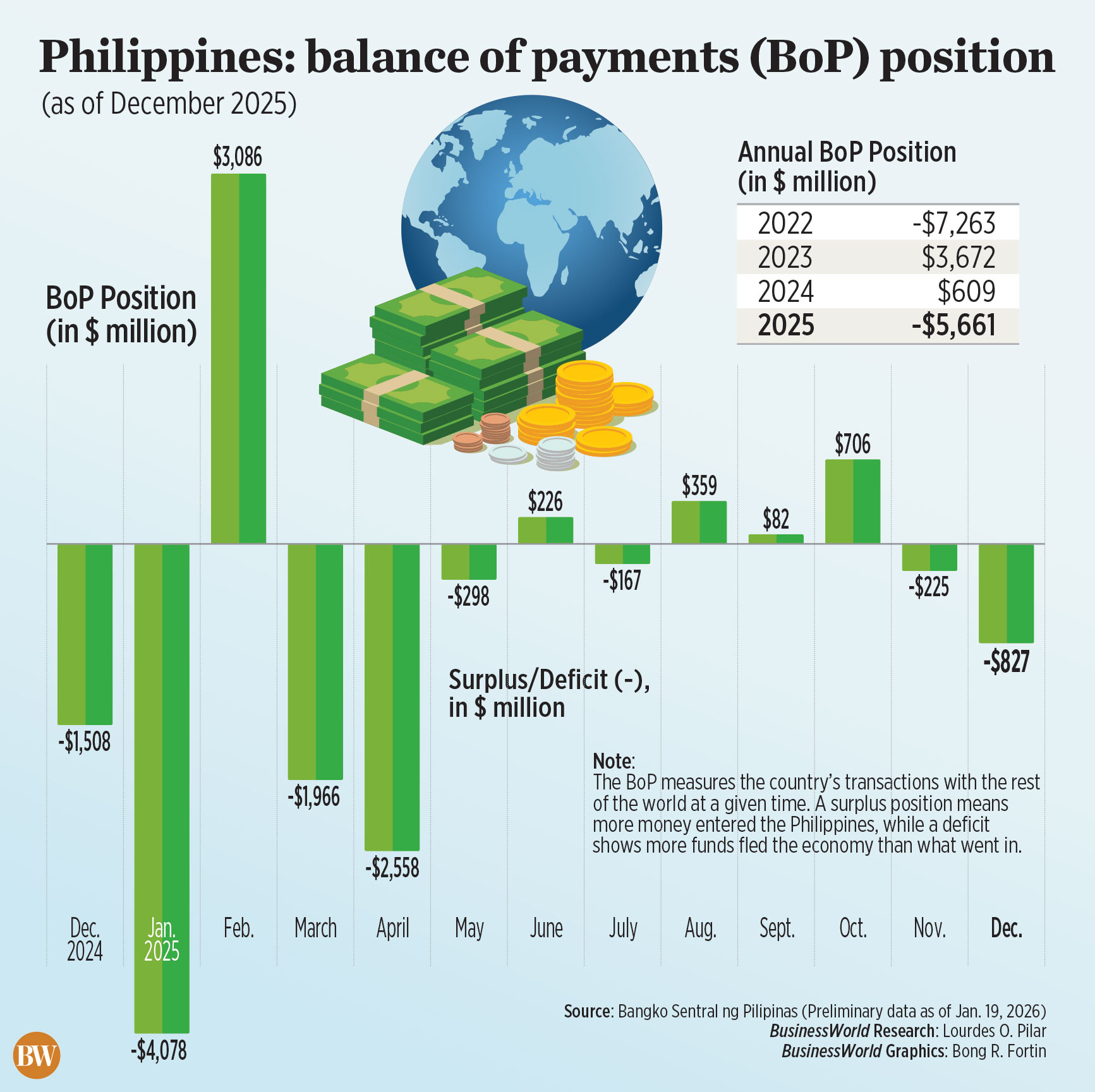
THE PHILIPPINES’ balance of payments (BoP) deficit in 2025 settled below the central bank’s full-year forecast despite posting a wider deficit in December.

Data from the Bangko Sentral ng Pilipinas (BSP) showed that the country’s BoP position swung to a $5.661-billion deficit, a reversal from the $609-million surplus seen in 2024.

This was narrower than the central bank’s projection of a $6.2-billion gap or -1.3% of the country’s gross domestic product (GDP).

In December alone, the BoP deficit narrowed year on year to $827 million from a $1.508-billion gap.

However, it widened from the $225-million shortfall recorded in November.

“The Philippines’ balance of payments registered an $827-million deficit in December 2025, bringing the full‑year outcome to a $5.7-billion deficit,” the BSP said in a statement late on Monday.

BoP refers to the country’s economic transactions with other nations. A surplus indicates more funds entered the country, while a deficit shows that the country spent more than it received.

Rizal Commercial Banking Corp. Chief Economist Michael L. Ricafort said the BoP deficit in December was partly due to the country’s continued trade deficit.   

The Philippines’ trade-in-goods balance, or the difference between the values of exports and imports, narrowed to a $45.2-billion gap as of end-November from $50.18 billion in the same period in 2024.

Meanwhile, John Paolo R. Rivera, a senior research fellow at the Philippine Institute for Development Studies, said subdued capital inflows and foreign direct investments, as well as sustained net outflows from portfolio investments, may have also fueled the recent BoP deficit.

“It reflects a mix of weaker capital inflows, softer FDI (foreign direct investment), and continued net outflows from portfolio investments, alongside a persistently wide trade deficit driven by imports,” he said in a Viber message.

“(The December) deficit likely reflects year-end debt servicing, profit repatriation, and portfolio rebalancing, which are typical toward the close of the year.”

FDI net inflows have recorded double-digit annual declines every month since August 2025. In October, it slumped by 39.8% to $642 million from $1.067 billion a year ago.

Mr. Ricafort said the country’s BoP position may improve in the near term if the administration’s governance reforms would materialize.

“For the coming months, BoP data would improve further if anti-corruption measures and other reform measures, especially in further leveling up the country’s governance standards, are taken seriously, just like 10-15 years ago, as these help further improve international investor confidence in the country,” he said in an e-mail.

RECORD DOLLAR RESERVES
Meanwhile, the central bank’s dollar reserves stood at $110.833 billion as of end-2025, 4.31% higher than the $106.257 billion logged in the prior year.

This marked a new all-time high gross international reserves (GIR) level on an annual basis, breaking the previous record of $110.117 billion at end-2020.

The dollar reserves level in 2025 also exceeded the BSP’s estimate of $109 billion for the year.

At end-December, the country’s GIR level translated to 7.4 months’ worth of imports of goods and payments of services and primary income, well above the three-month standard.

“Specifically, the latest GIR level ensures the availability of foreign exchange to meet balance of payments financing needs, such as for payment of imports and debt service, in extreme cases when there are no export earnings or foreign loans,” the central bank said.

It is also enough to cover about 3.9 times the country’s short-term external debt based on residual maturity.

GIR comprises foreign-denominated securities, foreign exchange, and other assets such as gold. It enables a country to finance imports and foreign debts, maintain the stability of its currency, and safeguard itself against global economic disruptions.

For Mr. Rivera, a rebound in FDIs, export performance, remittance inflows, the US Federal Reserve’s monetary policy actions, among other global financial conditions, will determine the country’s BoP position this year.

“While near-term pressures from global uncertainty and PHP (Philippine peso) weakness may persist, a pickup in investments and exports could help narrow the deficit this year, with GIR expected to remain broadly stable barring major external shocks,” he said.

For 2026, the BSP expects the overall BoP position to end at a $5.9-billion deficit or -1.2% of the Philippine GDP. Meanwhile, it sees the GIR level reaching $110 billion by yearend.

Philippines looks to raise $1.5B via triple-tranche dollar bonds

REUTERS

By Aaron Michael C. Sy, Reporter

THE GOVERNMENT is seeking to raise at least $1.5 billion from its triple-tranche offering of dollar-denominated notes, marking the Marcos administration’s fourth offshore bond issuance and its first in a year.

National Treasurer Sharon P. Almanza said in a Viber message that the government is targeting benchmark volumes of at least $500 million for the 5.5-year, 10-year, and 25-year issuances.

“This transaction marks the Republic’s return to the international capital markets for 2026, building on a robust track record of successful issuances, following a dual-currency issuance of $2.25 billion and €1 billion in January 2025, a $2.5-billion triple-tranche offering in August 2024, and a $2-billion dual-tranche offering in May 2024,” the Bureau of the Treasury said in a statement on Tuesday.

Proceeds of the issuance will be used for general budget financing, it added.

The government aims to price the 5.5-year tranche at about 70 basis points (bps) over the US Treasuries, the 10-year tranche at around 100 bps over US Treasuries, and the 25-year tranche at near 5.9% levels.

The transaction was scheduled to be priced during the New York session on Tuesday, with the settlement date set on Jan. 27.

“The Marcos administration remains firmly committed to promoting strong and inclusive socioeconomic growth. This transaction underscores our steadfast dedication to sound fiscal policy and sustainable development. We are confident that our policy direction and reform agenda will continue to resonate with the global investment community and support a successful outcome for this offering,” Finance Secretary Frederick D. Go said in a statement.

BofA Securities, Deutsche Bank, HSBC (B&D), JPMorgan, Morgan Stanley, Standard Chartered Bank and UBS were mandated as joint lead managers and bookrunners for the transaction.

The global bonds, which will be drawn from the government’s existing shelf program, were rated “Baa2” by Moody’s Ratings, “BBB+” by S&P Global Ratings, and “BBB” by Fitch Ratings. These ratings are in line with the Philippine government’s issuer rating.

“We have seen favorable market conditions for the Republic to return to the international capital markets today. Anchored on stable fundamentals and our recent credit affirmation, this transaction reflects our proactive and strategic approach to secure cost-efficient funding while advancing the National Government’s development priorities,” Ms. Almanza said.

Meanwhile, a trader said in a text message that the issuance could be affected by the sell-off in Japanese bonds and US Treasury yield movements on Tuesday, which could result in investors asking for higher yields but still lower than the initial price guidance.

Philippine Institute for Development Studies Senior Research Fellow John Paolo R. Rivera likewise said in a Viber message that the demand for the dollar bonds could be “healthy but selective” amid a weak peso and volatile US market.

The local unit on Tuesday closed at P59.455 versus the greenback, weakening by 1.5 centavos from its P59.44 finish on Monday, data from the Bankers Association of the Philippines  showed.

The peso’s intraday low of P59.50 was its weakest on record, surpassing the previous record low of P59.46 set on Jan. 15 as well as the P59.47 it briefly touched.

“A softer peso often pushes some investors toward higher-yield emerging-market papers like Philippine-issued USD bonds, especially if yields are attractive relative to US Treasuries and regional peers,” Mr. Rivera said. “But, global risk sentiment and interest rate uncertainty mean that investors will be discerning on timing, tenor, and pricing.”

Mr. Rivera added that the government will have to price the global bonds higher if the dollar rallies or risk appetite wanes to secure demand, but a more stable US market could tighten spreads.

“On rates, expect the government to pay a premium relative to recent periods of calm both to compensate for forex (foreign exchange) risk and global volatility,” Mr. Rivera said.

Philippine agriculture output likely increased in 2025

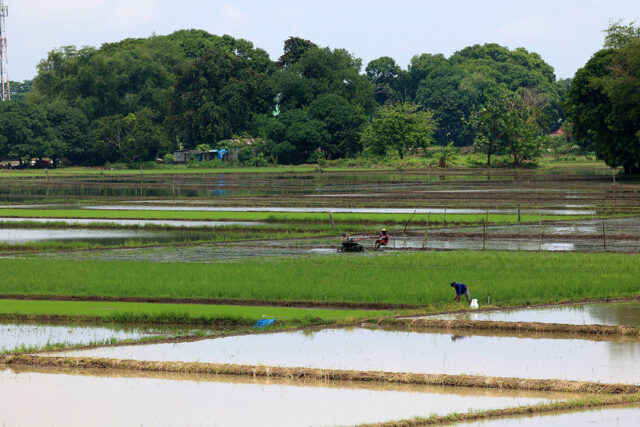
FARMERS manage their patch of land in Bustos, Bulacan, Aug. 13, 2025. — PHILIPPINE STAR/MIGUEL DE GUZMAN

By Vonn Andrei E. Villamiel

THE PHILIPPINES’ agricultural production is estimated to have grown modestly in 2025 as gains in poultry and crop output likely offset the decline in livestock and fisheries, analysts said.

Former Agriculture Secretary William D. Dar told BusinessWorld that he estimated agriculture output to have expanded by about 2% in 2025.

If this projection is realized, it will be a reversal from the 2.2% decline in farm output recorded in 2024.

The Philippine Statistics Authority (PSA) reported an agricultural output of P1.72 trillion in 2024, down from P1.76 trillion a year earlier. 

“Overall, for the 2025 performance of the agriculture sector, there is potentially an increase in output year on year. The crops and poultry subsector will have positive growth as compared to the negative growth of livestock and fisheries,” Mr. Dar said in a Viber message.

Former Agriculture Undersecretary Fermin D. Adriano said a higher full-year output in 2025 can be attributed to relatively better weather conditions.

“My sense is that agriculture performed better in 2025 compared to 2024, which saw a series of devastating typhoons and flooding,” he told BusinessWorld via Viber.

Meanwhile, Raul Q. Montemayor, national manager of the Federation of Free Farmers, said agriculture output is likely lower or flat in the fourth quarter of 2025.

According to PSA data, agricultural output in the fourth quarter of 2024 fell 1.95% to P484.59 million from P494.25 million a year earlier.

“I think it will basically be the same story — lower or stagnant output, with only the poultry sector as the bright spot. I think palay (unmilled rice) and corn will be down,” he told BusinessWorld via Viber.

Mr. Montemayor said the low farmgate prices of palay and corn last year likely discouraged farmers, leading to a reduced crop output.

Palay and corn account for about 27% of the Philippines’ total crop output.

Data from the PSA showed that palay production in the fourth quarter of 2025 fell by 5.21% to 6.85 million metric tons (MMT) from 7.23 MMT a year earlier.

POULTRY GROWTH
For both fourth-quarter and annual output, analysts project a strong turnout for the poultry subsector and declines in livestock and fisheries output.

Elias Jose M. Inciong, chairman of the United Broiler Raisers Association, told BusinessWorld that poultry output likely grew in the fourth quarter of 2025 from a year earlier.

“The reason would probably be an influx of new entrants to the industry,” he said in a Viber message.

For the livestock subsector, the African Swine Fever (ASF), a highly contagious viral disease lethal to swine and wild boars, likely continued to weigh down on production.

“ASF continues to be a problem not only in terms of casualties but also hesitance of hog raisers to repopulate because of the risk,” Mr. Montemayor said.

Meanwhile, Norberto O. Chingcuanco, a board member of the National Fisheries Research and Development Institute and co-convenor of Tugon Kabuhayan, said weather disruptions in the fourth quarter heavily affected fishery production.

“It was a good increase till Typhoon Uwan (international name: Fung-wong) hit us. A huge volume of fish escaped from sea cages,” he told BusinessWorld via Facebook Messenger in mixed English and Filipino

Data from the Department of Agriculture showed that Typhoon Uwan caused P83.66 million in damage to fisheries, with almost 21,000 metric tons of fishery commodities reported lost.

However, Mr. Chingcuanco said fishery output did not actually disappear or decline in terms of its contribution to national food security. Many of the fish that escaped from sea cages were later caught as community catch, which official statistics cannot track.

The PSA will release the 2025 fourth-quarter and full-year agriculture output data on Jan. 28, a day before the release of fourth-quarter and full-year preliminary gross domestic product (GDP) data on Jan. 29.

Agriculture output contributes about a tenth to GDP and a fourth of the country’s jobs.

Maybank sees Philippine economy growing below target until 2027

SHOPPERS crowd a busy street market in Divisoria. — PHILIPPINE STAR/RYAN BALDEMOR

PHILIPPINE ECONOMIC growth may continue to undershoot the government’s targets until next year as the lingering effects of the flood control corruption scandal will likely derail recovery, Maybank Investment Banking Group said.

Maybank economist Azril Rosli said the country’s gross domestic product (GDP) may have grown by 4.8% in 2025, before picking up slightly to 4.9% in 2026. This was down from their earlier estimates of 5.6% and 5.8%, respectively.

If realized, these will fall short of the government’s targets of 5.5%-6.5% for 2025 and 5%-6% for 2026.

“So, we did some quantification on the… impact of the flood control (issue on the Philippine economy). Based on the quantification, we actually revised our GDP growth for the Philippines to 4.8% in 2025 and to 4.9% in 2026,” Mr. Rosli told a media briefing on Tuesday.

“I think… currently the important significant features that we are looking at (are) driven by the flood control spending cuts, as well as the broader Department of Public Works and Highways (DPWH) budget consolidation,” he added. “We thought that the quantification is expected to derail the government’s medium-term economic targets.”

Last year, investigations into anomalous flood control projects across the country uncovered widescale corruption involving lawmakers, DPWH officials and private contractors.

The controversy weakened consumer and investor sentiment as well as slowed government spending and household consumption, driving GDP growth to an over four-year low of 4% in the third quarter. As of end-September, GDP growth stood at 5%.

However, Maybank analysts said the lower end of this year’s target is still attainable if private consumption, which accounts for about 43% of GDP, will pick up.

“(At) the end of the day, it’s really the consumer segment that’s the biggest driver for the Philippines. So, as long as your underlying demand remains quite robust… then the 5%, to a certain extent, is achievable,” Kervin Sisayan, head of equity research at Maybank Securities Philippines, said.

Mr. Rosli likewise said that the government’s renewed push for reforms and catch-up plans, if materialized, could provide some boost for domestic demand and investment climate in the near term.

“We’ll see clearer policy direction, improved regulatory certainty, and stronger public-private engagement that can help unlock delayed private investment and accelerate project implementation,” he said.

“So, this could definitely help in terms of, especially on infrastructure, energy as well as strategic industries. And, this could also provide (a) meaningful boost to domestic demand in the second half of the year.”

For 2027, Maybank expects the economy to expand by 5.2%, also below the 5.5%-6.5% aimed by the government.

If Maybank’s projections until 2027 hold true, the Philippines would miss its growth targets for a fifth straight year.

INFLATION TO PICK UP
Meanwhile, Maybank said Philippine inflation is expected to accelerate this year due to base effects, stabile utility costs and a weak peso in the first half.

The bank sees the consumer price index picking up to 2.2% this year from 1.7% in 2025. If realized, inflation will be back to the Bangko Sentral ng Pilipinas’ (BSP) 2%-4% target.

“Looking ahead, inflation is suspected to gradually pick up to around 2.2% in 2026, moving closer to the BSP’s target range as base effects fade and utility-related costs stabilize,” Mr. Rosli said.

He also noted that geopolitical tensions and exchange rate volatility pose risks to transport inflation, which could bring price pressures this year.

On Jan. 15, the peso slumped to a fresh low of P59.46 against the dollar, surpassing the previous record of P59.44 versus the greenback on Jan. 14.

Amid this macro backdrop, Maybank sees room for deeper cuts this year to bring the benchmark policy rate to 4%.

Mr. Rosli said the central bank will likely deliver one 25-basis-point (bp) cut in each half of the year.

“We’re maintaining vigilance on emerging risks from the external trade outlook, as well as geopolitical tensions and tariff-related uncertainties,” he said.

“So, the policy stance balances providing monetary accommodation to support economic activity while preserving credibility on inflation control, as well as maintaining adequate policy space for future shocks.”

The Monetary Board has so far lowered key borrowing costs by 200 bps since August 2024, bringing it to an over three-year low of 4.5%.

BSP Governor Eli M. Remolona, Jr. has said that they could consider easing further but noted that it may be unlikely given current economic data and as the policy rate is already close to where they want it to be.

Still, he left the door open for two 25-bp cuts this year if economic growth turns out weaker than they anticipated.

The Monetary Board is set to have its first policy review this year on Feb. 19. — Katherine K. Chan


ACEN to invest P60B in PHL solar, wind, and battery projects

ACENRENEWABLES.COM

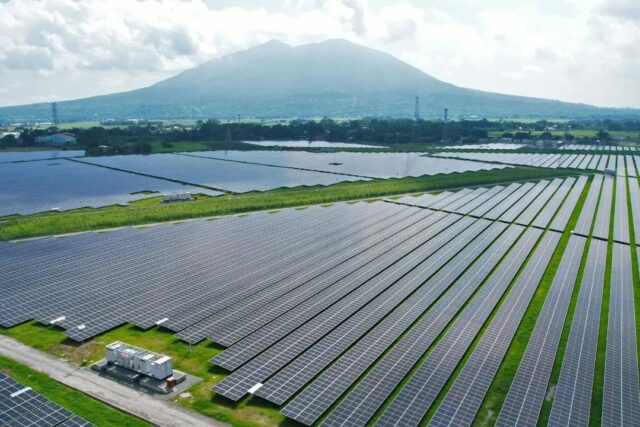
RENEWABLE ENERGY developer ACEN Corp. is expected to allocate the bulk of its P80-billion capital expenditure (capex) this year to the development of its major renewable energy projects in the Philippines.

Speaking to reporters on Tuesday, ACEN President and Chief Executive Officer Eric T. Francia said the budget will finance solar, wind, and battery storage projects currently in the company’s pipeline.

“Over 60 billion [is allocation for] the Philippines alone,” Mr. Francia said.

If realized, the P80-billion capex would surpass last year’s actual spending of around P55 billion.

ACEN currently operates 4.3 gigawatts (GW) of renewable energy projects across its markets, including the Philippines, Australia, Vietnam, India, Indonesia, Laos, and the United States.

Mr. Francia said the company expects to end the year with more than 5 GW of operational renewable energy capacity, as around 1 GW of projects is set to be energized this year.

“We’ll be more than 5 GW operational expected by end of this year. And then we should be close to 7 GW operational by next year,” he said, referring to projects under construction and backed by signed agreements.

The company also anticipates improved performance this year compared with 2025, supported by additional output from recently energized plants and those scheduled to come online.

“The wind farms that were impacted in late 2024 by the typhoon have been substantially restored already since the third quarter of last year,” Mr. Francia said.

“So the plants have been stable in terms of operations. That would definitely add to the volume output.”

For the nine months ending September, ACEN posted a 78% drop in attributable net income to P1.79 billion from P8.14 billion a year ago.

Revenues fell 18% to P23 billion from P28 billion in the previous year, reflecting softer electricity prices and lower power generation output.

On the local bourse on Tuesday, ACEN shares fell 3.92% to close at P2.94 apiece. — Sheldeen Joy Talavera

ADVERTISEMENT
ADVERTISEMENT