Home Blog Page 4050

Forests key to climate fight along with cutting fossil fuels, study suggests
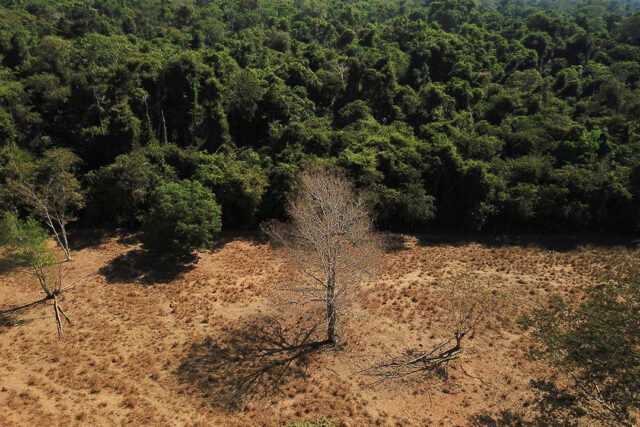
AN AERIAL VIEW shows a dead tree near a forest on the border between Amazonia and Cerrado in Nova Xavantina, Mato Grosso state, Brazil, July 28, 2021. — REUTERS

SAO PAULO — Restoring global forests could sequester 22 times as much carbon as the world emits in a year, according to a scientific study published on Monday, making the case that trees are a key tool in confronting the climate crisis along with cutting fossil fuels.

The study considers restoring forests where they would naturally exist if not for humans, either by allowing degraded woodlands to regrow or by reforesting denuded areas, but excludes areas vital to agriculture or already turned into cities.

Reaching the world’s full potential for restoration would draw out an estimated 226 gigatons of excess carbon from the atmosphere — or roughly one-third the amount added to the atmosphere since the industrial revolution, the research finds.

“There cannot be a choice between nature and decarbonizing. We absolutely must take steps to achieving both simultaneously,” said ecologist Thomas Crowther of Switzerland’s Federal Institute of Technology Zurich.

The paper, published in the journal Nature by Mr. Crowther and more than 200 other researchers, offers a major update to a 2019 paper that sparked fierce debate in the scientific community.

The new findings show that, while forests can help to combat climate change, it is counterproductive to use them to offset future greenhouse gas emissions, Mr. Crowther said. Any additional emissions will exacerbate climate change and extreme weather, damaging forests and hurting their ability to absorb carbon. That would negate the benefits of an offset, he said.

The idea of earning an offset through simply planting trees “is now categorically against what the science says,” Mr. Crowther said.

Mr. Crowther said he plans to attend the upcoming United Nations COP28 climate summit in Dubai to deliver that message to policymakers. “This paper has to be the one to kill greenwashing,” he told Reuters.

TREE CONTROVERSY
The research follows on a landmark 2019 study also co-authored by Mr. Crowther, indicating that 205 gigatons could be sequestered by forest restoration. Salesforce CEO Marc Benioff read the study and was inspired to work with the World Economic Forum to develop its initiative to plant a trillion trees.

But the paper and the trillion trees effort — which was quickly endorsed by then-US President Donald Trump — set off a controversy among scientists and environmentalists.

Many scientists — as well as Swedish activist Greta Thunberg — said trees were being presented as an overly simplistic cureall for the climate crisis that could distract from efforts to reduce the use of fossil fuels, the main culprit for climate change.

Mr. Crowther said the response drastically oversimplified the paper’s message.

More than 40 scientists wrote in the journal Science that the 2019 study may have inflated the carbon sequestration potential of forest restoration by 4-5 times by considering tree planting in non-forest ecosystems among other oversights.

Joseph Veldman, an ecologist at Texas A&M University and lead author of that criticism, said he thinks the new paper still exaggerates how much carbon could be sequestered, potentially by half.

He said the 226 gigaton figure includes carbon sequestered in places that are “inappropriate” for planting trees, like at high altitudes, and overly rely on forest gains in savannas, among other concerns.

“This is like the absolute, absolute upper bound of what could possibly ever be fathomable,” Mr. Veldman said. “You’re never going to get there. It’s unwise and it’s not feasible.”

Mr. Crowther said that while the current and previous study show where trees could be planted, it did not mean that they necessarily should be planted there.

The study’s authors specify that restoration must be done a certain way to be effective.

They argue that forests must be diverse, rather than mass plantings of a single species, and restoration must serve local community needs.

Cristina Banks-Leite, a tropical ecologist, teaches the 2019 Crowther paper and a paper that criticized it in the first week of her master’s course at Imperial College London to illustrate the debate around forests in the scientific community.

Doing such complex measurements for the whole world is always going to have some flaws, but also improves with technology advances, she said.

The paper also finds that protecting existing forests is more beneficial than trying to regrow them. Of the total carbon sequestration potential, only 39% would come from reforesting denuded areas. Most of the carbon gains, an estimated 61%, would come simply from protecting forests that are still standing and allowing degraded woodlands to recover.

“The take-home message – that the forest that we have should be protected – is absolutely foundational and correct,” said ecologist Nicola Stevens at University of Oxford, who had co-authored the criticism of Crowther’s earlier paper. — Reuters

Gang says ICBC paid ransom over hack that disrupted US Treasury market

REUTERS

LONDON — China’s biggest lender, the Industrial and Commercial Bank of China (ICBC), paid a ransom after it was hacked last week, a Lockbit ransomware gang representative said on Monday in a statement which Reuters was unable to independently verify.

ICBC, whose US arm was hit by a ransomware attack that disrupted trades in the US Treasury market on Nov. 9, did not immediately respond to a request for comment.

“They paid a ransom, deal closed,” the Lockbit representative told Reuters via Tox, an online messaging app.

The blackout at ICBC’s US broker-dealer left it temporarily owing BNY Mellon $9 billion, an amount many times larger than its net capital.

The hack was so extensive that even corporate email at the firm ceased to function, forcing employees to switch to Google mail, Reuters reported.

“The market is mostly back to normal now,” said Zhiwei Ren, a portfolio manager at Penn Mutual Asset Management.

The ransomware attack came at a time of heightened worries about the resiliency of the $26 trillion Treasury market, essential to the plumbing of global finance, and is likely to draw scrutiny from regulators.

A spokesperson for the US Treasury Department did not immediately provide comment on Monday.

The Financial Services Information Sharing and Analysis Center, a financial industry cybersecurity group, said financial firms have well-established protocols for sharing information on such incidents.

“We are reminding members to stay current on all protective measures and patch critical vulnerabilities immediately,” a spokesperson said in a statement, adding: “Ransomware remains one of the top threat vectors facing the financial sector.”

WHY PAY?
Lockbit has hacked some of the world’s largest organizations in recent months, stealing and leaking sensitive data in cases where victims refused to pay ransom.

In just three years, it has become the world’s top ransomware threat, according to US officials.

Nowhere has it been more disruptive than in the United States, hitting more than 1,700 American organizations in nearly every sector from financial services and food to schools, transportation and government departments.

Authorities have long advised against paying ransomware gangs in a bid to break the criminals’ business model. Ransom is usually demanded in the form of cryptocurrency, which is harder to trace and gives the receiver anonymity.

Some companies have quietly paid up in a bid to get back online quickly and avoid the reputational damage of having their sensitive data publicly leaked. Victims who do not have digital backups that allow them to restore their systems without the need of a decryption key sometimes have no choice but to pay.

Last week, Lockbit hackers published internal data from aerospace giant Boeing and said on their website they had infected computer systems at law firm Allen & Overy. — Reuters

Tricky politics on menu for China’s Xi at US business dinner

SCREENSHOT VIA APEC

SAN FRANCISCO — Top business leaders in the United States are expected to dine with Chinese President Xi Jinping in San Francisco on Wednesday as he seeks to court American companies and counter his country’s recent struggles to entice foreign investment.

The dinner on the margins of the Asia-Pacific Economic Cooperation (APEC) forum will follow a day of talks between Xi and U.S. President Joe Biden, aimed at stabilizing fraught ties between the world’s two largest economies.

For American businesses, it will be a chance to hear directly from China’s leader as they search for ways to navigate China’s economic slowdown, a U.S. push to “de-risk” some American supply chains away from China, and uncertainty caused by expanding Chinese security rules.

“The purpose of the dinner is to foster better communication,” one source close to the organizers told Reuters, declining to say who would speak while confirming representatives from both the Chinese and U.S. governments would share the podium.

But the event, yet to be formally announced by hosts U.S.-China Business Council (USCBC) and the National Committee on U.S.-China Relations (NCUSCR), also presents uneasy optics.

According to event notifications seen by Reuters, some U.S. firms will pay tens of thousands of dollars to hear a “Chinese state leader” from a government that Washington has accused of genocide against Muslim Uyghurs. China has vigorously denied the accusations.

The USCBC and NCUSCR both declined to comment on the planned dinner. China’s embassy in Washington did not respond to a request for comment.

Xi, who is widely expected to deliver a speech, will be eager to convince U.S. industry that China is still open for business after recording its first quarterly deficit in foreign direct investment.

Even as China this year cast off COVID-19 pandemic controls that effectively shut its borders, it has grown more suspicious of engagement with Western companies, in line with Xi’s emphasis on national security. Xi has overseen a crackdown on U.S. consultancy and due-diligence firms, a further blow to investor confidence.

‘FILET MIGNON’ AND HUMAN RIGHTS
For decades, business and trade has been at the center of U.S.-China relations, helping to fuel China’s explosive economic resurgence and offering what Beijing has often described as the ballast in otherwise contentious ties.

But concerns about a new style cold war between the rival economic and geopolitical superpowers has increasingly placed companies in the cross hairs of both governments.

Xi is on his first visit to the U.S. in more than six years and the pricey dinner, up to $40,000 for a table of eight, according to one notice for the event, is routine by standards for past Chinese presidential visits.

Reuters was not able to obtain a list of attendees, but executives of some companies who spoke privately to Reuters said they would steer clear given questions about the utility for their operations in China and U.S. political risks.

Jeff Moon, a former U.S. trade official turned business adviser, said China’s goal would be to soften Xi’s image and attract investment, but that the dinner was unlikely to “move any needles.”

U.S. lawmakers have castigated some American businesses for turning a blind eye to allegations of forced labor in China and some have been scathing in their criticism of the event.

“How does that dinner conversation go? ‘Wow, this filet mignon is a little dry. How’s your extrajudicial internment of over a million Uyghur Muslims going?” said Mike Gallagher, the Republican chair of the House of Representative’s select committee on China.

Despite human rights concerns, Biden has made a diplomatic push to improve relations, which slid to what many analysts viewed as an all-time low after the U.S. shot down an alleged Chinese spy balloon in February.

The Biden administration says communication at the highest level is essential to prevent competition veering into conflict, and in the interest of the global economy too.

Biden’s Treasury Secretary Janet Yellen reiterated ahead of the APEC summit that while the U.S. sought to reduce its dependence on China in some areas, it did not seek broad economic decoupling.

The dinner is Xi’s “reassurance tour,” and business leaders would look to him to set expectations for how foreign companies would be treated in China, said Nirav Patel, chief executive of consultancy The Asia Group.

“They have come to accept that there’s no substitute for hearing and seeing and observing what Xi Jinping is doing,” said Patel. “Of course, there are some that want to be able to demonstrate that they are committed to China and their presence in these meetings demonstrates that.” — Reuters

Philippines’ GCash banners success story at Singapore FinTech Festival 2023

Shares how it emerged as the country’s only double unicorn

The Philippines’ leading financial super app, GCash, brings its financial inclusion and FinTech success story to the global stage at the Singapore FinTech Festival (SFF) 2023 – sharing how it emerged as the country’s only double unicorn while making a positive impact on Filipinos’ daily lives.

GCash president and CEO Martha Sazon joins a panel discussion talking about, “Building Unicorns: An ASEAN Success Story” at the Insights stage of SFF 2023. She’s joined by Ernest Cu, the President and CEO of one of the Philippines’ biggest telecom companies, Globe Group. The panel is moderated by Ryan Huang, Assistant Finance Editor and Senior Producer and Presenter at Singapore’s MONEY FM 89.3.

“In line with our vision of achieving ‘Finance for All’, GCash has made big strides in transforming the Philippines’ digital economy to make sure no one is left behind. We are excited to engage like-minded organizations at the SFF 2023 as we continue to build partnerships and boost our capabilities in spearheading efforts to build an inclusive and safe digital ecosystem,” said Sazon.

“At GCash, we continue to look for ways on how we can enhance our services and continue pushing for innovations to serve Filipinos wherever they are,” she added.

GCash is the Philippines’ only double unicorn or duacorn with a valuation of over $2 billion. It has evolved beyond its core money transfer business – offering other financial services to the country’s millions of unserved and underserved individuals. These include fair lending, investment, insurance, cryptocurrencies, and other lifestyle services.

It’s also been expanding further by offering partner marketing solutions and ramping up its services for enterprise clients. GCash has also been broadening its reach through global payments partner, Alipay+, by allowing travelers to use the e-wallet for cashless transactions in 17 countries such as Singapore, Japan, and the USA. Likewise, it’s enabled users overseas to sign up for GCash using international mobile numbers in six countries like the USA, Italy, and Japan.

The Singapore FinTech Festival is organized by Elevandi, a non-profit organization set up by the Monetary Authority of Singapore (MAS), and Constellar, and in collaboration with MAS and the Associati. In its ninth year, the gathering focuses on “The Applications of AI in Financial Services” as it tackles how technologies such as AI and Web3 can help accelerate the transition to a low-carbon future; address the needs of the underserved; and secure the digital economy against risks.


Spotlight is BusinessWorld’s sponsored section that allows advertisers to amplify their brand and connect with BusinessWorld’s audience by enabling them to publish their stories directly on the BusinessWorld website. For more information, send an email to online@bworldonline.com.

Join us on Viber at https://bit.ly/3hv6bLA to get more updates and subscribe to BusinessWorld’s titles and get exclusive content through www.bworld-x.com.

Grab delivery riders optimistic in new earnings model

Grab delivery-partners actively participate in a series of forums and town halls, engaging in discussion with Grab as the platform introduces the effort-based earning model.

• Following the implementation of the effort-based model, leaders from the Grab rider community have reported stable to slight increase in their earnings

• For its part, Grab is firm against misinformation discrediting the company and the new earning model

Leaders from the Grab delivery-partner community expressed their cautious optimism about the newly introduced effort-based model. Over the past two weeks since the launch of the restructured earning model, the community leaders have noted that their average income has either remained at par or has incrementally improved.

The rider leaders highlight how the new effort-based model is addressing their existing concerns by incorporating pickup distance and the merchant waiting time in their earnings computation. “Natutuwa ako na ngayon, nasasama na sa computation ang waiting time tsaka ‘yung effort, kumbaga, papunta sa merchant. ‘Yung kita ko, napansin ko hindi bumababa kumpara sa dati, minsan tumataas pa,” shares Jerry from the Grab delivery-partner community.

Continued Assessment and Observation

The initial results of the Metro Manila implementation of the effort-based model attest to its efficacy. Following this, rider leaders are pushing for continued collaboration with Grab to assess and calibrate the earning model in response to emerging trends and the ever-evolving macroeconomic landscape. “Totoong maganda ang paunang resulta ng bagong earning model ni Grab. Ngunit, dahil itong bagong model ay nagsisimula pa lamang, sinisigurado namin ang bawat miyembro ng aming komunidad na patuloy tayong makikipag-dayalogo kay Grab upang mas mapabuti ang mga programa tulad ng effort-based model,” notes John, a rider from Gen T Valenzuela Tambayan.

In a separate statement, Grab has committed to closely monitoring the outcomes of the new earning model. Currently, Grab is complementing the effort-based model with guaranteed minimum fares and holistic incentive programs to ensure earning viability for riders.

Two-Way Communication

The rider leaders have expressed their community’s gratitude for Grab’s proactive approach in fostering open dialogues with the rider community. Among them is Mon, who underscores the significance of actively participating in Grab’s forums and discussion platforms to facilitate a constructive exchange of ideas with the company’s leadership. “Aktibo talaga akong sumasama sa mga forum ni Grab, lalo na pag alam kong maapektuhan ‘yung aming kita. Natutuwa ako na may ganoong klaseng opportunity para kami mismo makapagbahagi ng aming opinyon sa liderato ng Grab.”

Mon also appreciates that Grab has made feedback and dispute mechanisms available for its delivery-partners. In light of the effort-based model launch, Mon shared that Grab activated a new help portal for riders to file reports around concerns like fare computation and actual merchant waiting time. This is crucial in ensuring that the riders’ earnings calculations adhere to the model.

Trust in the Platform

The rider leaders have recognized their industry colleagues’ apprehension, acknowledging that changes can often be overwhelming. Bong, however, is confident that as Grab continues to reach out, educate and obtain riders’ feedback regarding the new effort-based model, riders will gain a clearer understanding of its advantages and how it aligns with the current market and economic conditions — ultimately ensuring the platform’s sustainability. Bong shares, “Sa tagal ko na sa Grab, bilang isa sa mga pioneers noong 2018, marami na akong nakitang pagbabago. Natural lang na may mga tanong at kaunting kalituhan sa umpisa ng mga ganitong bagong patakaran, pero meron na kong kumpiyansa sa mga pinapatupad ni Grab dahil nakita ko kung paano ito nakakatulong sa aming mga riders, tulad na lamang nitong effort-based pricing. Sana sa mga kapwa kong delivery riders, intindihin nating maigi ang mga ganitong klase ng panukala bago magpadala sa ating emosyon at saloobin ng mga ibang tao, lalo na ‘yung mga wala naman talaga sa ating hanay.”

Bong highlights that the rider community acknowledges that Grab remains to offer the most competitive earning model versus other delivery platforms in the Philippines. In the same forum with Grab, leaders from various delivery-partner communities recognized the company’s commitment to optimizing the earnings potential of its delivery-partners to enable them to earn substantially above the minimum wage.

Battling Misinformation

For its part, Grab Philippines emphasized its firm stance against the misinformation being propagated to malign Grab and the new earning model to the delivery-partners. Grab is committed to imposing sanctions on entities that disseminate false information both within and outside the Grab delivery-partner community.

Delivery-partners are instead encouraged to approach any rider leader to clarify their questions and check relevant content shared via the Grab driver app.


Spotlight is BusinessWorld’s sponsored section that allows advertisers to amplify their brand and connect with BusinessWorld’s audience by enabling them to publish their stories directly on the BusinessWorld website. For more information, send an email to online@bworldonline.com.

Join us on Viber at https://bit.ly/3hv6bLA to get more updates and subscribe to BusinessWorld’s titles and get exclusive content through www.bworld-x.com.

Biden meets with Indonesia president ahead of Xi summit

US PRESIDENT JOSEPH R. BIDEN — WHITEHOUSE.GOV

 – Leaders from the United States and Indonesia held discussions on Monday that will set the stage for US President Joe Biden‘s first in person meeting in a year with Chinese leader Xi Jinping later this week.

Mr. Biden greeted Indonesian President Joko Widodo at the White House as the two leaders prepare for a Asia-Pacific Economic Cooperation (APEC) summit in San Francisco, where Washington hopes to reduce friction with Beijing. Mr. Biden is due to meet Mr. Xi on Wednesday.

The United States and Indonesia agreed to new cooperation in defense areas including cybersecurity, space, combined exercises and nuclear threats, the White House said. On climate, they agreed on efforts to support the electrical grid and improve air quality.

Reuters reported on Sunday that the two countries are working to advance a potential minerals partnership focused on the electric vehicle (EV) battery metal nickel, citing three people with direct knowledge of the conversations.

But the Biden administration is still concerned about environmental, social and governance (ESG) standards in Indonesia and is examining how such a deal might work. The two sides will unveil a plan that will prepare the countries for negotiations on the issue, one of the US officials said.

The White House said on Monday that Mr. Biden would announce a memorandum of understanding (MOU) between the two sides on sustainable energy and mineral development.


INDONESIA MAKES APPEAL TO US ON GAZA

Mr. Jokowi, as the president is known, pressed Mr. Biden on steps to end Israel’s war with Hamas.

Indonesia appeals to the US to do more to stop the atrocities in Gaza. Ceasefire is a must for the sake of humanity,” Mr. Widodo said in the Oval Office at the start of talks with the US president.

Indonesia, an archipelago of 270 million people, is the largest Muslim-majority nation. Many Muslims have been outraged by Mr. Biden‘s support for Israel after Hamas militants killed about 1,200 people and took more than 200 hostages on Oct. 7, according to Israeli officials. Palestinian officials have said Israeli strikes have killed more than 11,000 Gaza residents.

“The president will look to ask Indonesia to a play a larger role and to assist us,” in the Middle East, a US official said, without elaborating on what such an expanded role might entail.

Like several of its neighbors in Southeast Asia, Indonesia is economically intertwined with China as it navigates territorial disputes with its larger neighbor and wants to avoid getting caught in the middle by hostile Washington-Beijing relations.

Jakarta and Washington formally upgraded relations to the highest diplomatic tier as part of the leaders’ meeting.

The two leaders were expected to discuss Indonesia‘s diplomatic efforts to resolve the conflict in Myanmar, where the military took control in a 2021 coup and has been engaged in clashes with rebel alliances, one of the officials said.

“It’s going to be time soon for us to think about what our next steps are together to deal with a situation that is untenable,” the person said.

Mr. Jokowi, first elected in 2014, is constitutionally required to leave office next year after serving the maximum two terms. – Reuters


North Korea criticizes G7 as ‘remnant of the Cold War’

FREEPIK

 – North Korea criticized the Group of Seven countries as a “remnant of the Cold War” that causes conflicts for their own interests and violates other countries’ sovereignty, its state media KCNA said on Tuesday.

Jo Chol Su, director general of the Department of International Organizations at Pyongyang’s foreign ministry, condemned G7 foreign ministers for “slandering” the country’s exercise of “self-defensive and legitimate sovereignty” in a joint statement following a meeting last week in Tokyo.

The joint statement by the G7 called for humanitarian pauses in the Israel-Hamas war, reaffirmed support for Ukraine in its war with Russia, and condemned North Korea‘s missile tests and arms transfers to Russia.

G7, which has caused and fomented the recent international crisis, says this or that to find fault with independent sovereign states,” Jo said, according to KCNA.

G7 is just the main dangerous source of destroying global peace and security and the main stumbling block to the establishment of a just international order.”

The group can not represent the international community but protects a few countries’ interests, Jo said, singling out the United States as a supplier of deadly weapons to Ukraine to “deliberately destroy peace and stability” in Europe.

Jo also accused Washington of “conniving at and fomenting” military strikes at Gaza while “shielding Israel’s hideous massacre of civilians.”

“It has lost the justification for its existence,” Jo said. “G7, the remnant of the Cold War, should be dismantled immediately, and this will be the first step toward defusing the present international crisis and restoring global peace.”

The North Korean statement coincides with South Korea hosting representatives of 17 member states of the U.N. Command (UNC) enforcing the Korean War armistice. The talks on Tuesday where expected to renew a pledge to respond to any aggression by North Korea. – Reuters

A century later, US Army overturns convictions of 110 Black soldiers

STOCK PHOTO | Image by Daniel Hadman from Pixabay

The US Army on Monday set aside the court-martial convictions from a century ago of 110 African American soldiers, including 19 who were executed, saying they were denied fair trials in a landmark acknowledgement of official racism in America.

The Army Board for Correction of Military Records overturned the convictions, restoring their service records as having concluded honorably and making their descendants eligible for military benefits, the Army said in a statement.

“After a thorough review, the Board found that these Soldiers were wrongly treated because of their race and were not given fair trials. By setting aside their convictions and granting honorable discharges, the Army is acknowledging past mistakes and setting the record straight,” Army Secretary Christine Wormuth said in a statement.

The reversal comes as right-wing politicians and parents banning books dealing with race and slavery in schools and the US Supreme Court striking down affirmative action policies intended to promote racial equality in university admissions.

The Army convictions arose out of the Houston Riots of Aug. 23, 1917, an outbreak of violence that followed months of racist taunts against Black soldiers of the 3rd Battalion, 24th Infantry Regiment. They were also known as the Buffalo Soldiers, a name of Native American origin that was given to Black regiments in the Army dating to the 19th Century.

On that day Black soldiers guarding a military property were subjected to racist slurs and physical attacks, the Army said. About 100 fellow Black soldiers came to their aid and marched into the city, where ensuing violence killed 19 people, the Army said.

Army courts-martial eventually convicted 110 Black soldiers, including 19 who received the death penalty, in a process that historians determined contained “numerous irregularities,” the Army said.

The review board found the court-martial cases were so fundamentally unfair that all the convictions should be set aside.

The mass execution of 19 soldiers was the largest carried out by the Army of American soldiers in history, the Army said.

The first group of men was hung in secret within one day of sentencing, the Army said.

The convictions were overturned after the South Texas College of Law petitioned the Army to review the cases, prompting requests from retired officers to grant clemency to all 110 soldiers, the Army said. – Reuters

Environmental change threatens what’s left of Japan’s cormorant fishing legacy

STOCK PHOTO | Image by Mercier Zeng from Pixabay

Cormorants have been a constant presence in Youichiro Adachi’s life, and when he was young, he cried whenever one of his family’s birds died.

Now 48, Mr. Adachi still cares deeply for his birds, drawing them out of their baskets each morning and stroking their long necks to confirm their health and maintain a bond.

“For me, cormorants are my partners,” he said.

Mr. Adachi is the 18th generation of his family to be a master cormorant fishermen, and one of about 50 people in Japan carrying on the 1,300-year tradition of using trained birds to dive for fish. It is considered the ideal way to catch the sweet ayu river fish, and his family has a hereditary mandate to supply the delicacy to the Japanese imperial household.

The method, known as ukai, was once common in Japan and a version of it has also been practiced in China. But today it is largely supported by tourists, who watch the fishermen and their birds bringing in the catch.

Now, environmental changes are making the fish ever more scarce and small, endangering the lifeline of the fisherman, known as usho, and their flocks.

“I go to the river every day so I can feel the changes,” Mr. Adachi said, drawing upon nearly four decades of working on the Nagara River in Oze, a town in central Gifu Prefecture.

Come sundown between May and October, he boards a boat along with an assistant, a steersman, and about 10 cormorants leashed at the neck and body. A basket of flames swings out over the dark river, waking the ayu from resting spots among the stones below. The cormorants catch them as they dart away, but the leash keeps the larger fish from going down the birds’ gullets.

The birds are coaxed to release the fish into a bucket. And from a nearby observation boat, tourists take in the spectacle of splashing feathers and dancing fire.

As is common these days, the haul is tiny. Guests at a traditional ryokan inn run by the Adachi family are fed salted, grilled ayu, but it is supplied by a local fish monger.

Mr. Adachi ascribes the dearth of fish to the weather, which he says has become more unpredictable, with heavier rains and flooding on the once calm river. And construction of flood barriers has led to smaller rocks and sand filling the river bottom, obstructing the larger rocks that form the ayu’s habitat.

“In the past, there were only big boulders, but now they’re small,” he said. “The sand and gravel has increased, and along with that the ayu have gotten smaller too.”

Environmental studies have confirmed his concerns. Temperatures in the Nagara River have risen to a high of 30 degrees Celsius (86 degrees Fahrenheit), delaying the spawning period of the ayu by a month, said Gifu University associate professor Morihiro Harada.

The fish like to eat algae that grow on large stones, Harada said, but those rocks have become less common after repeated anti-flooding works carried out by river management authorities.

Down river from Oze, the usho of Gifu City have a larger, more tourism-oriented operation. Fleets of boats allow visitors to eat and drink as they watch the fishermen and birds.

The same environmental shifts also affect this business, with rough waters sometimes pushing the tourist boats off course or leading to cancellations.

To contend with growing number of lost business days, an economic development body known as ORGAN set up an elevated riverside viewing deck on a trial basis, attempting to recreate the boat experience in evenings hosted by apprentice geishas and other traditional performers.

“We wanted to offer a more refined, higher-quality experience,” said ORGAN leader Yusuke Kaba.

Facing an uncertain future, Mr. Adachi can only honor the past and tend to the present. In his home, he prays before shrines dedicated to his usho ancestors. And in the yard, he tends to his 16 birds, one by one.

His son Toichiro helps out on the boat and is training to become the next master fisherman.

Mr. Toichiro wants to carry on the tradition. But for now, the 22-year old spends his days working with a computer at a maker of high-precision machine tools, the type of industry that transformed Japan’s economy and society in the post-war period.

“I want my son to inherit my job, but it’s tough to make a living,” Mr. Adachi said. “If we cannot catch fish anymore, our motivation is gone and there’s no meaning in what we do.” – Reuters

Chinese graduates hold off career dreams, take temporary government jobs

FREEPIK

 – Having failed to find his dream job at a Chinese internet company upon graduation, Peter Liu settled for a role in a state library where there is so little need for his participation that he spends his time studying for a change in his career path.

“It’s really hard to get work at big companies,” said the 24-year-old who majored in TV production at a Beijing university before moving back home in the central Henan province.

Mr. Liu got the librarian job after a government-led campaign to secure temporary work for graduates, which analysts describe as a short-term solution to preserve social stability in a slowing economy with little on offer for young Chinese.

Such “welfare jobs,” as they are known in China, include roles as receptionists, office administrators, security guards and community workers. Various government institutions offer such jobs every year, but they had usually drawn applications from disadvantaged groups, such as elderly or disabled people.

This year, amid a deepening youth joblessness crisis in the world’s second-largest economy, even remote rural positions have seen intense competition from young Chinese with diplomas from top universities, graduates and economists say.

The government sees employment as key to pacifying China’s most pessimistic generation in decades, while graduates gaining even limited work experience can also benefit their future employers if the economy recovers, analysts say.

The one-to-three year contracts pay roughly the minimum wage in the region, typically between 2,000 and 3,000 yuan ($275-$412) per month, sometimes including free meals – much less than their average expectation for a first job salary of 8,033 yuan, according to a survey by Chinese recruitment firm Liepin.

A separate program aiming for 1 million internships this year has courted state-owned and private firms for participation.

The Ministry of Human Resources and Social Security, which did not reply to a request for comment on the government programs or the job market, told state media last week youth employment was improving.

China has in the past year eased some regulatory burdens on tech, property and finance firms – traditionally large employers of new talent. But state media editorials have also encouraged young graduates to take lower skilled jobs.

On Wednesday, the statistics bureau is expected to omit for the fourth consecutive month the release of youth unemployment data, suspended in July after reaching a record 21.3% in June, just as 11.6 million fresh graduates were entering the job market.

The total take-up of short-term jobs and internships remains unknown, but social media posts commenting on the selection process and discussing career options are frequent and analysts expect such roles will be in demand in a slowing economy.

Still, the state sector – which provides a fifth of the urban jobs in China – can only temporarily alleviate economic pressure for a portion of university graduates through such campaigns, economists say, warning youth unemployment remains a major long-term headache for Beijing.

“Youth unemployment will stay with us for quite a long time, at least for five-to-10 years,” said Wang Jun, chief economist at Huatai Asset Management, adding the temporary jobs are “a short-term fix for stability, to relieve social conflicts brought by joblessness.”

China had witnessed high youth unemployment in the late 1970s and early 1980s as educated youth returned to cities after working the farmlands under Mao Zedong, as well as in the late 1990s when the country began shrinking inefficient state conglomerates.

A 23-year-old graduate surnamed Chen said she beat more than a dozen applicants in August to a secretary job at a local agriculture centre in the southwestern city of Chongqing.

“The gap between my dreams and reality is huge,” said Mr. Chen, who wanted to become a teacher.

Mr. Chen and Mr. Liu are both using the slow days at work to study for the highly-competitive 2024 civil service exam, which drew a record 2.6 million applicants, according to state media. If they pass, they would start on one of the most coveted career paths in China, often referred to as the “iron bowl” of financial stability.

Mr. Liu never expected to go for a public sector career, but for now he is at least happy that he can take that chance.

“I don’t want my parents to see me staying at home all day with nothing to do,” said Mr. Liu. – Reuters

Bank lending further slows in Sept.

BW FILE PHOTO

By Keisha B. Ta-asan, Reporter

CREDIT GROWTH further slowed to a 21-month low in September as high interest rates continued to dampen demand for loans.  Data from the Bangko Sentral ng Pilipinas (BSP) released on Monday showed outstanding loans by big banks, net of reverse repurchase (RRP) placements with the central bank, grew by 6.5% year on year to P11.17 trillion in September, slowing from the 7.2% growth logged in August.

The September pace was the slowest in 21 months or since the 4.8% expansion recorded in December 2021. September also marked the sixth straight month that loan growth eased.

On a month-on-month seasonally adjusted basis, lending net of RRP placements with the BSP inched up by 0.7%.

“Slower bank lending was to be expected, showcasing the fallout from policy rate hikes,” ING Bank N.V. Manila Senior Economist Nicholas Antonio T. Mapa said in an e-mail. “BSP rate hikes have a 9-12-month delay, and we are now seeing those hikes take hold.”

The BSP’s benchmark interest rate has been at a near 16-year high of 6.25% from March until October this year. It raised the policy rate by 25 basis points to 6.5% in an off-cycle move on Oct. 26.

“More concerning is the slowdown of lending to productive activities, which indicates productive capacity will be curtailed further,” Mr. Mapa said.

Based on BSP data, borrowings for productive activities rose by 4.9% to P9.65 trillion in September, slower than the 5.5% growth seen a month prior.

China Banking Corp. Chief Economist Domini S. Velasquez said loan growth to productive activities markedly slowed from double-digit growth rates in 2022.

“Loans to the manufacturing sector softened, aggravated by a tepid global trade. Segments under the services sector have also showed signs of deceleration such as accommodation and food service activities,” she said.

According to the BSP data, there was an annual decline in loans for professional, scientific, and technical services (-10.9%), education (-10.9%), manufacturing (-3.8%), as well as accommodation and food service activities (-1.6%).

Meanwhile, loan growth was recorded for major sectors such as electricity, gas, steam, and air-conditioning supply (9.2%); information and communication (8.1%); wholesale and retail trade, and repair of motor vehicles and motorcycles (6.6%); real estate (5%); and financial and insurance activities (4.9%).

The slowdown in lending to productive activities reflects the contraction in capital formation reported in the third-quarter gross domestic product (GDP) data, Mr. Mapa added.

Gross capital formation declined by 1.6% in the third quarter, ending nine straight quarters of growth. This was a reversal of the 18.2% expansion a year prior and 0.3% in the second quarter.

Despite this, the Philippine economy expanded to 5.9% in the third quarter due to robust government spending. This was significantly faster than 4.3% in the second quarter but slower than 7.7% a year earlier. Year to date, economic growth has averaged 5.5%.

Meanwhile, outstanding loans to residents, net of RRPs, rose by 6.6% to P10.85 trillion in September, easing from the 7.2% growth in August.

Total loans to nonresidents, net of RRPs, also inched up by 0.3% to P325.704 billion in September, significantly slower than the 8.4% growth seen the previous month. “On a positive note, consumer loans sustained its robust expansion with no immediate signs of weakening,” Ms. Velasquez said.

Consumer loans to residents jumped by 23.5% to P1.19 trillion, slightly faster than the 23.1% growth in August.

Broken down, annual increases were seen in credit card loans (30.4%), motor vehicle loans (13.4%), salary-based general purpose consumption loans (14.5%), and others (73.1%).

“Looking ahead, we anticipate that consumer loans will benefit from a slowdown in inflation and ongoing support through remittances and a strong labor market,” Ms. Velasquez added.   

MONEY SUPPLY
Despite slower growth in bank lending, domestic liquidity continued to expand by 7.9% to P16.6 trillion in September. This was faster than the 6.8% print in August, separate BSP data showed.

M3 or the broadest measure of liquidity in an economy edged up by 1% on a month-on-month seasonally adjusted basis.

Domestic claims rose by 9.5% in September from the revised 9.3% in August.

Claims on the private sector grew by 6.3%, slower than the revised 7.5% growth in the previous month, amid increased lending to nonfinancial firms and households.

Meanwhile, net claims on the central government also went up by 19.2% in September from the revised 15.2% in August, due to the decline in deposits by the National Government with the central bank.

Net foreign assets (NFA) in peso terms grew by 1% in September, slowing from the revised 3.5% expansion in the prior month.

“The BSP’s NFA grew by 2.3% in September after expanding by 3.2% in the previous month. Meanwhile, the NFA of banks contracted on account of higher bills payable and foreign deposit liabilities,” the central bank said. 

“Looking ahead, the BSP will continue to ensure that domestic liquidity conditions remain in line with the prevailing stance of monetary policy, consistent with its price and financial stability objectives,” it added.

Marcos taps Consing to head Maharlika

Rafael D. Consing, Jr. has been named as the chief executive officer (CEO) and president of the Maharlika Investment Corp. (MIC). — COURTESY OF THE PRESIDENTIAL COMMUNICATIONS OFFICE

PRESIDENT Ferdinand R. Marcos, Jr. has appointed his adviser on investments and economic affairs, Rafael D. Consing, Jr., as chief executive officer (CEO) and president of the Maharlika Investment Corp. (MIC), which the government hopes to be fully operational before the end of the year.

Some observers said the move only confirms speculations that the rules for the Philippines’ first sovereign wealth fund were revised to pave the way for Mr. Consing’s appointment.

A Palace statement described Mr. Consing as “well-versed in global corporate governance and has had a successful transition from regional investment banking to senior corporate management and government advisory.”

Mr. Consing was appointed the executive director of the Office of the Presidential Adviser for Investment and Economic Affairs (OPAIEA) in January. Prior to this, he was chief financial officer and compliance officer at the Razon-led International Container Terminal Services, Inc. (ICTSI).

As MIC president and CEO, he will “manage and invest” the initial and future contributions to the Philippines’ first sovereign wealth fund. He will have to establish a diversified portfolio of investments and other assets that align with the Maharlika fund’s objectives.

“(Mr. Consing) is an accomplished, results-driven, and multi-awarded C-level executive with a profound depth of experience in corporate governance, mergers and acquisitions, corporate finance, global capital markets, stakeholder relations, and business strategy development,” the Palace said.

Mr. Consing worked at ICTSI for 15 years, serving as its vice-president and treasurer in the first nine years. He was awarded Treasurer of the Philippines at The Asset’s Triple A Transaction Banking Award in 2011. 

He also worked at the Hongkong and Shanghai Banking Corp. Limited (HSBC Hong Kong), where he served as managing director from 2005 to 2007. He also worked at HSBC Singapore as managing director and head of debt finance group from 2003 to 2005, and HSBC Philippines as head of its debt finance group from 1999 to 2003.

Mr. Consing also worked at the Bankers Trust Company as vice-president for corporate finance (1997-1999); ING Barings, N.V. as vice-president for corporate finance (1996-1997); Aboitiz & Co., Inc. and Aboitiz Equity Ventures, Inc. as vice-president and treasurer (1995-1996); and Multinational Bancorporation as vice-president for capital markets (1989-1993).

Mr. Consing graduated with a political science degree from De La Salle University.

“Maharlika is at the crossroads of finance, development, and public administration. Mr. Consing has a strong background in all three areas,” House Ways and Means Committee Chair Jose Maria Clemente S. Salceda said in a statement.

He said Mr. Consing, as executive director of OPAIEA, had worked with lawmakers in crafting the amendments to the Corporate Recovery and Tax Incentives for Enterprises Act and the Public-Private Partnership Code.

Enrico P. Villanueva, a senior lecturer at the University of the Philippines Los Baños, said Mr. Consing “may do good” since he was immersed in capital markets early in his career.

But “someone with more extensive and direct experience in fund or asset management would have been preferred,” he said in a Facebook Messenger chat. “After all, that post has been politicized.”

Before Mr. Consing’s appointment, Mr. Marcos ordered the suspension of the Maharlika Investment Fund’s (MIF) implementing rules and regulations (IRR) to make revisions, raising speculations that the move may be aimed at allowing the President to have greater say on the choice of the MIC’s top executives.

The revised IRR was released at the weekend, removing requirements that the holder of the post now assumed by Mr. Consing should have an “advanced degree in finance, economics, business administration or a related field from a reputable university.”

House Deputy Minority leader and ACT Teachers Party-list Rep. France L. Castro said the appointment was “tailor-made” since Mr. Consing could have failed in meeting one of the original requirements.

“It seems that the IRR of the Maharlika Investment Fund Law was revised apparently to enable the appointment of Consing,” she said in a statement.

“A ‘leadership program’ is not an advanced degree,” she said, referring to Mr. Consing’s completion of the Stanford University Graduate School of Business’s Strategic Financial Leadership Program in 2016.

‘WITHIN THE BOUNDS OF LAW’
Meanwhile, the Department of Finance (DoF) assured that the revisions made to the IRR of the MIF are well within the limits of the law.

“The enhancements introduced by the IRR are all within the bounds of the law, meant to give full meaning to the establishment of a strong corporate governance structure,” the department said in a statement on Monday.

“In particular, the IRR’s emphasis on ensuring the independence of the board of directors of the MIC allows it more headroom to form credible oversight and risk management bodies while upholding the highest standards of effective fund management,” it added.

Among the changes made to the IRR include allowing the President to accept or reject nominations for the vacant board positions and removing additional qualifications for the MIC president and CEO, independent directors, and dependent directors.

“(The IRR’s) finalization comes at an opportune time as investors, both local and international, have signified in several investor promotion engagements their robust interest in the country’s first-ever sovereign wealth fund,” the DoF said.

The DoF said that the revision of the IRR shows the administration’s commitment to “see the fund off and running by the end of the year.” — Kyle Aristophere T. Atienza and Luisa Maria Jacinta C. Jocson

ADVERTISEMENT
ADVERTISEMENT