Home Blog Page 397

The economics of nuclear power

STOCK PHOTO | Image from Freepik

By Dianne Araral

THE Philippine government has been laying the legal, institutional, safety, and diplomatic groundwork for nuclear energy. This matters because the heavy reliance on imported fuels leaves electricity prices exposed to global commodity shocks. Coal accounts for around 60% of electricity generation, natural gas roughly 15-20%, and renewables — including hydro, geothermal, wind, and solar — about 20%. Demand continues to rise and large-scale renewables face intermittency, grid land constraints, and recently contract cancellations. Energy security is a precarious problem for the Philippines despite the recent Malampaya discovery.

In 2020, the president Rodrigo Duterte signed Executive Order (EO) No. 116, directing the development of a national position on nuclear energy, and EO No. 164 instructing the Department of Energy (DoE) to integrate nuclear power into the Philippine Energy Plan. Recently, President Ferdinand Marcos, Jr., signed the Philippine National Nuclear Energy Safety Act (PNNESA), creating an independent nuclear safety regulator. The Philippines has also secured US approval for the export of nuclear technology, including small modular reactors (SMRs), following the entry into force of a civil nuclear cooperation agreement.

These are all good. The next question now is whether nuclear energy can be deployed safely, affordably, and within the country’s fiscal constraints. This is where nuclear economics becomes decisive.

SMALLER REACTORS, NOT SMALLER RISKS
SMRs are typically defined as nuclear units below 300 megawatts. Their appeal is clear for an archipelagic country with uneven grid capacity: smaller units, potential modular construction, and the promise of faster builds.

The cost numbers are sobering. Current global estimates place SMR capital costs at roughly $4,000 to over $8,000 per kilowatt, depending on design, location, and financing terms. A single 300-MW SMR can therefore cost $1.2 billion to $2.4 billion before financing. These are first-of-a-kind costs. The price reductions often cited by proponents depend on serial production and repeat builds; they do not appear on the first unit.

Financing magnifies the challenge. Nuclear projects have long construction periods, and interest during construction can add hundreds of millions of dollars if schedules slip. Delays matter far more for nuclear than for gas or renewables because the capital base is large and revenues arrive late.

SMRs may be smaller than traditional reactors, but their economic risks are not proportionally smaller — especially for a first-time nuclear country.

Comparisons with other generation options make this clear. New coal plants typically produce electricity in the range of $70 to $200 per megawatt-hour, depending on fuel prices and environmental controls. Gas combined-cycle plants often fall in the $45 to $75 per megawatt-hour range but are highly exposed to fuel and foreign-exchange volatility. Utility-scale solar and wind are cheaper on paper, often below $70 per megawatt-hour, but require storage, backup, and grid upgrades to deliver reliable power. By contrast, SMRs span a wide range: optimistic projections for mature designs suggest costs competitive with gas and coal, while conservative assessments of first-of-a-kind projects place SMR costs well above those benchmarks once financing and delay risks are included. How nuclear is financed matters as much as the technology itself.

TECHNOLOGY RISK MEETS FISCAL REALITY
Most SMR designs remain early in commercial deployment. Some have cleared regulatory milestones in advanced economies; many have not. None has a long operating record without substantial public support. Investors therefore price multiple uncertainties at once: construction timelines, licensing outcomes, supply chains, fuel services, waste management, and decommissioning.

For government, these risks collide with fiscal reality. The Philippines operates with limited fiscal space. Debt servicing already absorbs a significant share of the national budget, while competing priorities — transport, health, education, disaster resilience, and climate adaptation — remain pressing. Any nuclear program that relies on poorly structured guarantees or implicit bailouts risks becoming a long-term fiscal burden.

This is why nuclear economics must drive design choices. If risks are misallocated at the outset, they do not disappear; they reappear later as tariff shocks, contract renegotiations, or quiet fiscal transfers.

WHY PPPS ARE TEMPTING — AND DANGEROUS IF MISUSED
Given these constraints, it is natural to look to Public-Private Partnerships (PPPs). The Philippines has used PPPs successfully for airports, expressways, and conventional power generation. The instinct is understandable: mobilize private capital, reduce fiscal pressure, and shift risk away from the state.

Nuclear breaks this logic.

Some nuclear risks cannot be transferred at any price voters will accept. Licensing risk is binary. Catastrophic tail risk is politically non-diversifiable. Long construction timelines make financing extremely sensitive to delay. When governments try to push these risks fully onto private investors, lenders demand high returns. Those returns surface as higher electricity prices, larger guarantees, or both.

International experience is consistent: fully private nuclear projects either do not get built, or they are built at prices that become politically untenable.

This does not mean PPPs are inappropriate. It means they must be designed around a basic truth: in nuclear energy, the state is the risk bearer of last resort, whether explicitly or implicitly.

LESSONS FROM ABROAD
International experience reinforces this point.

The United Arab Emirates (UAE) delivered its Barakah nuclear plant through a sovereign-anchored model, combining public finance with an experienced foreign vendor. Financing costs were kept low, and execution was relatively disciplined. The lesson is not to copy the UAE, but to recognize that first nuclear projects succeed when the state anchors risk and imports capability.

The United Kingdom illustrates the opposite hazard. Its private-led nuclear project, supported by long-term price guarantees, reached financial close but at high cost to consumers. Delays and overruns reinforced a basic lesson: shifting risk to private capital does not eliminate risk; it prices it into electricity bills.

France shows the advantages and limits of a state-led approach. Financing costs were low and standardization delivered efficiencies, but contingent liabilities ultimately rested with the state and consumers. China’s rapid nuclear expansion further underscores the same point: relatively low costs were achieved through state-owned enterprises, state banks, and serial construction — a model not transferable to the Philippine political economy.

The United States shows both sides of the ledger. Federal loan guarantees and regulated utility models enabled projects to proceed, yet major overruns demonstrate that finance cannot compensate for weak execution and governance.

Across these cases, one pattern stands out. Countries that treated early nuclear projects as publicly anchored learning investments managed risk better than those that tried to offload uncertainty onto private balance sheets from the start.

WHAT THIS MEANS FOR THE PHILIPPINES
For an initial SMR deployment, the government will inevitably bear a large share of risk — explicitly or implicitly. The honest approach is to recognize this upfront.

PPP structures where private partners are paid for delivering and operating a licensed, available plant — rather than betting on volatile power prices — are more realistic for a first project. They lower financing costs, protect consumers from excessive risk premiums, and give government tighter control over siting, safety, and emergency preparedness.

This does not exclude the private sector. Private firms still design, build, finance, and operate the plant. They are paid for performance. What changes is that non-diversifiable risks — first-of-a-kind uncertainty, regulatory tail risk, catastrophic risk — are not quietly pushed into tariffs or hidden guarantees.

As experience accumulates, uncertainty falls. Regulators gain hands-on capability. Construction benchmarks become clearer. Supply chains stabilize. At that point, more risk can be shifted to private investors through long-term contracts or hybrid arrangements without pushing prices to unsustainable levels.

Only after domestic capability is proven should more private, industrial, or merchant-style models even be considered. Industrial SMRs require creditworthy anchor customers willing to commit for decades. They do not eliminate first-of-a-kind risk; they merely repackage it.

In short, nuclear SMRs in the Philippines should be treated as strategic infrastructure, not merchant power.


Dianne Araral is a green finance and energy policy researcher based in Singapore.

Chris Pratt takes audiences along on immersive AI journey in Mercy

Mercy (2026
Mercy (2026

LONDON — Thriller Mercy imagines a near future where the justice system is powered by artificial intelligence (AI) and suspects are presumed guilty unless they can prove their innocence.

In a violence-ridden Los Angeles in 2029, police detective Chris Raven (Chris Pratt) wakes up in a stupor, shackled to a chair, facing the AI judge Maddox (Rebecca Ferguson) that he helped create. Raven is accused of murdering his wife and has 90 minutes to prove his innocence or he will be executed on the spot.

The Timur Bekmambetov-directed movie felt like a theater play said Mr. Pratt and Ms. Ferguson, who were split up on separate stages, communicating via earpieces and acting out 40-50-minute long scenes.

“I’ve never played a robot or AI, tapping into human emotions,” said Ms. Ferguson. “The conversations that came with that, it was really fun.”

“For me, being confined to a chair was something that was different. I’m a pretty physical person,” said Mr. Pratt, who asked to get strapped in for takes.

“I found it helpful because I truly felt I could fight against it, and felt even more claustrophobic.”

To portray the motionless Maddox, who mimics humans, Mr. Bekmambetov gave Ms. Ferguson a chart of emotions.

“He would say, ‘I want you to smile at the oddest moment,’” she said. “There wasn’t that much for me to work with, other than behind the eyes.”

Maddox has access to the city’s cloud, to which all citizens are legally obligated to connect their devices, and which Raven can use to try to exonerate himself.

Shot in Mr. Bekmambetov’s “screenlife” style, much of the film’s action takes place on displays. As Maddox and Raven scour social media accounts, surveillance feeds, police body cameras, doorbell recorders, and databases, the images are blasted on the futuristic courtroom’s walls.

Mr. Pratt believes the film’s immersive nature will make audiences question their own behavior.

“They’re going to probably be thinking, ‘I’ve etched each of my actions in digital stone over the past 12-15 years. If I’m ever put in a position where this could be used against me, there’s a lot of stuff out there,” he said.

“You’re kind of on the same journey with my character. As I’m defending myself, you’re sort of defending your own actions,” said Mr. Pratt. “It’s like your life is being thrown at you. It’s a little bit jarring.”

Mercy opens in Philippine theaters on Jan. 28. — Reuters

Peso strengthens to two-week high as Trump retracts tariff threats

BW FILE PHOTO

THE PESO rose to a two-week high against the dollar on Thursday on improving market sentiment after US President Donald J. Trump backed down on his earlier threats to impose tariffs on some European countries to get control of Greenland.

The local unit ended at P59.16 versus the greenback, rising by 10.1 centavos from its P59.261 finish on Wednesday, data from the Bankers Association of the Philippines showed.

This was its best close in over two weeks or since Jan. 5’s P59.13.

The peso opened Thursday’s trading session stronger at P59.18 against the dollar. Its intraday best was at P59.095, while it dropped to a low of P59.23 against the greenback.

Dollars traded rose to $1.367 billion from $1.557 billion on Wednesday.

The peso strengthened against the dollar on Tuesday amid improved global risk appetite after US President Donald J. Trump retracted his threats of higher tariffs on European countries as he sought to buy Greenland, Rizal Commercial Banking Corp. Chief Economist Michael L. Ricafort said in a Viber message.

The US dollar held on to overnight gains against major peers on Thursday after Mr. Trump withdrew a threat to impose tariffs on a number of European North Atlantic Treaty Organization (NATO) nations, trumpeting the framework of a deal with NATO over control of Greenland, Reuters reported.

Mr. Trump’s threat to levy tariffs on allied nations opposed to his ambition to control Greenland spooked markets and triggered a broad sell-off of US assets, but his comment in Davos on Wednesday that he had ruled out military action offered relief.

The US president said he had reached a framework for a deal with NATO over Greenland, but he did not offer any details in a post to his Truth Social platform about what that would entail. As a result, though, he said he would not impose tariffs.

President Ferdinand R. Marcos, Jr.’s statement on not wanting the peso to reach the P60 level also provided support to the currency, a trader said in a phone interview.

Palace Press Officer Clarissa A. Castro said at a news briefing on Thursday that Mr. Marcos hopes that the peso-dollar exchange rate will not reach P60, but reiterated that the central bank sees no need for market intervention.

For Friday, the trader sees the peso moving between P59 and P59.30 per dollar, while Mr. Ricafort expects it to range from P59.05 to P59.25. — A.M.C. Sy with Reuters

ILO cites impact of programs in BARMM to reduce child labor

PHILSTAR FILE PHOTO

THE International Labour Organization (ILO) said the Bangsamoro Autonomous Region in Muslim Mindanao (BARMM) is pursuing policy reforms, livelihood programs, and education interventions that help break the cycle of child labor.

The ILO cited the Japan-funded Achieving Reduction of Child Labour in Support of Education Project, which promotes sustainable livelihoods to reduce families’ reliance on children’s income. In Barangay Looy, South Upi, Maguindanao del Sur, families previously dependent on hazardous scavenging and farm work have shifted to small-scale enterprises such as mushroom farming.

Education access has also been expanded through the Alternative Learning System, which enables out-of-school youth to complete basic education and qualify for further studies through Accreditation and Equivalency  examinations, it said.

The ILO also pointed to labor governance reforms under the Bangsamoro Labour and Employment Code, which includes provisions on the minimum employment age, youth apprenticeship, skills training, and support for out-of-school children to prevent child labor.

Child labor in the Philippines fell to an estimated 509,000 children in 2024, down from 828,000 in 2022, according to the Philippine Statistics Authority (PSA). Many working children remain engaged in hazardous labor, particularly in agriculture and waste scavenging, the ILO said in a report released this week.

The PSA defines child labor as work or economic activity performed by a child aged 5 to 17 that is exploitative or harmful to their development.

“Child labor strips children of their rights to protection, learning, and health,” the ILO said, noting that poverty, agriculture-based livelihoods, and decades of armed conflict have heightened risks in parts of Bangsamoro.

Local governments have complemented national and regional efforts. Cotabato City Councilor Shalimar Candao, who chairs the city’s council against child labor, said a priority measure has been “relocating the families living inside the dump site” to reduce children’s exposure to hazardous work. — Erika Mae P. Sinaking

RCBC backs P2.8-B data center project in Rizal

RCBC/BW FILE PHOTO

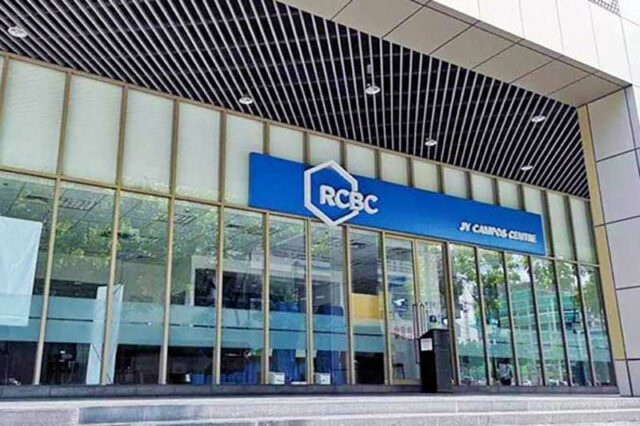
RIZAL COMMERCIAL Banking Corp. (RCBC) has approved a P2.786-billion project finance facility for Singapore-based Digital Halo’s (DH) first data center in the Philippines.

“While we have funded various infrastructures across the nation, today’s signing is for yet another milestone in RCBC’s project finance history. This project marks our first-ever project finance deal for a data center facility — another bold step for the bank, underscoring our commitment to the future of the Philippine economy — one that is increasingly driven by data, connectivity, and digital transformation,” RCBC President and Chief Executive Officer (CEO) Reginaldo Anthony B. Cariaso said on Thursday.

The financing will support the construction and development of Phase 1, comprising 6.5 megawatts, and the core infrastructure for DH’s inaugural MNL1 data center campus in Cainta, Rizal. The site was selected for its proximity to Metro Manila’s central business districts.

Digital Halo MNL1 is the first of three buildings in a planned 70-megawatt next-generation data center campus.

“The carrier-neutral, Tier 3, hyperscale, and AI-ready facility will cater to AI, hyperscale, and enterprise requirements. Other enterprise products include rackspace colocation, hybrid infrastructure, managed IT, and business continuity solutions to serve compute-intensive and mission-critical platforms,” RCBC said.

The 3.75-hectare property can be expanded into a campus with three buildings reaching 70 megawatts in total. The project is part of DH’s regional expansion, alongside its first phase of the JHB1 campus in Johor, Malaysia, which is nearing completion.

“The backing by RCBC reflects a shared vision to develop critical digital infrastructure to support the digital transformation and growing digital economy in the Philippines. Their involvement underscores the strength of our governance and execution discipline, providing hyperscale and enterprise customers with confidence in Digital Halo as a trusted, long-term infrastructure partner,” DH Co-Founder and CEO Kai Goh said. — Aaron Michael C. Sy

Thinking through recombinant capital

SB19’s Simula At Wakas World Tour in Perth, Australia. — FACEBOOK.COM/SB19OFFICIAL

By Jam Magdaleno and Cesar Ilao III

THE innovation race is leaving us behind. Even in the Global Innovation Index, where the country has inched upward in recent years, we are still being outpaced by most of our ASEAN neighbors. In AI Readiness, the gap is clearer: we remain in the bottom half of major Southeast Asian economies, trailing Singapore, Malaysia, Thailand, Indonesia, and notably Vietnam, which posts a score of 61.4 compared with the Philippines’ 58.5.

Why the performance? We do not lack talent in the Philippines. On the contrary, our creatives, BPOs, scientists, and engineers fare well globally.

Our view of innovation under the Fourth Industrial Revolution rests on two serious errors: the vanity of trying to be a “pioneer innovator,” essentially the next Silicon Valley, and that the government must be the driver of this innovation.

The first error is simply unrealistic. It’s too late to compete with nations like China or Singapore for top-innovator status — both technologically decades ahead. Such a goal leaves us in a perpetual state of anxiety that our industries, particularly BPOs, are one step away from obsolescence.

The second error is naive. The government is structurally inefficient as an engine of innovation. It always faces the gargantuan challenge posed by the “knowledge problem” —because the state enjoys a monopoly on decision-making, it engages in the serial processing of knowledge, and hence can only conduct one or few singular trials at a time. This creates a crisis of counterfactual evaluation. Unlike a scientist, the government has no control group for comparison. In contrast, markets operate through parallel processing, where the simultaneous experiments of competing firms function like trials in a laboratory. By relying on the state’s singular approach rather than the market’s parallel discoveries, we inevitably stifle the very innovation we seek.

A good example is the failed Jeepney Modernization Program. By mandating a singular, top-down template, the state forces the entire country into one “serial trial.” This is like a giant science experiment where the lead scientist refuses to have a control group. Because the government has a monopoly on the rules, we are all stuck on one path. We have no way of knowing if a different approach (like app-based dispatching, locally manufactured models, or engine retrofitting) would have been faster or cheaper, because the government never allowed those “parallel experiments” to happen. While the market works like a laboratory where hundreds of firms test different ideas at once, the state’s “singularity” forces us to wait for one slow, potentially flawed experiment to finish before we can try anything else.

Some might propose a Chinese-styled “engineering state” as the solution, as described by technology analyst Dan Wang. But this presumes an efficient developmental apparatus, a premise that collapses in our context. Here, the theoretical cost of state-led projects is frequently bloated by corruption spillovers, with leakage reaching staggering levels of 25% to 70%, as we have seen in the recent flood control controversies. This makes state-directed innovation not just inefficient, but fiscally predatory.

Instead of these assumptions. We must shift our view of innovation from the “invention of the new” to the “recombination of the existing.” As Harvard economist Martin Weitzman argued, long-run growth does not arise from simply adding more capital and labor — a process subject to diminishing returns, but from recombining existing ideas and assets into new, more valuable combinations. In this sense, the “recipe” matters far more than the quantity of ingredients.

The Philippine economy’s unique composition is better suited to recombination, leveraging existing capital and applying global technologies, rather than attempting to invent them from scratch. We hold a distinct advantage in sectors such as AI and the creative industries, underpinned by an asset that requires no government procurement to mobilize: a large, adaptable, English-speaking workforce.

We do not need to invent the next OpenAI, which is a game of massive capital. We need to master the art of splicing our existing, undervalued assets with emerging technologies to create unique value propositions.

On AI, our response remains on the defensive. We view it as a hurricane threatening to wipe out our BPO sector, prompting calls for “upskilling.” But this is a deficient solution. A recombinant approach sees the BPO sector with realism. While the threat of automation exists, we possess two massive, dormant assets: a workforce of 1.2 million culturally adaptable English speakers, and decades of unstructured data on Western consumer psychology (contained in call logs and chat histories).

While Singapore invests billions in “Compute” (hardware and data centers), the Philippines could invest in “Context.” The recombinant move is to merge our service workforce with Large Language Models (LLMs). We should not just be users of AI. We should be the global hub for vertical AI alignment. Generic models like GPT-4 are powerful but lack nuance. The Philippines can recombine its workforce’s “cultural empathy” with algorithmic power to create specialized, industry-specific models. For example, instead of just answering calls, Filipino teams could be training “empathy engines,” fine-tuning AI agents for US mental health or triage or geriatric care, where nuance is non-negotiable.

This shifts the value proposition from selling time (labor) to selling high-fidelity context (intellectual property). This requires zero investments on new bridges or airports, but relies on a regulatory environment that allows data and talent to mix freely.

Our fallacious view of innovation renders our approach reactive, even as our regional neighbors play a different game. Vietnam’s Green and Smart Mobility (GSM), for instance, didn’t wait for a state-mandated roadmap, nor did it invent EV. It succeeded by recombining existing capital — VinFast’s electric vehicle manufacturing with a high-tech digital ride-hailing platform. By merging hardware with software, GSM captured nearly half of Vietnam’s ride-hailing market in just two years and is now exporting its model across Southeast Asia, including the Philippines. Vietnam’s government has supportive policy environments for EV adoption, yet GSM’s expansion and market share are driven by corporate strategy, not state direction.

The government can also learn from the boy band SB19. Why? They did not succeed by simply mimicking OPM or K-Pop. They recombined existing capitals: the rigorous, algorithmic training capability of the Korean idol system and Filipino linguistic depth and vocal talent. They treated “performance discipline” as a capital asset and merged it with local creativity. No wonder they command global attention today.

SB19 learned to stop treating Filipino culture as a museum artifact and realized that, like any form of capital, it can be remixed into something new.

Why does this matter? Because this shift in perspective brings us back to the fundamental building blocks of innovation: property rights, enforceable contracts, and the rule of law. At a minimum, the government’s role is to ensure these elements are consistently observed and protected. Can entrepreneurs get permits without bribery? Can they access financing and technology? Can they hire talent and import materials freely? Can they experiment without the threat of monopolies?

If the government can’t get the basics right amid recent scandals, how can it claim to be the “driver” of innovation?


Jam Magdaleno is head of Information and Communications at the Foundation for Economic Freedom (FEF) and an Asia freedom fellow at the London School of Economics and Political Science (LSE) and King’s College London. Cesar Ilao III is a researcher and communications specialist for FEF. He is a lecturer at the University of the Philippines and was formerly a researcher at Monash University, Australia.

Jason Statham’s Shelter combines action and emotion

Shelter-(2026)-
Shelter (2026)

LONDON — Jason Statham is back in action in Shelter, but the British actor says his latest thriller is powered by his character’s emotional arc.

“I haven’t done anything like this. It feels very elevated in terms of the dramatic elements,” Mr. Statham said, premiering the movie in London on Tuesday.

Mr. Statham plays Michael Mason, a former elite operative hiding out on a remote island in the Outer Hebrides. Accompanied only by his dog, Mason spends his days drinking, drawing, and playing chess. An orphaned girl, Jesse (Bodhi Rae Breathnach), regularly brings him supplies on a rowboat, but is told to avoid contact. When a storm breaks out during one of her deliveries, Mason rescues Jesse, setting off events that lead his past enemies on his tracks and forcing Mason to take action to protect the youngster.

The film is about “an improbable pairing” finding purpose in each other, said Mr. Statham. “It’s certainly a slow burn.”

That gradual crescendo helps audiences connect with the characters, said director Ric Roman Waugh, known for Greenland and Angel Has Fallen.

“We’re unravelling a mystery in a way that creates empathy, creates emotional bond, so that when you hit the action, you’re not just watching it, you’re participating, and you’re rooting for your heroes,” he said.

A former stuntman, Mr. Waugh wanted to place viewers “inside the action” and shoot on real locations.

“What you get is a wild ride that is authentic and grounded and gets us away from the visual effects world where nothing feels real anymore,” he said. “Coming from the world of stunts, I’m trying to make you feel what I went through.”

Mr. Statham, 58, has a busy year ahead. His other 2026 releases include Mutiny and The Beekeeper 2 and he is about to reunite with filmmaker Guy Ritchie for their sixth feature collaboration, Viva La Madness.

“I’m very excited about that. My main man Guy Ritchie, he started my career almost 30 years ago, so I owe him a lot. He’s a mentor to me. He’s a very special person in my life and I’ve got a lot of love for the man,” said Mr. Statham, noting that shooting would start in a week but revealing no further details about the project.

Shelter, which also stars Bill Nighy and Naomi Ackie, begins its global theatrical rollout on Jan. 28. It comes to Philippine theaters on Feb. 11. — Reuters

AI and the finance sector: What will the BSP’s AI regulations look like?

Artificial intelligence  (AI) has been described as a pivotal technology, a linchpin, a game changer — and all these descriptors seem particularly apt when it comes to the financial sector. From powering operational efficiencies to investment research to credit rating, AI is here and, unless we revert to putting our savings in a bedpost, is pretty much here to stay.

The Bangko Sentral ng Pilipinas (BSP) itself uses generative artificial intelligence in its policy work and has made known its desire to create a “robust and trustworthy AI ecosystem” for the Philippine financial industry. The institution, however, has noted in studies and reports on consultations that widespread AI use can trigger significant risks that need to be mitigated. In this regard, and since the earlier part of 2025, the BSP reportedly has been developing rules and standards for the use of AI, but these have not been issued at the time of writing.

What will those standards look like? What should the financial sector be ready for?

In a talk given at the Asian Banking and Finance-Insurance Summit held in March last year, Melchor Pablasan, senior director for the BSP’s Risk and Innovation Supervision Department, had identified key pillars for the institution’s AI regulations: ethical AI deployment, management of algorithmic bias, and continuous improvement of AI’s accuracy. Mr. Pablasan had noted that regulations on cybersecurity, data privacy and technology risk management already exist, and therefore upcoming rules would be “clarificatory” and would address gaps, which essentially relate to ethical use.

The regulations therefore may emphasize assessment of quality of input in the system as part of regular monitoring, and require that there be clear evidence that output has adequate support or challenge. To establish more responsive controls, financial companies may be asked to adopt a tiering approach to risk, categorizing services by level of exposure to, for instance bias and discrimination risk and requiring more robust human oversight for these areas. The sector will likely be required to undertake and show proof of impact assessments, AI policies and governance frameworks, and transparency statements to users or customers. An interesting test for AI adopters would be implementation of a human-in-the-loop requirement for decision-making, e.g., providing credit or determining credit scores. These mitigation strategies are among those mentioned in a study prepared by the BSP’s Technology Risk and Supervision Department.

Businesses that have been gearing up or wish to gear up for the new regulations as well as any future policies and laws might also benefit from a review of or look-back at BSP Circular No. 1153, Series of 2022, which provides for a Regulatory Sandbox Framework and an approach for assessing AI-enabled products and services; the BSP Manuals of Regulations insofar as they set out guidelines on information technology risk management; National Privacy Commission Advisory No. 2024-04 on the application of the Data Privacy Act on AI systems processing personal data; some pending local AI legislation, including those that focus on worker displacement; and even the ASEAN Guide on AI Governance, as well as the EU AI Act, which prohibits financial institutions from certain AI uses such as those relating to social scoring and biometric categorizations.

The views expressed herein are the author’s own and do not necessarily reflect the opinion of her office as well as FINEX.


Rose Marie M. King-Dominguez is a senior partner of SyCip Salazar Hernandez & Gatmaitan and the head of the firm’s Special Projects Department. She is a FINEX member.

The best time to rewrite the code of conduct

I’m a newly hired human resources (HR) manager at a small bank. On my first week, I noticed several issues with the employees’ code of conduct (CoC). Many of the penalties for violations are excessive. For example, the penalty for a first-time tardiness offense is three days’ suspension. There’s no oral and written reprimand. Please advise. — Blue Comet.

Rewriting the CoC is a strategic management exercise in shaping behavior, reinforcing values, and protecting the company’s reputation. When done well, it can strengthen the culture. Done poorly, it becomes just another corporate document employees pretend to read before signing — “I received, read, and understood the contents of the CoC.”

​When revised poorly, it contributes to bigger organizational problems. You, as the new HR manager, having a fresh set of eyes, must take the lead in reviewing the CoC’s contents, subject to certain conditions.

​Are the employees complaining about the harsh penalties? If not, then don’t change it, unless they violate labor standards. What’s the violation rate? If this is not an issue, then don’t rock the boat, unless there’s a “fear” culture among the workers or weak enforcement by line leaders.

​Do you have a labor union? If the answer is yes, you must make them co-owners of the draft rules to promote mutual trust. And first things first, do you think management would agree to revise the code? If not, then don’t. Besides, you must focus your attention on other important things like attrition rates, the quality of supervision, and productivity, among other concerns.

GENERAL GUIDELINES
Just the same, let me give you a list of things to do before you decide to revise the CoC. The objective is to review the code to ensure clarity, relevance, and credibility. Here’s how to proceed:

​One, begin with an objective diagnosis. This is to balance the mutual interests of both management and employees. Are there patterns of misconduct? Repeated violations? Is your code aligned with legal and industry standards? This last question is important as your policy could be assailed in court.

​How about changes in employment terms allowing remote setups, gig workers, or expansion? Industry regulators may have shifted the rules, too. Once the reasons are clear, form a drafting team that includes HR, legal, compliance, and operations who can translate policies into day-to-day reality.

Two, make all policies easy to understand. Employees don’t need lawyers to interpret the rules. Write a Taglish version if most of your workers are not college graduates. Use simple, direct language that any employee can understand.

​Avoid punitive statements. Rather, the code must be positioned as a supportive, empowering signal so the employees can make wise decisions.

​Three, include disclaimers that the code can’t anticipate every situation. This may be included in the opening statement of the code. Have general guidelines covering actual behavior that are punishable by progressive penalties. Encourage employees to ask questions when in doubt.

​Involve the line supervisors and managers in explaining the rules. They’re the first line of defense. If a certain offense can’t be defined fully, make it clear that the Labor Code, Revised Penal Code, and Supreme Court jurisprudence may be applied instead.

Four, establish a confidential whistleblower hotline. A credible code may be clearly supported with authorized reporting channels that include a secure e-mail or executive escalation. Ensure that investigations are fair, confidential, and free from retaliation.

​An organization that punishes whistleblowers sends the message that the document is a decorative piece, not a real standard. Consequences must also be spelled out for false accusations, but not in a threatening way.

​Five, write a code that reflects corporate values. A revision isn’t just a response to current issues. It’s an opportunity to reinforce the culture that top management wants. The best policies start with values and translate them into expected behaviors. If integrity is a non-negotiable core value, then explain what it looks like.

​If health and safety are part of the corporate values, how should employees demonstrate them? If service excellence is a pillar, how should employees manifest it in dealing with fellow employees, the customers, and the general public.

​Six, publish the revised code in various channels. Many companies fail at this step. They update the code with great effort, then launch it quietly — an e-mail, a PDF link, and a required checkbox. That’s not proactive communication; that’s paperwork.

​Explain what changed, why it matters, and how it protects both employees and the organization. Leaders should endorse it publicly; a CEO message adds weight. Use FAQs, quick videos, or orientations to make it digestible.

Seven, make the code a living document. Set a regular review cycle once a year or every two to three years depending on business changes. Monitor feedback, complaints, case trends, and compliance gaps. Use these insights to refine the next version.

​Great companies don’t just tell employees how to behave — they evolve those expectations as the business and society evolve.

​In conclusion, understand that revising the code poses many challenges. But it’s not a good reason to skip it. It’s one of the most powerful ways. HR managers and other people managers can reinforce culture, trust, and integrity.

​A well-crafted code isn’t just a set of rules — it’s a blueprint for how the organization wants to show up in the world. And in an era where reputations can collapse overnight, that’s a document worth updating with both urgency and care.


Consult your management issues with Rey Elbo for free. E-mail elbonomics@gmail.com or DM him on Facebook, LinkedIn, X or via https://reyelbo.com.

Regulator simplifies process for companies to raise capital

SEC.GOV.PH

THE SECURITIES and Exchange Commission (SEC) has eased requirements for companies seeking to increase their authorized capital stock, allowing them to use subscription contracts instead of costly and time-consuming audit reports.

In a statement on Thursday, SEC Chairperson Francisco Ed. Lim said the move is aimed at making corporate processes “simpler, easier, and more cost-efficient, enabling more corporations, especially micro, small, and medium enterprises, to grow and thrive.”

Under Memorandum Circular No. 6, Series of 2026, companies can now submit subscription contracts for cash-paid capital stock increases, replacing the previous requirement for a Special Audit Report (SAR) when paid-up capital exceeds P50 million. Subscription contracts are legal agreements specifying the number of shares subscribed to and how payment is made.

“The streamlined compliance process could reduce the financial burdens of companies that plan to increase their capitalization, supporting their expansion and contribution to economic growth,” the SEC added.

The subscription contract must be signed by the subscriber and the company’s president and treasurer. If they are unavailable, a board resolution can authorize a director or officer to sign on their behalf.

Companies with public-interest obligations — including listed firms, those offering securities to the public, and holders of secondary SEC licenses — will still need to submit SARs for capital stock increases. — Alexandria Grace C. Magno

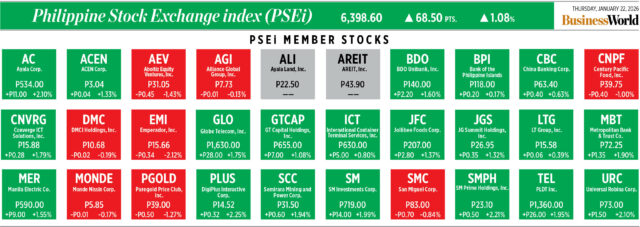
How PSEi member stocks performed — January 22, 2026

Here’s a quick glance at how PSEi stocks fared on Thursday, January 22, 2026.


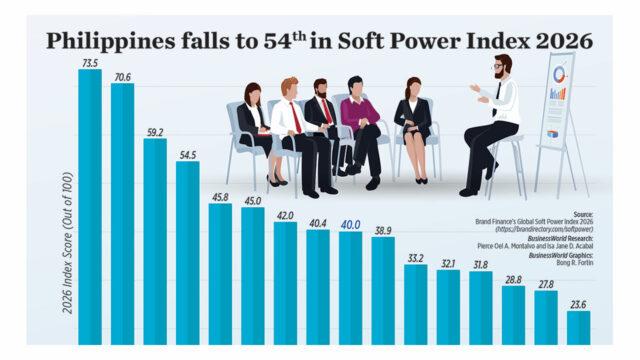
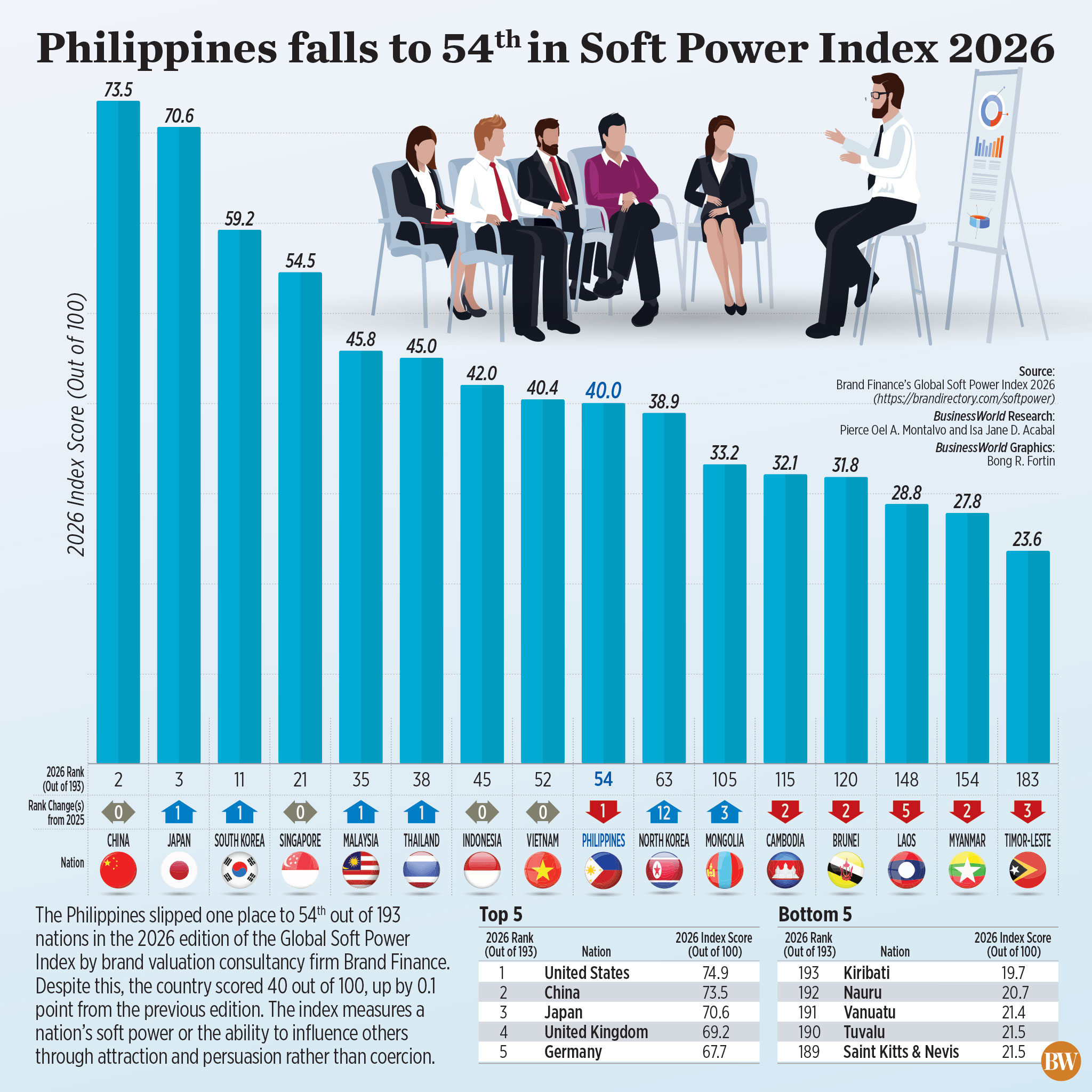
Philippines falls to 54th in Soft Power Index 2026

The Philippines slipped one place to 54th out of 193 nations in the 2026 edition of the Global Soft Power Index by brand valuation consultancy firm Brand Finance. Despite this, the country scored 40 out of 100, up by 0.1 point from the previous edition. The index measures a nation’s soft power or the ability to influence others through attraction and persuasion rather than coercion.

ADVERTISEMENT
ADVERTISEMENT