Home Blog Page 384

Eala is all set as PHL becomes part of women’s pro tennis circuit

ALEX EALA — PHILIPPINE STAR/RUSSELL PALMA

AND there’s the formality.

Alexandra “Alex” Eala is all set for her first-ever home tournament when she spearheads the historic Philippine Women’s Open (PWO) on Jan. 26 to 31 at the Rizal Memorial Sports Complex Tennis Center in Manila on the heels of a historic main draw debut in the Australian Open (AO) in Melbourne.

No less than the Filipina wunderkind confirmed her participation on Thursday right after landing at the Ninoy Aquino International Airport Terminal 3 with a grand welcome from the Philippine Sports Commission and the Philippine Tennis Association.

“Yes, I will be playing next week. I’m looking forward to it and I hope people can show up and support the Pinays,” beamed Ms. Eala on the WTA 125-level tourney as the country becomes a part of the women’s pro tennis circuit at last.

“It’s a huge milestone in Philippine tennis, and I think it’s a big deal for all of us Filipina tennis players.”

Ms. Eala, as early as the hosting announcement last year, was listed as a wildcard entry in the 32-player main draw but her availability in the PWO had been up in the air since then, owing to her AO campaign.

For a far bigger achievement not only for her but also for Philippine tennis, Ms. Eala could have not been available in the PWO with a deep AO run at least by the third round but she unfortunately absorbed an early boot.

At No. 49 in the Women’s Tennis Association (WTA) as the first Filipina ever to enter the world’s Top 50, Ms. Eala bowed to No. 99 Alycia Parks of the United States, 6-0, 3-6, 2-6, in the singles first round.

It’s the same fate in the doubles for Ms. Eala with Brazilian partner Ingrid Martins (WTA doubles No. 80), exiting with a 6-7 (3-7), 6-2, 3-6 defeat to Japan’s Shuko Aoyama (WTA doubles No. 52) and Poland’s Magda Linette (WTA singles No. 50 and doubles No. 140) in the opener.

Ms. Eala, according to the live WTA ranking, is at No. 44 for a potential new-career best despite the early AO exit barring any major shake-up for the players in front and behind her, leading to the PWO.

Now at home as one of the top-ranked players, hopes are high for Ms. Eala especially with a bigger Filipino crowd, who has been supportive of her WTA Tour stops anywhere in the world. Tickets, in fact, have already been sold out until the final day as per the organizers.

The PWO, where she’s joined by compatriots Stefi Aludo and Tenny Madis, will serve as Ms. Eala’s fourth tournament this season after the ASB Classic in Auckland, New Zealand, the Kooyong Classic in Melbourne and the AO.

She reached the final four in Auckland, her third WTA semis appearance ever, and was given the Evonne Goolagong Cawley trophy in Kooyong as the 2026 exhibition champion following a 6-3, 6-4 mastery of Paris Olympics silver medalist and 2024 Wimbledon semifinalist Donna Vekic of Croatia.

At stake for Ms. Eala — winner of two girls doubles Grand Slams as a former world junior No. 2 including the 2020 AO with Indonesian pal Priska Madelyn Nugroho — in Manila is her second WTA title after a breakthrough championship in the Guadalajara Open in Mexico last year that served as one of her springboard to a historic Top-50 world ranking.

But that would be easier said than done, especially with a stacked cast ready to neutralize her homecourt edge led by the top two seeds in world No. 42 Tatjana Maria of Germany and No. 46 Wang Xinyu of China along with No. 59 Janice Tjen of Indonesia, No. 63 Solana Sierra of Argentina, No. 72 Ms. Vekic, No. 76 Kimberly Birrell of Australia and No. 84 Camila Osorio of Colombia among the few.

A total of 24 listed players in the PWO including Ms. Eala also saw action in the AO, making it a star-studded and ultra-competitive slugfest as the country eyes to be a staple stop for the WTA Tour from here on with an expected bid for a higher 250-level tourney next year.

After the PWO, Ms. Eala will head back overseas for the rest of the WTA Tour starting with a qualifying round ticket in the Mubadala Abu Dhabi Open on Feb. 1 to 7 in the United Arab Emirates. — John Bryan Ulanday
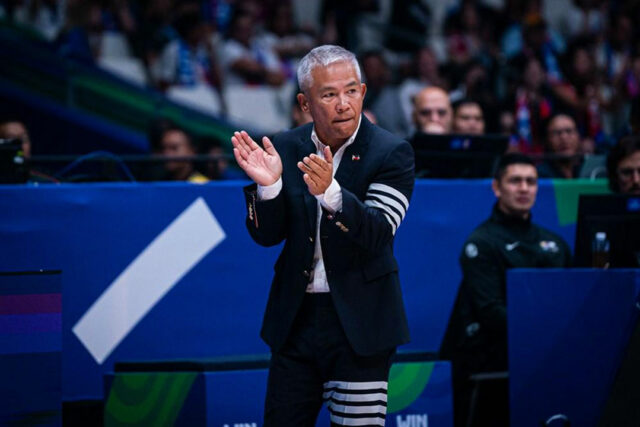

TNT braces for SMB adjustment in game two of Philippine Cup Finals

CHOT REYES — FIBA

Game on Friday
(Ynares Center-Antipolo)
7:30 p.m. – San Miguel Beermen vs TNT*
*TNT leads series, 1-0

EVEN if it was a winning performance, TNT’s errors in the PBA Season 50 Philippine Cup finals opener were so glaring that it was the first thing coach Chot Reyes pointed out post-game.

“We cannot survive on 19 turnovers,” said Mr. Reyes as he rued the Tropang 5G’s erratic ways that led to 25 extra points for San Miguel Beermen (SMB) and marred their 96-91 verdict.

“We got to improve that for the next game,” he added ahead of TNT’s bid to make it 2-0 in the race-to-four Last Dance against a Beermen crew hell-bent on a strike back on Friday at the Ynares Center-Antipolo.

Behind a strong defensive and hustle effort led by veteran Kelly Williams, TNT buried SMB to an early 19-point hole. The proud defending champions unleashed a massive comeback in the second half and came close to the Game 1 steal before Mr. Williams and his mates extinguished the threat with clutch endgame plays.

“In the huddle, I said, you know, we defended well. They’re not scoring on the half court set. They’re just scoring off our turnovers. We keep giving the ball to the other team. So I said, every time we make a defensive stop, we need to make sure that we get a shot. Whether we make it or miss it, doesn’t matter as long as we don’t turn it over. And that’s the story,” said Mr. Reyes.

The protagonists go into 7:30 p.m. second match wiser from the lessons of the opening tiff.

“We can’t be content at all against San Miguel. We know they’re going to come back strong, make adjustments so we have to make sure we come out with the same energy, the same togetherness and I think we’ll be fine,” said Mr. Williams who anchored TNT’s tough stance against June Mar Fajardo and Co. with 15 points, nine rebounds and three assists.

Despite the Game 1 heartbreaker, the Beermen still feel good about their chances in the series.

“I know our team has grit. We’re not just going to lay down. We’re not just going to go away. We’ll be ready,” said Mo Tautuaa who backstopped Mr. Fajardo with 22 and led their fightback with 13 third-quarter markers.

SMB took solace in the fact that it finished Game 1 stronger, 55-43, after getting thoroughly dominated by TNT in the first 24 minutes, 36-53. — Olmin Leyba

Time to right the ship

The 2025-26 season began with promise for the Knicks. They opened with purpose, banked early wins, collected the NBA Cup, and looked to have aligned ambition with execution. Unfortunately, the arc now appears to have flattened. Although still firmly in the Eastern Conference mix, they’ve become increasingly unsure of themselves; they appear to be searching for traction where there was once momentum. Madison Square Garden habitués have noticed the players’ inability to be collectively productive with consistency.

The low point came against the Mavericks the other day. Down by 30 at halftime, the Knicks were met with boos on their home floor. There was no tactical adjustment to hide behind, no officiating gripe to point to as an excuse. In the aftermath, head coach Mike Brown admitted there was little to say; the scoreboard had already delivered the message. For a roster built on toughness and defensive pride, the silence was louder than any diatribe in the locker room.

For captain Jalen Brunson enough was enough. The Knicks’ ninth setback in 11 outings necessitated a players-only meeting in which he did not mince words. Accountability had to come from within, he argued. They needed to fully commit to standards they claim to value. The onus was not on the brain trust in the sidelines. Systems provide guidance, but culture has to be enforced by those on the floor.

Workhorse Josh Hart echoed the sentiment with the bluntness that has defined his tenure. He spoke of soul searching, of habits that had slipped into disrepair and no longer matched identity. His critique was an indictment of effort and attention, areas that tend to separate contenders from pretenders. The numbers underscore the cause of the unease; stagnant offense has accompanied leaking defense. To be sure, there remains time to right the ship. Nonetheless, there can be no discounting the swoon.

The fans, often caricatured as impatient, have shown clarity, not demanding perfection but expecting commitment. Brunson and Karl-Anthony Towns acknowledged as much, recognizing that the noise from the stands mirrors the questions they are asking as well. At 25 and 18, the Knicks are neither broken nor secure. That said, they sit in a narrow band where a sense of urgency is required. Taken in this context, the meeting drew a line. What follows will determine whether their campaign resumes its climb or settles into mediocrity, remarkable only for a promise that never quite held.


Anthony L. Cuaycong has been writing Courtside since BusinessWorld introduced a Sports section in 1994. He is a consultant on strategic planning, operations and human resources management, corporate communications, and business development.

Trump reversal on Greenland followed push by aides against military option, sources say

REUTERS

WASHINGTON — President Donald J. Trump’s retreat from threats of force as an option for acquiring Greenland capped weeks of policy chaos, as top aides scrambled both to accommodate the president’s demands and ease the panic they caused among US allies, according to two sources with knowledge of the conversations.

In remarks on Wednesday at the World Economic Forum in Davos, Switzerland, Mr. Trump ruled out using military force after weeks of refusing to do so, and in a social media post said he would no longer be imposing tariffs that he had threatened to put into effect on Feb. 1.

White House officials had pushed a less provocative approach, with several key members of the president’s team unenthusiastic about possibly using military force to seize the Danish territory, the two White House sources said. They spoke on condition of anonymity to discuss internal deliberations.

After saying on Wednesday that tariffs are off the table, Mr. Trump said he and North Atlantic Treaty Organization (NATO) Secretary General Mark Rutte had “formed the framework of a future deal with respect to Greenland and, in fact, the entire Arctic Region” during talks in Davos. He tasked top officials with negotiating a potential deal.

The episode underscored how Mr. Trump’s long-running fascination with acquiring Greenland keeps crashing into diplomatic and political reality, emblematic of a second term defined by abrupt policy shifts and rapid reversals. Again and again, the Republican president has changed course on tariffs and other issues under economic, political or market pressure.

Asked about Mr. Trump’s aides not pursuing military options seriously on Greenland, White House spokeswoman Anna Kelly said: “The White House does not rule out options for President Trump unless he does so himself.”

“He announced today that he will not use force to take Greenland, and the entire administration will follow his lead,” Ms. Kelly said, adding that if a deal is reached, the United States would achieve its goals in Greenland at minimal long-term cost.

TRUMP’S ARCTIC AMBITIONS REJECTED
In recent weeks, Mr. Trump has revived his longstanding ambition to acquire the Arctic island, arguing that it is vital to US national security as great-power competition intensifies in the Arctic.

The leaders of Greenland and Denmark, which oversees the territory, have rejected Mr. Trump’s overtures, stressing that the island’s future is for its people to decide and accusing the United States of bullying tactics.

In a social media post on Saturday, Mr. Trump said he would implement a wave of increasing tariffs on European allies until the US was allowed to buy Greenland, which major European Union (EU) states decried as blackmail.

The idea to use tariffs came from Commerce Secretary Howard Lutnick and other cabinet members, the White House sources said.

Mr. Lutnick did not respond to a request for comment.

The threats in Mr. Trump’s post came after some European countries sent small numbers of military personnel to Greenland, ostensibly to show that they took US warnings about the island’s security seriously.

Ahead of the Davos summit, European leaders stepped up their pushback against the US acquiring Greenland.

“He doesn’t like being cornered,” said one of the White House sources, explaining Mr. Trump’s tariff threat.

That announcement set off a scramble in the White House to develop a tariff plan and understand how it would play out. Different agencies are still working out the “cycle of retaliation and counter-retaliation with tariffs” on EU members, the White House source said.

A spokesperson for the Danish embassy did not comment for this story.

TARIFF THREAT CATCHES AIDES OFF GUARD
Mr. Trump first floated the idea of taking over Greenland in 2019 but ramped up rhetoric after returning to power a year ago. In meetings last year, US officials assured their Danish counterparts that relations were stabilizing, leaving them with the impression that any military takeover of the Arctic territory was no longer top of mind for the administration, according to two separate sources familiar with those discussions.

That changed in December, when Mr. Trump abruptly announced that Louisiana Governor Jeff Landry would serve as special envoy to Greenland and renewed his push to acquire the territory, seemingly emboldened by the successful Jan. 3 operation to capture Venezuelan leader Nicolas Maduro.

While aides were broadly aligned on the goal of taking over Greenland, they were split over the president’s aggressive approach, the two White House sources said.

In most White House meetings, more officials have urged caution than those pushing for the United States to take the island by force, said the sources, who were unaware of serious discussions on military options to seize Greenland.

Tom Dans, appointed by Mr. Trump to lead the US Arctic Research Commission, along with Vice-President JD Vance and Secretary of State Marco Rubio, had been “pushing for a middle ground” on Greenland, while White House Deputy Chief of Staff Stephen Miller showed a willingness to keep annexation and the potential use of military force on the table, the sources said.

Mr. Dans and Mr. Miller did not immediately respond to a request for comment. A spokeswoman for Mr. Vance declined comment.

A State Department official said: “President Trump’s team, including Secretary Rubio, routinely present him with a suite of options on issues of national concern.”

Mr. Trump himself has been driving the issue, the sources said. One of them, speaking before Mr. Trump’s turnaround on tariffs and the use of force, said the president had wanted to retain the option of a military move.

US officials have not said what a military operation in Greenland would entail. As a Danish territory, the island is already a member of NATO and the United States maintains a military base there.

A 1951 agreement between Denmark and the United States allows the US military free access to the territory to defend Greenland or other NATO territories — something experts say already gives Washington the ability to send additional troops to Greenland.

Mr. Vance and Mr. Rubio last week hosted Danish and Greenlandic foreign ministers at the White House for talks characterized by Denmark’s Foreign Minister Lars Lokke Rasmussen as “frank but constructive.”

Military action was not considered seriously at that meeting, where Mr. Vance discussed how a solution should be found despite seemingly incompatible positions, one of the White House sources said. — Reuters

Putin to discuss Ukraine peace with US envoys after Trump says a deal is reasonably close

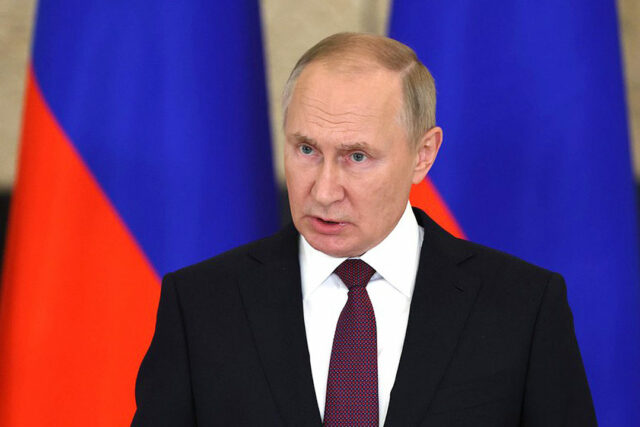
Russian President Vladimir Putin — KREMLIN.RU

MOSCOW — Russian President Vladimir Putin will discuss on Thursday a possible peace plan for Ukraine with US envoys Steve Witkoff and Jared Kushner in Moscow after President Donald J. Trump said a deal to end the war was “reasonably close.”

The United States has held talks with Russia, and separately with Kyiv and European leaders, on various different drafts of a plan for ending the war in Ukraine, but no deal has yet been reached despite Mr. Trump’s repeated promises to clinch one.

Mr. Putin, speaking at a Russian Security Council meeting late on Wednesday, said that he would meet Mr. Trump’s special envoy Mr. Witkoff and Mr. Trump’s son-in-law Mr. Kushner in Moscow to “continue dialogue on the Ukrainian settlement” as well as Mr. Trump’s “Board of Peace” idea.

At stake is how to end the deadliest war in Europe since World War II, the future of Ukraine, the extent to which European powers are sidelined and whether or not a peace deal brokered by the United States will endure.

“I believe they’re at a point now where they can come together and get a deal done,” Mr. Trump said, referring to Mr. Putin and Ukrainian President Volodymyr Zelensky. “And if they don’t, they’re stupid.” — Reuters

South Korea economy unexpectedly contracts in Q4, but AI boom brightens outlook

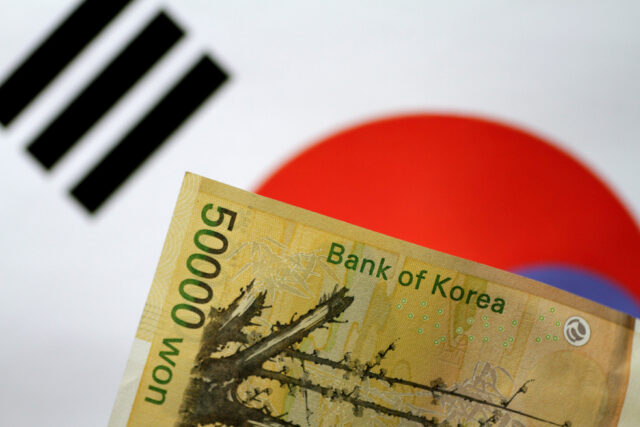
A South Korea won note is seen in this illustration photo May 31, 2017. — REUTERS/THOMASWHITE/ILLUSTRATION

SEOUL — South Korea’s economy unexpectedly shrank in the final quarter of 2025, marking the biggest slump in three years on weaker investment and exports, but the global artificial intelligence (AI) boom is set to improve the outlook and allow the central bank to retain its steady rates stance.

The contraction followed a sharp expansion in the third quarter when the new administration of President Lee Jae Myung rolled out stimulus policies to boost domestic demand.

“The fourth-quarter contraction has not derailed overall growth, and the policy backdrop points toward a cautious central bank,” said Dave Chia, an economist at Moody’s Analytics, echoing a consensus view for stronger growth this year underpinned by its roaring semiconductor sector.

Gross domestic product (GDP) decreased 0.3% in the October-December period from the preceding three months on a seasonally adjusted basis, advance central bank estimates showed on Thursday, compared with a median 0.1% increase tipped in a Reuters poll of economists.

It was the steepest economic contraction since the fourth quarter of 2022, but analysts say the result was largely payback from the previous quarter’s growth of 1.3%, which was the fastest in almost four years.

“On top of the unfavorable base effect, the pace of recovery in construction investment was weaker than expected, dragging down the growth rate a little more,” said Lee Dong-won, director general of the economic statistics department at the Bank of Korea (BOK).

Still, domestic investment is seen improving this year as more government infrastructure projects are expected, and companies plan to expand semiconductor factories and artificial intelligence investments, Mr. Lee said.

TECH DEMAND TO KEEP ECONOMY HUMMING
South Korea’s stock benchmark topped 5,000 points for the first time in morning trade on Thursday, powered by gains in chipmakers like Samsung Electronics and SK Hynix, a level targeted by President Lee in just over six months since he took office.

Construction investment, down 3.9%, was the biggest drag in the last quarter, while facility investment dropped 1.8%. Private consumption rose 0.3%, after expanding 1.3% in the previous quarter on a boost from the government’s extra budget.

Exports fell 2.1%, hurt by autos and machinery despite a tariff deal with the US that was finalized in November, while imports declined 1.7%, resulting in a net negative contribution of 0.2 percentage point.

Asia’s fourth-largest economy grew 1% in 2025, after expanding 2% in 2024, marking the slowest annual growth since 2020, according to the BOK, which expects the economy to grow 1.8% in 2026.

The government expects stronger growth of 2% this year.

The Bank of Korea last week signaled an end to its current easing cycle after keeping interest rates unchanged, prioritizing foreign exchange stability as it flagged upside risks to this year’s economic growth.

“With pressure from a weaker won in focus, rate cuts in early 2026 appear unlikely; easing now could worsen currency depreciation, heighten financial stability risks, and revive inflation pressures,” said Mr. Chia of Moody’s Analytics.

On a year-on-year basis, GDP expanded 1.5% in the fourth quarter, after rising 1.8% in the third quarter, also missing economists’ expectations for a median 1.9% increase.

“Growth held up last year on strong semiconductor exports and it is clear that this year will be stronger than last year, but other than the semiconductor sector, there is little momentum on the domestic demand side,” said Park Sang-hyun, an economist at iM Securities. — Reuters

Wind and solar beat fossil fuels in EU power mix in 2025, energy think tank says

PHILSTAR FILE PHOTO

WIND AND SOLAR power for the first time generated more electricity in the European Union (EU) than fossil fuels in 2025, driven by a surge in solar output, data from energy think tank Ember showed on Thursday.

Wind and solar made up a record 30% of the 27-country bloc’s power last year, overtaking fossil fuels that contributed 29%. Solar alone was responsible for 13% of power generation and expanded by more than 20% for the fourth-year running, surpassing both coal and hydro.

“As fossil fuel dependencies feed instability on the global stage, the stakes of transitioning to clean energy are clearer than ever,” Beatrice Petrovich, senior energy analyst at Ember and lead author of the report, said.

Solar generation grew in all EU countries amid widespread solar panel installations and supplied more than a fifth of electricity in Hungary, Cyprus, Greece, Spain and the Netherlands in 2025.

Renewable sources provided nearly half of the bloc’s power mix at 48%, even as unusual weather pushed hydro output 12% lower and wind 2% lower. Despite this, wind contributed 17% of electricity in the EU, more than gas.

Early 2025 was exceptionally sunny, marked by low wind speeds and low rainfall, but strong solar output helped keep the overall share of renewables stable, Ms. Petrovich told Reuters.

Fourteen EU countries produced more electricity from wind and solar than from fossil fuels, reinforcing a structural shift in the region’s power system that includes phasing out coal.

“Coal power is in its terminal decline. We could say it’s becoming history for the EU,” Ms. Petrovich said in the interview. The fossil fuel share in the power mix was at a record low of 9.2%.

“The next priority for the EU should be to put a serious dent in reliance on expensive, imported gas,” she added.

Gas generation in the EU rose 8% due to lower hydro availability, lifting gas import costs by 16% to €32 billion ($37 billion, $1 = 0.8601 euros) for the power sector, the first increase since the 2022 energy crisis.

Increased gas usage also lifted average wholesale power prices, which were 11% higher during gas-heavy hours than in 2024.

But rapid growth in battery storage, particularly in Germany, Italy and Poland, could help shift solar and wind power to meet evening demand peaks and stabilize prices, Ms. Petrovich said. — Reuters

New trade map takes shape in Davos as world adjusts to Trump tariffs

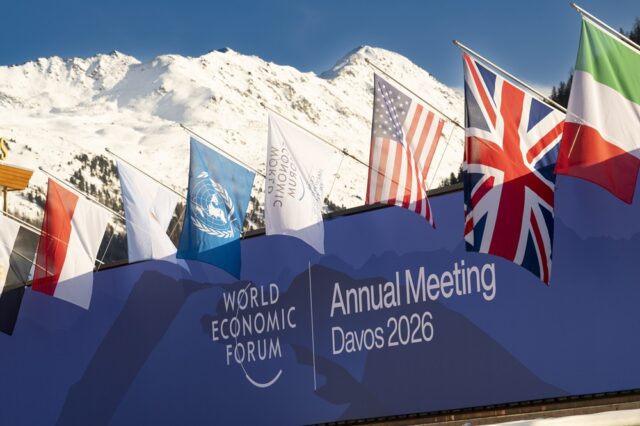
WORLD ECONOMIC FORUM

DAVOS, Switzerland — President Donald Trump’s use of tariffs as a foreign policy tool added fresh impetus in Davos this week to efforts to boost global trade beyond the US, with frustration palpable among many of Washington’s top trading partners.

Tariffs roared back into focus when Mr. Trump last weekend threatened new tariffs on European allies opposing his designs on Greenland, before stepping back from them on Wednesday after announcing a deal framework with NATO over the Arctic island.

“It’s the speed, scale, and scope of change that is really rattling the world,” Canadian Finance Minister Franзois-Philippe Champagne said during a panel discussion on tariffs at the World Economic Forum’s annual meeting in the Swiss mountain resort.

The WEF is meeting in Davos for the first time since Mr. Trump last year hiked US tariffs to their highest level in nearly a century, sending countries scrambling to pick up the slack by trading more with each other.

Mr. Trump, who says his policies are bringing back jobs to the United States, spurring trillions of dollars in investment and firing up growth, is ever present in WEF debates over how to temper exposure to the US, which studies forecast will play a lesser role in overall global trade than it did in the past.

Canada’s Mr. Champagne said countries were diversifying their commercial relations and doing more at a regional level to make their economies more resilient to trade policy shocks.

“When you talk to CEOs today, what do they want? Stability, predictability, and the rule of law. I would say it’s in short supply,” he said, days after Canada and China struck a deal to slash tariffs on electric vehicles and canola.

Hot on its heels came the signing of a free trade agreement this month between the European Union and South American bloc Mercosur after 25 years of negotiations – the EU’s largest ever trade pact, if it overcomes remaining legal obstacles.

Diversification of supply chains and reducing over-dependence are backed by the World Trade Organization, whose director-general Ngozi Okonjo-Iweala said such moves helped spread job creation and growth to other countries.

“This helps build global resilience and we are very supportive of it,” she told Reuters in Davos.

‘THE WORLD HAS BECOME MORE EXPENSIVE’
Boston Consulting Group forecasts the US share of global goods trade could decline from 12% to 9% in the decade through 2034, giving way to more domestic US economic activity.

“Trump is sawing on the branch he’s sitting on,” Dirk Jandura, head of Germany’s BGA exporters’ association, said this week after data showed German exports to the US falling by 9% during the first 11 months of 2025.

Volker Treier, foreign trade chief of the German Chambers of Industry and Commerce, said surveys showed tariffs on raw materials like steel and aluminum were making it dearer for companies to build up US industrial capacity.

US manufacturing activity contracted for a tenth month running in December, according to a closely watched survey.

“The world has become more expensive, and structurally it will get even more expensive,” Mr. Treier said.

‘WE HAVE TO RECONFIGURE OURSELVES VERY FAST’
BCG posits a patchwork of four main nodes dominating world trade: the US, China, BRICS+ minus China, and so-called plurilateralists comprising most of Europe, Canada, Mexico, Japan, Australia, and several Asia-Pacific economies.

In the BCG study, trade among plurilateralists and China’s commerce with allies in the Global South would be key drivers of global trade, with US trade advancing more slowly.

Noel Hacegaba, CEO of the Port of Long Beach, said trade flows have been evolving significantly since Mr. Trump’s first term.

In 2019, 70% of the port’s cargo was trade with China; by last year, that figure had fallen to 60%, with more coming instead from farther afield in Southeast Asia, including Vietnam, Thailand, and Malaysia, Mr. Hacegaba told Reuters.

Boudewijn Siemons, CEO of the Port of Rotterdam, Europe’s biggest, said trade flows were adjusting rapidly to the new reality, and that the continent needed to be nimble.

“We’ve been relying on cheap production in China, cheap energy from Russia, and cheap defense from the United States,” he said, adding: “And all three of these securities are falling away, so we have to reconfigure ourselves very fast.” — Reuters

TEPCO to shut reactor at world’s biggest nuclear plant a day after resumption

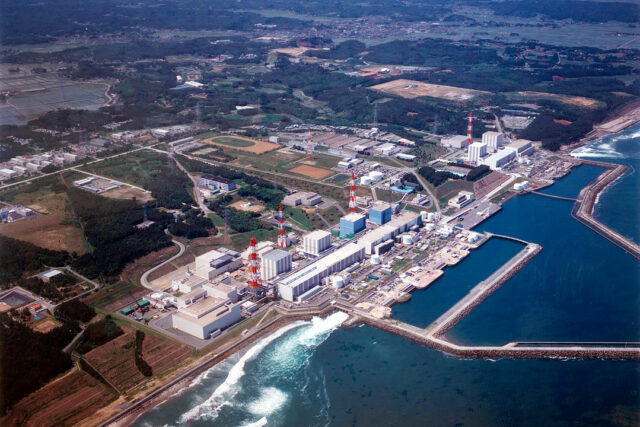
FUKUSHIMA Daiichi Nuclear Power Station in Fukushima, Japan. — TOKYO ELECTRIC POWER CO., TEPCO/EN.WIKIPEDIA.ORG

TOKYO — Tokyo Electric Power will shut down the No.6 reactor at the Kashiwazaki-Kariwa nuclear power plant after a malfunction was detected early on Thursday, a day after the unit went online for the first time in more than 13 years.

In early hours of Thursday, an alarm was triggered during work to withdraw control rods from the reactor, TEPCO said in a statement, adding it would stop the reactor to investigate the cause of the malfunction.

It did not say when the reactor could be restarted.

TEPCO restarted the No.6 unit at Kashiwazaki-Kariwa, the world’s biggest nuclear power plant, on Wednesday evening in what was its first nuclear reactor to be turned on since the Fukushima disaster in 2011.

The process had been delayed from Tuesday as TEPCO investigated an alarm malfunction. As of early Wednesday, the equipment in question was functioning normally, TEPCO said at the time.

Shares in TEPCO lost 3.5% on Thursday, underperforming the benchmark Nikkei share average, which gained 1.7%. — Reuters

South Korea launches landmark laws to regulate AI, startups warn of compliance burdens

STOCK PHOTO | Image by Rawpixel.Com from Freepik

SEOUL — South Korea introduced on Thursday what it says is the world’s first comprehensive set of laws regulating artificial intelligence, aiming to strengthen trust and safety in the sector, but startups fretted that compliance could hold them back.

Aiming to become one of the world’s top three AI powerhouses, South Korea is hoping that its new AI Basic Act will help position the country as a leader in the field. The laws in their entirety have taken effect sooner than the EU’s AI Act which is being applied in phases through 2027.

Global divisions remain over how to regulate AI, with the US favoring a more light-touch approach to avoid stifling innovation. China has introduced some rules and proposed creating a body to coordinate global regulation.

Under South Korea’s laws, companies must ensure there is human oversight in so-called “high-impact” AI which includes fields like nuclear safety, the production of drinking water, transport, healthcare, and financial uses such as credit evaluation and loan screening.

Other rules stipulate that companies must give users advance notice about products or services using high-impact or generative AI, and provide clear labelling when AI-generated output is difficult to distinguish from reality.

The Ministry of Science and ICT has said the legal framework was designed to promote AI adoption while building a foundation of safety and trust.

The bill was prepared after extensive consultation and companies will be given a grace period of at least a year before authorities begin imposing administrative fines for infractions.

The penalties can be hefty. A failure to label generative AI in South Korea, for example, could leave a company facing a fine of up to 30 million won ($20,400).

That said, potential penalties in the EU are much higher. Non-compliance with rules there can result in fines that range from as much as 1% of global turnover for smaller violations to as much as 7% for breaking bans on the use of high-risk AI.

GLOBAL AI POWER
Lim Jung-wook, co-head of South Korea’s Startup Alliance, said many founders were frustrated that key details of the law remain unsettled.

“There’s a bit of resentment — why do we have to be the first to do this?” he said.

One concern of the group is that the law’s language is vague and companies may default to safe but less innovative approaches to avoid regulatory risk.

President Lee Jae Myung on Thursday was sympathetic to such concerns. He urged policymakers to listen to the concerns of industry and ensure that venture companies and startups have enough support.

“It is essential to maximize the industry’s potential through institutional support, while pre-emptively managing anticipated side effects,” Mr. Lee said during a meeting with aides.

The Ministry of Science and ICT is planning a guidance platform and dedicated support center for companies during the grace period.

“Additionally, we will continue to review measures to minimize the burden on industry,” a spokesperson said, adding that authorities were looking at extending the grace period if domestic and overseas industry conditions warranted such a measure. — Reuters

New Zealand rescuers seek landslide survivors as weather havoc kills two

STOCK PHOTO | Image by Kerin Gedge from Unsplash

WELLINGTON — Rescue workers combed rubble on Thursday at a campsite in New Zealand as they searched for the missing, children among them, following a landslide triggered by heavy rains that snapped power links to thousands and caused widespread damage.

Homes were evacuated and roads closed as the rain lashed almost the entire eastern seaboard of the North Island, killing two people, while police put the number of those missing after the landslide in the single digits.

Rescuers at the campsite in the tourist spot of Mount Maunganui will use earthmoving equipment to claw away layers of debris as they work through the night to locate the missing, emergency services said in a statement.

“This is a complex and high-risk environment,” added Megan Stiffler, a fire and emergency services official. “The teams will be operating overnight until the search is complete.”

The number of missing was in the “single figures”, police superintendent Tim Anderson told a press conference, adding, “It is possible we could find someone alive.”

Helicopters and search and rescue dogs fanned out in the hunt, while media said 8,000 people are still without power, down from 16,000 earlier. No deaths had yet been confirmed.

SIGNS OF LIFE DETECTED
One witness, Nix Jaques, told Radio NZ she heard an incredibly loud noise as she was about to walk up a mountain.

“I turned around and I could see the land coming down onto some structures,” she said. “It came down on an ablutions block – I believe there were some people in the showers – and it shifted a campervan, there was a family with a campervan.”

No voices have been heard in the rubble since fears of further ground movement prompted first responders to withdraw despite detecting signs of life, said fire and emergency commander William Pike.

“My understanding was members of the public … tried to get into the rubble and did hear some voices,” he said, adding that the sounds were also heard by a fire crew at the scene.

“Shortly after our initial crew arrived, we withdrew everyone from the site, due to the possible movement of the slip,” Mr. Pike said.

Children were among the missing, media said, citing Mark Mitchell, the emergency management minister.

PEOPLE MISSING ELSEWHERE
Police said they found the bodies of two people who went missing after a landslide engulfed a house in the suburb of Papamoa on Thursday. A third was missing after a vehicle was washed away north of Auckland on Wednesday.

Prime Minister Christopher Luxon said the government was doing all it could to support those affected.

“We are standing with these local communities in the response – and we will stand with them in the recovery too,” he added on X.

Transport authorities said roads had been closed in the areas of Northland, Bay of Plenty and Waikato, while local authorities said road damage cut off some small communities.

Weather officials have lifted all North Island warnings as a tropical low moves east. — Reuters

KARAT WORLD welcomes ‘A New Year, A New Karat World’

Brand unveils SM North EDSA Superstore, marking a new era of elevated jewelry retail

KARAT WORLD officially marks a defining milestone in its brand journey with the grand opening of its Superstore at SM North EDSA, ushering in “A New Year, A New Karat World,” marking a new era of elevated jewelry detail.

The SM North EDSA Superstore marks a strategic step in KARAT WORLD’s continued growth — strengthening its retail platform, customer ecosystem, and long-term capacity to serve both local and international communities. It also signals a deeper articulation of the brand’s philosophy: unmatched trust, personalization, and defining game-changing experiences, delivered through an elevated yet welcoming retail experience that leaves clients happy and satisfied.

An Invitation-Only Celebration

The opening was an exclusive, invitation-only affair attended by select VIPs, partners, and members of the Karat World community across sectors. Guests were welcomed into a thoughtfully staged environment featuring striking visual displays and immersive storytelling moments.

Each attendee received bespoke keepsakes providing access to curated in-store experiences — a gesture that underscored Karat World’s commitment to appreciation, intimacy, and elevated hospitality.

A Space Designed for Discovery

Following welcome remarks from Felix Sarrabia-Gorriceta III, President & CEO of Lumina One Corp., guests experienced the store through a relaxed, free-flowing walkthrough.

The atmosphere blended sophistication and warmth, enhanced by curated house music, interactive installations, and an amusing claw machine with Karat Bears — including newspaper-style visual narratives charting the brand’s legacy and milestones.

At the heart of the event was the jewelry itself. Guided by dedicated product specialists, guests enjoyed one-on-one consultations, engaging more deeply with the craftsmanship and significance behind each piece.

Spotlighted during the event was the Nazar Line, embracing positivity. The featured collection is inspired by the light that follows its wearer, warding off negativity — a modern expression of symbolism rooted in meaning, protection, and emotional resonance.

Looking Ahead

The SM North EDSA Superstore marks a strategic step in KARAT WORLD’s continued growth — strengthening its retail platform, customer ecosystem, and long-term capacity to serve both local and international communities. Reflections shared by guests throughout the evening reinforced the brand’s resonance: trusted, evolving, and deeply rooted in its relationship with families across generations.

The event was made possible with the support of event partners including Kings & Elan Media Group, Azucar y Sal Manila, Arcade Rentals Philippines, and Taza Coffee Manila — each contributing to an experience grounded in detail, craftsmanship, and intention. This new superstore invites its community into “A New Year, A New Karat World:” defined by connection, discovery, and enduring value.

Diamonds Are Forever: The Timeless Vision of Karat World

Felix Gorriceta III, President of KARAT WORLD, affirms the brand’s greater purpose: giving back to the community that has supported it for nearly four decades. Viewing jewelry as a vessel for milestones and memories, Mr. Gorriceta emphasizes that KARAT WORLD seeks to shape meaningful moments not only for its customers, but also for future generations. Through years of sacrifice, innovation, and dedication to craft, the brand remains committed to its vision of making fine jewelry accessible to every Filipino — pieces that carry personal value and can be passed on through time.


Spotlight is BusinessWorld’s sponsored section that allows advertisers to amplify their brand and connect with BusinessWorld’s audience by publishing their stories on the BusinessWorld Web site. For more information, send an email to online@bworldonline.com.

Join us on Viber at https://bit.ly/3hv6bLA to get more updates and subscribe to BusinessWorld’s titles and get exclusive content through www.bworld-x.com.