Home Blog Page 3792

FAO team in town to consult with industry on farm modernization

REUTERS

THE Food and Agriculture Organization (FAO) will meet with agriculture industry representatives to support Philippine efforts to modernize farming.

In a statement, the FAO said it will oversee consultations with the government, private sector, academic institutions and non-governmental organizations this week.

“The Philippines has a unique experience in resilient agriculture and fisheries but is also facing unprecedented challenges,” FAO Country Representative to the Philippines Lionel Henri Valentin Dabbadie said over the weekend.

The FAO said that the results of the consultation will form part of the input for its Regional Conference for Asia and the Pacific (APRC), in which participants will seek to work out a strategy to tackle challenges to agriculture.

“Through this consultation, we look forward to better understanding how we can best support the efforts of the government to achieve a modern agriculture and fisheries sector,” Mr. Dabbadie said.

He added that the conference will “highlight the expertise that the Philippines can share to tackle the impending threats to food security and the environment that we face as a nation, a region, and the whole world.”

The United Nations organization said that the conference will generate proposals to guide FAO operations in the Asia-Pacific and ultimately to its global conference, which is the agency’s highest governing body.

The 37th APRC session will discuss current priorities for the agriculture industry, including food production losses and waste, financing for hunger mitigation programs, animal and human diseases, and the transformation of agri-food systems and capture fisheries and aquaculture.

The APRC is a biennial conference with Ministers of Agriculture from FAO member states. — Adrian H. Halili

Want to avoid fake news? Step away from Google

ARKAN PERDANA-UNSPLASH

Searching for information has become instant and effortless — just go to your nearest device, ask Siri, or click a few keys. But are we better informed than we were before Google became a verb?

A new paper published in Nature hints that we’re not. When researchers exposed volunteers to a mix of fake and real news stories, they found people became more prone to being fooled by fake stories after being asked to do an internet search.

That doesn’t negate the value of search engines, but as with all technology, there can be unintended consequences. Searches on misleading stories often pull people into a spiral of yet more bad information.

The Nature paper included results of several studies. In some, people were asked to evaluate news stories that had just broken in the last 48 hours. In one, they saw stories from recent months on COVID-19, spanning scientific, political, and economic angles. In some cases, people were randomly assigned to evaluate stories with or without doing their own search, and in others, the same people were asked to evaluate news items before and after a search.

Participants could classify stories as true, false/misleading, or undetermined. Before doing any research, about 30% of people incorrectly labeled false items as true. Searching led to about a 20% increase over that — after doing online research, about 36% of people classified fake news as fact. While subjects could use any search engine, most chose Google.

University of Central Florida social scientist Kevin Aslett, who led the study while at the Center for Social Media and Politics at NYU, said people put an incredible amount of trust in search engines — more than they put in the mainstream media. And advocates for news literacy often encourage people to go online to check questionable news stories. That’s why he thought online searching deserves more critical attention.

Some of the fake stories included an impending mini-ice age; thousands arrested for deliberately setting wildfires in Australia; homeless people defecating in San Francisco supermarket aisles; and news that hydroxychloroquine trials were “designed to kill COVID-19 patients.”

These stories share an emotional valence, touching on such contentious issues as COVID-19 business and school closures, vaccines and vaccine mandates, the Black Lives Matter protests, claims that COVID-19 originated in a laboratory, and various statements by and about former President Donald Trump.

Looking at how people searched gave Aslett and his colleagues a clue as to why they were becoming increasingly fooled. Stories from what he called low quality news sources often used words or phrases that were specific to a particular claim. One false news item accused President Biden of engineering a famine. If people googled “engineered famine” they would find other dubious stories, because mainstream news sites didn’t use that phrase.

People are often taught bad approaches to searching, said Joel Breakstone, director of the Stanford History Education Group. They are sometimes wrongly taught they should trust .org sites, for example, or that they should not use Wikipedia.

Some of his own research compared the search methods of professional fact checkers, academics, and students, and found the fact checkers gained an edge by more diligently checking into the credibility of a source. People are often deceived by the names of some sources, he said. They thought the Employment Policies Institute was a neutral source, for instance, when further examination would reveal it’s run by a PR firm that works on the behalf of the food and beverage industry and has a vested interest in keeping the minimum wage low.

Fact checkers also tended scan the results a search engine brings up before selecting which items to read, while other people in his research focused most of their attention on whatever the search algorithm placed on top, assuming that was the highest quality item without putting any thought into how the algorithms work.

One caveat is that even fact checkers don’t always agree. That was also true in the Nature paper, in which six professional fact checkers also vetted each story. The stories on which the fact checkers differed were also the ones where searching led people away from the majority view. These included stories under the headlines, “German Official Leaks Report Denouncing COVID-19 As ‘A Global False Alarm,’” “Leftie Governor Cooper Kills RNC Convention in Charlotte Due to COVID-19 And Then Goes and Marches with Leftist Mob in Street,” and “Forced Vaccinations Will Control Your Life, Warns Religious-Liberty Group.” All involved contentious material and some subjective judgements outside of concrete facts.

What makes a story credible is complicated. Journalists should explain what they know and how they know it, and show where there’s uncertainty. This new study is a good reminder that the idea that anyone can access the truth with a few keystrokes was always too good to be true.

BLOOMBERG OPINION

Xiaomi plugs into EV realm

PHOTO FROM XIAOMI

XIAOMI formalizes its entry into the realm of electric vehicles (EVs) with the Xiaomi SU7. In a release, the company said it banners five core technologies: an e-motor, battery, die-casting, Xiaomi Pilot Autonomous Driving, and a so-called Smart Cabin. “From the development of foundational core technologies, Xiaomi aims to redefine the technology of the automotive industry,” it reported.

Described as a “pre-launch,” more details about the Xiaomi SU7 — positioned as a full-size high-performance eco-technology sedan — have been revealed, such as design, performance, range, and safety features.

“With firm strides, we are crossing its summit,” said Xiaomi Group Founder, Chairman, and CEO Lei Jun, quoting a Chinese poem. The brand is now seen as making a huge leap from the smartphone industry into “closing the loop of the human x car x home smart ecosystem.” Lei Jun further expressed that the century-old automotive industry offers little room for maneuvering today: “Xiaomi has decided to invest tenfold, starting from the development of fundamental core technologies, committing to constructing an outstanding vehicle. Through 15 to 20 years of effort, Xiaomi aims to become one of the top five global automakers.”

The company said that smart electric vehicles are trending toward integration of the automotive industry with consumer electronics and intelligent ecosystems. Integrating full-stack technologies is a vital step for the industry’s evolution, and by integrating industrial manufacturing, smart software and AI, Xiaomi’s EV efforts will “completely redefine the automotive industry, marking a significant leap in its technological landscape.”

Xiaomi revealed it has invested over CNY10 billion in the initial research and development (R&D) phase. The R&D team comprises over 3,400 engineers and over a thousand technical experts in critical domains both in China and abroad. This showcases Xiaomi’s 13 years of comprehensive technological accumulation since its inception.

Xiaomi has independently developed and manufactured e-motors: HyperEngine V6/V6s, and HyperEngine V8s. The three e-motors are said to feature innovative technologies such as Bi-directional Full Oil Cooling Technology, S-shaped oil circuit design, and staggered silicon steel laminations design — enabling them to rival the performance of traditional large V8 and V6 powertrains.

Notably, the HyperEngine V8s, with a maximum speed of 27,200 rpm and able to output 425kW and 635Nm peak torque, employs the industry’s first ultra-high-strength silicon steel plate with a tensile strength of 960MPa, boasting strength that surpasses mainstream industry offerings by more than two times. HyperEngine V8s is in development and set to be mass-produced and implemented in Xiaomi EVs in 2025. On the other hand, Xiaomi’s self-developed HyperEngine V6/V6s e-motors muster 21,000rpm — surpassing the most powerful mass-produced electric motor.

Xiaomi has also self-developed CTB Integrated Battery Technology through innovative Inverted Cell Technology, multifunctional elastic interlayer, and a minimalistic wiring system. It features a battery integration efficiency of 77.8%, the highest of CTB batteries worldwide, a 24.4% overall performance improvement, and a height reduction of 17mm, with a maximum battery capacity of up to 150kWh and theoretical CLTC recharge range exceeding 1,200 kilometers.

Inside the vehicle, the Xiaomi EV Smart Cabin adopts a human-centric interaction architecture and features a 16.1-inch 3K central console, a 56-inch HUD head-up display, a 7.1-inch rotating dashboard, and two seatback extension mounts that allow for the mounting of two tablet devices. It is equipped with the Snapdragon 8295 in-car chip with AI computing power of up to 30 TOPS, enabling an ultimate interactive experience with the linking of five different screens.

The interactive experience is similar to tablets, allowing users to quickly adopt. The system operates smoothly, with the vehicle OS launching in a rapid 1.49 seconds after the door is unlocked. Additionally, it offers seamless cross-device connection between smartphones and the EV. For example, when the phone is brought into the cabin, the console automatically displays an icon, enabling easy access to the phone’s interface with a single touch.

The in-car OS integrates mainstream applications, including the whole Xiaomi tablet application ecosystem, with gradual adaptation to over 5,000 applications. Smartphone applications can be conveniently pinned to the car console, instantly transforming them into in-car applications. The Xiaomi SU7 supports over 1,000 Xiaomi smart home devices for effortless integration with the vehicle, enabling automatic discovery, password-free access, and the ability to set up automation scenarios, creating a robust CarIoT ecosystem. The car interior also has dedicated pinpoint expansion connections, supporting plug-and-play functionality for a wide range of devices. To meet the needs of users, the Xiaomi EV fully supports CarPlay, the mounting of iPads and iPad accessories, and applications on the rear extension mount.

Investors profit-take on Ayala Land’s optimistic outlook

SHARES in the Ayala-led property developer Ayala Land, Inc. dropped last week as investors took profits amid signals of rate cuts this year, which could support the company’s rosy outlook.

A total of 44.23 million shares, worth P1.52 billion, were traded from Jan. 8 to 12, according to data from the Philippine Stock Exchange (PSE), making it the eighth most actively traded stock last week.

Shares of the property development company dropped by 0.7% week on week, closing at P34.05 apiece last Friday from its P34.30 closing price on Jan. 5.

Year to date, Ayala Land’s stock slid by 1.2%.

To kick off the year, Ayala Land announced its plans to boost activities with the aim of doubling its earnings by 2028.

The property developer’s double-digit growth, seen during the third quarter of 2023, supported Ayala Land’s aggressive stance on its medium-term goal.

In the January to September 2023 period, the company’s net income grew by 28.5% to P20.94 billion from P16.3 billion in the same period in 2022.

Net attributable income also surged by 37.9% year on year to P18.39 billion from P13.34 billion.

In an e-mail exchange, Timson Securities, Inc. Equity Trader Jervin S. de Celis said that Ayala Land’s plans to double its earnings in the next five years can be supported by better economic conditions anticipated this year.

“Foreigners are noticeably net buyers of the stock since the first week of November and I guess their appetite for [Ayala Land’s] stock is stemming from the strong earnings performance of the company for the [nine]-month period of 2023 and the anticipation for the rate cuts in 2024,” he said.

“The stock price has been moving sideways since the [third] week of December. After touching the P35 level this week, it has since then retraced to P34 and may form a support level at around P32.50 within this month,” he added. 

On a quarterly basis, Ayala Land’s net attributable income increased by 33% to P7 billion during the July-to-September period last year.

Its third quarter net income also rose by 28.1% to P7.88 billion. 

The property developer arm of Ayala Corp. also announced last week its loan deal with Metropolitan Bank & Trust Co. (Metrobank) worth P15 billion to fund its capital expenditure and debt refinancing.

Metrobank became the second largest lender to Ayala Land after the loan.

The country’s inflation slowed to 3.9% in December last year, with full-year inflation settling at 6%, meeting the BSP’s targets for 2023.

This was also the third-straight month of easing since the 6.1% inflation in September last year. 

Mr. De Celis placed his full year income forecast for the stock to reach at least P20 billion, advising investors to lookout for headwinds this year namely El Niño and the ongoing conflict in Yemen, which could affect prices of oil once again. 

For the week, he placed his support and resistance levels at P32.50 and P35, respectively. 

“[T]he big players in the [Philippine] real estate market have weathered the effects of the pandemic as well as the skyrocketing inflation and interest rates for the past couple of years, so while there are headwinds coming from the local and international scene, ‘sustained local macroeconomic expansion and sound economic policies’ as Colliers mentioned in their December 2023 report will likely support the industry’s fast recovery this year and beyond,” Mr. De Celis said. — Bernadette Therese M. Gadon

Investors increase ECB cut bets

INVESTORS increased their bets on future European Central Bank (ECB) rate cuts on Friday, sending euro area government bond yields lower as data showed US producer price inflation was weaker than expected in December.

Money markets priced in 155 basis points (bps) of policy rate reductions by yearend from 145 before the US figures and 140 bps late on Thursday.

They also fully priced in a first ECB move in April, while the chances of a rate cut in March rose slightly to around 40%.

ECB Chief Economist Philip Lane said recent figures broadly confirmed current thinking at the central bank, but interest rate cuts are not a near-term topic of debate.

ECB euro-short term rate forwards priced in a 2.36% rate in December 2024, which implies a deposit facility rate at around 2.45% by yearend from the current 4%.

US producer prices unexpectedly fell amid a decline in the cost of goods, while prices for services were unchanged, which bodes well for lower inflation in the months ahead.

Analysts said the central banks’ emphasis on data dependency makes markets more prone to volatility and overshoots more in the dovish direction, but some reckon money markets went too far in their bets on future ECB moves.

Markets passed through strong US consumer prices, released on Thursday when short-dated US Treasury yields briefly moved higher before ending the day down 10 bps. — Reuters

Succession auction takes in over $600,000 as fans flock to props

TOM FORD “Jago” Sneakers worn by Jeremy Strong as the character “Kendall Roy” in the HBO Original Series Succession in Season 4, Episode 2. — ENTERTAINMENT.HA.COM

“HEY Buddha, nice Tom Fords,” says Roman Roy, pointing to Kendall’s sneakers in episode two, season four, of the HBO drama Succession. For a final price of $2,125, those Tom Fords could have been yours, spiritual teachings not included.

The shoes were among 236 lots of memorabilia from the hit series auctioned by US Heritage Auctions on Saturday, fetching a total of $627,000. The priciest item: pink notecards scribbled with the eulogy that Roman (Kieran Culkin) left undelivered at his father’s funeral in the final season. The cards sold for $25,000.

Succession, the story of three uber-rich siblings vying to take over their father’s media company, ended in May and is currently dominating the awards season. A week ago, the show scooped up four Golden Globes including best TV drama series.

One of the most iconic items listed was the “ludicrously capacious” Burberry bag carried by an outsider to a family event, which sold for $18,750. The sight of which made Tom Wambsgans, played by Matthew Macfadyen, famously quip, “What’s even in there, huh? Flat shoes for the subway?”

Collectors also vied for Lukas Matsson’s (Alexander Skarsgard) vape device; Roman’s Walmart kid’s T-shirt, which sold for $1,875; and Kendall’s (Jeremy Strong) fictional Forbes cover issue.

“We could not be more pleased with Saturday’s auction, and we’re sure those taking home a piece of the Roy legacy will feel the same way,” Heritage Screenbid Managing Director Jax Strobel said in a statement.

The auction brought in “a lot of fan engagement, not just collectors, but real fans of the show that are participating and bidding,” Mr. Strobel said in a separate statement.

The show led to Instagram accounts documenting the characters’ outfits and is credited with sparking the so-called “quiet luxury” fashion trend. A few lucky collectors now have their hands on Kendall’s Prada suit, sold for $7,500, or Shiv Roy’s (Sarah Snook) Max Mara power outfits. — Bloomberg

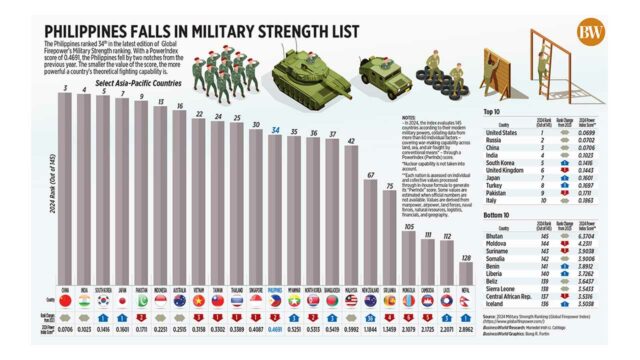
Philippines falls in military strength list

The Philippines ranked 34th in the latest edition of  Global Firepower’s Military Strength ranking. With a PowerIndex score of 0.4691, the Philippines fell by two notches from the previous year. The smaller the value of the score, the more powerful a country’s theoretical fighting capability is.


Philippines falls in military strength list

Indian coffee exports set to surge thanks to global price rally

REUTERS

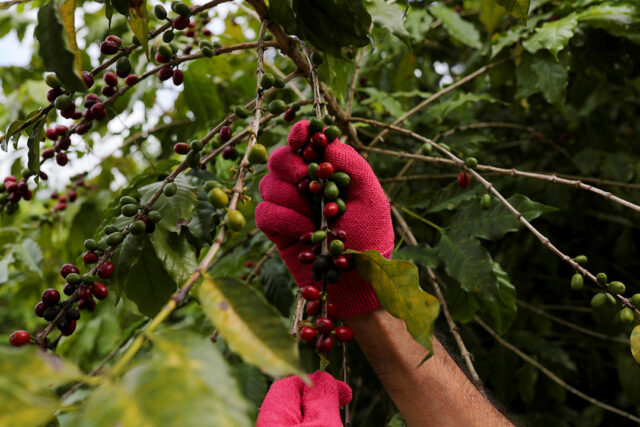
MUMBAI — India’s coffee exports are likely to rise as much as 10% in 2024 as a rally in global prices prompts European buyers to pay premiums in order to increase purchases from the country, industry officials told Reuters.

The South Asian country — famous as a tea producer — is also the world’s eighth-largest coffee grower, mainly churning out the robusta beans used to make instant coffee. It also produces some of the more expensive arabica variety.

“The demand for Indian coffee, particularly robusta beans, is strong due to firm global prices resulting from production issues,” said Ramesh Rajah, president of the Coffee Exporters’ Association of India, predicting a rise in exports this year of up to 10%.

Robusta coffee is trading near its highest in at least 15 years as Vietnam, the world’s biggest producer, is expected to produce less in 2023/24 than the previous season.

India exports three quarters of its production mainly to Italy, Germany and Belgium. Indian coffee typically commands a premium over the global benchmark because it is grown under shade, hand-picked, and sun-dried.

However, this year, premiums are higher than normal due to a production shortfall, exporters said. Coffee exports in 2024 could jump to 298,000 metric tons from last year’s 271,420 tons, said a Bengaluru-based dealer with a global trade house.

Indian robusta cherry is fetching a premium of nearly $300 a ton over London futures because of strong demand, he said.

While export demand is good, traders are waiting for supplies to increase, which could bring down local prices, the dealer said.

This season’s robusta harvest is almost 20% complete, although rainfall in recent days in growing areas has been disruptive, said M. M. Chengappa, a coffee grower from Kodagu, in top producing Karnataka state.

The state-run Coffee Board has estimated that India’s production could rise to 374,200 tons in the 2023/24 season, which started on Oct. 1, up from last year’s 352,000 tons.

However, farmers are saying that rainfall is limiting the upside in production. “Torrential unseasonal rain in the last few days, along with the rains in December, has caused a lot of fruit droppings,” said Mr. Chengappa.

Harvesting is also slowed by labor scarcity, despite offers of higher wages, said exporter Mr. Rajah. “Global prices are rising, but Indian farmers’ income is not rising in the same proportion due to higher production costs. They need to spend more on inputs and wages,” Mr. Rajah said. — Reuters

Urgent action on noncommunicable diseases

OLGA KONONENKO-UNSPLASH

Noncommunicable diseases (NCDs) are collectively responsible for 41 million deaths globally. Per the World Health Organization (WHO), this accounts for 74% of all deaths worldwide.

The WHO added that more than three-quarters of all NCD deaths, and 86% of the 17 million people who died prematurely, or before reaching 70 years of age, occur in low- and middle-income countries (LMICs).

NCDs are also referred to as chronic diseases as they tend to be of long duration and the result of a combination of genetic, physiological, environmental, and behavioral factors, explained the WHO. Furthermore, NCDs also share five major risk factors: tobacco use, physical inactivity, the harmful use of alcohol, unhealthy diets, and air pollution.

Cardiovascular diseases, such as heart attacks and stroke, account for most NCD deaths, approximating 17.9 million people annually. This is followed by cancers (9.3 million), chronic respiratory diseases (4.1 million), and diabetes (2.0 million including kidney disease deaths caused by diabetes).

NCDs have also become the major cause of disease burden in the Philippines. Moreover, premature deaths due to NCDs are most prevalent in poor communities. In 2019, NCDs accounted for about 70% of the 600,000 deaths nationwide. These are among the key findings of “Primary Health Care for Noncommunicable Diseases in the Philippines,” a study by the Philippine Institute for Development Studies (PIDS) released in December 2020.

National data from the Philippine Statistics Authority (PSA) showed that the top three causes of death in the country from January to July 2023 were NCDs. These are ischemic heart diseases, cancer, and cerebrovascular diseases. Meanwhile, the prevalence of chronic kidney disease (CKD) in the country is 36%, which is much higher than estimated global prevalence rates that range from 9% to 13%, according to a study by Filipino researchers published in the September 2023 issue of The Lancet.

According to the 2020 PIDS study, the Philippine health system is not equipped to combat NCDs, as it is designed to address infectious diseases and maternal and child health. This has led to a fragmented system of health services delivery, which makes the handling of NCDs difficult. The study recommends moving toward a primary healthcare-oriented and integrated health system and addressing specific challenges in health governance, financing, service delivery, and human resources.

The biopharmaceutical industry has a long-standing commitment to bring innovative solutions, bridge the NCDs care gap, and accelerate Universal Health Coverage (UHC) and the 2030 Sustainable Development Goals (SDGs). Our 2023 report “Action on NCDs: How the innovative pharmaceutical industry helps bridge the care gap” outlines four interconnected fronts that guide the industry’s action on NCDs.

First is innovation, which is investing on the discovery of new medicines and vaccines to prevent and fight disease. Second is availability which refers to promoting policies that drive expanded access to care. Third is empowerment of people living with NCDs, ensuring the design and implementation of policy solutions are co-created with people living with NCDs. The fourth is capacity building which is about working with health systems and their funders to build capacity that can effectively prevent, diagnose, treat, and manage life-long conditions.

The biopharmaceutical industry, being represented by the International Federation of Pharmaceutical Manufacturers and Associations (IFPMA), is putting forward policy recommendations to address NCDs.

Foremost in this set of recommendations is fostering an enabling environment for innovation and access to thrive. It involves ensuring policies and regulations are in place to promote innovation, support clinical trials, and improve access to medicines and vaccines.

Also an area for improvement is data generation and analysis of the NCD burden to leave no one behind. This relates to improving data systems and analysis of the NCD burden at global, regional, and national levels to identify and treat all people living with NCDs.

There is likewise a need to put multiple, sustainable financing mechanisms for NCDs in place. This is explained as developing sustainable and integrated financing mechanisms for NCDs within health systems that reflect each country’s needs and capacity. Integrating health awareness and promotion, prevention, diagnosis, treatment, and care as well as multi-sectoral collaborations will be important to address NCDs.

There is an urgent need to address the epidemic of NCDs in the Philippines today as they threaten individuals and families. If not abated, they can overwhelm and overburden the country’s health system that is still recovering from the COVID-19 pandemic.


Teodoro B. Padilla is the executive director of Pharmaceutical and Healthcare Association of the Philippines (PHAP).  PHAP represents the biopharmaceutical medicines and vaccines industry in the country. Its members are in the forefront of research and development efforts for COVID-19 and other diseases that affect Filipinos.

Snapshot

PHOTO BY KAP MACEDA AGUILA

That’s popular precision and stunt driver Russ Swift at the wheel of a Subaru Forester on two wheels. This was taken at the Suntec Center in Singapore, a day ahead of last week’s opening of the Singapore Motor Show 2024.

Yields on government debt end higher

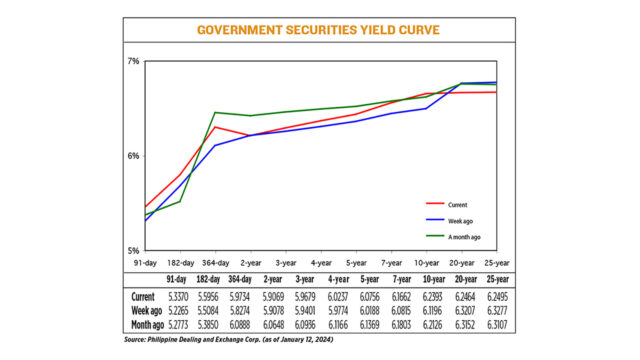
YIELDS on government securities (GS) mostly rose last week in a healthy correction from overbought conditions and amid market anticipation for fresh debt issuances and the US Federal Reserve’s next policy move.

GS yields, which move opposite to prices, went up by an average of 4.78 basis points (bps) week on week, according to PHP Bloomberg Valuation Service Reference Rates data as of Jan. 12 published on the Philippine Dealing System’s website.

Rates at the short end of the curve rose across the board. The 91-, 182-, and 364-day Treasury bills (T-bills) climbed by 11.05 bps (to 5.337%), 8.72 bps (5.5956%), and 14.6 bps (5.9734%), respectively.

At the belly, the three-, four-, five-, and seven-year Treasury bonds (T-bonds) rose by 2.78 bps (to 5.9679%), 4.63 bps (6.0237%), 5.68 bps (6.0756%), and 8.47 bps (6.1662%), respectively. Meanwhile, the two-year bond fell by 0.09 bp to 5.9069%.

Yields at the long end were mixed. The rate of the 10-year debt paper rose by 11.97 bps to 6.2393%, while yields on the 20-, and 25-year T-bonds fell by 7.43 bps (to 6.2464%) and 7.82 bps (6.2495%), respectively. 

Total GS volume traded rose to P16.5 billion on Friday from P15.05 billion the week prior.

“Over the past weeks, we’ve observed a pronounced upward shift in yields, primarily driven by a market correction from previously overbought curve brought by the aggressive yield declines we saw last month,” Lodevico M. Ulpo, Jr., vice-president and head of Fixed Income Strategies at ATRAM Trust Corp., said in an e-mail.

The Fed’s previous indications of rate cuts this year pushed the market to overbought territory, he said.

“The recent auction of the five-year bonds, which was fully awarded at P30 billion and witnessed a robust demand (approximately 2.5 times oversubscribed), significantly influenced [last] week’s rates. The market’s response, especially considering the uncertainties surrounding the US consumer price index (CPI) and continuous new bond series issuance, continued to be firm with sporadic selling to reflect expectations on market pricing in the primary market,” Mr. Ulpo added.

Last week, the Bureau of the Treasury (BTr) raised P30 billion as planned from its offer of new five-year bonds as total bids reached P74.329 billion, more than twice as much as the program. 

The bonds were awarded at a coupon rate of 6.125%. Accepted yields ranged from 5.86% to 6.125% for an average rate of 6.073%.

Meanwhile, US consumer prices increased more than expected in December, with Americans paying more for shelter and healthcare, suggesting it was probably too early for the Federal Reserve to start cutting interest rates, Reuters reported.

The consumer price index (CPI) rose 0.3% last month after nudging up 0.1% in November, the Labor department’s Bureau of Labor Statistics said.

In the 12 months through December, US CPI rose 3.4% after increasing 3.1% in November. Economists polled by Reuters had forecast the CPI would gain 0.2% on the month and climb 3.2% on a year-on-year basis.

Inflation averaged 4.1% in 2023, down from 8% in 2022.

Financial markets still see more than a 60% chance of a rate cut at the Fed’s March 19-20 policy meeting, according to CME Group’s FedWatch Tool. The Fed has hiked its policy rate by 525 basis points to the current 5.25%-5.5% range since March 2022.

“Yields took their cue largely from global bond market developments with sentiment influenced by expectations on the timing of the Fed rate cuts. There may have been investors sitting on the sidelines ahead of the US inflation report,” ING Bank N.V. Manila Senior Economist Nicholas Antonio T. Mapa added in an e-mail.

For this week, the market will monitor policy statements from newly appointed Finance Secretary Ralph G. Recto, Mr. Mapa said.

“Looking ahead to [this] week, we anticipate a surge in demand for the seven-year bonds, as investors begin to seek longer durations, aiming to lock in yields in anticipation of the January inflation figures,” Mr. Ulpo added.

“Additionally, the local market’s movements are likely to align closely with global yield trends, which are expected to mirror evolving monetary policy directions and expectations in the forthcoming months. This alignment will play a pivotal role in shaping market positioning and yield dynamics in the short term,” he said.

The BTr will offer P30 billion in fresh seven-year T-bonds on Tuesday. — A.C. Abestano with Reuters


Meralco commits to ERC guidelines for contract termination

MANILA Electric Co. (Meralco) has assured that contracts resulting from bids will adhere to the new rules of the Energy Regulatory Commission (ERC) on termination.

“With the new ERC guidelines, it is already stated there that before terminating [contracts], these need to go through the ERC,” Lawrence S. Fernandez, Meralco’s vice-president and head of utility economics, said on the sidelines of a media briefing last week.

“We will comply with that provision,” he added.

Meralco has recently launched the bidding for the procurement of its energy requirements, covering capacities of 1,800 megawatts (MW), 1,200 MW, and 660 MW.

The new bids for the 1,800 MW and 1,200 MW capacities aim to secure new suppliers following the termination of their power supply agreements (PSAs).

Last year, the ERC released guidelines governing the PSAs entered into by distribution utilities.

Under ERC Resolution No. 16, Series of 2023, the commission noted that no party to the PSA should be allowed to terminate the contract within a specified period “unless expressly allowed under these guidelines.”

Among the allowable grounds cited in Section 34 of the resolution is termination with prior approval from the ERC.

Mr. Fernandez, meanwhile, said that the recommendations from the ERC for the terms of reference (ToR) for the bidding covering 1,800 MW were also applied to the ToR for the 1,200-MW bidding. 

“Most of the suggestions of [ERC Chairman Monalisa C. Dimalanta] for the 1,800 [MW] were also applied to the 1,200 [MW] to address the concerns,” he said.

The 1,800 MW bidding is meant to replace the contract for the electricity that were supposed to be supplied by Excellent Energy Resources, Inc. and Masinloc Power Partners Co. Ltd. The two companies are subsidiaries of San Miguel Power Global Holdings Corp., the power arm of San Miguel Corp.

Last year, San Miguel Power Global issued notices of termination of its power supply deals with Meralco, which then were approved by the ERC as the PSA application went beyond the date by which it should have been approved by the regulator.

Meanwhile, Meralco PowerGen Corp. (MGen), the energy generation arm of Meralco, is optimistic about achieving its target of building 1,500 MW of renewable energy (RE) projects by 2030.

“We have a lot in our pipeline that will meet at least 1,500 [MW],” MGen Chief Operating Officer Dominador M. Camu Jr. told reporters in a recent interview.

“Although they will not be completed by 2024, but the construction and the pipeline is continuing to be filled up. This includes [projects] in RE — solar, we have wind,” Mr. Camu said.

In August last year, MGen said it has allocated P18 billion to put up about two gigawatts of gross RE capacity from solar and wind.

Currently, MGen Renewable Energy, Inc., the renewables arm of MGen, has a portfolio that includes the 55-MW-alternating current (MWac) BulacanSol solar plant in San Miguel, Bulacan in partnership with Powersource Energy Holdings Corp.

This also includes the 68-MWac solar farm in Ilocos Norte of Nuevo Solar Energy Corp., a joint venture between MGreen and Vena Energy.

Meanwhile, Mr. Camu said that the company is applying for environmental clearance to convert its coal-fired power plant project in Atimonan in Quezon province to one that runs on gas, he said.

Meralco’s controlling stakeholder, Beacon Electric Asset Holdings, Inc., is partly owned by PLDT Inc.

Hastings Holdings, Inc., a unit of PLDT Beneficial Trust Fund subsidiary MediaQuest Holdings, Inc., has an interest in BusinessWorld through the Philippine Star Group, which it controls. — Sheldeen Joy Talavera

ADVERTISEMENT
ADVERTISEMENT