Home Blog Page 3784

UP KEM presents the 2023 Students’ National Chemical Engineering Conference

On Jan. 20-21, the UP Chemical Engineering Society, Inc. (UP KEM) presents this year’s Students’ National Chemical Engineering Conference, (SNCEC), now going on 14 years strong. As UP KEM’s flagship event, SNCEC aims to connect chemical engineering students from all over the country and to celebrate the recent advancements in the field of chemical engineering.

The first of the three sub-events is the National Chemical Engineering Symposium (NACHES), now returning face-to-face after years being held on the screen. This full-day symposium on Jan. 20 intends to immerse aspiring chemical engineers into the current innovations and challenges of a particular industry. In this cycle, NACHES 2023 highlights the field of Renewable Energy, wherein various esteemed professionals are set to discuss sustainability and its place in the chemical engineering scene. With an estimate of more than a hundred participants, NACHES is certainly an event you must not miss!

On the evening of Jan. 20, the Students’ Chemical Engineering Networking Event (SCENE) will accomplish its goal in bridging participants with various engineers and company representatives from different chemical engineering industries, including Food Production, Pharmaceuticals, Petroleum & Energy, and Manufacturing. With at least seven participating companies this year, SCENE aims to serve as an opportunity for students to scout the diverse career options in chemical engineering.

Those brimming with competitive spirits may showcase their academic prowess in the Inter-University Chemical Engineering Quiz Show (Inter-U), UP KEM’s longest-running event. As a nationwide quiz bee competition designed to challenge the knowledge and proficiency of chemical engineering students in their course and in related fields, this year’s Inter-U is coming back to a face-to-face setting. With 23 participating teams last year, this year’s Inter-U promises to showcase the best of the best this Jan. 21. Don’t miss your chance to be the next Inter-U champion and sign up now!

For those interested in realizing their full potential as a chemical engineering student, sign up now on tinyurl.com/SNCEC2023Registration!

CEOs fear for their firms in pre-Davos survey as AI, climate risks rise

REUTERS

 – Global executives are increasingly worried about the long term viability of their businesses, a PricewaterhouseCoopers pre-Davos survey showed, with pressures mounting from generative artificial intelligence (AI) and climate disruption.

Some 45% of more than 4,700 global CEOs surveyed do not believe their businesses will survive, barring significant changes, in the next ten years, the “Big Four” auditor said.

“There’s the 55% who think they don’t have to change radically, and I would argue that’s a little naive because the world is changing so fast around them,” PwC Global Chairman Bob Moritz told the Reuters Global Markets Forum (GMF) ahead of the World Economic Forum’s annual meeting in Davos.

Advancements in generative AI were top of the concerns for most survey respondents, with almost 75% predicting it would significantly change their business in the next three years.

The majority expect AI to require training in new skills for employees, while many expressed concerns about cybersecurity risks, misinformation, and bias towards specific groups of customers or employees.

“If you just look at the same skills, I think yes, there will be impact,” said Juergen Mueller, SAP’s chief technology officer, referring to job losses and hiring freezes on junior positions in the tech sector.

“Therefore, what you do need is even better skilled people,” Mueller told GMF at Davos.

The PwC survey also showed a stronger focus on environmental concerns pressuring margins, with four in ten executives saying they accepted lower returns for climate-friendly investments.

Less than 50% reported progress, including on climate risks in financial planning, with 31% saying they had no plans to do so.

Overall, companies were more confident in the global growth picture, with 38% optimistic on growth, which was more than double those surveyed in 2023.

However, they were also less optimistic on revenue growth over the next year, with 37% confident of their ability to increase revenue, versus 42% in 2023.

“The ability to raise rates and raise prices is not as easy as ever before … that’s going to be a trend that we’re likely to see over the next two to three years,” Moritz said.


BRITAIN CALLING

PwC’s survey found that Britain was the top country to invest in, with nearly a third of US CEOs selecting the traditionally popular country as their top target.

Britain’s standing among China’s CEOs rose dramatically, to joint sixth, up from sixteenth last year.

However, the former European Union member has become slightly less strategically important for global CEOs, falling one place to fourth behind Germany, with the US and China keeping their first and second places respectively. – Reuters

More oil tankers shun southern Red Sea after US-led strikes in Yemen

STOCK PHOTO | Image by Gerhard Traschütz from Pixabay

 – At least six more oil tankers were steering clear of the southern Red Sea on Monday, as disruptions increase on the vital route for energy shipping in the wake of US-led strikes against Houthi targets in Yemen.

Following the U.S. and British strikes, the US-led Combined Maritime Forces (CMF) based in Bahrain on Friday warned all ships to avoid the Bab al-Mandab Strait at the south end of the Red Sea for several days, tanker body INTERTANKO said.

Prior to the strikes it had been mostly container ships which were avoiding the Red Sea, with oil tanker traffic largely unchanged in December.

But since the CMF’s warning, a growing number of oil tankers are avoiding the region, increasing the potential for disruptions to oil supply via the Suez Canal in both directions.

Reuters on Monday counted six tankers that had altered their course, making a total of at least fifteen vessels to do so since the start of the strikes, ship tracking data from LSEG and Kpler showed.

The tankers Torm Innovation, Proteus Harvonne, and Alfios I appeared to have turned away from the Suez Canal in favor of the longer route around Africa’s Cape of Good Hope for voyages to Europe and the US.

The Pacific Julia and STI Topaz are also heading straight for the Cape route.

The Octa Lune performed a U-turn in the northern part of the Red Sea on Jan. 12 and has returned to the Mediterranean with a Taiwan-bound cargo of naphtha.

Tankers tracked by Reuters on Friday that had diverted or paused have either taken the longer Cape route or paused in the Gulf of Aden or northern Red Sea.

Tanker owners including Torm, Hafnia and Stena Bulk said they would avoid Bab al-Mandab from Friday, while Euronav reaffirmed its temporary suspension of transits through the Red Sea. – Reuters


WATERBORNE OIL GLUT

The disruption is indirectly tightening the market by forcing up oil stocks on water by 35 million barrels, Citi analysts noted.

Oil prices gained 2% last week in response to the rising tide of conflict in the region, but the lack of direct impact on oil production could be limiting gains, according to analysts, as prices ticked lower on Monday.

The strikes last week across Yemen against Houthi forces came in retaliation for months of attacks on Red Sea shipping.

The Houthis said on Monday that their attacks would continue despite the US strikes, and struck a US-owned dry bulk vessel carrying steel products with an anti-ship ballistic missile in the Gulf of Aden on Monday.

Houthi militants have been targeting commercial vessels since late last year in attacks which the group says are in support for Palestinian group Hamas in its war with Israel in the Gaza Strip.

Those incidents have been concentrated on the Bab al-Mandab Strait, southwest of the Arabian Peninsula.

Regional shipping tensions also spread to the other side of the peninsula last week when Iran seized a tanker south of the Strait of Hormuz, another key shipping corridor. – Reuters

UK’s FTSE 100 slips as luxury, bank stocks weigh

The UK’s FTSE 100 fell on Monday, hurt by a sell-off in luxury and bank stocks, while lackluster corporate earnings forecasts weighed on the FTSE 250 shares.

The blue-chip FTSE 100 slid 0.4%, while the midcap FTSE 250 index was flat at the close.

Personal goods  index fell 4.4%, with Burberry extending losses with a 5.7% slump, after three brokerages cut the target price on the luxury retailer after it warned of a worsening slowdown in demand for luxury goods last week.

“Today’s biggest fallers on the FTSE100 are lower due to broker downgrades. Burberry shares have continued their recent slide after getting downgraded by Goldman Sachs to neutral on concern over further weakness in its margins,” said Michael Hewson, chief market analyst at CMC Markets UK.

Top performer non-life insurers gained 1.3%, while banks fell 1.8%, logging five straight days of losses.

Lender HSBC lost 2.2% after Exane downgraded the stock, citing margin headwinds.

Investors are awaiting British consumer price inflation data and retail sales figures for December, both of which are due later this week, for more clarity on the timing of expected interest rate cuts.

The Bank of England seems to be a relatively hawkish outlier compared to the Federal Reserve and the European Central Bank as they have stuck to their higher-for-longer policy rhetoric.

Across the Atlantic, investors will closely monitor U.S. business activity data for January and December retail sales.

Shares of PageGroup fell 0.3% after the global recruiter trimmed its annual profit forecast.

Crest Nicholson was down 0.8% after the homebuilder cut its annual profit forecast.

Meanwhile, average asking prices for British homes made the strongest start to the year since 2020, according to an industry survey that suggested the slowdown in the sector could be easing. – Reuters

Philippines hopes to sign troops pact with Japan in Q1

JAPAN and Philippine air force officers during a bilateral training on humanitarian assistance and disaster relief held at Clark Air Base in Pampanga in June 2022. — JAPANESE EMBASSY PHOTO

The Philippines hopes to sign in the first quarter of the year an agreement with Japan allowing the deployment of military forces on each other’s soil, Manila’s defense secretary said on Tuesday

The Philippines is strengthening its ties with neighbors and other countries to counter what it calls an increasingly aggressive Beijing in the South China Sea.

The Philippines and Canada are also working on a memorandum of understanding for enhanced security cooperation, Defense Secretary Gilberto C. Teodoro, Jr. told reporters on the sidelines of a cybersecurity forum.

Japan and the Philippines, two close allies of the United States, started negotiations on a reciprocal troop access deal in November. — Reuters

PHL reaffirms ‘One China policy’ after Marcos congratulates Taiwan’s Lai

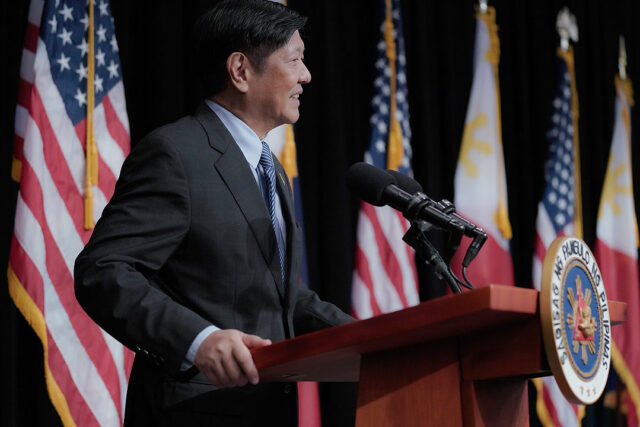
PRESIDENT Ferdinand R. Marcos, Jr. at the New York Stock Exchange. — OFFICE OF THE PRESS SECRETARY

The Philippines’ foreign ministry on Tuesday reaffirmed the country’s “One China policy” after its president, Ferdinand R. Marcos, Jr., congratulated Taiwan’s new leader Lai Ching-te.

Mr. Marcos on Monday congratulated Mr. Lai for winning Taiwan’s election, referring to him as its next president.

The Philippines’ foreign ministry said the congratulatory message was Mr. Marcos’ way of recognizing the Philippines and Taiwan’s “mutual interests”, including the 200,000 overseas Filipino workers (OFWs) in the democratically governed island.

“The message of President Marcos congratulating the new president was his way of thanking them for hosting our OFWs and holding a successful democratic process. Nevertheless, the Philippines reaffirms its One China Policy,” the statement said.

The Southeast Asian nation, which has expressed concerns over tensions in the Taiwan Strait, has ties with Taipei, with its Manila Economic and Cultural Office in Taiwan serving as a de facto embassy. — Reuters

Wilcon Depot kicks off year with first DIW store opening in Morong, Rizal

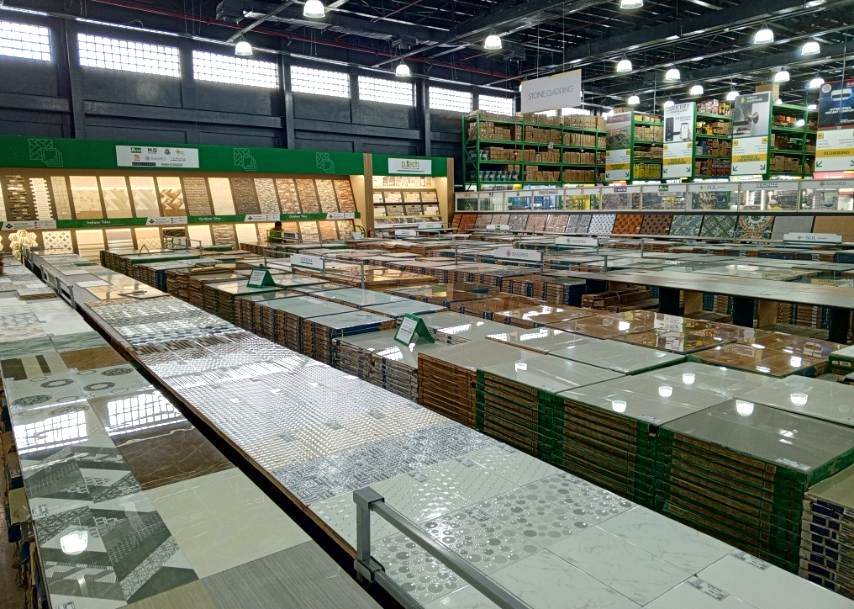
Wilcon Depot celebrates a milestone with the grand opening of its 1st Do It Wilcon Store in Morong, Rizal – marking the 6th branch in the province, bringing quality home solutions closer to its valued customers. Leading the ceremonial ribbon cutting are (L-R) Wilcon Depot AVP for Sales and Operations Rowell Suarez, President and CEO Lorraine Belo-Cincochan, Morong Rizal Honorable Vice Mayor Jose Fred Feliciano, Honorable Mayor Sidney B. Soriano, Wilcon Depot SEVP-COO Rosemarie Bosch-Ong and Ramonchito Kung.

Wilcon Depot welcomes the year in full swing

As a trusted building partner, the company strives to assist Filipinos in achieving their home and building projects. With the aim to make Wilcon Depot easily accessible to the community, the country’s leading home improvement and construction supplies retailer, marks another milestone as it opens its 91st store in Morong, Rizal and the first DO IT WILCON (DIW) store to open this year. The grand opening took place at Manila East Road, Lagundi, Morong, Rizal on Jan. 12.

As part of the ongoing #FlyingHighTo100 campaign, the opening of the first DO IT WILCON (DIW) store format for the year 2024 is a deliberate move to bring premium and future – forward home and building solutions to the growing community of Morong, Rizal. The event was graced by Wilcon Depot executives, esteemed guests, suppliers, and Municipal representatives of Morong.

The DO IT WILCON (DIW) is a new store format following the rebranding of Wilcon Home Essentials store. The grand opening marks the 6th store to open in Rizal following the success of stores in Masinag, Taytay, San Juan, San Isidro and Mayamot.

Morong nestles in the heart of the picturesque Rizal province, boasting a rich history. The town’s historical landmarks and stunning landscapes contribute to its emerging status as a potential business hotspot. Wilcon Depot is capitalizing on this by providing a convenient location accessible from the city, facilitating businesses to tap into the large consumer market of the capital.

Moreover, Morong’s steady population growth from the 2020 census constitues 2.14% of Rizal’s total population. With a 4.3% annual population growth from the year 2015 to 2020, Morong presents a promising consumer base for Wilcon Depot.

The new Morong, Rizal DO IT WILCON (DIW) branch proudly showcases an extensive array of construction materials, home improvement products, furniture, appliances, and  other essentials tailored for homeowners, builders, and contractors alike.

Wilcon prides itself on understanding the unique home preferences and needs of the local community, aiming to empower individuals to realize their building projects and home goals.

The company remains steadfast in its commitment to excellence by offering high-quality products and services. The company’s exclusive and in-house brands such as Pozzi for trusted bathroom solutions; Hamden, an ideal partner for your kitchen needs; Alphalux, an energy-efficient lighting solutions brand; Kaze, an appliance brand that will help you live a healthy space; Hills, a trusted brand for construction and electrical power tools; P.Tech, your partner for reliable household necessities; Verona Tiles, for a contemporary interpretation of a classic style; Sol Ceramica, Asian tiles for a more sophisticated home; Grohe and Kohler for bathroom and plumbing solutions; Franke, convenient kitchen solutions;  and Rubi a partner when it comes to tile cutting necessities; and among many other brands, are made accessible in the new Do-it-Wilcon (DIW) store at Morong, Rizal

Valued customers can also shop online at Wilcon by visiting shop.wilcon.com.ph/. Wilcon Depot also offers Browse, Call, Collect, or Deliver and Wilcon Virtual Tour services to complement the in-store shopping experience.

This 2023, Wilcon Depot plans to open more retail stores as part of their company’s #FlyingHighTo100 store expansion campaign, wherein the company aims to have 100 operating stores nationwide by 2025, barring any unexpected external factors.

Start building big ideas with Wilcon Depot and shop daily at its newest store from 8:00 AM to 7:00 PM. Visit DO IT WILCON (DIW). Morong, Rizal located at Manila East Road, Lagundi, Morong, Rizal.

For more information about Wilcon, visit www.wilcon.com.ph or follow their social media accounts on Facebook, Instagram, and Tiktok. or subscribe and connect with them on Viber Community, LinkedIn, and YouTube.


Spotlight is BusinessWorld’s sponsored section that allows advertisers to amplify their brand and connect with BusinessWorld’s audience by enabling them to publish their stories directly on the BusinessWorld website. For more information, send an email to online@bworldonline.com.

Join us on Viber at https://bit.ly/3hv6bLA to get more updates and subscribe to BusinessWorld’s titles and get exclusive content through www.bworld-x.com.

Nov. cash remittances sink to six-month low

REUTERS

By Keisha B. Ta-asan, Reporter

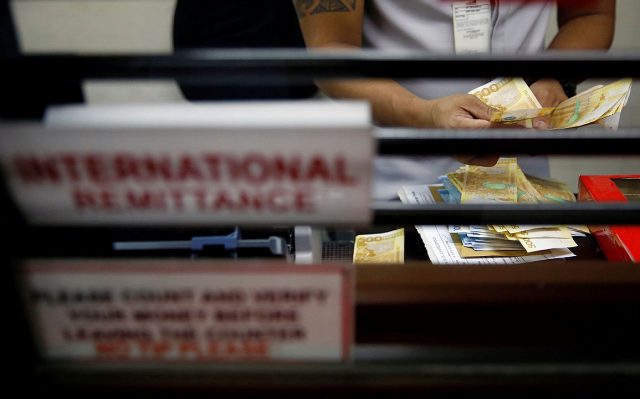
MONEY SENT HOME by overseas Filipino workers (OFWs) reached $2.719 billion in November — the lowest in six months — amid geopolitical tensions in the Middle East and a stronger peso against the dollar. 

Cash remittances grew by 2.8% from $2.644 billion a year earlier, according to data released by the Bangko Sentral ng Pilipinas (BSP) on Monday.

The growth in cash remittances was the slowest annual pace since the 2.6% in September.

Overseas Filipinos' cash remittances (Nov. 2023)

The amount of money sent by OFWs to the Philippines was also the lowest since $2.494 billion in May 2023.

Month on month, remittances declined by 9.3% from $2.998 billion in October. 

In a statement, the BSP attributed the year-on-year growth in cash remittances to higher receipts from land- and sea-based workers. 

Cash remittances from land-based OFWs jumped by an annual 2.9% to $2.14 billion in November, while inflows from sea-based workers increased by 2.6% to $579.747 million.   

Union Bank of the Philippines, Inc. Chief Economist Ruben Carlo O. Asuncion said migrant workers typically send more cash remittances in the fourth quarter.   

“October, November and December are peak remittance months, and we see that OFWs send more usually for the holiday celebrations and spending for their recipients,” he said.   

China Banking Corp. Chief Economist Domini S. Velasquez said the month-on-month slowdown in cash remittances was due to reduced inflows from the United States, the country’s main source of remittances.   

Based on BSP data, cash remittances from the US stood at $1.041 billion, 13.3% lower than $1.2 billion in October.   

“Remittances from the Middle East also stalled, possibly due to the challenging conditions faced by OFWs amid escalating tensions in the region,” Ms. Velasquez said.   

The Middle East has been on high alert amid fears of a wider conflict since Hamas militants launched a surprise attack on Israel in October 2023.    

“The lower dollar-peso exchange rate in the latter part of November might have dissuaded Filipinos from sending money back home,” Ms. Velasquez said.   

ING Bank N.V. Manila Senior Economist Nicholas Antonio T. Mapa noted that the peso appreciated against the dollar in November compared with a year ago.   

The peso closed at P55.485 versus the greenback on Nov. 30, appreciating by 2.2% or P1.245 from its P56.73 close on Oct. 31. The peso was also significantly stronger than its P56.56 finish at the end of November 2022.   

“On a positive note, remittances from Europe, particularly from the United Kingdom, surged in November as its economy showed a subtle rebound coming from a previous decline,” Ms. Velasquez said.   

For the January to November, cash remittances coursed through banks rose by 2.8% to $30.211 billion from $29.38 billion a year earlier.   

Still, this was below the BSP’s 3% remittance growth projection for 2023.

In the 11 months to November, the BSP said there were higher inflows from the United States, Saudi Arabia and the United Arab Emirates (UAE).

The United States was the biggest remittance source with a 41.2% share. It was followed by Singapore (6.9%), Saudi Arabia (6%), Japan (5%), the United Kingdom (4.7%), UAE (4.3%), Canada (3.6%), Qatar (2.8%), Taiwan (2.7%) and South Korea (2.5%). 

Remittances from the top 10 countries cumulatively made up 79.7% of the total during the 11-month period. 

Meanwhile, personal remittances, which include inflows in kind, rose by 2.9% to $3.017 billion in November from $2.931 billion a year ago. 

This brought the year-to-date level to $33.585 billion, up by 2.9% from $32.649 billion a year earlier. 

“We can expect remittances to sustain their growth to support domestic consumption, as well as provide the backbone for foreign currency flows, helping limit the impact from the chronic trade deficit,” Mr. Mapa said.   

Latest data from the Philippine Statistics Authority showed a trade deficit of $4.17 billion in October, against the $3.31-billion deficit a year earlier.    

Export revenue dropped 17.5% year on year to $6.36 billion in October, while merchandise imports declined by 4.4% to $10.54 billion.

“Looking ahead, we anticipate a decent growth in remittances, driven by the sustained demand for Filipino labor. Wage increases in Hong Kong and Taiwan in 2024 will also contribute to the growth of remittances,” Ms. Velasquez said.   

The central bank expects remittances to have grown by 3% in 2023. It also sees remittance growth at 3% this year.

Philippine-China tensions over South China Sea may have wider implications for region — Moody’s

A Philippine supply boat sails during a resupply mission for Filipino troops stationed at a grounded warship in the South China Sea, Oct. 4, 2023. — REUTERS

THE DISPUTE between the Philippines and China over the South China Sea could have more widespread effects on the Asia-Pacific region, Moody’s Investors Service said.

“Greater strains in China’s relationship with the Philippines over competing claims in the South China Sea over the past year could have more widespread implications for the region,” it said in a report dated Jan. 15.

Tensions between the Philippines and China have increased under the Marcos administration. The Philippines has cited incursions by Chinese vessels around South China Sea features closest to the Southeast Asian nation.

The situation has worsened after the Chinese Coast Guard last month fired water cannons to block Manila’s attempt to deliver food and other supplies to troops stationed at BRP Sierra Madre, a World War II-era warship intentionally grounded to stake the Philippines’ claim on the waterway.

A United Nations-backed tribunal in 2016 said China’s claim to nearly the entire South China Sea has no legal basis, but Beijing has largely ignored the ruling and continued its island-building activities.

Moody’s noted several geopolitical risks in the region such as a possible escalation of hostilities between North and South Korea, as well as the upcoming elections in Indonesia and India.

“We expect relative domestic political stability to provide some space for reform in Malaysia, the Philippines and Thailand,” it said.

DOMESTIC CONSUMPTION
Meanwhile, Moody’s noted stable domestic consumption in the Philippines would likely mitigate the impact of China’s slowdown, weak external demand and tight funding conditions globally.

It said Asia-Pacific economies would continue to face heightened liquidity strains, currency depreciation pressures and shifts in geopolitics this year. 

“Stable domestic consumption, underpinned by robust labor markets and the provision of limited targeted fiscal support, will mitigate such factors to varying degrees, particularly in large emerging markets such as India, Indonesia, the Philippines and Vietnam,” it said.

The government is targeting 6-7% gross domestic product (GDP) growth this year and 6.5-7.5% next year. The economy expanded by 5.9% in the third quarter. GDP needs to grow by 7.2% in the fourth quarter to reach the lower end of the government’s goal. 

Household consumption grew by 5% in the third quarter, slower than 8% a year ago and 5.5% in the previous quarter. It was also the weakest rise in consumption in two years.

The country’s unemployment rate fell to a fresh record low in November, easing to 3.6% from 4.2% in the previous month and in November 2022, based on the latest data from the local statistics agency.   

Meanwhile, Moody’s said GDP for 25 rated sovereigns in the Asia-Pacific region would decelerate to 3.6% in 2024 from a likely 4.2% growth in 2023. 

The debt watcher said the outlook for sovereign creditworthiness in the region is negative for 2024. This is on the back of a continued slowdown in China’s economic growth, weak external demand and tight global credit conditions. 

Moody’s said it sees China’s GDP slowing to 4% for the next two years from an average of 6% over 2014 to 2023. 

“A slew of structural factors, including an aging population and a shrinking labor force, as well as property stress and slow gains in productivity, will drive a further decline in the potential growth rate to around 3.5% by 2030,” it said. 

A slowdown in the United States in the near term and a subdued growth momentum in the Euro area would also weaken demand for Asia-Pacific (APAC) exports, it said. 

“The US and Europe are as significant as China as export destinations for many APAC economies,” the debt watcher said.

Philippine merchandise exports contracted by 13.7% to $6.13 billion in November, the third straight month of decline, though slower than the 17.5% drop in October. This was a reversal from the 13.1% growth a year ago.   

The United States was the top destination of locally made products in November with a 16% share worth $1.14 billion. This was followed by Japan, with a 13.2% share worth $938.3 million. Exports to China were valued at $876.27 million, equivalent to a 12.3% share. 

Meanwhile, Moody’s said fiscal deficits have remained wide in the region, as governments reallocated spending to infrastructure development and measures to address high inflation while balancing efforts to implement reforms that could raise revenue. 

“India and the Philippines will continue to leverage gains in digitalization from the pandemic to increase revenue through stricter tax compliance and other administrative measures, without a significant broadening of the tax base that could prove politically unpopular,” it said. 

Based on data from the Treasury department, the budget gap narrowed by 10.1% to P1.11 trillion as of end-November 2023 from a year earlier. This represents 74.1% of the programmed P1.499-trillion deficit for the full year.

Revenue collection rose by an annual 8.8% to P3.6 trillion, representing 95.58% of the P3.729-trillion target for 2023.

Borrowing costs might also remain elevated in the region, as central banks would only start easing gradually this year, the debt watcher said. 

“With the prominent exceptions of China and Japan, central banks in the region have hewed closely to the Fed’s policy stance even in the absence of significant demand-side pressures on inflation,” Moody’s said. 

“This has helped to stabilize exchange rates and dampen the pass-through from import prices, but inflation has remained above target for a number of economies and prompted further tightening in late 2023, including in Australia and the Philippines,” it added. 

The Philippine central bank raised interest rates by 450 basis points from May 2022 to October 2023, bringing the key rate to 6.5%, the highest in 16 years. — Keisha B. Ta-asan


Recto officially takes over DoF

FINANCE SECRETARY RALPH G. RECTO — DEPARTMENT OF FINANCE FACEBOOK PAGE

FORMER CONGRESSMAN and Senator Ralph G. Recto on Monday officially took over the Department of Finance (DoF) from Benjamin E. Diokno, at a time when the government needs to ramp up its fiscal consolidation efforts.

“Our task is to actualize the President’s vision articulated in the national development plan. There will be many obstacles for sure,” Mr. Recto said during the turnover ceremony at the DoF on Monday.

“But I am highly confident that through increased effort and sincere dedication, and by rethinking the way we do things and innovating on the way we govern, we can make significant progress towards approximating this vision,” he added.

Mr. Recto has retained the department’s undersecretaries, while designating Finance Undersecretary Maria Luwalhati C. Dorotan-Tiuseco as his chief of staff.

Ms. Dorotan-Tiuseco in a Viber message said she has been tapped as chief of staff, adding that there have been “no other changes” to date. She was the undersecretary  in charge of the Information Management Service, Political and Legislative Liaison Group and Climate Finance Policy Group.

At a briefing after his oath-taking ceremony on Friday, Mr. Recto said a reshuffle of the department officials is unlikely. “I don’t expect to. You know when I entered the National Economic and Development Authority, I only brought one person with me,” he said.

The agency’s roster of undersecretaries includes Catherine L. Fong of the Privatization and Corporate Affairs Group Maria Edita Z. Tan of the International Finance Group, and Bayani H. Agabin of the Legal Affairs Office and Revenue Integrity Protection Service.

Also included are Chief Economist Zeno Ronald. R. Abenoja, officer-in-charge Karlo Fermin S. Adriano of the Fiscal Policy and Monitoring Group and officer-in-charge Dakila Elteen M. Napao of the Revenue Operations Group.

At the turnover ceremony on Monday, Mr. Diokno described Mr. Recto as a “seasoned policy maker and an undeniable patriot.”

“He has sponsored several key economic and tax reforms that have transformed our economy for the better and reignited the country’s growth potential,” said Mr. Diokno, who returns to the Monetary Board.

The DoF said Mr. Recto is also scheduled to have briefings with heads of DoF-attached agencies and bureaus throughout the week.

Agencies and corporations under the DoF include the Bureau of Internal Revenue (BIR), Bureau of Customs (BoC), Bureau of the Treasury (BTr), Bureau of Local Government Finance, Insurance Commission, National Tax Research Center and Philippine Guarantee Corp.

The newly appointed Finance chief earlier said he would be continuing strategies under the Medium-Term Fiscal Framework, as well as push for the immediate passage of priority tax reforms.

Mr. Recto also said he would use measures to protect consumers from high prices and make sure to meet the revenue collection targets for the year.

The government is targeting to generate P4.235 trillion in revenues this year, equivalent to 15.5% of the gross domestic product (GDP), according to the latest Development Budget Coordination Committee (DBCC) statement.

This year, the BIR is tasked to raise P3.05 trillion, while the BoC is expected to collect P1 trillion.

Latest data from the Treasury showed that the National Government’s budget deficit narrowed by 10.1% to P1.11 trillion in January to November.

Revenue collection rose by 8.8% to P3.6 trillion as of end-November, as tax revenues went up by 7.3% to P3.18 trillion and nontax revenues jumped by 22.9% to P381.9 billion.

Mr. Recto said he will support the passage of the Capital Markets Development Act, push reforms in public and private pensions and ensure that the Maharlika Investment Fund is managed judiciously.

Meanwhile, the Financial Executives Institute of the Philippines (FINEX) in a statement on Monday welcomed Mr. Recto’s focus on improving revenue collection, accelerating investments and freeing up resources for social services.

“FINEX looks forward to working with (Mr. Recto), especially on matters affecting the capital markets and the financial sector of the economy,” it added.

The Bankers Association of the Philippines in an earlier statement said Mr. Recto would be crucial in the “reformation of fiscal and economic policies, together with balancing political realities.”

“While the Philippine economy continues to grow due to its strong fundamentals, it is currently facing local and global economic headwinds such as inflation,” BAP President Jose Teodoro K. Limcaoco said.

“The country needs an experienced economist who can navigate the ongoing challenges of this operating environment, and (Mr. Recto) is an ideal fit for this job,” he added. — Luisa Maria Jacinta C. Jocson

‘Precarious’ year ahead for world economy, Davos survey predicts

People walk around the financial district near the New York Stock Exchange in New York, US, Dec. 29, 2023. — REUTERS

THE GLOBAL ECONOMY faces a year of subdued growth prospects and uncertainty stemming from geopolitical strife, tight financing conditions and the disruptive impact of artificial intelligence (AI), a survey of top economists released on Monday found.

Conducted each year ahead of the World Economic Forum’s (WEF) annual meeting in the Swiss resort of Davos, the survey of 60-plus chief economists drawn globally from the private and public sectors attempts to sketch priorities for policy makers and business leaders.

About 56% of those surveyed expect overall global economic conditions to weaken this year, with a high degree of regional divergence. While the majority saw moderate or stronger growth in China and the United States, there was broad consensus that Europe would muster only weak or very weak growth.

The outlook for South Asia and East Asia and Pacific was more positive, with a very high majority expecting at least moderate growth in 2024.

Reflecting commentary from the world’s top central banks suggesting that interest rates have peaked, a full 70% of those surveyed nonetheless expected financial conditions to loosen as inflation ebbs and current tightness in labor markets eases.

AI was seen making an unequal mark on the world economy: while 94% expected AI to significantly boost productivity in high-income economies over the next five years, just 53% predicted the same for low-income economies.

Separately, the WEF released a study on the quality of economic growth across 107 economies that concluded that most countries are growing in ways that are neither environmentally sustainable nor socially inclusive.

“Reigniting global growth will be essential to addressing key challenges, yet growth alone is not enough,” said Saadia Zahidi, managing director, World Economic Forum.

The WEF said it was launching a campaign to define a new approach to growth and help policy makers balance it with social, environmental and other priorities. — Reuters

Gaming revenue reaches P285B in 2023; P336B eyed for 2024

MICHAL PARZUCHOWSKI-UNSPLASH

By Revin Mikhael D. Ochave, Reporter

THE PHILIPPINE Amusement and Gaming Corp. (PAGCOR) said revenue for 2023 reached P285.27 billion, marking a 33.1% increase from P214.33 billion reported in 2022.

This figure not only surpassed PAGCOR’s 2023 revenue target of P272.74 billion but also set a new record high, surpassing the previous record of P256.49 billion posted in 2019, PAGCOR Chairman and Chief Executive Officer Alejandro H. Tengco said during a briefing on Monday.

The country’s integrated resorts are the biggest revenue contributors at P207.48 billion, followed by the electronic games sector at P58.16 billion, he said.

“Electronic gaming has brought up our revenue substantially. The growth is very exponential and I believe it will continue to grow.”

PAGCOR-operated casinos under the Casino Filipino brand took up P19.62 billion last year.

“Our 2023 results exceeded even our most optimistic projections, and it proves beyond doubt that the Philippine gaming industry has fully recovered and is now poised for sustained growth in the medium- to long-term,” Mr. Tengco said.  

For 2024, Mr. Tengco said that PAGCOR is aiming to generate P336.38 billion worth of gross gaming revenue amid the expected opening of new integrated resorts.

“We are projecting that our licensed casinos from the Entertainment City, Metro Manila, Clark, Cebu, and the Fiesta Casinos in Rizal and Poro Point will contribute as much as P256.63 billion to our 2024 GGR,” Mr. Tengco said.

“I think the gaming sector will continue to grow. I’ve been around the world attending conferences and everybody is excited about the Philippine market,” he added.

He said that there is a possibility that the electronic gaming sector could eventually overcome land-based casino.

“I think the traditional land-based casinos will always stay. There are still people who still want to go for the actual excitement. Will electronic gaming eventually overcome land-based casinos? There is a possibility.”

Mr. Tengco also said that the proposed shutdown of Philippine Offshore Gaming Operators (POGOs) or internet gaming licensees (IGLs) is not an easy decision, adding that he remains open to issuing licenses to IGLs in the future.

“We used to have 200 IGLs. Now, we have 48 IGLs. We generated P5 billion revenues in 2023, compared to the almost P3 billion in 2022. We have one-fourth of licensees.”

“The shutdown is not easy. There are close to 70,000 people Filipinos who are working for IGLs. Then there are 625,000 square meters of space that are being leased,” he added.

In October last year, PAGCOR announced that it would use the term IGL instead amid the reported violations of POGO operations in the country.

The National Economic and Development Authority in September said the expulsion of POGOs would help encourage “quality investments” and would be beneficial for the country in the long term.

In the same month, the Senate Committee on Ways and Means previously recommended the gradual phase-out of POGO operations due to its “negative social impact.”

ADVERTISEMENT
ADVERTISEMENT