Home Blog Page 3759

Urban planning in the Philippines should shift to environmental realities, says expert

THE SUN rises behind buildings as seen from the Mabini Bridge in Manila, June 16, 2023. — PHILIPPINE STAR/MIGUEL DE GUZMAN

URBAN PLANNING in the Philippines must prioritize climate and geographical realities for holistic development, according to an expert.

“Our political constructs of provinces and regions don’t fit with the natural constructs of the ridges of mountains, watersheds, and river systems,” Paulo G. Alcazaren, urban planner and landscape architect, said in an interview with BusinessWorld.

When it comes to urban planning, he said it is important to consult economists, earth scientists, and physical planners and “just leave the politicians outside the door.”

Mr. Alcazaren suggested the government delineate the country’s 16 major river systems into areas for comprehensive planning to effectively manage resources and mitigate climate impact.

This will include benefits toward agricultural productivity, sustainable resource extractions, and proper expansion of urban settlements, he said.

Mr. Alcazaren noted there seems to be a focus on using concrete revetments, which “actually exacerbates flooding problems, and eventually compromises the ability of these river systems to adapt to climate change.”

“So we’re pouring trillions of vessels of concrete in the wrong place,” he added.

However, any sound comprehensive plan will imply a paradigm shift in governance structure, which Mr. Alcazaren noted as the main hurdle in realizing urban development.

“It’s a matter of developing and tweaking the priorities of National Economic and Development Authority (NEDA) and Department of Public Works and Highways (DPWH), even their whole framework for economic development, based on climate change realities and not political agendas,” he said.

Additionally, there are only about 7,000 environmental or urban planners in the Philippines, with limited skillsets in large-scale planning for towns and cities, according to Mr. Alcazaren.

He also said that local government units have outdated or cut-paste comprehensive land use plans, alongside physical frameworks that lack sense when paired with private real estate development.

“We are seeing a shift to focus on public infrastructure to address issues of mobility, specifically getting away from car-centric planning to mass transport,” he said.

“And we are only doing it after the fact that we expand our cities beyond our ability to cope with its problem, so we put the cart before the horse.”

Looking ahead, Mr. Alcazaren said secondary cities, such as Metro Iloilo, Tacloban, Lingayen, and Batangas, are governed by progressive administrations and have doubled down on urban plans.

“It’s easier to solve the urban problems of individual cities that are fairly independent of each other,” Mr. Alcazaren said, suggesting Metro Manila to be governed as a province to bridge cooperation among local government units.

“The myth that people have of urban planning is gleaming tall buildings, like those in BGC (Bonifacio Global City) and Makati. But it does not work for everyone in that place.”

Mr. Alcazaren noted that Metro Manila only has one to two square meters of open, accessible space — below the World Health Organization standard of nine.

“Urban development is where everyone has affordable housing, safety, can get to where they want to go without owning a car, has opportunities for education and livelihood, and has access to open green public space,” he said. — Miguel Hanz L. Antivola
Top 10 proposals to have blackout-free Philippines

The new year started badly in Panay Island — which is subdivided into four provinces (Iloilo, Capiz, Aklan, and Antique) with an estimated population in 2023 of 5.5 million people — when on Jan. 2 there was a huge power blackout which lasted many hours. Then it affected the island-province of Guimaras and the rest of the Visayas grid.

See these reports about it last week in BusinessWorld: “Panay power plant outages raise yellow alert in Visayas” (Jan. 2), “‘Improved planning’ needed after Panay outages — NGCP” (Jan. 3), “ERC: Committee looking into Panay Island power outage” (Jan. 4), and, “DoE plan must elevate energy security to top priority item, think tank says” (Jan. 7).

This piece will briefly discuss 10 proposals to avoid a similar event and the annual yellow-red alerts in the country. Three are related to power generation, three to transmission, two to distribution, and two to pricing and taxation. Here we go.

1. Overall power generation must expand. Generation must expand by 7-8 terawatt-hours (TWH) per year until 2026, then 8-9 TWH/year until 2030, from an average of 5-6 TWH/year in 2021-2022. Medium-term GDP growth targets and projections for the Philippines are 6-7.5% yearly until 2028, and this will require a huge increase in available power.

We should have an agnostic policy on power sources, with no favoritism for intermittent and variable renewables, and a focus on higher gigawatt hour (GWh) generation and not GW installed capacity. This is because intermittent sources have high GW capacity but low GWh output due to their low energy density and low capacity.

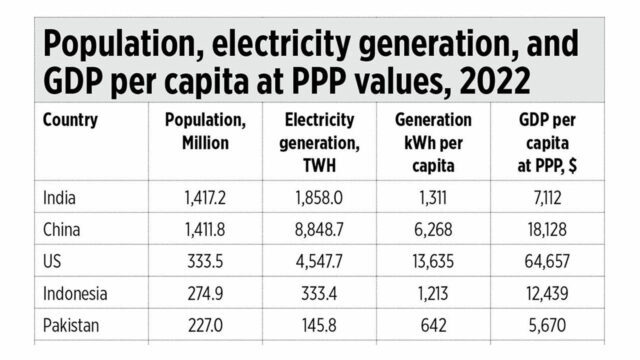
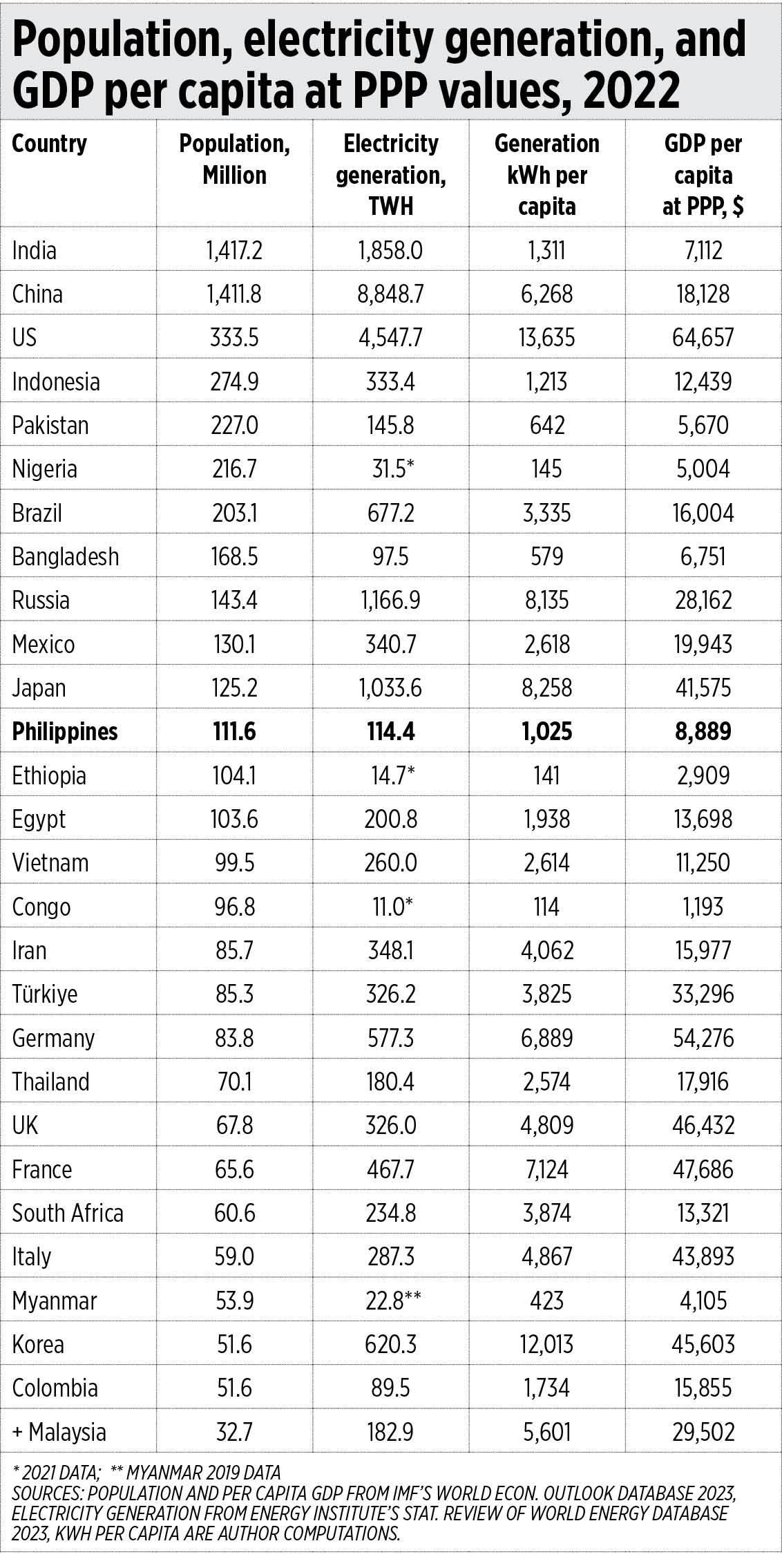
2. Aim for the generation of 2,000 kilowatt hour/person (kWh/person) by 2030 from only 1,025 kWh/person in 2022. Our ASEAN neighbors already had higher kWh/person generation than the Philippines in 2022: Indonesia had 1,213, Thailand had 2,574, Vietnam had 2,614, and Malaysia had 5,600. In the accompanying table I list the countries with the biggest populations (50 million people or more) plus their electricity generation (TWH), their electricity generation in kWh per capita, and their GDP per capita. I did not include Tanzania (61.5 million) and Kenya (50.6 million) because I cannot find available data on their electricity generation as of deadline.

3. Hasten the entry of nuclear energy that will greatly expand our power generation capacity.

Related to the generation issue, see the following BusinessWorld reports this month: “Market for AS power enters pilot operations” (Jan. 3), “Where’s the Philippine Energy Plan?” (Jan. 3), “Philippine energy companies bullish, eye 2024 demand surge” (Jan. 5), and, “3 gencos to supply Meralco’s 1,800-MW power requirement” (Jan. 8).

4. The National Grid Corp. of the Philippines (NGCP) must finish many long-delayed interconnection and transmission expansion projects (Mindanao-Visayas, Cebu-Negros, Iloilo-Negros, etc.). Islands with power-deficits cannot get additional supply easily from islands with power surpluses because of the unfinished or unexpanded transmission lines.

5. The NGCP must strictly comply with the Grid Code, especially when it comes to redundancy reserve requirements and getting reliable contingency reserves (CR). In the Panay Island blackout of Jan. 2, when PEDC Unit 1 (55.8 MW) tripped or conked out, the needed ancillary services (AS) and strong CR by NGCP were absent. Neither did it implement auto/manual load dropping (ALD/MLD) to reduce demand. Power demand continued at nearly 400 MW even though the supply declined from 356 MW to only 301 MW by 12:06 p.m. Two hours later, the other generating plants in the island also tripped, leading to the automatic tripping of distribution utility (DU) feeders, and entire island’s four provinces suffered from involuntary “Earth Hours.” I remember former Energy Secretary Al Cusi repeatedly pounding on the need for NGCP to finish long-delayed transmission projects, and to get reliable AS to avoid frequent yellow-red alerts.

6. The Energy Regulatory Commission (ERC) should disallow the use of battery energy storage systems (BESS) as CR. From what I read, the NGCP got BESS as its CR — this is bonkers because BESS are unreliable, small, and cannot store much energy when it is frequently cloudy and/or not windy. Only fossil fuel plants can provide reliable CR.

7. There should be more mergers and consolidations, not fragmentation, of energy providers. There are many small electric cooperatives (ECs) which do not have economies of scale and are viable only due to politics and protection by the National Electrification Administration (NEA). In my province — Negros Occidental — there are five ECs; in neighboring Negros Oriental, there are three ECs. That makes eight ECs in one island, with ERC having to monitor eight separate entities. No economies of scale mean a lack of capacity to strengthen the infrastructure against strong storms and earthquakes — even against falling trees! — leading to the occasional blackout. Existing strong distribution utilities (DUs) must remain consolidated and not divided.

8. Expand the Retail Competition and Open Access (RCOA) at a lower consumption threshold, with more retail electricity suppliers (RES) to provide more customized services to more clients, especially in areas covered by inefficient ECs. More generation plants will come in to serve more RES and more contestable customers.

9. End price controls via a primary-secondary price cap at the Wholesale Electricity Spot Market (WESM). The most expensive electricity is no electricity — in other words, blackouts. Quantify the damage done to manufacturing production, to offices and home appliances; the damage resulting from using candles (more fires) or gensets (more noise and air pollution); the damage caused by dark streets (more crimes and road accidents). A jump in the WESM price from P5/kWh to, say, P30 for a few hours is still better than “cheap but not available” power — blackouts. More peaking plants must come in and provide additional supply when needed and they should be undeterred by price controls.

10. End taxation discrimination in favor of more intermittent wind-solar. Wind and solar power generators have many tax-free privileges, and this leads to more unstable grids that will require more AS, resulting in higher overall prices.

There should be major changes in the country’s environment and energy policies, the end of climate alarmism, and the end of ecological central planning and power rationing in favor of intermittent, unreliable, and non-dispatchable on demand energy.


Bienvenido S. Oplas, Jr. is the president of Bienvenido S. Oplas, Jr. Research Consultancy Services, and Minimal Government Thinkers. He is an international fellow of the Tholos Foundation.

minimalgovernment@gmail.com

BSP signs MoU with BAIPHIL

Bangko Sentral ng Pilipinas main office in Manila. — BW FILE PHOTO

THE BANGKO SENTRAL ng Pilipinas (BSP) and the Bankers Institute of the Philippines (BAIPHIL) signed a memorandum of understanding (MoU) last month to strengthen their collaboration aimed at enhancing productivity among banks. 

The central bank formalized its long-standing partnership with the BAIPHIL by signing the MoU on Dec. 13, 2023 at the BSP’s head office in Manila, the BSP in a statement on Monday.

“The collaboration of BSP and BAIPHIL will go a long way in reaching out to our common stakeholders by providing support to banks toward productivity enhancement through research, information exchange, and education,” BSP Governor Eli M. Remolona, Jr. said.

Under the MoU, the BSP and the BAIPHIL will work together to develop capacity-building sessions for bank employees, officers, and directors. 

The MoU also covers the sharing of subject matter experts and research materials that are non-confidential, the BSP said. 

The partnership will also include advocacies for digital finance, financial literacy, financial inclusion, sustainable finance, legislative initiatives, and other reforms.

The BSP and BAIPHIL also agreed on joint research and publications on banking, monetary policy, and economic issues. 

The parties also agreed to exchange information on learning and training opportunities and regularly hold consultations on the conduct of seminars, conferences, and capacity-building.

“This MoU commits us to work together more closely toward our common goal of professional development for banking professionals, financial literacy, and financial inclusion for the underserved and unbanked,” BAIPHIL President Racquel B. Mañago said. — Keisha B. Ta-asan

Comic book on K-pop BTS charts group’s rise to stardom and military service

FAME- BTS —TIDALWAVECOMICS.COM

NEW YORK — A new comic book chronicles the rise to stardom of South Korea’s K-pop music sensation BTS and their recent transition to military service.

TidalWave Comics has added the 22-page book to its FAME series, which uses the comic medium to shine a light on musical acts.

Since their 2013 debut, BTS have become a worldwide sensation with their upbeat hits and social campaigns aimed at empowering youth.

The glossy chronicles how the seven singers became famous — and their switch from pop stars to soldiers.

All able-bodied men in South Korea aged between 18 and 28 must serve in the military for between 18 and 21 months as part of efforts to defend against nuclear-armed North Korea.

Some have won exemptions or served shorter terms, including Olympic medalists and prize-winning classical musicians. Some lawmakers had called for BTS to be exempt.

But in December 2022 the eldest member Jin joined the army, and the others followed, with the final four beginning their duty last month. Fans have pledged to wait until 2025 for them to perform as a group again.

The book will be released in both print and digital formats and soft and hardcovers on Jan. 10. — Reuters

AirAsia unifies aviation business

BW FILE PHOTO

MALAYSIA-BASED airline group Capital A Berhad, operator of budget carrier AirAsia Philippines, is transferring its aviation business to AirAsia X Berhad (AAX) to improve its aviation operations and strengthen financial performance, a company official said on Monday.

Capital A Berhad said it had entered into a non-binding agreement with its unit AirAsia X for the sale of its aviation businesses — AirAsia Berhad and AirAsia Aviation Group Ltd.

“We will combine Malaysia AirAsia and AirAsia Aviation Group, which [includes] Indonesia, the Philippines, Thailand, and Cambodia,” Capital A Chief Executive Officer Tony Fernandes said during an online briefing.

The move “positions AirAsia X to become the overarching regional aviation provider for all short and medium-haul routes under the AirAsia brand name,” Capital A Berhad said in a separate media release.

The definitive sale and purchase agreement are still being finalized, Mr. Fernandes said, adding that the transaction is expected to be signed in the next two weeks.

He said the restructuring would also allow Capital A to focus on its other companies, which include logistics aviation services and a digital services platform.

“Shareholders of Capital A will eventually be shareholders of AirAsia Aviation Group and Capital A. Eventually, AirAsia X and AirAsia will be merged into one airline. We will have a pure aviation group,” he said.

AirAsia X said the acquisition will provide the company “unparalleled advantages” and strengthen its market position by enhancing its financial performance.

“These strategic acquisitions serve as pivotal milestones in AAX’s post-PN17 revival strategy, bolstering our financial stability and enhancing our market positioning,” AirAsia X Chairman Dato’ Fam Lee Ee said.

Last year, AirAsia X exited its PN17 status, which is a classification issued by the Malaysian bourse to companies in financial distress.

“We are confident that by separating the aviation business from Capital A, the non-aviation businesses within the group, which we feel are currently undervalued by the market, will also be recognized for their intrinsic value and potential,” Mr. Fernandes said.

Mr. Fernandes added that the group needs to raise capital as it intends to add more fleet in Indonesia and the Philippines as the two are the group’s growth drivers.

“Really our growth is going to be very heavily driven by the Philippines and Indonesia on top of Malaysia and Thailand, which have a lot of growth. We really want to grow in Indonesia and the Philippines,” he said.

The group is looking to launch flights to the US by the end of this year, citing that it sees potential in the Philippines due to the growing demand in tourism.

The Philippines recorded 5.45-million international visitors in 2023, surpassing its 4.8-million target, the Tourism department said. This year, the agency is targeting 7.7-million visitors.

“By the end of this year, our first re-entry to Europe. And eventually, we’re going to go back to North America and South America. Manila will be a very good hub into America, and Thailand will be a great hub into Europe,” the group said.

For this year, AirAsia said it is working to fully restore its fleet as it seeks to reactivate 191 aircraft by the first quarter of 2024 with 166 already in operation. — Ashley Erika O. Jose

RCBC to offer $500M in sustainability notes in return to offshore debt market

PHILSTAR FILE PHOTO

RIZAL COMMERCIAL Banking Corp. (RCBC) is set to return to the offshore bond market and is looking to raise at least $500 million from an offering of senior unsecured sustainability notes.

The benchmark-sized bonds will be offered under the bank’s $3-billion medium-term note program, the Yuchengco-led bank said in a disclosure to the local bourse on Monday.

The bonds will be issued under RCBC’s Sustainable Finance Framework.

The note offering circular will uploaded to and in accordance with the Singapore Exchange Securities Trading Ltd.’s rules, RCBC said.

The bank was scheduled to hold investor calls on the offer on Monday.

RCBC has tapped Australia and New Zealand Banking Group Ltd., Citigroup Global Markets Ltd., and SMBC Nikko Securities (Hong Kong) Ltd. as the joint bookrunners for the offering, it said on Monday.

The lender in 2020 increased the size of its medium-term bond program to $3 billion from $2 billion previously.

So far, RCBC has raised $1.6 billion from the offshore debt market under its current medium-term note program, with its last offering held in August 2020, from which it raised $300 million through Tier 1 securities.

The bank saw its net income decline by 28.35% year on year to P2.81 billion in the third quarter as its interest expenses more than doubled and as non-interest income declined.

RCBC’s shares went up by five centavos or 0.22% to end at P22.90 apiece on Monday. — AMCS

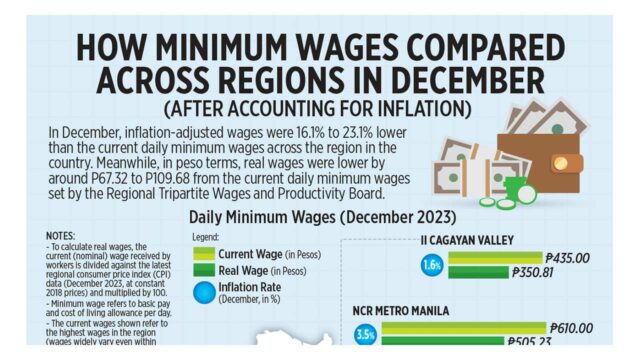
How minimum wages compared across regions in December

(After accounting for inflation)

In December, inflation-adjusted wages were 16.1% to 23.1% lower than the current daily minimum wages across the region in the country. Meanwhile, in peso terms, real wages were lower by around P67.32 to P109.68 from the current daily minimum wages set by the Regional Tripartite Wages and Productivity Board.


How minimum wages compared across regions in December

Can we make New Year’s resolutions work for the planet?

IAN SCHNEIDER-UNSPLASH

IF THERE’S A MONTH dedicated to self-betterment, it’s dark and dreary January. The gyms are full, the pubs are empty, and green juices are flying off the shelves. At least for now.

Even with the best of intentions, the vast majority of New Year’s resolutions don’t last very long at all. Many goal-setters give up on their commitments within just three months. We’re now in the second week of January, and some of you may have already slipped up on your promises. There’s no judgement here; your columnist has already watered down one of her ambitions (we’re doing “damp” January now).

But such faltering is important to note because we’re going to need permanent behavior changes in order to meet our emissions targets. Consumer decisions won’t halt climate change alone, but collectively we can make the task much easier by, for example, reducing demand for fossil fuels or carbon-intensive products. The question is how to make that happen, especially when our psychology makes voluntarily changing habits very difficult.

One reason for our collective annual failure is that we don’t tend to set goals for ourselves in a useful way, making them large without specificity or accountability. Setting a goal to “save money” is nearly useless without a target and an action plan to support it — such as, for example, setting aside $100 a month to reach a $1,200 target.

With that in mind, these might be more useful framings for things you could do to reduce your environmental impacts.

Instead of vowing to eat a more planet-friendly diet, you should narrow down what that means. If you’re not already a vegetarian or vegan, the best thing you could do to reduce your emissions is to cut out red meat, particularly beef. It might be more achievable to focus on a positive action rather than a subtractive one: Instead of the main target being to cut beef from your diet entirely, you could set a target to eat, say, five plant-based meals a week and find recipes — or menus — that you’re excited to try.

Likewise, food waste is responsible for around 6% of total greenhouse gas emissions — three times that of aviation. But it’s quite hard to measure how much you’re wasting at home — or it’s easy to shut your eyes as you drop bags of slimy salad, long forgotten at the back of the fridge, into the bin — making it a difficult target to remain accountable to. But setting a goal to create meal plans, or batch cook, or find ways to be creative with leftovers should naturally lead to a reduction in wastage.

Other behavioral changes we’ll need to see widely adopted include investing in an electric vehicle or heat pump, insulating homes, buying energy-efficient appliances and using public transport or active modes like cycling for appropriate journeys.

If we all committed to doing better for the planet, it’d help shift demand to cleaner technologies, show clear policy support for green measures, and reduce our energy consumption. But there are plenty of issues with relying purely on individual agency.

For example, consider the effects of inequality on our individual abilities to change. Insulation measures, heat pumps, and electric vehicles all require sizable investments. Supermarkets in poorer neighborhoods often have fewer varieties of fresh produce which inhibits the ability of residents to adopt healthier, more plant-based diets. Changing or forming better habits requires a cognitive effort which will be harder for some than it is for others. While one household may have the time to commit to cycling to work or meatless Mondays, another might be focused on economic survival.

That’s why we need policy — carbon taxes, subsidies, public information campaigns — to support behavior change. But it’s a touchy subject that many politicians are reluctant to act forcefully on. In the UK, the importance of behavior change is recognized, with the stated goal being to make it “easier and more affordable for people to shift towards a more sustainable lifestyle while at the same time maintain[ing] freedom or choice and fairness,” according to energy minister Lord Callanan. There are grants for heat pumps and the Great British Insulation Scheme, which offers free or cheaper insulation measures, for example.

But that doesn’t go far enough, with the House of Lords Environment and Climate Change Committee calling the government’s approach “seriously inadequate.” It doesn’t help that UK Prime Minister Rishi Sunak arguably made it a point of pride as he gears up for the next election, announcing last year that he had “scrapped” several imaginary policies including a meat tax and compulsory car-sharing.

Good policy to support sustainable lifestyle choices will not unfairly burden those who can least afford it, but it will make green options the no-brainer. Governments should not shy away from nudging people to behave more greenly with public engagement and price signals. After all, sometimes we all need a little help to do the right thing.

BLOOMBERG OPINION

Globe’s real estate platform plans more features to help boost sales

GLOBE Telecom, Inc. announced on Monday that its corporate venture builder 917Ventures is expanding its Housify real estate management platform to help brokers increase sales.

“In partnering with Housify, our objective is to provide brokers with the necessary tools to streamline their workflows and establish more efficient processes, enabling them to capitalize on sales opportunities,” said Ina Jacinto-Gervasio, Housify entrepreneur-in-residence at 917Ventures, in a media release on Monday.

Housify, a real estate marketplace and proptech (property technology) startup under 917Ventures, is set to introduce a new platform feature by integrating customer relationship management, offering brokers and realtors a “more efficient way to manage leads and convert them to sales.”

This year, the company anticipates onboarding over 2,000 brokers and realtors, driven by increased interest in the real estate sector due to the shift to hybrid work setups and improved financial habits.

Housify will also implement several enhancements on its platform, allowing users to effectively manage their portfolios.

To recall, 917Ventures is targeting to build generative artificial intelligence products as Globe taps into more technologies for its telco-to-techno strategy.

Globe’s telco-to-techno strategy refers to its plan to enter financial technology, health technology, educational technology, climate technology, shared services, investments, and entertainment.

At the stock exchange on Monday, shares in the company declined by P6 or 0.35% to end at P1,720 apiece. — A.E.O. Jose

Entertainment News (01/09/24)


Former King & Prince members reunite on new single

FORMER members of the J-pop group King & Prince have reunited to form a new music trio, Number_I. Composed of Sho Hirano, Yuta Jinguji, and Yuta Kishi, the group is under the TOBE record label. Number_I have released their first digital single, “GOAT.” It is now available on various streaming platforms, along with a music video unveiled on the official Number_I YouTube channel.


Robinsons opens luxury cinema in NUSTAR Cebu

Cinema operator Robinsons Movieworld has opened the NUSTAR Premier Cinema in Cebu, the first luxury cinema in the Visayas. With a Dolby Atmos digital surround sound system and Christie Digital Laser projection on a 15×6 meter screen, the cinema will have state-of-the-art technology and amenities, including fully reclining leather seats. It accommodates private screenings and allows moviegoers premium food and beverage choices from partner Nustar Resort and Mall outlets.


Aquaman and the Lost Kingdom returns to cinemas

Jason Momoa returns to Philippine cinemas as the King of Atlantis. After a two-week break from most local cinemas during the Metro Manila Film Festival, Aquaman and the Lost Kingdom returned to the big screen on Jan. 8. The James Wan-directed superhero sequel, which also stars Patrick Wilson, Yahya Abdul-Mateen II, Nicole Kidman, and Amber Heard, has so far grossed more than $255 million at the global box office. It is now showing in cinemas nationwide.


GMA Public Affairs premieres revenge series Makiling

To kick off 2024, GMA Public Affairs is presenting a mystery and revenge series, Makiling, airing weekdays starting Jan. 8. Headlined by Elle Villanueva and Derrick Monasterio, the show tells the story of a provincial lass struggling to pay off her family’s debts by working in Manila. There, she finds herself the unfortunate target of a group of rich, powerful, and sadistic bullies that eventually drive her to seek vengeance for all the suffering that they caused. It airs on GMA on weekdays at 4 p.m., while those abroad can catch it via GMA Pinoy TV.


Animé Synduality Noir returns with new episodes

After ending part one with a cliffhanger, Synduality Noir has returned with new episodes starting Jan. 8. Set in the year 2242, the animé series follows a group of humans forced deep underground in the wake of a terrible catastrophe known as the “Tears of the New Moon” incident. They are pushed to the surface when a threat known as the Enders arrive, looking to kill any humans they can discover. The series is now streaming on Disney+.

Gen Z real estate agents really want to sell you a house

A prospective buyer attends an open house at a home in San Francisco, California. — MICHAELA VATCHEVA/BLOOMBERG

AS FAR as jobs go, being a real estate agent looked like a no-brainer for Gen Z.

It was the height of the pandemic-era asset boom and home prices were heading “to the moon.” Buyers were moving fast, sometimes paying cash for properties sight unseen, and TikTok was flooded with tips about how to flip and sell properties. Gen Z’s digital know-how set them apart.

But just as the newest crop of real estate agents was settling into the business, the broader market — as well as the industry at large — got walloped by surging mortgage rates that froze the market and fueled layoffs at brokerages in 2023. Now, the industry’s new generation is in a frosty corner of a chilled labor market, exposed to unsettling early career turbulence.

Gila Goodman got in when times were good. She’d previously tried acting and was serving coffee on Hollywood sets, making “at most” $2,500 a month. But in 2021, when house prices were soaring, the 25-year-old met an agent. This time, he worked in real estate.

“He had a [Mercedes] G-wagon and was really put together,” Ms. Goodman remembers. “I was like, ‘All you do is show beautiful homes and talk to people.’ That got my mind turning.”

She pivoted. Ms. Goodman got her real-estate license, retooled her social-media accounts to focus on property content and left LA for Las Vegas, where home prices were on fire. Even with mortgage rates now near 20-year highs, Vegas remains “somewhat competitive,” according to the real estate company Redfin. Ms. Goodman said she sold 10 properties this October and earned almost $100,000 in commissions.

It’s an enviable story that has been hard to replicate for other young agents. Home sales slid last year as buyers balked at the higher borrowing costs and many potential sellers decided not to list their houses, fueling a shortage of available properties that has been building for years.

In recent weeks, there have been signs of a thaw. For one, there’s plenty of pent-up demand from first-time buyers stuck on the sidelines and current owners who want to move. And mortgage rates slid in the final weeks of 2023, dipping under 7% as the Federal Reserve eyes rate cuts in 2024.

COMMISSION SCRUTINY
But the challenges go beyond the market, with agents facing existential questions about the commission-based compensation that has long underpinned US real estate. In a bombshell verdict in October, a jury in Missouri found that the National Association of Realtors and others colluded to keep commissions — usually about 5-6% of a sale price split between the buyers’ and sellers’ agents — artificially high.

A larger class-action lawsuit focusing on the same central issue is expected to go to court in Illinois later this year and the Department of Justice has also been scrutinizing such practices. An end to the system could mean young agents struggle to bring in the income such commissions offered previous generations in an industry that is known for its boom-and-bust cycles.

That’s been a concern for Sabrina Powell, a 26-year-old agent in Los Angeles. After studying business in college, she met her boss through TikTok after he commented on one of her viral videos.

“I didn’t realize the issues with the real estate market until I was signing with a brokerage,” she said. “It wasn’t until I was in the field that I thought, ‘I missed the mark.’”

Ms. Powell said potential buyers have been telling her they don’t want to go through an agent, not realizing the amount of work she puts into a transaction. Despite her concerns, Ms. Powell maintains that the market is cyclical and is pushing to build up her practice.

Older agents have been through troughs before. And in part, age is what’s making the latest market downdrift difficult for younger real estate professionals. According to the National Association of Realtors, the typical member is “a 60-year-old white female who attended college and is a homeowner.” More broadly, people tend to think of real estate agents as older than twenty-something. And some buyers have a difficult time entrusting what is often the largest financial transaction of their life with a relative newcomer.

“When people see me, they think I’m 17 or 18,” said Amber Perkins, a 27-year-old agent in Los Angeles who is just on the cusp of the Gen Z age cutoff. “I’ve had people in my comment section say, ‘She’s young and inexperienced, she doesn’t know what she’s talking about.’”

CATCH-22
Ms. Perkins and her peers are grappling with a Catch-22 of early career real estate: You need deals to get experience, but you only get deals with experience. That’s especially hard in a market that abruptly turned down from historic highs that is now offering few transactions.

To deal with it, Ms. Perkins said she leans into her strengths as a digital native and pushes hard on social media. That’s where she gets most of her leads anyways.

“I’m young,” she said. “But I’m confident in my abilities and what I can do to get deals done.” — Bloomberg

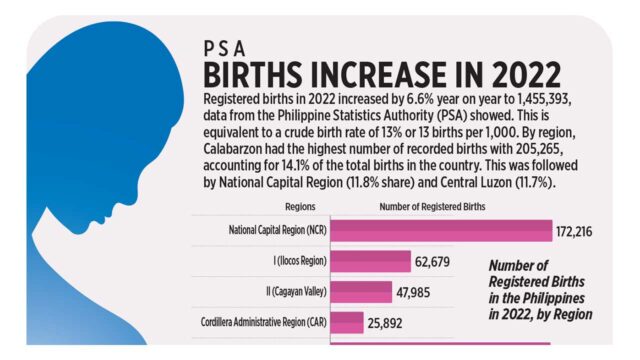
PSA: Births increase in 2022

Registered births in 2022 increased by 6.6% year on year to 1,455,393, data from the Philippine Statistics Authority (PSA) showed. This is equivalent to a crude birth rate of 13% or 13 births per 1,000. By region, Calabarzon had the highest number of recorded births with 205,265, accounting for 14.1% of the total births in the country. This was followed by National Capital Region (11.8% share) and Central Luzon (11.7%).


PSA: Births increase in 2022