Home Blog Page 3727

UnionBank allocates P11B of stock rights proceeds from 2023 for loans

BW FILE PHOTO

UNION BANK of the Philippines, Inc. (UnionBank) has allotted P10.96 billion of the P11.82-billion net proceeds from its stock rights offer last year for loans.

The lender used more than 90% of the proceeds for loans, while the rest was infused into its digital arm, Union Digital Bank, Inc., it said in a stock exchange filing on Tuesday.

“The net proceeds of the stock rights offer are intended for capital infusion to UnionDigital, loan availments and/or other business growth opportunities,” it said.

UnionDigital is the listed lender’s digital bank, which got a license from the Bangko Sentral ng Pilipinas in July 2021. It started operating a year later.

The Aboitiz-led bank in January last year offered 210.97 million shares to raise P12 billion with an entitlement ratio of one rights share per 10.1536 common shares as of Jan. 12, 2023.

In November last year, the lender infused P1.8 billion in capital into UnionDigital to support its growth and operations.

This was in addition to the P900 million capital infusion into the bank’s digital arm last year, approved by UnionBank’s board of directors in June.

UnionBank’s net income dropped by 58.99% year on year to P1.65 billion in the third quarter from a year earlier as it set aside more loan loss provisions.

Its shares were unchanged at P45 each. — Aaron Michael C. Sy

Cebu Landmasters expands hospitality portfolio with opening of lyf Cebu City  

LISTED property developer Cebu Landmasters, Inc. (CLI) expanded its hospitality portfolio with the opening of lyf Cebu City hotel on Tuesday.

In a regulatory filing, the company said that lyf Cebu City offers 159 rooms with various sizes, including studio queen, studio twin, two-bedroom, and four-bedroom units. The newly opened hotel is the company’s third operational hotel.

“The opening of lyf Cebu City brings CLI’s operational hotel count to three, following the launch of The Pad Co-Living last month with 258 rooms and Citadines Cebu City in 2019 with 180 rooms,” the listed property developer said.   

The new hotel is under the lyf brand of the global hotel operator The Ascott Limited, which caters to “young and dynamic travelers.”

It is located at CLI’s Base Line Center mixed-use property in mid-town Cebu near Fuente Osmeña Circle, a venue for the Sinulog Festival.

According to CLI, lyf Cebu City is the first lyf property in the Visayas and Mindanao (VisMin) region and the second in the country, joining lyf Malate in Manila.

“We are excited for the opening of lyf Cebu City that offers young travelers an exciting blend of modern accommodations and a dynamic environment unmatched in Cebu. CLI’s hotel portfolio is growing and we are happy to offer a unique experience to VisMin’s growing tourism market,” CLI Hotels & Resorts Director Mathias Bergundthal said.

Following the opening of lyf Cebu City, CLI now has ten projects under its hospitality portfolio, which features over 1,700 keys, with 316 rooms currently completed.

The property developer is set to open more hotels, such as the 200-room Citadines Bacolod City and the 144-room Radisson Red, which are expected to open in March and at the end of 2024, respectively.

“Unaudited revenue from the listed company’s hospitality business shows a 67% increase year on year in 2023,” CLI said.

Aside from The Ascott Limited, CLI also has partnerships with international hotel operators such as Radisson and Accor, as well as local players like the Abaca Group to strengthen its hospitality business.

Shares of CLI at the local bourse closed unchanged at P2.63 apiece on Tuesday. — Revin Mikhael D. Ochave

British conductor Jan Latham-Koenig charged with child sexual offenses

LONDON — Acclaimed British conductor Jan Latham-Koenig has been charged by police in London with child sexual offenses, authorities said on Friday.

Mr. Latham-Koenig, 70, was arrested at Victoria train station in London on Wednesday and charged the following day with arranging or facilitating a child sexual offense and sexual communication with a child, police said.

He was due to appear in a London court later on Friday. An agent for the conductor did not immediately respond to an e-mail seeking comment.

Mr. Latham-Koenig began his career as a concert conductor with the BBC, before going on to hold a number of music director positions at orchestras and opera theaters across Europe, including in Russia.

In 2020, Britain awarded him an OBE, a national honor, for services to music and UK/Russia cultural relations. — Reuters

The Ease of Paying Taxes Act — a boon or a bane?

VECTORJUICE-FREEPIK

Congress has enacted another piece of legislation meant to boost business in the country. It promotes fairness and modernization of tax administration. Will the Ease of Paying Taxes Act truly ease the burden of paying taxes? Or will it meet the same fate as the Ease of Doing Business Act, whose import depends on its effective implementation? The government’s job has just begun.

First, the Bureau of Internal Revenue (BIR) must immediately formulate its digitalization program mandate. Congress, in turn, must urgently provide the necessary funding. The Act’s full implementation will not only provide convenience but will also enhance government’s compliance monitoring.

Second, the Department of Finance (DoF) in its implementing regulations must sufficiently provide acceptable parameters when service providers may legally demand the payment of their fees. The law now uses “gross sales” as the base of tax on all activities. Service providers are similarly treated as merchandisers. They must issue official invoices instead of official receipts. More importantly, they must now pay VAT or percentage tax (if applicable) upon accrual, and not upon payment of their fees.

The regulations must recognize the nuances faced in the billing practices of the service industry. There are various circumstances when clients may be legally liable to pay for the billed fees. Gross sales need clarification and must be established with a higher level of certainty. It would be premature to require tax payment solely based on a Statement of Account. The credit or deduction mechanism to recoup the tax fully or partially on unpaid fees may not be fair in certain cases. Banks and other financial institutions are not affected. The law still provides “gross receipts” as base of the GRT or gross receipts tax.

Third, the DoF in its regulations must recognize that zero-rated taxpayers must still have an option to seek the issuance of tax credit certificates (TCCs) for unutilized input VAT, as provided in Sec. 112(A) of the Tax Code. They are bound to follow the deemed denial rule under now Sec. 229 and not under Sec. 112(C), which only covers claims for refund. Taxpayers can only pursue judicial claim for TCCs in case of the BIR’s inaction for 180 days and not 90 days. This gives the BIR ample time to act and consider the claim. Taxpayers will not be constrained to file a Court of Tax Appeals petition for the BIR’s inaction during the 90-day period, which as mentioned applies should they instead claim for a refund. Further, there should be meaningful risk classification in (and good faith implementation of) the expedited refund processing system.

The Act promotes equitability in providing special concessions to micro and small taxpayers. They are permitted to file simplified returns and given priority in the tax administration’s digitalization. They have reduced monetary penalties. It is, however, unfortunate that the President has rejected their proposed exemption from withholding obligation. The reduction in tax collection as the President’s veto justification highlights the need for the BIR to improve on its enforcement action. The BIR must focus on pursuing those who improperly report their revenues. The BIR cannot just rely on the withholding system, especially when the income payors do not have sufficient bargaining power to withhold tax on payments to their suppliers.

It is a relief that the Act has removed the double whammy penalty for non-withholding. Now, the BIR may only collect the unwithheld amount from the erring income payor. It cannot additionally collect deficiency income tax arising from such non-withholding of tax. In this regard, the Act incorporates the rule that withholding of tax arises at the time the income has become payable.

The Act has removed annual registration fees. The BIR should be lauded for its immediate implementation. There is no more civil penalty for filing and paying in the wrong venue. OFWs are exempted from filing returns on their exempt overseas income, provided they have no other Philippine sourced income. Husbands and wives are relieved from filing joint returns when it is impracticable for them to do so.

The Act recognizes the non-taxability of earmarked or in trust amounts for third parties. This is a relief for collecting agents (in general) and electric distribution utilities (in particular) whose bills must reflect pass on charges of generation and transmission companies under the Energy Regulatory Commission’s single billing system.

The ball is now in the court of the DoF and the BIR to fully realize the government’s lofty goals of modernizing our country’s tax administration. The implementing regulations, clarificatory issuances, and their overall implementation should promote and actively cultivate a healthy environment for taxpayers ensuring the protection of their interests. It is only then that the Act may become a boon rather than a bane, and lead to the country’s improved and effective tax collection.

The views and opinions expressed in this article are those of the author. This article is for general information and educational purposes, and not offered as, and does not constitute, legal advice or legal opinion.


Eric Recalde is a partner and the head of the Tax department of the Angara Abello Concepcion Regala & Cruz Law Offices (ACCRALAW).

errecalde@accralaw.com

02-8830-8000

Inclusive and collaborative digital upskilling sought for MSMEs

JASON GOODMAN-UNSPLASH

By Miguel Hanz L. Antivola, Reporter

DIGITAL upskilling for micro, small, and medium enterprises (MSMEs) can breed an inclusive movement nationwide with public-private collaborations and infrastructure investments.

“Those MSMEs in rural areas often lack access to digital tools and knowledge which puts them at a disadvantage compared to their urban counterparts,” Catherine L. Yap-Yang, first vice-president and corporate communications head at PLDT Inc., said in an interview with BusinessWorld.

“Collaboration and synergy among the key stakeholders are keys to creating not just a truly impactful digital upskilling movement, but a digital inclusion program for Filipino MSMEs,” she added.

The Philippines dropped to 59th place out of 64 economies in the 2023 global digital competitiveness index of the World Competitiveness Center of the International Institute for Management Development — its lowest ranking since the index started in 2017.

It was also among the lowest scorers in the Asia-Pacific region, ranking in at 13 —  just ahead of Mongolia.

The country also fell five places to 60th out of 121 countries in the 2023 edition of Digital Quality of Life index by virtual private network service provider Surfshark, albeit better than the global and Asian averages.

Additionally, only 26% of MSMEs in the country are aware of digitization programs offered by the government and other institutions, according to a study by the Trade department included in their 2022 e-commerce roadmap.

Of the 400 MSMEs surveyed, the study showed very low digitization as 23% did not utilize information and communications technology tools for business, and 51% were at level 1, only utilizing basic digital tools, e.g., Microsoft Office, e-mail, personal computers, etc.

Moreover, only 6% have advanced usage of digital tools, having purely online businesses or using advanced data analytics and other digital tools.

MSMEs have rated the importance of digital innovation in business at 3.6 on an ascending scale of 1 to 5. Those who favored digital innovation said that it helps improve efficiency or productivity and customer experience.

PLDT and its wireless unit Smart Communications, Inc. have recently expanded its eBiznovation program to the Visayas through a bazaar caravan in partnership with TikTok.

eBizNovation is its digital upskilling-to-e-commerce program, which provides capacity-building trainings on digital entrepreneurship, and onboards merchants to an e-commerce platform. 

For its latest outreach, PLDT and Smart tapped the local governments of Borongan City in Eastern Samar, Miagao in Iloilo, and Sibalom in Antique to deliver workshops on best practices for e-commerce and efficient online transactions.

The program has forged partnerships with government agencies, LGUs (local government units), local commerce chambers, and e-commerce platforms to aid in digitally thrusting MSMEs forward.

Ms. Yang said more than 21,000 MSMEs have been trained by eBizNovation over its two years of activity, and they hope to expand training in other areas such as the Bangsamoro Autonomous Region in Muslim Mindanao where they are also eyeing small business owners with disabilities.

She noted the continuous need to address the digital divide, “which makes it more challenging for MSME to participate in digital upskilling programs,” she said.

“And on a larger scale, to adopt and use digital technologies effectively for their businesses,” she added.

“We can work together to provide support, invest in infrastructure, and set up programs to help rural MSMEs improve their skills in order to help address some of the barriers mentioned.”

Hastings Holdings, Inc., a unit of PLDT Beneficial Trust Fund subsidiary MediaQuest Holdings, Inc., has a stake in BusinessWorld through the Philippine Star Group, which it controls.


Philippine Senate may discuss anti-fraud bill in plenary this month

FREEPIK

A SENATE BILL that seeks to impose harsher penalties on online investment scammers, phishers and other schemes of fraud is expected to reach the plenary for debates when the chamber resumes session on Jan. 22, according to a senator.

Senator Mark A. Villar, who heads the Senate committee on banks, swiftly ended Tuesday’s hearing on the proposed Anti-Financial Account Scamming Act after ordering members of a technical working group composed of central bank, police and communication officials to come up with recommendations.

“After we finish our technical working group meetings, we will finalize the draft substitute bill for our committee report, which we hope we will be able to submit to the plenary when the session opens,” he said.

“We have to continuously improve our legal system, if possible be two steps ahead of the scammers at all times to effectively protect the public from their nefarious acts,” he added.

Mark Anthony T. Amurao, legal counsel for e-wallet service of GCash, told the committee the payment platform is exploring more anti-fraud measures through a tie-up with the National Bureau of Investigation.

“The partnership is important for us to share expertise and knowledge — expertise to intensify our fight against cybercrimes,” he told the hearing.

Melchor T. Plabasan, a senior director at the Bangko Sentral ng Pilipinas (BSP), said they are reviewing the effectiveness of anti-fraud mechanisms of financial institutions.

“A lot of financial institutions have implemented AI (artificial intelligence) and machine-learning (to fight fraud),” he told the hearing.

The Bureau of Immigration on Jan. 13 said 128 foreign fugitives were arrested in the Philippines last year, including those wanted for investment scams and other economic crimes.

GCash in September partnered with the Securities and Exchange Commission to boost enforcement against online fraud, electronic scams and other cybercrimes.

Cybersecurity company Kaspersky in March said the Philippines ranked second among countries with the most cyberattacks worldwide in 2022.

Information and Communications Technology Secretary Ivan John E. Uy has said the Philippines only had about 200 certified cybersecurity experts in 2022.

The Anti-Money Laundering Council earlier said the Philippines seeks to be taken off the money laundering “gray list” of the Financial Action Task Force this year.

“We should have a good grasp of the current practices in use so that we could use them to springboard additional practices we would include in the Anti-Financial Account Scamming Act,” Mr. Villar said. “Trust is the currency of banking and finance.” — John Victor D. Ordoñez

Holcim opens virtual reality innovation hub in Davao

HOLCIM Philippines, Inc. has opened a virtual reality (VR) innovation hub in Davao City showcasing construction innovations.

The VR facility, “The Hub,” located at Holcim Davao Plant in Barangay Ilang, Bunawan District, Davao City, takes visitors to Holcim’s research center in Lyon, France, company officials said during a briefing on Tuesday.

The facility allows customers to explore construction innovations for decarbonizing buildings, the company noted.

Among the solutions displayed are low-carbon materials such as ECOPact concrete and ECOPlanet cement, and circular construction solutions such as Holcim’s proprietary ECOCycle circular technology platform, which recycles construction demolition materials into new building solutions.

“What we are going to do is make available to anybody who would like to see the latest innovations in terms of construction techniques, sustainability, and performance in construction, as well as the way of building materials right here in Davao,” said Holcim Philippines President and Chief Executive Officer Horia Adrian.

Ramakrishna Maganti, Holcim senior vice president for infrastructure and industrial sales, said: “What this innovation hub is going to do is to give people exactly the experience.”

Mr. Maganti also said that, besides customers, The Hub aims to engage with policy makers, like government agencies, to let them experience innovations in the industry and offer ideas for adjusting policies.

He added that the company is also targeting structural engineers and architects.

“These are the people whom we want to come here and experience the solutions, and hopefully, they will have a better perspective on their experience.”

The company can open The Hub for small enterprises and students, Mr. Maganti also said.

Holcim Philippines said it is accelerating its transformation as a sustainable and innovative building solutions provider, with a focus on advancing decarbonization and the circular economy in the construction industry. — Maya M. Padillo

Madrid museum welcomes ruling it can keep painting looted by Nazis

RUE SAINT-HONORÉ in the Afternoon. Effect of Rain - Pissarro, Camille. Museo Nacional Thyssen-Bornemisza —MUSEOTHYSSEN.ORG

MADRID — One of Spain’s top museums welcomed a US court decision allowing it to keep a French impressionist painting looted from a Jewish woman by the Nazis, which the museum said it had bought decades later in a transparent way.

RUE SAINT-HONORÉ in the Afternoon. Effect of Rain – Pissarro, Camille. Museo Nacional Thyssen-Bornemisza —MUSEOTHYSSEN.ORG

Last week’s decision by a California appeals court concerned one of the oldest Nazi art theft cases, which began in 2005 after the heirs of Jewish woman Lilly Neubauer brought forward an ownership claim for Camille Pissarro’s Rue Saint Honore, apres midi, effet de pluie (Rue Saint Honore, Afternoon, Rain Effect), depicting a Paris street scene.

“It is a regrettable story like everything else related to the Nazi plunder,” the general director of Madrid’s Thyssen-Bornemisza Museum, Evelio Acevedo, told Reuters. “(But) it is a very important decision because… it does justice.

“The Spanish state bought the painting with all legitimacy and in good faith,” he added.

Ms. Neubauer was forced to sell the artwork in 1939 for 900 Reichsmarks ($360) to obtain a visa and flee Germany, but was never paid.

According to Acevedo, Ms. Neubauer’s heirs, the Cassirer family, later “obtained compensation for the market value of the painting from the German government.”

Ownership passed through several hands until 1993, when the state-owned Thyssen-Bornemisza Museum bought it and put it on display, where it remains. After learning where the painting was, the Cassirers petitioned for its return and sued. The case reached the US Supreme Court two years ago.

In last week’s decision, Circuit Judge Carlos Bea said Spain’s interest in providing “certainty of title” to its museums outweighed California’s interest in deterring theft and obtaining recoveries for victims of stolen art who live there.

Another judge, Consuelo Callahan, said Spain should have voluntarily relinquished the painting but the law compelled a different outcome.

Lawyers for the Cassirers said the family sought to “challenge Spain’s continuing insistence on harboring Nazi looted art,” especially amid a recent resurgence in anti-Semitism around the world.

Acevedo said current circumstances have nothing to do with the history of the case and there was absolutely no anti-Semitic sentiment. — Reuters

Philippines falls in Global Knowledge Index

The Philippines dropped by three places to 80th out of 133 countries in the 2023 edition of Global Knowledge Index (GKI) by Knowledge 4 All Foundation, a nonprofit organization and advocate of artificial intelligence (AI) applications and open education. The index is a referential tool in supporting knowledge-based development and country-level performances in different knowledge sectors. The country has a GKI score of 44.68 (out of 100 as highest possible score), below the world average of 47.54.


Philippines falls in Global Knowledge Index

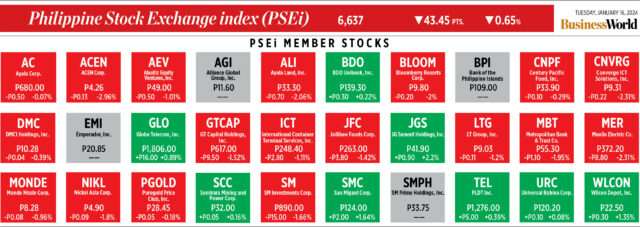
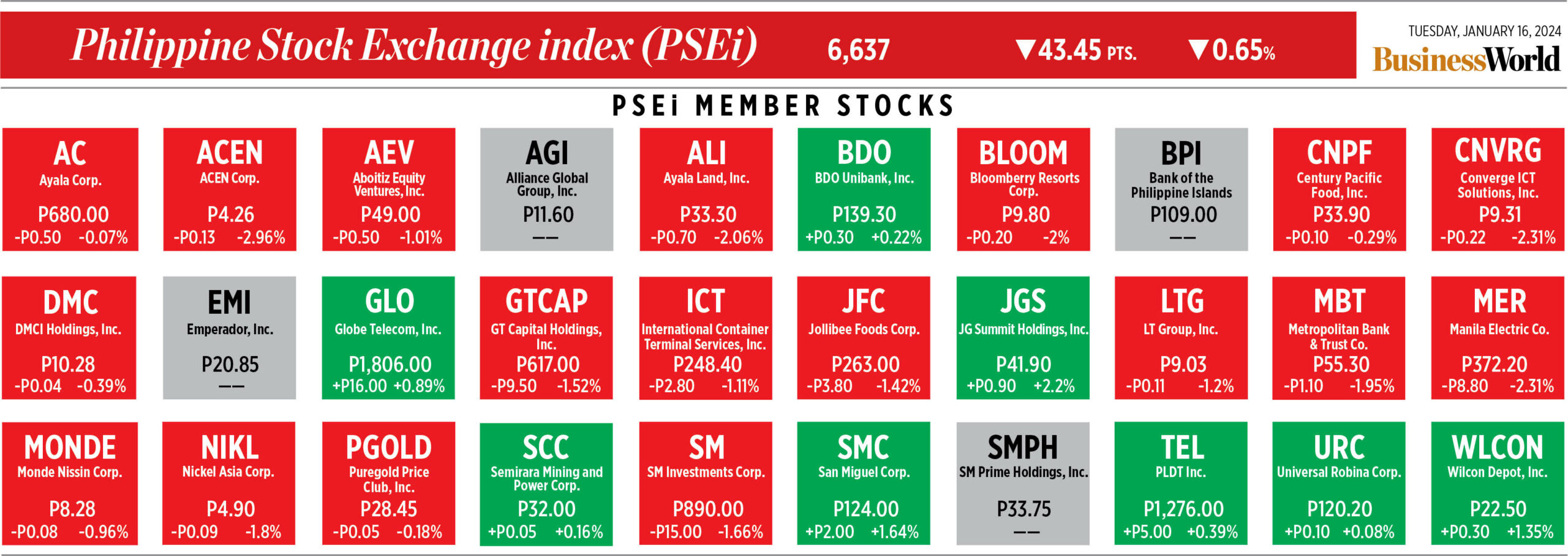
How PSEi member stocks performed — January 16, 2024

Here’s a quick glance at how PSEi stocks fared on Tuesday, January 16, 2024.


PSEi breaks three-day rally amid profit taking

REUTERS

By Revin Mikhael D. Ochave, Reporter

THE Philippine Stock Exchange Index (PSEi) fell on Tuesday as investors booked profits amid tensions in the Red Sea, breaking its three-day rally.

The 30-member stock Index dropped by 0.65% or 43.45 points to close at 6,637. The broader all-share index fell by 0.49% or 17.54 points to 3,506.23.

“The market declined as the main index approached a major technical resistance,” AB Capital Securities, Inc. Vice-President Jovis L. Vistan said in a Viber message. “The PSEi was hovering near a major downtrend line and a potential double as its current levels.”

“This prompted traders to take some profits following the recent run-up of the market,” he added. 

The local bourse declined as investors monitored tensions in the Red Sea, Mikhail Philippe Q. Plopenio, research and engagement officer at Philstocks Financial, Inc. said in a Viber message. 

“Tensions in the Red Sea is also being monitored by many because this poses an upside risk to oil prices,” he said. “This comes amid reports that oil tankers are avoiding the area amid the turmoil between United States forces and the Houthis.”

Investors were also waiting for a positive catalyst to emerge first before pushing through with a sustainable rally, Mr. Plopenio said. 

Last week, US and British warplanes, ships and submarines launched air strikes across Yemen in retaliation against Houthi attacks in the Red Sea, which is one of the world’s busiest shipping lanes. 

The Islamist militants said its attacks in the Red Sea aim to show its alliance with Palestinians amid the Israel-Hamas war.

All sectoral indexes fell on Tuesday. Mining and oil declined by 1.45% or 140.10 points to 9,497.39; industrials by 0.93% or 86.62 points to 9,139.20; holding firms by 0.64% or 41.43 points to 6,366.19; and property by 0.63% or 18.36 points to 2,882.57.

The service index also fell by 0.5% or 8.31 points to 1,636.40, while financials dropped by 0.22% or 4.18 points to 1,838.97.

“Among the index members, JG Summit Holdings, Inc. was at the top, climbing 2.2% to P41.90. ACEN Corp. lost the most, dropping 2.96% to P4.26,” Mr. Plopenio said. 

Value turnover improved to P5.98 billion with 501.41 million issues changing hands from P5.82 billion and 460.92 million issues on Monday.

Decliners outnumbered advancers 114 to 67, while 58 stocks were unchanged.

Net foreign buying reached P461.86 million, a turnaround from the P244.01 million net foreign outflows a day earlier.

Peso weakens amid Red Sea tensions and hawkish ECB

BW FILE PHOTO

By Keisha B. Ta-asan, Reporter

THE PESO weakened against the dollar on Tuesday as market players flocked to the safe-haven currency amid heightened tensions in the Red Sea and hawkish signals from the European Central Bank (ECB).   

The local currency closed at P55.83, six centavos weaker than a day earlier, data from the Bankers Association of the Philippines website showed.

The peso opened Tuesday’s session at P55.85 a dollar, appreciated to as much as P55.795 and weakened to as much as P55.99 against the greenback. Dollars traded rose to $1.62 billion from $1.31 billion on Monday.

The peso weakened after strengthening for three straight trading days as tensions increased in the Middle East, Michael L. Ricafort, chief economist at Rizal Commercial Banking Corp., said in a Viber message.

Attacks on ships in the Red Sea weighed on risk sentiment, as Houthi militants hit a US-owned container vessel with a missile in the Gulf of Aden, although the ship did not suffer significant damage. Iran also launched attacks against targets in Syria and Northern Iraq.

The peso also declined after hawkish comments from ECB officials, Mr. Ricafort said.

ECB Governing Council member Joachim Nagel has said it is too soon for market players to discuss policy rate cuts as inflation remained elevated. 

Robert Holzmann, another policy maker from the ECB, said no one should count on the ECB cutting rates at all this year given the conflict in the Red Sea, which could push up shipping costs through the Suez Canal.

The peso also weakened after government announcements that the strong El Niño episode could last until February, Mr. Ricafort said. 

In an advisory, the state weather agency said El Niño could persist through next month, advising government agencies and Filipinos to take precautionary measures to mitigate its impact. 

The Department of Agriculture has begun cluster meetings nationwide to discuss strategies on how to ease the impact of El Niño on rice output.

“The peso weakened amid potentially hawkish remarks on US policy from Fed official [Christopher J.] Waller tonight,” a trader said in an e-mail.

Markets are pricing in a 25-basis-point (bp) cut in March from the US Federal Reserve, which could be the first rate cut from the US Fed since it started hiking rates in March 2022. 

The Fed raised borrowing costs by 525 bps from March 2022 to July 2023, bringing the target Fed fund rate to 5.25-5.5%.

The trader expects the peso to continue weakening against the dollar on Wednesday as the market stays cautious before the release of China’s economic output report.

Mr. Ricafort expects the peso to move between P55.75 and P55.95 a dollar, while the trader sees it ranging from P55.75 to P56. — with Reuters