Home Blog Page 3698

Jobless rate may rise to 6.3% this year — BMI

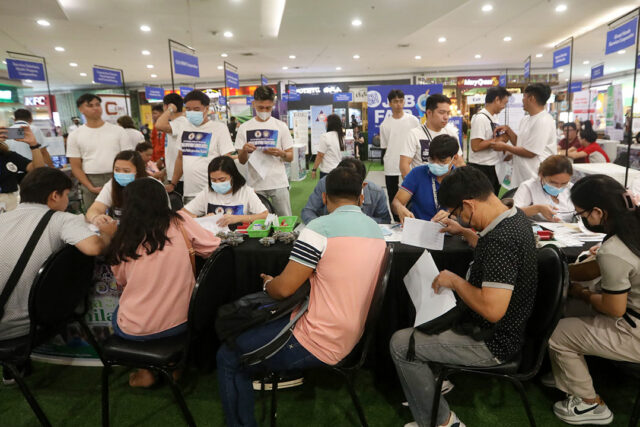
Jobseekers fill out application forms at a mall, Jan. 18, 2024. — PHILIPPINE STAR/EDD GUMBAN

THE UNEMPLOYMENT RATE in the Philippines may pick up to 6.3% this year, which could impact consumer spending throughout 2024, according to BMI Country Risk & Industry Research.

“The Philippine economy is heavily dependent on high employment, especially in the service industry,” BMI said in a report dated Feb. 1.

Latest data from the local statistics agency showed the jobless rate dropped to a record low of 3.6% in November 2023, lower than 4.2% in October and 4.2% seen a year earlier.

The number of unemployed Filipinos decreased by 12.3% to 1.83 million in November from 2.09 million in October, and by 15.8% from 2.18 million in November 2022.

For the first 11 months of 2023, the unemployment rate stood at 4.5%, well below the 5.3%-6.4% target under the Philippine Development Plan.

“Over 2024, we forecast unemployment to average 6.3%, as the labor market loosens slightly. While inflation continues to increase, the main drivers are elevated food and energy costs as opposed to wages,” BMI said.

According to BMI, the strong labor market led to a robust Philippine consumer spending growth in 2022 and 2023, even as elevated inflation dampened gains in incomes.

“However, as major markets and economies slow in 2024, we expect some uptick in unemployment rates across the board,” BMI said, noting that rising joblessness is a risk to the consumer outlook.

“Lower levels of personal savings, previously functioning as an option to support current consumption patterns, will mean that households will have to reorient their purchasing patterns and cut back on their spending (by moving down price points or buying fewer goods at similar spending levels),” it said.

BMI forecasts Philippine household spending to grow by 6.3% from the 5.6% growth recorded in 2023. This is also in line with the firm’s economic growth forecast of 6.2% this year, up from the 5.6% expansion in 2023 but still below the government’s 6.5-7.5% target.

“Spending will remain impacted by the environment of elevated inflationary pressures over 2023 as well as high debt levels, and its servicing costs. However, easing inflation and a tight labor market will support spending, as real wage growth returns to positive territory, supporting purchasing power over the year,” it said.

High levels of household debt may also hurt household spending this year, BMI said.

“A high level of household debt remains a risk to our consumer outlook, as it limits the future availability of debt, but also draws on current disposable income levels, especially as debt servicing costs increase on the back of interest rate increases,” it said.

The BSP raised key policy rates by 450 basis points (bps) from May 2022 to October 2023 to tame inflation, making it the most aggressive central bank in the region. This brought the key rate to 6.5%, the highest in 16 years.

Even though BMI expects policy rate cuts from central banks this year amid easing inflation, borrowing costs may not reach their pre-pandemic lows and households may need to adjust to high interest rates.

“Many households took on significant levels of debt in the previous low interest rate environment,” it said. “The risk to consumer spending is that the cost of servicing this debt at higher interest rates becomes a larger-than-anticipated draw on disposable incomes, to a point where consumers will have to cut back spending, especially in more non-essential segments.”

Consumer spending may also be affected by risks to the remittance outlook this year.

“There is a particular demand for Filipino workers skilled in jobs related to medical and health services, construction and housekeeping… However, we do highlight several risks to this income over 2024, mostly related to the negative impact from the rising inflation across several global markets.”

Based on the latest data from the central bank, cash remittances grew by 2.8% to $2.719 billion in November from $2.644 billion a year earlier. The growth in cash remittances was the slowest annual pace since the 2.6% in September. The amount of money sent home to the Philippines was also the lowest since $2.494 billion in May 2023. — Keisha B. Ta-asan

MCC sees ‘terrific’ opportunities for PHL

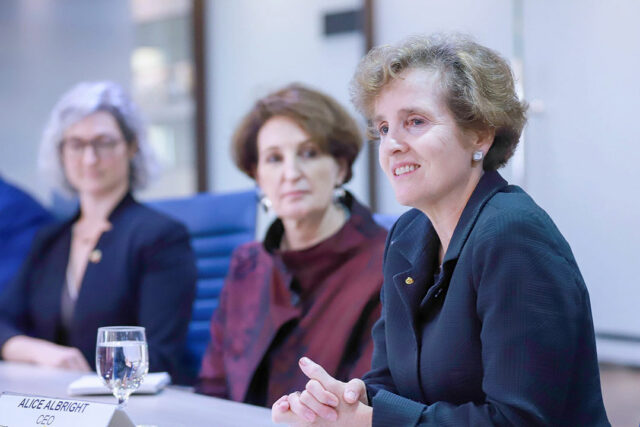
Millennium Challenge Corp. Chief Executive Officer Alice P. Albright — COURTESY OF DEPARTMENT OF FINANCE FACEBOOK PAGE

THE Millennium Challenge Corp. (MCC) is seeing “terrific” opportunities for the Philippines, which it says is on the right track after once again being eligible for its aid programs.

“We’re looking at a lot of the data for the Philippines. I think that the country has some terrific opportunities ahead,” MCC Chief Executive Officer Alice P. Albright said in a roundtable interview with reporters on Friday.

In December, the MCC Board selected the Philippines as eligible to develop a threshold program, which is a smaller grant focused on policy and institutional reforms.

“The Philippines, amongst several other countries, stood out as countries that are really on the right pathway forward. We’re back here and we’re just delighted about that. We think there’s a promising future,” Ms. Albright said.

The Department of Finance last week met with MCC executives to discuss the steps moving forward.

Finance Secretary Ralph G. Recto was also quoted saying that there is a need to expedite the process and eventually access compact grant resources.

The Philippines’ last threshold program concluded in 2009 and focused on improving anti-corruption across government agencies.

Its last compact program was a $434-million deal which closed in 2016. It supported reforms to strengthen revenue collection and community-driven development projects as well as the rehabilitation of a national road in Samar.

According to the MCC, a compact program is a five-year agreement that targets programs on poverty reduction and economic growth. If the country does not qualify for a compact, it may be eligible for a threshold program, which is smaller grants.

Ms. Albright noted that there was a change in legislation that allowed the Philippines to re-enter a threshold agreement even after its compact ended in 2016.

“We recently had a change in the legislation that allowed us to have a threshold with a country after the country had a compact. That is a new feature and so we’re very excited about that because it continues to give us more options and flexibilities and choices and pathways in working with different countries,” she said.

“The Board of Directors for the first time just this December decided to utilize that threshold after compact capability.”

The Philippines and Tanzania were the first two countries selected for threshold programs after a compact program.

“The country stood up in our latest selection and eligibility round as being very eligible for the threshold, so we’re very excited about that and getting started on it,” Ms. Albright said.

She also noted it may be possible for the Philippines to be eventually selected for the larger-scale compact program in the future.

“Is it possible that the country gets selected for a larger program at some point in the future? Sure, possible. But we’re very much focused on the threshold program right now,” she said.

To become a candidate for the programs, the country must not exceed a certain per-capita or income level and must not be subject to any number of US sanctions.

“In determining country eligibility, the Board considers: a country’s performance on the scorecard indicators; the opportunity to reduce poverty and generate economic growth within a country; and the availability of funds,” according to the MCC’s website.

Candidates for subsequent compact selection are also reviewed based on their performance implementing prior compact programs, country progress towards achieving its results, and the nature of the country’s partnership with the MCC, among others.

Meanwhile, the scorecard itself measures performance of the country on the policy criteria mandated in the MCC’s authorizing legislation. 

Based on the Philippines’ latest scorecard on the website, the Philippines passed half of the overall scorecard and the democratic rights criteria but failed the control of corruption indicator.

The Philippines also failed to meet the performance standard for other indicators such as fiscal policy, access to credit, rule of law, freedom of information, health expenditures, education expenditures, immunization rates, and girls’ secondary education completion rate.

“We do scorecards and sort of an evaluation internally of every country every year… it’s very evidence-based about who gets selected and why,” Ms. Albright added.

The MCC chief executive said the threshold program is still in the early stages and that it has not yet narrowed down a focus area or financing amount.

“The first step will be for the government to appoint what we call a national coordinator, which is the main counterparty that we will work with. But we can work as quickly as the government is able to work going forward, and we expect to have some very good conversations, and we expect things to unfold very, very quickly,” Ms. Albright said.

The MCC was created by the US Congress in 2004 and focuses on providing financing to developing countries. — Luisa Maria Jacinta C. Jocson

Energy companies seen to sustain earnings in first half

KENNY ELIASON-UNSPLASH

By Sheldeen Joy Talavera, Reporter

EARNINGS of listed energy companies in the Philippines are expected to be sustained during the first half of the year, driven by improving power supply conditions and capacity expansions, according to analysts.

“We expect energy sales volumes to post stable growth on the back of a growing economy. However, we do expect top-line growth to moderate year-on-year as power prices generally continue to ease given improving power supply conditions,” China Bank Securities Corp. Research Associate Andrei Soriano said in an e-mail.

Mr. Soriano said earnings growth in the industry will still be driven by the companies’ continued capacity expansion and margin improvements.

“PH energy companies are poised for growth in 2023 and 1H24, driven by increased demand, RE (renewable energy) initiatives, and infrastructure development,” Regina Capital Development Corp. Head of Sales Luis A. Limlingan said in a Viber message.

The government targets to increase the share of RE in the country’s energy mix to 35% by 2030 and 50% by 2040.

For the third quarter, listed energy companies in the country posted mixed results. Those companies that delivered higher income cited increased demand, higher electricity sales, and strong revenues.

Manila Electric Co. reported an attributable net income of P10.55 billion, up 58% from the P6.64 billion posted a year ago on the back of higher sales of electricity and other services.

For the nine months to September, the power distributor’s attributable net income reached P28.4 billion, higher by 44% from P19.76 billion.

New operating capacity drove the attributable net income of ACEN Corp., which increased by 20.5% to P2.33 billion from P1.94 billion in the previous year.

ACEN’s income attributable to the parent company for the first nine months climbed by 59% to P6.56 billion from P4.12 billion previously.

First Gen Corp. saw its attributable net income rise by 23% to $80.35 million from $65.31 million on the back of better earnings from its geothermal and natural gas portfolio.

From the January to September period, the company’s attributable net income jumped by 31.5% to $246.79 million from $187.62 million.

Meanwhile, Aboitiz Power Corp. registered a consolidated net income of P8.9 billion, marking a 7% decrease due to its distribution group’s “timing of refunds” following rate adjustments mandated by the Energy Regulatory Commission in a resolution issued in 2022.

However, the company’s net income from January to September was P26.74 billion, up 37% from the P19.52 billion a year earlier.

Semirara Mining and Power recorded a 66% decline in attributable net income to P3.4 billion for the third quarter, dragged down by weak coal selling prices, fewer shipments, and lower foreign exchange gains.

Its income for the three quarters fell by 37% to P22.62 billion from P35.95 billion, which the company attributed to the “high base effect and stabilizing global coal market.”

Despite projected growth, analysts said that energy companies should look out for external factors that could influence their operations and performance.

“Despite power gen companies’ commitment to develop the country’s power supply, we remain wary of challenges about the pace of connectivity infrastructure expansion and possible delays in capacity build-out,” Mr. Soriano said.

Globalinks Securities and Stocks, Inc. Head of Sales Trading Toby Allan C. Arce likewise said in a Viber message that the growth of the energy sector, especially in renewables, may be constrained by infrastructure challenges.

“Adequate infrastructure is crucial for the efficient generation and distribution of energy, and any delays or limitations in infrastructure development could hinder the sector’s growth,” he said.

Mr. Limlingan said that “vigilance is necessary to navigate challenges related to oil price volatility, regulatory changes, and supply chain disruptions.”

10 Lunar New Year gifts to kick off the Year of the Dragon

TW.LOUISVUITTON.COM

By Kristen Shirley

THE DRAGON is considered the luckiest sign in the Chinese zodiac. Those born in the Year of the Dragon are thought to be bold leaders, and the dragon itself represents strength, power, success, and good luck. As luxury brands invest more in creating Lunar New Year-themed products, the mythical creature is finding itself fêted in intricately carved watch dials and keepsakes, or elaborate packaging for wine and spirits. Many of these gifts feature the color red, which represents good fortune and prosperity.

Louis Vuitton Objects

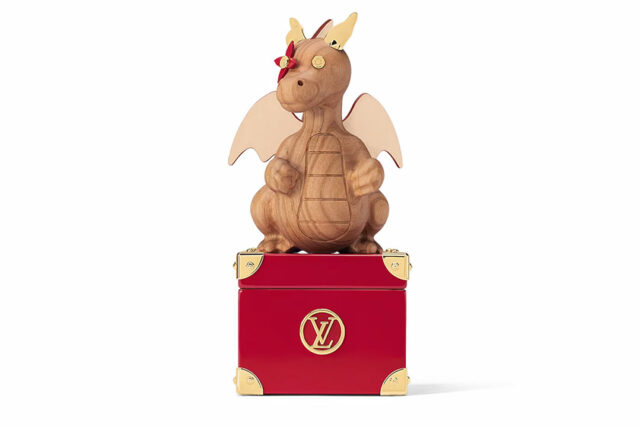
Louis Vuitton has a whole line of small knickknacks to celebrate the Year of the Dragon. The delightful LV Dragon Vivienne Figurine Key Holder and Bag Charm ($905) features a friendly dragon giving a ride to a figure with the LV monogram as its face. It is a playful addition to a handbag and makes a fun keychain. For more of a statement, give the Dragon Box ($2,710). The red lacquered box has trunk-style gold corners and the LV monogram and is topped with a carved wooden dragon with a red Monogram Flower eye and leather wings.

Penfolds Shiraz

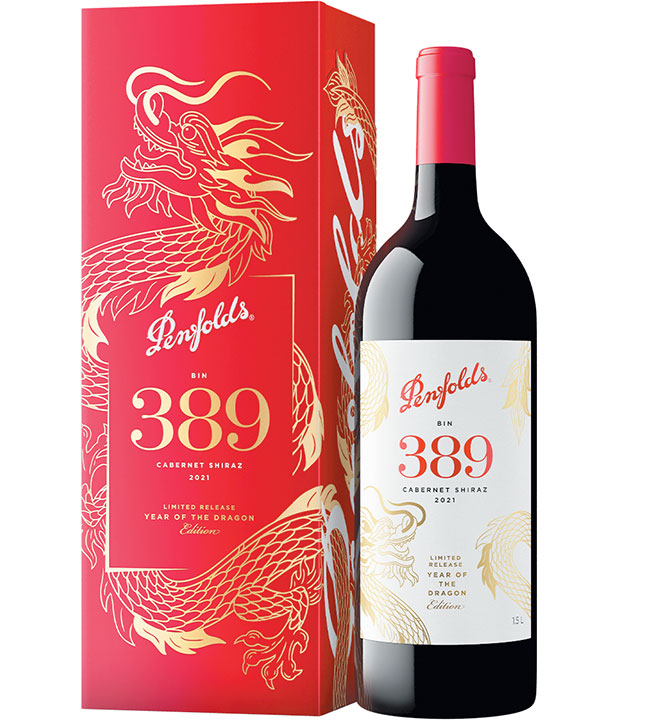
Australian winery Penfolds has a great bottle for celebratory dinners: The 2021 Bin 389 Cabernet Shiraz Lunar New Year Magnum ($200) comes with a red gift box decorated with a golden dragon. While Penfolds is best known for its famed Grange wine, a cabernet-Shiraz blend, savvy wine collectors snap up Bin 389, which is affectionately referred to as Baby Grange. The magnum bottle holds 1.5 liters, so it’s perfect for a dinner party, and the large format gives it longer aging potential if you want to enjoy it in the next Year of the Dragon.

Gucci Bags

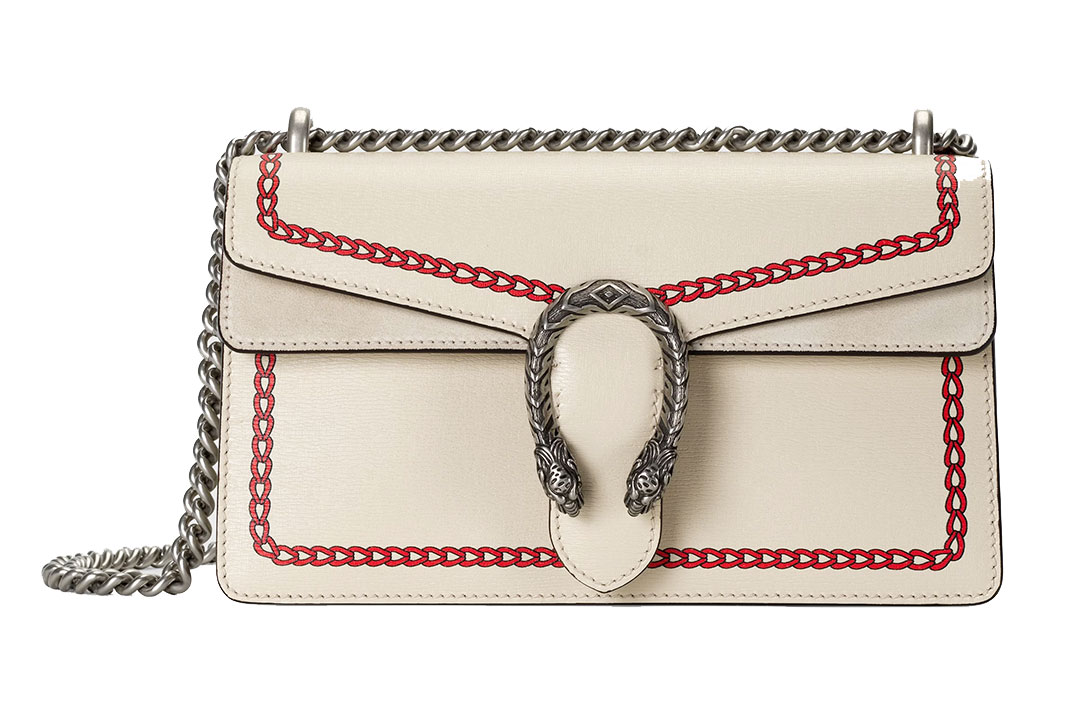
At first glance, these limited-edition Gucci handbags don’t appear to be designed for the Lunar New Year, which gives them more longevity. Both Dionysus bags have a red chain motif printed on the front, and the top handle bag ($4,250) has a red leather handle and shoulder strap. But the back of both bags features Gucci’s take on the dragon: The chain motif continues, forming the double GG logo with two dragonheads inside. It’s subtle enough to wear even in non-dragon years.

Bottega Veneta Bags

Bottega Veneta has made dragon card cases, bookmarks, and jewelry, but the standout pieces in its Lunar New Year collection are handbags with subtle dragon nods. The Sardine bag ($7,900) features the brand’s signature Intrecciato woven leather and blends red and white for a bold look. The bag’s edges and architectural gold handle are covered in colorful red and white fringe, which evokes spikes on a dragon’s back. The Mini Jodie ($3,500) uses the bag’s curved shape to mimic a curled-up green dragon. Triangular pieces of leather that protrude from the sides add to the effect.

Martell Cognac

Maison Martell is one of the world’s oldest cognac houses. It was founded in 1715 by Jean Martell, and the maison named its most prestigious cognac, L’Or de Jean Martell, in his honor. It features the oldest and finest eaux-de-vie, the name for the young brandies that become cognac when blended. Cellar Master Christophe Valtaud took L’Or de Jean Martell to the next level with the Zodiac Edition – Assemblage du Dragon ($10,000). This cognac features more than 1,400 eaux-de-vie, including the original L’Or de Jean Martell blend and eaux-de-vie from various Years of the Dragon. The final blend can never be re-created and is limited to 750 bottles worldwide. Despite the blend’s age and complexity, the nose has florals, fresh and candied fruit, and spices, and is very vibrant. This blend comes in a unique Baccarat decanter with an intricate crystal dragonhead stopper. To finish the look, the curved gold-toned bottle stand is embossed with scales.

John Hardy Necklace

John Hardy’s Naga collection has featured jewelry with dragonheads and scales since 1975, and the iconic design takes on special meaning this year. The company’s new creative chairman, Reed Krakoff, updated the collection with a sleek, modern look: The gorgeous Naga Lariat ($5,100) is crafted from 14K gold with white diamond accents and closes in an unusual way, with the dragon holding the opposite end of the chain in its maw. The new collection also includes rings, earrings, necklaces and bracelets in gold and silver.

Fabergé Ear Cuff

Although Game of Thrones ended five years ago, it still has a hold on pop culture. Fabergé brings the dragon to new heights in its Game of Thrones high-jewelry collection, which features sculptural pieces of jewelry with diamonds and responsibly sourced Mozambique rubies. Some pieces are abstract, but the Fabergé x Game of Thrones White and Rose Gold Ruby and Diamond Dragon Ear Cuff (price on request) best showcases the maison’s artistry. A glittering dragon wraps a wing around the wearer’s ear, with its body curving around the top. Rubies drip from its diamond body, which is covered in diamond spikes.

Chopard Watch

Every year, Chopard celebrates the Lunar New Year with a special métiers d’art watch that has a dial crafted from Urushi lacquer — an ancient Japanese art practiced by highly trained artisans. For this dragon project, Chopard partnered with master artist Minori Koizumi of Yamada Heiando to create 88 limited-edition dials. Koizumi used the Maki-e technique and painstakingly applied layers of lacquer, placing gold flakes between each layer. It took 20 hours to craft each dial. The dial features a stunning golden dragon flying in the sky, clutching a jewel in its claws. The L.U.C XP Urushi Year of the Dragon watch ($27,700) has an 18K rose gold case crafted from ethically sourced gold and is powered by the in-house automatic L.U.C 96.17-L movement.

Parmigiani Fleurier Clock

In addition to watches, Parmigiani Fleurier creates complicated and beautiful clocks. This one-of-a-kind objet d’art features a lifelike dragon sculpture seated atop the clock, and the beast makes a full rotation around the clock once an hour. The dragon is poised to grab the gemstone-encrusted “pearl” mounted on the base, and it always remains out of reach of the dragon’s claws as it turns around the clock. The body was crafted from solid silver and set with 585 scales made from natural jade set in 18K gold — each hand-applied and riveted to the body. The clock tells the time using the traditional Chinese 12 hours, and it rotates twice every 24 hours. This masterpiece took 5,800 hours to create. There is only one in the world, and it’s naturally priced on request.

Breguet Tourbillon Watch

It’s difficult to upstage two tourbillons, but the delicately engraved rose gold dragon steals the show in this Breguet watch. The gold stands out in a sharp contrast to the platinum case and the movement. The dragon curls around the double tourbillons, which each make a full rotation every 60 seconds. This impressive movement is visible through the sapphire crystal caseback. The creature clutches a pearl in its talons, here crafted from mother-of-pearl. The Classique Double Tourbillon Dragon timepiece ($767,800) is customizable; clients can change the dragon’s shape and color, as well as the Roman numerals and hands. Bloomberg

Hann Resorts Unveils ‘Play Bold. Live Bold.’ Campaign

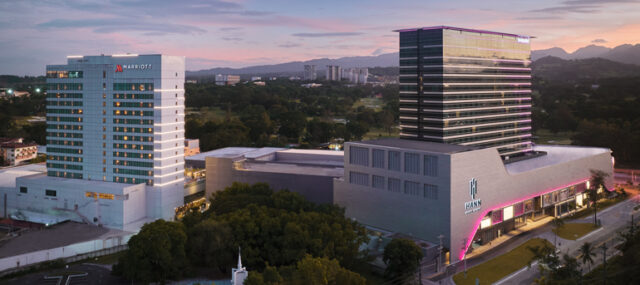
Nestled in the vibrant heart of Clark, Pampanga, Hann Resorts stands as the pioneering integrated resort in Central Luzon, shaping the landscape of hospitality with ingenuity and style. Today, Hann Resorts proudly unveils its latest and most thrilling advertising campaign, inviting everyone to “Play Bold. Live Bold.”

The Bold Evolution

In just two years since the successful inauguration of its flagship property, Hann Casino Resort has rapidly emerged as a significant player in the integrated resort industry. This noteworthy journey represents a remarkable transition from its predecessor, Widus Hotel & Casino, signaling a bold move that materialized with the grand opening in December 2021 — a momentous occasion achieved despite the challenging backdrop of the pandemic. This strategic shift has not only showcased the resilience of Hann Resorts but also demonstrated its commitment to pioneering new standards in the industry. The grand opening, conducted at the height of the pandemic, stands as a testament to Hann Resorts’ determination to redefine and elevate guest experience to new heights.

Hann Resorts made history as the first fully integrated resort within Clark, showcasing a modern and inviting facade that not only symbolizes architectural excellence but also signals the dawn of a new era in resort experiences here in Central Luzon. This distinctive beginning set the stage for Hann Resorts to redefine luxury and adventure in Clark and beyond.

The “Play Bold. Live Bold.” Campaign

Swissotel Clark’s Infinity Pool

This 2024, Hann Resorts proudly unveils its newest advertising campaign, “Play Bold. Live Bold.”, capturing the very essence of thrilling experiences, bold and fearless spirit, and explosive pleasures. This innovative campaign serves as a testament to Hann Resorts’ unwavering dedication to delivering unparalleled resort experiences, spanning from rejuvenating staycations to exquisite dining and exciting recreational activities.

At the heart of this campaign lies a profound message — every visit to Hann Resorts is a golden opportunity to seize life to the fullest. It extends an invitation for guests to immerse themselves in a realm of boundless excitement and indulgence, unfolding against the backdrop of the ultimate luxury playground in Clark.

Journey into a realm of elevated experiences with Hann Resorts where international five-star hospitality seamlessly unfolds. Within the resort, you’ll discover Clark Marriott, the first 5-star hotel brand in Central Luzon, and the first Swissotel brand in the country, offering guests an unparalleled fusion of comfort and luxury. These well-appointed hotels collectively operate a total of 15 restaurants, cafes and bars, all conveniently situated under one roof.

Japanese and Korean dishes at Smoki Moto, Clark Marriott Hotel

Dominating the Top 10 list of best restaurants in Clark by TripAdvisor, Hann Casino Resort proudly holds the title of the Culinary Capital of Clark. Travel by taste around the resort where every dish is a masterpiece, meticulously crafted to tantalize your taste buds and orchestrate a symphony of flavors.

Immerse in a world of excitement and entertainment, where world-class gaming beckons, promising an exhilarating experience that captivates the senses. Beyond the thrill of the games, make your way to 8th Avenue, where you can find an extensive selection of retail offerings that go beyond the ordinary, creating a shopping experience that is as unique as it is delightful.

At Hann Casino Resort, every facet of your stay is carefully curated to offer not just luxury, but an immersive journey where every detail contributes to an unforgettable adventure.

“Play Bold. Live Bold.” is an invitation that extends beyond the ordinary, inviting you to dive into a world where joy knows no bounds, and explosive pleasures await at every turn. Hann Resorts invites you to dare, play, and live life to the fullest, promising an extraordinary journey filled with limitless joy and unforgettable moments.

Captivating Audiences Across Platforms

Philippine International Hot Air Balloon Fiesta (PIHABF)

The “Play Bold. Live Bold.” campaign will come to life, making its presence felt on the pages of both local and international publications, as well as on towering, vibrant billboards. This dynamic campaign is strategically designed to reach a diverse audience through various channels, including online platforms and radio, ensuring a comprehensive and impactful presence that captures attention across multiple mediums.

Beauty and The Bold Concert featuring Ian Veneracion and K Brosas

Adding to the excitement is an engaging onsite activation featuring a captivating lobby installation showcasing a hot air balloon photo booth. At the same time, in celebration of the 24th Philippine International Hot Air Balloon Fiesta (PIHABF), Hann Resorts will have its very own hot air balloon in New Clark City on February 16-18, 2024. For those seeking a one-of-a-kind experience, calendars are marked for this February’s “Beauty & The Bold” concert at Bar 20 of Hann Casino Resort. This special event promises a unique musical experience, featuring the charismatic Ian Veneracion and the incredibly talented comedian K Brosas. Veneracion is set to perform his most-requested renditions, creating an atmosphere of pure love and magic.

But the excitement doesn’t end there. The campaign’s initiatives extend to the launch of a digital magazine — GameChangers. This has taken a unique concept spotlighting bold personalities in Pampanga from our very own, Mr. Daesik Han, the bold and visionary Chairman & CEO of Hann Resorts, to the aviation prowess of Capt. Joy Roa and the fashion flair of Philip Torres, these individuals embody the spirit of bold living, mirroring the essence of the campaign itself.

Get ready to be carried away by the immersive and experiential elements of this campaign that go beyond the ordinary, delivering a thrilling adventure in celebration of the bold and the fearless.

Embracing the Bold

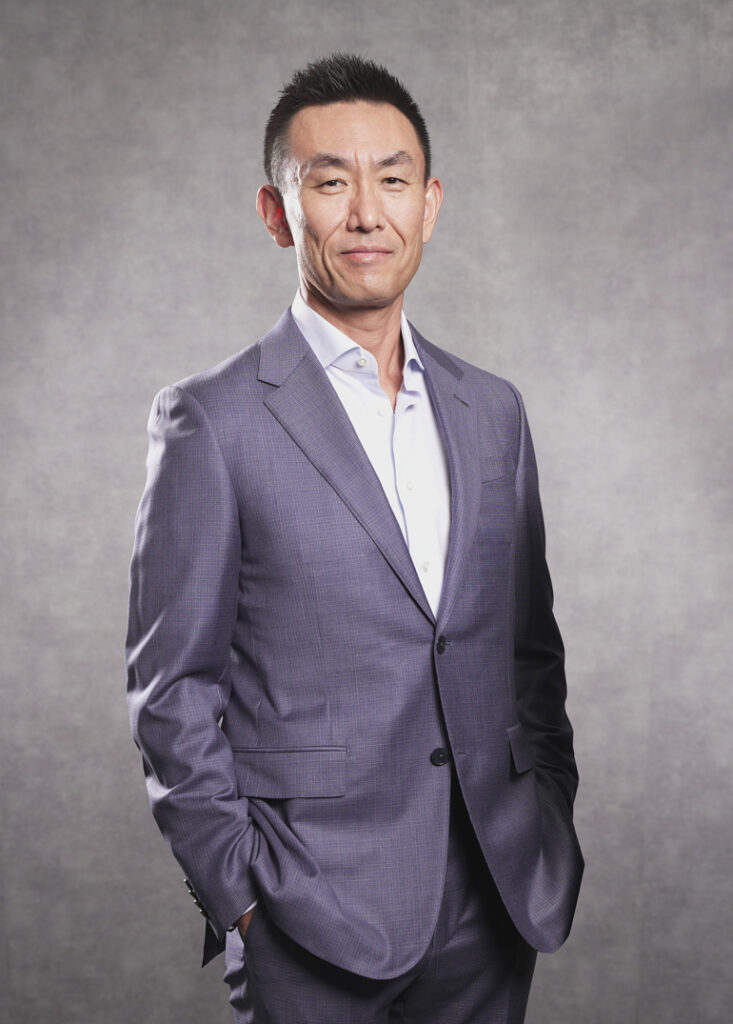
Daesik Han, Chairman and CEO of Hann Resorts

Mr. Han sets the stage for this exhilarating journey, expressing, “The ‘Play Bold. Live Bold.’ campaign is a symphony of extraordinary experiences, a poetic ode to a dauntless spirit, and an unwavering commitment to pursuing your boldest desires. It’s a transformative journey about pushing boundaries and relentlessly pursuing excellence. At its core, it’s an invitation to live boldly and unapologetically embrace the explosive pleasures life has to offer. Hann Resorts is not just a destination; it’s an exclusive invitation to wholeheartedly embrace the extraordinary.”

As we extend a warm invitation for you to join us on this bold adventure, seize the opportunity to explore Hann Resorts strategically situated for effortless accessibility from the National Capital Region (via NLEX & Skyway) and international countries (via Clark International Airport). The resort’s prime location not only ensures convenience but also situates you in close proximity to themed parks and a vibrant Korean Town, boasting its own unique retail and dining scene, thereby further enhancing its irresistible appeal.

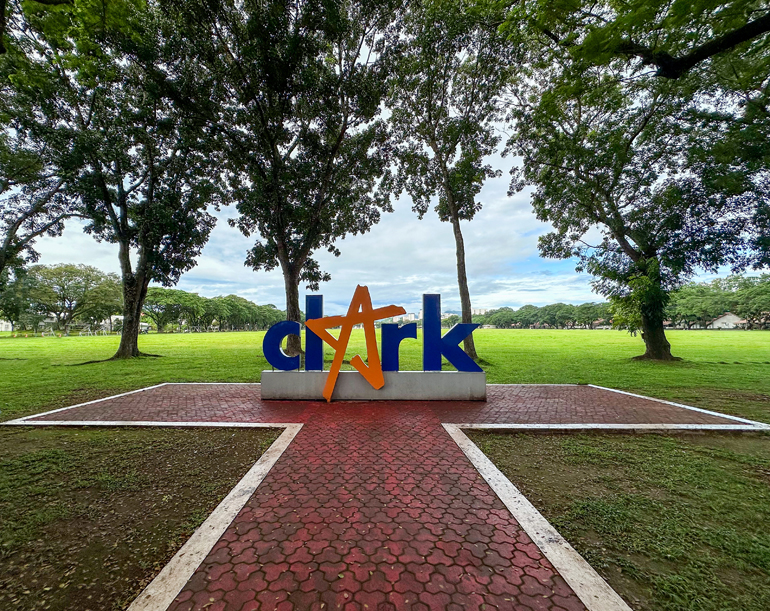
Clark Parade Grounds

Plan your visit now to bask in the transformative experiences that await you. Dare to play boldly, live boldly, and immerse yourself in the extraordinary tapestry of offerings that define Hann Resorts.

For bookings and more information, visit our website at hannresorts.com or our social media pages at @hannresorts.


Spotlight is BusinessWorld’s sponsored section that allows advertisers to amplify their brand and connect with BusinessWorld’s audience by enabling them to publish their stories directly on the BusinessWorld website. For more information, send an email to online@bworldonline.com.

Join us on Viber at https://bit.ly/3hv6bLA to get more updates and subscribe to BusinessWorld’s titles and get exclusive content through www.bworld-x.com.

SEC warns against investing in SK Pools Mining, SOAO

THE Securities and Exchange Commission (SEC) has cautioned the public against investing in SK Pools Mining Corp. and SOAO, saying these entities are not authorized to solicit investments.

In two separate advisories on its website, the corporate regulator said that the two entities do not have the necessary license to offer and sell securities.

SK Pools Mining is allegedly enticing the public via social media to purchase a cloud mining machine, ranging from P700 to P75,000, with promised daily earnings of P70 to P1,950, the SEC said.

The SEC also said that SK Pools Mining is using a fake certificate of incorporation to establish its legitimacy.

“The scheme employed by SK Pools Mining has the characteristics of a Ponzi scheme where monies from new investors are used in paying fake profits to prior investors and is designed mainly to favor its top recruiters and prior risk takers and is detrimental to subsequent members in case of scarcity of new investors,” the SEC said. 

Meanwhile, the SEC said that SOAO, SOAO Technology, SOAO-TechnologyCo.Ltd. Advertising OPC, SOAO Energy and SOAO Group are reportedly offering investments through a power generator rental scheme.

The entity allegedly promises earnings of P9 per kilowatt for 24 hours of rental.

“The amount and duration of rental and power output per 24 hour varies depending on its offering posted on their social media account and website,” the SEC said.

“An investor will also earn a commission from recruitment of new investors/partners up to level C,” it added.

According to the SEC, only SOAO-TechnologyCo.Ltd. Advertising OPC is registered with the government as a one-person corporation. However, all entities are not authorized to offer and sell any investments to the public.

“Such activities require a secondary license from the commission and the securities or investment product should likewise be registered with the SEC before they can be offered or sold to the public under Sections 8 and 12 of the Securities Regulation Code,” the SEC said.

BusinessWorld sought the comments of the two entities but has yet to receive a response as of the deadline. — Revin Mikhael D. Ochave

Triton tested

PHOTO BY KAP MACEDA AGUILA

Mitsubishi PHL unveils the brand’s latest pickup truck

By Dylan Afuang

BY INTRODUCING locally the Triton — which boasts new hardware and modern features — Mitsubishi Motors Philippines Corp. (MMPC) strengthens its presence in the popular pickup truck sector.

Unveiled worldwide last year, the Triton succeeds the Mitsubishi’s pickup truck line that once bore the names L200 and, of more recall to the local market, the Strada.

Seven variants of the Triton are available, with three four-wheel drive (4WD) and four two-wheel drive (2WD) models, with available with six-speed manual or automatic transmissions and four doors.

These trims are the Triton GL 2WD MT (P1.134 million), GLX 2WD MT (P1.311 million), GLX 2WD AT (P1.383 million), GLS 2WD AT (P1.582 million), GL 4WD MT (P1.157 million), GLX 4WD MT (P1.561 million), and the range-topping Athlete 4WD AT (P1.909 million).

“We believe this pickup will be a game-changer in the pickup segment,” MMPC President and CEO Takeshi Hara boasted during the Triton’s press launch, which also began the public showcase for the pickup that was graced by two-time Dakar Rally champion Hiroshi Masuoka, who raced a Triton Athlete around on a makeshift dirt course.

“Because we designed (the Triton) from the ground up,” Mr. Hara continued, “(it will) cater to Filipinos’ different lifestyles, it can be a workhorse or travel companion… a comfortable and functional (truck) at the same time.”

Powering the new truck is the brand’s newly developed 4N16 2.4-liter turbodiesel engine with varying outputs. The twin-turbo mill of the Triton Athlete model produces 201hp and 470Nm of torque. Exclusive to this model are electric power steering, seven drive modes, and active yaw control and Super Select II 4WD for better traction.

Lower variants use a single-turbo unit with 180hp and 430Nm, with the 4WD versions receiving Easy Select 4WD and hydraulic power steering. Standard on all 4WD trucks, regardless of trim level, is a rear differential lock that boosts its off-road capabilities.

All these are supported by the Triton’s new chassis, which is said to feature a redesigned suspension upgrade utilizing lightweight leaf springs with a longer suspension rebound. Depending on the variant, ground clearance ranges from 203mm to 223mm.

For his part, MMPC Senior Manager for Product Planning Allan Cruz explained to “Velocity” the reason behind the pickup’s new name. “The Triton name has actually been used in other markets for some time, and with the launch of the all-new model, we wanted to align with the global branding for our pickups,” Mr. Cruz said.

The executive added that the model’s GL 2WD- and 4WD MT variants are poised to serve fleet customers. In keeping with their fleet orientations, these GL trims feature basic black fabric upholstery in their five-passenger cabin.

In the more upscale Athlete and the GLS, these come with a nine-inch infotainment screen with six speakers, and wireless Apple CarPlay and Android Auto. These two trims also come standard with wireless charging, dual-zone automatic climate control, keyless entry, and push-start ignition.

Beyond its orange exterior finish contrasted by gloss black finishes, the Triton Athlete further differentiates itself inside with orange leather with black suede inserts and a 10-way power adjustable driver’s seat.

When asked by the media on the sidelines of the launch about the Triton’s expected monthly sales, Mr. Hara said that MMPC will aim for a “higher segment market share.” The executive also confirmed that Mitsubishi’s Thailand plant, which will produce the model for the Philippines, is ready to supply the model’s demand here.

For safety, the Athlete and the GLS boasts of advanced driver-assistance systems and a 360-degree camera. The GLX, on the other hand, comes with a single reversing camera.

The top two variants’ safety suite include forward collision mitigation with pedestrian detection, blind-spot warning with lane-changing assist, rear cross-traffic alert, lane departure alert, and auto high beam.

Above these, the Athlete offers hill-descent control, emergency assist for pedal misapplication, lane departure warning, and parking sensors.

Q&A: ‘I respect the people’

Mr. Takeda speaks to the press for the first time at the Geely North EDSA dealership. — PHOTO BY KAP MACEDA AGUILA

New Geely PHL chief Naoyuki Tekada is prioritizing existing customers, along with employees and dealer partners

Interview by Kap Maceda Aguila

LET’S GET this out of the way: Pretty much no one was surprised with the “reassignment” of former Sojitz G Auto Philippines (SGAP) or Geely Philippines President and CEO Yugo Kiyofuji.

To anyone following the tale of the Chinese automaker here in the country, it had seen better days – namely those overseen by the first SGAP chief Yosuke Nishi (before moving on to head Sojitz Fuso Philippines Corporation) who spearheaded the brand’s successful establishment here in 2019.

There were two general issues that people can say eventually led to the ouster of Mr. Kiyofuji, who had a tumultuously brief tenure from April 2022 to the end of 2023: A lack of – and we use the term loosely – likeability, and the savaging of the brand on social media as a result of after-sales woes.

First, it appeared that the executive wasn’t exactly the Mr. Popular in the organization – leading to an exodus of key people. Second, we also heard from the grapevine that dealers were left underwhelmed by him.

Even the optics on the turnover of command suggested a less-than-amicable split from SGAP. When the press release on the announcement of Mr. Takeda’s appointment was sent out, there was no traditional photo of the outgoing with the incoming. Instead, Geely Automobile International Corporation Regional Sales Director Will Wan appeared on a couple of images shaking hands with the new president. It seemed that Mr. Kiyofuji made – or was forced into – a hasty exit.

Still, Mr. Takeda’s quote on the official press statement was gracious. “I am grateful for Mr. Kiyofuji’s contributions as he leaves SGAP to focus on other aspects of the auto business in (the) Sojitz headquarters in Tokyo where his distinct management capabilities are required. He has completed his mission in SGAP in a very short time, making vast improvements in the organization, particularly in various systems processes and parts availability,” he said.

And after all, it’s no use to flog a dead horse. What can be worked on is the here and now. The executive seems to be cognizant that the first step toward reviving the Geely brand is to bravely face the music – to answer the questions previously met with silence and the vacuum of attrition.

Mr. Takeda is no stranger to the Philippine automotive industry as he had a “pivotal role” with Mitsubishi Motors Philippines Corporation (MMPC) Auto Financial Services and JACCS Finance Philippines for over six years until July 2022.

Last week, he presided over a preview of the Geometry C electric vehicle, expected to be launched this year. More importantly, he declared in a speech to media invitees: “At Geely, our commitment to excellence is more than a promise; it’s a pledge,” adding that “customer satisfaction is a yardstick of success.”

Alluding to the previous, much-publicized shortcomings in after-sales service, Mr. Takeda vowed to work on parts availability “supported by a fail-safe mechanism.” He promised that customer service representatives will be on hand to ensure the fulfillment of service concerns.

Directly addressing the media, he averred, “We are not just asking you to observe, we are inviting you to engage.”

Here are excerpts from our exclusive interview with Naoyuki Takeda.

VELOCITY: What were the marching orders upon your appointment?

NAOYUKI TEKADA: Sales are down, and the first priority is of course to bring back sales to (previous) levels. Also, my priority is to improve after-sales and customer satisfaction. For me, the most important thing is to take care of existing customers and regain their full trust – to make them happy and satisfied.

People have been very concerned about the brand. Were you aware of the issues, particularly those raised on social media? One of the concerns was after-sales service. Another is the exodus of executives from Geely Philippines.

I’m aware that many people left the company last year, but it’s already calmed down. My style is to completely follow the Philippine way. I manage the company in the Philippine way; I respect the people. I respect our employees, I respect the dealers, I respect the media, I respect the banks. My style is the Philippine way, and I believe that in doing it the Philippine way, I will motivate the internal and external people. By doing so, I hope we can regain the employees’ motivation and loyalty to the company.

With regard to after-sales service, there have been concerns about the lack of parts, and service that’s not up to par. How are you going to change this?

This is my first priority. For parts availability, we have already improved a lot. The current service fill rate is over 90%. However, I know it’s still far from perfect, because there is no perfect in this field. My commitment is to keep improving service.

For 2023, Geely Philippines is ninth in sales, per CAMPI (Chamber of Automotive Manufacturers of the Philippines). Do you have a sales target for 2024? Are you going to open more dealerships?

Of course, we have plans to launch new models, although we haven’t decided on anything concrete. We will increase the number of dealers, but the number of dealers is not so important at the moment because we’ve already reached close to our target number. The more important thing is the quality and performance of the existing dealerships. We have to keep improving our collaborations with our existing dealers to increase sales and service quality. We will support our dealers.

Are you happy being in ninth place?

Of course, we are targeting a higher position.

The perfect white shirt

SEIKISHI White Shirt from Benjamin Barker

RUSTAN MARKETING CORP. President Bienvenido “Donnie” Tantoco III has found the perfect white shirt, and all it took was to spill wine on someone else.

At a business conference he attended, a Malaysian tycoon he knew told Mr. Tantoco to throw a glass of wine on the shirt he was wearing — “[It was] a very nice, crisp white shirt that was also very flattering,” Mr. Tantoco told the guests on Feb. 1. “I just met the guy, [and] he was asking me to commit violence against him.” But Mr. Tantoco went along with the request and poured the wine on his new friend’s shirt.

“It looked terrible at first,” he recalled. The man then simply took a white cloth and wiped the shirt clean. Next, he told Mr. Tantoco to spill coffee on his cuffs — which also wiped off quite easily. “His shirt looked like it was freshly laundered and pressed,” Mr. Tantoco said.

He had found the perfect white shirt.

Mr. Tantoco had told the story during the launch of the men’s suit brand Benjamin Barker in Rustan’s Makati. The man in the perfect white shirt turned out to be an investor in the brand, created by Nelson Yap.

Mr. Yap, who had been a filmmaker living in Australia, left that life to care for his ailing father and his business selling suits in Singapore. That was in 2009.

While Mr. Yap may have been exposed to suits because of his father’s job of selling them, he found gaps in the market when it came to price and in size. Singapore’s multicultural nature means many international brands can be found there, but, “They don’t fit very well. We’re Asians.” He also noted that suits of Western origin really weren’t always built for the hot, humid Asian climate.

So he created Benjamin Barker, a suit business focusing on the Asian client. His fabric choices include linen and mixed cottons, for better breathing in the tropics. The suit jackets are half-lined for ventilation.

Benjamin Barker is present not only in Singapore, but also in Australia, Malaysia, Cambodia, Vietnam, and in the Philippines.

Mr. Yap, in a speech, recalled this his first employees in Singapore were Filipinas, who used to chide him about opening in the Philippines. “Today, here we are, after 15 years.”

He explained to BusinessWorld the secret of the perfect white shirts: they are dipped in special chemicals at the yarn level to make them resistant to stains, and also to UV light, viruses, bacteria, and wrinkles.

The fabrics and the tailoring are fit for Asian bodies, and the price isn’t too bad either: a look at their racks shows items priced between P6,000 to P12,000.

“I feel like there are a lot of luxury brands out there already,” he said. “We want the everyday man to be able to express themselves.”

Benjamin Barker is available at Rustan’s Makati. — Joseph L. Garcia

Cebu Pacific targets to resume China route by October

CEBUPACIFICAIR

BUDGET CARRIER Cebu Pacific is planning to defer the resumption of its Manila-Beijing flights to October as the company weighs the current market demand, its president said.

“It looks like it’s going to be [October] 2024 and again, it is because China’s been so soft. Until we see a rebound in terms of our forward bookings, I think we have to take a deliberate approach on China,” Alexander G. Lao, Cebu Pacific president and chief commercial officer, told reporters in a media gathering last week.

Cebu Pacific’s Manila-Beijing route was initially set to resume in 2023 but was then deferred to early 2024.

The budget carrier is working to increase its international source market by intensifying its frequencies in other existing networks, Mr. Lao said. 

“International though our tourism numbers are still far behind and one of the key reasons is China, I think it was our second largest source market and today it’s not even within out top five or six,” he said, adding that the potential contributions of China’s market was not as large as its share pre-pandemic level.

Last year, Cebu Pacific launched its Manila-Da Nang flight, which operates three times a week. 

“I think Da Nang is probably the most recent route we’ve opened. We’re looking at maybe one to two routes to come back. Our strategy is to try to bring back our international capacity to pre-COVID level which we should see this year,” he said.

The company is planning to bring its wide-body aircraft to routes where there is a strong demand, he added.

“Whether it is Japan, Thailand, or Hong Kong. So not a lot of new routes this year, but we will try to open routes selectively, whether through more frequencies or higher capacity,” he said.

The company is expecting to complete its aircraft purchase by the first half of the year, allowing it to increase its network capacity. — Ashley Erika O. Jose

Indonesia’s Valentine’s Day vote

PRANANTA HAROUN-UNSPLASH

On Feb. 14, Indonesians will vote in parliamentary and presidential elections in what is likely to be the country’s most consequential elections since the fall of Suharto in 1998. Indonesia is Southeast Asia’s largest country by population, area and economic output. It is among the top global exporters of thermal coal, processed nickel, copper, bauxite, and palm oil, among others. Indonesia supplies almost all of the coal for Philippine power plants, while its mineral export policies affect our own nickel and copper sectors. Indonesia is also one of the largest consumers of rice, and occasionally imports from Vietnam and Thailand in competition with the Philippines.

Indonesia is also a regional political leader. The Bandung conference held in West Java in 1955 eventually became the basis for the Non-Aligned Movement that was formed in the early years of the Cold War, and which became the single largest grouping of countries outside the nuclear superpowers. Until today Jakarta continues to have a strong voice across many regional foreign policy issues, from ASEAN cooperation to the region’s stand on the many crises in the Middle East to the return of democracy in Myanmar.

Politically and socially, if the Philippines wanted to find a country today that faces many of the same challenges and seemingly unfulfilled potential, none in Asia comes closer than Indonesia, as it faces many of the same challenges. Its institutions are weak, and corruption is a pervasive problem that has discouraged foreign investors and destroyed economic value, with the most visible effect being Indonesia’s decline as an oil and gas exporter. Patronage politics is rife. Deforestation, land rights disputes, and plastic waste in the rivers are common environmental and social problems. The moniker “land of broken investor promises” could be applied as much to the Philippines as to Indonesia.

The country is also attempting to move a large part of its population out of agriculture into the manufacturing and service industries, with a particular emphasis now on manufacturing for renewable energy, batteries, and autos. And like us, many of its citizens work abroad as ours do — on cargo and cruise ships, as caregivers in Singapore and Hong Kong, and in the service sectors in the Middle East. Like us, its overseas workers give hope to their families, and it is similarly concerned with how to protect its own OFWs from maltreatment, abuse, and war. And Indonesia’s creation of its own sovereign wealth fund, the Indonesia Investment Authority, was one of the models for the Maharlika Investment Fund.

Therefore, what happens to Indonesia as a country not only affects the Philippines through trade and commerce but makes for an interesting mirror for our country and could provide additional context for what we are trying to do to lift our country to the next stage of development. Its industrialization mistakes today could serve as lessons for us.

The vote next week is therefore more than a passing interest. What makes it especially consequential is that the leading candidate is a retired general with a checkered human rights history, who occasionally voices his impatience for democratic politics and has, through three election campaigns, railed against foreign investor participation in the economy.

THE PERSONALITIES INVOLVED
Indonesian presidents are limited to two terms, which makes President Joko Widodo ineligible to run again, having won in 2014 and 2019. Should none of the three candidates win a majority next week, a runoff between the top two vote-getters will be held in June.

Leading the race is the country’s defense minister, Prabowo Subianto, a retired general who spent most of his career in Indonesia’s special forces command, Kopassus, during the Suharto era. Prabowo is estimated to have around 46%-48% voter support, which puts him within range of winning it all next week. Trailing him are the former governor of Jakarta, Anies Baswedan (with roughly 26%-27%), who is running as an independent, and the former governor of Central Java province, Ganjar Pranowo (with 20%-21%), who belongs to the Indonesian Democratic Struggle Party (PDI-P) of Widodo. Should Prabowo fall short of a majority, he is still the strong favorite to defeat either of the two in June.

Curiously, Widodo supports Prabowo, not Ganjar of his own PDI-P party. Until early this year, Widodo had backed Ganjar, strongly lobbying PDI-P leader and former president Megawati Sukarnoputri to select him as the party nominee. Megawati preferred that her daughter, Puan Maharani, be PDI-P’s presidential candidate. But Puan was not popular and Widodo eventually prevailed.

However, while Widodo was lobbying Megawati to choose Ganjar, his inner circle was apparently also considering that their political future might be better served by siding with Prabowo. Ganjar was a PDI-P loyalist after all, assuring that Megawati would have a strong, if not dominant, voice in a Ganjar administration. Meanwhile, Prabowo was also open to an alliance with the popular Widodo, due to the electoral boost that it would give. Eventually, Gibran Rakabuming Raka, Widodo’s son and Solo city mayor, became Prabowo’s vice-presidential running mate. Widodo has not openly endorsed Prabowo yet, but his support for the defense minister is the worst-kept secret in all of Indonesia.

WHY THIS VOTE MATTERS
Foreign investors are hoping that Widodo’s influence in what is likely to be a Prabowo government and the fragmented nature of Indonesia’s politics make it unlikely that there will be a major shift in policy, and that continuity will largely prevail, from the shift of the capital to Nusantara to the development of domestic manufacturing sectors. What gives them hope is that Prabowo has proven to be a team player in the Widodo cabinet and a largely uncontroversial defense minister since 2019.

But Prabowo has another side. He admitted to having played a role as head of the strategic forces (Kostrad) in the abduction and torture of pro-democracy activists during the last days of the Suharto regime, with at least a dozen of those taken still missing. He has also been accused of leading violent crackdowns in what was then East Timor while he was in the special forces. But Prabowo puts this as being in the context of him as a soldier in the autocratic Suharto regime.

It is Prabowo’s combination with Widodo that makes some local political analysts uncomfortable, because Widodo has shown a willingness to also disregard democratic guardrails, as could be seen indirectly in his lieutenants’ efforts over the past year to take over the Democrat Party, a half-hearted attempt to postpone the elections or to let his son Gibran run as VP despite the fact that the Constitutional Court decision that lowered the age for vice-presidential candidates (and which directly benefited Gibran) was decided while Widodo’s brother-in-law was chief justice. An ethics panel later removed him from the chief justice post. Widodo oversaw the passage of a law in 2019 that weakened the Anti-Corruption Commission.

As presidential candidate in 2014, 2019, and 2024, Prabowo has railed against foreign investor participation in the economy; he believes that foreigners have extracted much of the wealth in the economy, with benefits only trickling down to the citizens. He described Indonesians partnering with foreign investors as “lackeys” and “puppets,” while ordinary Indonesians become employees who only get “small salaries.” Recently, he said that “a neoliberal economy cares only about profit and… we cannot be like that.”

Regardless of Prabowo’s framing, if his administration adopts more nationalist policies and is successful in advancing Indonesian industry forward in the short-term, then this could add to the clamor in other countries such as the Philippines to adopt industrial policy and for the government to intervene more in the economy and to have national champions.

But it could also lead to a turn away from broader party-based politics and the democratic institutions such as the anti-corruption agency KPK that had been seemingly strengthened after the fall of Suharto — a backsliding that warns that democracy’s move forward should never be taken for granted.

Widodo has gained international recognition for how far forward he has brought Indonesia’s economy, including the development of Morowali for its nickel industry and the construction of Southeast Asia’s first high-speed rail service. But the country and its people deserve a deeper look because its political and economic evolution could also serve as both cautionary tale and model for the Philippines.


Bob Herrera-Lim is a managing director at Teneo, a New York-based consulting firm that advises companies and investors globally. He covers all of Southeast Asia for the firm’s clients. He is also a fellow of the Foundation for Economic Freedom.


Lexus cornered 42% of premium auto market in ’23

The Lexus LBX on display at the recent Singapore Motor Show — PHOTO BY KAP MACEDA AGUILA

Toyota’s luxury brand is now a leader as well

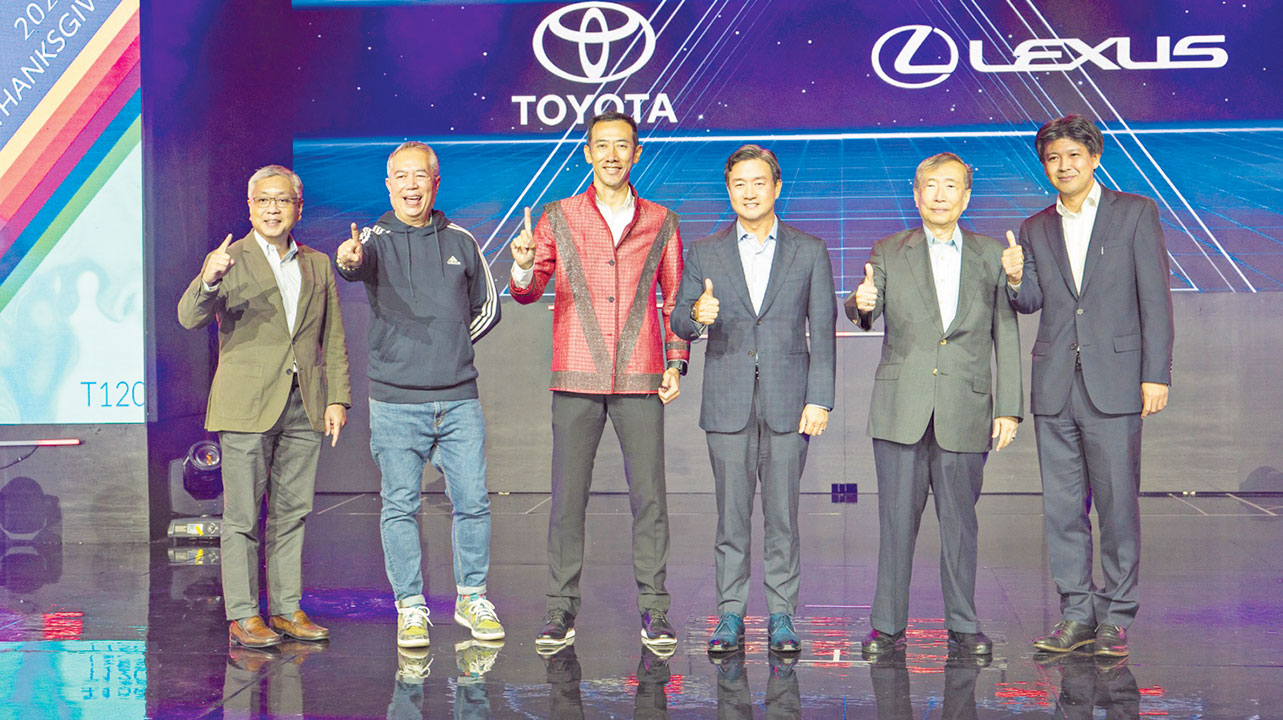
AT THE RECENT media thanksgiving party of Toyota Motor Philippines (TMP), Chairman Alfred Ty looked back at 2023 as a “remarkable year,” and outlined some of the many highlights for the company.

“On the occasion of our 35th anniversary, we were fortunate to have President Ferdinand Romualdez Marcos, Jr. visit our Sta. Rosa factory. (Toyota Motor Corp. Chairman) Akio Toyoda and I hosted him during his visit, and we were very encouraged by his high level of interest in our operations. In fact, PBBM mentioned that he felt like he was visiting an automotive factory in Japan given the level of quality he observed,” shared Mr. Ty.

Speaking of Mr. Toyoda, he also attended TMP’s first-ever GR Festival last August and got behind the wheel of a WRC-spec Toyota GR Yaris — assuming his motoring nom de guerre Morizo to showcase his drifting skills in front of a Quirino Grandstand crowd. That was certainly a particularly unforgettable moment for me personally, as I was among only a handful of individuals who rode shotgun as the smiling executive pushed the vehicle to do donuts and more.

“To this day, Morizo is all smiles when he recalls his visit to Manila last year,” Mr. Ty continued.

Arguably the centerpiece of TMP’s embarrassment of riches is the company’s 22nd consecutive “triple crown.” It again led auto companies in passenger car, commercial vehicle, and total sales. “I am also very happy that we set a new all-time sales record in 2023, with sales shattering the 200,000-unit barrier,” he told the attendees. The exact figure, 200,031, represents 46.54% of total vehicle sales, per the reckoning of the Chamber of Automotive Manufacturers of the Philippines, Inc. (CAMPI) and Truck Manufacturers Association (TMA).

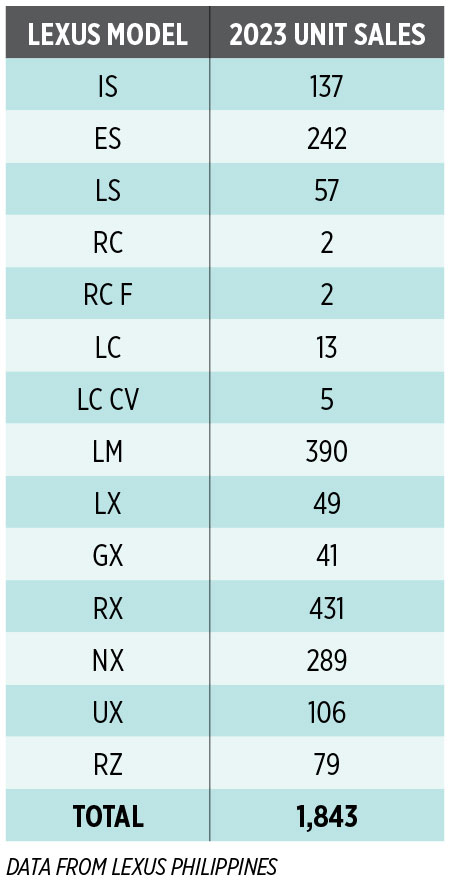
If the triple crown has perennially been a foregone conclusion owing to the utter domination in sales numbers, TMP added a welcome feather on its cap through Toyota’s luxury brand. You could even say it’s a now a quadruple crown as Lexus annexes the luxury auto market sales title with a sum of 1,843 units — good for 41.92% of the total.

“What this tells me is that the Filipinos are on their way to a higher quality of life and standard of living, in line with the government’s goal of making the Philippines an upper middle-income society,” stated Mr. Ty.

The executive additionally noted that, “carbon neutrality is gaining ground with sales of our hybrids and Lexus RZ BEV increasing their representation in our lineup to 3.6% from 1.2% in 2022.”

As vehicle production across the industry has largely returned to its pre-pandemic state, Lexus Philippines can surely gird for more growth this year. As the table above suggests, there is healthy demand (and, surely, supply) anew for its popular MPV model, the LM — outpaced only by the RX (also in all-new guise).

On the horizon, too, is the opening of a new, bigger Lexus facility at the Bonifacio Global City, this one near Mitsukoshi and a breath away from its original location. That one, we’ve heard, will revert back to Federal Land control.

But surely, all eyes must be on the LBX crossover, slated to debut locally in the first quarter, according to Lexus Philippines. Even smaller than the UX, the LBX will effectively become the new entry point into the Lexus stable. This, of course, will make the brand even more accessible to more people seeking admittance into the luxury segment.

ADVERTISEMENT
ADVERTISEMENT