LONDON — Candace Bushnell, the US writer whose work inspired Sex and the City, is completely relaxed about dating and not even suffering from stage fright as she takes her one-woman show on a United Kingdom (UK) tour.
“I don’t have a lot of nerves or anything like that. It just it feels very natural,” the 65-year-old told Reuters on the eve of a series of British stage performances of her True Tales of Sex, Success and SEX AND THE CITY.
She says her show, which has already had a run in New York, reveals how she came to invent Carrie Bradshaw, played by actress Sarah Jessica Parker in the Sex and the City television series. It was first aired in the late 1990s and had its roots in Ms. Bushnell’s newspaper column and best-selling book.
Two films followed, as well as a current spin-off television series And Just Like That.
Reflecting on the enduring comic appeal of Bradshaw and her fictional friends Samantha (Kim Cattrall), Miranda (Cynthia Nixon), and Charlotte (Kristin Davis) and their many romantic adventures, Ms. Bushnell said independence was what she valued most.
Married for 10 years to dancer Charles Askegard, Ms. Bushnell said she uses dating apps, but is not bothered whether she meets someone.
“I’m not looking to get married and have kids, so I’m really very relaxed about it,” she said.
“I’m really just enormously grateful that I am able to live an independent life and to pursue my very important message to women, which is to be independent and to be your own Mr. Big,” she said. Played by actor Chris Noth, the character Mr. Big was Bradshaw’s on/off love interest, with the name referring to his supposedly impressive job and large presence in New York.
British audiences will hear about him and Ms. Bushnell’s other characters beginning on Friday in the southern city of Southampton.
The UK tour also has dates in cities including Manchester in the north and Glasgow in Scotland, and a night at the London Palladium on Feb. 7. — Reuters
THE Department of Energy (DoE) has partnered with Mitsubishi Motors Philippines Corp. (MMPC) to promote the use of plug-in hybrid electric vehicles (PHEVs), aiming to bolster clean transportation initiatives in the country.
The Energy department recently signed a memorandum of agreement with MMPC, the Philippine unit of Japanese car manufacturer Mitsubishi Motors Corp., to lend out a PHEV unit, it said in a social media post on Tuesday.
PHEVs are “hybrid electric vehicles with a rechargeable energy storage system that can be charged from an external electric energy source, the department said.
Energy Secretary Raphael P.M. Lotilla has encouraged MMPC to “continuously support the clean transport system through extending their innovation to EV charging stations and other EV infrastructure.”
This also includes assistance for the development of soft skills on the new technologies.
Under the Comprehensive Roadmap for the Electric Vehicle Industry, the DoE aims to raise the rollout of EVs in the Philippines to 10%, or beyond the 5% mandated under the Republic Act No. 11697 or the Electric Vehicle Industry Development Act.
By 2028, the DoE wants to roll out approximately 2.45 million EVs comprising of cars, tricycles, motorcycles, and buses and installation of 65,000 EV charging stations nationwide.
As of January, Mr. Lotilla said there were 194 battery EVs, 19 plug-in hybrid EVs, 30 hybrid EVs, and 32 light EVs registered, while 96 commercial EV charging stations had been deployed as of December last year. — Sheldeen Joy Talavera
Philippine education is facing a crisis. Without exaggerating the problem, as some people who unwarrantedly talk about “mass stupidity” of Philippine teenagers, let us examine the nature of the problem and identify both short-term and long-term practical solutions to the problem.
I am fortunate to belong to a group of leaders of both business and civil society who have organized the Philippine Business for Education (PBEd), an NGO that is committed to work with the government to do continuing research on the state of Philippine education and to propose ways and means of improving its quality at all levels, especially at the basic education level. PBEd not only proposes solutions but actually implements programs to improve the quality of Philippine education, in partnership with both local and international agencies.
For 2024, the priority areas of PBEd’s programs are in education governance, teacher quality, data assessment, per student spending, government-industry-academe collaboration, early childhood care and development, public-private collaboration, mass promotion, and mental health.
In its most recent report, PBEd describes the State of Philippine Education as follows: nine out of 10 learners aged 10 years old cannot read simple text. One root cause of this situation is that one out of three Filipino children under five years of age are undernourished or malnourished. Undernourishment or malnourishment of children during the first 1,000 days of their existence (from the wombs of their mothers to two years of age) results in some brain damage so that, no matter how good the quality of education they receive during their childhood years, it will have limited effectiveness. That is why food security for the poor is an important pre-condition to the improvement of mass literacy. There are some LGUs, such as those in Quezon and Bataan provinces, that have been implementing what is known as the 1,000 days feeding program, i.e., providing free food supplements to children from the time they are conceived in their mothers’ wombs to their turning two years old. It is highly recommended that all LGUs adopt this feeding program, preferable using whatever extra budget they get from the implementation of the so-called Mandanas ruling in order to solve the problem of undernourishment or malnourishment of the children of the poor (who now constitute some 22% of our population).
Other current developments affecting or reflecting, for better or worse, the state of Philippine education are the following:
Teachers are not well capacitated to facilitate learning.
Youth unemployment is at 9.7%. The underemployment rate is 12.2%.
There is persistent job-skills mismatch. Many graduates of the formal schooling system do not have the skills demanded by industry.
The Second Congressional Commission on Education (EDCOM 2) convened.
The Department of Education reviewed the K to 12 curriculum.
The Vice-President of the Philippines, Sara Duterte, was appointed Secretary of Education. She delivered her Basic Education Report 2024 on Jan. 25 in which, among others, she presented the revised Matatag curriculum which will focus on foundation skills and the inculcation of values and virtues that will lead to graduates of the K to 12 curriculum who are competent and job-ready.
Both the Department of Education and the private schooling system implemented remediation programs to address the learning crisis. Among the concrete measures, as reported by VP Duterte in her Basic Education Report, were the National Learning Recovery camps and the Catch-up Friday reading sessions to address the reading inability of teenagers.
To quantify the magnitude of the education sector, the following are the vital statistics: At the basic education level, there are 59,890 schools, of which 47,678 are public schools and 12,212 are private schools. The total number of students at the basic education level is 28,304,205 million of whom 24,676,699 (87.2%) are in public schools and 3,627,506 (12.8%) are in private schools. At the higher education level, there are 2,423 higher education institutions (HEIs) of which 1,729 are private and 695 are public. There are 2,095,160 million students in State Universities and Colleges (SUCs) and 2,069,649 in private HEIs, a 50-50 sharing.
At this juncture, let me already express my opinion that the government has gone overboard establishing SUCs, many of which impart very poor-quality education, whose graduates are usually unemployable. Since there is always a shortage of funds at the basic education level (e.g., not enough school buildings), the government should shift the funds being spent on SUCs to the schools at the basic education level and depend more on the private HEIs to deliver quality higher education. The voucher system should be used to enable deserving children of poor families to enroll in high-quality private colleges or universities. Also, part of the funds that can be shifted away from SUCs should be invested in establishing more quality Technical Education and Skills Development Authority (TESDA)-type schools that are more likely to train skilled workers in great demand in the booming sectors of construction, tourism, healthcare, and agribusiness.
To mobilize mass support for the priority programs identified by PBEd for the calendar year of 2024, let me list the plans for policy advocacy of the Foundation:
As regards improving teacher quality, there will be programs and policy advocacies to improve and expand teacher development pathways and to unlock teacher progression. To promote more tripartite collaboration between the government, industry, and the academe, private sector participation should be enhanced and there should be established an effective national enterprise-based training program. Many more private businesses, whether large-, medium-scale and small, should take in students in various fields and professions as on-the-job trainees or apprentices, emulating the famous dualvoc system made popular in German-speaking nations in Europe. The role models here should be Dualtech Training Institute and the Meralco Training Institute in Metro Manila and the Center for Industrial Technology and Enterprise (CITE) in Metro Cebu.
As regards education governance, serious efforts should be made to decentralize it. There is a clear constitutional mandate of the Philippine Constitution of 1987 for government functions to be decentralized to the regions. Education should be among the first to be decentralized because of the significant differences in economic conditions, culture, linguistic traditions, and other circumstances affecting the educational experiences of the youth from one region to another. To guarantee the attainment of minimum standards in education, a National Coordinating Council should be established. A concrete model for the establishment of an independent assessment agency should also be recommended. Since these measures would require legislation, it is incumbent upon the Second Congressional Commission on Education (EDCOM 2) — made up of members of both the Senate and the House of Representatives — to have the corresponding laws passed. I am glad to note that the EDCOM has some legislators whom I personally know as among the intellectual elite in their respective chambers, such as Senators Sherwin Gatchalian, Sonny Angara. Francis Escudero, Joel Villanueva, and Pia Cayetano, as well as Mark Go and Roman Romulo from the House of Representatives.
EDCOM 2 has identified the following priority areas for possible legislative measures: Early Childhood Care and Development and Basic Education; Higher Education and Teacher Education and Development; Technical-Vocational Education and Training (TVET) and Lifelong Learning; Governance and Finance. The bills that have already been filed are HB 8559 on Teacher Quality (Amendment of the Teacher Professionalization Act) and SB 2354 (Apprentice Training System Act).
I fully support these priority areas and will devote a good part of my research and communions work to identifying concrete programs of actions in these strategic areas, especially in teacher education (particularly in the fields of economics education and values education) and in apprentice training. In fact, I just have launched, with co-author Luis Molina, an updated version of my Guide to Economics for Filipinos (used as a textbook by at least three generations of high school students who were being introduced to the science of economics) and a third volume of my Book of Virtues and Values that can be used either at the senior high or college education levels in courses on values education.
(To be continued.)
Bernardo M. Villegas has a Ph.D. in Economics from Harvard, is professor emeritus at the University of Asia and the Pacific, and a visiting professor at the IESE Business School in Barcelona, Spain. He was a member of the 1986 Constitutional Commission.
LONDON — Classic 1970s comedy show Fawlty Towers is hitting the London stage in May in a new theatrical adaptation, nearly 50 years after the original television series first aired.
Fawlty Towers The Play has been adapted for the stage by series writer and actor John Cleese, who played Basil Fawlty, the inhospitable owner of a chaotic fictional hotel in the southern English seaside resort town of Torquay.
Mr. Cleese said he had adapted three of his favorite episodes for the play and written “one huge finale, which will bring together the endings of all three episodes.”
“What a thrill to be bringing Fawlty Towers to the West End for the first time — nearly 50 years since the show was first recorded, in December 1974,” he said in a statement on the play’s website.
“We’ve been involved in the casting process for some time, being constantly reminded of what a wealth of acting talent we have in Britain — sorting the very, very, very good from the merely very, very good.”
Fawlty Towers, written by Mr. Cleese and Connie Booth, ran for 12 episodes in 1975 and 1979.
Actor Adam Jackson-Smith will play Basil while Anna-Jane Casey will take on the role of his bossy wife, Sybil.
The play, directed by Caroline Jay Ranger, will run at the Apollo Theater on London’s central Shaftesbury Avenue from May 4.
“I do hope some of you will come to the Apollo to laugh together. And laugh. And laugh……,” Mr. Cleese said. — Reuters
THE Securities and Exchange Commission (SEC) has set the deadlines for the submission of annual financial statements (AFS) and general information sheets (GIS) of corporations.
In a statement on Tuesday, the commission said the deadline for AFS submission will depend on the last digit of their registration or license number. The deadlines are provided under SEC Memorandum Circular No. 2 released on Jan. 27.
The AFS submission deadline covers all corporations, including branch offices, representative offices, regional headquarters, and regional operating headquarters of foreign corporations whose fiscal years ended on Dec. 31 last year.
Licenses or registration numbers ending in 1 and 2 should pass their AFS on the following dates: April 29 and 30, May 2, 3, 6, 7, 8, 9, and 10.
Those with licenses or registration numbers ending in 3 and 4 should file starting May 13, 14, 15, 16, 17, 20, 21, 22, 23, and 24.
Companies with licenses or registration numbers with 5 and 6 as the last digit should submit from May 27, 28, 29, 30, 31; and June 3, 4, 5, 6, and 7.
Licenses or registration numbers ending in 7 and 8 should file starting June 10, 11, 13, 14, 17, 18, 19, 20, and 21.
Companies who have 9 and 0 as last digits of their licenses or registration should pass from June 24, 25, 26, 27, 28; and July 1, 2, 3, 4, and 5.
The SEC added that a corporation with a fiscal year that ends on a date other than Dec. 31 last year should file its AFS within 120 calendar days from the end of its fiscal year.
The annual report of a broker dealer whose fiscal year ended on Dec. 31 should be filed on April 30, while those with fiscal years ending on a date other than Dec. 31 must file their reports 120 calendar days after the close of their respective fiscal years.
Corporations whose securities are listed on the Philippine Stock Exchange (PSE), as well as securities registered but not listed on the PSE, those considered as public companies, and those covered under Section 17.2 of Republic Act No. 8799 or the Securities Regulation Code (SRC) should file their AFS within 105 calendar days after the end of their respective fiscal years, as an attachment to their annual reports.
Corporations whose AFS are being audited by the Commission on Audit (CoA) are exempted from the deadlines as long as they attach a signed affidavit proving that they provided the CoA with the financial statements and supporting documents and that the CoA audit has just been concluded, as well as a letter from the CoA confirming such information.
“Failure to follow the formal requirements prescribed under Revised SRC Rule 68 shall be considered a sufficient ground for the imposition of penalties by the SEC. The acceptance and receipt by the commission of the financial statements shall be without prejudice to such penalties,” the commission said.
The deadline for GIS submission is within 30 calendar days from the date of the annual stockholders’ meeting for stock corporations; or from the date of actual annual members meeting for non-stock corporations; or from the anniversary date of the issuance of SEC license for foreign corporations.
“All stock and nonstock corporations are required to submit their annual reports online through the SEC electronic filing and submission tool,” the SEC said.
“The SEC shall not accept submissions over the counter and through courier, in line with the zero-contact policy and automation of business-related transactions mandated by Republic Act No. 11032, or the Ease of Doing Business and Efficient Government Service Delivery Act of 2018,” it added.
The SEC also said that one-person corporations are not mandated to submit the GIS, but should submit the form for appointment of officers within 15 days from the date of issuance of their certificate of incorporation, or within five days from subsequent changes. — Revin Mikhael D. Ochave
On Jan. 29 to 30, President Ferdinand Marcos, Jr. went on a state visit to Vietnam upon the invitation of Vietnamese President Vo Van Thuong. Vietnam is a strategic partner to the Philippines — the only ASEAN country with which we enjoy this diplomatic relationship.
The two leaders’ meeting resulted in a joint statement with the following highlights: an acknowledgment of the importance of strong security and defense cooperation, the need to strengthen existing maritime cooperation mechanisms, and the importance of maintaining peace, stability, maritime security, safety, and freedom of navigation in and overflight above the South China Sea.
On the first point, the leaders agreed to: 1.) continue high-level visits, information sharing, education and training exchanges, and defense dialogue mechanisms; 2.) further enhance collaboration on defense industry, as well as cooperation on military medicine, search and rescue, humanitarian assistance and disaster relief (HADR) operations, maritime and aviation security, counter-terrorism, cybersecurity, peacekeeping operations, among others; 3.) intensify law enforcement cooperation against transnational crimes, including those related to migrant smuggling, human trafficking, gambling, underground and illegal credit facilities, illegal residence and labor as well as other traditional and non-traditional security concerns, and called on concerned officials to build on each other’s expertise and experience.
With regard to existing maritime cooperation mechanisms, the two leaders vowed to strengthen the Joint Commission on Maritime and Ocean Affairs at the Deputy-Minister level, the hotline communication mechanism between coast guard authorities of both countries, among others, and to adopt other measures to ensure the safety and security of fishermen from both countries as well as to solve amicably the unexpected incidents at sea.
It is maritime cooperation, according to Mr. Marcos, that is the foundation of the two countries’ strategic partnership. Thus, it is critical for both countries to work together in various areas of cooperation such as defense, trade, agriculture, and culture, among others.
Under maritime cooperation, the two heads of state witnessed the signing of two memoranda of agreement. First was the MOU on Incident and Management in the South China Sea, which seeks to promote mutual trust and confidence between the two countries in common issues and interests in the maritime domain. Included here are the resolution of territorial or jurisdictional disputes by peaceful means, through consultation and negotiation in accordance with international law.
There was also the Memorandum of Understanding on Maritime Cooperation. This establishes a hotline between the Philippine Coast Guard and the Vietnamese Coast Guard. The hotline is intended to enhance communication and adopt measures to ensure the safety and security of fishermen from both countries. It could also help amicably resolve any incidents that may arise.
Finally, the two leaders emphasized the importance of exercising self-restraint in the conduct of activities that might complicate or escalate disputes, and in the process affect regional peace and stability.
They also highlighted the need to avoid unilateral acts that can change the status quo and increase tensions. They underscored the importance of the peaceful settlement of disputes without resorting to the threat or use of force in accordance with international law, particularly the 1982 United Nations Convention on the Law of Sea (UNCLOS).
They reaffirmed their commitment to ensuring the full and effective implementation of the 2002 ASEAN-China Declaration on the Conduct of Parties in the South China Sea (DOC) in its entirety and working towards the early conclusion of an effective and substantive Code of Conduct in the South China Sea (COC) that is in accordance with international law, particularly the 1982 UNCLOS. In this regard, they urged promoting an environment conducive to the COC negotiations.
This state visit, the statement, agreements, and resulting activities illustrate the Philippines’ pursuit of opportunities for collaboration with like-minded partners, specifically in the maritime domain. Vietnam is an especially valuable strategic partner: like the Philippines, it is a maritime country, and they are separated by the South China Sea. Thus, the two countries’ cooperation in maritime security and marine resource conservation is crucial to ensuring a secure, stable, and prosperous region.
Demonstrating this is the Philippine Coast Guard’s invitation to the Vietnamese Coast Guard to join, for the first time, the trilateral marine pollution exercise (Marpolex) in June. The Indonesian and Japanese Coast Guards will participate in this exercise that will be held in Bacolod in June.
Such an effort on the part of the Philippines is aligned with its stature as a rising middle power that is facing asymmetric challenges on many fronts.
The strategic partnership between Vietnam and the Philippines represents a powerful commitment to a rules-based international order and a shared understanding of the value of norms in the international community. Filipinos count themselves fortunate to be in a partnership with Vietnam and look forward to the days ahead, confident that whatever challenges may arise, we have a steadfast partner with which we stand side by side.
Victor Andres “Dindo” C. Manhit is the president of the Stratbase ADR Institute.
HEADLINE INFLATION sharply decelerated to an over three-year low of 2.8% in January, marking the second straight month it fell within the Bangko Sentral ng Pilipinas’ (BSP) 2-4% target range. Read the full story.
TWENTY-seven-year-old artist Nina Bantoto, who is diagnosed with autism, has an ongoing solo exhibit titled “Enter the Dragon”atGalerie Joaquin. The exhibit showcases her fascination with the Chinese Zodiac animals, perfectly suited to the upcoming Year of the Dragon. Ms. Bantoto and her parents established Arte Autismo Filipino (AAF) in 2019, a social enterprise composed of parents and their artistic children with autism. Ms. Bantoto’s favorite mediums are acrylic paints, watercolor, charcoal, and colored pencils, and recently, she started working on digital art. Her exhibit runs until Feb. 15 at the Galerie Joaquin at the Podium Mall, Ortigas, Mandaluyong City.
Silverlens presents Pacita Abad solo exhibition
THE landmark exhibition “Love is Like a Heat Wave,” featuring works by the late Filipina-American artist Pacita Abad, celebrates the 20th anniversary of her iconic Cultural Center of the Philippines exhibition, “Circles in My Mind” (which was the final presentation of the artist’s work before her passing in 2004). The pieces in the new show are part of a series of works on paper produced during her residency at the Singapore Tyler Print Institute (STPI) in 2003, where she explored her longstanding interest in color and material culture. Rounding out the exhibition are Ms. Abad’s rarely exhibited floral oil-on-paper monoprints, created during her residence in Jakarta in the late 1990s. “Love Is Like a Heat Wave” is on view the Silverlens Gallery Manila, 2263 Don Chino Roces Ave. Ext., Makati City, until March 16.
Miss Saigon run extended, tickets now available
DUE to the enthusiastic response from the Filipino audience, GMG Productions has announced the final extension dates of Cameron Mackintosh’s production of Boublil and Schönberg’s Miss Saigon in Manila. The production will now run until May 12 at The Theatre at Solaire. The cast is led by Abigail Adriano as Kim, Seann Miley Moore as the Engineer, Nigel Huckle as Chris, Laurence Mossman as Thuy, Kiara Dario as Gigi, Sarah Morrison as Ellen, and Lewis Francis as John. Tickets to the new playdates are available onlinethrough TicketWorld.
British Council to give grants to Filipino art projects
THE British Council is now accepting applications for its International Collaboration Grants, a £1-million grant program designed to foster innovative artistic and cultural collaborations between the UK and the Philippines. Applicants in the Philippines can apply for grants of up to £75,000 (P5 million), for projects that enable genuine international collaboration between the UK and partner countries. Projects can address any theme and are required to include at least one UK-based organization and one organization based in the Philippines. An information session will be held on Feb. 13 and 14 while the deadline for applications is on April 30. For more details, visit https://www.britishcouncil.org/arts/international-collaboration-grants.
AFM, Qube, Eskinita Art Farm present exhibit
THE exhibit “Cross Currents,” co-produced by Alliance Française de Manille, Qube Gallery, and Eskinita Art Farm as part of the “10 Days Before Art Fair Philippines,” presents artists from Luzon and the Visayas in an exhibit in Makati. It highlights the diverse artistic heritage of these regions and offers a visual narrative that traces the evolution of contemporary art in the Philippines, deeply rooted in cultural history. The exhibit runs until March 9 at the AFM Gallery on 209 Nicanor Garcia Street, Makati City.
Fundacion Sansó artworks as Valentine’s gifts
THIS Valentine’s Day, lovers and art lovers can get their gifts from the Fundacion Sansó Museum Shop, which recently launched their latest collection of art prints and gifts. These include elegant Sansó fans that come in florals and soothing landscapes, Sansó-print ceramic his-and-hers mugs with matching coasters, silk scarves and twinning T-Shirts in various designs, and bohemian blouses done in collaboration with Inday Cadapan. Check these items out at the Fundacion Sansó Museum Shop on 32 V. Cruz St., Brgy. Sta. Lucia, San Juan, or shop online atfundacionsanso.shop.
Dr. Renato Cheng exhibition at ArtistSpace
FOR Dr. Renato Cheng, painting is not work; it’s a joyous expression, and his latest exhibition, “Landscape Memories,” showcases pieces that are romantic renditions of nature. Some offer optical illusions, where colors shift and transform. They are currently on view until Feb. 20 at ArtistSpace at the Ayala Museum Annex on Makati Ave. corner De La Rosa St., Greenbelt Park, Makati City.
Newspaper reports say Metro Manila’s traffic gridlock is the worst, or at least one of the worst, in the world. Television news constantly features the horrendous visual congestion that is said to cost the country something like P3 billion per day!
These days there are debates about the suggested need for a “traffic czar.” The Metropolitan Manila Development Authority (MMDA) manager disputes this, saying it is not needed. Does he have a better solution? Every budget year, the National Government allocates billions of pesos for more and more infrastructure in Metro Manila that is supposedly designed to loosen the overcrowding; yet it just seems to get worse and worse.
The problem, it seems to me, is the inability to think strategically about this. More one-ways, more skyways, and more high rails have not helped. These are more expensive interventions versus symptoms, but not versus the causes.
What, fundamentally are the causes of the heavy traffic?
The extreme primacy in economics and governance of the National Capital Region causing much travel from provinces to Metro Manila, and from zone to zone.
The metropolis’ rapidly increasing population from year to year due to attractive job opportunities in the Center. Metro Manila is like a combination of both New York City and Washington DC in one place.
The inadequate public transport system that causes the acquisition of more and more private cars. Probably inefficient zoning of residences vs. offices and workstations. Plus, the poor training, if any, as requirements for drivers’ licenses, which are circumvented with petty bribes, etc., etc.
About 40 years ago, the late former Cebu governor Lito “Promdi” Osmeña, in reply to my question as to how he would solve the traffic problem, said: “Two things. Move the national capital to Clark. And hire private contractors to build a highway around the Laguna Lake. The latter should not cost the government anything since the contractors could be authorized to develop properties alongside the reclaimed highway. And Clark has a first-class airport and deep harbors in nearby Subic.” That, I thought, was the strategic solution! I have not come across better ideas since then. Why the government has not made it happen, I do not know.
Cebu City traffic threatens to become like Metro Manila’s sooner rather than later. Fortunately, the provincial government is finally acting on Lito Osmeña’s plan to move the Cebu provincial capital to Balamban town in West Cebu, where only 20% of the population of Cebu resides. Western Cebu could certainly use the intervention as it has a great deal of poverty.
Perhaps the government entities involved in dealing with Metro Manila traffic should get together with the private sector and organize a planning group that will work out strategic plans, rather than continue with the endless petty ideas that have been brewing for decades, with no perceptible improvement.
There is too much government money already being spent in the National Capital Region (NCR). Perhaps if more of the billions are allocated to provincial development centers, fewer people will move to Manila; and more and more NCR residents will return or move to the provinces. If a survey is done, we will probably find that most of the residents of Metro Manila have a home province elsewhere. I was one of those until, thank heavens, I chose to go back to Cebu when I retired in 2006.
If Clark becomes the national capital, Central Luzon will flourish. If more money is invested in Mindanao, this issue of separating the region from the country will become irrelevant.
The current government’s proclaimed drive to bring in more foreign direct investments should encourage — with tax and other incentives — specific provincial locations for these investments. Ever since the Local Government Code of 1991 which President Corazon Aquino aggressively pushed for, many provinces have been able to enhance their attractiveness to investors. Local government executives and bureaucrats should be oriented on these incentives and learn to be investor friendly. In fact, investments in the Metro Manila area should be discouraged with taxes and other disincentives. More and more job opportunities at home will discourage probinsiyanos from moving to Metro Manila.
There is too much at stake with this grievous traffic problem. OMG, P3 billion per day! What that could do for the rest of the country! What that could do for our millions of poor and hungry families!
Teresa S. Abesamis is a former professor at the Asian Institute of Management and fellow of the Development Academy of the Philippines.
BEING UPFRONT about the condition of the cars in your lot is necessary to succeed in the used car business, according to an industry entrepreneur.
Nothing beats first-hand experience either, Roger “Rocky” A. Zambarrano said.
“Kailangan talaga sipag [You really need to work hard],” Mr. Zambarrano told BusinessWorld, adding this adds significantly to a seller’s knowledge of the market.
“Minsan magkakamali ka ng assessment mo, minsan hindi momave-verify ’yung papeles. Minsan may biglang lalabas na sira ng kotse, so kailangan mo aralin talaga [Sometimes your assessment of a car will be wrong, other times, you’ll have trouble verifying a car’s papers. Other times still, you’ll be faced with unexpected problems so you really need to study the business].”
Mr. Zambarrano handles three businesses — a meat shop, an antiques buy-and-sell, and a car buy-and-sell — although the latter is his bread and butter.
He started buying and selling cars as a college student in 2010 and now rents a lot in the Tandang Sora area in Quezon City where he has an average inventory of 15-20 cars.
Among his current inventory is a 2007 BMW, a couple of Hyundai Accents, and various Toyotas.
“I get the cars, I fix the cars that need to be fixed. I also do the selling — para wala ng ibang kausap ’yung tao [so the buyer won’t need to talk to anyone else],” he said.
BUYER PREFERENCES
Toyota Vios and Toyota Innova are the models that are most popular among used car buyers, says Mr. Zambarrano.
“Preferably, Toyota pa rin. Kahit maliit ’yung margin, ’yung volume, ’yung habulan [Toyotas are preferred. Even if the profit margin is low, you can compensate volume-wise].”
Japanese cars, in general, sell within one to three months, European cars, meanwhile, have a six to 12 month turnover.
Mr. Zambarrano says the profit margin ranges between 5-10%, adding that he marks up “if I see that matagal sa pintura or matagal darating ’yung parts [if I see that fixing the vehicle will take time].”
About 5% of his business is now also geared towards motorcycle enthusiasts, to address the need of the growing niche.
He started selling scooters during the COVID-19 pandemic because they were fast moving, but then switched to bigger bikes such as Ducatis because “the profit [for selling scooters] wasn’t rewarding compared to the work done.”
“Maganda actually bentahan ng big bikes nung [The sales for big bikes have been pretty good during the] pandemic until now,” he told BusinessWorld.
Mr. Zambarrano also said his business taught him how to take loss with grace, adding he learned this when sales of a particular model fell after a competitor lowered their prices.
“Our net loss was about P30,000-40,000 per unit,” he said.
MARKET STATISTICS The Philippine used car market was valued at $75.18 million (or P4.2 billion) in 2024, according to Mordor Intelligence, a market intelligence and advisory company. The market is projected to grow to $115.37 million (or P6.48 billion) in the coming five years — a compound annual growth rate of 7.4% in terms of revenue.
The Hyderabad-headquartered company said the preference for private transportation increased at the height of the pandemic when people became more concerned about personal health and hygiene. This created opportunities for the Philippine used car market, its 2024-2029 forecast reported.
Meanwhile, joint data from the Chamber of Automotive Manufacturers of the Philippines, Inc. (CAMPI) and the Truck Manufacturers Association showed that new motor vehicle sales reached 314,843 units from January to September 2023, growing at a rate of 26.9% more than the 248,154 units in the same period in 2022.
Rommel R. Gutierrez, CAMPI’s president, said the chamber sees a robust 2024 for the automotive sector, given expectations of slower inflation and a more robust economic growth trajectory.
“[Selling 500,000 units] is possible. We had 21.9% growth last year. It is near 500,000 units sold,” he said in January.
STARTING OUT There already are a lot of players in the car buy-and-sell business, Mr. Zambarrano said, noting that there are six of them in his subdivision alone.
Aspiring entrepreneurs will have to weigh factors such as where to acquire cars (whether from bank repossessions, middle agents, friends), as well as the market they want to serve.
“How much you need as capital depends on what your market is. Maglo-low budget ka ba [Will you go low budget] or high value?” Mr. Zambarrano asked. “Siyempre, payo ko [Of course, my advice] for those starting out is to go low- to mid-range.”
Mr. Zambarrano, who grosses P100,000-300,000 per month, said it isn’t all about the money.
Be honest, he said.
“If you’re only thinking about the profit, it will not roll,” he told BusinessWorld. “Important sa business that you’re very honest sa pagbibilhan mo. Pati sa pinagbebentahan mo, kailangan honest ka [It’s important in business to be honest to both the person you’re buying from, and the person you’re selling to].”
“Lahat ng nakikita kong flaws, sinasabi ko [I disclose all the flaws that I discover],” he added.
THE GOVERNMENT rejected all bids for the reissued five-year Treasury bonds (T-bonds) it offered on Tuesday as investors asked for higher rates even as inflation slowed sharply last month.
The Bureau of the Treasury (BTr) did not accept any tenders for its offer of P30 billion in reissued five-year bonds on Tuesday despite total demand reaching P53.426 billion, higher than the amount on the auction block.
Had the Treasury made a full award, the bonds, which have a remaining life of four years and 11 months, would have fetched an average rate of 6.219% as tendered yields ranged from 6.09% to 6.27%.
This average rate is 14.6 basis points (bps) higher than the 6.073% quoted for the papers when they were first offered on Jan. 9 and 9.4 bps above the 6.125% coupon fetched for the series.
It is also 13.3 bps above the 6.086% seen for the same bond series and 5.6 bps higher than the 6.163% quoted for the five-year bond at the secondary market before Tuesday’s auction, based on PHP Bloomberg Valuation Service Reference Rates data provided by the Treasury.
The government did not award any five-year bonds due to higher bid yields compared with secondary market rates, Rizal Commercial Banking Corp. Chief Economist Michael L. Ricafort said in a Viber message.
“The flexibility to reject higher bid yields would have been due to the upcoming retail Treasury bond (RTB)… in view of P700-billion RTBs maturing by early March 2024,” Mr. Ricafort said.
The BTr is looking to raise at least P30 billion from its offer of five-year retail Treasury bonds, which will also have an exchange component for holders of three- and five-year RTBs maturing next month, it announced on Tuesday.
The Treasury will hold a rate-setting auction for the retail bonds on Feb. 13, which will also be the start of the public offer period and submission of bond exchange offers. The offering is scheduled to end on Feb. 23, unless closed earlier by the Treasury.
The new retail bonds will be issued on Feb. 28.
“The Bureau of Treasury has likely decided to reject today’s bids to provide investors with sufficient time to reassess their local bond yield expectations following the softer domestic inflation report released earlier today,” a trader said in an e-mail on Tuesday.
“The latest easing headline inflation trend would also support lower borrowing costs for the government in the coming weeks or months, especially if the Federal Reserve starts cutting rates later in 2024 that could be matched locally if inflation is well within the Bangko Sentral ng Pilipinas’ (BSP) inflation target of 2-4% for the coming months,” Mr. Ricafort added.
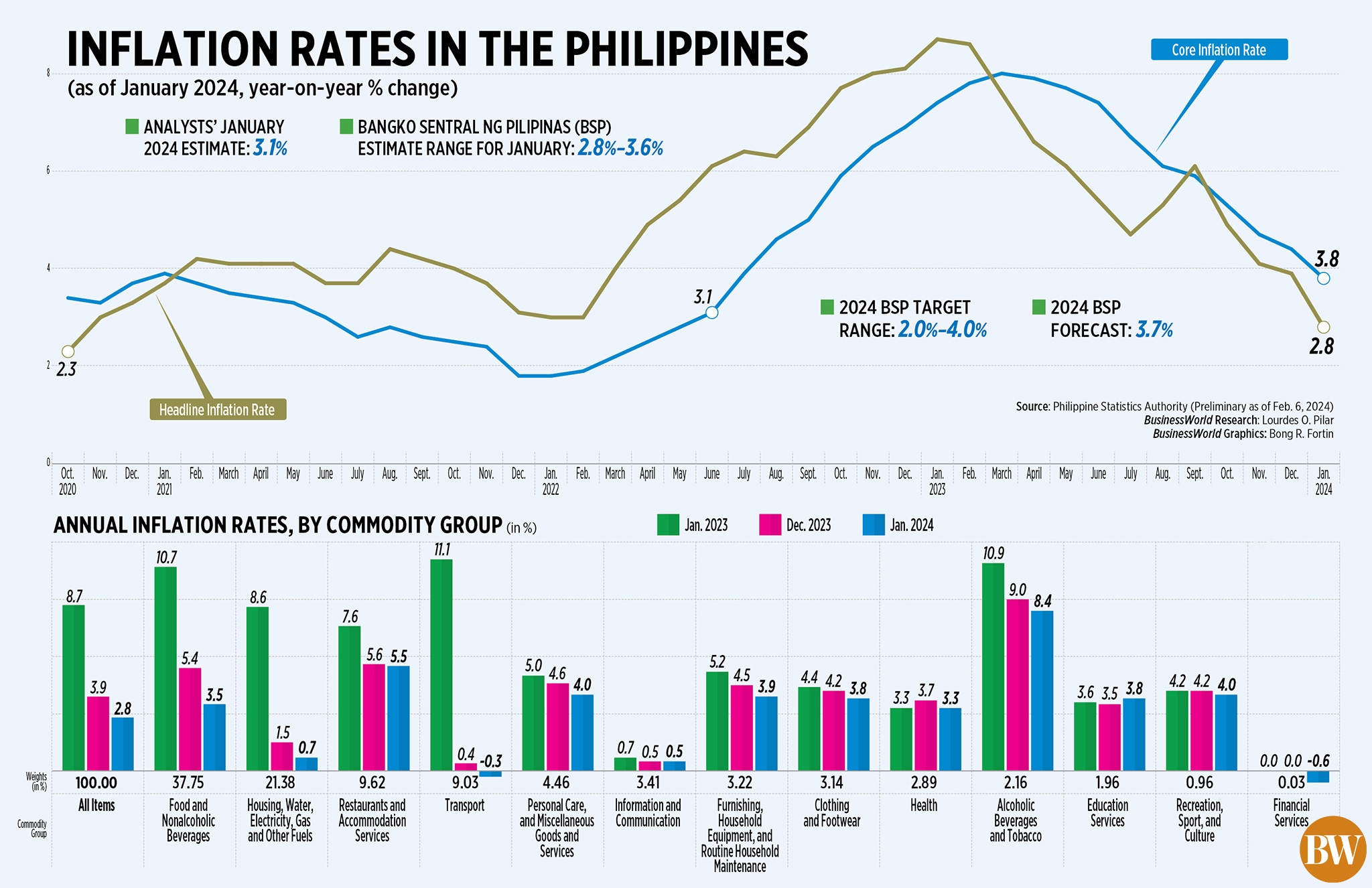
Headline inflation slowed to 2.8% in January from 3.9% in November and 8.7% a year ago, the Philippine Statistics Authority reported on Tuesday.
This was the slowest print recorded in three years or since the 2.3% seen in October 2020, during the coronavirus pandemic.
The January consumer price index (CPI) was below the 3.1% median estimate in a BusinessWorld poll last week and was at the lower end of the BSP’s 2.8-3.6% forecast for the month.
It also marked the second straight month that inflation was within the central bank’s 2-4% annual target.
The BSP on Tuesday said slower January CPI is consistent with its view that inflation is likely to ease this quarter due to a higher base and easing supply issues.
However, it noted that inflation may accelerate anew by the second quarter due to lingering risks, such as the impact of El Niño weather conditions.
“The balance of risks to the inflation outlook still leans significantly towards the upside. Key upside risks are associated with potential pressures emanating from higher transport charges, increased electricity rates, higher oil prices, and higher food prices due to strong El Niño conditions. Meanwhile, the impact of a relatively weak global recovery and the government measures to mitigate the effects of El Niño could ease some price pressures,” the BSP said.
“Looking ahead, the Monetary Board deems it necessary to keep monetary policy settings sufficiently tight until a sustained downtrend in inflation becomes evident. The BSP will consider the latest inflation and GDP (gross domestic product) outturns for the Monetary Board’s policy meeting on Feb. 15,” the central bank added.
The BSP raised benchmark interest rates by 450 bps from May 2022 to October 2023, bringing the policy rate to a 16-year high of 6.5%.
Meanwhile, the Fed kept its target rate steady at the 5.25-5.5% range for the fourth straight meeting last week.
Fed Chair Jerome H. Powell said after their two-day review that they are unlikely to ease their policy stance in their March 19-20 meeting amid lingering inflation risks.
The US central bank hiked borrowing costs by 525 bps from March 2022 to July 2023.
The BTr plans to raise P210 billion from the domestic market this month, or P60 billion via Treasury bills and P150 billion through T-bonds.
The government borrows from local and foreign sources to help fund its budget deficit, which is capped at 5.1% of gross domestic product this year or P1.39 trillion. — AMCS
HEADLINE INFLATION sharply decelerated to an over three-year low of 2.8% in January, marking the second straight month it fell within the Bangko Sentral ng Pilipinas’ (BSP) 2-4% target range. Read the full story.