
Inflation rates in the Philippines
HEADLINE INFLATION sharply decelerated to an over three-year low of 2.8% in January, marking the second straight month it fell within the Bangko Sentral ng Pilipinas’ (BSP) 2-4% target range. Read the full story.
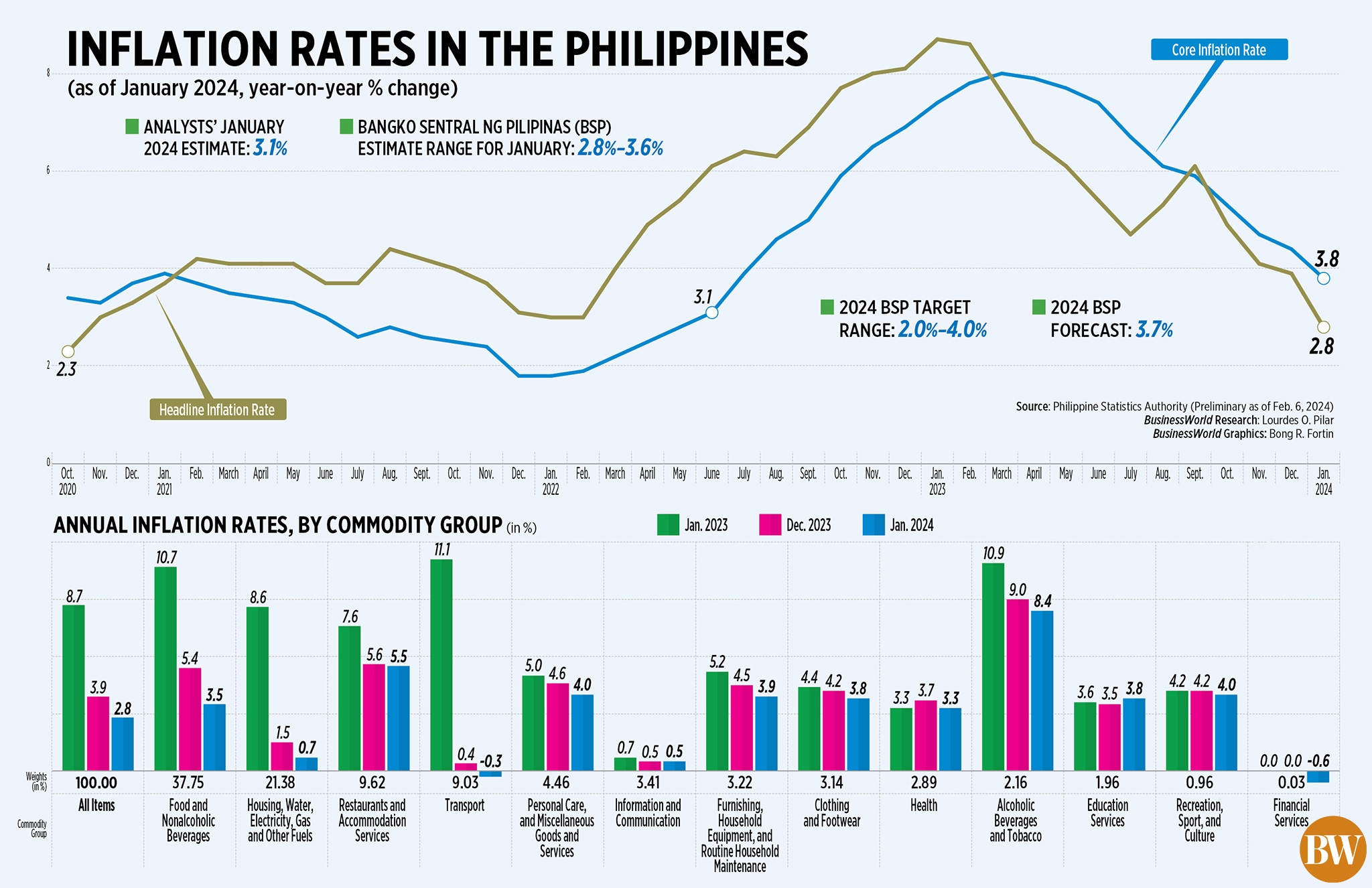
HEADLINE INFLATION sharply decelerated to an over three-year low of 2.8% in January, marking the second straight month it fell within the Bangko Sentral ng Pilipinas’ (BSP) 2-4% target range. Read the full story.








TWENTY-seven-year-old artist Nina Bantoto, who is diagnosed with autism, has an ongoing solo exhibit titled “Enter the Dragon” at Galerie Joaquin. The exhibit showcases her fascination with the Chinese Zodiac animals, perfectly suited to the upcoming Year of the Dragon. Ms. Bantoto and her parents established Arte Autismo Filipino (AAF) in 2019, a social enterprise composed of parents and their artistic children with autism. Ms. Bantoto’s favorite mediums are acrylic paints, watercolor, charcoal, and colored pencils, and recently, she started working on digital art. Her exhibit runs until Feb. 15 at the Galerie Joaquin at the Podium Mall, Ortigas, Mandaluyong City.
THE landmark exhibition “Love is Like a Heat Wave,” featuring works by the late Filipina-American artist Pacita Abad, celebrates the 20th anniversary of her iconic Cultural Center of the Philippines exhibition, “Circles in My Mind” (which was the final presentation of the artist’s work before her passing in 2004). The pieces in the new show are part of a series of works on paper produced during her residency at the Singapore Tyler Print Institute (STPI) in 2003, where she explored her longstanding interest in color and material culture. Rounding out the exhibition are Ms. Abad’s rarely exhibited floral oil-on-paper monoprints, created during her residence in Jakarta in the late 1990s. “Love Is Like a Heat Wave” is on view the Silverlens Gallery Manila, 2263 Don Chino Roces Ave. Ext., Makati City, until March 16.
DUE to the enthusiastic response from the Filipino audience, GMG Productions has announced the final extension dates of Cameron Mackintosh’s production of Boublil and Schönberg’s Miss Saigon in Manila. The production will now run until May 12 at The Theatre at Solaire. The cast is led by Abigail Adriano as Kim, Seann Miley Moore as the Engineer, Nigel Huckle as Chris, Laurence Mossman as Thuy, Kiara Dario as Gigi, Sarah Morrison as Ellen, and Lewis Francis as John. Tickets to the new playdates are available onlinethrough TicketWorld.
THE British Council is now accepting applications for its International Collaboration Grants, a £1-million grant program designed to foster innovative artistic and cultural collaborations between the UK and the Philippines. Applicants in the Philippines can apply for grants of up to £75,000 (P5 million), for projects that enable genuine international collaboration between the UK and partner countries. Projects can address any theme and are required to include at least one UK-based organization and one organization based in the Philippines. An information session will be held on Feb. 13 and 14 while the deadline for applications is on April 30. For more details, visit https://www.britishcouncil.org/arts/international-collaboration-grants.
THE exhibit “Cross Currents,” co-produced by Alliance Française de Manille, Qube Gallery, and Eskinita Art Farm as part of the “10 Days Before Art Fair Philippines,” presents artists from Luzon and the Visayas in an exhibit in Makati. It highlights the diverse artistic heritage of these regions and offers a visual narrative that traces the evolution of contemporary art in the Philippines, deeply rooted in cultural history. The exhibit runs until March 9 at the AFM Gallery on 209 Nicanor Garcia Street, Makati City.
THIS Valentine’s Day, lovers and art lovers can get their gifts from the Fundacion Sansó Museum Shop, which recently launched their latest collection of art prints and gifts. These include elegant Sansó fans that come in florals and soothing landscapes, Sansó-print ceramic his-and-hers mugs with matching coasters, silk scarves and twinning T-Shirts in various designs, and bohemian blouses done in collaboration with Inday Cadapan. Check these items out at the Fundacion Sansó Museum Shop on 32 V. Cruz St., Brgy. Sta. Lucia, San Juan, or shop online at fundacionsanso.shop.
FOR Dr. Renato Cheng, painting is not work; it’s a joyous expression, and his latest exhibition, “Landscape Memories,” showcases pieces that are romantic renditions of nature. Some offer optical illusions, where colors shift and transform. They are currently on view until Feb. 20 at ArtistSpace at the Ayala Museum Annex on Makati Ave. corner De La Rosa St., Greenbelt Park, Makati City.

Newspaper reports say Metro Manila’s traffic gridlock is the worst, or at least one of the worst, in the world. Television news constantly features the horrendous visual congestion that is said to cost the country something like P3 billion per day!
These days there are debates about the suggested need for a “traffic czar.” The Metropolitan Manila Development Authority (MMDA) manager disputes this, saying it is not needed. Does he have a better solution? Every budget year, the National Government allocates billions of pesos for more and more infrastructure in Metro Manila that is supposedly designed to loosen the overcrowding; yet it just seems to get worse and worse.
The problem, it seems to me, is the inability to think strategically about this. More one-ways, more skyways, and more high rails have not helped. These are more expensive interventions versus symptoms, but not versus the causes.
What, fundamentally are the causes of the heavy traffic?
About 40 years ago, the late former Cebu governor Lito “Promdi” Osmeña, in reply to my question as to how he would solve the traffic problem, said: “Two things. Move the national capital to Clark. And hire private contractors to build a highway around the Laguna Lake. The latter should not cost the government anything since the contractors could be authorized to develop properties alongside the reclaimed highway. And Clark has a first-class airport and deep harbors in nearby Subic.” That, I thought, was the strategic solution! I have not come across better ideas since then. Why the government has not made it happen, I do not know.
Cebu City traffic threatens to become like Metro Manila’s sooner rather than later. Fortunately, the provincial government is finally acting on Lito Osmeña’s plan to move the Cebu provincial capital to Balamban town in West Cebu, where only 20% of the population of Cebu resides. Western Cebu could certainly use the intervention as it has a great deal of poverty.
Perhaps the government entities involved in dealing with Metro Manila traffic should get together with the private sector and organize a planning group that will work out strategic plans, rather than continue with the endless petty ideas that have been brewing for decades, with no perceptible improvement.
There is too much government money already being spent in the National Capital Region (NCR). Perhaps if more of the billions are allocated to provincial development centers, fewer people will move to Manila; and more and more NCR residents will return or move to the provinces. If a survey is done, we will probably find that most of the residents of Metro Manila have a home province elsewhere. I was one of those until, thank heavens, I chose to go back to Cebu when I retired in 2006.
If Clark becomes the national capital, Central Luzon will flourish. If more money is invested in Mindanao, this issue of separating the region from the country will become irrelevant.
The current government’s proclaimed drive to bring in more foreign direct investments should encourage — with tax and other incentives — specific provincial locations for these investments. Ever since the Local Government Code of 1991 which President Corazon Aquino aggressively pushed for, many provinces have been able to enhance their attractiveness to investors. Local government executives and bureaucrats should be oriented on these incentives and learn to be investor friendly. In fact, investments in the Metro Manila area should be discouraged with taxes and other disincentives. More and more job opportunities at home will discourage probinsiyanos from moving to Metro Manila.
There is too much at stake with this grievous traffic problem. OMG, P3 billion per day! What that could do for the rest of the country! What that could do for our millions of poor and hungry families!
Teresa S. Abesamis is a former professor at the Asian Institute of Management and fellow of the Development Academy of the Philippines.

By Patricia B. Mirasol, Multimedia Producer
BEING UPFRONT about the condition of the cars in your lot is necessary to succeed in the used car business, according to an industry entrepreneur.
Nothing beats first-hand experience either, Roger “Rocky” A. Zambarrano said.
“Kailangan talaga sipag [You really need to work hard],” Mr. Zambarrano told BusinessWorld, adding this adds significantly to a seller’s knowledge of the market.
“Minsan magkakamali ka ng assessment mo, minsan hindi mo mave-verify ’yung papeles. Minsan may biglang lalabas na sira ng kotse, so kailangan mo aralin talaga [Sometimes your assessment of a car will be wrong, other times, you’ll have trouble verifying a car’s papers. Other times still, you’ll be faced with unexpected problems so you really need to study the business].”
Mr. Zambarrano handles three businesses — a meat shop, an antiques buy-and-sell, and a car buy-and-sell — although the latter is his bread and butter.
He started buying and selling cars as a college student in 2010 and now rents a lot in the Tandang Sora area in Quezon City where he has an average inventory of 15-20 cars.
Among his current inventory is a 2007 BMW, a couple of Hyundai Accents, and various Toyotas.
“I get the cars, I fix the cars that need to be fixed. I also do the selling — para wala ng ibang kausap ’yung tao [so the buyer won’t need to talk to anyone else],” he said.
BUYER PREFERENCES
Toyota Vios and Toyota Innova are the models that are most popular among used car buyers, says Mr. Zambarrano.
“Preferably, Toyota pa rin. Kahit maliit ’yung margin, ’yung volume, ’yung habulan [Toyotas are preferred. Even if the profit margin is low, you can compensate volume-wise].”
Japanese cars, in general, sell within one to three months, European cars, meanwhile, have a six to 12 month turnover.
Mr. Zambarrano says the profit margin ranges between 5-10%, adding that he marks up “if I see that matagal sa pintura or matagal darating ’yung parts [if I see that fixing the vehicle will take time].”
About 5% of his business is now also geared towards motorcycle enthusiasts, to address the need of the growing niche.
He started selling scooters during the COVID-19 pandemic because they were fast moving, but then switched to bigger bikes such as Ducatis because “the profit [for selling scooters] wasn’t rewarding compared to the work done.”
“Maganda actually bentahan ng big bikes nung [The sales for big bikes have been pretty good during the] pandemic until now,” he told BusinessWorld.
Mr. Zambarrano also said his business taught him how to take loss with grace, adding he learned this when sales of a particular model fell after a competitor lowered their prices.
“Our net loss was about P30,000-40,000 per unit,” he said.
MARKET STATISTICS
The Philippine used car market was valued at $75.18 million (or P4.2 billion) in 2024, according to Mordor Intelligence, a market intelligence and advisory company. The market is projected to grow to $115.37 million (or P6.48 billion) in the coming five years — a compound annual growth rate of 7.4% in terms of revenue.
The Hyderabad-headquartered company said the preference for private transportation increased at the height of the pandemic when people became more concerned about personal health and hygiene. This created opportunities for the Philippine used car market, its 2024-2029 forecast reported.
Meanwhile, joint data from the Chamber of Automotive Manufacturers of the Philippines, Inc. (CAMPI) and the Truck Manufacturers Association showed that new motor vehicle sales reached 314,843 units from January to September 2023, growing at a rate of 26.9% more than the 248,154 units in the same period in 2022.
Rommel R. Gutierrez, CAMPI’s president, said the chamber sees a robust 2024 for the automotive sector, given expectations of slower inflation and a more robust economic growth trajectory.
“[Selling 500,000 units] is possible. We had 21.9% growth last year. It is near 500,000 units sold,” he said in January.
STARTING OUT
There already are a lot of players in the car buy-and-sell business, Mr. Zambarrano said, noting that there are six of them in his subdivision alone.
Aspiring entrepreneurs will have to weigh factors such as where to acquire cars (whether from bank repossessions, middle agents, friends), as well as the market they want to serve.
“How much you need as capital depends on what your market is. Maglo-low budget ka ba [Will you go low budget] or high value?” Mr. Zambarrano asked. “Siyempre, payo ko [Of course, my advice] for those starting out is to go low- to mid-range.”
Mr. Zambarrano, who grosses P100,000-300,000 per month, said it isn’t all about the money.
Be honest, he said.
“If you’re only thinking about the profit, it will not roll,” he told BusinessWorld. “Important sa business that you’re very honest sa pagbibilhan mo. Pati sa pinagbebentahan mo, kailangan honest ka [It’s important in business to be honest to both the person you’re buying from, and the person you’re selling to].”
“Lahat ng nakikita kong flaws, sinasabi ko [I disclose all the flaws that I discover],” he added.

THE GOVERNMENT rejected all bids for the reissued five-year Treasury bonds (T-bonds) it offered on Tuesday as investors asked for higher rates even as inflation slowed sharply last month.
The Bureau of the Treasury (BTr) did not accept any tenders for its offer of P30 billion in reissued five-year bonds on Tuesday despite total demand reaching P53.426 billion, higher than the amount on the auction block.
Had the Treasury made a full award, the bonds, which have a remaining life of four years and 11 months, would have fetched an average rate of 6.219% as tendered yields ranged from 6.09% to 6.27%.
This average rate is 14.6 basis points (bps) higher than the 6.073% quoted for the papers when they were first offered on Jan. 9 and 9.4 bps above the 6.125% coupon fetched for the series.
It is also 13.3 bps above the 6.086% seen for the same bond series and 5.6 bps higher than the 6.163% quoted for the five-year bond at the secondary market before Tuesday’s auction, based on PHP Bloomberg Valuation Service Reference Rates data provided by the Treasury.
The government did not award any five-year bonds due to higher bid yields compared with secondary market rates, Rizal Commercial Banking Corp. Chief Economist Michael L. Ricafort said in a Viber message.
“The flexibility to reject higher bid yields would have been due to the upcoming retail Treasury bond (RTB)… in view of P700-billion RTBs maturing by early March 2024,” Mr. Ricafort said.
The BTr is looking to raise at least P30 billion from its offer of five-year retail Treasury bonds, which will also have an exchange component for holders of three- and five-year RTBs maturing next month, it announced on Tuesday.
The Treasury will hold a rate-setting auction for the retail bonds on Feb. 13, which will also be the start of the public offer period and submission of bond exchange offers. The offering is scheduled to end on Feb. 23, unless closed earlier by the Treasury.
The new retail bonds will be issued on Feb. 28.
“The Bureau of Treasury has likely decided to reject today’s bids to provide investors with sufficient time to reassess their local bond yield expectations following the softer domestic inflation report released earlier today,” a trader said in an e-mail on Tuesday.
“The latest easing headline inflation trend would also support lower borrowing costs for the government in the coming weeks or months, especially if the Federal Reserve starts cutting rates later in 2024 that could be matched locally if inflation is well within the Bangko Sentral ng Pilipinas’ (BSP) inflation target of 2-4% for the coming months,” Mr. Ricafort added.
Headline inflation slowed to 2.8% in January from 3.9% in November and 8.7% a year ago, the Philippine Statistics Authority reported on Tuesday.
This was the slowest print recorded in three years or since the 2.3% seen in October 2020, during the coronavirus pandemic.
The January consumer price index (CPI) was below the 3.1% median estimate in a BusinessWorld poll last week and was at the lower end of the BSP’s 2.8-3.6% forecast for the month.
It also marked the second straight month that inflation was within the central bank’s 2-4% annual target.
The BSP on Tuesday said slower January CPI is consistent with its view that inflation is likely to ease this quarter due to a higher base and easing supply issues.
However, it noted that inflation may accelerate anew by the second quarter due to lingering risks, such as the impact of El Niño weather conditions.
“The balance of risks to the inflation outlook still leans significantly towards the upside. Key upside risks are associated with potential pressures emanating from higher transport charges, increased electricity rates, higher oil prices, and higher food prices due to strong El Niño conditions. Meanwhile, the impact of a relatively weak global recovery and the government measures to mitigate the effects of El Niño could ease some price pressures,” the BSP said.
“Looking ahead, the Monetary Board deems it necessary to keep monetary policy settings sufficiently tight until a sustained downtrend in inflation becomes evident. The BSP will consider the latest inflation and GDP (gross domestic product) outturns for the Monetary Board’s policy meeting on Feb. 15,” the central bank added.
The BSP raised benchmark interest rates by 450 bps from May 2022 to October 2023, bringing the policy rate to a 16-year high of 6.5%.
Meanwhile, the Fed kept its target rate steady at the 5.25-5.5% range for the fourth straight meeting last week.
Fed Chair Jerome H. Powell said after their two-day review that they are unlikely to ease their policy stance in their March 19-20 meeting amid lingering inflation risks.
The US central bank hiked borrowing costs by 525 bps from March 2022 to July 2023.
The BTr plans to raise P210 billion from the domestic market this month, or P60 billion via Treasury bills and P150 billion through T-bonds.
The government borrows from local and foreign sources to help fund its budget deficit, which is capped at 5.1% of gross domestic product this year or P1.39 trillion. — AMCS
HEADLINE INFLATION sharply decelerated to an over three-year low of 2.8% in January, marking the second straight month it fell within the Bangko Sentral ng Pilipinas’ (BSP) 2-4% target range. Read the full story.
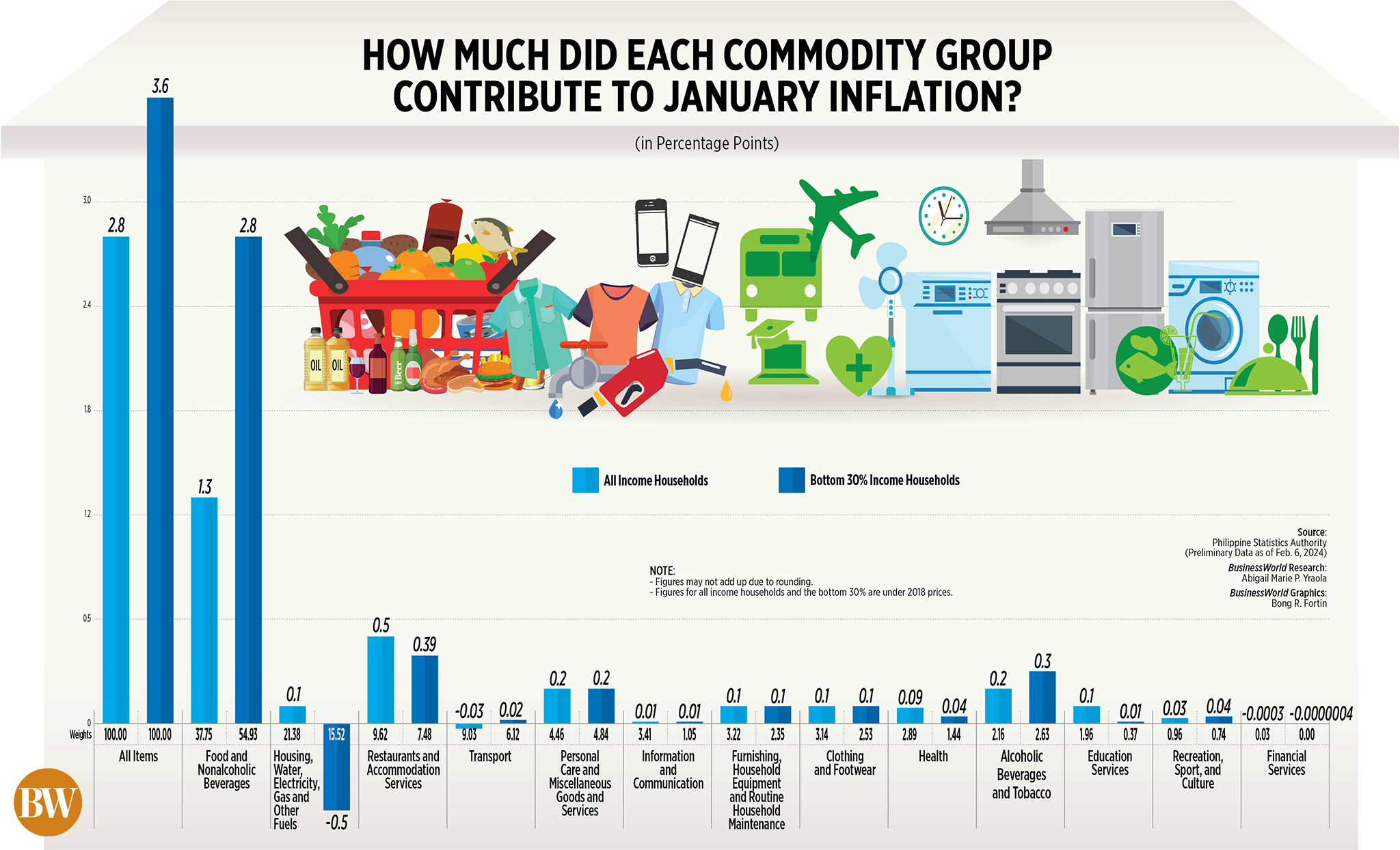

SECURITY BANK Corp. expects its credit card billings and cards in force to continue growing this year, an official said.
“Our target this year for billings is almost double. For cards in force, our target is close to 700,000 coming from 507,000 [last year],” Security Bank First Vice-President and Unsecured Lending Head Christian Eugene S. Quiros told reporters on Monday.
“Right now, I think the credit card industry has gone out of the pandemic stage. That’s why even the other banks are not saying they are growing. It’s just that we’re growing faster than them,” he added.
At end-2023, Security Bank’s cards in force grew by 30% year on year, while its billings rose by almost 50% to around P76 billion from P50 billion in 2022, Mr. Quiros said. New approvals also increased by 45%.
Growth this year will be boosted by Security Bank’s plan to launch an online cards platform in the coming months to allow cardholders to redeem rewards easily, he said.
“Once we launch this platform, it will enable them to choose from thousands of partner merchants. So, they can convert it to miles, vouchers, cash, or credit on their own,” he said.
Meanwhile, Security Bank on Monday launched the Wave Mastercard, which has no annual fee and offers 1% cashback on all online purchases.
“For us to really grow the cards in force, we revisited the customer value proposition of the cards. That’s why we came up with this decision to launch a no frills card,” Mr. Quiros said.
“Last January, we approved new cards close to 20,000, but of course we have to consider attrition. If some would go bad and if cards get delinquent, they might not be able to use them anymore. So, we target to at least approve or process 8,000 Wave Mastercards this year. Next year, it will incrementally increase,” he added.
The Wave Mastercard is made of 100% recycled PVC, making it the bank’s first credit card made of fully recycled material.
“So far, we did some pencil pushing in terms of profitability because it’s more expensive than the usual plastic, but what’s important is we’re able to help the environment. Our direction is to continue it, so most probably, our next card will be recycled,” Mr. Quiros said.
Security Bank saw its net income rise by 14.73% year on year to P2.65 billion in the third quarter of 2023.
Its shares went up by P1.05 or 1.46% to end at P73 apiece on Tuesday. — A.M.C. Sy

MAYNILAD Water Services, Inc. said on Tuesday that it had started the initial operations of its newly constructed sewage treatment plant (STP) in Marulas, Valenzuela City, treating around 12 million liter per day (MLD) of wastewater.
The STP is designed to treat wastewater generated by some 300,000 customers within nine barangays in Valenzuela City, the company said in an e-mailed statement.
It will be able to collect and treat wastewater of up to 60 MLD once it has installed the 27.4-kilometer sewer network in the city within the year.
In particular, the STP will provide services to barangays Gen. T. De Leon, Karuhatan, Malinta, Marulas, Maysan, Parada, Paso De Blas, and portions of Lingunan and West Canumay.
Maynilad said that the Valenzuelaa STP serves as its 23rd wastewater treatment facility. It is expecting to have 27 wastewater treatment facilities by 2027 with the completion of the ongoing construction of four new ones in Las Piñas, Bacoor, and Tunasan and Cupang in Muntinlupa City.
The company is also upgrading a wastewater facility in Caloocan City.
“The Valenzuela Water Reclamation Facility is also among the STPs that Maynilad plans to eventually tap for the production of NEW WATER, or potable supply sourced from used water,” it said.
Maynilad serves Manila, except portions of San Andres and Sta. Ana. It also operates in Quezon City, Makati, Caloocan, Pasay, Parañaque, Las Piñas, Muntinlupa, Valenzuela, Navotas, and Malabon.
It also supplies the cities of Cavite, Bacoor, and Imus, and the towns of Kawit, Noveleta, and Rosario, all in Cavite province.
Metro Pacific Investments Corp., which has a majority stake in Maynilad, is one of three Philippine units of Hong Kong-based First Pacific Co. Ltd., the others being Philex Mining Corp. and PLDT Inc.
Hastings Holdings, Inc., a unit of PLDT Beneficial Trust Fund subsidiary MediaQuest Holdings, Inc., has an interest in BusinessWorld through the Philippine Star Group, which it controls. — Sheldeen Joy Talavera

Business organizations, like any other ventures, are not immune to the complexities of economic downturns that may be brought about by volatile market conditions, shifting consumer preferences, or unforeseen global events. Whether it is a multinational corporation navigating international markets or a small family-owned business operating in a local community, the impact of economic fluctuations can reverberate across industries and sectors. When faced with such challenges, businesses often find themselves navigating treacherous financial waters, struggling to stay afloat and maintain their operations to continue as a going concern. This is where the importance of financial rehabilitation becomes paramount. It offers businesses the opportunity to regain their financial footing and restore stability.
Under Section 7, Rule 2 of the 2013 Financial Rehabilitation Rules of Procedure (FR Rules), if the court finds the petition for rehabilitation to be sufficient in form and substance, it shall, within five working days from the filing of the petition, issue a Commencement Order, which shall include a Stay Order. Pursuant to Section 16 of the Financial Rehabilitation and Insolvency Act (FRIA) of 2010, this Stay or Suspension Order has the effect of, among others, suspending all actions or proceedings in court or otherwise, for the enforcement of all claims against the debtor, as well as suspending all actions to enforce any judgment, attachment, or other provisional remedies against the debtor.
While this Stay Order suspends all actions for claims against a business organization undergoing rehabilitation, it does not, however, work to divest a court of its jurisdiction over a case properly filed before it. As held in Philippine Airlines v. Spouses Sadic and Aisha Kurangking, et. al. [2002], the reasons behind the suspension of all claims are the following: 1.) to enable the rehabilitation receiver to effectively exercise its or his powers free from or unburdened by any judicial or extrajudicial interference that might unduly hinder or prevent the rescue of the debtor company; and, 2.) to enable the management committee or the rehabilitation receiver to substitute for the defendant in any pending action against it before any court, tribunal, board, or body. The law’s mandate is to consolidate the resolution of all such legal proceedings by and against the debtor to the rehabilitation court.
These claims include all claims or demands of whatever nature or character against the debtor or its property, whether for money or otherwise, liquidated or unliquidated, fixed or contingent, matured or unmatured, disputed or undisputed, including, but not limited to: 1.) all claims of the government, whether national or local, including taxes, tariffs, and customs duties; and, 2.) claims against directors and officers of the debtor arising from acts done in the discharge of their functions falling within the scope of their authority (Sec. 3, FRIA).
However, ensuring that other courts and tribunals are properly informed of the rehabilitation proceedings and the issuance of the Commencement Order that involves or affects the party litigants, whether as creditor or debtor, presents a practical challenge. In many cases, courts and tribunals are not promptly notified of such orders, thereby resulting in separate suits or appeals questioning orders or judgments rendered in violation of the Commencement Order. To illustrate, in cases where multiple creditors are involved, individual creditors may pursue separate legal actions against the same debtor, unaware of the ongoing rehabilitation process. This fragmented approach not only complicates the resolution of claims, but also hampers the debtor’s ability to restructure and regain financial stability. Further, it may result in conflicting judgments and prolonged legal battles, exacerbating the delays in the overall rehabilitation process and thereby impeding the debtor’s chances of successful recovery.
Therefore, to address this issue and to streamline the rehabilitation process, the Supreme Court En Banc outlined the guidelines on the matter of providing actual notice to the concerned courts or tribunals regarding the financial rehabilitation proceedings in its July 11, 2023 decision in the case of Pacific Cement v. Oil and Natural Gas Commission, G.R. No. 229471. The Supreme Court set the following guidelines to be observed in the conduct of financial rehabilitation proceedings pursuant to FRIA and FR Rules, to wit:
Clearly, the foregoing court-mandated guidelines on proper notification in financial rehabilitation proceedings carry several implications beyond simply ensuring courts are adequately informed. First, these guidelines streamline the legal process, reducing delays and complications in handling rehabilitation cases. Second, they enhance transparency and fairness by ensuring all involved parties are properly notified and have the opportunity to participate in the proceedings. Third, these guidelines promote the efficient resolution of legal matters related to rehabilitation, contributing to the overall effectiveness of the financial rehabilitation system. Finally, by establishing clear protocols for notification, these guidelines help safeguard the rights and interests of debtors, creditors, and other stakeholders involved in the rehabilitation process. All these factors pave the way for the business organization’s successful recovery and continued growth in the ever-dynamic business environment.
The views and opinions expressed in this article are those of the author. This article is for general informational and educational purposes only and not offered as and does not constitute legal advice or legal opinion.
Wildy L. Pahayahay is an associate of the Angara Abello Concepcion Regala & Cruz Law Offices (ACCRALAW), Davao Branch.
(6382) 224-0996

IMPROVED CYBERSECURITY and data security measures — including the adoption of a Privacy by Design (PbD) approach — can create a privacy-oriented retail environment, in turn building trust among consumers, according to a fintech expert.
PbD is the integration of privacy in the creation of devices, infrastructure, and policies. Examples of it include the end-to-end encryption of the messaging app, WhatsApp, as well as the differential privacy efforts of technology giant Apple, which helps prevent the extraction of data by adding noise to it.
This approach can also be practiced by family-owned stores, says Aleksei Kosenko, the president of UnaCash, a financial solutions provider that offers Buy Now, Pay Later (BNPL) services to merchants.
“It is practical for small businesses like mom-and-pop shops to follow PbD principles, even with limited resources,” he said in a Feb. 5 e-mail.
Mom-and-pop shops can tailor this to a minimum, he said, by “using tools to protect data without exhausting resources, and being clear in cascading data privacy rules on simple terms through their respective platforms [such as their website and social media] to secure data.”
Mr. Kosenko told BusinessWorld that embracing PbD early on helps build confidence among consumers, while shielding the business from data-related risks.
ONLINE RETAIL GROWTH
A November 2023 study by UnaCash found that the gross merchandise value (GMV) for BNPL purchase options is expected to increase by 173% in 2024.
The e-Conomy SEA report by Google, Temasek Holdings, and Bain & Co., meanwhile, projects a $24-billion GMV for Philippine e-commerce next year, surging to about $60 billion by 2030.
GMV is the total amount of sales a company makes over a specified period.
Statista, a market data portal, estimates that the number of e-commerce users in the Philippines will reach 60.41 million in 2027.
The Philippines’ gains in digitalization highlights the need for a balance between retail transformation and data protection, Mr. Kosenko said.
“We anticipate a sophisticated retail system, where predictive analytics and learning will not only enhance operation efficiency but also contribute to privacy-preserving solutions,” he e-mailed in a Jan. 31 statement.
The foremost goal for companies, he said, is the reduction of data breaches and online attacks through the implementation of a compliant data center infrastructure.
“This has a higher chance of security and is a holistic approach to data protection in the retail sector,” added Mr. Kosenko.
“Over time, a significant number of e-commerce players in the Philippines may adhere to the principles of PbD,” he also said, which “underscores the importance of prioritizing data confidentiality… to safeguard a robust data security ecosystem.” — Patricia B. Mirasol
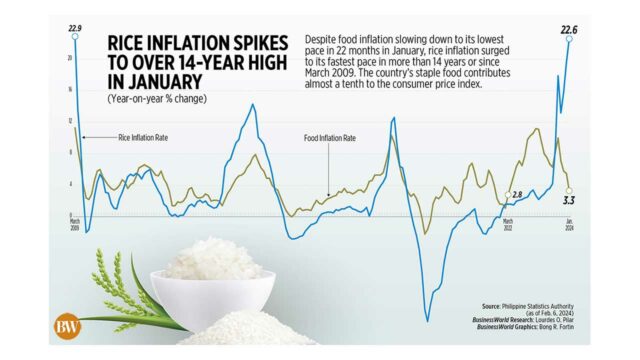
HEADLINE INFLATION sharply decelerated to an over three-year low of 2.8% in January, marking the second straight month it fell within the Bangko Sentral ng Pilipinas’ (BSP) 2-4% target range. Read the full story.

LOS ANGELES — Taylor Swift’s record-setting night at the Grammys drew the largest audience for music’s highest honors since a pre-pandemic show in 2020, broadcaster CBS said on Monday.
Television viewership averaged roughly 16.9 million people for the three-hour-plus ceremony shown live from Los Angeles, according to Nielsen data released by CBS. That was a 34% jump from last year.
Ms. Swift made history during Sunday’s telecast, winning an unprecedented fourth Album of the Year award with her pop record Midnights, and women swept the major awards. Ms. Swift also used the occasion to announce a new album.
TV viewership for traditional television, and entertainment award shows in particular, has been on the decline in recent years as viewers shift to streaming. Audiences dwindled even more during the constrained awards shows put on during the COVID-19 pandemic.
Sunday’s Grammy tally is close to last year’s audience for the Academy Awards, which drew about 18.7 million viewers.
The largest audience on US television every year is the Super Bowl football championship, which typically draws around 100 million viewers.
CBS said live streaming viewership of the Grammys hit a record on Paramount+, jumping 173% from a year ago, but it did not provide the size of the streaming audience. — Reuters
