Home Blog Page 367

Intellicare’s 30-year legacy sets the tone for a strong 2026

HMO leader continues to expand the ripple of care to employees, members, partners

Leading HMO provider Intellicare reinforces its longstanding commitment to Leading the Ripple of Care, a philosophy rooted in gratitude, performance, and purposeful growth, as it marks 30 years in healthcare management and advances its vision to 2026.

Intellicare commemorated this milestone in a recent Thanksgiving event with the theme Pearls of Celebration at the SMX Convention Center Manila, bringing together employees and steadfast clients and long-time partners, including employee health care benefit administrators and intermediaries, to recognize the shared efforts that have shaped the organization over the years.

“As we gather to celebrate Intellicare’s 30th anniversary, I am filled with a quiet sense of reflection and an overwhelming sense of honor. ‘Leading the Ripples of Care,’ beautifully captures who we are at our core. Because at Intellicare, every act of service creates a ripple that reaches families, communities, and lives far beyond what we witness in a single moment,” said Intellicare Executive Vice-President Audrey Gallardo.

Featuring performances, announcements, and awards, the gathering reflected Intellicare’s three-decade culture of care, one that begins internally, extends to valued partners, providers, members, and eventually to the greater whole of the Philippine healthcare landscape.

“Intellicare’s vision is rooted in a dream embedded in our hearts 30 years ago, carried individually and collectively through challenges, and steadfastly sustained through every high water and storm. With care at our core, we aim to lead the ripple, to have it grow further and be felt deeper,” said Intellicare Chairman Mario Silos.

Robust industry performance

Intellicare demonstrated its dedication to reliable healthcare management following its robust third-quarter performance based on the Insurance Commission’s (IC) 2025 Third Quarter HMO Report. The company recorded a net income of PHP 715 million, the highest among HMOs in the said period. Together with its sister company, Avega Managed Care, Inc., Intellicare accounted for approximately 39% of the industry’s net income for the quarter.

While the company’s numbers have been positive, Intellicare emphasizes that its performance has been rooted in care and humanity.

“Healthcare only happens when people choose to care consistently, ethically, and courageously. We may measure our progress in numbers — lives served, clinics built, teams grown — but our true impact lives in moments: relief after uncertainty, recovery after illness, dignity restored, hope renewed,” said Intellicare President Jeremy Matti.

He ends it with a promise: “Intellicare will continue to lead with integrity, resilience, and heart.”

From L-R: Intellicare President Jeremy Matti, Executive Vice-President Audrey Gallardo, and Intellicare Group Chairman Mario Silos joined by Avega President Norman Amora

Expanding the Ripple of Care

Looking ahead, Intellicare seeks to deliver digital enhancements to the AGORA App as the primary gateway for member services, wider use of electronic RCS (eRCS Express) to simplify referrals and requests for consultations and procedures, as well as improvements to customer service lines through better feedback systems and tools.

The company is also expanding access through Intellicare Locale, a suite of HMO programs designed for budget-conscious MSMEs in regional growth centers.

In addition, Intellicare is deepening the integration of Economic, Environmental, Social, and Governance (EESG) pillars across its operations, from mindful sourcing and support for local suppliers to encouraging sustainable everyday practices among employees.

To know more about Intellicare, visit their website at intellicare.com.ph, or their social media accounts, @Intellicare on Facebook or @IntellicarePH on Instagram, and linkedin.com/company/intellicare-ph on LinkedIn.

About Intellicare

Intellicare (Asalus Corp.) is the Philippines’ preeminent Health Maintenance Organization (HMO) provider that leads and innovates a holistic approach to healthcare management.

Guided by values such as integrity, fairness, honesty, hard work, and enduring sense of humanity, Intellicare upholds every individual’s right to health by making quality healthcare efficient, accessible, affordable, and compassionate, empowering Filipinos to have better and healthier lives.

Intellicare is dedicated to improving the health and well-being of its members, providing reliable support and peace of mind during times of medical need.

Intellicare is part of Fullerton Health Group, a leading integrated healthcare provider in Asia-Pacific, offering end-to-end services from managed care to diagnostics, specialty care, and ancillary services.


Spotlight is BusinessWorld’s sponsored section that allows advertisers to amplify their brand and connect with BusinessWorld’s audience by publishing their stories on the BusinessWorld Web site. For more information, send an email to online@bworldonline.com.

Join us on Viber at https://bit.ly/3hv6bLA to get more updates and subscribe to BusinessWorld’s titles and get exclusive content through www.bworld-x.com.

Philippines’ Q4 GDP growth sharply slows to 3% amid corruption scandal

The Bangko Sentral ng Pilipinas (BSP) unexpectedly slashed its policy rate by 25 basis points, as it warned the economic outlook has weakened amid a widening corruption scandal. — PHILIPPINE STAR/MIGUEL DE GUZMAN

MANILA (UPDATE) — Philippine economic growth slumped to its weakest in almost five years in the final quarter of 2025, with the full-year pace coming in well behind the government’s target in a sharp blow to this year’s outlook and raising the odds of further rate cuts.

The weak economic performance was in part caused by a corruption scandal tied to infrastructure projects that slowed public spending and undermined consumer and investor confidence.

Gross domestic product expanded 3.0% in the fourth quarter from a year earlier, the slowest pace since the first quarter of 2021 and well below the 4.0% median forecast in a Reuters poll, bringing full-year growth to 4.4%. It was also significantly short of the government’s 5.5% to 6.5% target for the year.

Household consumption grew 3.8% in the fourth quarter year-on-year, and government spending rose 3.7%, both easing from 4.1% and 5.8% in the prior quarter. Gross capital formation contracted 10.9%, a sharper decline from 2.8% in the third quarter.

Department of Economy, Planning and Development Secretary Arsenio M. Balisacan said the depth of the slowdown came as a surprise, but stressed the government was committed to reversing the trend this year through a host of reforms aimed at rebuilding public confidence.

“We see 2026 as our rally point. We are accelerating efforts to restore public trust through improvements in governance and public services,” Mr. Balisacan told a press conference.

Growth is expected to regain momentum, with the government forecasting a 5.0% to 6.0% expansion in 2026 and further acceleration in 2027.

Bangko Sentral ng Pilipinas Governor Eli Remolona said last week that a weaker-than-expected fourth quarter GDP would factor into the central bank’s decision at its February 19 policy meeting.

The central bank has cut its benchmark rate by a cumulative 200 basis points to a three-year low of 4.5% in the current cycle, which Remolona has said was nearing its end.

But some analysts expect more rate cuts this year.

Capital Economics, for instance, is pencilling in additional reductions to borrowing costs in the coming quarters following the disappointing data.

“Authorities have pledged to restart infrastructure projects, which should help to reverse some of the recent weakness in activity. Even so, risks to the outlook remain firmly skewed to the downside,” Capital Economics said in a note. — Reuters

Grab, MOVE IT strengthen on-trip protection with expanded COCOLIFE partnership

MOVE IT General Manager Wayne Jacinto (second from left) and Grab Philippines Head of Central Operations Clarize Morito (left) spearheaded the signing of the memorandum of agreement between the on-demand service platforms and COCOLIFE. With them are COCOLIFE Healthcare Division Head Atty. Alloysius Yebra (3rd from left), First Vice-President and Head of Sales and Marketing Department Christopher V. Tan (right).

Grab Philippines and motorcycle taxi platform MOVE IT have expanded their emergency insurance support with COCOLIFE, widening hospital assistance and financial protection for both rider-partners and passengers in a bid to make coverage more accessible and comprehensive for users of the on-demand mobility services.

Through the deepened partnership, rider-partners and passengers gain 24/7 access to a wider network of more than 700 COCOLIFE-accredited hospitals nationwide for emergency situations involving a Grab or MOVE IT ride.

The expanded hospital assistance with COCOLIFE strengthens Grab Philippines and MOVE IT’s protection ecosystem by addressing the most time-critical gap in on-trip incidents: emergency care and hospitalization support for both rider-partners and passengers.

It is designed to complement existing coverage across the platforms. Grab and MOVE IT’s group personal accident insurance, administered through AIG Philippines, continues to provide complimentary on-trip protection for fatal injuries, permanent disablement, and accident-related medical expenses for passengers and partners, while AXA-backed life and disability protection remains an incentive-based benefit for top-performing driver-, delivery-, and rider-partners.

“Safety and protection have to keep evolving with the realities our partners and passengers face every day,” said Ronald Roda, managing director of Grab Philippines. “This expanded support with COCOLIFE builds on our work to strengthen welfare protection in the gig economy. Grab and MOVE IT remain committed to the people who make every trip possible, and to the passengers who place their trust in us with every booking. We’ll keep investing in stronger safety nets so partners can keep earning with confidence, and passengers can ride with greater peace of mind.”

Under the expanded coverage, Grab and MOVE IT riders and passengers nationwide are entitled to hospital assistance for accidents that occur while a trip is active on the platform. The policy provides up to P50,000 per member per year to help cover essential accident-related healthcare costs, with benefits available for emergency room, inpatient, and outpatient services across COCOLIFE’s accredited hospital network nationwide — with additional assistance available subject to case assessment.

The claiming process was also streamlined so users can access care more quickly during emergencies. A rider or passenger may proceed directly to any COCOLIFE-accredited hospital, which then coordinates with COCOLIFE, Grab, and MOVE IT’s support teams for verification and approval. Once cleared, the user can immediately receive the necessary medical treatment, whether for ER care, admission, or outpatient services.

For on-the-ground assistance, the Grab and MOVE IT Emergency Response Unit works alongside the Incident Response Team to facilitate transfers and endorsements to accredited hospitals when needed, helping ensure prompt admission and treatment.

“Our partnership with COCOLIFE is a clear demonstration that our investment in safety goes far beyond the road — it is protection built on malasakit, from the moment our rider-partners are onboarded to the care we extend after every trip,” said Wayne Jacinto, general manager of MOVE IT. “We know the risks on our urban roads can carry real financial consequences, and we are committed to shielding both our partners and passengers from those shocks so users of our platforms keep moving forward with dignity and security.”


Spotlight is BusinessWorld’s sponsored section that allows advertisers to amplify their brand and connect with BusinessWorld’s audience by publishing their stories on the BusinessWorld Web site. For more information, send an email to online@bworldonline.com.

Join us on Viber at https://bit.ly/3hv6bLA to get more updates and subscribe to BusinessWorld’s titles and get exclusive content through www.bworld-x.com.

EDCOM 2: Only 200k students retained despite declining proficiency rates

EDCOM 2 Executive Director Karol Mark R. Yee at the launch of the commission’s final report in Senate.— ALMIRA S. MARTINEZ

Only 200,000 of the 24 million learners nationwide are being retained in their grade levels despite plummeting proficiency rates, according to the Second Congressional Commission on Education (EDCOM 2) on Tuesday.

“There are only about 200,000 students who get retained. This means that there are students who get retained, but a very slim proportion of the 24 million students that we have,” EDCOM 2 Executive Director Karol Mark R. Yee told BusinessWorld in an interview.

“We really need to understand better if this is a figure that we can trust? Is this a credible figure that is representative of all those who are really struggling?” he added.

In its Final Report, the commission found that separate assessment tests showed “non-proficient” students grew from 30% in Grade 3 up to 74% in Grade 12.

“The steep decline is from Grade 3, Grade 6, Grade 10, and Grade 12,” Mr. Yee said.

“People may be progressing by grade level, they keep getting promoted without really having the knowledge or ensuring that the competencies are really there,” he added.

In terms of reading proficiency, 88% of students struggle to read according to their grade level at the beginning of the school year.

For junior high school students, 40% to 52% are at least two grade levels behind in reading, based on the Philippine Informal Reading Inventory (Phil-IRI) assessment.

“These evince the urgency of addressing mass promotion and the rolling out of well-designed interventions to address literacy gaps at the secondary level,” EDCOM 2 said in its report.

“Literacy is the gateway to learning numeracy, and other competencies across subjects,” it added.

‘Mass promotion culture’
A key issue underscored in EDCOM 2’s report is the country’s mass promotion culture and its correlation with other problems existing within the education system.

“For us, mass promotion is many things. There is no real policy of DepEd (Department of Education) to promote students automatically, but it is a confluence of multiple factors,” Mr. Yee said.

“It is really more about looking at the system as a whole and addressing all of these barriers that stop our teachers from being able to support their students well,” he added.

Teachers’ professional autonomy in deciding learners’ promotion is heavily influenced by the pressure from higher authorities in the school.

“We’ve also heard from many stories of teachers that they usually get castigated by principals or other colleagues,” Mr. Yee said. “If they fail any student they have to justify to the principal, to the division office, why a student had to fail.”

“It seems like they have to prove that they did everything and exhausted all supports available, when in fact no support or very little support was given to them themselves as teachers,” he added.

The DepEd’s policy on grade transmutation also amplifies the demand to pass all students despite not meeting the expected skills and knowledge.

In the Transmutation Table from DepEd Order No. 8 s. 2015, the initial grade of 60 to 61.59 is transmuted to 75, or about a 15-point increase.

“We have constantly been repeating and advocating that it is time to review that policy, maybe phase it out at the soonest possible time,” he said. “It is giving us a semblance of normality, or that everything is okay when in fact it is not.”

EDCOM 2 proposes reconfigurations of the Results-Based Performance Management System (RPMS) and Office Performance Commitment and Review Form (OPCRF) to ensure that no incentives are given related to learners’ promotion.

“The performance of the school is tied to completion rate, passing rates, zero dropout rates, and therefore, it is all connected,” Mr. Yee said.

“As long as we keep doing that, we are really unintentionally reinforcing mass promotion, which is why our position is we need to revise our targets,” he added.

In January, the Alliance of Concerned Teachers Philippines called for the review of RPMS following the death of a public school teacher during her scheduled classroom observation. — Almira Louise S. Martinez

Philippines hosts ASEAN foreign minister retreat to tackle regional issues

Foreign Affairs Secretary Ma. Theresa P. Lazaro at the Extended Informal Consultation on the Implementation of the Five-Point Consensus meeting in Cebu City, Jan. 28, 2026.— ASEAN 2026 PH FB PAGE

CEBU, Philippines — Foreign ministers from Southeast Asia began a meeting on Thursday to tackle key issues in the region, including tensions in the South China Sea, an escalating civil war in Myanmar and a border conflict between Thailand and Cambodia.

The foreign ministers’ retreat of the Association of Southeast Asian Nations aims to set the bloc’s agenda for the year under the chairmanship of the Philippines.

Philippine Foreign Minister Ma. Theresa P. Lazaro told her ASEAN counterparts that the global security environment has become more “challenging” and “more complex and interconnected”.

She vowed that Manila would continue to uphold the international rules-based order, and maintain ASEAN’s adherence to the principles of restraint, dialogue and international law.

“Across our region, we continue to see tensions at sea, protracted internal conflicts and unresolved border and humanitarian concerns,” Ms. Lazaro said in her opening remarks.

“Our meeting today allows us to collectively take stock of ASEAN’s priorities and exchange views on regional and global developments that directly affect us,” she added.

The Philippines recently hosted a dialogue among opponents of Myanmar’s ruling junta in a bid to facilitate dialogue and humanitarian aid.

A 2021 coup in Myanmar triggered widespread protests that were brutally suppressed by the junta, unleashing a civil war involving a loose alliance of rebel groups.

Manila is also aiming this year to finish a long-delayed code of conduct for the South China Sea, where tensions have escalated over the past three years.— Reuters

Fall of top Chinese general stirs US uncertainty about China’s military

REUTERS

WASHINGTON/BEIJING — With the downfall of China’s top general, the United States has lost an important contact on Beijing’s top military body and now faces a People’s Liberation Army that increasingly lacks steady, experienced commanders, said former US officials and analysts.

China’s defense ministry said on Saturday that Zhang Youxia, second-in-command under President Xi Jinping as vice-chairman of the Central Military Commission (CMC), is under investigation. It is the latest and highest-profile purge of the country’s top military leadership amid Mr. Xi’s crackdown on corruption in the armed forces.

For Washington, Mr. Zhang’s surprising demise removes a respected and well-known figure within China’s military at a time when successive US administrations have worked to build senior-level contacts to avoid mishaps between the world’s two most powerful militaries.

Several former senior US officials told Reuters that Mr. Zhang’s dismissal came as a shock.

Mr. Xi allowed Mr. Zhang to communicate with the US during the Biden administration after a 17-month-long period during which China had cut off nearly all military-to-military communications following a visit to Taiwan by then-Speaker of the US House of Representatives Nancy Pelosi.

Such a senior-level connection – in China’s political system, Mr. Zhang outranks the defense minister – was seen as an important relationship and a channel that remained viable for further talks.

One of just a few leading officers with combat experience from China’s invasion of Vietnam in the late-1970s, Mr. Zhang was seen in the US as a competent adviser to Mr. Xi, who sits atop the Central Military Commission, now staffed by only one general, a career political commissar Zhang Shengmin.

“Who does Xi Jinping convene in a crisis if there’s only one person on his commission?” said Drew Thompson, a senior fellow at the S. Rajaratnam School of International Studies in Singapore who engaged with Mr. Zhang as a former US defense official.

Thompson said he believed Mr. Zhang was the one active-duty PLA officer who could give Mr. Xi objective advice about China’s military capabilities and shortcomings, as well as the human cost of conflict.

“There’s a risk that Xi Jinping is given bad advice by sycophants who tell him what he wants to hear,” he said. “That creates a risk of miscalculation.”

A senior US administration official said the White House had nothing to share regarding “reports of palace intrigue” in China, adding that the Trump administration is “building a military capable of denying aggression anywhere in the First Island Chain.”

The Pentagon did not respond to a request for comment. The Chinese Embassy in Washington also did not respond.

NEED FOR INSIGHT AS THE PLA MODERNIZES
US Defense Secretary Pete Hegseth has held talks multiple times with China’s Defense Minister Dong Jun – who does not sit on the CMC – since September, part of US efforts to improve communications with China over its military modernization, nuclear weapons build-up, and more aggressive posture toward US allies and actions in the Indo-Pacific.

But American officials have long prized contact with vice chairs of the CMC over the country’s Defense Ministry, which lacks command authority over China’s armed forces.

Among senior Chinese generals, Mr. Zhang was a known quantity to US officials, having joined a week-long military delegation to the US in May 2012 when he was a lower-level general.

David Stilwell, a former US Air Force General who served as the State Department’s top diplomat for East Asia in the first Trump administration, recalls that Mr. Zhang was the only Chinese officer who wanted to fly in one of the US military’s Osprey aircraft on that trip.

“He is very different from his fellow PLA brothers. He could have fit in very well in the US military,” Mr. Stilwell said, noting that he was keen to talk to US soldiers and try out US weapons, and struck the Americans as a professional rather than political soldier.

Still, Mr. Stilwell said senior-level engagement with CMC generals was typically perfunctory. Without Mr. Zhang to advise Mr. Xi, his main concern was that the PLA was more likely to believe a self-constructed narrative that they were ready for a “Taiwan adventure.”

“I think what you lose with Zhang Youxia gone is a voice of reason,” Mr. Stilwell said.

US interactions with senior CMC generals have been an infrequent feature of bilateral diplomacy over the past two decades.

Biden administration national security advisor Jake Sullivan was the last known senior US official to meet Mr.  Zhang when the two held talks in August 2024 in Beijing.

Eric Hundman, a Chinese military expert at Washington-based security consultancy BluePath Labs, said military-to-military exchanges under Mr. Xi, even at the CMC level, tended to be scripted.

“The PLA knows its capabilities fairly well and is not interested in moving on Taiwan before they think they’re ready. My question mark has always been how much Xi Jinping listens to them on that point,” Mr. Hundman said.

“To the degree that he’s getting worse advice, that would worry me,” he said.— Reuters

US tells UN: Gaza demilitarization to include internationally funded buyback program

REUTERS FILE PHOTO

UNITED NATIONS — The demilitarization of Gaza will include decommissioning weapons through an agreed process “supported by an internationally funded buyback” program, the United States told the UN Security Council on Wednesday.

Palestinian militant group Hamas retains control of just under half of Gaza following an October ceasefire deal brokered by US President Donald Trump. The agreement ties further Israeli troop withdrawals to Hamas giving up its weapons.

The United States – along with the 26 countries who have so far joined Mr. Trump’s so-called Board of Peace and in consultation with the Palestinian National Committee that it oversees – will apply pressure on Hamas to disarm, according to the US Ambassador to the United Nations Mike Waltz.

“Hamas must not have any role in the governance of Gaza, directly or indirectly, in any form, period,” he told the 15-member council. “All military terror and offensive infrastructure, including tunnels and weapon production facilities, will be destroyed and not rebuilt.

“International, independent monitors will supervise a process of demilitarization of Gaza to include placing weapons permanently beyond use through an agreed process of decommissioning and supported by an internationally funded buyback and reintegration program,” he added.

His comments reflect point 13 of Mr. Trump’s 20-point Gaza peace plan.

HAMAS STILL HEAVILY ARMED, SAYS ISRAEL
When asked for more detail on the independent monitoring and proposed buyback program, a US State Department spokesperson said: “Discussions on implementation of phase 2, including demilitarization, are ongoing.”

Hamas recently agreed to discuss disarmament with other Palestinian factions and with mediators, sources have said. However, two Hamas officials told Reuters that neither Washington nor the mediators had presented the group with any detailed or concrete disarmament proposal.

A US official, speaking on condition of anonymity, said on Monday Washington believes disarmament by Hamas militants would come with some sort of amnesty for the Islamist group.

Hamas remains heavily armed, Israel’s UN Ambassador Danny Danon told the Security Council.

“It still holds thousands of rockets, anti-tank missiles, and tens of thousands of Kalashnikov rifles. In total, Hamas still holds roughly 60,000 assault rifles,” Mr. Danon said. “These weapons are used not only against Israel but against Gazans who oppose Hamas rule.”

INTERNATIONAL STABILIZATION FORCE FOR GAZA
The Security Council in November mandated Mr. Trump’s Board of Peace through 2027 and solely focused on the Gaza Strip. Russia and China abstained, complaining the US-drafted resolution did not give the United Nations a clear role in Gaza’s future.

The resolution described the board as a transitional administration “that will set the framework and coordinate funding for the redevelopment of Gaza” under Mr. Trump’s peace plan until the Palestinian Authority has satisfactorily reformed. It also authorized the board to deploy a temporary International Stabilization Force in Gaza.

“We salute and thank our friends who have agreed to contribute to the International Stabilization Force,” Mr. Waltz said. The United States has not yet announced which countries have agreed to contribute.

“The ISF will begin to establish control and stability, so that the Israeli Defense Forces can withdraw from Gaza based on standards, milestones and time frames linked to demilitarization,” said Mr. Waltz.

He added that these would be agreed upon by the Israeli military, the ISF and the guarantors for the ceasefire agreement – the United States, Egypt, and Qatar. — Reuters

Amazon axes 16,000 jobs as it pushes AI and efficiency

REUTERS

AMAZON confirmed 16,000 corporate job cuts on Wednesday, completing a plan for around 30,000 since October, while leaving open the possibility of further reductions.

Reuters first reported last week that Amazon was planning a second round of job cuts as part of its broader goal under CEO Andy Jassy, who has been trying to reduce bureaucracy and abandon underperforming businesses.

Amazon said on Tuesday it was closing its remaining brick-and-mortar Fresh grocery stores and Go markets, despite years of effort, and said it was dropping its Amazon One biometric payment system, which scans the palm of a customer’s hand.

Although 30,000 represents a small portion of Amazon’s 1.58 million employees, who are mostly in fulfillment centers and warehouses, it is nearly 10% of its corporate workforce and represents the largest job cuts in its three decades, surpassing the 27,000 it pared between late 2022 and early 2023.

The job cuts were necessary to strengthen the company by “reducing layers, increasing ownership, and removing bureaucracy” at Amazon, its top human resources executive, Beth Galetti, said in a post.

Ms. Galetti left open the possibility of further reductions, saying some teams will continue to “make adjustments as appropriate.”

The latest cuts mark the second major round of layoffs in three months after Amazon pared 14,000 jobs in October, saying at the time that artificial intelligence and concerns over shifting corporate culture were to blame.

Amazon has also said it overhired during the COVID-19 pandemic, when demand for online shopping skyrocketed.

“Some of you might ask if this is the beginning of a new rhythm – where we announce broad reductions every few months,” Ms. Galetti said in Wednesday’s note. “That’s not our plan,” she said.

‘PROJECT DAWN’
Amazon on Tuesday mistakenly sent an email appearing to refer to the layoff plan as “Project Dawn” to some Amazon Web Services staff, unsettling thousands of workers.

The full scope of the cuts could not be learned, but employees from multiple AWS units, the Alexa voice assistant, Prime Video, devices, advertising and last mile delivery, among others, indicated online and in emails to Reuters that they had been impacted. Additional roles affected include those in Kindle and supply chain optimization, a group within Amazon’s fulfillment unit.

Amazon, which began the corporate job cuts on Tuesday by announcing its plans to close the Fresh and Go stores, did not respond to a Reuters request for comment.

The job cuts also underscore how artificial intelligence is changing corporate workforce dynamics. Significant improvements in AI assistants are helping enterprises execute duties from routine administrative tasks to complex coding problems with rapid speed and precision, driving widespread adoption.

Mr. Jassy said last summer that rising use of AI tools would mean more automation of duties, leading to corporate job losses.

Executives at the World Economic Forum’s annual meeting in Davos said last week that while jobs would disappear, new ones would spring up, with two telling Reuters that AI would be used as an excuse by companies planning to cut jobs anyway.

Tech giants, including Amazon, Facebook-parent Meta Platforms and Microsoft, sharply ramped up hiring during the COVID-19 pandemic demand surge and have lately been restructuring. UPS, Pinterest, and ASML all announced staff reductions in recent days.

Amazon has been investing in robotics at its warehouses to speed up packaging and deliveries for its e-commerce segment, reduce reliance on human labor and cut costs.

Shares in Amazon, which is set to report quarterly results next week, were down 2.1% in regular trading Wednesday.— Reuters

Fed leaves rates unchanged, sees ‘somewhat elevated’ inflation

View of the facade as construction continues on the Federal Reserve Board Building in Washington, DC, Sept. 17, 2025. — REUTERS/KEN CEDENO

WASHINGTON – The Federal Reserve held interest rates steady on Wednesday amid what US central bank chief Jerome Powell described as a solid economy and diminished risks to both inflation and employment, an outlook that could signal a lengthy wait before any further reductions in borrowing costs.

“The economy has once again surprised us with its strength,” Powell said at a press conference after Fed policymakers voted 10-2 to hold the central bank’s benchmark interest rate in the 3.50%-3.75% range following a two-day meeting.

Noting broad internal support for the decision, Powell said the Fed remains “well-positioned” to assess when or whether another rate cut may be needed.

“There could be combinations, infinite numbers of combinations that would cause us to want to move,” he said, with labor market weakening or inflation heading back down to the Fed’s 2% goal as two of those possibilities.

Since the Fed’s last policy meeting in December, when it delivered a third straight rate cut, “the upside risks to inflation and the downside risks to employment have diminished. But they still exist,” Powell said. “We think our policy is in a good place.”

Both Governor Christopher Waller, a contender to replace Powell when his term as central bank chief ends in May, and Governor Stephen Miran, on leave from his job as an economic adviser at the White House, dissented in favor of a quarter-percentage-point rate cut.

The actual rate decision, which was widely expected by financial markets, was overshadowed during the post-meeting press conference as reporters questioned Powell about threats to Fed independence and whether he intended to stay on at the central bank after his term as central bank chief ends in May, a possibility given new life after the Trump administration opened a criminal investigation into him earlier this month.

President Donald Trump has excoriated the Fed and Powell for failing to deliver the large rate cuts the president believes are needed to stimulate the economy.

Powell said at the time that the probe was aimed at pressuring the central bank to cut rates in line with the president’s preferences. The Fed chief on Wednesday declined to comment further on the matter.

But he did have some advice for his successor: “Don’t get pulled into elected politics,” Powell said, adding that the next Fed chief also should work hard at being accountable to Congress, which oversees the central bank.

INFLATION REMAINS ABOVE TARGET
The statement from the policy-setting Federal Open Market Committee offered no hint about when another rate cut might come, noting that “the extent and timing of additional adjustments” to the policy rate would depend on incoming data and the economic outlook, phrasing that Powell also used in his remarks.

“We expect the Federal Reserve to remain on an extended pause. Interest rates are close to neutral and labor market conditions are stabilizing,” Michael Pearce, chief US economist at Oxford Economics, wrote after the policy decision, anticipating that an eventual decline in inflation, still running about 1 percentage point above the Fed’s target, would lead to rate cuts in June and September.

That outlook would likely push the next rate decision to Powell’s successor, who is expected to be nominated by Trump soon and confirmed by the Senate in time to lead the June 16-17 meeting.

It may not be a clear-cut decision if price pressures have not begun declining by then. Inflation has shown little progress over the past year and remains “somewhat elevated” in the view of Fed officials who believe prices are still rising because of the Trump administration’s imposition last year of new tariffs on imported goods.

Powell said he expects the tariff impact to fade by the middle of this year. If that doesn’t happen, it could pose an immediate dilemma for his successor’s management of a policy committee scarred by the rapid rise in prices that followed the COVID-19 pandemic and concerned that five years of above-target price increases may make inflation harder to control in the future.

So far, however, Powell says inflation expectations remain in check, allowing the Fed to watch in particular whether the market remains stable.

Though the Fed noted on Wednesday that “job gains have remained low,” policymakers also removed language from their prior statement saying that downside risks to employment had risen – an indication they as a group are becoming less worried about a rapid downturn.

Fed officials ahead of this week’s meeting had largely characterized the job market as roughly in balance, with the smaller job gains matching the slower growth in the numbers of those seeking employment as a result of the Trump administration’s stricter immigration policies. The unemployment rate in December fell to 4.4%.

Major US stock indexes lost a bit of ground after the release of the policy statement and closed largely flat. The yield on the 10-year Treasury note ticked up to around 4.25%, while the yield on the two-year Treasury note was largely unchanged around 3.57%. Interest rate futures moved to price in the next Fed rate cut at the June meeting. — Reuters

Agri output jumps 2.6% in 2025, fastest since 2017

Fisherman are seen drying fish on a bamboo tray in Long Beach, Noveleta, Cavite.   Photo by EDD GUMBAN, THE PHILIPPINE STAR

By Vonn Andrei E. Villamiel

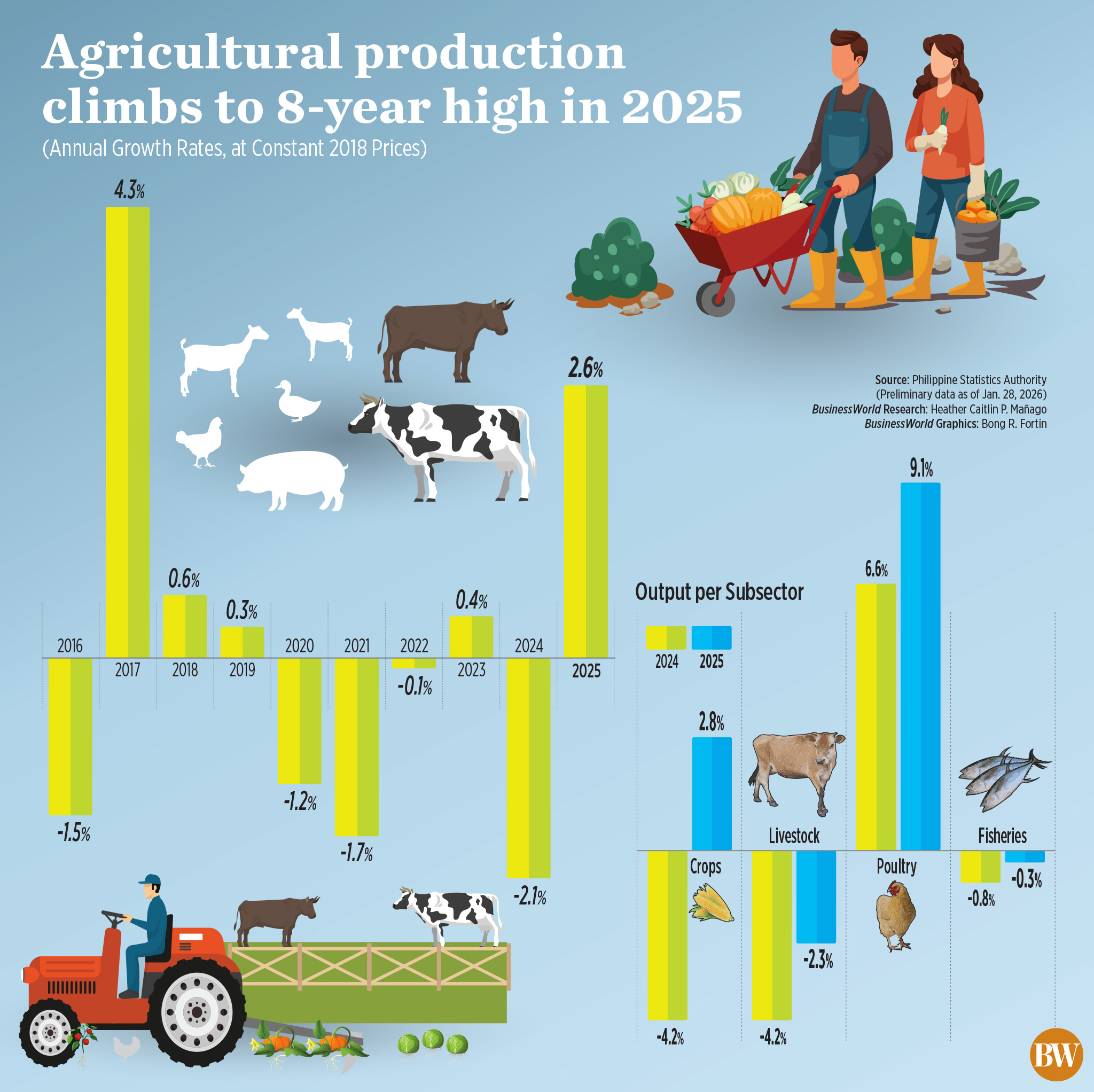
THE PHILIPPINES’ agricultural production grew by 2.6% in 2025, the fastest pace in eight years, as gains in crop output and strong poultry performance offset the decline in livestock and fisheries, the Philippine Statistics Authority (PSA) said.   

Data from the PSA showed the value of production in agriculture and fisheries at constant 2018 prices rose to P1.77 trillion last year from P1.73 trillion in 2024.

This was a reversal of the 2.1% contraction in 2024 when the agriculture sector was affected by drought and dry spells caused by the El Niño.

This was also the fastest growth in farm output since the 4.3% increase reported in 2017.

The rebound in the farm sector’s performance was driven by the growth in crops (2.8%) and poultry (9.1%), which helped offset the decline in livestock (-2.3%) and fisheries (-0.3%).

In the fourth quarter alone, the value of agricultural production rose by 0.5% to P487.04 billion, despite a drop in crop output. This was a turnaround from the 2% contraction during the same period in 2024.

“Increments in the value of livestock, poultry, and fisheries production contributed to this growth. In contrast, the value of crop production declined during the said period,” the PSA said, citing constant 2018 prices.

At current prices, however, the value of production in agriculture and fisheries fell by 2% year on year to P651.47 billion in the fourth quarter from P664.85 billion previously.

Agriculture Assistant Secretary Arnel V. De Mesa told a briefing that while the 2.6% full-year growth exceeded the 1-2% target of the Department of Agriculture (DA), output could have been higher.

“It really surpassed the target of the DA. It could have been higher, but the typhoons in the last quarter affected the crop subsector. But these typhoons are unavoidable,” he said.

Mr. De Mesa also attributed the rebound in output to a higher budget for the farm sector.

“The higher funding is poured into programs on production and productivity of our farmers, including the reduction of post-harvest losses and improvements in inputs,” he said.

CROP, POULTRY GAINS
Crop output, which accounted for 55.7% of the total value of agricultural production, rose by 2.8% to P986.81 billion in 2025 from P960.19 billion a year earlier. This was a turnaround from the 4.2% decline in 2024.

However, crop output contracted by 2.5% to P274.3 billion in the fourth quarter, driven by a 5.2% decline in palay (unmilled rice) production.

In 2025, palay production rose 3.3%, improving from the 5% contraction a year earlier.

PSA data showed corn production increased by 2.3% in 2025, a turnaround from the 3.2% decline in 2024. Coconut also registered a 0.1% increase, an improvement from a 2.7% contraction in 2024. 

Double-digit growth was recorded in sugarcane (41.3%), tobacco (19.9%), onion (15.4%), and coffee (11.5%). Increase in production was also seen in cacao (9.4%), rubber (7.7%), and cabbage (4.7%).

Meanwhile, declines in output were recorded in abaca (-13.7%), sweet potato (-11.1%), and mango (-6.8%).

Former Agriculture Secretary William D. Dar told BusinessWorld via Viber that full-year crop production rose due to increased government assistance in rice, corn, and high-value crops.

He noted that the decline in crop output in the fourth quarter is “due mainly to the very devastating typhoons and subsequent flooding.”

The poultry sector, which accounted for 17.2% of total farm output, jumped 9.1% to P304.71 billion in 2025 from P279.41 billion a year earlier. The growth was faster than the 6.6% logged in 2024.

In the fourth quarter of 2025, poultry output also grew by 8.9% to P78.18 billion from P71.81 billion in the same period in 2024.

For 2025, chicken production recorded an annual gain of 9.8% by value, while chicken eggs and duck posted 8.4% and 0.6% growth, respectively. Duck eggs, on the other hand, declined 4.1%.

Elias Jose M. Inciong, chairman of the United Broiler Raisers Association, earlier told BusinessWorld that the growth in the poultry sector may be attributed to “an influx of new entrants to the industry.”

DIP IN LIVESTOCK, FISHERIES
On the other hand, livestock production, which accounted for 13.9% of the total farm output, contracted by 2.3% to P246.42 billion in 2025, from P252.27 billion in 2024. This marks an improvement from the 4.2% contraction in 2024.

Livestock production in the fourth quarter of 2025 rose by 1% to P68.43 billion, reversing the 6.1% decline in the same period in 2024.

Dairy was the lone bright spot in the livestock sector, recording a 27.7% increase in output in 2025, from 13.2% a year earlier.

Hog production, which accounted for 81% of the sector’s total output, fell by 2.7%, improving from the 5% contraction in 2024.

Carabao production slipped by 3.6%, while goat dropped by 2.7% and cattle dipped by 0.2%.

“African Swine Fever (ASF) continues to be the major factor in the full-year decline of livestock,” Mr. Dar said.

ASF, which continues to affect the domestic and global hog industries, is a contagious viral disease lethal to swine and wild boars.

Mr. De Mesa said, however, that the fourth-quarter growth and slower full-year contraction in the livestock sector point to a continuous recovery in the hog sector.

“Recently, there have been only eight barangays with positive incidence of ASF. Which shows that our hog industry is able to adjust to the effects of ASF. Producers now know how to adjust to the disease and improve their biosecurity,” he said.

Fishery output, which accounted for 13.2% of overall production, also slipped by 0.3% to P233.67 billion in 2025 from P234.31 billion a year earlier. This marks the fourth straight year that fishery production declined.

In the fourth quarter, fishery output grew by 4% to P66.14 billion from P63.57 billion a year earlier.

Gains were also recorded in 2025 for squid (15.5%), milkfish (11.2%), Indian mackerel (alumahan, 9.6%), yellowfin tuna (tambakol, 6.1%), grouper (lapu-lapu, 5.2%), slipmouth (sapsap, 4.1%), and tilapia (3.3%).

Meanwhile, declines were seen for P. Vannamei (-22.7%), mudcrab (alimango, -12.4%), Bali sardinella (tamban, -11.9%), roundscad (galunggong, -11.7%), and fimbriated sardines (tunsoy, -10.3%).

Norberto O. Chingcuanco, a board member of the National Fisheries Research and Development Institute and co-convenor of Tugon Kabuhayan, earlier told BusinessWorld that weather disruptions heavily affected fishery production as a huge volume of fish escaped from sea cages.

He said, however, that actual fishery output did not decline as many of the fish that escaped were later caught as community catch, which official statistics cannot track.

‘NO REAL IMPROVEMENT’
Despite the headline growth in farm output, analysts said the gains did not necessarily translate into better livelihoods for farmers and livestock raisers.

Jayson H. Cainglet, executive director of Samahang Industriya ng Agrikultura, told BusinessWorld via Viber that growth figures and production values “are meaningless from the lens of the local agriculture sector.”

Mr. Cainglet said that output growth could still result in losses for producers if production costs rose or farmgate prices collapsed in peak harvest periods.

“There may be growth (in output), but if production costs also increase, then there is no real improvement. In fact, local producers may have incurred bigger losses due to the sharp drop in farmgate prices,” he said.

Mr. Cainglet said the growth figures may also be misleading, as these are measured against a weaker 2024 base.

Meanwhile, Raul Q. Montemayor, national manager of the Federation of Free Farmers, said the sector’s performance appears less impressive when compared to levels in 2023, before the farm sector was hit with a series of weather disturbances in 2024.

“There is less than half a percent growth over 2023. All major subsectors except poultry declined in 2025 when compared against 2023 output. Poultry remains the only significant bright spot in agriculture,” he said.   

Mr. Montemayor also said overall sector growth remained weak despite substantial government spending, noting that the increase in output did not appear proportional to public investment.

“Between 2025 and 2024, total output at constant 2018 prices rose by around P45 billion, far less than the amount of public funds poured into the sector during the year,” he said

In a statement on Wednesday, Agriculture Secretary Francisco P. Tiu Laurel, Jr. said the DA is “laying the groundwork for a smarter, climate-resilient agriculture” by investing in infrastructure to further improve farm production.

The DA said it is projecting higher agricultural production in 2026, driven by increased output in poultry and crops and a further recovery in the livestock sector, particularly in the swine industry.

The agriculture sector accounts for about a tenth of the country’s gross domestic product and provides about a quarter of all jobs.

IBPAP cautiously optimistic for IT-BPM sector in 2026

CONDOMINIUM and office buildings dominate the skyline of the Ortigas Business District. — PHILIPPINE STAR/MIGUEL DE GUZMAN

By Justine Irish D. Tabile, Reporter

THE IT & Business Process Association of the Philippines (IBPAP) is cautiously optimistic that the industry will achieve revenue and headcount growth this year despite continued uncertainty.

IBPAP President and Chief Executive Officer Jonathan R. Madrid said there was a challenging geopolitical and macroeconomic climate in 2025, which may have affected investor confidence and appetite for expansion.

“We will continue to see some of that uncertainty as we begin 2026, but I can say that we are cautiously optimistic about another positive year of growth for the Philippine information technology and business process management (IT-BPM) industry,” Mr. Madrid told reporters on Wednesday.

In 2025, he said that the industry was able to achieve a 5% growth in export revenues to over $40 billion and a 4% growth in headcount to 1.9 million.

These figures, he said, are consistent with the baseline targets set under the industry’s roadmap.

While he did not share exact targets for 2026, Mr. Madrid said: “I’ll be happy if we did that (5% growth in revenues and 4% growth in headcount).”

“But you have to remember that we are coming from a bigger base and the bigger your starting base, the harder it is to maintain,” he added.

Under the roadmap, the baseline targets for 2026 are $42 billion in revenues and 1.97 million in headcount.

Mr. Madrid said that he expects global capability centers (GCCs), such as JPMorgan Chase, to drive the sector’s growth this year.

“I see this as a particularly positive growth because the GCCs have been amazingly successful and are growing very fast in India. They have over 1,800 GCCs there,” he said.

“Of course, India is a much bigger country with a bigger population, but we are actually positioned very well to be a very strong second to India in terms of GCCs. We have about 160 GCCs in the country now,” he added.

Mr. Madrid said growth is expected in the financial services, insurance, and healthcare sectors.

“But we will continue to see the GCC segment grow in 2026. In fact, I think it will continue to outpace the overall growth rate of the IT-BPM sector,” he added.

CHALLENGES
Mr. Madrid said that the industry continues to struggle with the ease of doing business and the availability of employable talent.

“We have to remember that the majority of our industry is composed of foreign investors who have decided on the Philippines to set up their operations,” he said.

Mr. Madrid said investors are banking on the Philippines to deliver on its promise of a good business environment, which includes “investment incentives, a good business environment, availability of talent, good workspace, and last but not least, a competitive cost structure.”

“If we do not meet the expectations of our investors, justifying their decision to establish operations in the Philippines, then that would be a challenge,” he added.

Mr. Madrid said another challenge is to find employable talent as jobs in the IT-BPM sector continue to evolve. From simple and almost exclusively voice-based services, tasks now are more complicated and complex.

“That is why talent development and upskilling continue to be one of the biggest investments that our members make,” he said.

Before a worker in the industry becomes productive, the worker goes through a minimum of two weeks of training.

Mr. Madrid estimated the industry invests around P1.4 billion in talent development annually. This is an area where the government could also offer its support for the industry, he added.

“We have to remember that it is no longer just India and the Philippines. In the past decades, new IT-BPM destinations have emerged. And they are aiming to capture some of the market share of the Philippines,” he said.

“Countries like Egypt, Poland, South Africa, Vietnam, Malaysia, Colombia, South America, and Costa Rica are some of the destinations that global companies go to,” he added.

These destinations, he said, offer various advantages, including complementary time zones and Spanish-speaking agents, among others.

“The good news is, India and the Philippines continue to be the major players, and it should be our collective objective to protect and retain that market share,” he added.

Philippine GDP growth print lowered to 3.9% in 3rd quarter

A vendor sells vegetables at a market in Quezon City. — PHILIPPINE STAR/MIGUEL DE GUZMAN

THE PHILIPPINE Statistics Authority (PSA) on Wednesday said it downwardly revised the third-quarter gross domestic product (GDP) growth to 3.9% from the 4% initially reported.

The revision brought the nine-month average growth to 4.9%, down from the 5% initially estimated.

This is well below the 5.5%-6.5% growth target of the Development Budget Coordination Committee (DBCC) for 2025.

The PSA will release the fourth-quarter and full-year 2025 GDP data today (Jan. 29).

A recent BusinessWorld poll of 18 economists yielded a median estimate of 4.2% for the fourth quarter and 4.8% for the full year.

To meet the poll’s 4.8% estimate for 2025, fourth-quarter GDP growth must hit at least 4.4%. Fourth-quarter GDP must expand by 7.2% to reach 5.5% or the low end of the DBCC’s target.

If realized, GDP growth in 2025 would still be slower than the 5.7% GDP growth in 2024.

The PSA downwardly revised third-quarter figures for electricity, steam, water and waste management (-0.6% from 0.6% previously), real estate and ownership of dwellings (4% from 4.7%), and accommodation and food service activities (4.8% from 5.7%). These revisions mainly contributed to the lower overall third-quarter GDP expansion.

Lower revisions were also given to education (6.4% from 6.8% previously) and other services (4.4% from 5.1%).

In terms of expenditure, third-quarter growth for private consumption and government spending were left unchanged at 4.1% and 5.8%, respectively.

Gross national income was lowered to 5.4% from the 5.6% preliminary estimate. Similarly, the net primary income from the rest of the world for the July-to-September period was trimmed to 16.2% from 16.9% previously.

The PSA said that national account estimates are lowered based on an approved revision policy, which is aligned with international standard practices. Matthew Miguel L. Castillo

ADVERTISEMENT
ADVERTISEMENT