Home Blog Page 36

US-Iran peace talks end without agreement; Vance leaves Pakistan
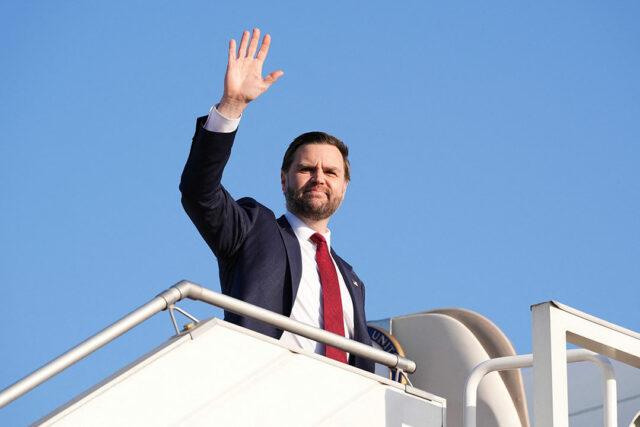
US VICE-PRESIDENT JD Vance waves as he boards Air Force Two, after peace talks with Iran in Islamabad, Pakistan, on Sunday, April 12, 2026. — POOL VIA REUTERS/JACQUELYN MARTIN

ISLAMABAD — The US and Iran failed to reach an agreement to end their war despite lengthy talks that concluded on Sunday in the Pakistani capital Islamabad, jeopardizing a fragile ceasefire.

Each side blamed the other for the failure of the 21-hour long negotiations to end fighting that has killed thousands and sent global oil prices soaring since it began over six weeks ago.

“The bad news is that we have not reached an agreement, and I think that’s bad news for Iran much more than it’s bad news for the United States of America,” Vice-President JD Vance, the head of the US delegation, told reporters shortly before he left Islamabad.

US CITES ‘RED LINES,’ IRAN SAYS DEMANDS ‘EXCESSIVE’
“So we go back to the United States having not come to an agreement. We’ve made very clear what our red lines are.”

The US delegation later left Pakistan, while the Iranians were to depart later on Sunday, two Pakistani sources told Reuters.

Mr. Vance said Iran had chosen not to accept American terms, including not to build nuclear weapons.

“We need to see an affirmative commitment that they will not seek a nuclear weapon, and they will not seek the tools that would enable them to quickly achieve a nuclear weapon. That is the core goal of the president of the United States, and that’s what we’ve tried to achieve through these negotiations.”

The talks in Islamabad, after a ceasefire earlier in the week, were the first direct US-Iranian meeting in more than a decade and the highest-level discussions since the 1979 Islamic Revolution.

Iran’s semi-official Tasnim news agency said that “excessive” US demands had hindered reaching an agreement. Other Iranian media said there was agreement on a number of issues but that the Strait of Hormuz and Iran’s nuclear program were the main points of difference.

A spokesperson for Iran’s foreign ministry said the talks were conducted in an atmosphere of mistrust. “It is natural that we shouldn’t have expected to reach agreement in just one session,” the spokesperson was quoted as saying by Iranian media.

“It is imperative that the parties continue to uphold their commitment to ceasefire,” Pakistan’s Foreign Minister Ishaq Dar said in a statement after the talks. The two sides agreed on Tuesday to a two-week ceasefire in an attempt to wind down a war that began on Feb. 28 with airstrikes by the US and Israel on Iran.

In his brief press conference, Mr. Vance did not mention reopening the Strait of Hormuz, a chokepoint for about 20% of global energy supplies that Tehran has blocked since the war began.

Mr. Vance said he had spoken with President Donald J. Trump as many as a dozen times during the talks. But even as the negotiations continued, Mr. Trump said on Saturday that a deal was not entirely necessary.

“We’re negotiating, whether we make a deal or not makes no difference to me, because we’ve won,” he told reporters.

The US delegation included special envoy Steve Witkoff and Mr. Trump’s son-in-law Jared Kushner. Iran’s team included Parliamentary Speaker Mohammad Bagher Ghalibaf and Foreign Minister Abbas Araghchi.

STRAIT OF HORMUZ
“There were mood swings from the two sides and the temperature went up and down during the meeting,” a Pakistani source said in reference to an early round of talks, which carried on overnight.

Islamabad, a city of more than 2 million people, was locked down during the talks with thousands of paramilitary personnel and army troops on the streets.

Before the talks began, a senior Iranian source told Reuters the US had agreed to release frozen assets in Qatar and other foreign banks. A US official denied agreeing to release the money.

As well as the release of assets abroad, Tehran is demanding control of the Strait of Hormuz, payment of war reparations and a ceasefire across the region, including in Lebanon, according to Iranian state TV and officials.

Tehran also wants to collect transit fees in the Strait of Hormuz.

Despite the differences in Islamabad, three supertankers fully laden with oil passed through the Strait of Hormuz on Saturday, shipping data showed, in what appeared to be the first vessels to exit the Gulf since the US-Iran ceasefire deal.

Hundreds of tankers are still stuck in the Gulf, waiting to exit during the two-week ceasefire period.

Mr. Trump’s stated goals have shifted, but as a minimum he wants free passage for global shipping through the Strait and the crippling of Iran’s nuclear enrichment program to ensure it cannot produce an atomic bomb.

Tehran has long denied wanting to build a nuclear weapon.

US ally Israel has also been bombing Tehran-backed Hezbollah militants in Lebanon and says that conflict is not part of the Iran-US ceasefire. Iran has insisted that the fighting in Lebanon has to stop. Reuters

Tankers exit Gulf via Strait of Hormuz as US-Iran talks begin

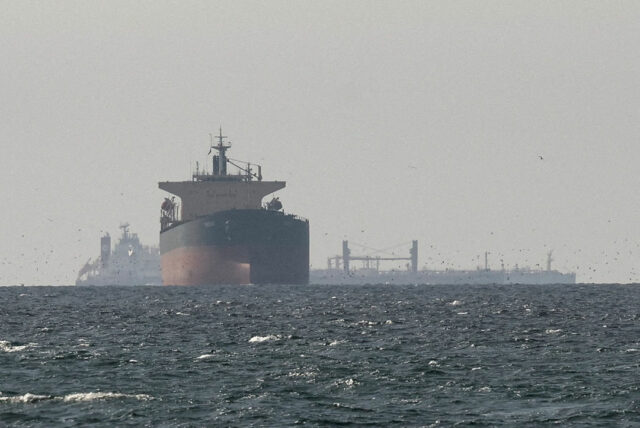
Tankers sail in the Gulf, near the Strait of Hormuz, as seen from northern Ras al-Khaimah, near the border with Oman’s Musandam governance, amid the US-Israeli conflict with Iran, in United Arab Emirates, March 11, 2026. — REUTERS

SINGAPORE/KUALA LUMPUR — Three supertankers fully laden with oil passed through the Strait of Hormuz on Saturday, shipping data showed, in what appeared to be the first vessels to exit the Gulf since the US-Iran ceasefire deal.

Tehran’s blockade of the Strait, a chokepoint for about 20% of global oil and liquefied natural gas shipments, has disrupted global energy supplies and sent oil prices soaring since the start of the Iran war at the end of February.

The Liberia-flagged Very Large Crude Carrier (VLCC) Serifos and China-flagged VLCCs Cospearl Lake and He Rong Hai, entered and exited the “Hormuz Passage trial anchorage” that bypasses Iran’s Larak Island on Saturday, LSEG data showed.

Each vessel is capable of carrying 2 million barrels of oil.

SERIFOS HEADS TO MALAYSIA
Serifos, which LSEG and Kpler data showed is chartered by Thai state-owned energy firm PTT, is among seven vessels that Malaysia sought clearance from Iran to transit the Strait, two people familiar with the matter told Reuters. The tanker, carrying crude loaded from Saudi Arabia and the United Arab Emirates in early March, is expected to arrive at Malaysia’s Malacca port on April 21, data from LSEG and analytics firm Kpler showed.

Malaysia’s foreign ministry, Petronas and PTT did not respond to requests for comment on Sunday outside office hours. Another tanker Ocean Thunder, loaded with Iraqi crude and chartered by a unit of Malaysian state energy firm Petronas, transited the waterway last week.

TWO CHINESE VLCCS CLEAR HORMUZ TRANSIT
Cospearl Lake, laden with Iraqi oil, is expected to arrive at eastern China’s Zhoushan port on May 1, LSEG data showed. It was not clear where He Rong Hai will discharge the Saudi crude on board.

Both VLCCs are chartered by Unipec, the trading arm of Chinese energy giant Sinopec, the data showed.

Sinopec did not respond to a request for comment outside office hours.

Hundreds of tankers are still stuck in the Gulf, waiting to exit during the two-week ceasefire period.

EMPTY VESSELS SAILING INTO GULF
Three other empty tankers — Mombasa B, Agios Fanourios I and Shalamar —were sailing in the Strait of Hormuz on Sunday to enter the Gulf and load oil, LSEG data showed.

Malta-flagged VLCC Agios Fanourios I signaled that it is heading to Iraq to load Basrah crude for Vietnam, the data showed.

Eastern Mediterranean Maritime, which manages Agios Fanourios I and CMB.TECH NV, the manager for Liberia-flagged VLCC Mombasa B, did not immediately respond to requests for comment outside office hours.

Pakistan National Shipping, which manages the tanker Shalamar, did not immediately respond to a request for comment. Reuters

China should abandon threats against Taiwan, US diplomat says

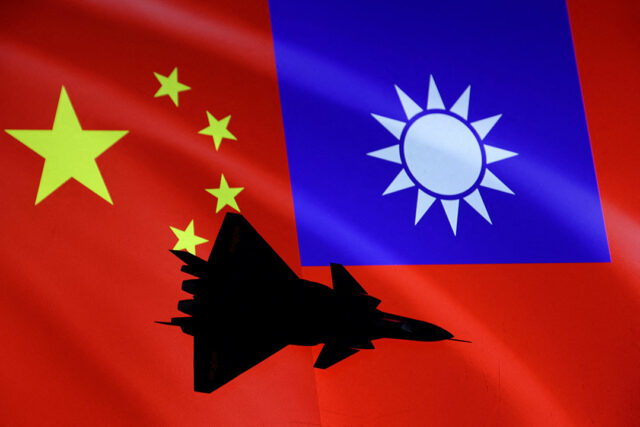
Airplane is seen in front of Chinese and Taiwanese flags in this illustration, August 6, 2022. — REUTERS/DADO RUVIC/ILLUSTRATION/FILE PHOTO

TAIPEI — The top US diplomat in Taiwan said China should abandon its threats and military pressure against Taiwan and talk to the island’s leaders as that would avoid misunderstandings and stabilize relations.

Raymond Greene, the de facto ambassador as head of the American Institute in Taiwan, which handles relations in the absence of formal diplomatic ties, said the consistent US policy has been to support exchanges across the Taiwan Strait.

He was discussing the visit of Taiwan’s opposition leader to China on a Taiwanese political talk show on Saturday. “However, we also expect China — Beijing — to maintain open communication channels with all of Taiwan’s political parties, especially the leaders elected by the Taiwanese people, in order to avoid misunderstandings and to stabilize cross-strait relations,” Mr. Greene said in Mandarin.

“We further expect China to abandon threats against Taiwan or military pressure. I believe this would help ease cross-strait tensions.”

China’s Taiwan Affairs Office did not immediately respond to a request for comment. China views democratically governed Taiwan as its own territory and has never renounced the use of force to bring the island under its control. Taiwan’s government rejects Beijing’s sovereignty claims.

Beijing refuses to speak to Taiwan President Lai Ching-te, saying he is a “separatist,” but Chinese President Xi Jinping on Friday met Cheng Li-wun, chairwoman of Taiwan’s largest opposition party, the Kuomintang, during what she called a mission of peace to China.

The Chinese military operates daily around Taiwan, activities that have continued while Ms. Cheng has been in China.

Taiwan’s opposition, which has a majority in parliament, has stalled government military spending plans, including an extra $40-billion special defense budget which has provisions to buy US weapons and which Washington has backed.

Despite the lack of formal diplomatic ties, the US is Taiwan’s most important arms supplier and international backer.

Mr. Greene said that while the US supports dialogue, that cannot replace deterrence.

“I don’t think there is a conflict here, because if there is sufficient deterrence capability, it will lead to a more equal dialogue,” he added.

“There are three ways to resolve cross-strait differences: the first is dialogue, the second is coercion and the third is war. So if Taiwan can have sufficient deterrence capability, it can take the option of war off the table.” — Reuters

New Russian space launch vehicle undergoing final tests, top official says

A RUSSIAN FLAG flies with the Spasskaya Tower of the Kremlin in the background in Moscow, Russia, Feb. 27, 2019. — REUTERS

A NEW Russian launch vehicle, Soyuz-5, is undergoing its final tests and is “absolutely ready” for use in space projects, Russia’s top space official said on Saturday.

Dmitry Bakanov, head of the Russian space agency Roscosmos, was presenting details of the rocket to Russian President Vladimir Putin on the eve of the 65th anniversary of the first flight in space by Soviet cosmonaut Yuri Gagarin.

Mr. Bakanov said the Soyuz-5 would be the first new launch vehicle developed in Russia since 2014.

“The new Soyuz-5 launch vehicle is absolutely ready. This is our joint project with our partners in Kazakhstan known as Baiterek,” Russian news agencies quoted Mr. Bakanov as saying.

“Currently, tests of all units and assemblies are underway.”

Mr. Bakanov said the rocket had already been placed during tests in a vertical position as preparations proceeded.

Plans call for the new two-stage rocket, capable of placing payloads of up to 17 metric tons in orbit, to be used in place of Zenit rockets.

Launches will be conducted at the Baikonur space center dating from Soviet times and now located in Kazakhstan.

Mr. Putin, quoted by Russian news agencies, said Russia’s space industry was now “feeling more confident. I know that many problems had accumulated there over a long period of time.” — Reuters

US considers new crackdown on Chinese telecom companies

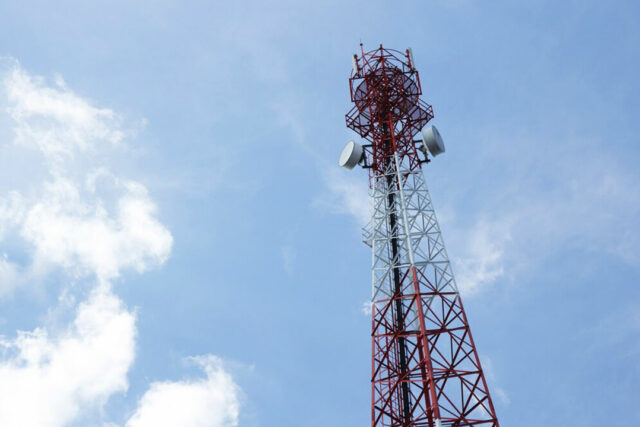
STOCK PHOTO | Image by Aopsan from Freepik

WASHINGTON — The US Federal Communications Commission (FCC) said it may bar three major Chinese telecommunications companies from operating their data centers in the US and could ban telecom carriers from connecting with those Chinese carriers.

The FCC said it has tentatively concluded it should prohibit American and other telecommunications carriers operating in the US from interconnecting with companies on the so-called “Covered List” that it says pose national security concerns, including China Mobile, China Telecom, and China Unicom.

The FCC said it was also considering prohibiting Chinese telecoms that own data centers or so-called Points of Presence that sit at internet exchange points from interconnecting with other companies. The agency also said it was considering extending the ban on providing US telecom services to some affiliates of companies on the national security list.

The FCC could also prohibit telecommunications carriers from interconnecting with companies that have installed equipment from companies on the list including Huawei and ZTE.

The FCC plans to take an initial vote on the proposal at its April 30 meeting.

The Chinese Embassy in Washington said China “consistently opposes the overstretching of the concept of national security and the abuse of state power to suppress Chinese enterprises.” The FCC has aggressively moved to clamp down on Beijing.

On Oct. 15, the FCC said it was moving to revoke the ability of HKT, a leading Hong Kong telecom carrier and subsidiary of PCCW, to operate in the US, citing national security concerns.

In December, the FCC said it could bar China Mobile, Telecom and Unicom from connecting to US networks, in an effort to prevent robocalls.

Previously, the FCC barred the three companies from operating in the US. In 2019, it rejected China Mobile’s bid to provide US telecommunications services. It revoked US operations authorization for China Unicom, Pacific Networks and its wholly owned subsidiary ComNet in 2021 and China Telecom Americas in 2022.

On Wednesday, the FCC said it will also vote on April 30 a proposal to bar all Chinese labs from testing electronic devices such as smartphones, cameras and computers for use in the US, widening a previous action targeting Beijing.

Last Friday, the FCC proposed to ban the import of equipment from Chinese manufacturers on its Covered List. In 2022, the agency barred approvals of new models by those companies.

In December, the FCC banned the import of all new models of Chinese drones, and last month, it banned imports of new models of Chinese-made consumer routers, the boxes connecting computers, phones, and smart devices to the internet. Reuters

Meta pulls ads aimed at recruiting plaintiffs for social media addiction lawsuits

CHICAGO — Meta Platforms said on Thursday it is pulling ads from Facebook and Instagram aimed at recruiting new plaintiffs for ongoing litigation accusing it and other social media companies of designing their platforms to be addictive to young users.

Meta spokesperson Andy Stone said the company is actively defending itself against the lawsuits, which include thousands of cases in both state and federal courts in California, and is removing the ads.

“We will not allow trial lawyers to profit from our platforms while simultaneously claiming they are harmful,” Mr. Stone said in a statement.

The move follows Meta’s loss in two key trials over the allegations.

At the end of March, a Los Angeles jury found Meta and Alphabet’s Google liable for a young woman’s depression and suicidal thoughts after she said she became addicted to Instagram and Google’s YouTube at a young age, ordering them to pay a combined $6 million in damages.

In a separate New Mexico case that wrapped up just a day earlier, jurors ordered Meta to pay $375 million after finding the company misled users about the safety of its products for young users and enabled the sexual exploitation of children on its platforms.

More than 3,300 lawsuits involving addiction claims are pending in California state court against Meta, Google, Snapchat parent Snap Inc. and ByteDance, TikTok’s parent company. Another 2,400 lawsuits brought by individuals, municipalities, states and school districts have been centralized in California federal court, according to court records.

The companies have denied the allegations and say they take extensive steps to keep teens and young users safe on their platforms.

The state court cases largely involve individuals suing the companies over claims that addiction to social media caused mental health harms. The federal litigation includes more lawsuits filed by public entities such as school districts, states and municipalities, which claim the platforms harmed the mental health of young people, forcing the government entities to spend money to address the fallout. 

FINDING PLAINTIFFS
Law firms representing plaintiffs in these types of cases typically work on contingency, so they are only paid if a plaintiff wins damages or receives a settlement. Often, firms in mass cases are seeking to represent as many plaintiffs as possible to make the cases financially viable. Ads on television, radio and online are aimed at recruiting individual plaintiffs, who may not know about the litigation otherwise.

Law firms such as Morgan & Morgan, which represents plaintiffs in the litigation and was part of the trial team that won the Los Angeles case, are among the firms that placed ads on Facebook.

Morgan & Morgan attorney Emily Jeffcott said in a statement that Meta’s resources would be better spent improving user safety.

“Blocking the ads doesn’t make the harms go away. It just makes it harder on victims,” Ms. Jeffcott said.

Companies that seek to connect potential clients with law firms, such as Tennessee-based White Heart Legal, are also advertising the litigation on social media, according to X Ante, a company that tracks mass tort advertising.

White Heart Legal did not respond to a request for comment.

X Ante founder Rustin Silverstein said social media has become an increasingly popular place for advertisers seeking potential law clients in mass tort litigation, but accounts for only a portion of the ads that have been airing this year for the social media cases.

A total of 671 television ads promoting social media claims aired nationwide in March — more than in any month since July 2024, Mr. Silverstein said. The number of radio ads in March nearly tripled to 20,000 after the verdicts, he said.

There are also ads on Google’s platforms for the litigation. Social Media Victims Law Center, one of the law firms leading the wave of lawsuits, advertises on Google, according to Google records.

Google did not respond to a question about whether it would also be pulling the ads related to the cases. — Reuters

TSMC’s first-quarter revenue surges as AI interest propels sales beyond market forecasts

TAIPEI — TSMC, the world’s largest contract chipmaker, on Friday reported a 35% surge in first-quarter revenue, beating market forecasts, thanks to unabated interest in artificial intelligence (AI) applications.

January-March revenue reached T$1.134 trillion ($35.71 billion) compared with T$839.3 billion in the same period a year earlier, TSMC said in a statement without elaborating.

The result topped a London Stock Exchange Group (LSEG) SmartEstimates of T$1.125 trillion drawn from 20 analysts, and was in line with TSMC’s January guidance of $34.6 billion to $35.8 billion given at its last earnings call. TSMC only issues guidance in US dollars.

TSMC’s latest record-smashing quarterly revenue comes as war in the Middle East is raising energy costs and upending global markets. That in turn threatens to disrupt the supply of production materials for semiconductors which analysts said could force companies to delay AI data center investment.

Analysts nevertheless raised their forecast for TSMC’s April-June revenue by 2.3% over the last 30 days to a record T$1.2 trillion, LSEG data showed, betting on constrained capacity for advanced AI chip production to boost the firm’s earnings.

TSMC will report first-quarter earnings on April 16 along with an updated outlook for the current quarter and full year.

The chipmaker, whose customers include Nvidia, has been a major beneficiary of advances in AI, which has more than offset a tapering-off in pandemic-led demand for chips used in consumer electronics such as tablet computers.

Its Taipei-listed shares have gained 29% this year versus a rise of 22% in the benchmark share price index. The stock closed up 2.3% on Friday ahead of its sales announcement.

Compatriot Foxconn, the world’s largest contract electronics maker and Nvidia’s biggest server maker, has also reported bumper first-quarter sales with an on-year rise of 30%. Reuters

IBM to pay $17 million to settle US government probe over DEI

WASHINGTON — IBM has agreed to pay $17 million to settle a US government probe over the firm’s diversity, equity and inclusion (DEI) practices, which President Donald J. Trump’s administration has cracked down on during his second term in office.

The settlement marks the first resolution from the US Department of Justice’s (DoJ) unit formed last year called the “Civil Rights Fraud Initiative” to crack down on DEI policies using a civil anti-fraud law.

Mr. Trump has targeted public and private organizations — from government agencies to private universities — over DEI practices that civil rights advocates say help address historic inequities for marginalized groups like women and ethnic minorities.

In a settlement signed by the DoJ and IBM, the US government alleged that IBM’s practices included using a “diversity modifier” that “tied bonus compensation to achieving demographic targets,” among other claims.

The settlement also said IBM terminated or modified various programs and policies, but that the company denied engaging in unlawful conduct.

“This agreement is neither an admission of liability by IBM nor a concession by the United States that its claims are not well-founded,” the agreement said.

The White House casts DEI as anti-merit and discriminatory against groups like white people and men. Mr. Trump has signed executive orders asking federal contractors and subcontractors to eliminate DEI.

Many US companies scaled back or modified diversity policies after Mr. Trump’s orders. — Reuters

Tesla’s supervised self-driving software gets Dutch okay, first in Europe

AMSTERDAM/SAN FRANCISCO — Dutch regulators approved the use of Tesla’s self-driving software with required human supervision on highways and city streets in a European first for the electric car maker, which hopes to see similar action from the rest of the European Union (EU).

Wide full self-driving (FSD) adoption is central to Tesla’s growth strategy. Much of the company’s $1-trillion valuation hinges on Chief Executive Officer Elon Musk’s bet that artificial intelligence (AI)-driven self-driving software and robotaxis will become a major revenue stream.

The Netherlands’ approval for the technology, called Full Self-Driving Supervised, which can steer, brake and accelerate a car, follows more than 18 months of tests and analysis by the Dutch vehicle authority RDW.

“Proper use of this driver assistance system makes a positive contribution to road safety,” RDW said in a statement on Friday, adding that it would also submit an application for the technology to be used throughout the EU.

Tesla is also counting on self-driving software to boost vehicle sales, which have slowed in Europe due to its aging electric vehicle lineup and Mr. Musk’s far-right political rhetoric that has alienated some consumers. Tesla’s sales in Europe rose in February for the first time in more than a year.

“I expect FSD approval by the Dutch authority and subsequent European regulators will lead to improved sales in Europe over the coming months as consumers are excited to try FSD,” said Morningstar analyst Seth Goldstein.

Tesla shares rose about 0.7% in aftermarket trading on Friday. Its shares have fallen 23% this year, lagging the US stock market.

“We’re excited to bring FSD Supervised to more European countries soon,” Tesla said in a post on social media platform X, adding that it will start rolling out the technology in the Netherlands shortly.

The software is already available as a subscription for US drivers, where it is also facing consumer lawsuits and federal investigations after crashes and reports of traffic violations.

RDW said the EU sets stricter requirements for safety during vehicle approvals than the US. “This means that the FSD Supervised version in the US is not comparable to the FSD Supervised version in the EU,” it said, without providing further details.

AIMING FOR EUROPE-WIDE ADOPTION
Tesla is the most popular maker of electric cars in the Netherlands, with around 100,000 Model 3 and Model Ys combined that would be eligible for FSD software.

Many companies are working on self-driving systems. Most use several hardware sensors to track the driving environment, while Tesla relies primarily on cameras and AI.

Other carmakers including Mercedes, Ford, and BMW have introduced “hands-free” driving technology on select highways and at limited speeds, mostly in Germany. Tesla’s is the first that will be usable in a wider range of situations.

RDW said it would now submit the application for authentication within the entire EU to the European Commission. All member states will then vote on the application, which requires a majority within the responsible committee for the system to become valid EU-wide.

If it does not win a majority, individual countries may still decide to allow it. Tesla said last month it was anticipating possible EU-wide approval during the summer. — Reuters

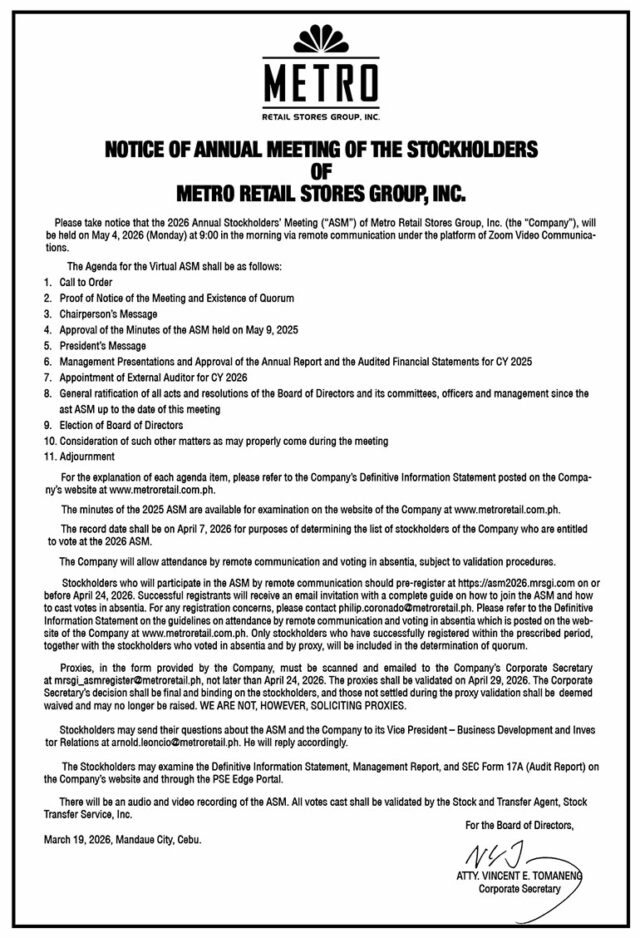
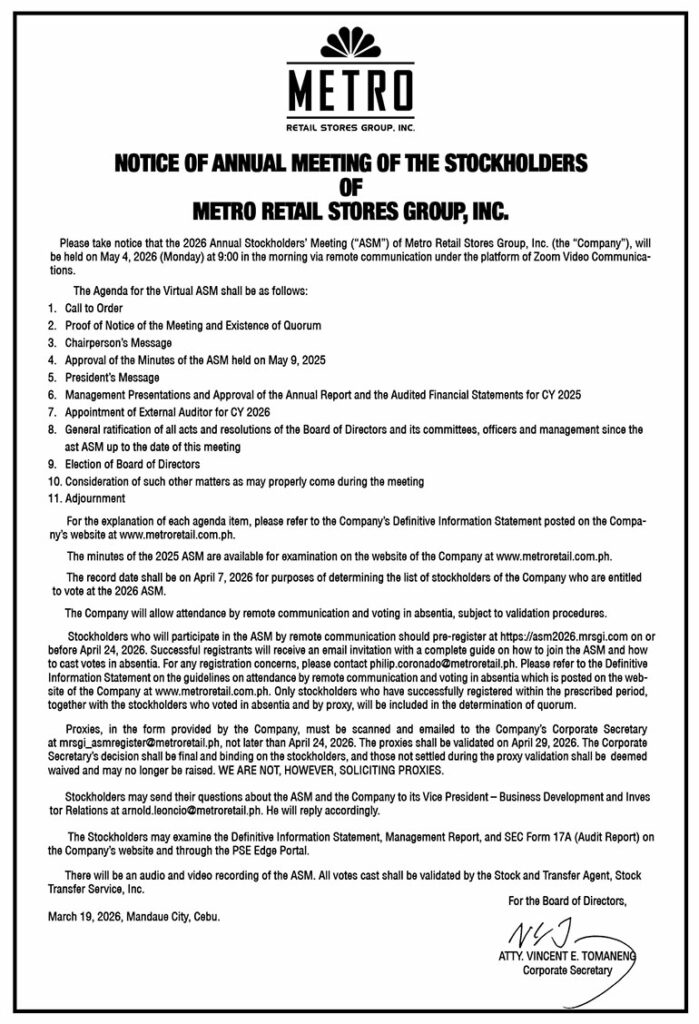
Metro Retail Stores Group, Inc. to hold Annual Stockholders’ Meeting on May 4 via Zoom


Spotlight is BusinessWorld’s sponsored section that allows advertisers to amplify their brand and connect with BusinessWorld’s audience by publishing their stories on the BusinessWorld Web site. For more information, send an email to online@bworldonline.com.

Join us on Viber at https://bit.ly/3hv6bLA to get more updates and subscribe to BusinessWorld’s titles and get exclusive content through www.bworld-x.com.

Crease-less foldable Oppo Find N6 to launch in PH soon

Oppo's hinge engineering and Auto-Smoothing Flex Glass work together to deliver a crease-free screen. — EDG EVA

Chinese tech brand Oppo on Friday announced that its new flagship foldable, the Oppo Find N6, is set to arrive in the Philippines soon.

The device has drawn significant attention since its global launch in March for its virtually crease-free display.

“So here at Oppo, we continue to push innovation and industry-leading capabilities,” Jubilius Yu, integrated marketing communications (IMC) officer at Oppo Philippines, said during the Oppo Find Series pre-briefing event on Friday.

“And we’re truly excited for everyone to experience them through our newest Find series,” he added.

The crease-free display of the new Oppo Find N6 has been made possible through the company’s precise hinge engineering and Auto-Smoothing Flex Glass, which work together to deliver a flat and smooth touch experience, Oppo said on its website.

The hinge system uses Oppo’s second-generation Titanium Flexion Hinge, which incorporates 3D liquid printing and Clover Balance Pivot technology.

BusinessWorld had a chance to get an early hands-on with the company’s new flagship foldable, and it is indeed virtually crease-free from every angle, as seen in the photos.

Under the hood, the Oppo Find N6 is powered by Qualcomm’s flagship Snapdragon 8 Elite Gen 5 chip, which on paper can handle highly demanding games and multimedia applications.

Both the inner and cover displays are capable of adapting from 1 to 120 hertz, and both offer up to 1,800 nits of peak brightness, according to Oppo.

As for its cameras, they are co-developed with renowned camera brand Hasselblad. It features five cameras, including a 200-megapixel (MP) main lens, 50MP ultra-wide lens, 50MP periscope telephoto lens, true color camera, and a 20MP front camera.

Other key features include a 6,000mAh typical battery capacity with 80-watt fast charging.

The Oppo Find N6 comes in two colors: Stellar Titanium and Blossom Orange.

Official pricing and promotions will be announced upon its arrival in the Philippines.

For updates on the device, readers may check Oppo’s official website and social media pages. — Edg Adrian A. Eva

Australia, Singapore leaders pledge closer energy ties to tackle global supply shock

REUTERS

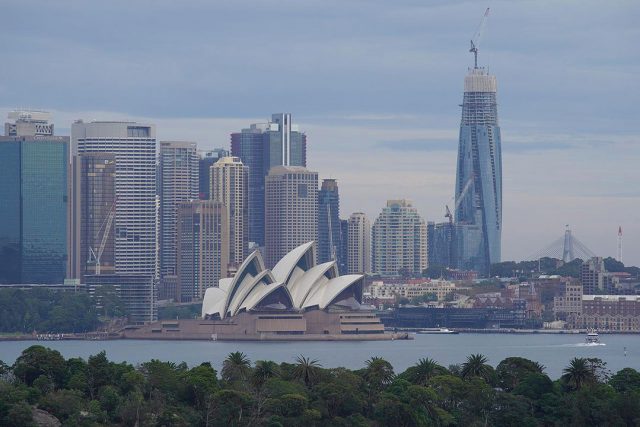
SINGAPORE/PERTH — Australian Prime Minister Anthony Albanese held talks in Singapore on Friday with counterpart Lawrence Wong, in which they vowed closer cooperation to ensure energy security in the face of disruptions caused by the Middle East conflict.

Asia’s oil trading hub of Singapore is the largest supplier of petrol and a major supplier of diesel and jet fuel to Australia, where tight domestic supplies of diesel are rattling the farming and mining sectors, its key users.

The leaders said they agreed to ensure the flow of essential supplies including diesel and LNG, making “maximum efforts” to boost their energy security.

“We reaffirmed our commitment to working together, particularly during crises, to support a resilient, rules-based multilateral trading system that underpins stability during periods of global disruption,” they said in a joint statement.

SOME AUSTRALIAN PETROL STATIONS RUN DRY

Panic buying has caused several petrol stations to run dry across Australia, which has limited stockpiles and far-flung distribution networks.

Australia supplies about a third of Singapore’s imports of liquefied natural gas, while getting about 26% of its refined fuel from the city-state, Mr. Albanese said.

“It’s vitally important that we coordinate our response to the global fuel crisis and cooperate,” he said during a joint news conference with Wong. “This is a win-win.”

Singapore had no plans to curb exports despite the global energy shock, Mr. Wong added.

“We didn’t have to do so even in the darkest days of COVID, and we will not do so during this energy crisis,” he said. “It won’t happen.”

Friday’s commitments would be reflected in a legally binding protocol to their existing free trade pact, said the leaders, who visited an LNG terminal and the Singapore Refining Co in the city state.

CLOSURE OF THE STRAIT OF HORMUZ

Australia is among the Asian countries worried about fuel supplies after Iran closed the Strait of Hormuz, through which about a fifth of the world’s oil and gas transited before the Middle East conflict.

Ship traffic along the Strait remains at a near standstill despite a fragile peace deal between the US and Iran.

Australia, which uses roughly a million barrels of oil a day and imported 84% of its petroleum product demand last year, has two refineries, down from eight in 2005.

Singapore is a major refining center in Asia with three refineries that have combined capacity of about 1.2 million barrels per day, though refineries have cut output after crude supplies were disrupted by the closure of the Strait of Hormuz.

Statistics from insurer NRMA late in March showed Singapore accounted for 54.7% of Australia’s petrol imports, or close to 6 billion liters. South Korea was second with 22.5%, and India third, with 11.5% or 1.25 billion liters.

Mr. Albanese and Foreign Minister Penny Wong have held talks with Asian counterparts on fuel supplies since early March.

Australia has said it has held talks with Brunei, China Indonesia, Japan, Malaysia, and South Korea, among others. — Reuters

ADVERTISEMENT
ADVERTISEMENT