Home Blog Page 3559

Meta’s Facebook, Instagram back up after global outage

UNSPLASH

META-OWNED Facebook and Instagram were back up on Tuesday after a more than two-hour outage that was caused by a technical issue and impacted hundreds of thousands of users globally.

The disruptions started at around 10 a.m. Eastern Time, with many users saying on rival social media platform X they had been booted out of Facebook and Instagram and were unable to log in.

The White House National Security Council was monitoring the incident and not aware of any specific malicious cyber activity at this time, a spokesperson said.

At the peak of the outage, there were more than 550,000 reports of disruptions for Facebook and about 92,000 for Instagram, according to outage tracking website Downdetector.com.

“Earlier today, a technical issue caused people to have difficulty accessing some of our services. We resolved the issue… for everyone who was impacted,” Meta Spokesperson Andy Stone said in a post on X, without elaborating on the issue.

Meta, whose shares were down 1.2% in afternoon trading, did not immediately respond to a request seeking more details on the technical problem.

The company has about 3.19 billion daily active users across its family of apps, which also includes WhatsApp and Threads.

Its status dashboard earlier showed the application programming interface for WhatsApp Business was also facing issues.

However, the outage for Whats-App and Threads was much smaller, according to Downdetector, which tracks outages by collating status reports from several sources including users.

Several employees of Meta said on anonymous messaging app Blind that they were unable to log in to their internal work systems, which left them wondering if they were laid off, according to posts seen by Reuters.

The outage was among the top trending topics on X, formerly Twitter, with the platform’s owner Elon Musk taking a shot at Meta with a post that said: “If you’re reading this post, it’s because our servers are working.”

X itself has faced several disruptions to its service after Mr. Musk’s $44-billion purchase of the social media platform in October 2022, with an outage in December causing issues for more than 77,000 users in countries from the US to France. — Reuters

Motoring and the judiciary

PHILIPPINE STAR/MIGUEL DE GUZMAN

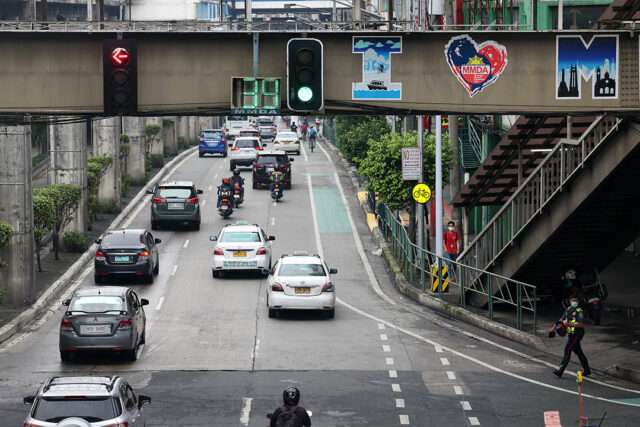
The Supreme Court has ruled that Metro Manila cities cannot cite motorists for traffic violations using their own “tickets,” and that they cannot confiscate driver’s licenses, unless they were “authorized” to do so by the Metro Manila Development Authority (MMDA). Also, local governments must use only the MMDA’s single-ticketing system for citing traffic violations.

The court decision was reportedly dated July 2023, but was released only recently. The court prohibited traffic enforcers of local government units (LGUs) in Metro Manila from issuing local violation receipts and confiscating licenses, claiming that under the MMDA charter, Republic Act 7924, the agency has exclusive power to do this.

In this line, LGUs must follow the MMDA’s Joint Metro Traffic Circular No. 12-01 issued in 2012, which details the uniform ticketing system. The MMDA intended the use of a unified ordinance violation receipt that would be recognized by the MMDA, the Land Transportation Office (LTO), and all Metro Manila LGUs as a valid traffic citation receipt and temporary driver’s license.

The MMDA circular was issued in 2012, but it took the court system 12 years to resolve the matter with finality. In a way, it has been overtaken by events as only a few cities continue to issue their own traffic tickets. People who petitioned against the uniform ticketing system have probably lost interest in the matter as well.

And this is where Filipinos’ tendency to be litigious creates complications for policymakers and regulators. Instead of moving forward on several things, presumably for the public’s benefit, government agencies take pause and step backward because of some perceived slight against a party, a perceived violation of law, or perhaps a misunderstanding in legal interpretation.

Take the case of the No Contact Apprehension Policy or NCAP, where motorists are cited for traffic violations through the use mainly of technology like traffic cameras and monitoring stations. The NCAP has been in use in other parts of the world for many years now. Over here, however, questions arose whether no-contact apprehension is “constitutional.”

This was after hundreds, if not thousands, of motorists all over Metro Manila were “apprehended” by computers and cameras and subsequently fined thousands of pesos for traffic violations. Mounting complaints led to a court case, and the use of the NCAP by the MMDA and LGUs has been on hold since 2022 because of a restraining order from the Supreme Court.

And then there is the LTO problem with its license card supplier. A restraining order in 2023 stopped the LTO from awarding the license card supply contract. Meantime, the LTO has not been issuing plastic license cards and instead opted for digital licenses. The funny part, in my case, my license card was “signed” by one LTO chief but the digital version of the same was signed by his successor.

Also last year, the Supreme Court dismissed the petitions filed by drivers and transport groups questioning the constitutionality and fairness of higher fines set for traffic law violations. That case took nine years to resolve, with the court eventually ruling that higher fines were necessary to promote public safety and welfare.

It also took the court 12 years to finally resolve the legal question on the use of a single-ticketing system. One can only guess how long it will take the judiciary to finally resolve the legal questions on the NCAP and license cards. The issue of license plates was with the courts for some time as well. Prior to this, years back, the LTO use of RFIDs went to court, too.

And then there are the looming issues involving motorcycle taxis and electric vehicles running on two and three wheels. As Congress moves to deliberate on a proposed law on two-wheel taxis, expect legal questions to arise. Already, UV Express operators have gone to court questioning the legality of motorcycle taxis. Expect legal questions on two-wheel and three-wheel electric vehicles as well.

From law to regulations, and then to implementation, it can take years if not over a decade before something can be executed. The MMDA’s unified ticketing system policy dated back to 2012 but the legal issues hounding it were resolved only this week. The issue regarding higher fines took nine years to resolve. The NCAP issue dates back to 2022, while the license card issue dates back to last year. Both are still pending in court.

The public, by now, cannot help but be disappointed by how cumbersome government works. And for some reason, the LTO continues to be party to many of these lawsuits. Perhaps this is unsurprising considering that other than the shortage of license cards and license plates, we were also reliably informed that many new car buyers now wait for as long as two months for the release of their new car registration.

As I have written in a previous column, people, in general, are willing to pay for good service. What is important to them is that service is delivered efficiently, whether water or electricity service, internet, public transportation and mass transit, public housing, permitting and inspection, etc. Obviously, there is always a price to pay for efficiency.

The issue is that service efficiency, particularly in government, is always cyclical and never consistent. In some way, the cycles follow the changes in administration. Take the case of driving licenses, registrations, and license plates. Four administrations ago, we seemed to have resolved supply issues, with the public generally satisfied with the service. Since then, it has been a case of catch-up.

The thing is, while concerned agencies can find ways to be more efficient and to resolve many pending issues, this will be for naught if many policy changes or initiatives involving land transportation will just end up in court and wait for legal resolution for who knows how long. In a way, one cannot help but suspect that the judiciary is being used primarily to delay rather than resolve issues.

In this line, perhaps it is also time that we consider establishing traffic courts. Now that a unified ticketing system has been upheld, and higher fines have been validated, perhaps adjudication of violations can also be assigned to specially designated courts that deal mainly with traffic issues. This is in anticipation of more lawsuits in case the NCAP gets the judiciary’s nod as well.


Marvin Tort is a former managing editor of BusinessWorld, and a former chairman of the Philippine Press Council

matort@yahoo.com

Alternergy consolidates wind assets

ALTERNERGY HOLDINGS Corp. has transferred 60,060 shares in its subsidiary Alternergy Tanay Wind Corp. (ATWC) to another subsidiary Pililla A VPC Corp. (PACO) to consolidate its wind assets.

The listed energy company’s board of directors approved on Tuesday the sale of all of its shares in ATWC, it said in a regulatory filing on Wednesday.

“The transfer of the ATWC shares currently held by ALTER to PACO serves as a realignment of ALTER’s corporate entities so that ATWC, similar to other special purpose vehicles for wind resource development, will fall under PACO,” Alternergy said.

ATWC was its subsidiary focused on the development of the 86-megawatt (MW) Tanay wind power project in the province of Rizal.

PACO is Alternergy’s intermediate holding company for its project companies implementing wind resource development.

The company said that PACO will be changing its name to Alternergy Wind Holdings Corp., which will own current and future wind assets.

“The change is being effected so as not to run into valuation issues down the road when new capital has been infused in ATWC and construction works are underway for the Tanay Wind Power Project,” the company said.

Alternergy aims to develop up to 1,370 MW of renewable energy sources such as onshore and offshore wind, solar, and run-of-river hydropower.

At the local bourse on Wednesday, shares of the company closed at P0.76 apiece. — Sheldeen Joy Talavera

PHL tablet shipments hit 11-year-record low — IDC

THE PHILIPPINE tablet market saw a decline of 39.8% to 750,300 units in 2023, marking the lowest shipments since 2012, according to International Data Corp. (IDC).

“Tablet shipments dropped to pre-pandemic levels after averaging over a million units per year between 2020 to 2023,” IDC Philippines Senior Market Analyst Angela V. Medez said in IDC’s report on Feb. 29.

“This was the lowest annual shipment recorded since 2012,” she added.

In 2023, Samsung led the Philippine market with a 29.5% share, IDC said, citing data from its Worldwide Quarterly Personal Computing Device Tracker.

However, Samsung’s shipments decreased by 42.1% to 221,500 units in 2023 from 382,800 units a year earlier.

Cherry Mobile followed with a 14.1% share, selling 105,600 units, while Huawei and Xiaomi held 11.8% and 10% shares, respectively, shipping 88,700 and 74,700 units.

IDC reported a 35.1% increase in fourth-quarter shipments in 2023 due to multiple product launches by various brands.

Samsung’s new Galaxy Tab A9 & S9 FE series alone accounted for nearly 40% of the quarter’s 218,000 shipments.

IDC also anticipates a contraction in commercial tablet shipments this year as government agencies shift priorities away from procurement for distance learning programs during the COVID-19 pandemic.

“Until tablets can differentiate themselves from smartphones and PCs through innovation and unique positioning, they may not be consumers’ top choice for electronic purchases,” said Ms. Medez. 

Similar to the local trend, global tablet sales also dropped by 20.5% to 128.5 million units last year, marking the lowest sales since 2011. — Aubrey Rose A. Inosante

Champagne makers quietly woo King Charles to supply royal court

POLROGER.COM

WHEN King Charles III visited France in September, a lavish dinner in his honor at the Palace of Versailles featured Champagne Pol Roger’s Sir Winston Churchill cuvee.

The choice was a boost to the 175-year-old family-owned vineyard, one of nine champagne makers that enjoy special status as official suppliers to the United Kingdom (UK) royal household. Their royal warrants allow them to display the coats of arms on bottles and “By appointment to…” as well as reap the financial benefits that can come from the endorsement.

While some producers have held their warrants for more than a century — Queen Victoria first awarded one to Champagne Bollinger in 1884 and to Champagne Lanson in 1900 — all of them could lose the highly coveted designation. By Sept. 8, the second anniversary of Queen Elizabeth II’s death, King Charles is due to communicate which of the 800 or so current holders across all sectors will have their status renewed.

While the 75-year-old monarch has canceled his public engagements as he receives treatment for an unspecified form of cancer, he’ll continue “state business and official paperwork,” Buckingham Palace said on Feb. 5. A representative of the Royal Warrant Holders Association, which acts as an intermediary between the purveyors and the royal household, confirmed the review process “is ongoing” but declined to give any details.

Lanson, Bollinger and Louis Roederer are among the champagne maisons that have applied for a renewal. Luxury giant LVMH, which holds warrants for its Krug, Moet & Chandon, and Veuve Clicquot labels, declined to comment on whether it had sought a renewal, as did a Pernod Ricard SA spokesperson about the warrants held by its Mumm champagne and Dubonnet fortified wine.

SOFT MARKET
“The royal warrant is a big part of our history and a strong symbol,” said Julie Renault, head of marketing and communications at Lanson, whose biggest market is the UK. “It’s a guarantee of quality and for us it’s very important.”

Compared with other alcohol labels, the champagne houses hold an outsize number of warrants and a loss would come as a blow to at least some of them, especially at a time when the market has softened. Exports of the sparkling wine made in the Champagne region east of Paris dropped 8% last year.

Warrant holders also include multinational food brands like Coca-Cola, Heinz, Kellogg’s, and Nestle. British fashion label Burberry and luxury carmaker Bentley also enjoy royal favor, along with a broad swath of smaller businesses like butchers, tailors, a chimney sweep, and producers of umbrellas, candles, and horse bedding.

In the UK, warrants raise the profile of holders and confer bragging rights, although publicizing them is restricted. In a study last year, brand valuation consultancy Brand Finance said the warrants would deliver £212 million ($268 million) in economic benefits for the financial year based on the estimated commercial value that holders collectively place on having them.

“Royal warrant holders benefit from the strong brand equity associated with the royal family,” Managing Director Richard Haigh said by email. “This establishes greater awareness and prestige and grants them access to markets and consumers they may not otherwise reach.”

The champagne makers comprise a third of all of the producers of alcoholic drinks on the list, dwarfing makers of gin, port, and beer and even outnumbering the five Scottish whiskies: Famous Grouse, John Dewar & Sons, Johnnie Walker, Laphroaig, and Royal Lochnagar.

QUEEN VICTORIA
The choices reflect what is served during official functions and the tastes of the late Queen, who was reported to drink a glass of champagne every evening. In 2021 she granted a royal warrant to Dubonnet, which when mixed with gin and lemon was reputed to be her and the Queen Mother’s favorite cocktail.

Since Queen Victoria brought champagne to the royal court, some of the French houses have knit close ties with the UK, which would make any loss of a warrant particularly disappointing. Overall, the UK was the sector’s largest export market in 2022 after the US.

Bollinger has been James Bond’s favorite bubbly since the 1979 movie Moonraker thanks to an agreement between the family owning the vineyard and the one with the film rights. This has helped make the UK its biggest foreign market.

In the case of Pol Roger, Churchill struck up a friendship with family member Odette Pol-Roger at a post-war lunch in Paris and named one of his racehorses after the brand. The champagne house created its premium Churchill cuvee in 1975.

King Charles first granted Laurent-Perrier a warrant in 1998. He had visited the vineyard as a young prince in 1979 and was given the right to give out the distinctions in 1980.

The application process for renewal is long and complex, requiring all kinds of business details with a particular focus on sustainable agriculture, waste management, worker protection, and supply chains, according to representatives of champagne makers who asked not to be identified out of fear of harming their chances.

The King has long been a supporter of sustainable farming and some of the champagne brands holding warrants, including Louis Roederer, display the designation prominently on their websites. — Bloomberg

On the nuclear mission in Canada, the AP-MGen-SMC partnership, and electric cooperatives

TORONTO — It is my first time to set foot in Canada. Our plane from Hong Kong landed in the evening and I saw from the air how extensive the bright lights of Toronto are — amazing and fantastic! This is clear proof of a country’s level of development and industrialization — that it has a huge supply of power that is efficiently distributed at competitive prices to wide areas of the country.

I will be discussing four energy topics in this column.

PHL NUCLEAR TRADE MISSION TO CANADA
I am participating in Canadian government-organized events in Ottawa, Toronto, and Saskatoon from March 4 to 12. The Philippine delegation is headed by Energy Undersecretary Sharon Garin, Science Undersecretary Leah Buendia, Energy Regulatory Commission (ERC) Chairperson Monalisa Dimalanta, Philippine Nuclear Research Institute Deputy Director Vallerie Samson, officials from the Philippine embassy in Ottawa, the Philippine consulate in Toronto, and officials from the Canadian embassy in Manila. There are also participants from Philippine private corporations: Aboitiz Power, Meralco, and Prime Metro BMD. And a few members from Philippines media, me included. But we will participate only in the Toronto leg, from March 6-8. The formal events will start today and I will write about them next week.

I believe that the small modular reactors (SMRs) will be viable in off-grid islands and provinces that currently have up to 99% of their energy needs provided by diesel/bunker oil gensets. They have frequent blackouts; their power cost is expensive and made “affordable” only via the subsidy that is the universal charge for missionary electrification (UC-ME) that is slapped on all on-grid consumers nationwide. Many potential investors fear blackouts and expensive energy and hence, job creation on these islands is limited.

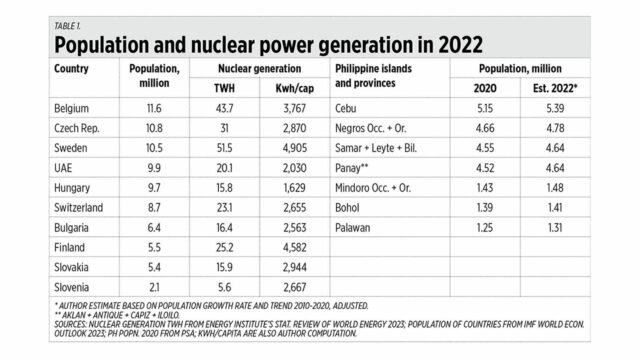
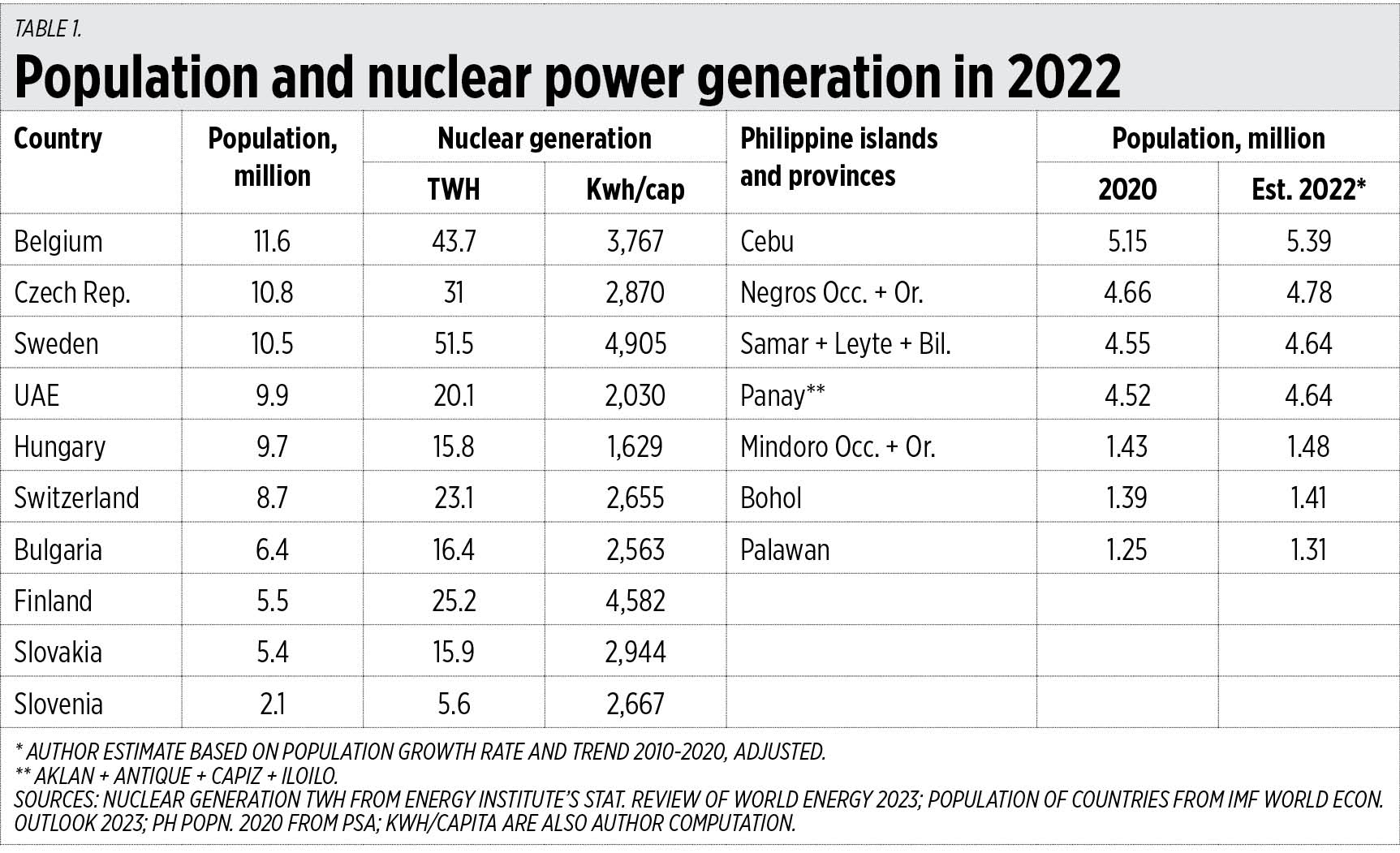
There are many small industrialized countries which have big power supplies. They have been using nuclear power for many decades and have had no nuclear accidents (I list them in Table 1). Small countries like Slovenia, Slovakia, and Bulgaria generate 2,500+ kWh per capita from nuclear energy alone. Meanwhile, in 2022, the Philippines generated a total of only 1,000+ kWh per capita of power from all energy sources.
MGEN, AP, SMGP PARTNERSHIP
Last Friday, three of the largest power companies in the country — Meralco PowerGen Corp. (MGen), Aboitiz Power Corp. (AP) and San Miguel Global Power Holdings Corp. (SMGP) — launched the Philippines’ first and most expansive integrated liquefied natural gas (LNG) facilities in Batangas. AP and MGen will invest jointly in two of SMGP’s gas plants — the existing 1,278-megawatt (MW) Ilijan power plant and the new 1,320-MW combined cycle power plant which is expected to start operations by end-2024. See this report in BusinessWorld: “MGen, AboitizPower, and SMGP sign $3.3-B deal for Batangas LNG facility” (March 4).

I like this development as it further ensures our energy security, so I congratulate the companies. I like these quotes from the heads of the three power conglomerates from the press release that was issued.

“Apart from transforming the energy landscape of the Philippines, this symbolizes a milestone alliance among major players in the energy industry towards a more sustainable future. We are thrilled to have such reliable partners as we lay the foundation for a brighter, greener future,” said MGen Chairman Manuel V. Pangilinan.

AP Chairman Sabin M. Aboitiz noted, “Both LNG and renewables are needed to achieve a balanced energy mix and well-planned energy transition. Above all, this is a big win for the Philippines and the people. Economic development is impossible without energy security.”

SMGP Chairman and President Ramon S. Ang said, “For the first time, three leading power companies are working together to secure our country’s energy needs while transitioning towards cleaner power sources. This represents a major leap forward for our energy future, ensuring not just reliability but also cost-efficient power for many Filipinos.”

In a separate press release, AP President and CEO Emannuel Rubio was quoted as having said, “We continue to diversify our generation portfolio and increase our capability in energy security in the Philippines through a minority share in the first integrated LNG facility, to keep the lights on.”

For Table 2, I looked at the financial conditions of these three players and I included FirstGen as it is a big gas company too. I notice that the four big power companies have a combined gross revenue of about P1 trillion.
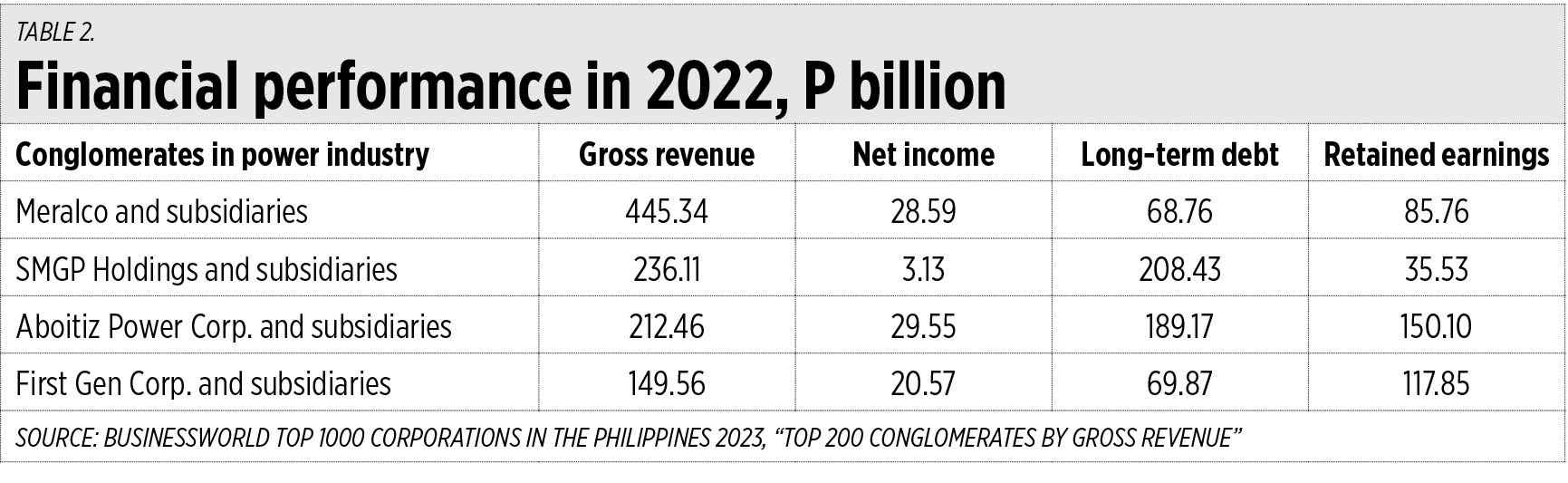
When converted to US dollars, that’s only $17.9 billion gross — “small” compared to most energy companies in the ASEAN-6 and developed East Asia.

THE VISAYAS’ TIGHT POWER SUPPLY
From the monthly operations report by the Independent Electricity Market Operator of the Philippines (IEMOP) one sees that the average power margin (supply minus demand) is about 2,500 MW in the Luzon grid, about 1,200 MW in the Visayas grid, and only around 300 MW in the Mindanao grid. Thin reserves and small margins mean the grid is courting yellow-red alerts or near-actual rotating blackouts, that prices are high, and consumers are forced to cut their electricity use — not good.

Of the roughly 1,850 MW average demand in the Visayas grid, about half of it goes to Cebu alone, and the other half is shared by the sub-grids in Negros, Panay, and Samar-Leyte. Expansion of a coal plant in Cebu is being planned, but instead of welcoming it, some blackout-friendly environmental activists are lobbying that it should be discontinued because… climate. When there are frequent blackouts, the poor use more candles while the rich use more diesel-powered gensets. More candles often lead to fires, the destruction of property and injury or death. Today, not decades from now.

The national and local governments, local businesses and consumers should prioritize 24/7 electricity and job creation, not scare people about what will happen to the climate 50 or 100 years from now.

COSTLY ELECTRIC COOPERATIVES
In my recent column “On electric cooperative cases at the ERC, renewables, and food inflation” (Feb. 29), I forgot to emphasize that many electric cooperatives (ECs) in the country are indeed abusing their consumers with expensive rates that have no regulatory approval, and that some of these ECs have already been penalized by the ERC but are still awaiting the implementation of fines and penalties. The ERC people might be over-worked since there are 120+ ECs to monitor monthly nationwide.

This is another reason why there should be mergers and consolidation of ECs nationwide. I wrote here before that in my province Negros Occidental, there are five ECs, plus another three in Negros Oriental, or eight ECs in just one island. Meaning that the ERC has to monitor and evaluate eight ECs every month in Negros Island. I believe there should be only one corporate distribution utility (DU) in Negros Island, another single DU in Panay Island, and so on. This would result in economies of scale for the DU, less work for the regulators, and lower electricity cost for consumers.


Bienvenido S. Oplas, Jr. is the president of Bienvenido S. Oplas, Jr. Research Consultancy Services, and Minimal Government Thinkers. He is an international fellow of the Tholos Foundation.

minimalgovernment@gmail.com

Atlas Mining income down 65% in 2023

LISTED Atlas Consolidated Mining and Development Corp. announced on Wednesday a net income of P1.12 billion for 2023, down 65% from P3.22 billion a year prior.

In a disclosure, Atlas Mining said that the decline was mainly due to the lower prices of copper in 2023 and a one-time gain on its early payment loans.

“Copper metal price this year averaged at $3.81 per pound, lower by 15% from the previous year’s equivalent of $4.51 per pound,” it said.

The mining firm said that revenues rose 13% to P19.91 billion from P17.68 billion in 2022.

Earnings before interest, taxes, depreciation, and amortization went up by 23% to P6.7 billion from P5.4 billion in 2022.

Meanwhile, the company’s subsidiary Carmen Copper Corp. recorded an increase in gold and copper production and shipments last year.

Its gold production went up by 20% to 26,818 ounces while copper output rose by 13% to 84.1 million pounds.

Carmen Copper saw a 9% jump in copper shipments to 83.57 million pounds.

The subsidiary’s gold shipments likewise increased by 20% to 25,366 ounces.

Carmen Copper is the operator of Atlas Mining’s copper mines in Toledo, Cebu, which produces and exports copper metal in concentrate, and gold and silver as the principal by-products. It exports 100% of the copper to smelters in China and Japan.

At the stock exchange on Wednesday, shares for Atlas Mining fell by 3.22% or 11 centavos to close at P3.31 per share. — Adrian H. Halili

Insurtech Igloo, Lazada team up for online shopping protection

SNOWING-FREEPIK

INSURANCE TECHNOLOGY firm Igloo has partnered with Lazada to introduce online shopping protection plans in response to the increasing number of e-commerce transactions in the Philippines.

“As the number of Filipinos engaging in online purchases continues to rise, it becomes increasingly imperative to provide them with protection throughout their entire shopping journey, extending support even after they’ve received their products,” Igloo Philippines Commercial Lead Roberto S. Vea said in a statement on Monday.

Customers shopping on Lazada’s platform may now assess eligibility for protection plans, review premium costs, and delve into policy specifics during the checkout process.

The insurance offerings on Lazada encompass electronic and gadget protection, merchandise protection, and product liability protection.

Electronic protection and gadget protection plans cover accidental damage, liquid damage, theft, and loss for electronic devices, accompanied by professional repair services at authorized centers.

Merchandise protection, in collaboration with Etiqa Philippines, safeguards non-electronic purchases against accidental damage and theft, enhancing consumer confidence in online transactions.

Igloo plans to introduce a fourth insurance plan in December, focusing on non-electronic products’ accidental and liquid damage protection, diversifying coverage options for shoppers.

Product liability protection, underwritten by Liberty Insurance, addresses adverse reactions from beauty products, ensuring customers have access to medical consultations, reimbursements, and emergency hospitalization if necessary.

According to Mr. Vea, the premiums for these protection plans typically amount to around 5-6% of the product cost, maintaining affordability while delivering comprehensive coverage.

In addition to the Lazada partnership, Igloo previously collaborated with GCash to extend insurance coverage to users for transactions across various online marketplaces, including Lazada, Shopee, Viber, and Facebook.

The surge in e-commerce activity is reflected in the 38.9 million current e-commerce shoppers in the Philippines, projected to reach 55.8 million by 2025, according to Locad.

GlobalData forecasts e-commerce sales to escalate to P968.9 billion ($19 billion) by 2026, highlighting the significant growth potential in the online retail sector. — Aubrey Rose A. Inosante

New Garcia Marquez novel launched 10 years after his death

PENGUINRANDOMHOUSE.COM

MADRID — Gabriel Garcia Marquez died a decade ago, but a previously unpublished book by the author who popularized the Latin American “magical realism” narrative genre will hit the stores on Wednesday, somewhat despite his wishes.

At a presentation in Madrid on Tuesday, his sons, Gonzalo and Rodrigo Garcia Barcha, unveiled the 120-page novel Until August written by the Colombian-born Nobel Prize winner in 2004.

It will be released in Spanish on Wednesday, which is Garcia Marquez’s birthday, and on March 12 in English, according to publisher Penguin Random House.

Before his death in 2014 aged 87, Garcia Marquez said the book was useless and should be “destroyed,” but his sons and his agents reviewed the various manuscripts and considered them to have a literary value that may not have been perceived by the author in the last few years of his life, marked by memory loss.

“For me it means that all of Gabo’s work has been published, that nothing is still pending and that in that sense he has closed a cycle,” Gonzalo Garcia Barcha told a news conference, using the name Garcia Marquez affectionately went by across Latin America.

Garcia Marquez was best known for One Hundred Years of Solitude, a dream-like, dynastic epic that helped him win the Nobel Prize for Literature in 1982.

The new book tells the story of Ana Magdalena Bach who every August takes a ferry to an island to visit her mother’s grave, and there takes a new lover for one night.

His family considers that the book, although left unpolished by Gabo, still carries the author’s recognizable beautiful prose and his deep knowledge of the human being. — Reuters

Cisco, BAP partners for cybersecurity program

REUTERS

CISCO Philippines has partnered with the Bankers Association of the Philippines (BAP) to train employees in the banking industry on cybersecurity.

Nineteen employees from the first batch have completed the course, Cisco Philippines Managing Director Zaza Soriano-Nicart said at the awarding ceremonies on Wednesday.

The workers came from 13 member-banks, she said.

“We developed a curriculum through our Cisco networking academy, one of the world’s longest-running IT skills-to-job program to equip both IT and non-IT professionals in the banking industry with fundamental cybersecurity skills,” Ms. Nicart said.

The beginners’ program, which is self-paced and requires 36 hours, must be completed in four months. The specialized course is a more rigorous training program for managers with technical roles.

Ms. Nicart said Cisco is accepting its second batch of applications for the program, which will start in April.

The next phase will be updated with an ethical hacker course and will offer insights on offensive security to detect cyberthreats. — Aaron Michael C. Sy

The surprise chain

LINUS NYLUND-UNSPLASH

THERE are unexpected and unplanned events like plane crashes, typhoons, earthquakes, and the early split-up of a political alliance. But corporate surprises are usually planned. The hierarchy of an organization is divided into two camps, the surprisers (those who make the decisions) and those who are surprised (those affected by the decisions).

The surprise chain begins with the surprisers who throw the pebble to create the ripples. The first part involves those at the top who make the decisions. (Sometimes, even the top can be surprised by the board or outside developments.) One informal link in the chain consists of those who surround the surprisers. They feed the grapevine with hearsay and speculations based on informal access and overheard conversations.

Chronology (when did you know?) determines one’s position in the hierarchy. The surprise chain includes information on events that have already happened but are not yet widely known. The rumor mill fans the flames with speculation and possible scenarios of events that are not yet known and can go in various directions depending on the reactions to the unknown.

Rumors (with a few variations on the sources) can assume a life of their own, disseminated and embellished by online postings. The “word-of-thumb” spreads swiftly like a virus. The ease of forwarding posts to many addressees at once speeds up the ripple effect and stokes the suspense — yes, I got that text last night.

The surprise chain ends only with an official announcement in a memo or public disclosure for a listed company. An official spokesperson (who may even be among the surprised) distributes the news to the media. (Are there any questions?)

Speculations on possible replacements of an announced “resignation for more time with the family,” unconfirmed job offers, and a major reorganization (involving a new hire) follow the official announcement.

Can one take an all-knowing stance, like claiming knowledge of the event even before the surprisers? The surprised ones are often clueless and disbelieving of even the possibility of an unpleasant surprise. (I just had a pleasant lunch with the CEO last week, so how could he possibly fire me?) To paraphrase Rudyard Kipling’s maxim — “If you can keep your head when all around you are losing theirs — maybe you haven’t heard the news.”

A surprise should be evaluated on its effect on individuals. An event, no matter how surprising, may be simply interesting, if it has no adverse effect on any person, like a change of the corporate logo.

The shock of surprise depends on the individual affected, like one who loses a high-visibility position. (Can I keep my security contingent?) Adding to the consternation is the realization that one did not even have any defenders at the top. Nobody even organized a despedida party, with a video of the departing one’s achievements… if any.

While one cannot anticipate surprise, he can control his reaction to it. Showing shock at the news indicates the following: a.) The rumors about his exit were not baseless; b.) He could not stop the decision from being finalized; and, c.) He was at the tail of the surprise chain and had no control of the runaway events, except maybe his exit package. (Can he keep the golf club share?)

The word “surprise” comes from French — sur prendre, to take over. There is therefore an element of being taken over and overwhelmed by unexpected developments.

When surprise incapacitates action and abandons self-esteem, the consequences are even worse.

Containing one’s surprise works best. It does no good to look around and check who was not at all surprised by what happened. Surely, a few knew ahead of time, maybe were even part of the group of surprisers. (I was just as surprised as you.)

One form of surprise is disappointment (which can also be unanticipated). When a development seems to have already been approved and the barriers to its completion cleared, it can be disappointing to see nothing further going on. (We will give more details when the closing conditions have been ironed out.)

The best reaction is to remain calm and pretend that the unexpected turn of events was all for the best. Maybe, moving on from some unpleasant news can bring the surprising relief… that it could have been worse.


Tony Samson is chairman and CEO of TOUCH xda

ar.samson@yahoo.com

LRT-1 operator says Cavite extension nears completion

PHILIPPINE STAR/EDD GUMBAN

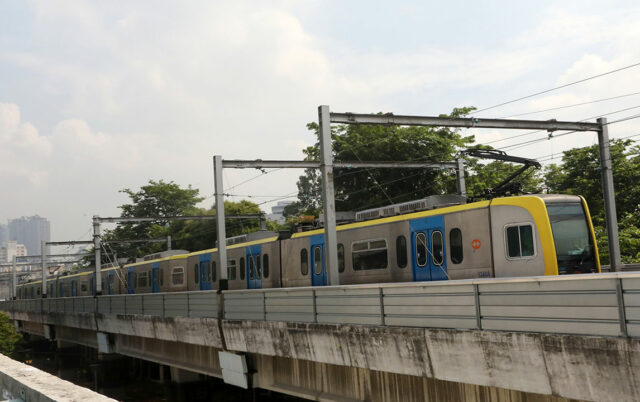
LIGHT Rail Manila Corp. (LRMC) is on track to launch the first phase of the Light Rail Transit Line 1 (LRT-1) Cavite extension by yearend, the operator of LRT-1 said on Wednesday.

The first phase of the Cavite line extension is now 97% complete, LRMC said in a statement.

“We are optimistic about the progress achieved in the LRT-1 Cavite Extension Phase 1 project,” LRMC President and Chief Executive Officer Juan F. Alfonso said.

LRMC said the five new stations to be completed are Redemptorist Station at 93.3%, MIA Station at 93.5%, Asia World Station at 83%, Ninoy Aquino Station at 88%, and Dr. Santos Station at 94.1%.

LRMC is also conducting test runs of various generations of LRT-1 trains. the company said.

“The LRT-1 Cavite Extension Project is poised to significantly contribute to the nation’s economic growth and development by fostering improved connectivity between individuals and communities,” Mr. Alfonso said.

Once finished, the first phase of the LRT-1 Cavite extension will add a total of 6.2-kilometer line, connecting Baclaran Station in Pasay City to Dr. Santos Station in Parañaque City.

The LRT-1 Cavite Extension Phase 1 is expected to serve about 600,000 passengers daily.

LRMC is the joint venture of Ayala Corp., Metro Pacific Light Rail Corp., and Macquarie Infrastructure Holdings (Philippines) Pte. Ltd. Metro Pacific Light Rail is a unit of Metro Pacific Investments Corp., which is one of three Philippine subsidiaries of Hong Kong’s First Pacific Co. Ltd., the others being PLDT Inc. and Philex Mining Corp.

Hastings Holdings, Inc., a unit of PLDT Beneficial Trust Fund subsidiary MediaQuest Holdings, Inc., maintains interest in BusinessWorld through the Philippine Star Group, which it controls. — Ashley Erika O. Jose