Home Blog Page 3481

TIMELINE: Rift deepens between Manila, Beijing
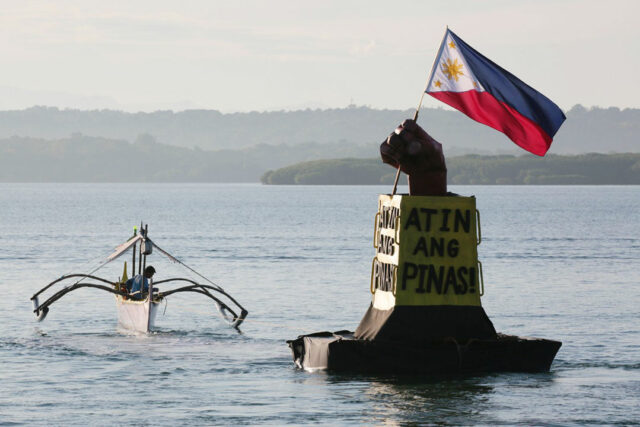
FISHERMEN from Masinloc, Zambales province in northern Philippines released on Monday an 18-foot-tall buoy on which it is written: “Atin ang Pinas” (The Philippines is ours). Fisherfolk in Zambales, whose coast faces the South China Sea, are protesting China’s “continued harassment” of Filipino fishermen at the Scarborough Shoal. — PHILIPPINE STAR/MICHAEL VARCAS

RELATIONS between Manila and Beijing have soured under Philippine President Ferdinand R. Marcos, Jr., with Manila pivoting back towards the United States which supports the Southeast Asian nation in its maritime disputes with China.

Here is a timeline of key events since 2023 that have escalated tensions between the Philippines and China:

JAN. 3-5 — Marcos goes on three-day visit to Beijing where he and Chinese President Xi Jinping agree to set up direct communications between their foreign ministries on the South China Sea.

FEB. 2 — The Philippines grants the United States greater access to four more military bases under the 2014 Enhanced Defense Cooperation Agreement (EDCA).

FEB. 13-14 — The Philippines accuses China’s coastguard of directing a “military-grade laser” at its troops living aboard an aging warship that Manila deliberately grounded on the disputed Second Thomas Shoal in 1999. Marcos summons China’s ambassador.

APRIL 3 — The Philippines reveals the locations of the four additional bases that Washington can use under EDCA. Three face north towards Taiwan and one is near the disputed Spratly Islands.

APRIL 11 — More than 17,000 Filipino and US soldiers begin their largest ever joint military drills in the Philippines.

APRIL 22 — Marcos and his foreign secretary meet China’s then-foreign minister Qin Gang in Manila, pledging to work together to resolve maritime differences.

MAY 1 — US President Joseph R. Biden welcomes Marcos at the White House, the first visit by a Philippine leader in 10 years. They express “unwavering commitment to freedom of navigation and overflight in the South China Sea.”

MAY 3 — The United States and the Philippines agree on new guidelines for their 1951 Mutual Defense Treaty, which specifically mention that mutual defense commitments would be invoked in an armed attack on either country “anywhere in the South China Sea.”

JUNE 6 — The coast guards of the United States, Japan and the Philippines hold trilateral exercises in the South China Sea, the first such manoeuvres.

AUG. 5 — The Philippines accuses China’s coast guard of blocking and firing a water cannon against a supply boat transporting food for troops on the Second Thomas Shoal, known in China as Renai Reef and in Manila as Ayungin Shoal.

AUG. 7 — China’s coast guard urges the Philippines to remove the grounded warship from the Second Thomas Shoal.

OCT. 22-24 — The Philippines accuses Chinese coastguard vessels of intentionally colliding with its vessels routinely supplying forces stationed at the Second Thomas Shoal. No one was harmed.

NOV. 16 — The Philippines calls on China to remove all “illegal structures” built within its exclusive economic zone (EEZ), cease reclamation in those areas and be accountable for the damage the activities caused.

NOV. 21 — The militaries of the Philippines and the United States launch joint patrols from waters near Taiwan to the South China Sea.

NOV. 25 — The Philippines and Australia begin their first joint sea and air patrols in the South China Sea.

DEC. 9-10 — The Philippines accuses China of firing water cannon at its boats, including one carrying its military chief, and ramming others, causing serious engine damage. China’s coast guard says the Philippine vessel intentionally rammed its ship.

DEC. 19 — Marcos says a “paradigm shift” is needed in how his country approaches the South China Sea, as diplomatic efforts with Beijing were headed in a “poor direction.”

DEC. 21 — China says bilateral relations are at a crossroads and warns the Philippines against “misjudging” the maritime situation.

JAN. 3 — The Philippines and the United States carry out their second joint patrol in the South China Sea as China conducts a similar activity with its naval and air forces in the disputed waterway.

FEB. 9 — The Philippines and the United States conduct joint maritime exercises in the South China Sea for a third time as China carries out “routine patrols” in the area.

FEB. 10 — The Philippine Coast Guard accuses China of “dangerous and blocking” maneuvers while its vessel patrolled near Scarborough Shoal in the South China Sea this month.

MARCH 5 — The Philippines calls out China for its coast guard’s “reckless” and “illegal” actions that led to a collision between a Chinese and Philippine ship, damaging the latter and injuring some of its crew, during a resupply mission for troops at the Second Thomas Shoal. China says the Philippine vessels illegally intruded into waters adjacent to the shoal.

MARCH 6 — The Philippines summons China’s deputy chief of mission in Manila to protest “aggressive actions” by Chinese naval forces against the resupply mission.

MARCH 20 — China says the United States must refrain from “stirring up trouble” or taking sides on the South China Sea issue, after US Secretary of State Antony Blinken said, while on a visit to Manila, a security deal with the Philippines extended to attacks on the Philippine coast guard.

MARCH 24 — China’s coastguard says it had taken measures against Philippine vessels carrying out a resupply mission for troops at the Second Thomas Shoal, while the Philippines decried the moves, including the use of water cannon that damaged its ship and injured its crew, as “irresponsible and provocative.”

MARCH 25 — Philippines summons China’s envoy to protest “aggressive actions” in the South China Sea, as Manila’s Defense minister dared Beijing to bolster its vast sovereignty claims by taking them to international arbitration. — Reuters

Timor Leste to hold hearings on wanted Pinoy congressman

POLÍCIA CIENTÍFICA E DE INVESTIGAÇÃO CRIMINAL/ FACEBOOK/PHILSTAR FILE PHOTO

By Chloe Mari A. Hufana

IT MAY take as long as 40 days before an expelled congressman accused of masterminding the killing of his province’s governor can be deported back to the Philippines from Timor Leste, where he will first undergo court proceedings, according to government agents.

A Timor Leste court will hold court proceedings to determine whether to send ex-Negros Oriental Rep. Arnolfo A. Teves, Jr. back home, National Bureau of Investigation (NBI) Director Medardo G. de Lemos told a news briefing on Monday.

“Mr. Teves will be presented in a court to decide if they will allow him to go back here to the country,” he said.

Timor Leste President Jose Ramos-Horta promised the NBI seven to 40 days to resolve the case.

NBI agents earlier returned to the Philippines after filing to get custody of the former lawmaker in Timor Leste. Mr. De Lemos blamed Timor Leste’s complex justice system for the delay.

Deportation proceedings had yet to start because authorities were still evaluating the red notice issued by the International Police, he added.

Mr. De Lemos said the NBI was not expecting to bring home Mr. Teves on their first visit to Timor Leste, adding that agents went there to verify his arrest.

The NBI team managed to get a “smiling photo” and the fingerprints of Mr. Teves, he added.

Ferdinand S. Topacio, the ex-congressman’s lawyer in the Philippines, accused the NBI of harassment by getting a photo of his client while being detained.

He said Mr. Teves fears for his safety and is not keen to come home.

He is now an undocumented alien in Timor Leste after the Philippines’ Department of Foreign Affairs (DFA) canceled his passport.

The Department of Justice is also looking at rendition or voluntary surrender to bring Mr. Teves home.

Ephraim B. Cortez, president of the National Union of People’s Lawyers, told BusinessWorld via Viber that the easiest way to bring Mr. Teves home is for the Timor Leste government to surrender custody.

Mr. Topacio said they might bring his client’s case to the United Nations Commission on Human Rights.

“We do not recognize or acknowledge any camp that refuses to go through our justice system,” Justice Assistant Secretary Jose Dominic F. Clavano IV told reporters in a WhatsApp message.

“The brutal crimes happened here in the Philippines,” he said. “The families of the victims are here in the Philippines. So, we want justice to be served here in the Philippines.”

Mr. Teves is accused of masterminding the murder of former Negros Oriental Governor Roel R. Degamo last year and five others. He was added to Interpol’s red notice list last month.

DoE, PNP partner to clean up LPG industry

A man arranges tanks of liquefied petroleum gas (LPG) on a truck. — PHILIPPINE STAR/EDD GUMBAN

By Sheldeen Joy Talavera, Reporter

THE DEPARTMENT of Energy (DoE) and the Philippine National Police (PNP) are launching a crackdown on illegal and hazardous practices in refilling, trading and maintenance of liquefied petroleum gas (LPG) cylinders in the country.

“Recognizing the significant risk to both life and property, the government acknowledges the urgent need to ensure that all activities involving the commerce of LPG meet the highest quality and safety standards,” Energy Secretary Raphael P.M. Lotilla said in a statement on Sunday.

The DoE and the PNP have already inked an agreement to strictly enforce the laws regulating the industry and “ensure the protection of the interests and general welfare of the public.”

Under the agreement, the DoE and PNP will establish “Oplan LIRA,” which shall enforce compliance to Republic Act No. 11592, the LPG Industry Regulation Act (LIRA), on all levels of the industry.

It activates the police Criminal Investigation and Detection Group (CIDG) in DoE-led inspections of LPG facilities: retailers, refillers, motor vehicles involved in the transportation of LPG in bulk or LPG cylinders and cartridges.

“Strict monitoring and enforcement is paramount to mitigate risks associated with LPG operations and promote responsible and sustainable practices within the industry,” Mr. Lotilla said.

The PNP is also tasked to investigate potential criminal violations under the LIRA, either upon receiving a report or on its initiative.

The joint DoE-PNP activities could involve the conduct of surveillance, entrapment, filing search warrant applications, and initiating criminal actions against violators.

“The passage of LIRA has prompted the government to shift focus on consumer welfare and protection, where the DoE has prioritized quality, health, safety, and environmental standards,” the DoE statement said.

Based on its records, the DoE has issued licenses to about 15,000 business establishments in the LPG trade as of end-2023.

Marcos declares half-day work on March 27

PHILIPPINE President Ferdinand R. Marcos, Jr. has ordered the suspension of work in government offices from 12 noon onwards on Wednesday, March 27 so state workers can observe the Catholic Holy Week.

Under Memorandum Circular No. 45 signed by Executive Secretary Lucas P. Bersamin and published on Monday, agencies that handle health services, disaster response and other vital services will not be covered by the memo.

The shorter workday would let government employees travel to and from the different regions in the country before Maundy Thursday and Good Friday, according to a copy of the memo.

About 78.8% of the population or 85.65 million Filipinos are Roman Catholics, according to the local statistics agency. — John Victor D. Ordoñez

Monitor Lenten prices, DA urged

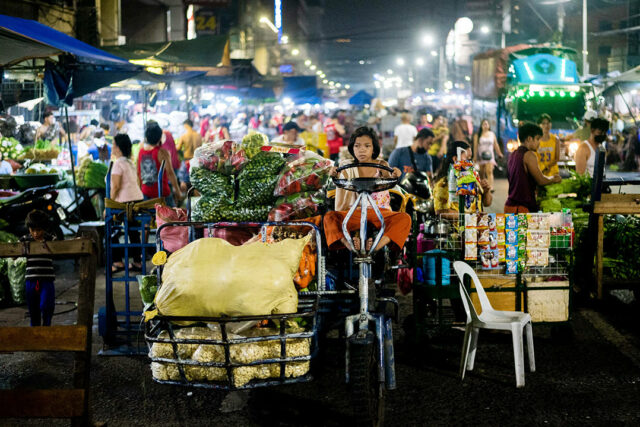
A child sits in a motorized vehicle loaded with vegetables at a public market in Manila, Philippines, Oct. 21, 2022. — REUTERS/LISA MARIE DAVID

PRICES of basic commodities, especially fish and vegetables, should be guarded against unwarranted increases during the Holy Week, a congressman urged the Department of Agriculture (DA) on Monday.

Party-list Rep. Wilbert T. Lee also called on the Department of Trade and Industry (DTI) to set suggested retail prices for basic goods to prevent price gouging in the culminating week of the Lenten season.

“While it is natural for the retail prices of vegetables and fish to go up during the Holy Week, the DA and DTI should still closely monitor its prices,” Mr. Lee said in mixed English and Filipino in a statement.

Last week, the DA reported that it expects a spike in retail prices for fish and vegetables — the preferred food of Catholics who would be observing abstinence from pork and other meat products.

Fish products are expected to increase by 10% to 20%, DA Assistant Secretary Arnel V. de Mesa said in a public briefing last Friday even if he assured a sufficient supply in the market throughout the Holy Week. 

Commenting on DA’s statement, Mr. Lee said that “price increases should not be so significant” despite increased demand for the last week of Lent.

According to DA’s Bantay Presyo program, the average retail prices for a kilo of Bangus (milk fish), Tilapia, local and imported Galunggong in the National Capital Region (NCR) last week stood at P192.61, P141.33, P222.66, and P193.33, respectively.

While the DA’s Bantay Presyo initiative was set to cover the 17 regions of the country — the program only provides complete and updated data to the National Capital Region (NCR).

“As for now, the DA only monitors Metro Manila prices. We hope that this program will be extended to provinces and other regions so that other people not from the NCR can also benefit from price monitoring,” Mr. Lee said in Filipino. Kenneth Christiane L. Basilio

P72-M cannabis farm raided

BAGUIO CITY — Law enforcement authorities raided a P72-million cannabis plantation tucked along a mountain area far off Kennon Road in Tuba, Benguet last weekend.

The discovery of the illegal plantation in Sitio Sangilo, Barangay Camp 4 in Tuba was made following a drug sting by anti-narcotics operatives that yielded 60 kilos of marijuana last March 20.

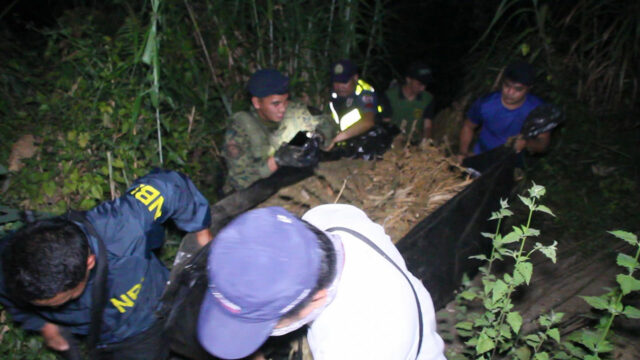
Joint police, Philippine Drug Enforcement Agency (PDEA) and National Bureau of Investigation (NBI) agents went on a three-hour trek to find the source of the contraband until they reached the plantation.

It was there that they seized at least 600 kilos of dried marijuana with stalks and fruiting tops bundled into 12 oversized chute sacks and covered with plastic sheets.

Police in Tuba already have the identities of the four cultivators, but withheld their identities pending a case-buildup with the cooperation of a key witness in the operation of the cannabis plantation. — Artemio A. Dumlao

SEC opens new office in Butuan

SEC.GOV.PH

THE SECURITIES and Exchange Commission (SEC) has opened its 11th extension office in the country in Butuan City as part of expanding the corporate regulator’s presence in the southern Philippines.

“Choosing Butuan as the newest location for our extension office was an easy decision to make, as the high number of business name registrations in the area shows its potential to become a thriving business hub in the future,” SEC Chairperson Emilio B. Aquino said in a statement released on Monday.

The new SEC office is located at JC Aquino Training Center, JC Aquino Avenue, Barangay Libertad, and serves the Caraga Administrative Region, which has 7,158 registered corporations and partnerships. These were all previously under the jurisdiction of SEC’s extension office in Cagayan de Oro. 

According to the SEC, the Butuan extension office was requested by the Regional Development Council of the Caraga Region and  the Office of Agusan del Norte First District Representative Jose S. Aquino II.

“The establishment of the extension office aligns with the commission’s mandate to ensure the efficient delivery of public services and effective enforcement of laws concerning the capital market, financing and lending companies, and the overall corporate sector,” the SEC said. Revin Mikhael D. Ochave

SC sets guidelines on rape cases

BW FILE PHOTO

A NEW decision by the Supreme Court (SC) has clearly defined the aggravating and qualifying circumstances in rape cases involving minors when the elements of both statutory rape and qualified rape — which carries the heavier penalty of death — are present.

According to the SC en banc decision penned by Associate Justice Mario V. Lopez and released on Monday, a crime shall be treated as qualified rape of a minor if “twin circumstances of minority and relationship, or the age of the victim is below seven years old,” or “the accused’s knowledge of the mental disability of the victim at the time of the commission of rape” were present. 

This condition will also be applied if the victim is below the statutory age or is suffering from mental retardation comparable to a child below the statutory age.

In differentiating statutory rape from qualified rape, the top court cited the Revised Penal Code, which defined statutory rape as “carnal knowledge of a woman below 12 years of age regardless of her consent or the lack of it, to the sexual act.” Proof of force, intimidation, or consent is unnecessary in statutory rape, which carries the penalty of reclusion perpetua or life imprisonment. Meanwhile, the aggravating circumstances under qualified rape are relationship, moral ascendancy, or influence, abuse of authority, ignominy, and personal circumstances.

“The term ‘statutory age’ in these guidelines shall mean either “below 12 years old” or “under 16 years old” depending on whether the crime of rape was committed before or after the effectivity of the Special Protection of Children Against Abuse, Exploitation, and Discrimination Act (RA 11648), respectively,” the Court clarified. — Chloe Mari A. Hufana

13 burned to death in Cotabato road accident

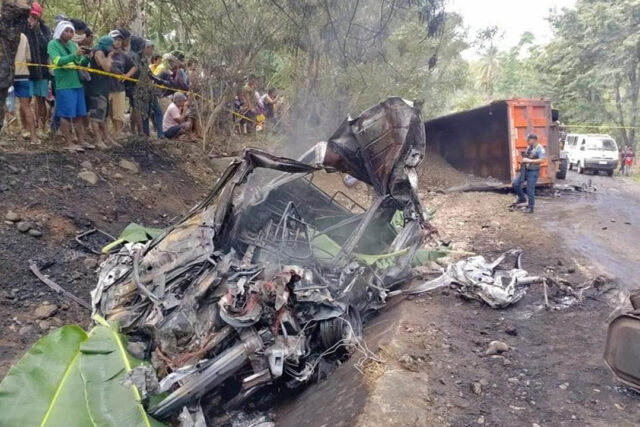
FIVE people were burned in a commuter van that collided with a dump truck and caught fire on a highway in Barangay Luhong in Antipas, Cotabato. — PHILIPPINE STAR/JOHN FELIX M. UNSON

COTABATO CITY — Thirteen passengers of a commuter van were burned to death after their vehicle went up in flames after a high-speed collision with a dump truck in Cotabato province, southern Philippines on Monday.

Witnesses said the impact of the collision in Barangay Luhong, Antipas town, was so forceful that the passenger van first flipped, rolled over and then plunged into a flood control ditch before bursting into flames.

The dump truck turned-turtle and landed on its side some six meters away from the van and also caught fire.

Policemen and municipal officials have identified only six of the 13 fatalities by 4 p.m. Monday.

Col. Gilbert Balneg Tuzon, Cotabato provincial police director, said on Monday afternoon that probers from the Antipas Municipal Police Station and personnel of the Antipas Municipal Disaster Risk Reduction and Management Office are still trying to determine which vehicle was at fault. — John Felix M. Unson

Soldiers foil communist rebels’ attempt to regain bases in Aurora, Nueva Vizcaya

UNSPLASH

BAGUIO CITY — An attempt by communist guerrillas to recover their lost rebel bases and mass support in villages along the borders of Aurora and Nueva Vizcaya provinces in northern Luzon was foiled by government forces.

Following a tip-off from residents, soldiers from the Philippine Army’s 91st Infantry Battalion supported by the Tactical Control Unit from the Philippine Army’s 84th Infantry Battalion reportedly fought with remnants of the rebels last Friday in Barangay Galintuja, Maria Aurora, in Aurora province.

Major General Andrew D. Costelo, commander of the Philippine Army’s 7th Infantry Division said, communist rebels were attempting to recover in the boundary Barangays of Maria Aurora and Nueva Vizcaya when the tip off was received.

Acting swiftly on the information, soldiers led by 2Lt. Karl Angelou A. Buquida engaged the rebels in a 30-minute gunbattle sending the outmaneuvered rebels scampering away.

No one was reported hurt from the government side while Costelo said they believed rebels suffered casualties though could still not account for it.

After the gunbattle, two short magazines of M16 rifle, 24 rounds of ammunition for M203 grenade launcher, 143 rounds of M16 ammunition, 110 rounds of ammunition for M14 rifle, 1 pair of rifle handguard, a rifle dust cover of M16 were seized at the encounter site including personal belongings, medical items, and rebel documents.

Mr. Costelo believed the rebels are trying to regain support from the populace through extortion and exploitation, but they were tipped off signifying “the community’s rejection of their deceptive tactics.” — Artemio A. Dumlao

Recto proposal for 6% growth seen less likely to expand deficit

FINANCE SECRETARY RALPH G. RECTO — DEPARTMENT OF FINANCE FACEBOOK PAGE

THE Development Budget Coordination Committee (DBCC) needs to adjust its growth and fiscal targets to lower the risk of a revenue shortfall that would widen the deficit, analysts said.

Finance Secretary Ralph G. Recto had earlier called on the DBCC to adjust its growth targets this year and in the medium term to be “more realistic.”

He said the economy could aim for 6% gross domestic product (GDP) growth, but keep 6.5% as an aspirational target.

“If you project a very high GDP, then you’re projecting a very high revenue, and if you miss it, your deficit will increase and your debt to GDP will also increase,” he told reporters on the sidelines of an Economic Journalists Association of the Philippines event last week.

“Underpromise but overdeliver, that’s what I believe,” he said.

Last year, the DBCC narrowed its GDP growth target range to 6.5-7.5% from 6.5-8% previously. The economy grew 5.6% in 2023, falling short of the DBCC goal for the year and underperforming the 7.6% expansion in 2022.

The DBCC is also projecting 6.5-8% economic growth from 2025 until 2028.

Economic managers have yet to release a decision on whether they will maintain or revise targets.

To achieve GDP targets, the government should bolster revenue collection and asset privatization, Mr. Recto said.

“We will push not only the BIR [Bureau of Internal Revenue], not only the BoC (Bureau of Customs), the GoCCs (government-owned and -controlled corporations) to pay more dividends… [we are looking] to collect more effectively fees and charges, not only taxes, [and] do some privatization.”

Last week, the Finance Secretary proposed the idea to sell and develop the Ninoy Aquino International Airport’s 600-hectare property to generate revenues for the government.

Security Bank Corp. Chief Economist Robert Dan J. Roces welcomed the more realistic fiscal targets, citing global and domestic uncertainties.

“The Finance Secretary’s adjusted expectations of 6-6.5% reflect a nuanced approach, considering potential shifts in policy to support economic stability and growth, and the potential volatility to markets that these shifts may cause,” Mr. Roces said in a Viber message.

Key industries like manufacturing, construction, and services are expected to lead the drive to hit the growth targets, Mr. Roces said. 

However, enhanced regulation and ease of doing business should also help stimulate investment and ensure growth, he added.

On the other hand, agriculture and external trade could pose a drag on GDP growth, Mr. Roces said.

“Agriculture and external trade face headwinds that could temper growth, so this will highlight the importance of targeted policy measures to mitigate risks and capitalize on opportunities for sustainable economic advancement.”

Agriculture sector has suffered P1.75 billion worth of damage from El Niño, the Agriculture department said last week, with the dry conditions expected to last until the second quarter.

Key exports that suffered negative year-on-year growth in January included wearables, electronic telecommunication products, cathodes and refined copper, and other mineral products.

Albay Rep. Jose Ma. Clemente S. Salceda, who heads the House Committee on Ways and Means, said the government should manage rice prices — which account for one fifth of poor households’ spending — to help meet growth targets.

“The more expensive the rice, the less the budget is for other things, the slower economic activity becomes,” he said in a Viber chat.

Rice inflation accelerated to 23.7% in February from 22.6% in January and 2.2% a year earlier, according to the Philippine Statistics Authority. — Beatriz Marie D. Cruz

Single-use plastics tax seen generating up to P34 billion

PHILSTAR FILE PHOTO

THE Department of Finance (DoF) said its proposal to impose excise taxes on single-use plastic bags could yield up to P33.856 billion in the first five years of implementation.

In a statement on Monday, the DoF said that the tax measure will reduce pollution, promote sustainable practices and generate revenue to support growth.

“When a good has some negative externalities, meaning the consumption or use of a product causes some social cost, we try to regulate that through taxation,” DoF Fiscal Policy and Monitoring Group Officer-in-Charge Undersecretary Karlo Fermin S. Adriano was quoted as saying in a statement.

“In the case of single-use plastics, the social cost is mismanaged waste,” he added.

The revenue generated by this measure will be used to fund solid waste management programs for local governments.

The DoF estimates that the proposal will generate P2.334 billion in its first year of implementation, followed by P6.96 billion in the second year, P7.412 billion in the third year; P8.162 billion in the fourth year; and P8.988 billion in the fifth year.

It also noted these revenue estimates assume that the measure will be implemented as early as the third quarter with 50% tax compliance and assuming 70% tax compliance between 2025 and 2028.

For the 2025 to 2028 period, the measure is expected to yield P31.52 billion in revenue.

The DoF’s proposal imposes an excise tax of P100 per kilogram of single-use plastic bags. It is also proposing 4% annual indexation on the third year of the measure’s implementation or beginning Jan. 1, 2026.

“The proposal covers single-use plastic bags that are not recyclable, such as ‘ice’, ‘labo’, or ‘sando’ bags (with or without handles),” it said.

“Under the DoF’s proposal, the price of labo bags per piece will slightly increase from P0.47 to P0.82 while sando bags will be priced at P0.51 to P0.91 each,” it added.

The DoF said that the Philippines has one of the cheapest tax rates for single-use plastic bags compared to other countries at P0.40 per bag.

Citing World Bank data, the Philippines was found to be the third-largest contributor of mismanaged plastic in the ocean each year.

“This is a low-hanging fruit that has been on the table for more than a decade. I am confident that our legislators will support this measure,” Finance Secretary Ralph G. Recto added.

A bill seeking to impose an excise tax on plastic bags was approved by the House of Representatives in November 2022. A similar measure is pending at the Senate committee level.

The House and Senate versions likewise impose an excise tax of P100 for every kilogram of single-use plastic bags. The rate of tax is due to increase by 4% every year, effective Jan. 1, 2026.

Meanwhile, another bill pending at the Senate proposes to charge a P20 excise tax on single-use plastic bags, but also proposes 4% annual indexation. — Luisa Maria Jacinta C. Jocson

ADVERTISEMENT
ADVERTISEMENT