Home Blog Page 3470

Philippine waste pickers may be missing piece in EPR enigma

A waste picker carries bags of trash out of his junk shop in Quezon City, Metro Manila, Philippines, July 7, 2020. — REUTERS

By Sheldeen Joy Talavera, Reporter

APOLINARIO O. GERONIMO’S otherwise soft voice blares through the megaphone as he combs the streets of Tondo, Manila on his sidecar trying to collect scrap TVs and electric fans from residents.

“I disassemble broken appliances and sell the copper wire and other metals to a nearby scrapyard,” the 66-year-old widower and father of 14, who’s been making money from trash since 2000, said by telephone in Filipino. “Sometimes, I fix and sell them for cheap.”

Mr. Geronimo is already a step ahead of the average waste picker in the Philippines who, according to the International Alliance of Waste Pickers (IAWP), earns P70 ($1.26) to P100 a day.

The Philippines generates 61,000 metric tons of solid waste daily, as much as a quarter of which is plastic, according to the Department of Environment and Natural Resources (DENR).

The informal waste sector also includes waste pickers at dumpsites and communal waste collection points who help recycle trash in a country where solid waste management is rarely enforced among households.

Informal waste pickers collect a staggering 60% of the world’s plastics destined for recycling, according to the IAWP.

Environment Secretary Maria Antonia Yulo-Loyzaga has said she wants to integrate the informal waste sector into the extended producer responsibility (EPR) system.

The EPR Act, which lapsed into law in 2022, requires big companies with assets worth more than P100 million to be environmentally responsible throughout the life cycle of a product, especially its post-consumer or end-of-life stage.

Under the law, these companies must register with the National Solid Waste Management Commission their EPR programs to reduce or recover for reuse or recycling the plastic packaging waste that they release to the local market.

Plastic packaging covered by the law includes sachets, labels, laminates and other flexible plastic packaging products; rigid plastics used for beverages, food, home, personal care and cosmetic products and their caps, cutlery, plates and drinking straws; plastic bags; and polystyrene.

DENR data showed that as of October 2023, 745 enterprises had submitted their EPR programs, fewer than the 4,000 expected.

“The EPR law presents an opportunity for the informal waste sector to be formally included into the circular economy value chain,” the DENR’s Environmental Management Bureau (EMB) said in a Viber message.

Elizabeth dela Torre Ampuyas, 68, who has been a registered member of Canadian social enterprise Plastic Bank since 2019, earns P85 daily by collecting plastic bottles, for which she also gets grocery vouchers and school supplies.

“The vouchers from Plastic Bank are a big help,” she said by telephone in Filipino. “I can also help save the environment by picking up trash.”

Plastic Bank builds recycling ecosystems in underdeveloped communities to fight plastic pollution in oceans and help cut poverty in developing countries.

The for-profit social enterprise partners with companies that buy “social plastics” and repurpose these into another material, Camille Nuñez, marketing manager at Plastic Bank, said in a text message.

“The problem of plastic is systemic,” she said. “The government has been doing its best to provide solutions to the problem. However, it all goes down to how things are implemented. If people understand how valuable plastics are, they will treat plastics as a resource, not as a waste.”

The informal waste sector is often overlooked and doesn’t get enough credit for its contribution to solid waste management, according to Marian Frances T. Ledesma, zero-waste campaigner at Greenpeace Southeast Asia-Philippines.

“The government should recognize the work of the informal waste sector by documenting their roles in the community and making their work official under the law — either as self-employed individuals or as part of a group,” she said in an e-mailed reply to questions.

RECOGNITION
Integrating the informal waste sector into a city’s solid waste management strategies is imperative, according to the United Nations Development Programme (UNDP).

“Despite their significant contributions to waste segregation and recycling, informal waste workers often grapple with challenges such as a lack of formal recognition, discrimination, hazardous working conditions, low income and limited support for livelihood opportunities,” Cheska Peralta, communications analyst for the Accelerating NDC through Circular Economy in Cities (ACE) project, wrote in a blog posted on the UNDP website in December. Ms. Ledesma said waste pickers shouldn’t be boxed into just waste management. “They should be given the opportunity to learn or be trained to lead or participate in sustainable business models,” she added. 

She said waste workers might want to work in emerging companies that produce little to no waste, such as those that deal with reverse logistics for reuse systems or startups built on reuse concepts.

Michael Anthony Santos, EPR project manager at the World Wide Fund for Nature (WWF) Philippines, said local governments should start recognizing informal waste workers by giving them IDs.

“If waste workers have IDs, they will be recognized as waste collectors,” he said via Zoom. “The first step in formalizing them is by employing them as barangay waste collectors.”

“It starts with the recognition that they need our help so… the least that local governments can do is to provide them with IDs,” he added.

If done fairly and in consultation with waste workers, integrating the informal waste sector into the EPR law would let them fully participate in the circular economy, Ms. Ledesma said.

The Environment department is encouraging big enterprises to work with cities in integrating the informal waste sector into their extended producer responsibility programs.

“The EPR law may be new, and challenges may arise initially, but as we adapt and learn, the potential to reap the benefits of a circular economy becomes increasingly tangible,” the EMB said.

Mr. Geronimo, the trash collector from Tondo, gets more than a kilo of scrap metal from the broken appliances that he buys from households.

“I earn P500 to P700 a day,” he said. “Sometimes, it’s not enough given spiraling prices, but it’s better than nothing.”


IBPAP hoping to unlock new markets through EU-PHL FTA

REUTERS

A FREE TRADE AGREEMENT (FTA) between the Philippines and the European Union (EU) is expected to help unlock new markets for the information technology and business process management (IT-BPM) sector, an industry executive said.

IT and Business Process Association of the Philippines (IBPAP) President and Chief Executive Officer Jack Madrid said that the Philippine IT-BPM sector continues to cater mostly to North American clients, noting the need to expand into other markets.

“Free trade is always a good idea. (Our market in Europe) is growing, but I would like it to be bigger. We’re still dominated by North America,” he said in a chance interview on March 19.

The Philippines and EU earlier this month formally resumed FTA negotiations, seven years after it was stalled due to concerns over the human rights record of then President Rodrigo R. Duterte.

Mr. Madrid said there is a need to promote the Philippines “a little bit more” in Europe, so they can be aware of the “special talent of the Filipino workforce.”

He was part of the business delegation that accompanied President Ferdinand R. Marcos, Jr. on his working visit to Germany and state visit to the Czech Republic earlier this month.

“There are a number of German companies that have been doing good business here for many, many years, but (the) Czech (market) is something we want to eventually capture. It’s a country with a low population, so I think we can identify what verticals we can help them with,” Mr. Madrid said.

IBPAP and the Confederation of Industry of the Czech Republic signed on March 15 a memorandum of understanding (MoU) during a business forum in Prague.

“We hope to identify mutual investors with each other, and we also talked about sharing best practices,” he said.

The Department of Trade and Industry (DTI) previously said that the two groups will cooperate on trade and investment promotion, as well as exchange information on policies, talent development and artificial intelligence implementation.

In a separate interview, the Philippine Economic Zone Authority (PEZA) said that the EU-Philippines FTA will help make the Philippines more attractive as an outsourcing hub for European companies.

“As one of the investment promotion agencies in the country, this will likewise be instrumental in PEZA’s quest towards positioning the Philippines as the ideal base for off-shore operations by EU companies eyeing to penetrate the much more vibrant ASEAN (Association of Southeast Asian Nations) and Asia-Pacific markets,” it said.

Meanwhile, Philippine Chamber of Commerce and Industry President Enunina V. Mangio told BusinessWorld that the FTA should expand opportunities for the Philippines, “especially in services such as business process outsourcing, knowledge process outsourcing, digital commerce, and agritechnology.”

Ms. Mangio said the issues that stalled FTA negotiations in 2017 are still a concern for the EU, such as intellectual property rights and data exclusivity.

“The EU must be realistic in its expectations of the Philippines. And our negotiators, while being able to leverage on our comparative advantages for an EU-Philippines partnership, must ensure that the conditionalities imposed by the EU are justifiable under our level of development,” she added.

Sought for comment, Rizal Commercial Banking Corp. Chief Economist Michael L. Ricafort said that the FTA would help the IT-BPM sector expand its client base.

“This would further expand and diversify more outsourcing clients and present opportunities for the Philippines to include more EU global companies that may wish to outsource in the country to realize more cost savings and become more competitive,” he said.

“So, there is still great potential to tap European global companies to outsource in the Philippines, with or without the FTA,” he added.

However, IBPAP’s Mr. Madrid said that the country needs to address the talent supply shortage to meet the sector’s demand for skilled workers.

“We don’t have a demand problem; we have a talent supply challenge. And the reason for that is not because of the numbers, it’s the matching of skills to jobs,” he said.

“The skills are becoming a little bit tougher. So, we need to exert more effort to increase our set of skills.”

The IBPAP recently signed agreements with Microsoft Corp. for digital courses specifically aimed at upskilling IT-BPM workers.

“These kinds of talent partnerships are important for IBPAP because we are increasingly seeing more interest in micro credentials than four-year courses,” he added.

He said that Microsoft is yet to identify how many IT-BPM workers will benefit from the partnership and cited that the IBPAP already has an existing partnership with LinkedIn (which is also owned by Microsoft) for upskilling. — Justine Irish D. tabile

Foreign partners, tech, simpler tax system seen to boost PHL mineral sector

By John Victor D. Ordoñez, Reporter

THE PHILIPPINES needs to prioritize securing funding support and new technology from other countries to enhance its mineral processing capacity, alongside efforts to simplify taxes for the mining sector, according to economists and industry players.

“Getting investments and processing technology from other countries should be a key consideration for the government if it wants to develop a competitive domestic mineral processing industry,” Ronald S. Recidoro, executive director of the Chamber of Mines of the Philippines (CoMP), said in a Viber message.

The Philippines is under pressure to simplify its mining tax regime to make it competitive with other countries and boost state revenue from the sector. It also seeks miners to invest in processing to increase the value of mineral exports.

Mr. Recidoro said that the government should tackle the high costs of power and logistics in the country, which continue to hinder investment in the mining sector.

“We need to find our own foreign partners that have the risk appetite, capital, and technology that can operate competitively in the country,” he said.

At a Senate hearing discussing proposals for a simplified mining tax regime, Finance Assistant Secretary Karlo Fermin S. Adriano said that streamlining the fiscal regime was the initial step in advancing the Philippine mining industry, citing the need to establish mineral processing and property valuation of ores.

Mr. Recidoro cited Indonesia’s strategy of attracting more investments from China to construct additional mineral processing plants, thereby increasing its production of minerals such as nickel.

The country currently only has five mineral processing plants: two nickel plants, two gold plants, and one copper smelter, according to CoMP Chairman Michael T. Toledo.

The lack of competitive mineral processing facilities capable of turning raw ores into precious metals results in a lower tax base, according to Albay Rep. Jose Ma. Clemente S. Salceda, who chairs the Committee on Ways and Means.

“The tax base will definitely increase if we make the investment environment attractive to quality investors who will produce much-needed mineral ores that, in turn, will ensure a steady supply to feed mineral processing facilities,” Mr. Toledo told BusinessWorld via Viber.

“Ultimately, I think the problem with mining is not the rate, but the base,” Mr.Salceda said in a Viber message, referring to Department of Finance’s (DoF) proposal to simplify the mining tax regime.

The House of Representatives approved House Bill No. 8937 in September, which proposes margin-based royalties and a windfall profit tax on large-scale miners.

The bill, one of Philippine President Ferdinand R. Marcos, Jr.’s 20 priority measures, has no Senate counterpart.

The DoF is proposing a simpler mining regime with just four windfall profit tax tiers from 10 tiers under the House bill.

Mineral processing in the Philippines might not be viable yet due to high energy costs, Bienvenido S. Oplas, Jr., founder of the free market think tank Minimal Government Thinkers, said in a Viber message.

He said Manila should explore deals on modular nuclear reactors with countries such as United States, France, and Canada, which he said could bring down power costs.

Miners and semiconductor companies are reluctant to invest in the Philippines due to expensive power costs,  US State Department Undersecretary for Economic Growth, Energy, and the Environment Jose W. Fernandez said during his visit to Manila last month.

US Secretary of Commerce Gina Raimondo has said that American companies plan to invest over a billion dollars in the Philippines, including deals on developing power and refueling stations in the country.

“Government must work on facilitating factors to enhance mineral processing capacity — infrastructure, policy, communication, business climate, power and utilities, sustainability — all at the same time to ensure that this will work to the best interests of all parties — people, planet, profits,” John Paolo R. Rivera, president and chief economist at Oikonomia Advisory & Research, Inc., said in a Viber message.

Senator Juan Edgardo M. Angara, who heads the ways and means subcommittee handling these proposals, said last week that the Senate plans to begin plenary debates on the mining fiscal regime measure in May.

Mr. Salceda said that the discussions surrounding the proposed tax rates for the mining fiscal regime are “extremely marginal” as the Philippines lacks the capacity to process raw ores domestically.

“The argument about rates is extremely marginal without the necessary regulatory capacity to verify the quality of mineral ores and the industrial capacity to process them here,” he said last week, commenting on DoF’s tax regime proposal.

Under the DoF’s proposal, miners within metallic mining operations have to pay the government 5% of the market value of the gross output, up from the 4% proposed in the House bill.

It also seeks a margin-based royalty rate of 1.5-5% in four tiers against the 1-5% with eight tiers laid out in the House proposal.

CoMP plans to seek a middle ground with the DoF on simplifying the fiscal regime without significantly increasing taxes.

Mr. Toledo said, measures to amend the tax regime should consider the local and national taxes that mining companies have to deal with, referring to the industry as overtaxed.

A simpler mining tax system would encourage the processing and production of minerals like copper and gold. Investors are hesitant to fund Philippine mining projects due to uncertainty in the current regime,  Romeo B. Bachoco, senior vice-president and chief financial officer of Philex Mining Corp. told senators during a hearing last week.

The DoF is expecting the measure to generate an average of about P10.23 billion a year between 2025 and 2028.

It also expects P5.5 billion in yearly royalties from miners within mineral reservations, P1.31 billion from royalties on miners outside mineral reservations, and P3.37 billion from windfall profit taxes. — with Kenneth Christiane L. Basilio

PHL telco giants start blocking access to Binance webpages

REUTERS

GLOBAL cryptocurrency exchange Binance will no longer be accessible in the Philippines after the National Telecommunications Commission (NTC) ordered internet service providers (ISPs) to block access to the cryptocurrency giant.

This comes after the Securities and Exchange Commission (SEC) asked the NTC to block Binance as it has no license to operate in the Philippines.

“The ISPs were given by the NTC a period of not later than five days from receipt of said memorandum to submit a report on the action taken regarding said directive,” NTC said in a media release on Tuesday.

Globe Telecom, Inc. is already working to block access to Binance’s website and its other webpages, said Anton Reynaldo M. Bonifacio, Globe’s chief information security officer.

However, advertisements in social media platforms are not within the telecommunications company’s control, he added. 

SEC has also sought assistance from Google and Facebook operator Meta to prevent Binance’s online advertisements from targeting users in the Philippines.

“Globe will comply with the NTC order to block access to the domain. However, ads inside social media are not within our control, and blocking of those will have to be done by the social media platforms,” Mr. Bonifacio said in a message.

Pangilinan-led PLDT Inc. said it has already blocked access to Binance.

“Since this morning, PLDT Group has complied with the NTC memorandum, blocking access to Binance in the Philippines,” PLDT said in a Viber statement. 

BusinessWorld has yet to receive a reply from Converge ICT Solutions, Inc.

SEC said its action aims to prevent ”further proliferation of [Binance’s] illegal activities in the country, and to protect the investing public from its detrimental effects.”

Binance is said to be the largest cryptocurrency exchange in the world, with more than 183 million members, having an average daily trading volume of $65 billion covering over 402 cryptocurrencies. — Ashley Erika O. Jose

Seaoil opens bulk terminal in Zamboanga ecozone

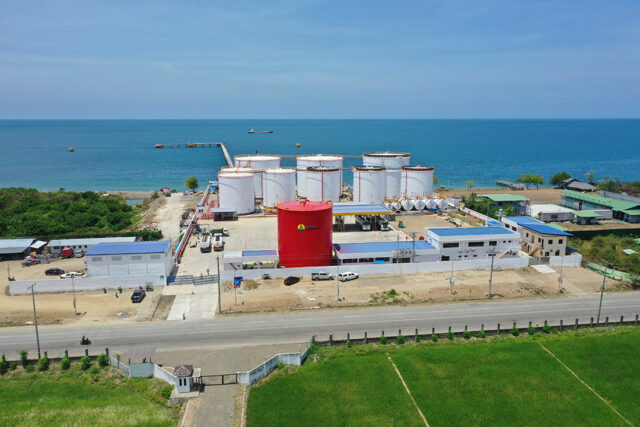
SEAOIL ZAMBOANGA BULK TERMINAL

SEAOIL has opened a bulk terminal in an economic zone in Zamboanga City, making it the fuel company’s 13th depot in the Philippines.

“As we continue to expand our retail and depot footprint across the country, we strive to make sure that we reach customers in as many areas as possible,” Stephen Yu, Seaoil’s president for commercial business and chief operations officer, said in a statement on Tuesday.

“Our locations are strategic in the sense that consumers and businesses can easily avail of our products and services,” he added.

The company has invested P822 million for its new terminal storage and berthing facility with a maximum storage capacity of 30.5 million liters of fuel.

Located at the Zamboecozone Authority and Freeport, the company will offer its fuel and lubricant products to  both consumers and commercial clients.

The facility is “strategically” located along with three other terminals in Mindanao — Santa Cruz, General Santos, Irasan — which are equipped to receive direct fuel importations, it said.

The 13th depot brings the company’s total fuel capacity to over 440 million liters.

Seaoil said it is also looking into starting more corporate social responsibility projects in the area.

It plans to introduce the Seaoil Foundation’s Tugon sa Gutom program and provide partners with free on-the-job training on tanker safety and marine environmental protection.

“As a top taxpayer in the areas where its depots are present, SEAOIL looks to bring better revenues and raise the collection of regional districts in Zamboanga City,” the company said.

Seaoil currently has 820 stations and 13 terminals nationwide. — Sheldeen Joy Talavera

PetroGreen secures P834-M loan for large-scale solar project in Bohol

YUCHENGCO-LED PetroGreen Energy Corp. (PGEC) has secured a loan facility worth P834 million from a local bank for the development of its 27.5-megawatt solar power project in Bohol.

The company secured the financing from Rizal Commercial Banking Corp. (RCBC), PGEC said in a statement on Tuesday.

The loan will be used for the construction of the Dagohoy Solar Power Project (DSPP) in San Vicente and Sta. Cruz, Dagohoy, Bohol, which is targeted for completion by the fourth quarter.

“This is a significant milestone for PGEC as we accelerate and increase our renewable energy business and assets,” PGEC Senior Vice-President for Corporate Services Arlan P. Profeta said.

“We have forged a time-tested and fruitful relationship with RCBC, which have resulted in successful implementation of our other RE (renewable energy) projects and we are grateful that we are able to continue the partnership,” he added.

According to PGEC, the DSPP is expected to be the first large-scale solar power facility in Bohol and “will reduce the province’ dependency from power generation coming from outside the island province.”

The company has already completed the site clearing and development, and the installation of photovoltaic solar panels will begin soon.

“Working with PGEC to fund their various renewable energy projects is very much consistent with RCBC’s sustainability initiatives and direction of supporting projects with positive impact to the environmental and society,” RCBC Corporate Banking Group Head Elizabeth E. Coronel said.

PGEC is the renewable energy arm of publicly-listed PetroEnergy Resources Corp. (PERC) and is a joint venture with Kyuden International Corp., the overseas investment unit of Kyushu Electric Power of Japan.

For the third quarter, PERC reported an attributable net income of P167.95 million, up 51.3%. Gross revenues grew by 46.2% to P959.51 million.

At the local bourse on Tuesday, PGEC’s shares went up by P0.03 or 0.67% to close at P4.49 each. — Sheldeen Joy Talavera

Cosco acquires 60% stake in Catuiran Hydropower

COSCO Capital, Inc. has finalized its acquisition of 60% outstanding shares in Catuiran Hydropower Corp., operator of the eight-megawatt hydroelectric power plant in Naujan, Oriental Mindoro, the retail holding company announced on Tuesday.

The listed company has acquired a total of 360 million shares in Catuiran at a price of P1.533 per share, it said in a stock exchange disclosure.

Cosco has received a letter from the Philippine Competition Commission, saying “the transaction is not subject to compulsory notification, thus clearing the path for the parties to close the transaction.”

“The acquisition of Catuiran will provide an opportunity for Cosco Capital, Inc. to engage in another profitable line of business while contributing to the country’s economic development, which aligns with the government’s thrust toward creating more sustainable energy sources,” the company said.

The company has paid to Union Energy Corp. in exchange for 60% of its shareholdings in Catuiran, Cosco said.

“The total consideration is below 10% of Cosco’s total book value as of December 31, 2023,” the company said.

Incorporated in 2012, Catuiran is primarily engaged in the business of building, constructing, operating, and maintaining power plant.

Cosco has a portfolio of businesses in retail, real estate, wine and liquor, and oil and mineral.

At the stock exchange on Tuesday, shares of the company climbed by P0.04 or 0.82% to close at P4.94 each. — Sheldeen Joy Talavera

SEC warns public vs investing in Gercel Apparel Shop, Gercelhomes Staycation, and Triumph Edge Academy

THE Securities and Exchange Commission (SEC) has warned the public against investing in Gercel Apparel Shop, Gercelhomes Staycation, and Triumph Edge Academy, saying these entities are not registered to solicit investments.

In an advisory, the SEC said Gercel Apparel Shop is offering investments from P5,000 to P100,000, with weekly earnings of P1,000, or 20% income weekly.

The entity reportedly marks-up the item for sale from 50% to 100%. It gives 20% interest weekly to the capitalist, while earning 50% to 100% on daily live selling.

“Interested capitalist will fill-up a form, then they will share the Department of Trade and Industry (DTI) permit, provide a contract and copy of their ID. The income will be sent weekly through GCash or bank deposit. They can also set a virtual meeting for further discussion and transparency for those who will join with the maximum amount of P100,000.00,” the SEC said.

“They will also provide postdated cheques and notarized contract and can do a meet-up, for investments with P50,000 to P100,000 capital,” it added.

The SEC said that Gercelhomes Staycation allegedly offers accommodation with amenities through a one-bedroom condominium unit in Azure North, San Fernando, Pampanga.

The entity reportedly offers investments at a minimum of P10,000. Investors could earn 10-20% monthly fixed income and a contract for a lock-in period of six months. The profit is sent to investors through bank transfer and post-dated cheques.

“The public is being made aware that an investment contract exists when there is an investment or placement of money in a common enterprise with a reasonable expectation of profits to be derived from the efforts of others which is prominent in the scheme of Gercelhomes Staycation,” the SEC said.

Meanwhile, the Triumph Edge Academy allegedly offers “comprehensive instruction in multi-servicing solutions, crypto and forex trading proficiency, and a cutting-edge suite of digital products,” the commission said.

The entity reportedly provides passive income with weekly returns and profits rates of 20% to 25% depending on the course or investment tier that an investor would choose. Investors are also entitled to mentorship bonus up to the tenth level.

“Triumph Edge Academy recognizes its members by number of successful mentorships they have created and rewards members through bonuses. There are nine tiers of the academy level and each represent number of mentorships earned and the corresponding rewards bonus,” the SEC said. — Revin Mikhael D. Ochave

JG Summit Holdings net income surges to P20.2 billion

GOKONGWEI-LED conglomerate JG Summit Holdings, Inc. said its net income reached P20.2 billion in 2023, up by 30 times from the P700 million net income the prior year, led by higher revenues from its airline and real estate businesses.

“Incorporating more favorable foreign exchange and mark-to-market adjustments, net income leapt to P20.2 billion, 30x the P0.7 billion reported in the same period last year,” JG Summit said in a stock exchange disclosure on Tuesday.

JG Summit saw a 14% increase in 2023 revenues to P343.8 billion led by the first full year of unrestricted travel demand coupled with the broad-based growth in its real estate unit and the steady improvement in its food and petrochemical sales.

The conglomerate’s core net income surged to P19.6 billion in 2023 from P6.2 billion in 2022.

“In 2023, we saw our airline and property businesses benefiting from fully lifted mobility restrictions while we carefully navigated the tough inflationary environment that affected demand and margins, especially for our food business,” JG Summit President and Chief Executive Officer Lance Y. Gokongwei said. 

“Our petrochemical unit, however, still suffered from weaker overall demand but we are encouraged by the internal progress of our transformation program that ensures it remains competitive when the cycle turns,” he added.

For the air transportation business, Cebu Air, Inc. (CEB) recorded a P7.9-billion net income in 2023, a reversal of the P14-billion net loss in 2022 due to more efficient operations and lower fuel costs.

The airline’s revenues rose 60% to P90.6 billion as it served 20.8 million passengers and increased flights by 30% year on year.

 As of end-2023, CEB’s fleet consisted of 85 aircraft. It operates in 60 destinations across 108 routes with over 2,700 weekly flights.

 “CEB’s efforts to recover capacity and efficiently serve the strong travel demand bore fruit as it reclaimed its first full-year profitability since the pandemic,” JG Summit said.

 For the real estate and hotels business, Robinsons Land Corp. (RLC) recorded a 24% jump in its net income to P12.1 billion. Its top line reached P39 billion led by its malls, hotels, and residential businesses.

 RLC Residences posted a 26% increase in net sales take-up to P21.3 billion while joint ventures net sales take-up improved 117%.

 For the food business, Universal Robina Corp. (URC) saw a 13% decline in its 2023 net income to P12.2 billion. Its revenues rose by 6% to P158.4 billion following the expansion of its agro-industrial division, the post-price correction recovery of its international business, and the growth in most of its domestic categories.

To support its expansion efforts, URC is investing in a 31-hectare production plant in Malvar, Batangas where many of the company’s products that would be introduced in the coming years would be manufactured.

 For its petrochemicals business, JG Summit Olefins Corp. (JGSOC) narrowed its net loss to P12.9 billion in 2023 as it began to recognize as expenses the interest on project-related debt and depreciation on the newly completed plants.

 The company’s revenues expanded by 6% to P38 billion amid lower petrochemical selling prices.

 “As the industry remained strained during the prolonged petrochemical cycle trough, JGSOC made the strategic decision to shut down the plant in early 2023 and began to resume operations in June,” JG Summit said.

For the core investments, JG Summit’s share in the earnings of Manila Electric Co. improved 26% to P9.8 billion in 2023 due to higher contributions from its power generation and retail electricity businesses, as well as the continued growth of its distribution business.

 The equity income from Singapore Land Group fell by 16.7% to P2.5 billion from P3 billion following the decrease in the contribution from its residential projects. The decline was offset by the recovery of the hospitality industry that led to better hotel operations.

 JG Summit had 8% lower dividends from PLDT, Inc. totaling P2.6 billion as the telecommunications company halved its special dividends from tower sales to P14 per share. Its regular dividends increased by P5 to P94 per share.

 Meanwhile, Mr. Gokongwei said that JG Summit is eyeing to bring its 2024 core profits closer to pre-pandemic levels

 “As we look forward, easing inflation and the potential rate cuts would bode well for consumer demand and lower input prices. We hope to recover lost volume and market shares in our food business, sustain portfolio expansion in our real estate arm, increase capacity and short-haul recovery for our airline, and crystallize the financial gains from our petrochemical transformation program,” Mr. Gokongwei said.

 On Tuesday, JG Summit shares rose by 1.41% or 50 centavos to P35.95 apiece. RLC stocks improved by 0.72% or 12 centavos to P16.68 per share. URC shares gained by 0.68% or 70 centavos to P103.80 each. CEB stocks were unchanged at P31 per share. — Revin Mikhael D. Ochave

Cebu Air says 2023 results signal ‘stronger’ performance this year

CEBUPACIFICAIR

CEBU AIR, Inc. (CEB), operator of budget carrier Cebu Pacific, expects higher earnings this year after returning to profitability in 2023, driven by strong passenger demand. 

“Moving forward, we are optimistic that Cebu Pacific’s solid 2023 financial results will set the foundation for a stronger financial performance in 2024,” Mark Julius V. Cezar, Cebu Air chief financial officer, told the stock exchange on Tuesday. 

Without disclosing comparative figures, Cebu Air registered a net income of P7.9 billion for 2023, reversing its losses in 2022.

Based on the company’s financial statement, as previously disclosed at the stock exchange, Cebu Air registered a net loss of P13.98 billion in 2022.

For 2023, the company recorded an operating income of P8.6 billion; while its EBITDA or earnings before interest, taxes, depreciation, and amortization reached P21.8 billion, marking a significant increase from the P664 million in 2022.

Its revenue climbed by 60% to P90.6 billion fueled by robust travel demand, the company said.

Passenger business posted a 78% increase, posting a total revenue of P62.5 billion.

Last year, Cebu Pacific flew over 20 million passengers and more than 140,000 flights, this translated to about 41% and 30% increase, respectively from the year earlier.

Seat load factor, which is used to measure the percentage of available seating capacity filled, has also improved to 84%.

Further, its total operating expenses also expanded by 20% to P82 billion which it attributed to higher fuel costs and fleet-related expenses.

“CEB took 18 aircraft deliveries throughout 2023, increasing its fleet to improve its operational resiliency while sustaining capacity growth. Also embedded in its expenses are digitalization and other efforts to support its customer first initiatives,” the company said.

For the three months to December, Cebu Air’s has also returned to profitability by recording an earnings of P2.9 billion from a loss of P1.9 billion in 2022.

Its fourth quarter revenues, which expanded by 23%, has also pushed the company’s growth. In the last quarter of 2023, Cebu Air’s top line reached P23.7 billion, its strongest in terms of revenue for the year.

The company logged a P2.4 billion operating net income for the fourth quarter, reversing its net loss of P232 million in the same period a year earlier.

At the local bourse on Tuesday, shares in the company closed unchanged at P31 apiece. — Ashley Erika O. Jose

Filinvest Land completes turnover of factory for battery production of StB GIGA

LISTED property developer Filinvest Land, Inc. (FLI) has turned over a ready-built factory to StB GIGA for the production of lithium iron phosphate (LFP) batteries in Filinvest New Clark City.

 The factory, spanning 5,000 square meters of industrial space in Filinvest Innovation Park, was turned over to StB GIGA on Feb. 28, FLI said in a statement on Tuesday.

 “The handover… signifies the commencement of StB GIGA’s move-in process, paving the way for their LFP battery manufacturing facility within the innovative industrial park,” FLI said.

 StB GIGA is a Philippine subsidiary of StBattalion Pte. Ltd., which is jointly owned with the St Baker Energy Innovation Fund. The fund is managed by StB Capital Partners, an Australian investment manager that incubates and invests in companies in the energy and e-mobility sectors.

 “With the official handover of the ready-built factory unit, we are one step closer to realizing our vision of establishing a world-class LFP battery manufacturing facility in the Philippines. This facility will not only cater to the growing demand for electric vehicles but also contribute to a greener, digital, and more sustainable future for the nation,”StB GIGA Chief Executive Officer Dennis Chan Ibarra said.

 The Filinvest Innovation Park is an industrial park within the Filinvest New Clark City mixed-use township, which is part of the 9,450-hectare New Clark City development in Capas, Tarlac.

 The ready-built factory compound of Filinvest Innovation Park will feature 10 units to be built on a 40,000-square meter lot. Each of the units is designed for logistics, e-commerce, and light manufacturing locators.

 The units come with a two-bay loading dock with dock levelers, roll-up doors, an eight-meter ceiling clearance, a floor load capacity of three tons per square meter, and a fire suppression system. They also have rainwater harvesting and recycling system as well as solar panel-ready roofs.

 “We are very pleased to welcome StB GIGA to Filinvest Innovation Park. This partnership not only strengthens our commitment to attracting leading sustainable businesses but also generates substantial employment opportunities for the region, contributing to the overall economic growth of the Philippines,” FLI Senior Vice-President and Industrial Business Unit Head Francis V. Ceballos said.

 On Tuesday, FLI shares were unchanged at 68 centavos apiece. — Revin Mikhael D. Ochave

The pianist’s body

Cecile Licad on Nedy Tantoco, practice, and reaching her peak

WHEN we watch a classical music performance, what we see is a union between human and instrument. Few people do that better than piano prodigy Cecile Licad, who passed audition at the Curtis Institute of Music at 12 and had been one of the youngest recipients of the Leventritt Gold Medal in 1981. Now in her 60s, Ms. Licad talked to BusinessWorld about how the pianist’s body performs, in light of her March 19 concert, Cecile Licad at the Met: A Women’s Month Concert, held at The Metropolitan Theater in Manila.

Asked what a piano demands from its player, she said, “From my feet, to my hands, to my head, to my heart.”

But first, the concert: conducted by Gregorz Nowak, Ms. Licad performed with the Philippine Philharmonic Orchestra, who opened the concert with Brahms’ Symphony No. 2, Op. 73 in D major. The program said, “The D-Major Symphony seems to reflect the composer’s relaxed state of mind during the happy summer of 1877.” After an intermission, Ms. Licad appeared on stage, playing, in concert with the orchestra, Piano Concerto No. 1, Op. 23 in B-flat minor on a Fazioli. After that, Ms. Licad appeared on stage for three encores: she dedicated a piece to late Rustan’s matriarch Zenaida “Nedy” Tantoco (namely, Schumann’s Widmung), a piece by her great-uncle, composer Francisco Buencamino, and Chopin’s Minute Waltz.

During a group interview at Ms. Tantoco’s home in Forbes Park two days after the concert, Ms. Licad discussed why those pieces were chosen. She played the piece by her great-uncle because it had been used in movies shown at the Metropolitan Theater during its heyday; she picked the Minute Waltz because the conductor that evening was Polish. As for the dedication to Ms. Tantoco, she said, “In any room, I always have the most beautiful flowers, and it’s always from Tita Nedy.” In fact, asked about the floral-appliqued black dress she wore and where she got it, she said, “Rustan’s! Rustan’s is the best. What can I say?”

As for the Tchaikovsky piece she selected to play, she said, “I feel like I’m ready to tackle it again. I feel like — sometimes you just feel like, ‘I want to eat this.’ I want to build some kind of muscle again.”

THE PIANO AND HER BODY
“It requires a lot. It requires physical strength. It requires sharp reflexes, and it requires a soul of a… a hot soul!,” she said with laughter, describing what that particular Tchaikovsky piece requires of her.

She recalled teaching a masterclass once, and hearing a student perform, she said, “Can you put, like a mainit na ano (something hot) in your ass?” Then she laughed. “I’m so sorry, but that’s really the way I talk. People don’t know what’s in my head when I’m playing. They think it’s like something so intellectual, whatever. But sometimes I have to make kurot (pinch) myself; since my mother’s not there. I would do anything — I would eat a hot pepper if I’m nervous. And then I would be like, ‘Ay, ang anghang (that’s hot)!’ Then I’d be like, ‘Yes!’

“You have to feel a burn in your butt!”

Ms. Licad talked about how her body works with a piano. “I talk to it. It’s like a pet. ‘You better deliver,’” she said. “I don’t care about any piano that I will play, but it has to work. It’s a machine. It’s usually the player who will make it alive. But it helps to have a piano technician.”

Then she talks about practicing and rehearsals, for which her fingers and feet come to play. “I have to talk to my fingers,” she said. “I would change my fingering to what I feel at that moment. That’s why I practice. So that all my fingers are independent.”

“When I’m playing — you’re like an actor. I have to feel the teleserye (TV soap opera). I call it like a novel, inside, so that I can convey it to the public. If I don’t feel anything — but not only feel — it goes to the fingers. It’s like channeling, really.”

And her feet! “People don’t know that, but the pedaling of the piano is the most important.”

MAINTAINING HER BODY
As with any person who uses their body to work, it is toned and perfected by practice.

Ms. Licad talks about how she practices, and how she always begins from scratch. Here, she isn’t the child prodigy traveling the world as a teen, or given awards by presidents: she has a Presidential Medal of Merit from the late President Corazon Aquino, a Pamana sa Pilipino Award from Mrs. Aquino’s son, President Benigno “Noynoy” Aquino, and former First Lady Imelda Marcos held the phone for her so the pianist Van Cliburn could hear her play when she had turned 12 (a story she recounted to Mrs. Marcos’ son, now-President Ferdinand Marcos, Jr.). When practicing, she is always a student.

“The practicing is the hardest. Performing for me — it’s also hard. I’m not going to pretend that… but it’s more the process, the practicing process. What fingerings I should use, maybe I use this, but at the concert — it’s hard to explain,” she said. “I’m learning it totally from scratch. That’s how I learn. I don’t listen to recordings. I’m not an ear, like I can play whatever I hear. I relearn from scratch. I will look at the notes very, very slowly, carefully, and then I hear.

“Nobody can recognize me practicing sometimes. That’s why I like to be private when I’m practicing,” she said, saying that when she’s practicing very slowly, she’s sometimes mistaken as a beginner — even by herself. “In fact, I always tell myself that: ‘beginner ka lang. Umpisa ka (you’re just a beginner. You’re just at the start).’ I would tell myself I don’t know how to play piano.”

But all bodies are mortal, and they weaken and, well, stop working at some point. She counts that her career is now 50 years old, but then she pointed out: “One of my teachers debuted in Carnegie Hall, he was already 97.”

“All my teachers — their best playing is at 80-something,” she said. “It’s just different — if you have a good foundation, you can always reinvent. Maybe if ever I lost my hands, I can still play with my elbow,” she said, laughing.

How then, does she maintain all the working parts of her body so when it meets a piano, it constitutes a perfect union? Surprisingly, the answer is just doing everything else. “You know what I do? I just do other things. I go to the grocery. I organize my things.”

“I’m not particular with my hands at all. Except with knives; cutting onions. That’s very scary. Especially if it’s slippery. There’s an angle. I watch the YouTube stuff, the cooks. You have to have a sharp knife, because if you don’t have a sharp knife, the more you will cut yourself.”

She even gave us a recipe for her clothes’ cleaning spray: Everclear, a grain alcohol bottled at up to 95% (“Whenever I buy it at the liquor store, they would be like, ‘You’re not going to drink this, are you? You’re going to die.’”), mixed with either eucalyptus, peppermint, or tea tree oil. ‘Especially, [since] I smoke. In America, everybody’s smelling you,” she said, sniffing. “‘She’s a smoker. Let’s get out of here.’”

REACHING A PEAK
If her teachers played their best at 80, Ms. Licad in her 60s still has many years to go. Asked if she’s already reached her peak, she said, “I don’t think we’ll ever reach a peak. We will always be in our peak. The last concert has to be your peak. For me, every concert is a peak.

“You can never be confident. You can’t rest on your laurels. I still keep going, and learn a new horizon of another composer, or something I haven’t even tried.

“Maybe I’ll become an actor.” — Joseph L. Garcia

ADVERTISEMENT
ADVERTISEMENT