Home Blog Page 3431

How financial services CEOs prioritize CX

Twenty-five percent of customers switched banks, and over a third switched their insurers and wealth managers. This is according to a 2022 global study by Maze, a user research tech firm. This is why delivering superior customer experience (CX) has emerged as a strategic imperative for the C-suite across the ever-evolving landscape of financial services, including in the Philippines. This shift in focus stems from a confluence of factors, ranging from technological advancements to changing consumer preferences, all of which have reshaped the dynamics of competition and heightened the importance of CX as a key differentiator in the market.

One of the primary drivers behind the prioritization of CX within financial services firms is the increasingly crowded marketplace. With the proliferation of fintech startups and nontraditional players entering the scene, competition has intensified, and customers are presented with a plethora of options when it comes to managing their finances. In such a fiercely competitive environment, providing an exceptional CX becomes crucial for retaining existing customers and attracting new ones.

Take the example of Philippine bank Rizal Commercial Banking Corporation (RCBC) which has embarked on a comprehensive digital transformation journey aimed at enhancing customer experiences and satisfaction. Through its digital banking platform, Pulz, customers can access a wide array of banking services conveniently, from fund transfers to bill payments, with just a few clicks. Moreover, customers can easily perform various banking tasks, such as depositing or withdrawing money using QR codes, depositing local checks just by taking a photo, and directly transferring funds locally or abroad, with the pioneering digital concierge service.

Another driver of CX is consumers’ demand for convenience, personalization, and speed in every interaction, including their financial transactions. This shift in expectations has compelled financial services CEOs to rethink their approach to CX and invest in technologies that enable them to deliver tailored experiences across various touchpoints.

UnionDigital Bank, a subsidiary of Union Bank of the Philippines, has been at the forefront of digital banking innovation, offering a range of customer-centric services that cater to the evolving needs of today’s consumers. Through its user-friendly mobile app and online platform, it provides customers with seamless access to banking services, from account management to fund transfers, anytime and anywhere. Moreover, the digital bank leverages advanced technologies such as artificial intelligence and data analytics to deliver personalized experiences and proactive financial insights to its customers, enhancing overall satisfaction and loyalty.

Another notable example is Singlife Philippines, a digital life insurer, which has disrupted the traditional insurance sector by offering innovative products and services that prioritize simplicity, transparency, and customer-centricity. Through its mobile app and online platform, Singlife Philippines provides customers with easy access to life insurance and investment products, allowing them to manage their finances conveniently and efficiently. Moreover, it leverages technology to deliver personalized recommendations and insights, empowering customers to make informed decisions about their financial future.

Regulatory pressures have also played a significant role in driving the CX agenda among financial services firms. In the aftermath of the global financial crisis, regulators around the world have placed greater emphasis on consumer protection and transparency, prompting companies to reevaluate their practices and prioritize customer-centricity. By focusing on CX, firms can not only comply with regulatory requirements but also build trust and credibility with their customer base.

The Bangko Sentral ng Pilipinas (BSP), the central bank of the Philippines, has been actively promoting customer-centricity within the financial sector, recognizing the pivotal role that CX plays in fostering trust, stability, and innovation. The BSP has emphasized the importance of technology in shaping the future of CX in the Philippine financial sector. In its Digital Payments Transformation Roadmap, the BSP outlines strategies to promote the adoption of digital financial services and enhance CX through innovation and collaboration.

It is opportune that leaders in the technology CX space — Hungry Workhorse, Insider, and Contentsquare — are banding together to organize the CxO Dialogue on Innovating Customer Experience in Banking & Insurance 2024 happening on April 18, 2024. Distinguished speakers are Eugene S. Acevedo, RCBC President and CEO; Sherie Ng, Singlife Philippines Co-Founder & Executive Director; and Henry Aguda, UnionDigital Bank, President and CEO. Together with industry leaders, we will converse on why the C-suite is prioritizing CX.

The views expressed herein are his own and does not necessarily reflect the opinion of his office as well as FINEX.


Reynaldo C. Lugtu, Jr.  is the founder and CEO of Hungry Workhorse, a digital, culture, and customer experience transformation consulting firm. He is a fellow at the US-based Institute for Digital Transformation. He is the chair of the Digital Transformation IT Governance Committee of FINEX Academy. He teaches strategic management and digital transformation in the MBA Program of De La Salle University. The author may be e-mailed at rey.lugtu@hungryworkhorse.com


DENR says gov’t fast-tracking bidding for Cavite bulk water project

FREEPIK

THE GOVERNMENT is fast-tracking the bidding process for the Cavite-wide Bulk Water Supply Project contract, the Department of Environment and Natural Resources (DENR) said.

“We are in the process now of consolidating all the dams and then have one supplier for the whole province, that is the Cavite bulk. We have transferred the rights to Cavite and they will do the PPP (public–private partnership),” Environment Undersecretary Carlos Primo C. David told reporters on the sidelines of  Israel-Philippines Water technology innovations forum on Thursday.

The DENR has already turned over the rights for the project to the Cavite government as it is poised to conduct the competitive bidding for the project within the year.

“For now there are studies that need to be done very soon. We will request for proposals,” he said. 

The project aims to consolidate all 18 dams in Cavite into one bulk water supplier for the whole province of Cavite.

“We have 18 dams in Cavite. So what we will do is consolidate all the dams and then only have one supplier for the whole province.  We have already transferred, assigned the rights to Cavite and they will now do the public–private partnership,” he said.

The project serves as an augmentation measure to meet the growing supply demand in the province, Mr. David said, adding that the project would increase its current supply by 30%. 

The Cavite Bulk Water Supply project is considered a massive project as it will be a provincial-wide water supply system, he said. — Ashley Erika O. Jose

Entertainment News (04/05/24)


Red Ollero at Samsung Performing Arts Theater

FRESH off his Netflix special, Red Ollero is bringing an ensemble of rising stars in the local stand-up scene for his April 6 show, RED-OL-MANIA. The stand-up showcase aims to feature the best of Filipino comedy today. Guests include Alexio Tabafunda, Andren Bernardo, Issa Villaverde, Judd Gregorio, Leland Lim, and Rae Mammuad. The show is set for April 6, 8 p.m., at the Samsung Performing Arts Theater, Circuit, Makati. Tickets, ranging in price from P800 to P1,500, are available via TicketWorld.


Baraptasan Grand Finals on Saturday

THE CULTURAL Center of the Philippines (CCP) presents the CCP Kanto Kultura: Baraptasan 2024 Grand Finals on April 6, 3 p.m., at the Rizal Park Open Air Auditorium in Manila. It is a celebration of the centennial anniversary of the balagtasan, the art of verbal jousting, wherein 10 finalists will battle it out in a modern showdown of skillful wordplay. The event is free and open to the public.


Awesome Summer Fanfest set this April

SAMSUNG presents the Awesome Summer Fanfest on April 13 to 14 at the SM North EDSA Annex in Quezon City. People can try Samsung’s latest A-series phones like the Galaxy A55 5G and A35 5G in various colorful content areas, with the chance to bring home giveaways worth up to P7,500. There will also be meet and greet tickets available for fans to meet up with celebrities like Donny Pangilinan and Belle Mariano, Filipino girl group BINI, and Gen Z original Pilipino music (OPM) singer Adie. For more details, go to Samsung PH’s social media pages.


24 Oras anchor Mel Tiangco renews ties with GMA

AWARD-winning news anchor Mel Tiangco renewed her contract with GMA Integrated News on April 2. She signed her contract with GMA Network Chairman Felipe L. Gozon present, continuing her relationship with GMA which started in 1996. GMA’s flagship newscast 24 Oras also marks its 20th year on air this year.


Spotify RADAR PHL showcases 10 Filipino artists

SPOTIFY’S playlist and global music program RADAR has returned with its 2024 slate of artists across different genres. This year’s lineup spans various genres, including the next generation of Pinoy hip-hop stars Hev Abi and Illest Morena and OPM singers Maki, Cup of Joe, Dionela. Also joining are Pinoy R&B singers Jason Dhakal and Denise Julia, indie sibling duo Ysanygo, and Bicol’s dwta. Completing the list is RADAR returnee P-Pop girl group BINI. Since its launch in 2020, RADAR Philippines has seen a stream increase of more than 2.5 times. The playlist features some of the freshest Pinoy sounds by rising artists.


Tickets available for BTS BVERSE exhibit

FANS of Korean boy group BTS can now get tickets to Araneta City’s BVERSE “BTS, Singing the Stars” immersive exhibition. The virtual reality experience includes vivid recreations of BTS’ iconic The Fact Music Awards performances, a showcase that features each member in themed rooms, a mapping show, and more. Fans can choose between two types of passes for the exhibit: regular passes costing P1,500, which will allow entry only during their chosen date and time; and a Flexi-Pass costing P1,900, for those who can come in at any time during their chosen date. BVERSE Manila will be held from May 17 to Aug. 15, at Level 4 of the New Gateway Mall 2, Quezon City. Tickets are available on Ticketnet Online.


Crime drama Chief Detective 1958 on Disney+

SET 10 years before the popular 1970s and ’80s Korean drama Chief Inspector comes Chief Detective 1958, which builds on the original series’ heritage of captivating storytelling and memorable characters. The leads are Detectives Park Yeonghan (played by Lee Jehoon) and Kim Sangsun (Lee Donghwi) as the iconic crime-fighting duo. The series is directed by Kim Sunghoon. Chief Detective 1958 arrives April 19 on Disney+.


K-pop singer Nancy joins Sparkle GMA Artist Center

SPARKLE GMA Artist Center has added a global Korean popstar to its roster of artists — Nancy Jewel Mcdonie a.k.a. Nancy. She was a member of the third-generation K-pop girl group MOMOLAND, best known for their songs “Bboom Bboom,” “BAAM,” “Wrap Me In Plastic,” and “Yummy Yummy Love,” among others. Nancy also has a knack for hosting, having hosted the Korean music program Pops in Seoul. “This 2024, Nancy is ready to explore more of the world and her artistry as she officially signs with Sparkle,” said GMA in a statement.

What to do when seeking a promotion

After working as a supervisor for the past 10 years, I believe I’m ready to be promoted to a managerial post. What’s the best approach? Should I formalize my request? — Ready to go.

None of the above. The best approach is for you to establish a consistent, above-average performance for at least five years before asking for a promotion. You must also establish that you possess certain skills that are difficult to find elsewhere. Focus on these two things. And don’t even attempt to say you deserve a promotion after 10 years. That would sound entitled.

Katy Evans is right: “Don’t talk, act. Don’t say, show. Don’t promise, prove.” In other words, it’s better that your performance do the talking and let your boss reciprocate. After all, no boss in his right mind would ignore an impressive track record.

Theoretically, you must also understand the basic meaning of a performance management system (PMS) which I suppose is present in your organization in various forms: One, as a strategic link between an employee’s career goals and his track record with the organization’s vision, mission, and values. Two, as an administrative reference for merit pay increase, promotion, demotion, discipline, and up to the termination of employment. And three, as a developmental tool to help managers and their direct reports develop their maximum potential or overcome shortcomings through training or other progressive tools.

PMS, as an evaluation and feedback mechanism, provides an opportunity for a formal interaction between a boss and his direct reports. That’s the only thing I can think of, if and when you decide to proceed to stay in the same organization.

OTHER OPTIONS
What if you decide to stay, say for another two or three years, and exceed the boss’ expectations, but still no promotion is forthcoming. What’s next? There are two options — ask for an inter-department transfer or resign. That’s assuming there’s another department willing to accept you and there’s a job offer somewhere.

Before doing anything, I suggest talking with your boss. It’s possible that they don’t care about you. Or, they too may be suffering from the same problem as you’ve been experiencing. It’s either that your boss has fallen from the good graces of top management that it would be difficult for you to be recommended to a promotion.

Find out more about it from the grapevine. It could be the right time for you. Wait a little longer as you explore other opportunities elsewhere. While you’re at it, examine all the angles, if and when your boss is removed from the equation for whatever reason. It could be your chance.

Also, remember to protect your seniority rights. If you’ve been in that organization for 13 years, it’s best to stay put by exploring an intra-department transfer. However, all this depends on your personal circumstances like age, marital status and the size of your family. If you’re at least 45 years old, I suggest that you stay a little longer.

Accepting a job elsewhere is not an assurance that you will be materially rewarded in the long term or fully accepted by people with different cultures and agenda, among other reasons. It happened to me and to many of my contemporaries who moved to another company. It was too late by the time we found out that we had jumped out of the frying pan direct to the fire.

UNDERSTAND YOURSELF
I started as a working college student in 1971. None of us fully understands who we are in terms of career goals. Even if we take stock of our diplomas, certificates, awards and years of work experience, we need to dig deeper into what we can truly do for our current organization while trying to achieve our personal goals.

Job hunting is totally different from staying put in one organization until retirement. Not too many people would do that. If they’re not happy or being treated unfairly, they would surely pack their bags even in the absence of a new job. Therefore, I would advise that you do the following as your homework:

One, acquire as many skills as possible. Two, widen your professional network, either in person or through social media. Three, volunteer to perform difficult assignments with your employer. And last, be kind to all people, regardless of their status. You’ll never know how things turn out in the future.


Bring Rey Elbo’s leadership program called “Superior Subordinate Supervision” to your line leaders. Contact him via Facebook, LinkedIn, X or e-mail elbonomics@gmail.com or via https://reyelbo.com

Of appeasement, treason, and other ungentlemanly acts

PHILIPPINE STAR/KRIZ JOHN ROSALES

“We’ve gotta shake the old snow globe once in a while, don’t we? But the important thing is, you’ve gotta learn from the experience.” So says the grizzled gamekeeper Geoff Seacomb, in Netflix’s excellent new show The Gentlemen. “Excellent,” however, isn’t the word that comes to mind for those malevolently sabotaging the Marcos Administration’s policy towards China in defense of our territory.

Read history and use commonsense. The possibility of war is minimized if both countries declare and are convinced that both are quite willing to fight it out, thus making the cost of war higher than the cost of peace.

It’s when a country (or its leaders) exhibit weakness, is deferential to another country, declares unwillingness to fight, or declares the inability to fight that things get problematic. That country is inviting invasion by a foreign country.

If we ever go to war, it is not because we showed strength and declared (as we are correctly doing now) that we’ll defend our territories and stand for our rights. More likely, it’ll happen because the other country got the idea somehow or from someone that we’re divided, weak, or insecure, and unwilling to fight for what is ours.

This is an insight borne and proven consistently by history and current events. The latest example is that taken from the opposite side of the world:

“We have been here before. Europe’s previous attempts to appease a revisionist power with expansionist ambitions were similarly well-meaning, but they nevertheless resulted in WWII. Like Putin, Hitler also rejected the international order of the day and sought to create new realities on the ground through an audacious foreign policy linked to support for ethnic comrades left stranded abroad by post-war borders,” wrote Oleksiy Goncharenko in “The lesson of Crimea: Appeasement never works” (Atlantic Council, February 2020).

“When the Anschluss with Austria went ahead unopposed in March 1938, Hitler laid claim to the Sudetenland in neighboring Czechoslovakia. This led to the Munich Agreement, which has come to be recognized as the ultimate symbol of appeasement. Within a matter of months, Czechoslovakia had ceased to exist and a new world war was underway,” he wrote.

Thus, “history has already taught us that appeasement of an aggressor simply does not work. If the lesson of the 1930s was insufficient, we now have the additional example of the past six years to refresh memories.”

The charge, of course, is that President Marcos the Younger is not merely rectifying any alleged appeasement committed before him but is instead causing undue offense, even aggression, towards China. But this is an argument completely and obnoxiously mind-blowingly insane, free of any moorings from fact and reason:

“A deeper look into the matter reveals otherwise. In fact, tensions in the waters near the Philippines had been growing before Marcos came to power. According to Philippine officials and security experts, ships belonging to China’s coast guard and maritime militias frequently entered disputed waters during Duterte’s time in office, trying to expand their effective control by intimidating and provoking Philippine boats,” wrote Hiroyuki Akita, a Nikkei commentator.

“But Duterte concealed most of these incidents, revealing only a few. His administration was clearly loath to ruffle Beijing’s feathers or admit the failure of its conciliatory policy toward China,” he continued, in a commentary in Nikkei Asia in March called “Why appeasing China will never work.”

‘“The Marcos administration has turned to a policy of publicizing aggressive and dangerous actions by China in order to make the world aware of the existing threat,”’ said Philippine Coast Guard spokesperson Commodore Jay Tristan Tarriela.

‘“But China’s aggressive behavior did not begin during the Marcos era. While there are three serious dangerous actions by China that were publicized during the Duterte administration, there are many other incidents then as well,”’ wrote Mr. Akita, quoting Commodore Tarriela.

“After taking office, Marcos must have realized that the strategy of appeasing China had not worked and never would.” (https://asia.nikkei.com/Spotlight/Comment/Why-appeasing-China-will-never-work)

Which leads us then to the ungentlemanly “gentlemen’s agreement” supposedly entered into between the previous administration and China. The problem is that (even if true) such could not be effected for its obvious unconstitutionality: treaties need to be in writing to have any utility as far as the International Court of Justice is concerned and — more importantly — need to be concurred in by the Senate to be a binding and effective international agreement.

Not to mention that any such agreement is potentially violative of Article I (on Philippine territory), Art XII.2.2 (on the need to protect the nation’s marine wealth in its archipelagic waters, territorial sea, and exclusive economic zone, and reserve its use and enjoyment exclusively to Filipino citizens) and — quite clearly — Article VII.5 (the presidential oath) of the Constitution.

Marcos the Younger, thankfully, was quite clear in rebuffing the idea of any such “agreement”: “I’m not aware of any agreement that the Philippines should remove from its own territory its own ship, the BRP Sierra Madre, from the Ayungin Shoal. And let me go further, if there does exist such an agreement, I rescind that agreement as of now.”

In similar vein, he promised “deliberate” countermeasures against what he termed “illegal, coercive, aggressive, and dangerous attacks” by China. What those countermeasures are, are for now being left unsaid but surely there are many options available to the President under international law, and economic and diplomatic policy.

And even then, countermeasures could be as simple as:

• Implementing our laws;

• Clamping down on smuggling, including “technical smuggling”;

• Stricter application of our immigration rules and enforcing deportations;

• Strictly implementing criminal laws on Chinese workers, fishermen, etc.

• Strictly implementing copyright and patent laws;

• Stricter application of taxation laws on China’s investments and businesses; and,

• Conducting foreign and trade relations with the view to financial gain but also to advancing human rights, labor standards, environmental protection, and democratic values.

• Finally, we cannot allow the malicious manipulation of our own laws to be used to limit our ability to defend ourselves. The Supreme Court has long been consistently clear that certain speech can and should be regulated. There have been various standards laid down by the Supreme Court to determine if certain speech should be silenced, and we thus need to recognize confidently that, whether it be Philippine or international law, the right to free speech is not absolute and that there are inherent limitations to it. We must therefore consider criminally sanctioning or legislate to criminally sanction those:

• Giving support to a foreign country we are in conflict with, with committing treason;

• Contradicting our government due to local political differences that effectively provide support to a foreign country we are in conflict, with committing treason;

• Receiving compensation or benefits from a foreign country we are in conflict with for the purpose of giving support to that foreign country against our country, with committing treason;

• Receiving compensation or benefits from a foreign country for the purpose of giving information to that foreign country to the damage of our country’s national security, with committing espionage.

• Asking citizens to not support our government or to do acts that undermine our government’s proper national security measures or policy, with committing sedition.

Speaking of espionage, Commonwealth Act No. 616 punishes with up to 10- or 20-years imprisonment those inappropriately divulging, during “peacetime,” confidential or non-confidential government information or document (memos, minutes, etc.) to the injury of our national defense and to the advantage of any foreign nation, or does “disloyal acts or works” with intent to interfere with, impair, or influence the loyalty, morale, or discipline of any member of the Philippine military.

An enduring benefit of an Oxbridge education is recognizing that being “a gentleman is to know precisely when to stop being one.” A lesson surely learned by our Oxonian president. We’d be opening ourselves to a larger problem if we allow a misguided minority to demand surrender to a foreign bully. And we must force ourselves to grasp that a defeatist attitude toward China will never work, shows ignorance of history, and is practically treasonous at this juncture.


Jemy Gatdula read international law at the University of Cambridge. He is the dean of the Institute of Law of the University of Asia and the Pacific, and is a Philippine Judicial Academy lecturer for constitutional philosophy and jurisprudence.

https://www.facebook.com/jigatdula/

Twitter  @jemygatdula

How PSEi member stocks performed — April 4, 2024

Here’s a quick glance at how PSEi stocks fared on Thursday, April 4, 2024.


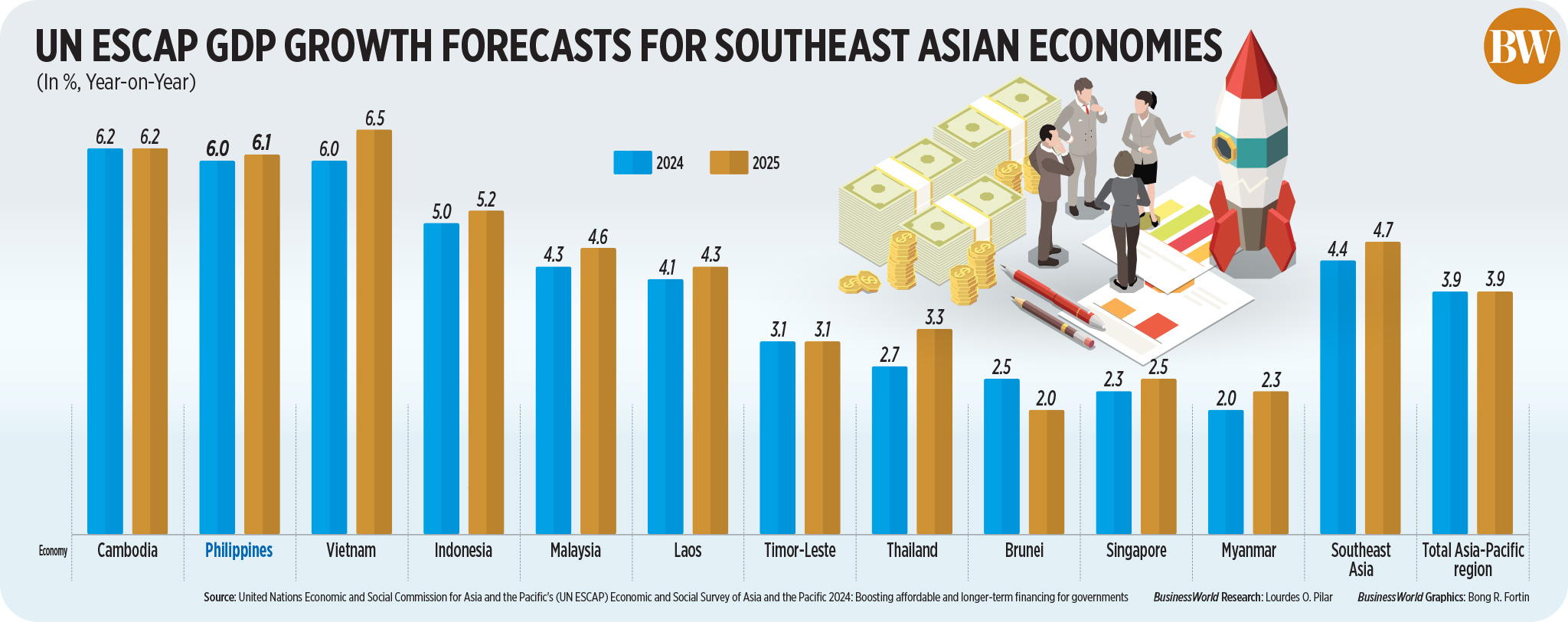
UN ESCAP GDP growth forecasts for Southeast Asian Economies

THE Philippine economy is expected to grow 6% this year, according to the United Nations Economic and Social Commission for Asia and the Pacific (ESCAP), upgrading a 5.7% forecast issued in April. Read the full story.

UN ESCAP GDP growth forecasts for Southeast Asian Economies

ESCAP upgrades Philippine GDP growth forecast to 6%

THE Philippine economy is expected to grow 6% this year, according to the United Nations Economic and Social Commission for Asia and the Pacific (ESCAP), upgrading a 5.7% forecast issued in April.

If borne out, the ESCAP projection would fall within the government’s revised 6-7% growth target for 2024.

Based on ESCAP’s estimates, the Philippines and Vietnam (6%) would be the second fastest growing economies in Southeast Asia this year, behind Cambodia (6.2%).

UN ESCAP GDP growth forecasts for Southeast Asian Economies

For 2025, Philippine gross domestic product (GDP) growth is estimated at 6.1%, which is also within the government’s 6.5-7.5% forecast range.

In its Economic and Social Survey of Asia and the Pacific report, ESCAP expects growth in the Asia-Pacific region to slow to 4.4% in 2024.

“The moderation is most notable in East and Northeast Asia, in contrast to an expected economic rebound in Southeast Asia and a relatively stable trend in other subregions. Overall, supported by declining inflation, household consumption would continue to drive output growth in the near term amid weak external demand,” according to the report.

Meanwhile, Philippine headline inflation is projected at 3.8% this year, falling within the Bangko Sentral ng Pilipinas (BSP) target range of 2-4%, before slowing to 3.5% next year.

The Southeast Asian inflation average is forecast at 2.8% and 2.6% in 2024 and 2025.

“Caution continues to be required from monetary authorities in terms of deciding the path of monetary policy to ensure that inflation is effectively tamed,” ESCAP said.

The BSP maintained interest rates at a near 17-year high 6.5% in February, standing pat for a third straight meeting. To tame inflation, the central bank raised borrowing costs by 450 basis points from May 2022 to October 2023. — Beatriz Marie D. Cruz

New SRP list expected by May

PHOTO BY BERNARD HERMANT

THE Department of Trade and Industry (DTI) said that it will be moving the target release date of the suggested retail price (SRP) bulletin to May to give manufacturers more time to prepare their price adjustment requests.

The DTI had initially hoped to release the updated bulletin in the first quarter.

“We will probably publish it in May, because the advisories from manufacturers are still not complete,” DTI-Consumer Protection Group Assistant Secretary Amanda F. Nograles told BusinessWorld in a Viber message.

Early this year, the DTI said that it would be reviewing the price adjustments for 63 SKUs (stock keeping units), 18 of which the department had announced in January.

For 2024, the DTI expects price increases to average 6%, against the 10% average in 2023. — Justine Irish D. Tabile

Rice imports seen dropping below 4M MT on stronger-than-expected domestic output

BW FILE PHOTO

THE Department of Agriculture (DA) said on Thursday that rice imports are expected to come in below 4 million metric tons (MT) as domestic producers are picking up the slack despite El Niño.

“We may not reach 4 million MT this year since production seems to be (on track) even with El Niño,” Agriculture Secretary Francisco P. Tiu Laurel, Jr. said on government network PTV.

The US Department of Agriculture (USDA) had estimated Philippine rice imports at 4 million MT, which Mr. Laurel called a “worst-case scenario” should domestic production falter.

“The estimate (from) the USDA might be too high,” he added.

The 4 million MT USDA estimate itself is a downgrade from an earlier projection of 4.1 million.

Citing the Philippine Statistics Authority, Mr. Laurel said that harvest of palay, or unmilled rice, may hit 4.78 million MT in the first quarter, which if borne out would represent a 1.1% increase from a year earlier.

He said that the estimates are also in line with the projections of the Philippine Rice Research Institute and PRISM (Philippine Rice Information System).

“Total production (for the first quarter) should reach about 4.78 million MT. Also…there seems to be an incremental increase in production,” he added.

Mr. Laurel said that harvest for the second quarter could still be affected by El Niño.

The government weather service known as PAGASA (Philippine Atmospheric, Geophysical and Astronomical Services Administration), has said that El Niño is starting to weaken, though its effects may run until August.

“But after El Niño, we expect that the harvest will be okay,” he said, adding that the effect of La Niña, which will bring about higher-than-usual rainfall, may not be significant.

The likelihood of La Niña occurring is at 62% by June, the Department of Science and Technology said.

“We’re hoping there is a slight increase in production of rice for this year,” he added.

The DA is projecting palay product to top 20 million MT this year. Production in 2023 had been 20.06 million MT. — Adrian H. Halili

DTI to consult with canners after fish import freeze

PHILIPPINE STAR/MIGUEL DE GUZMAN

THE Department of Trade and Industry (DTI) said it is set to meet with canners to discuss concerns about access to supply after the suspension of import permits for types of fish they use as raw material.

Undersecretary for Communications Jose Edgardo G. Sunico told reporters on Thursday that the meetings are routine consultations with the industry, though the potential for disrupted supply will be top of the next session’s agenda.

On Monday, the Department of Agriculture (DA) halted the issuance of sanitary and phytosanitary import clearances for fish intended for institutional buyers.

The DA reported that imported round scad (galunggong), mackerel, and bonito, meant for the use of canners and processors, are being diverted to public markets.

Mackerel intended for canning was exempted from the import permit freeze.

“There will be a special focus (at the next meeting) to see about needed interventions from the DTI,” Mr. Sunico said.

Other topics will include possible price increases, he said.

The Canned Sardines Association of the Philippines has warned earlier that the supply of canned mackerel may be disrupted due to the import freeze and raised the possibility of higher prices.

Agriculture Secretary Francisco P. Tiu Laurel, Jr. said about 90,000 to 100,000 metric tons of imported fish were being diverted each year.

Separately, Mr. Laurel said he does not expect any supply concerns for canned mackerel as imports of the fish were exempt from the freeze.

Volumes of imported mackerel are to be based on the VATable sales of the canned product during the prior year, plus an additional 10%.

“Technically, they should be able to import 10% more of what they are using now. So I don’t see any reason (to fear for supply),” he said in an interview with government network PTV. — Adrian H. Halili

SSS sees net profit topping P100B this year

BW FILE PHOTO

THE Social Security System (SSS) said it expects net profit to surpass P100 billion this year.

SSS President and Chief Executive Officer Rolando L. Macasaet said in a briefing on Thursday that bottom-line profit will be “over P100 billion” in 2024.

Last year, the pension fund booked a record net profit of P83.13 billion, up 58% from 2022.

SSS revenue increased 15.6% to P353.82 billion in 2023.

Contribution collections rose 18.2% to P309.12 billion.

Mr. Macasaet said this year’s earnings will be driven by increased member contributions, stepped-up collection efforts and prudent management.

“We have receivables of over P60 billion…though it’s already in accounts receivable, that exact amount will go to income,” he said.

He also noted the strong performance of the stock market. “The stock market today is almost at 7,000 points. We will hit 7,000. If we hit 8,000 by year and they are predicting a little over 8,000 by year’s end, we have almost P500 billion in the Philippine Stock Exchange (PSE), so you can imagine the income we’ll make,” he added.

On Thursday, the Philippine Stock Exchange Index declined 0.53% to 6,827.06 while the broader all-shares index dropped 0.25% to 3,580.32.

The SSS is also pushing to expand its membership, Mr. Macasaet said.

“I’ve given instructions that we increase the number of SSS members from say 1 million to 1.5 million to at least 2 million a year to exceed the population growth rate. Otherwise, over time the number of Filipinos having pensions will decrease as a percentage of population,” he said.

“Our target this year is 2 million, and I’m happy to inform you for the first quarter, I think we have hit half a million new members. I’m told we might hit 2.5 million instead of 2 million,” he added. — Luisa Maria Jacinta C. Jocson

ADVERTISEMENT
ADVERTISEMENT