Home Blog Page 3373

Motion to lift cease and desist order vs MFT Group denied — regulator

The cease-and-desist order (CDO) issued against Maria Francesca F. Tan (MFT) Group of Companies, Inc. and Foundry Ventures I, Inc. has been made permanent, the Securities and Exchange Commission (SEC) announced on Wednesday.

The Commission En Banc denied the omnibus motion filed by the MFT Group due to lack of merit, the SEC said in a statement.

It also denied the motion to lift the CDO filed by Foundry Ventures for lack of merit, it added.

“Under the resolution, the CDO against the MFT Group and Foundry Ventures was declared permanent with respect to the execution and issuance of new loan agreements and checks/promissory notes, which are securities in the form of investment contracts and/or evidence of indebtedness, without the necessary secondary license from the SEC,” it said.

The CDO was issued on Jan. 16 after the MFT Group, which later on transitioned to Foundry Ventures, was found to have engaged in the unlawful solicitation, offer, and/or sale of securities in the form of investment contracts without the necessary license from the SEC.

“The MFT Group organized public events where it solicited investments supposedly for start-up companies in exchange for a guaranteed return ranging from 12% to 18% per annum. For this purpose, the MFT Group issued postdated checks but the amounts indicated therein were not paid,” the SEC said.

“While registered as corporations, MFT Group of Companies and Foundry Ventures have not secured the required secondary license in the form of an approved registration statement and a permit to sell securities to the public, as required under Section 8 of the Securities Regulation Code (SRC), in relation to Section 3 of the 2015 SRC Implementing Rules and Regulations,” it added. — Revin Mikhael D. Ochave 

Basic Energy forms JV with Japanese firm for wind project

BASIC ENERGY Corp. has signed a joint venture (JV) agreement with Japanese company Renova, Inc. for the development of the 50-megawatt Mabini Wind Power Project in Batangas.

“Our collaboration underscores our commitment to fostering enduring relationships within the Philippine energy sector,” Basic Energy President and Chief Executive Officer Oscar L. de Venecia, Jr., said during the signing ceremony on Wednesday.

The two companies began with the installation of a 120-meter meteorological mast in Brgy. San Teodoro, Mabini in November 2022.

This was followed by the deployment of Light Detection and Ranging equipment in Brgy. Estrella, Mabini, in June 2023.

Basic Energy Chief Operating Officer Luisito V. Poblete said the project will likely require a total of approximately P4.5 billion, which is expected to be sourced from both local and international banks and financing institutions, in addition to contributions from both companies.

The Mabini wind power project covers 4,860 hectares in the Mabini Peninsula. The wind energy service contract (WESC) for the project was awarded by the Department of Energy to the company in 2021.

The WESC covers a 25-year term, comprising a five-year pre-development phase and an option for a 25-year extension. 

Renova develops and operates renewable power plants utilizing existing energy resources in each region and provides decarbonization solutions in Japan and overseas.

At the local bourse, shares in the company went down by P0.002 or 1.22% to close at P0.16 each. — Sheldeen Joy Talavera

Term deposit yields mixed on hawkish Fed, BSP

BW FILE PHOTO

YIELDS on the central bank’s term deposits were mixed on Wednesday following hawkish signals from the US Federal Reserve and the Bangko Sentral ng Pilipinas (BSP).

Demand for the BSP’s term deposit facility (TDF) reached P224.66 billion on Wednesday, below the P280-billion offer but higher than the P219.989 billion in bids for the P350-billion offer at last week’s auction.

Broken down, bids for the seven-day papers amounted to P103.135 billion, lower than the P160 billion auctioned off by the BSP as well as the P109.811 billion in tenders seen in the previous week for P200 billion on the auction block.

Banks asked for yields ranging from 6.52% to 6.565%, a slightly lower band compared to the 6.5% to 6.555% seen a week ago. This caused the average rate of the one-week term deposits to inch down by 0.29 basis point (bp) to 6.5384% from 6.5413% previously.

Meanwhile, the 14-day term deposits attracted tenders amounting to P121.525  billion, above the P120-billion offer and the P110.178 billion in bids recorded a week ago for the P150-billion offering.

Accepted rates for the tenor ranged from 6.55% to 6.6%, a marginally wider margin versus the 6.56% to 6.6% seen last week. This caused the average rate of the two-week papers to inch up by 0.17 bp to 6.5824% from 6.5807% in the prior auction.

The BSP has not auctioned off 28-day term deposits for three years to give way to its weekly offering of securities with the same tenor.

The term deposits and the 28-day bills are used by the BSP to mop up excess liquidity in the financial system and to better guide market rates.

TDF yields were mixed on Wednesday amid hawkish signals from Fed officials, Rizal Commercial Banking Corp. Chief Economist Michael L. Ricafort said in a Viber message.

Top US central bank officials including Federal Reserve Chair Jerome H. Powell backed away on Tuesday from providing any guidance on when interest rates may be cut, saying instead that monetary policy needs to be restrictive for longer and further dashing investors’ hopes for meaningful reductions in borrowing costs this year, Reuters reported.

Fed policy makers have said since the start of the year that rate cuts are contingent on gaining “greater confidence” that inflation is moving towards the central bank’s 2% goal, but readings over the past few months show price pressures may even be moving in the opposite direction.

“The recent data have clearly not given us greater confidence and instead indicate that it’s likely to take longer than expected to achieve that confidence,” Mr. Powell told a forum in Washington, in what is likely to be his last public appearance before the April 30-May 1 policy meeting.

“Right now, given the strength of the labor market and progress on inflation so far, it’s appropriate to allow restrictive policy further time to work and let the data and the evolving outlook guide us,” he said.

US central bankers are universally expected to leave rates unchanged at their upcoming meeting, but until early this month analysts and investors thought rate cuts would likely start with an initial quarter-percentage-point reduction at the Fed’s June 11-12 meeting, with two more cuts happening by the end of 2024.

Now, the first cut is expected in September and the odds of a second cut are dwindling.

The Fed last month kept its target rate at the 5.25%-5.5% range for a fifth straight meeting following cumulative hikes worth 525 bps from March 2022 to July 2023.

Yields were mixed amid signals of an extended policy pause from the BSP, Mr. Ricafort added.

BSP Governor Eli M. Remolona, Jr. said on Wednesday that if “things are worse,” the start of their planned easing cycle may be pushed back to the first quarter of 2025.

He also told Bloomberg in an interview on Monday that rate cuts won’t be huge and will bring the policy rate closer to about 6%.

The Monetary Board this month left its target reverse repurchase rate unchanged at a near 17-year high of 6.5% for a fourth straight meeting.

The BSP raised borrowing costs by 450 bps from May 2022 to October 2023 to help bring down elevated inflation.

Mr. Remolona last week said upside risks to inflation have worsened, prompting the central bank to be “somewhat more hawkish than before.” — Luisa Maria Jacinta C. Jocson with Reuters

If only the West backed Ukraine as it did Israel

FREEPIK

IT’S TIME to call ourselves out over Ukraine. Because if the approach of the West, and the US in particular, doesn’t change very soon, the country risks being first pulverized and then overrun at enormous cost — to Ukrainians, Europe, and the US.

No contrast could be more stark, or frankly sickening, than the experiences this weekend of Kharkiv, Ukraine’s second-largest city, and Israel, as each came under fire from intense combined missile and Shahed drone at-tacks.

Israel was left almost untouched by a vast barrage on Saturday, protected by its own richly resupplied air defense systems and the actions of the US, UK, French, and Jordanian militaries that helped shoot down many of the warheads Iran fired before they could reach Israeli airspace. For all the well-deserved criticism that Israel’s Prime Minister Benjamin Netanyahu gets for the way he has conducted a retaliatory war against Hamas in Gaza, this coordinated response was exactly how it should have been.

Such extensive and direct help cannot just be put down to Israeli exceptionalism. Jordan’s participation, despite an appalling relationship with Netanyahu and a population deeply sympathetic to the Palestinian cause, attests to that. Jordan simply recognized, as did the other participants, that Iran must not be allowed to succeed, because that would pose dangers well beyond Israel.

This is firstly because Iran has an aggressive, totalitarian and fanatically Islamist regime that’s engaged in suborning and destabilizing the Levant around it. Second, had Israeli cities and lives been destroyed in a hail of missiles and drones, it would have forced a rapid and harsh response, triggering a regional war that would send economic and security costs rippling across the globe.

Exactly the same is true of Ukraine, and yet it was all but abandoned when Russian missiles and drones struck earlier the same day. Nobody expected US and British pilots to take to the skies, but Ukraine’s allies are now starving it of the means to defend itself. As a result, Kharkiv, a city of 1.4 million, just 32 kilometers from the Russian border, was unable to deflect what’s emerging as a systematic air campaign to make it uninhabitable and ripe for conquest.

The main power and heating stations were hit. So were apartment blocks, killing at least seven people. The attack was just part of an accelerating bombing spree against the major Ukrainian cities still in Russian President Vladimir Putin’s sights, including so-called double-tap strikes aimed at killing civilians first and then the rescue workers who arrive to help them.

Russia, like Iran, is an authoritarian state, captured by its own brand of fanaticism as it tries to resurrect a lost imperial glory at the cost of its neighbors. Putin has proved himself vengeful. He has put his economy on a war foot-ing and is convinced he is in a civilizational war with the West. Anyone who thinks he wouldn’t follow up on military success in Ukraine by turning his attention to Moldova, the Baltic States and the Balkans, while forcing dramatic political and security shifts in Europe, has not been paying attention.

There is ample blame to go around for this turn of events, but in order of culpability, US House Speaker Mike Johnson, backed by his puppeteer Donald Trump, deserves top billing. His blockage of funding since October has played a huge role in ensuring that Ukraine now suffers a five- or six-to-one disadvantage in artillery fire, due to lack of ammunition, and has become increasingly exposed to missile attacks, for lack of interceptors that only the US can provide. Lives are being lost as a direct consequence.

Hungary’s Prime Minister Viktor Orban deserves a special mention in Europe, where he too has done all he can to delay European Union aid for Ukraine and ensure Russia prevails, dressing his stance in favor of Putin’s war-mongering as a bid for peace. Less egregious, but also to blame for an inability to think and act strategically is Germany’s Chancellor Olaf Scholz, who has provided significant help to Ukraine over time but has also consistently delayed the transfer of key equipment.

Delay matters in war because so much can change overnight. Like a central bank setting monetary policy, decisions on arms supplies and recruitment have to be made well in advance of when their impact on the front lines is needed. And here, Joe Biden’s and Volodymyr Zelenskiy’s administrations bear responsibility also. Biden and his advisers have drip-fed the types and quantities of arms Ukraine needs in such a way that it can survive but not end the war — even before Johnson blocked further aid. They’ve also been pressuring Ukraine not to strike at key Russian infrastructure, even as Russia fires on Ukraine’s from its territory.

Zelenskiy’s failure has been in summoning the political courage (no one can fault his personal bravery) required to mobilize more troops when the decision was needed last year. The result is that Ukraine now faces a severe manpower shortage at the front. Brigades are understrength, unable to replace dead and wounded or to rest soldiers who’ve been holding the line for as long as two years under a constant shower of Russian artillery fire now joined by high-powered glide bombs.

This darkening outlook can still be turned around. Johnson, after months of obstructionism, has promised to hold separate votes on aid to Israel, Taiwan, and Ukraine as early as Friday. We’ll see what poison pills are insert-ed, as a package passed by the Senate in February is broken apart. Kyiv desperately needs all of the $60.6 billion that was in it, and more specifically the weapons and ammunition supplies that the cash should have released long ago.

On Tuesday, Ukraine’s Rada, or parliament, finally sent a much-amended bill on mobilization for Zelenskiy to sign, the success of which will depend in large part on whether potential recruits believe there will be weapons for them to use and ammunition to protect them. Despite not having a navy, Kyiv’s sea drones have won a significant battle against Russia’s Black Sea Fleet. The first F-16s should be flying over Ukraine soon, and the Czech Re-public has organized an admirable campaign to secure 800,000 shells for its artillery.

Two of the best Western analysts of the war in Ukraine, Michael Kofman, a senior fellow at the Carnegie Endowment for International Peace in Washington, and Rob Lee, of Philadelphia’s Foreign Policy Research Institute, recently returned from a trip to Ukraine with the following bottom lines: They found the situation grim, but not yet catastrophic. The Russians have solved their manpower issues and are adapting, they said, but are still losing three times as many personnel and far more equipment than Ukraine to make only slow gains, despite all their advantages in troop numbers and fire power. To prevent a breakthrough, Ukraine must restore manpower, build defenses, and secure ammunition supplies.

“I do think Ukraine can hold if those things are addressed,” Lee said in their post-trip podcast, adding that the officers and politicians they had spoken to were well aware of the task. At that point, they should define a strategy for winning that no longer includes the unlikely goal of retrieving all lost territories. “But again, it depends on key decisions being made, and the sooner the better.”

With a starting gun now fired on mobilization, the most important of these decisions will fall to Western leaders. Johnson, in particular, will bear a heavy and personal responsibility for the consequences, if Ukraine’s allies should fail or continue to procrastinate.

BLOOMBERG OPINION

MaivenPoint looks to bring two edtech products to Philippines

SOFTWARE as a Service learning provider MaivenPoint Philippines targets to bring in its educational technology (edtech) platforms that aim to modernize the operations of companies and academic institutions.

“This year, we are actively penetrating the local market… MaivenPoint Philippines aims to serve higher education institutions, training academies, and other organizations keen on digitalizing their training operations or education systems,” MaivenPoint Chief Customer Officer Albert Toh via an e-mail interview.

Mr. Toh said the company aims to bring two prime solutions to the country, namely Curricula and Examena.

The cloud-based learning management systems (LMS) Curricula is used to create corporate interactive training modules that cover industry-specific best practices, organizational knowledge, or technology upskilling.

Mr. Toh said the technology benefits corporate training providers across various stages, from initial onboarding to mandatory compliance training.

Curricula is integrated with Microsoft Teams and eliminates the need for additional software to track the progress of their employees’ attendance and progress.

“Curricula enhances personalized learning experiences by accommodating individual learning paces and preferences, supported by features such as data analytics, progress tracking, diverse assessment tools, and insightful reports,” he said.

Meanwhile, Examena caters to academic institutions and aims to digitalize all aspects of examinations.

These features include artificial intelligence (AI)-powered anti-cheating systems, exam scheduling and planning, diversified test questions, and anonymous exam grading.

Mr. Toh said Singapore Quality Institute (SQI), which now uses MaivenPoint Curricula, has seen increased productivity and digitalized online course delivery and administration.

“SQI has recorded an estimated $1-million return on investment over five years, increased access to more than 200 remote professionals during the COVID-19 pandemic,” he said, adding that the course creation to lesson delivery has been reduced by over 2,500 hours a year.

In contrast, traditional software solutions require expensive upfront investments in software licenses and ongoing maintenance.

“We are proud of our run over the past years and continuing services for our clients, and we are looking at the same momentum and servicing for institutions and organizations in the Philippines,” he said.

AI continues to simultaneously be a threat and a solution for the local workforce, Mr. Toh said.

“In studying our target markets and localizing our operations, we found out that countries including the Philippines are looking to increasingly use edtech to better prepare their workers who are facing increasing risk of job loss due to rapid technological advancements,” he said. — Aubrey Rose A. Inosante

Dining In/Out (04/18/24)


Hello Kitty: Peninsula Manila’s new guest

Hello Kitty and The Peninsula Manila are taking things to a new level with a Hello Kitty Afternoon Tea at The Lobby. Inspired by Hello Kitty’s signature red bow, the cute collection of afternoon tea classics includes Strawberry Financiers and Strawberry and Rose Tea Sandwich Cookies and comes with a limited-edition cuddly Hello Kitty and The Peninsula Bear plush toy set. The Peninsula’s 50th anniversary Hello Kitty-themed Afternoon Tea runs until May 15, and is available daily from 2:30 to 5 p.m. The Lobby’s Hello Kitty Afternoon Tea is priced at P5,000 (with a pot of tea) and P7,000 (with two flutes of Champagne). Prices are subject to VAT, 10% service charge, and 12.6% local taxes. For inquiries, call The Peninsula Manila at 8887-2888, ext. 6694 or e-mail diningPMN@peninsula.com for Restaurant Reservations, or visit peninsula.com.


Tanduay Heritage Rum celebrates excellence

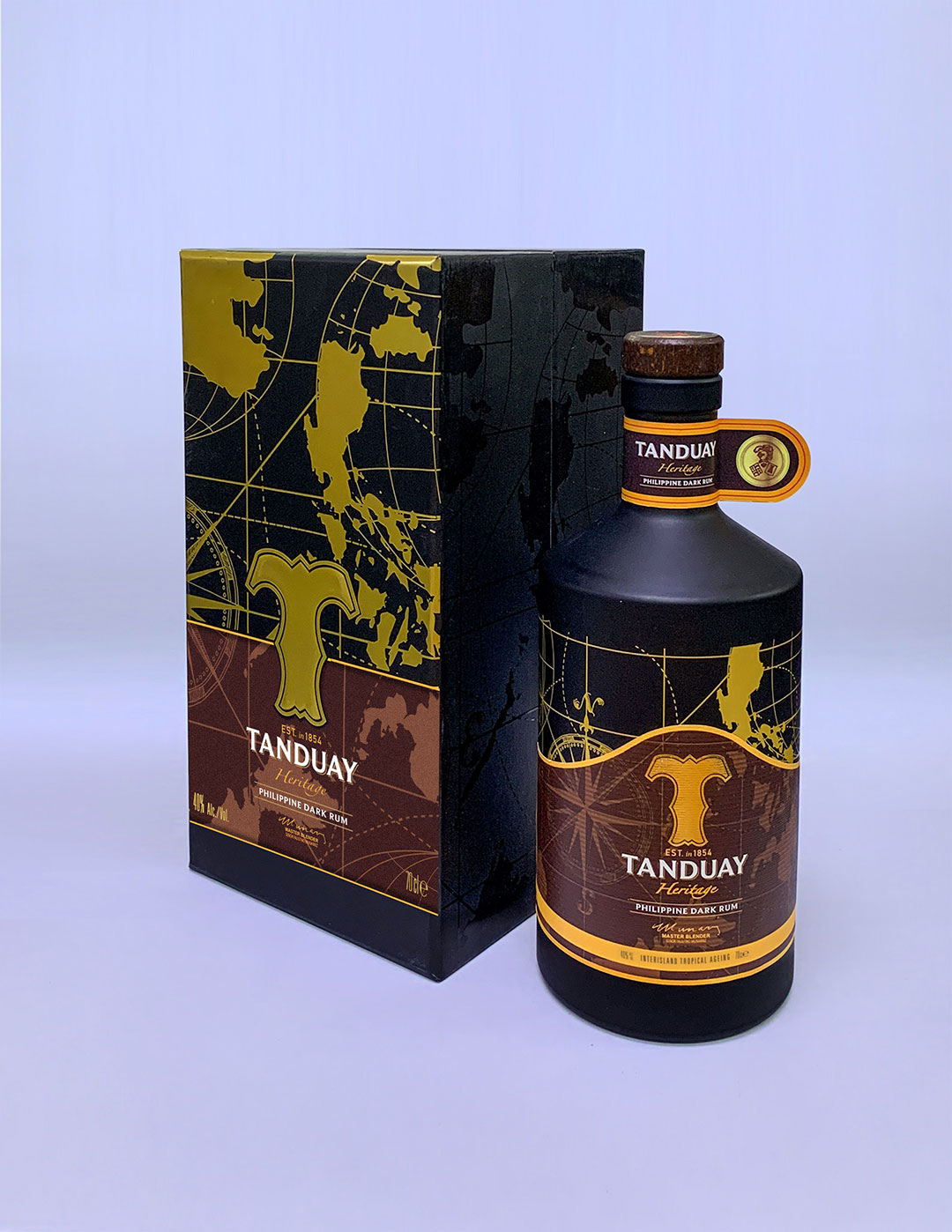
Tanduay commemorates 170 years of rum-making with the launch of Tanduay Heritage, a blend of rums matured through inter-island tropical aging. “Tanduay Heritage pays homage to our Spanish roots in rum-making, back to our founding in 1854 during the Spanish period in our history. It also represents the brand’s striving for excellence throughout the years as it is blended from Tanduay’s finest reserves from different parts of the country,” said Roy Sumang, Tanduay International Business Development Manager. While Tanduay Heritage is a Spanish-style rum, it is 100% crafted by Filipinos and was made in the country’s different islands. It is blended from the reserved rums of Tanduay’s aging warehouses in Quiapo, Cabuyao, and Negros, which were column-distilled in Batangas and Negros. The molasses used in making Tanduay Heritage also came from Negros, and the reserved rums that went into it were aged up to 19 years in oak barrels that were once used for bourbon. Tanduay Heritage comes in an accordion-type gift box in black with streaks of gold, symbolizing a treasure that is being unveiled. Its bottle is also black and has a natural cork. Tanduay Heritage has a dark amber color, with aromas of dried tropical fruits, vanilla, oak, and caramel. It has a medium, smooth, and fruity body and tastes of toffee, creme caramel, pepper, oak, and honey. It has a warming medium-long finish manifesting nuances of molasses cookies and raisins. It is bottled at 40% ABV. Only 10,000 bottles of the Tanduay Heritage were made in a one-time production. It is available only until supplies last. “This is one of the most expensive rums that we are introducing. In the US, it will retail at around $80 and here in the Philippines, it will be around P4,000,” Mr. Sumang said. Tanduay Heritage is now available for purchase at select local and international stores. It will be available at shots.ph this month.


Oatside is having a festival

Oatside invites everyone to the Oatside Pocket Festival on April 20 to 21 at the Bonifacio High Street, 9th Avenue, Bonifacio Global City, Taguig. Booths are open to the public and there will be games (Stack the Oats, Dunk the Oats, Pocket the Oats, Spin the Wheel), prizes, and other activities. The festival celebrates their latest oat milk offering — the Pocket Pack series. The plant-based milk is now available in a convenient 200 ml size and is now available in an Oat Latte flavor. Oatside Pocket Packs are already available at convenience stores like 7-Eleven, Uncle John’s, Lawson, and more, as well as Puregold, Landmark, Landers, All Day, and other leading supermarkets nationwide. The Oatside Pocket Festival is open to the public on April 20 to 21, 10 a.m. to 8 p.m.


Pancake House opens at HCCH

Pancake House opened its newest branch at the Healthway Cancer Care Hospital (HCCH). In partnership with Ayala Land, it is the only restaurant invited by the group to be a part of the medical facility. The store was officially inaugurated on April 5 by members of Max’s Group, Inc. and Ayala Land. HCCH is the first comprehensive cancer specialty hospital in the Philippines that offers end-to-end services. Now, with Pancake House in the fold, that also includes providing them, their family, and friends, as well as the medical staff, with the warmth of classic comfort food during trying times. Pancake House is on the ground floor of the Healthway Cancer Care Hospital in Arca South, Taguig City. It is open from 7 a.m. to 9 p.m.


C2 releases Black Tea Peach

C2, the bottled tea brand, introduced C2 Black Tea Peach. Like other C2 variants, this peach-flavored drink is made with freshly brewed tea, brewed and bottled on the same day to retain peak freshness. C2 Black Peach comes in three sizes: solo (230 ml), regular (500 ml), and litro (1 L). C2 Cool & Clean is from Universal Robina Corp., the maker of snack and beverage brands such as Great Taste Coffee, Jack ‘n Jill Piattos, Magic Crackers, Cloud 9, and Cream-O.

Decaf is the hottest thing in coffee right now

unsplash

On a trip to Colombia last year, Weihong Zhang was given a “mysterious bag of coffee” by his friend Francesco Sanapo, a three-time Italian Barista Champion. This was not quite as suspect as it might sound: Weihong is the owner of BlendIn Coffee Club, a roastery with a pair of cafes in Houston. Mysterious bags of coffee are kind of his thing.

With its notes of eucalyptus and strawberry, Weihong assumed the bag contained expensive beans like anaerobically fermented Geishas or Sidras. But Sanapo revealed something much more rare for a coffee of this quality: It was caffeine-free.

“It completely opened my eyes to decaf,” Weihong recalls. He decided to use the beans, a basic typica variety from Finca Los Nogales in Colombia, in his upcoming appearance in Rancho Cucamonga at the US Brewers’ Cup, a competition that “highlights the craft of filter coffee brewing by hand.”

He won. It was the first time in the competition’s 20-year history that a decaf coffee had taken the title.

Such an unlikely victory isn’t quite the same as winning the Tour de France on a unicycle. But a comparison to the so-called Judgment of Paris in 1976, in which California wines prevailed in a blind tasting against established French vintages, isn’t so far off. The event upended perceptions of American wines and ushered in a new era of global wine production.

As Sergei Kutrovski, who with his brother Mark runs Mirror Coffee Roasters in Bellingham, Washington, put it on their podcast analyzing the ramifications of this victory: “I feel bad for people who tattooed ‘Death Before Decaf’ with, like, the grim reaper.”

CHANGING PERCEPTIONS

Decaf has long been the subject of derision and jokes within the coffee industry and out. But it has quietly continued to grow in both quality and popularity. Skyquest Technology predicts that the decaf market will grow, from $19.5 billion in 2022 to $28.86 billion by the end of the decade.

In 2022, Erin Reed, the director of marketing for Swiss Water Decaffeinated Coffee, told coffee industry publication New Ground that “decaf growth has largely been outpacing regular [coffee] growth over the past five years.”

In an e-mail, Reed confirmed that “this growth trend still holds. And is even stronger within the specialty segment,” referring to artisanal roasted, higher-quality coffee than typical grocery store fare.

Sales of Blue Bottle Coffee’s Night Light Decaf blend put it in the “top five blends in both our cafes and online,” according to Matthew Longwell, the brand’s global director of coffee and beverage.

With alcohol-free cocktails and meat-free hamburgers all the rage, decaf doesn’t seem such a strange proposition, says Adam Paronto, a founder of Chicago’s Reprise Coffee Roasters.

“People want their drugs without their drugs,” he says. “I hear this phrase all the time, and it’s like: People want their rituals, but they don’t want it to mess them up where they can’t function normally, whether that be their job, or socially or whatever.”

RENEWED AND RE-BREWED

New techniques in caffeine removal have played a key role.

The process dates back to the early 20th century in Bremen, Germany, when Ludwig Roselius noticed that coffee beans accidentally soaked in seawater had lost most of their caffeine content while losing little flavor. In 1906, he patented a process that involved steaming coffee beans to open their pores. Then he switched to using benzene (now known to be a carcinogen) as a solvent to remove the caffeine and established Kaffee HAG (Kaffee-Handels-Aktiengesellschaft) to sell his decaffeinated coffee.

Other solvents, such as methylene chloride — also a carcinogen — eventually replaced benzene and became integral to what became known as the European Method of decaffeination.

Organizations such as the Clean Label Project recently petitioned the California Assembly and the US Food and Drug Administration to prohibit use of the substance, which has already been banned by the EPA in products like paint strippers. The National Coffee Association has pushed back, arguing that all of the samples tested by the Clean Label Project were within the FDA’s level of concern.

A process for removing caffeine from coffee without the use of chemicals was developed in Schaffhausen, Switzerland, in the 1930s. Swiss Water Decaffeinated Coffee Inc. has refined that method into a proprietary process in which green coffee is immersed in green coffee extract, during which 99.9% of the caffeine is released and filtered out. (In the US, removal of 97% of the caffeine is enough for a coffee to qualify as decaffeinated; in the European Union, 99.9% must be removed.)

While it is generally considered to preserve the taste of coffee better than other methods, the method is relatively expensive. It adds $1 to $2 per pound to the cost of the green coffee, says Paronto — not to mention travel and time to the process, because decaffeination takes place at Swiss Water’s facility in Delta, British Columbia.

In recent years, another process using ethyl acetate has been gaining popularity. The chemical can be used in a synthetic form or derived naturally in what is often called the “sugarcane method.” In either case, the beans are steamed to open their pores and then soaked in a solution containing ethyl acetate, which bonds to caffeine molecules before being flushed.

The coffee Weihong used was decaffeinated via a modified version in which the pulp, or mucilage, of the coffee berry is added to the fermented sugarcane solution. “It’s a groundbreaking way to do the decaffeination,” he says, because “it not only doesn’t take out any flavors, it imparts nuanced complexity into the cup.”

Weihong was set try his hand in the World Coffee Championships at the Specialty Coffee Expo in Chicago. Whatever the outcome (Martin Wolfl of Austria won. — Ed.), things are changing quickly. He thought he had a six-month supply of Los Nogales decaf, but it sold out within a week of his victory at the US Brewers Cup. The next batch, a Castillo variety, is slated to arrive at the end of the month.

WHERE TO GET A DECAFFEINATED FIX IN THE US

While Blue Bottle Coffee’s Swiss Water Process-treated Night Light Decaf is always available, the dawn of cold brew season has us looking to a more sporadic offering: Decaf New Orleans-style coffee and chicory. Traditionally served as a sweet, milky antidote to the Crescent City’s heat and humidity, this decaf version is suitable for even late afternoon coffee breaks. ($21 for 12 oz)

Rather than just the typical decaf and half-caf, Chicago’s Reprise Roasters makes the cuts in its Uncaf line where you’d least expect them. Along with Zero, a 99.99% caffeine-free Swiss Water Process-treated blend of beans from Central America and Africa, it offers the Micro Dose, with 10% caffeine, and Light Buzz, with 25%. ($16.49 for 12 oz)

Dare to challenge two stereotypes in one cup? Perc Coffee of Savannah, Georgia, offers decaffeinated Huila, a Colombian coffee that’s also … instant. ($12 for a pack of five)

If neither caffeine nor brewing appeals, Explorer’s 32-oz, 20-serving bottles of cold brew concentrate offer a just-add-water solution. Daydreamer is a 99.9% caffeine-free Swiss Water Process decaf brew; Seeker is the half-caffeine option. Do not, under any circumstance, confuse them with Maverick, which speeds in the opposite direction — meaning twice the caffeine. ($45 for a 32-oz bottle)Bloomberg

To contact the author of this story:

Matthew Kronsberg in New York at matt.kronsberg@gmail.com

© 2024 Bloomberg L.P.

Maybank Philippines, foreign entity seek to obtain Islamic banking licenses

PHILIPPINE STAR/DEEJAE DUMLAO

TWO ENTITIES have expressed interest in obtaining Islamic banking licenses, Bangko Sentral ng Pilipinas (BSP) officials said on Wednesday.

“We are seeing two potential applicants, but they have not yet submitted applications. But we have held meetings with them already, discussing the requirements for establishing Islamic banking units,” BSP Assistant Governor Arifa A. Ala said at a press briefing on Wednesday.

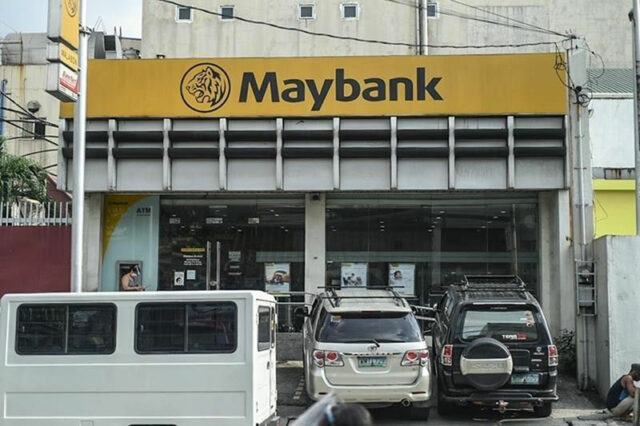
One of these is Maybank Philippines, which is seeking to set up an Islamic banking window, while the other is a foreign applicant, Ms. Ala said. Their applications are in the advanced stages of discussion, she added.

The only lenders with Islamic banking operations in the country are the state-owned Al Amanah Islamic Investment Bank and CARD Bank, Inc., which opened an Islamic banking branch in Cotabato City this year.

“We would like to have more because for the longest time, we only have one Islamic bank in the name of Al Amanah Islamic Investment Bank. Now we have two because CARD Bank has an Islamic banking unit,” Ms. Ala said.

According to BSP data, about 29% of local government units remain unbanked. The Bangsamoro Autonomous Region in Muslim Mindanao (BARMM) is the most unbanked region, followed by Eastern Visayas.

In BARMM alone, 92% of the population is unbanked and only 8% have bank accounts.

“I think by introducing Islamic banking, we can bring more people into the formal banking system. The most attractive banking instruments for (BARMM) would be Islamic banking,” BSP Governor Eli M. Remolona, Jr. said at the same briefing.

Islamic banking must be compliant with principles of Shari’ah Law. In Islamic banking, interest is prohibited, while in conventional banking, interest is the main source of income.

“Basically, it means whenever you have an instrument or an asset, instead of paying interest, you’re paying profit based on some underlying asset,” Mr. Remolona said.

Ms. Ala said Islamic banking is also not exclusive to Muslims and can be tapped by all religions.

“But for the non-Muslims, Islamic banks can be alternative investment options, because essentially, Islamic banking is about sharing of profit and cost,” she added.

The BSP is also working on educating the public on Islamic banking, she said.

“We recognize that the main hindrance in promoting Islamic banking and finance is the low awareness or low understanding,” Ms. Ala said.

“What we want to do is create an inclusive banking system, a sustainable and vibrant Islamic finance ecosystem within the country to complement the banking system we already have,” Mr. Remolona added.

Meanwhile, the BSP chief said issuing Sukuk bonds in the domestic market is a “good idea.”

“I think it has a good chance in the Philippines as a peso instrument instead of just a dollar instrument. Maybe it should be retail — maybe small denominations,” he added.

In December, the government raised $1 billion from its maiden issuance of Sukuk bonds. — Luisa Maria Jacinta C. Jocson

On oil economics and Philippines vital statistics

On April 1, Israel bombed the Iran embassy annex building in Syria. Last Saturday, April 13, Iran sent hundreds of drones and cruise missiles to Israel. Since April 14, the world has been waiting to see if a large-scale counterattack by Israel would happen or not. As of this writing, there has been none; de-escalation of the conflict is good for the world.

OIL ECONOMICS: SUPPLY, DEMAND AND PRICES
World oil prices did not jump up high after the exchange of bombs and missiles between the two countries. WTI crude went from $82/barrel in end-March to $87 on April 5 and $85 as of April 17. Dubai crude was $84/barrel in end-March and went up to $91 on April 5 and $90 as of April 17.

Iran is the third largest oil producer among the 12-members Organization of Petroleum Exporting Countries (OPEC). Its oil output was 3.2 million barrels per day (mbpd) in the first quarter of 2024. But a major war between Israel and Iran will affect not only Iranian oil output and exports but also those of the neighboring countries like Iraq, Kuwait, Saudi Arabia, and the United Arab Emirates (see Table 1).

The US is the largest oil producer and largest oil consumer in the world. In 2023, its total liquids output was 20.9 mbpd but its consumption was 20.6 mbpd. Not all oil is the same so US refineries still import a lot of oil from the Middle East, Africa, and South America with different qualities from US crude oil to produce the desired gasoline and petrochemical products.

Russia is the world’s second largest oil producer. In 2023 it produced 10.93 mbpd while its consumption was only 3.84 mbpd, giving it a surplus of 7.1 mbpd for exports, most of it going to China and India.

China is the fourth largest oil producer (Saudi Arabia is third) but it is the second largest oil consumer after the US. In 2023, China’s oil output was 4.52 mbpd while its consumption was 16.22 mbpd so to cover its deficit of 11.7 mbpd, it buys mostly from Russia, Iran, and Saudi Arabia.

Total global oil demand was 102.21 mbpd in 2023 and is projected to rise to 104.46 mbpd in 2024 and 106.31 mbpd in 2025 (data from OPEC). The bulk of rising global oil demand will be supplied by major oil exporters Russia, Saudi Arabia, and the other OPEC member-countries.

There are three main lessons to draw from current global oil economics.

One, global oil demand keeps rising despite all the demonization against oil and fossil fuels.

Two, de-escalation of the Middle East conflict, especially between Israel and Iran plus its allies in Yemen (Houthis), Lebanon (Hezbollah), Syria and Iraq (Shi’ite militias), and Palestine (Hamas), is very important.

Three, since all major military hot spots in the world have US involvement — Ukraine, Iraq and Syria, Israel-Iran, Taiwan, the South China Sea, etc. — the US should learn to step back from too much interventionism, allow disputing countries to talk to each other and resolve conflicts as peacefully as possible and help stabilize global energy markets.

PHILIPPINES VITAL STATISTICS
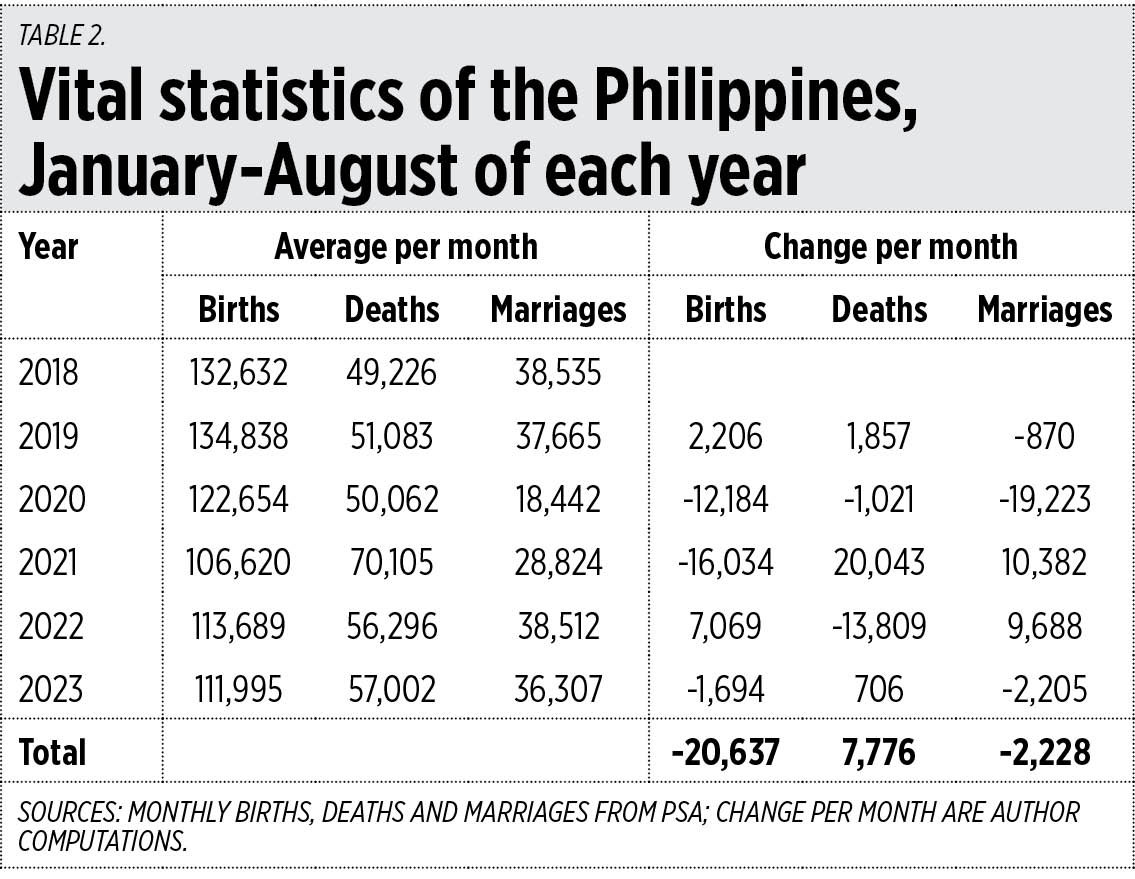
Last week, the Philippine Statistics Authority (PSA) released the monthly update of the country’s demographics and mortality statistics for 2023. I summed up the total for January to August and compared it with data for the same period in preceding years. The results are not exactly good.

One, the number of births has been falling since the imposition of lockdown dictatorship in 2020-2021 and mandatory COVID vaccination in 2021-2022.

Two, there were no excess deaths in 2020 over 2019 despite the high number of reported COVID cases, but there was a high number of excess deaths in 2021 (when mass vaccination was done in March 2021 onwards) compared to 2020 and 2019. There were 20,000/month excess deaths in 2021.

Three, the number of marriages significantly declined in 2020-2021 during lockdown. This recovered in 2022, going up to 2018’s level, then declined again in 2023 (see Table 2).

The COVID vaccines, being experimental with no long-term studies on their effect on heart conditions, fertility, and other health indicators, could be a major factor for the rise in excess deaths in 2021 and the decline in births until 2023 and possibly until today.

Economic scarring like the -9.5% GDP performance in 2020 (the worst in Asia that year, the worst in Philippine economic records since post World War 2), very high unemployment numbers and increase in business bankruptcies, and now an emerging demographic problem of declining births — these are the major damage caused by the lockdown dictatorship and mandatory vaccination.

Philippines government, business, and civil society leaders should keep this in mind: that curtailing economic freedom, disrespecting natural immunity from the virus and believing only in so-called vax immunity, are a sure formula for economic underdevelopment and demographic distortion.


Bienvenido S. Oplas, Jr. is the president of Bienvenido S. Oplas, Jr. Research Consultancy Services, and Minimal Government Thinkers. He is an international fellow of the Tholos Foundation.

minimalgovernment@gmail.com

Paywatch Philippines wants to onboard more employees, companies

EARNED wage access (EWA) service provider Paywatch Philippines is looking to onboard more employees and partner employers on its online platform this year, its top official said.

The company expects to onboard at least 100,000 employees and partner with more employers this year, Paywatch Philippines President Rowell O. Del Fierro said in a briefing on Tuesday.

It has partnered with over 30 employers, including the five Shangri-La Hotels under Shang Properties, Inc., Rustan’s, a franchise owner of Dunkin Donuts, and Wilmar, he said.

Mr. Del Fierro said they will focus on partnering with business process outsourcing companies.

“Their main problem is retention and attrition. The other thing is their employees are very young, so cash flow is very important,” he said.

The company is also looking to partner with companies that have a high number of employees, such as factories and those in the retail sector.

“We’re targeting companies that have over 1,000 employees as a base. That’s our sweet spot. Eventually, we can move down to small businesses,” Mr. Del Fierro said.

They also hope to tap government employees and micro, small, and medium enterprises in the future, he said.

“There are close to 50 million employees [in the Philippines]. Short-term liquidity is normally catered to by credit cards. There are only seven million credit card holders. So, the only other alternative are these digital lending companies with predatory rates. Banks are not cheap either,” Mr. Del Fierro said.

“To our knowledge, there is no significant player offering free EWA in the Philippines. Most of them are EWA-like, but it’s offered by a lending company and they probably offer lending products. We don’t offer loans,” he added.

Meanwhile, Paywatch Philippines also wants to introduce a bills payment feature on its app in the next three to four months, as well as savings and insurance within a year, said Mr. Del Fierro.

The company may partner with a a bank to bring the savings feature to its platform, he said.

Malaysia-based Paywatch Global Pte. Ltd. lets employees withdraw a portion of their wages early for a small fee and with zero interest, giving them access to cash for essential expenses like bills or transportation. These withdrawals do not require approval from an employer’s human resources department.

The company said its bank-backed services help companies increase employee retention and decrease rehiring costs.

Mr. Del Fierro said Paywatch finances the early wage withdrawal and the amount borrowed will be deducted from the employee’s total wage for the end of the cycle, and then the employer will pay Paywatch for the withdrawn amount.

Paywatch President and Co-founder Alex Kim said the expected growth in employee onboarding in the Philippines is faster than Malaysia’s but similar to Indonesia’s.

Aside from the Philippines, Indonesia, and Malaysia, Paywatch also operates in Hong Kong and South Korea, based on its website. —

Paywatch Philippines obtained its license to operate from the Securities and Exchange Commission in August 2023 and has been active for six months. It also has an Operator of Payment System license from the Bangko Sentral ng Pilipinas. — A.M.C. Sy

Metro Retail income drops to P618 million

METRORETAIL.COM.PH

LISTED Metro Retail Stores Group, Inc. recorded a 32.6% decline in its net income to P618 million last year from P917.3 million in 2022, mainly due to macroeconomic challenges, the company said on Wednesday.

The company’s sales grew by 0.4% to P38.3 billion from 38.1 billion in 2022 despite inflationary pressures that affected consumer spending, Metro Retail said in a stock exchange disclosure.

Metro Retail said its comparable same-store sales growth slipped by 0.8% due to a decline in wholesale business contribution.

By business, general merchandise increased by 4.7% driven by apparel, electronics, appliances, and travel gear; food retail declined by 1.2% due to bulk wholesale business scaling down versus last year; and food retail sales expanded by 6.2%.

“Even with the challenged outturn, Metro Retail reiterates its commitment of offering improved services to customers and better returns to stakeholders underpinned by its strategic initiatives to bolster growth and stability in 2024 and onwards,” Metro Retail President and Chief Operating Officer Manuel C. Alberto said.

Metro Retail’s expansion continued with the launch of its neighborhood minimart Metro Value Mart in General Trias, Cavite and opening of two new Metro Supermarkets in Lapu-Lapu City, Cebu and Alangalang, Leyte.

The company added that its growth will be supported by the recent inauguration of the Metro Distribution Center in Sta. Rosa, Laguna last quarter.  

On Wednesday, Metro Retail stocks declined by 1.41% or two centavos to P1.40 per share. — Revin Mikhael D. Ochave

Replacement strategy

8PHOTO-FREEPIK

EVEN for a pedestrian a decision as trading in an old car that is too often in the repair shop, there is a replacement strategy based on need and costs. An alternative will involve either a brand-new car, if one can afford it, or a “previously owned” one with low mileage. Or just keeping the headache another few months.

Institutions too are confronted with a replacement decision, sometimes triggered by the death of an incumbent leader. These include the monarchy in some countries, and even a religious organization. Government posi-tions have term limits which end unless a dictatorship is imposed. There are still many democratic countries that mandate a popular vote in designating a successor.

Even listed companies in the United States, including one with a market cap of over $2.7 trillion like Apple, are vacated by their founders to turn over the helm of their ships to a designated successor. Microsoft and Amazon too are good examples.

One of the lowest priorities for many CEOs seems to be planning a replacement strategy. Even those of advanced age beyond mandated retirement may not prioritize the search for a successor. Maybe, a replacement exer-cise is akin to writing out one’s last will and testament which is premised on not being around when its contents are announced.

What are the possible responses to talks on a succession plan from inquisitive stockholders or business media? There are steps that can be taken to evidence some effort in finding a replacement.

Form a search committee. This can be assigned to some directors of the board who are understood to have no designs (or qualifications) for the position being discussed. Some guidelines can be given to the group in determining a worthy candidate — must be able to leap tall buildings in a single bound. (A cape will be provided.)

Create a new position for a clear Number Two. This vacancy is then filled by an executive from within who will be designated with an appropriate title like Chief Operating Officer (COO) with an appropriate jump in his Guar-anteed Annual Cash Compensation (GACC). This is a signal that the appointee is at the head of the line for the top job.

Give a timeline for effecting a succession plan. This timeline need not be a specific date. It can be expressed in external phenomena, like “the next solar eclipse” after the recent one.

While the above moves may be construed as delaying tactics, they present an action plan that is subject to monitoring. The intended time horizon may be accelerated by events or moves by the board. The clear candidate may already be in place as COO, someone the incumbent CEO has personally picked, maybe even mentored. Other events like loss of market share or health issues may move the replacement earlier.

Even after a new successor has taken over, the appointment is in a “probationary” stage. The new leader is being constantly evaluated. He is compared with his predecessor, especially by those who were close to the previ-ous leader and may have lost their influence.

The predecessor who may still be sitting on the board may be queried on how his successor is faring. He usually refrains from any form of criticism — it’s too early to tell.

The temptation to knock a successor down is absent when the predecessor has retired from the corporate scene and merely wants to enjoy his retirement. He can extol the joy of living in a farm — you can hear the cocks crowing.

The CEO position, especially of a large, listed company is both a source of significant revenues and a raiser of profile and status. Willingly stepping down from such a high perch can be difficult. The mandatory retirement age of any company is supposed to take out the uncertainty of designating a replacement. But this rule is not always followed for the top position.

The certainty of a leadership position and the power it holds over the company and its stakeholders supports what behavioral economists call the “status quo bias.” Why change what seems to be working well?

More uncertain perhaps for a CEO’s exit is the prospect of not having meetings one after another and holding sway over a large organization, maybe even a country. Still, the anonymity of leaving the scene has its own at-tractions. One walks into a room and conversation does not stop — he gained a lot of weight.


Tony Samson is chairman and CEO of TOUCH xda

ar.samson@yahoo.com

ADVERTISEMENT
ADVERTISEMENT