Home Blog Page 3255

Globe secures P1.5 billion from tower sales 

GLOBE Telecom, Inc. on Monday said it has completed the sale of its 100 towers to Phil-Tower Consortium, Inc. (PhilTower) for P1.5 billion.

Overall, Globe has closed the sale of 1,100 towers, representing 80% of the 1,350 towers to be acquired by PhilTower, the company said in a regulatory filing.

“The transaction will result in availability of funds for Globe to support future capital expenditures, debt repayments and debt avoidance with the expectation to improve the balance sheet health of the company,” it said.

In September last year, Globe signed an agreement with PhilTower for the sale of 1,350 telecommunication towers and related passive infrastructure for about P20 billion. 

For this year, Globe is allocating $1 billion for its capital expenditures funded by internally generated funds, debts and proceeds from its tower sales. 

PhilTower is a local tower company. It builds shared telecommunication infrastructure for mobile operators. 

At the stock exchange on Monday, shares in the company closed P40 or 2.23% higher at P1,830 apiece. — Ashley Erika O. Jose

PHL banks’ assets higher by 10.8% at end-March

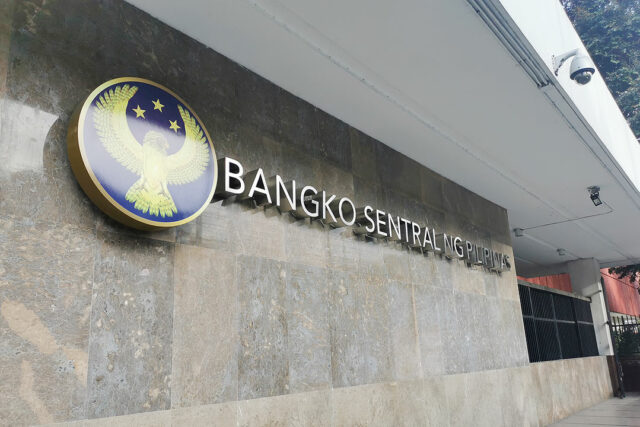
Bangko Sentral ng Pilipinas main office in Manila. — BW FILE PHOTO

THE PHILIPPINE banking industry’s total assets rose by 10.8% as of end-March, according to Bangko Sentral ng Pilipinas (BSP) data.

Banks’ combined assets increased to P25.65 trillion as of end-March from P23.15 trillion in the same period a year ago, preliminary data from the central bank showed.

Banks’ assets are mainly supported by deposits, loans, and investments. These include cash and due from banks as well as interbank loans receivable (IBL) and reverse repurchase (RRP), net of allowances for credit losses.

The banking industry’s total loan portfolio inclusive of IBL and RRP rose by 9.9% to P13.22 trillion in the first quarter from P12.03 trillion a year ago.

Net investments, or financial assets and equity investments in subsidiaries, climbed by 10% to P7.36 trillion in the period from P6.69 trillion.

On the other hand, cash and due from banks declined by 4.9% to P2.94 trillion at end-March from P3.09 trillion in the year prior.

Net real and other properties acquired went up by 5.9% to P106.99 billion in the first quarter from P101.03 billion.

BSP data showed banks’ other assets surged by 64% to P2.02 trillion from P1.23 trillion.

Meanwhile, the total liabilities of the banking system rose by 10.7% to P22.53 trillion in the first quarter from P20.36 trillion a year earlier.

Rizal Commercial Banking Corp. Chief Economist Michael L. Ricafort said the higher asset level as of end-March was consistent with recent loan growth data.

Outstanding loans of universal and commercial banks grew by 9.4% year on year to P11.796 trillion as of March, BSP data showed.

“This was also facilitated by the growth in banks’ deposits that supported the continued growth in banks’ loans, investments, and in overall assets,” Mr. Ricafort said in a Viber message.

“Furthermore, the continued growth in banks’ earnings also led to higher capital that also supported increased lending and investment activities, thereby leading to further growth in banks’ assets,” he added.

Separate central bank data showed that the Philippine banking industry’s net income rose by 2.95% to P92.107 billion at end-March from P89.47 billion in the same period a year ago. — Luisa Maria Jacinta C. Jocson

Doctor Who star Ncuti Gatwa says new series feels like ‘a fresh era’

DOCTORWHO.TV

LOS ANGELES — Ncuti Gatwa, the first Black actor to play the lead role in Doctor Who, says its new series feels like “a fresh era” as the British sci-fi television show goes global.

The much-loved BBC cult show will now also be streamed to audiences outside the United Kingdom in a new collaboration between the British broadcaster and Walt Disney Co.’s streaming service Disney+.

The Rwandan-born Scottish actor, who shot to fame in Netflix show Sex Education, plays the latest incarnation of the Time Lord in the new series, which also sees screenwriter and producer Russell T Davies return as showrunner.

“It feels very much like a new era and a fresh era. So, it’s a really great point for people to jump on board to the show,”

Mr. Gatwa told Reuters at the series premiere in Los Angeles on last week.

“We’ve got new villains and new monsters. The Doctor’s a lot more out of his depth than we’ve ever seen him before.”

The Doctor is able to regenerate, allowing different actors to play the role since the series first aired in 1963.

“My approach was to watch, study all the past Doctors that have been before, find out their weaknesses and how I can be better,” Mr. Gatwa joked.

“No, I really wanted to immerse myself in the world of it all and just understand what was unmistakably the doctor about each of them and like what they brought individually to the role and tried to see where I could fit in with that. I don’t know whether I’ve done that or not but we shall see.”

Actor Millie Gibson, known for British television soap Coronation Street, plays the Doctor’s new companion Ruby Sunday.

In the new series, the pair will head to the Regency era as well as war-torn future worlds in their TARDIS, a time-traveling craft in the shape of a police telephone box that famously looks bigger on the inside than the outside.

“It’s timeless. I mean, not only does the doctor regenerate, the show regenerates with it and so does its audience,” Gibson said.

Doctor Who premiered on Disney+ on Friday and on the BBC on Saturday. — Reuters

PHL growth resilience amid a deteriorating global economy

Last week, the Philippine Statistics Authority (PSA) released the growth data of the first quarter (Q1) of 2024. It was 5.7%, lower than the projected 6% or higher. Economic pessimists jumped on the discrepancy to say that they were correct in their regular attacks against the policies of the current government economic team and the administration. Except that they forgot about or deliberately omitted showing the growth rate of our Asian neighbors and other countries in the world.

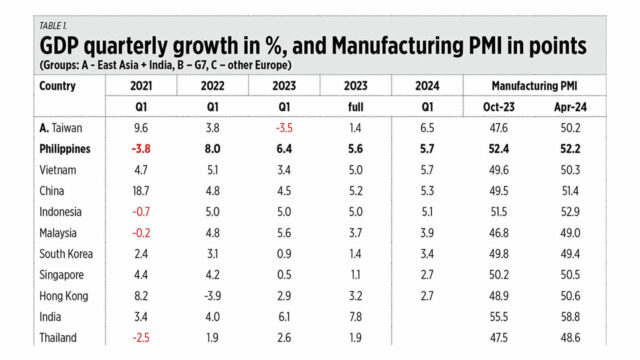
In Q1 2024, Taiwan had the fastest gross domestic product (GDP) growth at 6.5% — but it was more of a base effect as Taiwan’s economy contracted by -3.5% in Q1 2023. So, Vietnam and Philippines were the co-leaders when it came to fast growth in Q1 — but then again, Vietnam was also coming from a low base, low growth in Q1 2023, while the Philippines was coming from a high base, high growth in the same period. Thus, the Philippines is the best performing major economy in the world, except perhaps for India — but they have not released their Q1 2024 GDP data yet.

Another indicator of economic dynamism, or lack of it, is the Manufacturing Purchasing Manager’s Index (PMI). An index above 50 is good, meaning that purchasing managers are optimistic about the economy in the coming months and quarters. An index below 50 is bad, while one below 47 is horribly bad. For the accompanying table, I took the April 2024 PMI and that from six months before, October 2023. The Philippines had a high PMI of 52.

Many G7 countries and other European nations are already on the path of degrowth and deindustrialization. These include Germany, Italy, the UK, Austria, Sweden, Ireland, Finland, and so on. They are also the same countries with bad or horribly bad PMIs (see Table 1).

Finance Secretary Ralph G. Recto made a good observation about the 5.7% growth, saying that “More than our performance in the region, what is to be celebrated here is the encouraging growth seen in the manufacturing sector as it is the most crucial sector for long-term employment, productivity, value-added generation, and innovation. This sets the course for the Philippines to become a premier manufacturing hub in Asia.”

Budget Secretary Amenah F. Pangandaman noted the role of fiscal discipline in sustaining growth: “I am confident that growth will accelerate further in the coming quarters as we prioritize shovel-ready projects for a more efficient implementation of the Build-Better-More program… We also look forward to the passage of the new Government Procurement Reform Act, which will boost efficiency in procurement and exponentially improve budget utilization.”

Secretary Arsenio M. Balisacan of the National Economic and Development Authority (NEDA) reiterated the optimistic view that “with hard work and the right policies in place, we are confident that we will achieve our growth target of 6-7% this year.”

I support the optimism of the economic team. I laugh at the pessimism of the detractors who do not include the deteriorating global economic environment in their constant criticism and yet the Philippine economy is able to stand tall.

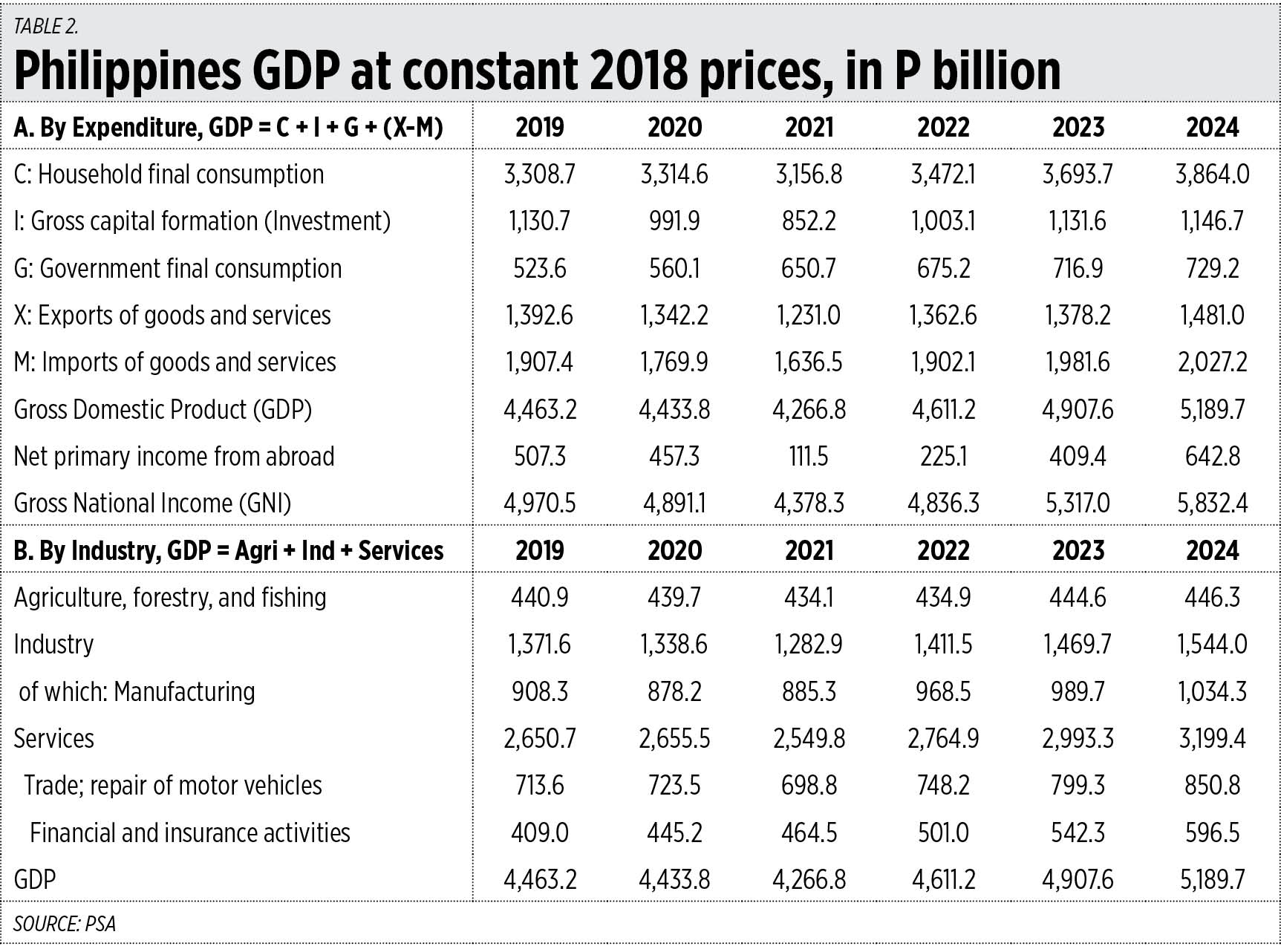
Looking now at the details of the sectoral performance of the Philippine economy, in GDP by expenditure or the demand side, the main driver of the 5.7% growth in Q1 were the Exports of Services (15.6% of GDP in Q1 2024) — BPO, the tourism sub-sectors, even POGOs — which grew at 8.9%. Household consumption (which makes up 75% of GDP) had modest growth of only 4.6%, while Investments and government consumption had low growth of only 1.7% and 1.3% respectively.

Looking at the GDP by industry origin or the supply side, the growth drivers were the services sector (which comprised 62% of GDP) with 6.9% growth led by Accommodation and food services with growth of 14%, and financial and insurance activities with 10% growth. Industry makes up 30% of GDP and had 5.1% growth.

The Manufacturing sub-sector (20% of GDP) grew by 4.5%. Low growth in agriculture, forestry, and fishery is shown by their low output — only P446 billion — in Q1 this year, with little expansion from their P441 billion output in Q1 2019 (see Table 2).
Mining is really an under-rated and unrecognized growth driver. In Q1 2024, mining and quarrying output was P43.3 billion (constant prices), even lower than its Q1 2019 output of P45.6 billion. This was among the topics discussed in the Stratbase ADR Institute’s mining conference last Friday, May 10, at the Makati Diamond Residences. Environment Secretary Ma. Antonia Yulo-Loyzaga and NEDA Secretary Balisacan were the keynote speakers. The ambassadors of Australia, Canada, Japan, and the European Union were also among the speakers.

Meanwhile, here are two conferences that I will be attending.

Lunas Pilipinas and the Concerned Doctors and Citizens of the Philippines (CDC PH) will be holding a conference on May 18 at the University of Asia and the Pacific (UA&P) with the theme, “Healing from COVID Lockdown and Mandatory Vaccination: From trauma and tragedy to resilience and victory.” Among the speakers will be BusinessWorld columnist Jemy Gatdula, who is the Dean of UA&P College of Law; Dr. Romy Quijano, a retired professor of Pharmacology and Toxicology at the UP College of Medicine; and Dr. Marivic Villa, a pulmonologist, internist, and practitioner of critical care, and anti-aging medicine based in Florida, USA, who is also President of CDC PH.

I will also be attending the BusinessWorld Economic Forum on May 22 at the Grand Hyatt Manila in BGC, Taguig, with the theme “PH Next: Growth Drivers.” The keynote speakers will be NEDA’s Mr. Balisacan, and JG Summit President and CEO Lance Y. Gokongwei. Other speakers will be the corporate leaders of Angkas, Aboitiz InfraCapital, Converge, Globe, Grab, EastWest Bank, Lazada, Maya, GCash, CICC, PEZA, Destileria Limtuaco, ACEN, FirstGen, Meralco, and IEMOP.


Bienvenido S. Oplas, Jr. is the president of Bienvenido S. Oplas, Jr. Research Consultancy Services, and Minimal Government Thinkers. He is an international fellow of the Tholos Foundation.

minimalgovernment@gmail.com

AI integration expected to revolutionize construction

PLANRADAR.COM

THE integration of artificial intelligence (AI) and building information models (BIM) is poised to significantly benefit the construction sector, construction technology firm PlanRadar said.

This synergy could yield considerable reductions in construction costs while simultaneously minimizing design errors, PlanRadar Head of Sales, Central Asia, MENA, and APAC Vitaly Berezka said in an e-mail interview last week.

BIM refers to 3D model-based software that assists engineers and architects in planning and design.

Mr. Berezka cited fluctuating material prices and labor expenses, influenced by factors such as inflation, as affecting project viability and profitability.

He added that embracing digitalization allows developers to adapt and stay competitive amid evolving market demands, delivering high-quality projects that meet the needs of clients and communities.

“For instance, AI-powered predictive analytics can anticipate delays and bottlenecks, enabling proactive mitigation measures that may reduce construction time by weeks or even months,” he said.

Meanwhile, for aerial surveys and site monitoring, AI-enabled drones can be used to provide real-time data on project progress and detect plan backlogs.

According to an industry report by Procore Technologies, Inc. in 2022, despite the enthusiasm in the local construction industry, there are technological challenges in upgrading, particularly in developing countries like the Philippines.

The survey found that 44% of respondents expressed concerns with data security, while 43% were concerned with other issues, including inadequate software solutions, the high cost of digital transfers, and a lack of support from technological providers.

In response, Mr. Berezka said industry stakeholders must maintain transparent communication and education about AI technologies, dispelling misconceptions and building the industry’s confidence in their capabilities.

Developers need to focus on deploying strong encryption protocols and access controls to protect sensitive data and thwart unauthorized entry, he said.

“Investing in robust data security measures and compliance frameworks can alleviate potential risks related to data breaches and privacy concerns.”

He said a culture of cybersecurity awareness should be established through training among staff members to be able to pinpoint and address potential threats adeptly.

Mr. Berezka also suggested partnering with cybersecurity professionals and governmental bodies that offer valuable expertise and tools to bolster infrastructure resilience against cyberattacks.

On the necessary steps in digital transformation for Filipino developers, Mr. Berezka said it starts with an assessment of current capabilities and identifying areas for improvement.

It is then followed by developing a comprehensive digital strategy tailored to the company’s goals and resources that covers technology adoption and implementation, workforce training, and change management.

Developers can use digital solutions, such as digital project scheduling and project management software, to make data-driven decisions, he said.

Digital technologies like BIM typically incur initial setup costs for software licenses, hardware, and training, but Mr. Berezka said these investments yield significant long-term benefits.

“From pilot to full-scale rollout of new technologies, continuous evaluation and adaptation are vital to ensure the digital transformation aligns with evolving business needs and industry trends,” he said.

PlanRadar is digital construction and real estate management software with 18 global offices. — Aubrey Rose A. Inosante

San Miguel Corp. to conduct Regular Meeting of the Stockholders on June 11


Spotlight is BusinessWorld’s sponsored section that allows advertisers to amplify their brand and connect with BusinessWorld’s audience by publishing their stories on the BusinessWorld Web site. For more information, send an email to online@bworldonline.com.

Join us on Viber at https://bit.ly/3hv6bLA to get more updates and subscribe to BusinessWorld’s titles and get exclusive content through www.bworld-x.com.

Premium Leisure Corp. plans voluntary delisting by July 9

LISTED Premium Leisure Corp. (PLC) said it intends to voluntarily delist from the Philippine Stock Exchange (PSE) by July 9, following the tender offer made by its parent company Belle Corp.

 “PLC, as proposed by and with the full support of its majority shareholder, Belle Corp., respectfully submits this petition for voluntary delisting of PLC’s common shares with a par value of 25 centavos per share from the main board of the PSE, with proposed voluntary delisting effective on July 9,” PLC said in a stock exchange disclosure on Monday.

 The PSE suspended trading of PLC shares on May 7 following a tender offer by Belle Corp., consisting of 6.17 million PLC shares priced at 85 centavos, with a total value of P5.25 billion. The move brought PLC’s public float below the 20% minimum requirement of the PSE.

 Belle Corp. is engaged in integrated resorts business. It is one of the portfolio investments of Sy-led conglomerate SM Investments Corp.

Meanwhile, PLC has a stake in the City of Dreams Manila integrated entertainment and gaming complex in Parañaque City.

 It also has a 50.1% stake in listed Pacific Online Systems Corp. that leases online betting software and equipment to the Philippine Charity Sweepstakes Office for lottery operations in Visayas and Mindanao. — Revin Mikhael D. Ochave

San Miguel Food and Beverage, Inc. to conduct 2024 Annual Meeting of the Stockholders on June 5


Spotlight is BusinessWorld’s sponsored section that allows advertisers to amplify their brand and connect with BusinessWorld’s audience by publishing their stories on the BusinessWorld Web site. For more information, send an email to online@bworldonline.com.

Join us on Viber at https://bit.ly/3hv6bLA to get more updates and subscribe to BusinessWorld’s titles and get exclusive content through www.bworld-x.com.

RCBC net profit down to P2.2B

BW FILE PHOTO

RIZAL Commercial Banking Corp. (RCBC) saw its net income fall by 39.47% in the first quarter in the absence of a one-off gain from its sale of properties recorded in the same period last year, it reported on Monday.

The lender’s attributable net income stood at P2.2 billion last quarter, down from P3.64 billion in the same period last year, the bank’s quarterly report disclosed to the stock exchange showed.

This translated to a return on average equity and a return on average assets of 5.6% and 0.7%, respectively.

The year-on-year decline was mainly driven by a 53.27% decrease in its other operating income to P2.68 billion from P5.73 billion, the report showed.

This was due to a 96.7% decrease in net gains from assets sold to P112 million in the quarter from P3.35 billion a year prior. The higher net gain recorded last year came from the sale of various real estate properties, RCBC said.

The lender also recorded lower gains from trading and securities and foreign exchange in the period due to valuation adjustments amid market conditions.

RCBC also saw a 100% reduction year on year in earnings from trust fees in the first quarter as it spun off its trust operations to a stand-alone corporation effective Jan. 2, it said.

Meanwhile, earnings from service fees and commissions rose by 43.8% year on year to P2.046 billion in the first quarter amid an increase in fee-based income.

The bank’s miscellaneous income also climbed by 32.4% to P507 million in the period on the back of higher dividend earnings.

On the other hand, revenues from core businesses stood at P11.6 billion, RCBC said in a separate statement.

The bank’s net interest income rose by 31.55% to P9.56 billion in the first quarter from P7.27 billion a year prior, amid higher loan volume and average yields.

“Interest income on loans and receivables was higher by 32.3% or P3.5 billion; interest income on trading and investment securities increased by 23.1% or P745 million and other interest income higher by 2.3% or P17 million,” RCBC said in its quarterly report.

“Total interest expense increased by 26% or P1.9 billion due to higher interest expense on deposit liabilities by 32.5% or P2 billion as a result of higher average costs and growth in average volume. Meanwhile, interest expense on bills payable and other borrowings was down by 7% or P85 million,” it said.

The bank’s interest margin was at 3.6% at end-March.

On the other hand, its operating expenses went up by 7.94% to P7.77 billion in the first quarter from P7.19 billion the year prior amid increases in employee benefits and occupancy and equipment-related costs.

Miscellaneous expenses also rose by 13.3% “due to higher credit card-related expenses and increase in regulatory fees and other volume-driven expenses,” RCBC said in its report.

The bank’s cost-to-income ratio stood at 63.5%.

Total assets rose by 7% year on year to P1.23 trillion at end-March amid a 13% growth in earning assets, the lender said

“This was mostly driven by the loan expansion, especially in the consumer segment. Backed by data-driven acquisition and cross-sell campaigns to manage portfolio quality, credit card remains as the bank’s fastest-growing segment which soared by 55%, outperforming industry’s 30%. Similarly, credit card billings closed 42% higher versus industry’s 17%. Meanwhile, personal and salary loans more than doubled from last year as the bank continues to enhance customer experience across its platforms,” the bank said in the statement.

Net loans and receivables stood at P649.19 billion at end-March, its financial statement showed. Its nonperforming loan ratio was at 1.7%.

“Deposits sustained their momentum and closed 12% higher at P959 billion. CASA (current account and savings account) deposits climbed 13% amid stronger push for various cash management initiatives, coupled with client acquisition programs,” the bank added.

Its loan-to-deposit ratio stood at 65.8% at end-March.

The bank’s total equity was at P150.84 billion in the period. Its capital adequacy ratio and common equity Tier 1 ratio stood at 16.27% and 13.71%, respectively.

“We continue to reap the benefits of the bank’s continued digital transformation across the organization. From AI (artificial intelligence) and data-driven campaigns to streamlined processes via robotic process automation, we commit to exploring new and exciting ways we can bring customer experience to the next level,” RCBC President and Chief Executive Officer Eugene S. Acevedo said.

The bank had a consolidated network of 458 branches, 1,465 automated teller machines, and 6,246 ATM Go terminals nationwide at end-March.

RCBC’s shares went down by 20 centavos or 0.87% to close at P22.70 apiece on Monday. — AMCS

What should movement-media solidarity look like?

VISUALS-UNSPLASH

This piece comes out in the wake of two major international observations — International Labor Day (on May 1) and World Press Freedom Day (May 3). The proximity of these two commemorations in May, serendipitous or intentional, invites much reflection on the state of political and social engagement in the Philippines in the post-EDSA period.

Much-weaved into the storyline of Philippine history and society (partly for being the Catholic feast day of St. Joseph the Worker and a decades-long observance of the labor movement in the Philippines), Mayo Uno — May 1 — has been a perennial day of observance for workers’ rights activists, labor unions, and human rights advocates. The relationship between the Philippine Catholic Church and the workers’ movements was never readily apparent — what with the ideological clashes the Catholic Church internationally has had with the specter of communist discourse (of which global workers’ movements are unabashed heirs to).

Even in the 2000s and 2010s, the largely secular workers’ movements can and have been at odds with the Philippine Church when it comes to women’s rights and gender development policies (the Reproductive Health Law being just one of many). Nevertheless, these policy differences can and have been superseded by a shared commitment to human rights and the provisions of the 1987 Constitution. This became existential in the hostile relationship former president Rodrigo Duterte had with Philippine civil society, and the benign-yet- insidious attempts of the incumbent Ferdinand Marcos, Jr. government on charter change.

This is likely behind the symbolic choice of the groups Simbahan at Komunidad Laban sa Charter Change (SIKLAB) and the National Wage Coalition (comprised of the major Philippine trade union blocs) to march from Quiapo Church to their traditional grounds in Mendiola last Mayo Uno, Wednesday. This reaffirms the need for a more united front across different sections of civil society if it is to remain an effective counterbalance to state propaganda and clientelist economic management. This brings us, in turn, to the much-contentious position of mass media and journalism in Philippine politics.

There are enough arguments that the Philippines owes its existence to mass media as much as revolutionary wars: Philippine nationalism was jumpstarted by the literary and journalistic efforts of the Propaganda Movement, after all. Indeed, what kinds of political engagement continue to populate the collective imagination of the Filipino public is as much the decision of organizations mounting their activities as it is the editorial choice of the mass media sector portraying them. Are they are seen as steadfast practitioners of our bill of rights, or perennial rabble-rousers that inconvenience the increasingly gentrifying generations of Filipinos traversing our urban centers and sub-urban spaces? It is almost always a question of which media platform molds which Filipino viewer’s minds, values, and prejudices.

Yet the Philippine media sector, by virtue of its major organs operating under corporate and private ownership, has always struggled with the challenge of living up to its professional and ethical standards. They are further challenged in maintaining their credibility to a population whose reading, watching, and viewing patterns have drastically shifted away from existing market models. They are already prey to (if not actively hooked into) the disinformation networks that bloomed unabated under Duterte and Marcos Jr.

Investigative journalism and editorial/commentary traditions, in turn, have always bumped on the glass ceiling of either operational profitability, funder political alignments, or the ever-present threat of a hostile state apparatus (which may or may not include military/police harassment). This is further problematized when newly established media outfits themselves are either enlisted or built specifically to be the mouthpieces of political interests — witness our reckoning with the SMNI channel of the evangelical Kingdom of Jesus Christ (KJC).

The understanding of the social sciences that the mass media sector and civil society sector are “referees” between competing political factions is currently being upended. Can such sectors really remain “impartial” when they are faced with governments and political coalitions (almost always conservative or right-wing this 21st century) hell-bent on either suborning them to their control, or just flat-out eliminating and suppressing them? Furthermore, how can they bridge connections with the current generations of Filipinos (Millennials, Gen Z, and Gen Alpha) whose experience and relationship with them is largely institutional — and thus likely laced with disappointment, disillusionment, and suspicion?

The answers, perhaps, are already staring us in the face. We benefit from our exposure to global forms of resistance, advocacy, and journalism. Younger generations of every country are actively forging links between media distribution and civil society advocacy. Social media, while actively the breeding ground of negative political stories, is precisely seen as the space of resistance — the seedbed and sandbox of new solidarities that will be brought offline. The ready parallels younger generations see between the Russian invasion of Ukraine, the US-backed genocide of Palestinians by Israel, and China’s bullying of its Asia-Pacific neighbors are difficult to contend with — something older activists shaped by their Cold War-era ideological and geographical loyalties may be blinded by.

Cross-generational solidarity is shown to be possible, but it needs to operate on the forward-looking aspiration of securing a future. This is the very thing younger generations of Filipinos are despairing over as they do not have or are being actively distracted from. Our youth must be reared as direct partners and even immediate leaders of any possible cross-sectoral push for a democratic correction course. They cannot and must not be treated as mere “heirs” to old slogans, tired dreams, and perhaps even falsified aspirations. It is their future, their battle to fight, and therefore their voices that should be at front and center.

When the Philippines is roasting under a harsh summer that is as much about climate change as it is about corporate and politico-driven destruction of our natural resources, there is everything to fight for. These questions are likely going to be the very same dilemmas that will determine the results of the next election cycle in May 2025.


Hansley A. Juliano serves as a lecturer to the Department of Political Science, School of Social Sciences, Ateneo de Manila University. In addition to finishing his doctoral research at the Graduate School of International Development, Nagoya University, he also serves as a fellow of the LEARN Research Institute.

Kingdom of the Planet of the Apes cast harnessed their inner apes

IMDB
IMDB

LOS ANGELES — When Freya Allan arrived on set for the first day of filming Kingdom of the Planet of the Apes, she was in for a surprise.

“I walked into this basement and Owen just came towards me as an ape, and there were just a bunch of them running around,” said Ms. Allan, who plays a human named Mae.

“I was like ‘Here we go! This is gonna be the next six months of my life,’” added the 22-year-old British actress.

The film’s lead, Owen Teague, who plays a chimpanzee named Noa, went to “ape school,” along with many other cast members to prepare for their roles.

“We were working on the movement and the voices, and we had this wonderful teacher, Alain Gauthier, who helped us find our bodies as apes, but it was also a bonding experience for the whole ape cast,” Mr. Teague said.

Disney’s 20th Century Fox film, directed by Wes Ball, serves as the franchise’s 10th film in total and the fourth installment of the Planet of the Apes reboot films.

It takes place 300 years after War for the Planet of the Apes and follows young chimp Noa as he tries to protect his clan from a corrupt monarch named Proximus Caesar, who warps the teachings of the original Caesar.

Noa befriends Mae and an orangutan named Raka as they work together to shape the destinies of both apes and humans.

The science-fiction film arrived in theaters on Friday.

Peter Macon, who portrays Raka, also appreciated the opportunity to attend ape school to immerse himself in the ape world.

“School began with studying the skeletal structures of various apes that we were taking on,” he said.

“Orangutans have very different skeletal structures than gorillas, than chimpanzees, than bonobos, so they’re all different,” he added.

He quickly realized that, as the only orangutan in the film, he would have slower movements while all people playing different types of apes could run, jump, and participate in faster action.

For Kevin Durand, who plays the bonobo ape Proximus Caesar, meeting his co-stars as apes before meeting them as their real-life human selves was special.

“We all gave each other license by going into this world together, and just believing in each other and really connecting with each other,” Mr. Durand said.

“Out of those connections, is performances,” he added. — Reuters

Alveo highlights green spaces in new Southern Luzon projects

SERENEO NUVALI — AYALAALVEOLAND.COM

ALVEO LAND CORP. said it is prioritizing extensive parks, open spaces, and spine roads in its latest projects: Sereneo Nuvali and Caleia Vermosa in Southern Luzon.

Launched in March, the 41-hectare Sereneo is the sixth project in the Nuvali eco-estate in Laguna, while Caleia is the second development at Vermosa, located in Imus, Cavite.

“When we looked at what matters, the parks, the pools, the buildings, the clubhouses, we wanted to showcase what is to come. So dedicating greens and open spaces just outside the entrance is already to signal what it’s like,” Alveo President Joseph Carmichael Z. Jugo told reporters last week.

Sereneo has 415 lots with an average size of 275 square meters (sq.m.).

In line with the theme of extensive greenery, about five hectares are dedicated to parks and open spaces, and all lots are within a 200-meter radius.

According to Alveo Land General Manager South Operations Paulo R. Ong, the design includes a five-pavilion multi-structured clubhouse.

Situated on a hilltop, the 770 sq.m. pool complex is said to be the largest pool amenity among all Nuvali neighborhoods.

“Upon entering the development, future residents will be greeted with the Sereneo main spine greenway. What we want to do is from the entrance you’ll be greeted by a linear park leading towards our central amenity core,” Mr. Ong said.

The terminals of the green spine will be 3-hectare Sereneo Central Park.

Meanwhile, the 28-hectare Caleia subdivision inside the Vermosa 725-hectare estate offers 540 lots with an average size of 250 sq.m.

Similarly, it took into consideration the need for expansive greens. This development features 3.3 hectares of interconnected parks and amenities and a 1,700-park entrance, Mr. Ong said.

It also features a multi-structure clubhouse with a 550 sq.m. pool complex.

Caleia is the first residential brand to develop in the north portion of Vermosa, Mr. Ong said.

Among the highlights of this project is the Caleia Park System, a 20-meter-wide and 320-meter green spine that spans the village.

This links the main entrance, main roads, central park amenities, and picnic grove.

“When you enter the development, you’ll drive down the very elegant and quite formal Spine Road where these roads grow trees,” Mr. Jugo said, adding it leads to the 2.5-hectare Central Park.

Among the amenities is the Calaeia Ze Courtyard, featuring a multi-pavilion clubhouse, while the Caleia Picnic Grove has complete barbecue pits and garden tables available.

On lot prices, Sereneo is priced at about P52,000 per sq.m., with a total package price of P15 million.

Meanwhile, Caleia is priced slightly higher at P56,000 per sq.m., with a package price also at P15 million.

Reservation sales from January to March soared by 41% to P12.7 billion, according to Mr. Jugo. — Aubrey Rose A. Inosante

ADVERTISEMENT
ADVERTISEMENT