Home Blog Page 3213

Arts & Culture (05/22/24)



Kaye Tinga is the new CCP president

THE CULTURAL Center of the Philippines (CCP) has announced that its new president is businesswoman and philanthropist Kaye Tinga. She replaces early childhood educator Michelle Nikki Junia, who acted as president ad interim from September 2023 to March 2024. Championing Filipino design talents, Ms. Tinga is the co-founder and co-chairperson of the Red Charity Gala, an annual event that celebrates local fashion through the works of renowned Filipino designers and raises funds for charitable causes like the Philippine Red Cross. She is also the co-founder and managing director of W/17, a home furnishing and accessories brand that collaborated with craftsmen from across the country, and is a board member of MINT College, a business and creative arts college and senior high school. She will assume the duties of the CCP presidency on June 1.


Peninsula Manila exhibits eight BenCab tapestries

TO herald the return of its contemporary art program, “Art in Resonance,” The Peninsula Manila has put up a new exhibition of eight, site-specific tapestries by Philippine National Artist for Visual Arts Benedicto “BenCab” Cabrera. In collaboration with Moooi Carpets, the tapestries are located at The Lobby of the hotel as part of the art program that aims to offer hotel guests immersive experiences that promote vibrant local culture. The tapestries — Sette Movementi, Triptych on Sabel 2 and Triptych on Sabel 3, Noong Bata pa si Sabel, Farm Boy, Isadora’s Dance, and Three Muses — are based on Sabel, BenCab’s acclaimed solitary figure of a scavenger emerging from a dark landscape, and on his Larawan paintings, inspired by turn-of-the-century Philippine photographs. The exhibition is open to the public until July 21.


Biodiversity for all

THE WHOLE family can get to know about biodiversity and various species of flora and fauna unique to the Philippines when they come visit the Be Part of the Plan International Day for Biodiversity exhibit at Gateway Mall 2 in Araneta City, Quezon City. The exhibit runs from May 20 to May 22 (the actual date for International Day for Biological Diversity). The highlight is a photo exhibit showcasing Philippine flora and fauna from key biodiversity areas where INSPIRE (Investing in Sustainability and Partnerships for Inclusive Growth and Regenerative Ecosystems) operates, distributed across three galleries designed to educate visitors on wildlife conservation in marine, coastal, and terrestrial ecosystems. Species highlighted include the Yellow-faced Flameback, the Crimson Sunbird, the Philippine Crocodile, while for flora, one can learn about the critically endangered Malabayabas tree. The exhibit also features installations made of reclaimed materials and plastic discards by renowned artist Jan Leeroy New, forming arches around the exhibit. The exhibit, which is open to the public, features other activities including biodiversity quiz-games, storytelling sessions with Make Believe, a sketch walk with Urban Sketchers Manila, and flora painting workshops featuring the Rafflesia flower and Waling-waling orchid. On the last day of the exhibit, May 22, the BB. Pilipinas candidates will visit the exhibit. On the same day, there will also be a Kids’ Biodiversity art session, and a performance by the QC Symphonic Band. The exhibit is found at Gateway Mall 2’s Quantum Skyview Activity Center. It is presented by the INSPIRE project of the United States Agency for International Development and its implementing partner, the Gerry Roxas Foundation, together with the Araneta Group and the J. Amado Araneta Foundation.


Dance heritage showcased in Pulso Pilipinas

LEADING dance companies, groups, and artists will be showcasing the diverse Philippine dance heritage, from folk and indigenous, to contemporary, hip-hop, jazz, ballroom, and classical ballet dances in Pulso Pilipinas: Mga Likhang Sayaw. The two-day dance event is slated for May 23 and 24 at the Metropolitan Theater in Manila City. It is organized by the Cultural Center of the Philippines (CCP) and directed by Marciano Viri, and brings together the Ramon Obusan Folkloric Group, Bayanihan, The National Folk Dance Company of the Philippines, Ballet Philippines, Alice Reyes Dance Philippines, Ballet Manila, the Philippine Dancesport Team, The Crew, the University of Santo Tomas Salinggawi Dance Troupe, and Aljana “Cheenee” Alicia Rose Marie Limuaco. Tickets, costing P500,  P800, and P1,000, are available at Ticketworld and the CCP Box Office.


Norjan Ismail Abbas holds Gateway Gallery exhibit

ARTIST Norjan Ismail Abbas has returned to the art scene with an ongoing exhibit titled “Talukbong at Tapis,” held at the Gateway Gallery Studio.  It features 16 works, both new and old, depicting vignettes of Filipinas in traditional garb, a continuation of a series of works he had done before. The exhibit combines fashion and pictures of daily life on the islands, conveying feelings of nostalgia and yearning for the simpler life of the past. “Talukbong at Tapis” runs until May 24 at the Gateway Gallery in Araneta City, Quezon City.


Call for entries to Komposo Festival 2024

ON its second year, the Komposo Festival aims to revive, promote, and revitalize the komposo, a Hiligaynon narrative song or ballad that recounts historical events in a locality. Led by the National Commission for Culture and the Arts (NCCA), in collaboration with the Hubon Manunulat, Komisyon ng Wikang Filipino, National Book Development Board, and Keamanan Inc., participants are invited to explore the theme of “Ang Panulatan kag Paghidaet” (Literature and Peace). The komposo is traditionally accompanied by a guitar, but for the competition, innovations on the melody, arrangement, and accompaniment are welcome. Entries should be written in Hiligaynon, with a length of eight to 16 stanzas. Entries must be submitted by May 25, either via e-mail to hubonmanunulat@gmail.com or at the UP Visayas Delgado Gate Guardhouse. Two winners and three consolation prize winners for each category will advance to the live performance contest on June 8 at SM City Iloilo. The complete guidelines are available at: http://surl.li/trjky.


Hamlet to close CCP’s National Theatre Live this year

SHAKESPEARE’S longest and most popular revenge tragedy, Hamlet, closes the first season of CCP National Theatre Live on May 28. The play stars Benedict Cumberbatch taking on the iconic role of Hamlet, with his inner conflicts and moral dilemmas as he is haunted by the ghost of his father and forced to avenge his death. Also in the production are well-known UK theater actors Ciaran Hinds, Sian Brooke, and Kobna Holdbrook-Smith. Filmed live at the Barbican Theatre, this rendition of the classic story, directed by Lyndsey Turner, comes to the Philippines on May 28, 6 p.m., at Greenbelt 3 Cinema 1. Tickets, costing P250 for regular price and P150 for students and senior citizens, are available via SureSeats.


Robinsons Galleria’s ARTablado focuses on flowers

AS THE DUTIFUL daughter, Rachell Ann Morada followed her parents’ advice and enrolled in an accountancy course. She graduated and began to help support her family — but a creative life continued to beckon to her. In 2021, she discovered acrylic paint and began using color to bring her flowers to life. Following her 30th birthday earlier this year, Ms. Morada went beyond her Instagram account (@rachelience_art) to prepare for a solo exhibition, titled “Life in Bloom.” Her floral paintings aim to evoke the feeling that life is robust and alive. They are on view at ARTablado at Robinsons Galleria, Ortigas, Quezon City, until May 31.


ARTablado Antipolo hosts 3 groups from art program

THE EXHIBITION “Kalampag” takes its name from a Filipino term for rattling against or challenging the status quo. In it, curator Frederick Epistola brings together three batches from the Art Show Philippines (ASP) Online Mentoring Program that began in 2021. “Through the program, the artists got to connect with a supportive community of fellow artists, which, after completion, became equipped with individual artistic styles and powerful narratives that can take their art to the next level.” The three groups that emerged from this program are: Kalatas (2021), Marilag (2022), and Alpas (2023). “Kalampag” is on view at ARTablado on the upper ground floor of Robinsons Antipolo until May 31.


Chrisanto Aquino puts up exhibit at Kapitolyo

THE UPCOMING solo exhibition “Crossroads of Consciousness” by award-winning visual artist Chrisanto Aquino is going up at 29 Kapitolyo Art Space this month. A visual artist from Tarlac, Mr. Aquino’s works are rich in detail. The show will be on display view May 25 to June 12 at 29 Kapitolyo Art Space, Capitol Drive, Pasig City.


Fernando Modesto mounts one-man exhibition

AS a member of the Philippines’ artistic community since the early 1970s, Fernando Modesto is once again set to show off his irreverent, whimsical, and colorful works in the exhibition Looking Back, his first since the pandemic. It is a celebration of the artist’s unconventional and zany approach to art and painting and takes viewers on a joyful journey through seven decades of colorful and eccentric creations. The exhibit is on view until June 30 at Galerie Hans Brumann in Legazpi Village, Makati City.


Bawat Bonggang Bagay makes a comeback

FOR a special Pride Month celebration at the Samsung Performing Arts Theater, the multifaceted artist and comedy icon Jon Santos will be back to stage Bawat Bonggang Bagay, an interactive one-act play that was initially staged by The Sandbox Collective last year. It follows the story of a young child growing up with a parent facing mental illness. The show encourages audience participation in telling its message and story. The six performances will take place from June 22 to 30 at the Samsung Performing Arts Theater in Circuit Makati. It is recommended for audiences ages 15 and older. Tickets are now available via TicketWorld.


Benilde to hold art workshops for all ages in June

A SERIES of art workshops titled “STAR 2024: A Journey to Stardom” invites kids, teens, and young adults to explore their passion and talent in music, theater, dance, design, and production management. Organized by De La Salle-College of Saint Benilde (DLS-CSB), the nine-week program starting on June 1 includes sessions facilitated by artists from Coro San Benildo, Saint Benilde Romançon Dance Company Hip Hop and Contemporary, and Dulaang Filipino. Volunteers from the Karilyo Shadowplay Collective, Stage Production Operations Team, and Cultural Promotions Team will also impart their experience at the workshops. Modules cost P5,000 per workshop, inclusive of the recital fee for the concluding recital on July 27. All sessions will be conducted at the Benilde Taft Campus, Malate, Manila. Interested participants may register through https://tinyurl.com/STAR2024Workshops.
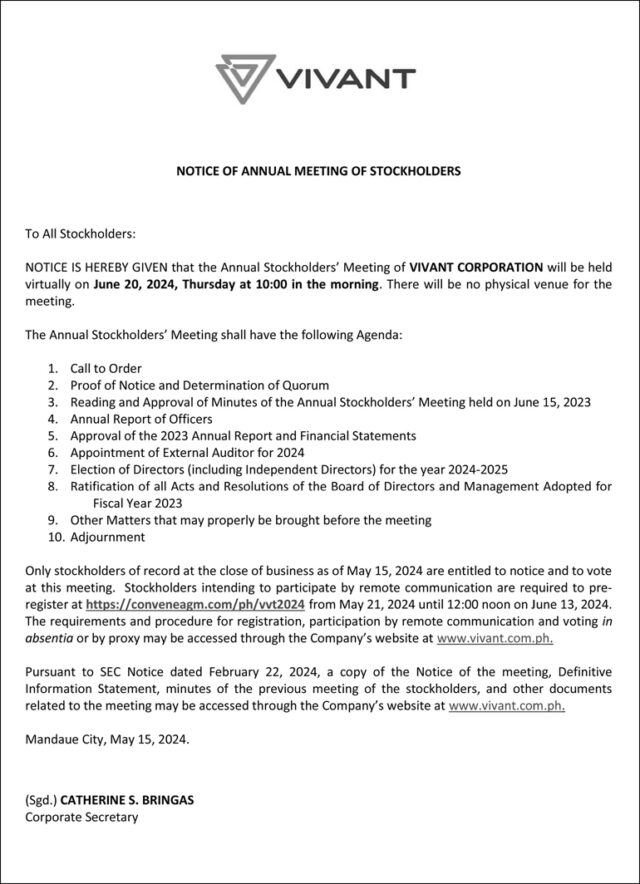

Vivant Corp. announces virtual Annual Stockholders’ Meeting on June 20


Spotlight is BusinessWorld’s sponsored section that allows advertisers to amplify their brand and connect with BusinessWorld’s audience by publishing their stories on the BusinessWorld Web site. For more information, send an email to online@bworldonline.com.

Join us on Viber at https://bit.ly/3hv6bLA to get more updates and subscribe to BusinessWorld’s titles and get exclusive content through www.bworld-x.com.

Federal Reserve policy makers still cautious on inflation, policy

REUTERS

US FEDERAL RESERVE officials are not ready to say inflation is heading to the central bank’s 2% target after data last week showed a welcome easing in consumer price pressures in April, with several on Monday calling for continued policy caution.

“It is too early to tell whether the recent slowdown in the disinflationary process will be long lasting,” Fed Vice Chair Philip Jefferson told the Mortgage Bankers Association conference in New York, even as he called the April data “encouraging.”

Mr. Jefferson described current monetary policy as restrictive and declined to say if he expected rate cuts to commence this year, only noting that he will be carefully assessing incoming economic data, the outlook, and balance of risks.

Speaking separately at a conference held by the Atlanta Fed, Fed Vice Chair of Supervision Michael Barr, said “disappointing” first-quarter inflation readings were “did not provide me with the increased confidence that I was hoping to find to support easing monetary policy.”

Like Mr. Jefferson, Mr. Barr reinforced the Fed’s overarching message that rate cuts, highly anticipated by markets, are on hold until it is clear inflation will return to the Fed’s 2% target.

“We will need to allow our restrictive policy some further time to continue its work,” Barr said.

Consumer prices cooled in April, and retail spending did not increase at all, two welcome signs that the economy may be losing some steam in the face of a policy rate that the Fed has held in the 5.25%-5.5% range since last July.

But Fed policy makers, stung by a string of higher-than-expected inflation readings for the three months prior, remain cautious and want to make sure pricing pressures are fully on track back to the Fed’s 2% target rate before starting to cut its benchmark interest rate.

Cleveland Federal Reserve Bank President Loretta Mester, speaking to Bloomberg TV on Monday, said she continues to believe that inflation will fall this year, though more slowly than she had expected.

But the lack of progress on inflation in the first quarter, along with a stronger-than-expected economy, mean she no longer sees three rate cuts this year as likely, she said.

And, she said, if inflation against her expectation does stall out or gain ground, the Fed is well-positioned to respond “either by holding rates at current levels for longer or, if appropriate, raising the rate.”

San Francisco Fed President Mary Daly, in an interview with Axios published Monday, said she sees no evidence of the need to hike rates, but at the same time is “not confident” that inflation is falling toward 2% and sees no urgency to cut rates.

The Fed’s next policy meeting is June 11-12. Traders in contracts tied to the central bank’s policy rate currently do not expect an interest rate cut until September.

In comments after his formal remarks, Mr. Jefferson said, “I am cautiously optimistic that we can continue our battle against inflation” while permitting the economy to continue to grow and create more jobs. He noted growth and job creation have been resilient, which gives him some confidence the Fed can do what it needs to do to get price pressures down.

Mr. Jefferson also weighed in the state of the Fed’s balance sheet drawdown and noted the recently announced plans to slow the pace of the shrinkage comes allows the process to play out with reduced risk of creating financial market stress. He also noted there’s little way to know yet how far the Fed needs to contract its holdings. — Reuters

Meralco energizes P450-M Batangas substation

MANILA Electric Co. (Meralco) said it has energized a P450-million new substation in Batangas City.

“The newly energized Pallocan West substation will not only cater to the existing energy demand of Batangas City but is also designed to support the future power requirements of the emerging economic hub,” Meralco Executive Vice-President and Chief Operating Officer Ronnie L. Aperocho said in a statement on Tuesday.

The power distributor said that the new 69 kilovolt (kV)-13.8 kV gas-insulated switchgear substation comes with an installation of a 50-megavolt-ampere power transformer.

It also has two new 13.8 kV distribution feeders and a new 69 kV line source.

The new substation is expected to provide power to key government establishments in the province such as the Office of the Vice Governor, the Batangas Provincial Disaster Risk, Evaluation, Alleviation, and Mitigation Zone, the Bureau of Internal Revenue District Office – Batangas City, and the Batangas City Hall of Justice.

It will also cover the energy requirements of business establishments including SM City Batangas, Wilcon Depot Batangas, United Doctors of St. Camillus de Lellis Hospital and Medical Center, Jesus of Nazareth Hospital Batangas, Days Hotel by Wyndham Batangas, and Pontefino Hotel and Residences.

“Moving forward, Meralco will continue investing heavily on projects that will not just improve the electricity distribution system, but also contribute to ensuring that the infrastructure support for the government’s nation-building efforts,” Mr. Aperocho said.

Earlier this month, Meralco said it had switched on the P170.81-million Malinta Substation in Valenzuela City.

Meralco’s controlling stakeholder, Beacon Electric Asset Holdings, Inc., is partly owned by PLDT Inc.

Hastings Holdings, Inc., a unit of PLDT Beneficial Trust Fund subsidiary MediaQuest Holdings, Inc., has an interest in BusinessWorld through the Philippine Star Group, which it controls. — Sheldeen Joy Talavera

At Cannes, Russian director condemns detentions over play

CANNES, France — Russian director Kirill Serebrennikov used his appearance at the Cannes Film Festival on Monday to launch a protest against the detention and trial of a playwright and a theater director in Moscow.

Mr. Serebrennikov — who premiered his film Limonov: The Ballad at the movie extravaganza — held up a picture of Russian director Zhenya Berkovich and playwright Svetlana Petriychuk at a news conference in the French Riviera resort town.

“Today the trial started of these amazing young women,” he said. “They didn’t do anything wrong, they just staged a play that won a national theater award. And for a year now they have been jailed.”

Both have been held on charges of “justifying terrorism” through the play Finist, the Brave Falcon — written by Ms. Petriychuk and premiered in 2020 under Berkovich’s direction — which is about Russian women who married Islamic State fighters.

The trial started on Monday, Russian media reported.

OPPOSING TERRORISM
Ms. Berkovich and Ms. Petriychuk told a court on Monday they were not guilty of charges of justifying terrorism on the first day of their trial over the staging of an award-winning play, Mediazona reported.

The case has become a focus for fellow artists, human rights defenders and free speech campaigners, with an open letter in their support garnering more than 16,000 signatures.

The two women told a Moscow military court they had set out to advocate against terrorism, not to support it, according to a transcript of the hearing published by independent outlet Mediazona, which reports on Russian trials.

“I staged the performance to prevent terrorism,” Ms. Berkovich, 39, told the court, Mediazona reported. Towards terrorists, she said, “I have nothing but condemnation and disgust.”

Ms. Petriychuk, 44, echoed Ms. Berkovich and denied any guilt.

“It is unlikely that Islamic radicals would use modern theater to promote their ideas, because they sort of forbid these types of art,” she said, according to the report.

The women were added to Russia’s official list of “terrorists and extremists” in April, joining thousands of people and entities who have been similarly designated in a crackdown on perceived subversive activity that intensified after Russia launched its invasion of Ukraine in 2022.

The Kremlin does not comment on individual cases but says Russia is engaged in an existential struggle with the West and needs to robustly uphold its laws and defend itself.

The offense of providing justification for terrorism can lead to up to seven years in prison.

More people have been prosecuted in Russia in the past six years than in the almost 30 years under the rule of Soviet leaders Nikita Khrushchev and Leonid Brezhnev, according to data analyzed by independent outlet Proekt.

LIMONOV: THE BALLAD
Mr. Serebrennikov’s film, which stars Ben Whishaw in the title role, premiered at Cannes on Sunday.

It follows Limonov from the 1960s in his hometown of Kharkiv to Moscow, New York, Paris, and finally to post-Soviet Russia, where he co-founded a left-wing and ultra-nationalist political party in the early 1990s.

Limonov: The Ballad — based on a book by French author Emmanuel Carrere — shows the main character’s journey from poet to aspiring political leader, with a postscript saying he supported Russia’s 2014 annexation of Crimea before his death in 2020.

The Cannes festival has banned official Russian delegations from attending since 2022, but Mr. Serebrennikov, who has spoken out against the invasion of Ukraine, also attended that year with his film Tchaikovsky’s Wife. — Reuters

Skills development in the IT-BPM sector: New technologies

(Part 4)

Beyond the term of the present Administration, which will end in June 2028, we must make sure that there will be a sufficient supply of university graduates with knowledge and skills in Reading, Mathematics, and Science at a globally competitive level. Five to 10 years from now, much of what was forecast in the 2022 Roadmap of the information technology and business process management (IT-BPM) industry shall have come to fruition. Technology developments will transform industries, enabling them to become more digitized, more connected and smarter businesses. For example, the healthcare sector, which was the most impacted by the COVID-19 pandemic, is rapidly expanding its focus from post-incident care to more preventive care, thanks to technologies such as wearable sensors, data analytics, and cloud-enabled monitoring. There are new technologies related to energy harvesting, cogeneration, smart grids and smart meters which are redefining the energy industry.

The industry-led industry transformations present both direct and indirect impacts on the IT-BPM sector. For example, driverless cars require large amounts of computing and analytical power at the back end to ensure incident-free operations. Advances in drone technology applications in retail supply chains could result in greater decentralization of e-commerce, delivery management, and analytics, providing greater avenues for outsourcing. Robotics, automation, and cloud computing, among other technologies, are seen to have a direct impact on the IT-BPM sector. In the financial services industry, emerging blockchain technology is expected to become a key differentiator among service providers in the near future.

Among the many technological advances that are already very visible even in a less developed economy like the Philippines, there are four digital trends that stand out:

• Big Data and Analytics (BDA). This refers to a data discovery process using techniques and tools, i.e., mining useful information or insights from huge sets of data (both structured and unstructured) enabled through exponential increases in both computing power and storage capacity.

• Internet-of-Things (IoT): This refers to everyday devices connected to the internet through sensors and computing power to monitor and manage actions, offering greater influence over their environment.

• Automation and Artificial Intelligence: Combining technologies such as Robotics Process Automation (RPA), Artificial Intelligence, and machine learning.

• Cloud computing: Delivering IT services hosted over the internet to transform computer resources into a utility.

As a guide to parents and their senior high school children in choosing their future careers, in addition to the usual choices like engineering, business administration, accounting, medicine, law, education, political science, etc., let me describe briefly these new fields that they can consider. Increasingly, they will see these new specializations listed in the course offerings of some of the leading universities. I hope there will be enough senior high school graduates daring enough to take these non-traditional specializations (I am elated to know that some of my grand-nephews and -nieces have already chosen these careers).

The first is Big Data and Analytics (BDA) which refers to a data discovery process using techniques and tools to mine useful information or insights from voluminous sets of data. The primary goal of BDA is to assist organizations to use data more efficiently to make informed decisions in real time. The process facilitates access to traditionally siloed data sources and uncovers previously inaccessible information. Analytics capabilities uncover patterns and detect anomalies across multiple data streams. This process is done with the use of software algorithms, computer programming and statistical modeling techniques to find valuable and timely correlations, resulting in actionable insights that drive business decisions.

As regards IoT, it is considered a technological revolution which is adding a new dimension to the world’s information and communication technology by embedding short-range mobile transceivers into gadgets. The expanding capabilities of these devices leads to a virtuous cycle of value improvement, making them smart connected devices, or SCD. Convergence of objects and enterprise assets with computing technologies through IoT is helping to bridge the gap between the physical environment and the digital world. IoT has already introduced significant transformation across industries. For example, manufacturing is already one of the top adopters of IoT technologies. Leveraging the power of advanced sensor-embedded connected devices and superfast wireless communication networks, applications such as remote monitoring and control of complex manufacturing processes and assets are already gaining rapid adoption. IoT is also anticipated to obtain significant acceptance in the public sector (smart cities) and in the healthcare (health and wellness) sector.

Then there is intelligent automation which combines technologies such as robotics process automation, artificial intelligence, and machine learning. This technology is transforming the fundamental way of doing business in almost every sector all over the world. The following are the various technologies that fall under this category:

Robotics Process Automation: refers to business process automation using software robots that can automate rule-based and repetitive tasks, basically clerical in nature. Largely used for high volume, high transactional applications across industries.

Machine Learning: automation enabled through self-learning by building software algorithms instead of programmed instructions. It is about unsupervised learning and making machines “intelligent,” providing the basis for “Artificial Intelligence.”

Artificial Intelligence: the ability of computer systems to perform tasks that would ordinarily require human intelligence, for example, decision making and virtual perception. Chat-GPT, for example, is now an example of a widely used form of Artificial Intelligence. Developments in the field of AI have dramatically expanded recently and will continue unabated.

Finally, there is Cloud Computing. The delivery of IT services hosted over the internet is commonly called cloud computing. It consumes computing resources as a utility, rather than building and maintaining infrastructures on premises. The key advantage is that computer resources are measured at a granular level, allowing users to pay for only the resources and workloads they use. The cloud, i.e., as-a-service model, is evolving into an everything-as-a-service approach. This basically refers to everything being sold and consumed as a service. Users may own an IT product, but only pay for the services rendered, bringing immense cost savings and maximizing efficiencies among various other benefits derived.

There are other key technologies which should be watched closely for their impact on implications for the IT-BPM sector. Among these are blockchain technology and augmented reality (AR). The first refers to the maintenance of a continuously growing list of records (called “blocks”) which are secure from tampering and revision by providing a timestamp and a link to a previous block. It was initially developed for bitcoin transactions as a solution to the problem of making a database both secure and not requiring a trusted administrator. So-called “smart contracts” that create invoices that pay themselves when a shipment arrives is one example of the use of blockchain technologies. This technology is likely to find wide application to support financial transactions across various industries. The second (AR) is the real-time super imposition of digital elements on the original environment. These digital elements could be computer generated sensory input such as imagery, sound, and video of GPS data. The surroundings of the user of AR become interactive, where the user can even amend the digital elements. The main objective of AR is to provide the best user experience by enhancing their sensory perception of the environment.

The very brief descriptions of these new technologies that will impact significantly on the IT-BPM industry clearly demonstrate that the skills needed by those who will apply them would require normally the education and training required of college or even masteral degree holders. Industry and Government must work closely with institutes of higher learning such as colleges and universities in developing the appropriate curricula to turn out professionals in these more demanding fields of knowledge.

Except for a few excellent state universities and colleges (SUCs), it is desirable that the task of educating these professionals should be primarily assigned to the private sector. The Government should spend most of its limited budget for education to significantly improve the public schools at the basic education level (the K to 12) which account for 90% of enrollment in our elementary and secondary schools. It is the primary responsibility of the Government to address the serious crisis of learning poverty of our youth, as shown by the very low scores of Filipino students taking international achievement tests in reading, mathematics, and science. This crisis is predominantly a public education problem since products of the private schools at the basic education level have scores in these international achievement tests that are globally competitive.

(To be continued.)


Bernardo M. Villegas has a Ph.D. in Economics from Harvard, is professor emeritus at the University of Asia and the Pacific, and a visiting professor at the IESE Business School in Barcelona, Spain. He was a member of the 1986 Constitutional Commission.

bernardo.villegas@uap.asia

Thailand’s new finance minister has chance to improve strained ties with central bank over rates

BENGALURU — Thailand’s new finance minister has refrained from pressuring the central bank and has a chance to improve relations amid a longstanding disagreement on interest rates, former finance minister Thirachai Phuvanatnaranubala said on Tuesday.

Speaking in the Reuters Global Markets Forum, Thirachai said Prime Minister Srettha Thavisin’s repeated public push for a rate cut had created unnecessary strain and new Finance Minister Pichai Chunhavajira was in a position to smooth things over.

“The new finance minister must try to find a way to convince the Bank of Thailand (BoT) there is a need for a more relaxed monetary policy,” Thirachai, who is also former central bank deputy governor, told the Reuters forum.

For months, Mr. Srettha has been at odds with the central bank, which has refused to bow to his pressure to cut rates, currently at a more than decade-high of 2.5%. The next rate review is on June 12.

Srettha and his ruling Pheu Thai Party maintain the current monetary policy stance is hurting an economy he says is in crisis. Srettha, a real estate mogul and political newcomer, has repeatedly said he respects the central bank’s independence.

Pheu Thai and previous incarnations also founded by influential former premier Thaksin Shinawatra have dominated politics for the past two decades and have clashed previously with the BoT on rates.

Billionaire Mr. Thaksin has officially retired but remains a towering figure in Thai politics, with sway over the current government.

His politician daughter and Pheu Thai leader Paetongtarn Shinawatra recently caused a stir, calling the BoT’s independence an “obstacle” in resolving economic problems.

STRONG POSITION
Mr. Thirachai was at the BoT the last time a Thai central bank governor was sacked in 2001, by Thaksin, a move he said would be difficult to repeat now.

“The position of the governor is fairly strong because Thailand has a tradition of giving weight and protection to the Bank of Thailand,” he said.

“We had amended the law to make it difficult for the government, for any government, to remove the central bank governor, unless there is a real, apparent, necessary cause.”

New Finance Minister Mr. Pichai Chunhavajira has recently said he is more worried about people’s access to finance than the level of interest rates. On Tuesday, he reiterated the government’s position that economic stimulus was needed.

Mr. Thirachai said he believed the current interest rate of 2.5% was perhaps a little high and in his opinion, monetary policy should be more relaxed.

He said there should be no concern over weakness of the baht currency if there were to be a rate cut.

The BoT has said a rate cut could give the economy a short-term boost, but that benefit would be outweighed by potential long-term negative impacts it might create on the economy, which needed to be restructured. — Reuters

COVID-19 shut down businesses but also spurred entrepreneurship

FREEPIK

THE coronavirus pandemic shuttered a number of businesses amid lockdowns, but it also harnessed the entrepreneurial spirit of Filipinos.

“The biggest trend is that more people are getting into business, which is good,” Kendrick C. Co, head of strategic partnerships at nonbank financing company Esquire, said at a recent small business forum.

“A lot of people got into that mindset of seeing a need and then thinking ‘Oh, maybe I can fulfill that need,’” he said. “That’s the root of entrepreneurship.”

Another factor was the work-from-home setup that made erstwhile corporate workers reluctant to return to the office, Mr. Co said.

“Webinars and online events are another trend that became popular, so people got into that rabbit hole of learning about entrepreneurship,” he separately told BusinessWorld.

Entrepreneurship is “one of those things that’s hard to shut off” once you get a taste of it, he said. “You’ll want to keep on trying.” 

Esquire offers noncollateral loans to small and medium enterprises.

Small businesses account for 99.59% of companies in the Philippines, according to data from the local statistics agency.

With the interest in entrepreneurship growing, “the aim is to make small businesses graduate from one level to the next,” said Trixie Esguerra-Abrenilla, managing director at the Philippine SME (PHILSME), which organized the business expo earlier this month.

“The expo’s overall objective is to help them come together, collaborate with each other, and have them showcase their business solutions,” she added. 

Ms. Abrenilla said these activities for SMEs go beyond the expo through the Philippine Business Network, a monthly gathering of business owners where they get updated on offers from different companies, as well as interact with other service providers. 

“With PHILSME, we will continue to support these businesses. We will continue to give valuable resources and opportunities to them,” she told a news briefing on the sidelines of the expo. — PBM

SEC files complaints vs. four entities

SEC.GOV.PH

THE Securities and Exchange Commission (SEC) has filed criminal complaints with the Justice department against four entities for allegedly soliciting investments without licenses.

The commission lodged complaints against Bear Mountain World, Inc., Beyond Skin Care Ventures, Inc., SCET Colleens Corp., and Great 4 International Marketing Corp. for allegedly violating several provisions of Republic Act No. 8799 or The Securities Regulation Code (SRC), the SEC said in a statement on Tuesday.

 The complaints also implicated the incorporators and officers of the entities in question.

 Under the SRC, it is prohibited to sell or distribute securities without a registration duly filed and approved by the SEC. Those deemed guilty will face a fine of up to P5 million, or imprisonment of up to 21 years, or both.

 “All four corporations have previously been registered with the SEC as corporations. However, none of them have secured the necessary secondary license that would allow them to offer securities to the public,” the SEC said.

 The SEC said that Bear Mountain allegedly offers investments with a promised monthly income of 20%-30% of the amount invested in three years.

 Beyond Skin Care Ventures, which operates under the name Dermacare Face Body and Laser Center, reportedly entices the public to invest in its franchise partnership agreement for a promise of receiving a guaranteed return of 12.6% interest every quarter for a period of five years, with complimentary salon services.

 Great 4 International Marketing, operating under the business name and style Home Organic Wellness, allegedly offers a guaranteed monthly income of 14.4% of the amount invested in 18 months.

 SCET Colleens reportedly offers investments ranging from P3,800 to P1.08 million, with a return on investment supposedly from 5% to 8% per month.

 “The SEC-Enforcement and Investor Protection department has already revoked the corporate registrations of SCET Colleens and Beyond Skin Care Ventures on Feb. 23, 2023 and Nov. 7, 2023, respectively,” the SEC said. — Revin Mikhael D. Ochave

Election year Trump biopic The Apprentice premieres at Cannes

JEREMY STRONG and Sebastian Stan in a scene from The Apprentice. — IMDB

CANNES, France The Apprentice, Iran-born director Ali Abbasi’s much-anticipated drama of a young Donald Trump’s ascendancy as a New York real estate mogul, premiered at the Cannes Film Festival on Monday.

Part of the pull of the film is its timing, as Mr. Trump, now 77, looks to win another term as US president in November.

The film shares its title with the reality show that helped turn Mr. Trump into a household name.

Sebastian Stan, who made his name in the Captain America trilogy as the Winter Soldier, morphs into Mr. Trump, from his early stages as an upstart working for his father’s business to a brazen, self-centered tycoon.

The story focuses on Mr. Trump’s time under the tutelage of Roy Cohn, a political fixer best known for his involvement in Senator Joseph McCarthy’s anti-communist scare campaigns of the 1950s and portrayed by Succession’s Jeremy Strong.

His three rules for success, which Mr. Trump later takes credit for while speaking with the writer of his business advice book The Art of the Deal, are prescient of his traits in office: deny everything, always be on the attack, and never admit defeat.

Mr. Abbasi is known for his eclectic film repertoire, including 2022’s Cannes entry Holy Spider about the killings of sex workers in Iran and Border, a fantasy love story in Sweden.

Critics were mixed, praising Mr. Stan and Mr. Strong while seeing the film’s basis in actual events as a limitation.

‘Sebastian Stan Plays Donald Trump in a Docudrama That Nails Everything About Him but His Mystery,” read the headline for entertainment website Variety, while trade publication IndieWire pointed out that the film “can’t get around the fact that Trump is too base and pathological to be of much dramatic interest.” — Reuters

The power of investing in infrastructure and sustainability

ACCIONA

The Indo-Pacific region is fast gaining the focus and attention of the international community. Over the next 30 years, it is seen to become the greatest contributor to world economic growth.

The Philippines is located strategically at the heart of this rising center of global economic activity. Thus, there are great impetus for the Philippines to develop its infrastructure and boost its economy, so that it can be competitive and fully partake of the growth potential of the region.

We must begin positioning ourselves to become a significant economic player in this dynamic region. And while there are multiple and multifaceted risks — for example, asymmetric security challenges and rising inflation — we must instead focus on the multiple opportunities that would redound to the benefit of the Filipino people.

The ASEAN+3 Macroeconomic Research Office sees the Philippines as one of the fastest-growing economies in Southeast Asia, with a projected 6% (or over) of growth in 2024 and 2025. These projections are based on the nature of the Philippine economy: a consumption-driven one, boosted by a thriving consumer services sector, and partly powered by remittances from overseas Filipino workers who religiously send money back home to their families. In fact, for the first quarter of 2024, the service sector largely contributed to the national gross domestic product, with a 6.9% share.

But as we have seen too often, and especially during the pandemic-driven lockdowns that halted economic activity and dealt a heavy blow to the economy, consumption alone makes a society vulnerable to external shocks and supply disruptions.

Investments, on the other hand, are a different story.

Investments, especially in infrastructure, have a multiplier effect because they occasion the building of workplaces, creation of quality and long-term and green jobs, provision of job security, and income generation, among others. They bring economic activity to the community, elevate the skill level of their employees, and transfer technology we may not otherwise have access to. Investments will also make us resilient against global uncertainties. By applying this strategic approach, enhancing productivity, promoting innovation, and economic security for the nation will be achieved.

The challenge now is how to shift from consumption to investments, or at least increase the share of investments relative to consumption. Attracting investments has always been mentioned from administration to administration, and yet progress in this aspect has been slow relative to other regional economies.

To be sure, the current administration has been relentless in its efforts to attract investments, recognizing their potential as catalysts of economic growth. Of special significance is the renewable energy sector given the increasing energy demand and the need to source it from clean methods in a bid to help address climate change. The Philippine government is promoting the development of renewables to reduce its dependence on imported fossil fuels and has set targets to increase the share of renewable energy in the energy mix to 35% by 2030 and 50% by 2040.

One such foreign investor comes from Spain, with its chairman and CEO visiting the Philippines this month and meeting government leaders. The company, Acciona, is a global leader in sustainable energy. The acquisition of the stake in Freya Renewables by Acciona Energía brings an additional portfolio of 880 MW under development.

Its chairman and CEO, Jose Manuel Entrecanales, met with Special Assistant to the President for Investment and Economic Affairs Secretary Frederic Go and Cebu Governor Gwendolyn Garcia, among others, and confirmed that Acciona Energía will soon construct, operate, and maintain a 150-MW solar power plant in Daanbantayan. This will be the country’s first public-private partnership (PPP) in solar power generation.

They also announced the development of another 156-MW wind farm in the municipality of Pantabangan, located 150 kilometers north of Manila. Additionally, it has commenced construction of the 100-MW Kalayaan 2 wind farm in Laguna Province.

Acciona is not new to the Philippines. Transportation is also a key area of its activity, with the 8.5-kilometer Cebu-Cordova bridge, lines 02 and 04 of the Malolos-Clark Railway project, the Airport Railway Express Service linking Makati to Clark, and the South Commuter Railway Project 02 from Clark Airport to Calamba. Water infrastructure is another area, with the Laguna Lake DWTP, and the East Bay Water Treatment Plant. Finally, Acciona is also helping impoverished and remote areas of Palawan gain access to electricity through solar home units.

There are more companies like Acciona who have the financial and technical muscle to undertake such investments that may be given the opportunity to bring their business here for our mutual gain and benefit.

Addressing the country’s infrastructure gaps by opening up and even incentivizing the entry of quality and long-term investments through PPP engagements is the right strategy that would optimize the potential of the country’s human and natural assets with infrastructure networks that will empower all sectors of society to participate and thrive in a prosperous and sustainable economic system.


Victor Andres “Dindo” C. Manhit is the president of the Stratbase ADR Institute.

Filipinos worry about falling for financial scams — study

PHILIPPINE STAR/EDD GUMBAN

FILIPINOS are most concerned about falling for financial scams amid the surge in real-time payments (RTP), according to a survey by global analytics software firm FICO released on Tuesday.

Around 35% of Filipino respondents in FICO’s survey said their top worry is the risk of being tricked into sending money to criminals, which leads to instant, irrevocable losses that are rarely eligible for reimbursement.

FICO surveyed 1,001 adults in November 2023.

“The Philippines’ adoption of real-time payments continues to accelerate, with 98% of adults having sent a real-time payment and 65% expecting to increase their use over the next year,” Chee Keong Leo, FICO lead for fraud, security, and financial crime in Asia-Pacific, said in a statement.

Mr. Leo added that as the adoption of RTP surges, driven by payment platforms like Maya, GCash, and GrabPay, there has been a “transformative shift in financial behavior” among Filipinos.

“Yet, amidst this rapid digitization comes an urgent need for heightened vigilance against fraudsters lurking in the digital realm,” he added.

FICO cited a 2023 study on trends in authorized push payment (APP) fraud and real-time payments in the Philippines, which reported that 82% of Filipinos have received unsolicited text messages, e-mails, phone calls, or other communication that they believed to be part of a scam, while 61% surveyed said that their friends or relatives had been affected. However, only 26% reported actual or suspected losses to their banks.

In a separate report, FICO said that 25% of respondents experienced sending real-time payments for investments, goods, or services they never received.

About 74% of those who fell for scams using RTP lost up to P25,000, while 1% saw losses of P300,000.

“Banks now face a crucial moment to invest in cutting-edge solutions to tackle the surge in scams, particularly with the swift uptake of real-time payments in the Asia-Pacific financial landscape,” Mr. Leo said.

“The irrevocable nature of these transactions has led to new criminal threats. By integrating scam-specific analysis and scoring into transactions, along with robust decision-making capabilities across the customer journey, banks can preemptively detect and thwart scam payments, sparing customers from financial harm. Furthermore, while some consumers may ignore warnings, the majority will heed alerts and refrain from making real-time payments if alerted to potential scams,” he added.

Meanwhile, concerns about identity theft also persist among Filipino respondents, with over 23% citing it as their top financial crime concern, FICO added. This was followed by having a bank account taken over by a fraudster (16%), their credit or debit card being stolen and used (13%), their cash being stolen (8%), and fake online retailers and fake advertisement tricking them into buying goods that never arrive (6%).

FICO, however, noted the difference between perception and reality among Filipinos in terms of instances of identity fraud, with about 33% believing they are unlikely to have been a victim, while 19% see it possible and 27% confident their identity is untouched.

“Moreover, only 5% of Filipino respondents reported their stolen identity being used to open a financial account, a slight increase from 4.5% in 2022,” it said.

“While some may downplay the risk of identity theft in the Philippines, millions remain vulnerable,” Mr. Leo said. “This underscores the need for heightened awareness and proactive measures. By breaking down silos and integrating identity verification and fraud detection processes, we can streamline applications and bolster trust in legitimate customers.”

Meanwhile, Filipino respondents said their most important considerations when opening financial accounts are good fraud protection and ease of use, FICO said.

“These were both considered significantly more important than good customer service, strong anti-money laundering policies, sound green/environmental policies, ethical use of customer data, behaving fairly, and good value for money,” it added. — A.R.A. Inosante

ADVERTISEMENT
ADVERTISEMENT