Home Blog Page 306

Philippines falls in labor resilience index

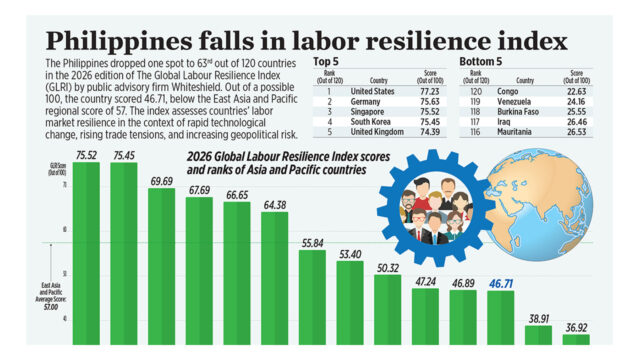
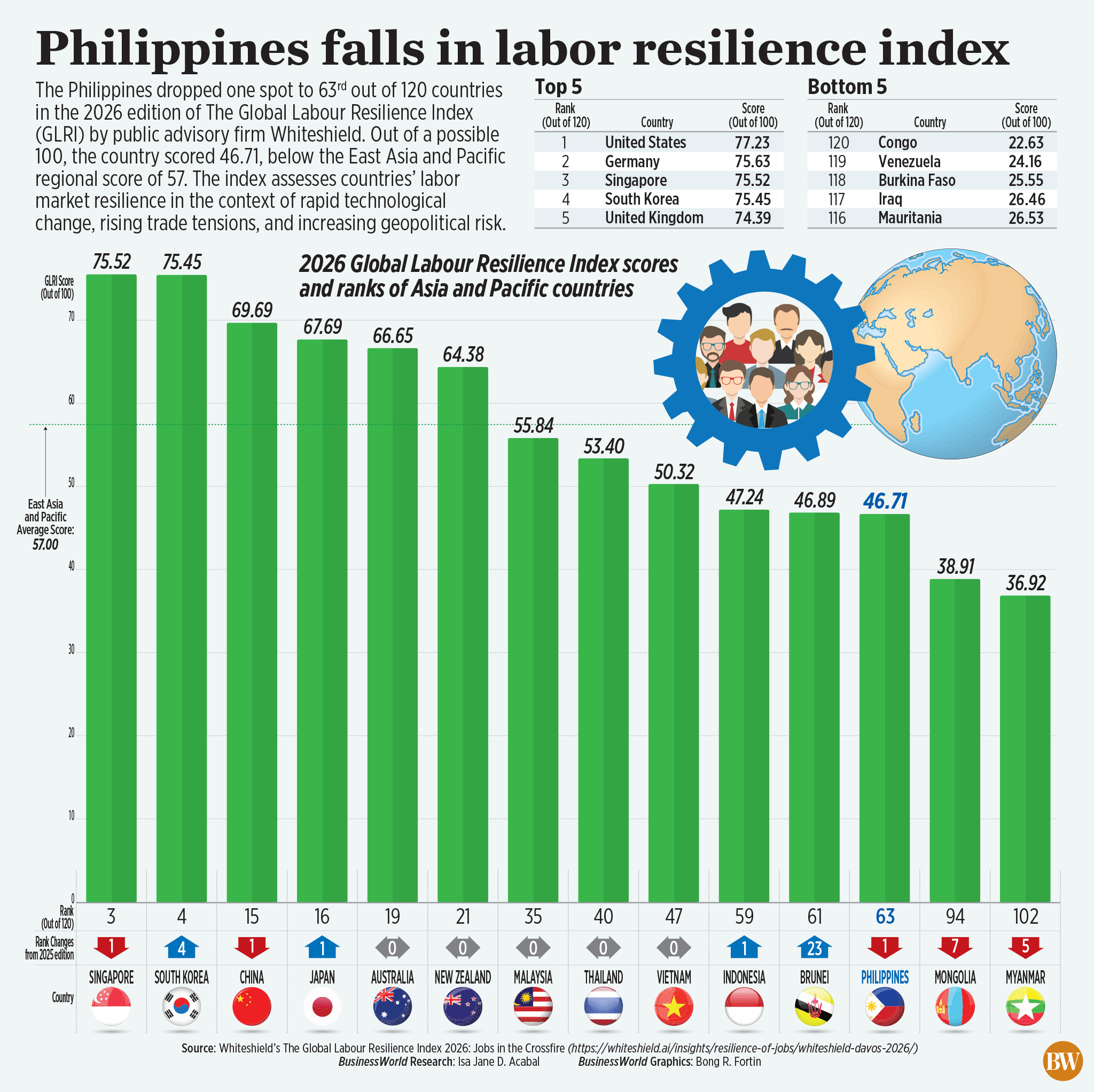
The Philippines dropped one spot to 63rd out of 120 countries in the 2026 edition of The Global Labour Resilience Index (GLRI) by public advisory firm Whiteshield. Out of a possible 100, the country scored 46.71, below the East Asia and Pacific regional score of 57. The index assesses countries’ labor market resilience in the context of rapid technological change, rising trade tensions, and increasing geopolitical risk.

PAGCOR projecting flat GGR on caution over stagnant tourism

PAGCOR

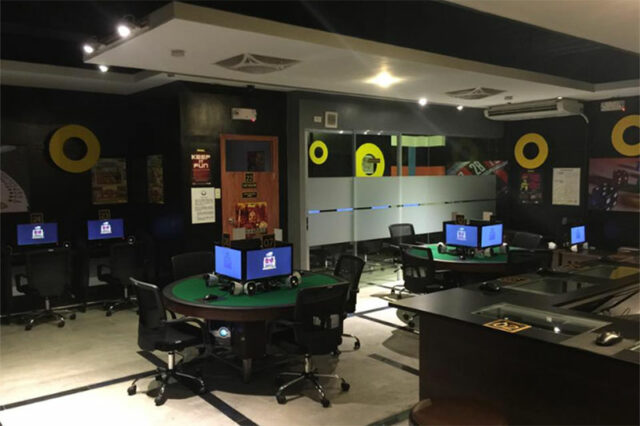
GROSS GAMING REVENUE (GGR) is expected to be flat this year on caution over tourist arrivals, the Philippine Amusement and Gaming Corp. (PAGCOR) said.

“GGR will be flat primarily because as of now, we’re still looking at the effects of the (declining) number of tourist arrivals,” PAGCOR Chairman and Chief Executive Officer Alejandro H. Tengco told BusinessWorld on the sidelines of a Senate hearing on Wednesday.

Gambling operations generated about P400 billion in 2025, Mr. Tengco said, compared with the P372.33 billion collected by PAGCOR a year earlier. He did not provide a breakdown.

He added that any upside on the tourism front will come from visa-free status granted to visitors from China and India.

“We’re getting a feel for things because who knows, with the visa-free (entry) for Indians and Chinese now, we might see an influx of tourists again,” he said.

Tourist arrivals totaled 6.48 million last year, up 0.76% according to the Department of Tourism.

He added that online gaming income is also expected to hold steady as regulators assess the impact of the central bank’s order requiring e-wallet providers to remove in-app links to gambling sites.

“With regard to online, I also want to be conservative and say it’s also flat. Primarily because we have not yet seen the long-term effect of de-linking,” Mr. Tengco said.

During a Senate hearing on online gambling, Senator Sherwin T. Gatchalian, citing PAGCOR data, said registered online gambling users quadrupled to 32.12 million from their 2024 levels.

Mr. Gatchalian noted that the number was concerning as “because more than half of our adult population is gambling.”

Mr. Tengco clarified that the actual number of active players logged in 2025 was 10 million, noting that a crackdown on illegal online gaming operations is continuing.

“There have been feelers from illegals wanting to become legal, if they come legal obviously our revenue will grow,” he added.

He said that PAGCOR is preparing a position paper to propose reversing the central bank’s de-linking order.

“We’re actually putting it together. By March we will be able to come up with a recommendation to the Banko Sentral about the possibility of maybe looking or studying (a reversal),” he added. 

The Bangko Sentral ng Pilipinas last year ordered all electronic wallets (e-wallets), banks and other supervised institutions to remove in-app links to online gambling websites, following calls to either regulate or ban the industry outright.

“When everything settles and the industry is more mature, then we can also consider payment channels that are properly regulated and monitored,” Mr. Tengco said.

Asked to comment, Filomeno S. Sta. Ana III, coordinator of Action for Economic Reforms, said the industry should be taxed higher to discourage gambling.

“We should not be relying on gaming revenue. The main purpose of taxing gambling is not to earn revenue, which would suggest that we are encouraging gambling,” he said via Viber.

President Ferdinand R. Marcos, Jr. has identified laws on online gambling as priority measures, following a Legislative-Executive Development Advisory Council meeting. — Adrian H. Halili

Philippines pushes calm diplomacy as sea dispute with China deepens

FILE PHOTO of a China Coast Guard vessel fires a water cannon at the BRP Datu Pagbuaya near Thitu Island, in the latest flare-up between Manila and Beijing in the disputed South China Sea. — PCG

By Adrian H. Halili, Reporter and Erika Mae P. Sinaking

THE Department of Foreign Affairs (DFA) on Wednesday urged the Chinese Embassy in Manila to respond calmly and professionally to statements made by Philippine officials, as a war of words between the two sides continues over tensions in the South China Sea.

DFA Maritime Affairs spokesman Rogelio E. Villanueva, Jr. said the embassy should remain mindful of diplomatic norms and mutual respect in its public statements.

“We urge the Chinese Embassy to be constructive in its statements towards a healthy dialogue despite major differences, with a view to advance the overall bilateral relationship,” he said in a statement.

He added that diplomatic engagement should remain grounded in professionalism, particularly amid disagreements on sensitive issues.

The DFA values candid and vigorous debate with foreign counterparts on important issues, consistent with the Philippines’ democratic tradition, he added.

The Chinese Embassy did not immediately reply to a Viber message seeking comment.

The DFA statement follows an escalating verbal exchange between Philippine and Chinese officials over their opposing positions on the South China Sea, with each side accusing the other of fueling tensions in the disputed waters.

The row has also spilled into the Philippine Senate, where lawmakers denounced Beijing for dismissing a Senate resolution that criticized statements made by Chinese Embassy officials against Philippine officials and uniformed personnel.

Last week, the Senate adopted Senate Resolution No. 256, which condemned what it described as “undiplomatic” remarks by Chinese Embassy personnel following weeks of heated debate.

Senator Francis Pancratius N. Pangilinan, who authored the resolution, called on the DFA to take appropriate diplomatic action to protect the country’s dignity.

The DFA must take necessary measures to ensure that relations with other states are conducted in accordance with international law and established principles of state relations, Mr. Pangilinan said in a statement.

He said the Chinese Embassy’s response to an official act of the Philippine Senate was “undiplomatic and boorish,” arguing that it ran counter to the Vienna Convention on Diplomatic Relations.

For her part, Senator Ana Theresia Hontiveros-Baraquel said Senate resolutions are legitimate tools for lawmakers to express concern over actions affecting Philippine laws, sovereignty and national interests.

“We can file 100 resolutions, and the situation won’t improve because the real problem facing the Philippines isn’t the Chinese Embassy descending to the level of the common internet troll,” she said in a statement.

“The real problem is the People’s Liberation Army Navy, Chinese Coast Guard and maritime militia’s coercive behavior in the West Philippine Sea,” she added.

Ms. Hontiveros added that despite tensions, the Philippines remains open to cooperation, exchanges and the peaceful settlement of disputes with China.

Separately, the DFA also criticized Beijing’s decision to bar officials from Kalayaan Municipality from entering Chinese territory, including Hong Kong and Macau, saying the move undermines bilateral relations.

“While preventing the entry of foreign nationals into their territory is a country’s sovereign prerogative, such actions do not contribute to fostering good and vibrant bilateral relations,” the agency said.

It added that restrictions affecting local officials weaken efforts to strengthen people-to-people ties, which both governments have committed to promote.

Officials from Kalayaan Municipality were barred after the local council declared Chinese Ambassador to the Philippines Huang Xilian persona non grata, citing Chinese actions in the West Philippine Sea.

Tensions between Manila and Beijing have intensified amid repeated confrontations at sea. Philippine authorities have reported incidents involving Chinese Coast Guard and maritime militia vessels, including close-range maneuvers and the use of water cannons near features Manila considers part of its exclusive economic zone.

‘FIRM BUT DIPLOMATIC’
China has continued to assert its claims in the South China Sea despite a 2016 ruling by a United Nations-backed arbitral tribunal that voided its sweeping claims. China has rejected the decision.

Malacañang on Wednesday said the Philippine government respects freedom of expression while maintaining a firm yet diplomatic approach in its dealings with China.

“The President respects freedom of the press,” Palace Press Officer Clarissa A. Castro told a news briefing in Filipino.

“If China has freedom to express its views, the same applies to any Filipino and to whatever the Senate has expressed,” she said.

Ms. Castro reiterated President Ferdinand R. Marcos, Jr.’s position on relations with Beijing, describing it as “firm but diplomatic.”

The Chinese Embassy earlier condemned Senate Resolution No. 256, which criticized its statements and urged measures to protect Philippine dignity, adding to the strain in already tense bilateral relations.


House vows same standards for Sara impeachment review

VICE-PRESIDENT SARA DUTERTE-CARPIO FACEBOOK PAGE

THE House of Representatives Justice Committee will review the impeachment complaints against Vice-President Sara Duterte-Carpio with the same strict standards applied to those against President Ferdinand R. Marcos, Jr., its chairwoman said.

In a statement on Wednesday, Batangas Rep. Gerville R. Luistro said the Justice committee would apply the same “constitutional standards” it used in evaluating the ouster bids against Mr. Marcos, which the lower chamber dismissed after finding it lacked merit.

“The parameters, deliberations and approach used by the Justice committee in handling the impeachment complaints against the President will likewise be adopted for evaluating and determining the sufficiency in form and substance of the impeachment complaints against the Vice-President,” she said.

Ms. Duterte faces three impeachment complaints alleging the misuse of P612.5 million in confidential and intelligence funds allocated to her office and to the Education department when she was secretary.

The House is dominated by Marcos allies, and analysts said the chamber’s composition plays a key role in the impeachment process.

The rejection of the ouster charges showed Mr. Marcos still wields influence in the 318-member Legislature, with impeachment votes likely to be swayed based on political lines.

“Since the legislative majority remains closely aligned with Ferdinand Marcos, Jr. rather than with Sara Duterte, impeachment proceedings may be treated less as a protective institutional exercise and more as a viable accountability pathway,” Ederson DT. Tapia, a political science professor at the University of Makati, said in a Facebook Messenger chat.

“Impeachment rarely moves on legal sufficiency alone,” he said. “It advances when constitutional grounds intersect with coalition stability and political timing, which are both present in this case.”

“We haven’t seen the complaints yet,” said Ms. Luistro. The ouster charges had not been sent to the Justice committee, which will evaluate whether the allegations meet the threshold to elevate the case to the Senate, which sits as an impeachment court.

Sending the complaints to the committee also blocks other groups from filing separate charges, protecting the Vice-President from another impeachment bid within the same calendar year.

Ms. Duterte was impeached by the House last year, but the Supreme Court later voided the proceedings, ruling that lawmakers violated constitutional rules by bypassing earlier complaints. — Kenneth Christiane L. Basilio

Marcos shifts construction of classrooms to local government units

PHILSTAR FILE PHOTO

PRESIDENT Ferdinand R. Marcos, Jr. is revamping how the Philippines builds public school classrooms, shifting construction to local governments in a bid to cut a backlog that has forced students into split-day schedules and makeshift learning spaces.

Under a new performance-based partnership, the Department of Education (DepEd) will fund and set standards for school buildings, while provincial governments will take charge of procurement and construction.

The arrangement was formalized on Wednesday through a memorandum of agreement signed with provinces representing more than 90% of the country.

The overhaul targets a classroom shortage of about 145,000 units, which Mr. Marcos said has stretched schools to the limit.

Some students attend classes at dawn, while others leave campus late in the evening. In harder-hit areas, lessons are held in basketball courts or under trees.

“We cannot wait another five or 10 years to ensure that every student has a comfortable classroom,” the President said at the signing ceremony in Malacañan Palace.

The first phase of the program aims to deliver 4,000 classrooms nationwide. About P9.6 billion has been allocated, including P4.1 billion for provincial governments to build about 1,200 classrooms.

DepEd will separately procure roughly 2,800 prefabricated classrooms worth more than P5 billion.

Mr. Marcos said the framework is meant to speed up delivery by cutting bottlenecks that have slowed national projects in the past, while keeping controls in place.

DepEd will provide standard designs, release funds and validate completed projects before turnover.

“There will be no final turnover without written validation from DepEd,” he said, stressing that funding will be tied to performance and compliance with technical standards.

Education Secretary Juan Edgardo “Sonny” M. Angara said the agreement marks a break from fragmented implementation and working in silos.

“This agreement is our clear promise that no classroom will be delayed due to hesitation, and no education will be interrupted because of a lack of coordination,” Mr. Angara said.

In a statement, DepEd said provincial leaders welcomed the clearer division of responsibilities, with local governments leading construction and the agency overseeing standards, reporting and accountability throughout project implementation.

Malacañang said the President would closely oversee the rollout to avoid problems such as unfinished or nonexistent classrooms.

Palace Press Officer Clarissa A. Castro said the warning was meant to signal that local governments would not have unchecked control despite being given funds and procurement authority.

“This is still a DepEd program implemented with local governments. The President will continue to monitor it,” she told a news briefing in Filipino.

The classroom drive sits within a broader education spending push. The proposed 2026 national budget sets aside P85.39 billion for basic education facilities.

Mr. Marcos said the funding must translate into visible results under a strict performance-based system.

Beyond physical infrastructure, the administration is also working to connect more than 14,000 unserved and underserved schools to the internet, building on roughly 34,000 already connected public schools. Learning recovery programs are also being scaled up.

Mr. Marcos said the classroom shortage remains the most urgent constraint on education reform.

“If there are no classrooms, nothing will happen,” he said, noting that teacher hiring, equipment purchases and digital investments would fall short without adequate learning spaces. — Erika Mae P. Sinaking

AmCham welcomes leadership continuity after DoF’s Go takes over economic dev’t panel

FREDERICK D. GO — DEPARTMENT OF FINANCE

THE American Chamber of Commerce of the Philippines (AmCham Philippines) said Finance Secretary Frederick D. Go’s appointment as the head of the Economic Development Committee will ensure continuity in investment oversight.

AmCham Philippines said: “Continuity in investment oversight is essential to aligning fiscal policy, incentives, and national development priorities.”

Executive Order (EO) No. 108, abolished the Office of Special Assistant to the President for Investment and Economic Affairs (OSAPIEA), which Mr. Go had previously led before moving to the Department of Finance (DoF).

OSAPIEA had been created by EO 49, which also designated the head of the agency to serve as chairman of the Economic Development Committee.

Under EO 108, the Secretary of Finance (DoF) will instead serve as the committee’s chairman.

AmCham EO 108 “strengthens coordination across government agencies and reinforces a clear and predictable framework for economic policy and investment promotion.”

In a statement, the Philippine Chamber of Commerce and Industry (PCCI) also welcomed the issuance of EO 108, calling it “a decisive step to streamline investment promotion, strengthen competitiveness, and attract more investment.”

“We commend the administration for consolidating its economic team under Secretary Go’s leadership. His continuing role as economic czar sends a strong signal that the government is serious about improving efficiency and reducing bureaucratic red tape,” PCCI President Ferdinand A. Ferrer said.

The PCCI said Mr. Go’s responsiveness to business concerns could help yield meaningful reforms.

“The chamber reaffirmed its commitment to continue working with the DoF and other agencies to make the Philippine business environment more efficient, transparent, and competitive,” it added. — Justine Irish D. Tabile

Franchise revocation looming for operator of Basilan sunken ship

FACEBOOK.COM/COASTGUARDPH

THE Department of Transportation (DoTr) directed the Maritime Industry Authority (MARINA) to pursue administrative action against Aleson Shipping Lines, Inc. following safety violations and negligence in breach of maritime law.

“We have instructed MARINA to file administrative cases against Aleson Shipping Lines to determine whether or not to revoke their certificate of public convenience or their franchise,” Transportation Acting Secretary Giovanni Z. Lopez said at a briefing on Wednesday. 

Aleson Shipping Lines operates the passenger vessel M/V Trisha Kerstin 3, which sank off Basilan last month, leaving at least 50 dead.

The DoTr said the vessel was able to sail even after exceeding passenger capacity certification and in the absence of seaworthiness certification and compliance with drydock/repair standards.

Mr. Lopez said MARINA found that the violations include overloading of both passengers and cargo and failure to use the weigh bridge.

The DoTr also relieved eight MARINA personnel who conducted the pre-departure inspection.

“Once we proved that they committed gross negligence in their duties, we will not hesitate to also file criminal cases against them for possible violations of RA 3019, the Anti-Graft and Corrupt Practices Act,” Mr. Lopez said.

The DoTr is also set to issue a department order calling for a risk categorization of ships and routes.

Last month, MARINA issued permits to other shipping lines to operate routes connecting Zamboanga City to Isabela City and Lamitan City, Basilan; Siasi City and Jolo, Sulu; and Bongao, Tawi-Tawi. — Ashley Erika O. Jose

Discaya’s Rolls-Royce sold for P29M

CONSTRACTORS Pacifico F. Discaya II and Cezarah Rowena C. Discaya attends a Senate investigation on anomalous flood control projects, Sept. 8, 2025. — SENATE PRIB FILE PHOTO

THE Bureau of Customs (BoC) raised P29.04 million from the sale of a Rolls‑Royce Cullinan once owned by Cezarah Rowena “Sarah” C. Discaya and Pacifico “Curlee” F. Discaya II, the lone luxury vehicle successfully auctioned on Wednesday.

In a public auction, the BoC said the luxury vehicle was snagged by the winning bidder, Igorot Stone Kingdom, Inc. Chief Executive Officer Pio Velasco.

The auction featured 10 high‑end vehicles, eight of which were linked to contractors tied to flood control projects.

Other cars on the block included a 2024 Lincoln Navigator, 2021 Cadillac Escalade, and 2022 GMC Yukon XL Denali.

Among the registered bidders in the public auction were celebrity television host Wilfredo “Willie” Revillame and R33 Car Exchange Corp. — Aubrey Rose A. Inosante

DoLE backs TESDA’s digital initiative

THE Department of Labor and Employment (DoLE) on Wednesday said it supports the Technical Education and Skills Development Authority’s (TESDA) latest digital initiative, citing the platform as a key measure to strengthen the link between skills training, certification, and employment

In a statement, DoLE said the newly launched Skills Passport mobile application aims to ease the transition of trainees into the workforce by consolidating essential services into a single, accessible digital platform.

TESDA Secretary Jose Francisco “Kiko” B. Benitez highlighted that the app functions as a digital portfolio, allowing users to store and present their skills, credentials and generate QR code-enabled resumes for potential employers.

He added that this feature makes workers’ skills “visible, verifiable, and valuable,” and emphasized that the app ensures training leads to proper employment.

The mobile application was officially launched last Feb. 5, spearheaded by President Ferdinand R. Marcos, Jr. and TESDA officials. — Erika Mae P. Sinaking

Nueva Ecija biobank to help improve cacao, banana disease management

JICA.GO.JP

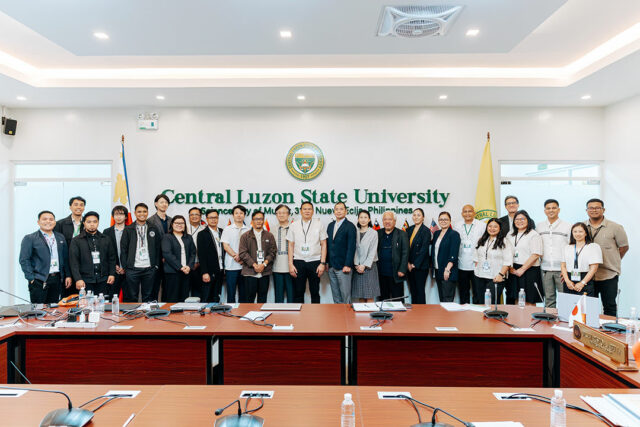
A FUNGAL BIOBANK at Central Luzon State University in Nueva Ecija is expected to improve disease management practices for high-value crops for cacao and banana.

The facility, built with support from the Japan International Cooperation Agency (JICA), will serve as a centralized repository of fungal isolates in Luzon linked to major diseases affecting high-value crops.

“By improving sample preservation, the biobank is expected to support better crop disease diagnosis, strengthen research continuity, and improve disease management,” JICA said in a statement.

The biobank is part of the Science and Technology Research Partnership for Sustainable Development’s Project for the Development of Novel Disease Management Systems for Banana and Cacao.

JICA said isolates from bananas are also currently conserved at Tamagawa University in Japan, with the support of the Department of Agriculture’s Bureau of Plant Industry (BPI).

In September last year, BPI and JICA signed a memorandum of agreement to promote plant health, particularly in sustainable banana and cacao production, part of a five-year initiative that began in 2021. — Vonn Andrei E. Villamiel

Plunder case filed vs NFA employee

REUTERS

THE National Food Authority (NFA) said it has filed a plunder case against one of its employees over the disappearance of rice stocks valued at roughly P53 million.

“On Dec. 19, we filed a case with the Ombudsman. It’s a plunder and malversation case against one of our employees,” NFA Administrator Larry R. Lacson told reporters on the sidelines of the Bureau of Plant Industry’s anniversary event on Wednesday.

He said the agency has yet to receive feedback from the Ombudsman and is awaiting further developments.

The case stems from the reported loss of rice stocks, which was uncovered following intensified audits conducted by the agency. Mr. Lacson earlier said the missing stocks likely dated back to 2020 to 2021 and accumulated over several years.

He said the NFA is also investigating other possible irregularities but declined to give details.

“We are still investigating other cases. I don’t want to pre-empt that. Let’s see the results of our investigation,” he said.

Mr. Lacson said the NFA remains firm in holding erring personnel accountable as part of broader reforms within the agency.

“We’re continuously making our mandate to hold people accountable. Our reform is continuous. It’s continuous because our reform is not only the management and the people. It also entails our overhauling of the standard operating procedures,” he said. — Vonn Andrei E. Villamiel

PHL hoping to regain spot as top banana exporter to Japan

BW FILE PHOTO

THE Department of Trade and Industry (DTI) said the Philippines is hoping to regain its former status as the leading banana exporter to Japan when the Japan-Philippines Economic Partnership Agreement (JPEPA) is reviewed.

“Our bananas reclaimed the number two position last year … We are continuously talking to the Japanese government if we could, of course, start the talks,” Trade Secretary Ma. Cristina A. Roque told reporters on Wednesday.

“We are hoping that with the Japanese support, (as we are) trying to really push for the JPEPA,” she added, through the help of which “we could really get the top spot again.”

She is scheduled to meet her Japanese counterpart within the first quarter to discuss JPEPA.

“We talked to their foreign affairs official who came here last month… they are aware of (our position). But I still have to talk to my (trade) counterpart,” she said.

“I am setting a meeting very soon, within the first quarter definitely. We hope that we can sit down and get this going,” she added.

For this year, she said the Philippines is also looking to conclude free trade agreements (FTAs) with the European Union, Chile, and Canada.

“Our President will go down in history (as the one with) the most FTAs that were signed during his term,” she said. “And we hope to do more (with countries like) Brazil and many others.”

She said an FTA with Brazil is on the wish list of Philippine exporters.

She said the Philippines should also prepare its logistics to help micro, small, and medium enterprises (MSMEs) tap global markets.

On Wednesday, the DTI onboarded more private sector partners to its logistics network, which includes Toyota Motor Philippines (TMP) Corp.

“Through our partnership with the DTI’s Supply Chain and Logistics Center, we aim to strengthen businesses by improving their logistics capabilities — making them more efficient, accessible, and resilient,” TMP President Masando Hashimoto said.

“Our shared goal is simple: to empower businesses to move forward, expand opportunities, and succeed — with trusted mobility and stronger logistics support at every step,” he added.

During the event, Mr. Hashimoto also welcomed the resolution of the funding for the Comprehensive Automotive Resurgence Strategy program.

“This support secures our local manufacturing and industrial systems,” he said.

He said that the company’s operations have been boosted by the production of the Toyota Tamaraw light business truck.

“As of end-January, we have proudly produced over 21,000 units, made possible by the dedication of 4,500 Filipino workers and the support of 44 parts suppliers — many of whom are MSMEs themselves,” he added.

Among its new partners were the Association of International Shipping Lines (AISL) and the Philippine Chamber of Customs Brokers, Inc. (PCCBI).

“As Philippine exports continue to climb, the DTI is ensuring local logistics capabilities can keep pace with international demand. The inclusion of AISL and PCCBI is designed to bridge the gap between local production and global markets,” the DTI said.

Established in June, the Supply Chain and Logistics Center is meant to help MSMEs access real-time service referrals and cost-saving regulatory guidance. — Justine Irish D. Tabile

ADVERTISEMENT
ADVERTISEMENT