Home Blog Page 301

CCA Manila’s first-ever Tikim Weekend Food Market showcases Filipino culinary entrepreneurship

The country’s leading culinary education institution, the Center for Culinary Arts (CCA Manila), held the inaugural Tikim Weekend Food Market last Oct. 3-4 at the Brittany Hotel in BGC. The event celebrated Filipino culinary innovation while serving as a launchpad for aspiring food entrepreneurs and future chefs.

More than just a food fair, Tikim became a dynamic learning and business platform, where culinary passion met real-world opportunity through live discussions, mentorship from industry pioneers, and marketplace exposure for promising food brands. For CCA Manila, this festival reinforced its 28-year mission to train world-class Filipino culinary talent through academics, experience, and entrepreneurship.

The two-day festival featured Tikim Business Workshops where participants learned from seasoned entrepreneurs and culinary leaders who have built successful ventures from scratch. Speakers include Cyrill Chan of Panero, who talked about scaling a bakery business; Chef Menoy Gimenez, who explained menu engineering and profitability; and Princess San Diego of What’s Your Flan?, who discussed how passion-led concepts can evolve into multi-franchise businesses. CCA alumna Chef Danica Lucero of Say Halo! also inspired the audience, as she made waves when she impressed Chef Gordon Ramsay with her innovative rendition of the halo-halo during his visit to the Philippines.

Aaron Limpe-Aw of Destileria Limtuaco shared how Filipino heritage flavors can succeed globally, while Chit Juan of ECHOStore highlighted sustainability and branding through local sourcing. Rounding off the program were practical sessions on financial management, operations technology, and food safety.

“These workshops reflect CCA Manila’s long-established approach to culinary education that goes beyond recipe execution. Tikim became a learning space as much as it is a celebration,” said Dr. Veritas F. Luna, chancellor of CCA Manila.

“By bringing together entrepreneurs, chefs, alumni, and foodies, we hope to highlight the hard work and creativity that go into building food businesses. This event reflects CCA’s vision of nurturing Filipino talent and shaping leaders in the culinary industry.”

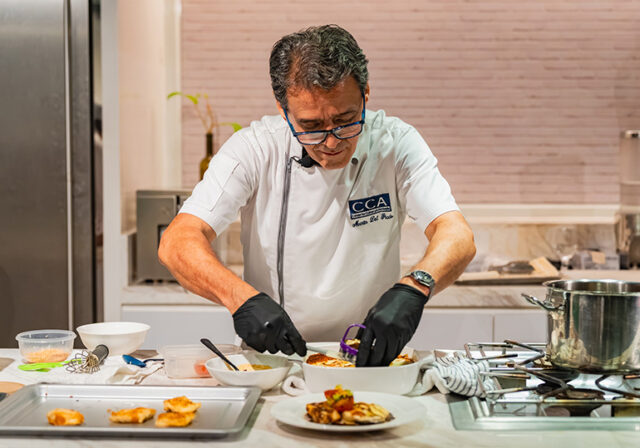
On Day 2, the program shifted to the Tikim Live Kitchen. Guests witnessed culinary artistry in action through interactive demos by celebrated chefs and CCA Manila alumni, presenting food as both craft and storytelling.

Heritage dishes by Chef Reggie Aspiras and Chef Martin del Prado placed a spotlight on Filipino culinary roots, while global-meets-local innovation was showcased by Chef Sharwin Tee. Chef Anne Atanacio wowed the audience with her dessert innovation, inspiring creativity in modern pastry.

Running throughout both days was the Tikim Food Market, which featured over 30 curated food brands from alumni, emerging entrepreneurs, and established culinary names.

With campuses in BGC and UP Diliman, and accreditation from the American Culinary Federation Education Foundation (ACFEF), CCA Manila has long been recognized as the training ground for award-winning chefs and founders of globally recognized food businesses.

“Tikim is a direct extension of this mission — a living classroom where students gain exposure to entrepreneurship, innovation, branding, operations, and trend dynamics, beyond traditional kitchen practice. Many alumni leading Tikim sessions, from global restaurateurs to micro-enterprise founders, began as CCA Manila students who transformed culinary passion into profession,” said Dr. Luna.

Tikim Weekend Food Market was made possible with the support of Brittany Hotel BGC, BPI, SB Finance, Metrobank, SCPA (Cheers), PrepSafe, Sysu (Clara Olé), Aguila (Golden A), Sine Haraya, San Miguel Brewery, Urban Farmers, Sinaya Seafood, and Avolution, Inc.


SparkUp is BusinessWorld’s multimedia brand created to inform, inspire, and empower the Philippine startups; micro, small and medium enterprises (MSMEs); and future business leaders. This section will be published every other Monday. For pitches and releases about startups, e-mail to bmbeltran@bworldonline.com (cc: abconoza@bworldonline.com). Materials sent become BW property.

PHL debt yields may track drop in secondary market on rate cut bets

BW FILE PHOTO

By Aaron Michael C. Sy, Reporter

PHILIPPINE Treasury bill and bond rates may extend their recent decline this week as traders position for another Bangko Sentral ng Pilipinas (BSP) rate cut in December. 

The Bureau of the Treasury will offer P22 billion in T-bills on Monday, split into P7 billion in 91-day notes and P7.5 billion each in 182- and 364-day securities. A day later, the government will auction P35 billion across two tenors: P20 billion in 10-year bonds with a remaining life of six years and 10 months, and P15 billion in 20-year notes with 18 years and six months left.

T-bill and T-bond yields may follow the drop seen in the secondary market last week amid rising expectations of easier monetary policy, Michael L. Ricafort, chief economist at Rizal Commercial Banking Corp., said in a Viber message.

The central bank cut its benchmark rate by 25 basis points last month, the fourth straight reduction, bringing the policy rate to 4.75%. The Monetary Board has lowered rates by 175 bps since August last year.

BSP Governor Eli M. Remolona, Jr. said a further cut at the Dec. 11 meeting is possible as growth risks mount, including a fallout from a widening corruption scandal tied to public infrastructure spending.

Secondary-market yields extended their slide on Friday. The 91-, 182- and 364-day T-bills fell 4.89 bps, 3.35 bps, and 7.18 bps, respectively, to 4.8914%, 5.0425%, and 5.1082%, PHP Bloomberg Valuation Service data showed.

The 10-year yield dropped 9.48 bps to 5.883%, while the seven-year — the closest benchmark for the reissued 10-year bonds — slipped 9.77 bps to 5.6584%. The 20-year eased 0.97 bp to 6.3701%.

A trader said the market saw profit-taking on Friday as political tensions escalated. Former House Committee on Appropriations Chairman Zaldy S. Co accused President Ferdinand R. Marcos, Jr. of ordering P100 billion in project insertions in the 2025 budget, a claim rejected by the Presidential Communications Office and Budget Secretary Amenah F. Pangandaman.

The trader expects solid demand at this week’s T-bond sale, forecasting yields of 5.625% to 5.675% for the seven-year bucket and 6.3% to 6.35% for the 20-year notes.

Last week, the Treasury raised P22 billion as planned from its T-bill auction, with total bids reaching P98.311 billion. The 91-day average rate slipped to 4.821%, the 182-day to 4.981%, and the 364-day to 5.054%, each down by about 4-5 bps from the prior auction.

The reissued 10-year bond was last sold on Sept. 2 at an average 5.939%, while the 20-year was last offered on Sept. 23 at 6.421%, when the sale fell short of target.

The Treasury seeks to raise P158 billion from the domestic market this month, including P88 billion in T-bills and P70 billion in T-bonds. The government relies on local and external borrowing to fund a budget deficit capped at P1.56 trillion, or 5.5% of economic output.

How the world is quietly winning on climate

STOCK PHOTO | Image from Freepik

By David Fickling

PERHAPS it’s time to give up on climate?

That’s what all the serious people are saying. The targets we set to limit our carbon pollution are unachievable and universally fail. So let’s just stop pretending and drill, baby, drill.

A “pragmatic way forward” for the energy transition is to conclude, in essence, that it’s not happening, according to an April essay by energy historian Daniel Yergin and others. Current ambitions are “unrealistic and therefore unworkable,” a think tank set up by former British Prime Minister Tony Blair argued. In the more pungent words of President Donald Trump, climate action is a “con job,” and should be abandoned.

This contrarian chorus is so noisy and persistent that it’s easy to miss how dramatically wrong it is — especially when some ambitions, like the promise to keep warming below 1.5° Celsius, are being missed. In truth, however, the evidence of nearly three decades of climate diplomacy is that when we set ourselves an objective, more often than not we will hit it. That should stiffen the spines of the politicians gathered at the COP30 climate meeting in the Brazilian city of Belém this week.

Take the Kyoto Protocol, the 1997 agreement between industrialized nations, promising to cut their emissions by 5% below their levels in 1990. Now remembered as an ignominious failure, it was actually a resounding success, delivering a far deeper 22.6% cut. The problem wasn’t that the goal was missed. Emissions did indeed increase over the 2000s — but that was due to the countries that weren’t party to the protocol, rather than the ones that were.

Or consider the European Union’s first pledge under the 2015 Paris Agreement to cut emissions in 2030 to 40% below levels in 1990.

Plenty scoffed at the time. The promises “will fail to accomplish anything substantial to rein in climate change,” Bjorn Lomborg, a long-time opponent of action, wrote in the Wall Street Journal.

Even more credible sources had their doubts. The European Environment Agency in 2017 projected the bloc would miss the goal and that the pace of emission reductions would soon slow.

In fact, greenhouse pollution last year was already 37% below 1990, and on current trends the EU may achieve a 54% cut, almost sufficient to hit a stricter target passed in 2020. These self-styled pragmatists now mocking Brussels’ most recent ambition to deepen reductions to 90% by 2040 should face up to a long history of promises that have been kept, not broken.

It’s the same with China’s promise five years ago to install 1,200 gigawatts of wind and solar power by 2030. At the end of September, it had already blown that figure out of the water, with more than 1,700 gigawatts connected. This year, few have even bothered to question the 3,600 gigawatts by 2035 goal President Xi Jinping announced in September.

In instance after instance, sober realists have been proved wrong, while the wildest hopes of campaigners have been exceeded. That even applies to the detailed pictures of the future laid out by the International Energy Agency (IEA). The amount of renewable electricity the world will generate this year will be about 9% more than what the IEA in 2018 reckoned we’d need to keep global warming below 2 degrees.

If you’d followed the IEA’s Current Policies scenario (a fossil fuel-favoring model the agency reintroduced this year after lobbying by the Trump administration) you’d have overestimated 2025’s level of oil demand by about 4.2 million barrels a day. That’s equivalent to the output of Iraq, OPEC’s second-biggest producer. That same scenario underestimated this year’s renewable production by 2,600 terawatt-hours, similar to all the electricity generated in the EU.

The problem is not that we fail to hit the objectives we set for ourselves. It’s that the drumbeat of bad-faith nihilism encourages us to forget the progress we’ve already made, and lower our ambitions for the future. Emissions keep inching up, not because of nations that fail to uphold their promises on climate, but because of nations that aren’t making adequate promises at all — in Xi’s failure to set a number on reducing China’s coal consumption, for instance, or Trump’s wrecking of US climate measures.

Five years ago, the most ambitious emission reduction plans laid out by governments would have resulted in about 3 degrees of warming by the end of the century. We’re now staring at 2.3 degrees of warming — a still-disastrous change, but one that’s moving ever closer to the place well below 2 degrees where we need to be. The 2015 Paris Agreement, dismissed at the time as a “fraud” and “dangerous incrementalism,” is actually working.

As solar panels, wind turbines, electric vehicles and rechargeable batteries remake our power systems, the energy transition is on the brink of victory. Ignore the doomsayers who can’t see it.

BLOOMBERG OPINION

Style (11/17/25)


Fendi offers its Pre-Collection Spring/Summer 2026

FENDI has released the Pre-Collection SS 2026, designed by Silvia Venturini Fendi. The women’s collection offers flashbacks to Jackie Onassis in Rome and Studio 54 in New York fused with sartorial sportswear. The palette is drawn from the last days of disco, with turquoise and mandarin, slate blue and blush pink, with dappled shades of coffee, burgundy, black and white. Tailoring fabrics are cut in rakish volumes, from a peak lapel blazer with a matching ra-ra skirt to boxy city shorts or oversize trousers with a high cuff. Zip-through parachute pants come in glossy taffeta, and silk cotton parkas sport velvet or corduroy lapels. Prim shirts extend into box-pleat kilts under hooded patch-pocket taffeta coatdresses, as pencil skirts unzip like bomber jackets. Polka dot patterns are abstracted across the collection, starting with the deep neckline, ruffled peplum and all. Taffeta bubble skirts and bustiers are splashed with hand-drawn spots. A speckled “moth wing” motif appears in taffeta, intarsia and shaved shearling, culminating in embroidered evening dresses that sparkle with micro sequins. For men, Venturini Fendi extends the party with relaxed jewel-toned layers and boyish silhouettes. There are velvet tuxedos with detached satin lapels, moth print shirts, and jacquard denim jeans. A denim cashmere caban, silicone-bonded patent leather parkas and garment-dyed corduroy trucker jackets are a conscious call-and-repeat with the women’s collection. The women’s accessories riff on the season’s abstract variety of Falena pattern, with butterfly wing-embroidered or sequined Baguette styles, shaved shearling and intarsia Peekaboo versions, and speckled peppered moth prints appearing on the soft Fendi Spy bag. In smooth calfskin, the new “keep-all” tote slides on adjustable shoulder straps finished with FF logo hardware, and the Baguette appears as a slim FF buckle clutch. Arched-heel peep-toe sandals and two-tone calfskin court shoes play with vivid colors, and Colibrì pumps are finished with soft satin bows. Articulated O’Lock brooches and FF earrings designed by Delfina Delettrez Fendi are dotted with pearls, bows and crystals forming a unique and precious choreography. For men, accessories echo the season’s palette from burnished burgundy lug-soled lace-ups to flat FF buckled loafers, a Falena print FENDI Lui duffel bag and the wearable Baguette bag in soft calfskin leather, and the Peekaboo in an upcycled patchwork of Cuoio Romano leather. The collection is now available at Fendi boutiques and on fendi.com.


Robinsons Department Store offers stackable discounts

STARTING this November until Dec. 31, shoppers at Robinsons Department Store can avail of up to 70% off on select items, as well as stackable promos when they purchase from its Holiday Catalog and other sections. This means that shoppers can combine discounts, cashback, and other offers to save up and get more value with every purchase. Throughout the holiday season, shoppers can enjoy exclusive savings, installment perks, and loyalty rewards both in-store and via LazMall, Shopee, and TikTok Shop. Robinsons Department Store’s Shop Now, Pay Later promo (ongoing until Dec. 31) offers flexible payment options with 0% interest for up to three months for a minimum spend of P3,000. There are also limited-time promos, like Red Fridays every Friday until Nov. 28, which give shoppers P200 off and 2X GoRewards Points for every minimum spend of P3,500. Likewise, shoppers get payday discounts with the Holiday Savings promo on Nov. 29 to 30. They can get P500 off and 100 GoRewards points for a minimum spend of P7,000. RCBC Credit Card holders can also get up to P700 cashback for a minimum spend of P5,000 straight transaction or P10,000 installment. If paying with GCash for a minimum spend of P1,000, shoppers can enjoy P100 off their purchase. Then there is the Robinsons Department Store’s Shop & Win Holiday Rafflewhere shoppers have a chance to win a P1-million cash prize, a Vespa S125, and shopping sprees.


Montblanc releases Happy Holidays capsule

THIS YEAR’S Happy Holidays capsule collection pays homage to Montblanc’s heritage of writing and travel. The collection pieces feature a hand-drawn illustration inspired by the Montblanc archives. The illustration captures a traveling couple at the foot of the Mont Blanc mountain, surrounded by vintage planes, trains, and letters in flight. The capsule collection features a tote, a mini crossbody bag, and a clutch crafted in embroidered ivory canvas with black leather detailing. The seasonal collection is further completed with a #MY4810 trolley in the cabin size, as well as a pen pouch and notebook in printed Sartorial leather. Meanwhile, Montblanc offers its leather goods collection. Crafted in supple grain leather in an earthy khaki shade, the document case echoes the details of a fountain pen nib through its stitching, zip pullers, and handle detailing. With top handles and a detachable shoulder strap, it offers a blend of practicality and sartorial refinement. The Montblanc Companion backpack, in khaki-colored grain leather, has thoughtfully arranged external zipped pockets for effortless organization. Suitable for short trips and overnight escapes, the Weekender is available in noisette-colored grain leather or khaki-hued corteccia leather finished with a gradient sfumato finish. The compact Montblanc Envelope Clutch in black or noisette-colored grain leather is accented with Meisterstück calfskin leather detailing. The clutch can also be worn by a wrist strap, while an open back pocket offers convenient access to essentials. Completing the leather goods assortment, the Montblanc Companion Crossbody Bag provides lightweight versatility in khaki-colored grain leather, with nib-shaped side cutouts showcasing a subtle signature of Montblanc’s design language. Montblanc is available at Rustans Makati, Rustans Shangri-La, Rustan’s Cebu, Greenbelt 5, and Solaire Resort Entertainment City. For more information, visit Rustans.com


Pilipinas Shell Foundation launches textile circulatory hub

THE Pilipinas Shell Foundation, Inc. (PSFI), in partnership with ANTHILL, Maybank Foundation, and the Quezon City local government unit, officially launched the Manila Circularity Hub under the ReShell: Weaving Waste Project located at the Payatas Controlled Disposal Facility. Re-Shell: Weaving Waste is a two-year initiative under Shell LiveWire that transforms textile waste into reusable materials such as uniforms and corporate giveaways, reducing landfill and ocean waste. The hub features 10 looms, five of which are sponsored by Shell, and will train 10 women from Payatas to become community weavers equipped with sustainable livelihood skills. Additionally, 10 mothers from the non-profit organization Dear Me will receive sewing training to enhance their skills and increase their income opportunities.


Holiday gifts from Doughnut, Ipanema, and Zaxy

DISCOVER presents from Doughnut, Ipanema, and Zaxy — three brands that offer design, comfort, and creativity. Born in 2010 from a graduation trip in search of the perfect travel bag, Doughnut has grown into a global lifestyle brand. The You-Niverse Series features pop-color trims, vegan leather details, and a water-repellent finish, while the Voyager Beyond the Horizon Series is made with a puffy, water-repellent nylon design that balances comfort and sophistication. Doughnut is also introducing the Gossamer and Gossamer Tiny bags as part of the Small Wins Club. These dumpling-shaped crossbody bags feature recycled, water-repellent materials, magnetic and drawstring closures, multifunction slots, and Doughnut’s signature star-shaped charm. Meanwhile, Ipanema has its Hello Kitty and Friends collection featuring playful candy stripes and Hello Kitty in her classic outfit. Finally, there is Zaxy, a 100% vegan and cruelty-free Brazilian footwear brand established in 2009. The brand welcomes the holidays with a mix of modern silhouettes, glossy finishes, and metallic accents. The Zaxy Nina has dainty designs and whimsical details like satin textures, bow accents, heart embellishments, and flower appliqués in a candy-colored palette. Shop Doughnut, Ipanema, and Zaxy in-store, or online at doughnutphilippines.com, ipanema.ph, zaxy.ph, Lazada, Shopee, Zalora, or TikTok. They are also found in major malls nationwide.

AirAsia PHL bets on new routes to reach 7-M target

NEWSROOM.AIRASIA.COM

By Alexandria Grace C. Magno

PHILIPPINE AIRASIA, INC. (AirAsia Philippines) said it is “pushing very hard” to reach its seven-million-passenger goal by the end of the year amid flight cancellations.

“We are pushing very hard to reach the seven-million target. As you know, there have been some cancellations due to typhoons and natural issues, which are beyond the airline’s control,” President and General Manager Suresh Bangah told BusinessWorld on the sidelines of the launch of its Cebu hub expansion on Saturday.

“But yes, we are going to push very, very hard and try to make up as much as possible during the peak travel period to reach our target by the end of December.”

In May, AirAsia announced it had received about 3.5 million advance bookings, noting that booking surges typically occur in the second half of the year or during holiday periods.

From January to June, the low-cost carrier recorded over three million passengers. The airline, however, did not provide updated figures.

On Saturday, AirAsia Philippines began operating two new international routes and three domestic routes from the Mactan-Cebu International Airport (MCIA), part of five new services that further expand its Cebu hub.

Starting Nov. 15, AirAsia Philippines will operate flights from Cebu to Iloilo, Caticlan, and Davao, while also offering services between Cebu and Kuala Lumpur and Macau. Its inaugural Kuala Lumpur-Cebu flight was welcomed with a water cannon salute upon arrival.

FLEET EXPANSION
Meanwhile, AirAsia Philippines Communications and Public Affairs Head Steve F. Dailisan said the carrier’s current operational fleet is sufficient to meet peak travel demand this December, while reiterating its plans to expand.

“According to Captain Suresh, the plan is still there. So currently, it’s 16 in Manila and two here in Cebu, but in his previous announcement, we will gradually increase the fleet size of two per year,” he said.

In July, AirAsia Philippines said it aimed to expand its operational fleet to 19 aircraft to meet growing demand and boost capacity.

“Every year, from 2026. So that’s the original plan, but it can go higher depending on the market demand but so far as growth is concerned, at least two aircraft per year,” Mr. Dailisan said.

Philippines signs seasonal labor deal for farm workers with South Korea

KOREA.NET/IMSIL-GUN COUNTY OFFICE

THE PHILIPPINES and South Korea have signed a joint memorandum on the implementation of South Korea’s Seasonal Workers Program (SWP), with the agreement billed as improving protections for Filipino farm workers in South Korea.

The Department of Agriculture (DA) said in a statement that the agreement between the two governments establishes a framework that will ensure fair labor practices, legal safeguards, and welfare support for Filipino seasonal farm workers in South Korea.

The SWP allows foreign workers to take on temporary jobs in South Korean agriculture and fisheries to fill labor shortages during peak seasons.

Under the agreement, the DA will implement agricultural training, livelihood programs, and reintegration assistance for returning workers.

The DA said it will also work closely with local governments and the Department of Migrant Workers to ensure deployments “match the country’s agricultural priorities and global standards.”

The memorandum also outlines an integrated support system to monitor workers and work with South Korean local authorities.

“This partnership ensures that our seasonal workers are protected, empowered, and equipped to contribute to both nations’ agricultural growth,” the DA said in a statement. — Vonn Andrei E. Villamiel

Peso may trade sideways ahead of delayed US economic data

BW FILE PHOTO

THE PESO is expected to move within a tight band this week as traders wait for a batch of delayed US economic reports following the end of a state shutdown.

It closed at P59.065 a dollar on Friday, 6.5 centavos weaker than Thursday, according to Bankers Association of the Philippines data posted on its website. It was also slightly down from its P59.04 finish a week earlier.

A trader said the peso initially strengthened, touching P58.77, after risk appetite improved when US President Donald J. Trump signed a funding bill restoring government operations. The 43-day shutdown had halted several data releases, leaving investors without economic signals.

Demand for risk assets lifted the peso early on, but sentiment turned after former Party-list Rep. Elizaldy S. Co linked President Ferdinand R. Marcos, Jr. to the flood control scandal, the trader said. That pulled the currency back toward the 59 level.

Mr. Co has accused the President of directing P100 billion worth of projects into the 2025 budget. Malacañang and the Budget department denied the allegation.

The dollar was also supported by cautious remarks from some US Federal Reserve officials, Rizal Commercial Banking Corp. Chief Economist Michael Ricafort said. He noted the peso stayed slightly above the key P59 mark, which had held for more than three years until late October.

He added that political uncertainty, weak foreign investment data and the sharp sell-off in local equities have kept investors guarded. The benchmark stock index fell 2.5% on Friday to its lowest finish in more than five years.

Still, he said seasonal remittance inflows and holiday spending might help temper pressure on the currency as the year winds down. Large foreign-exchange reserves also offer support.

This week, traders will watch for the release of US inflation, retail and labor indicators that were delayed by the shutdown. These reports are expected to guide market expectations for the Fed’s policy path in December.

The trader expects the peso to trade from P58.80 to P59.25 a dollar this week, while Mr. Ricafort projects a range of P58.75 to P59.25. — Aaron Michael C. Sy

Our failing health system: Overcrowded hospitals, understaffed health clinics

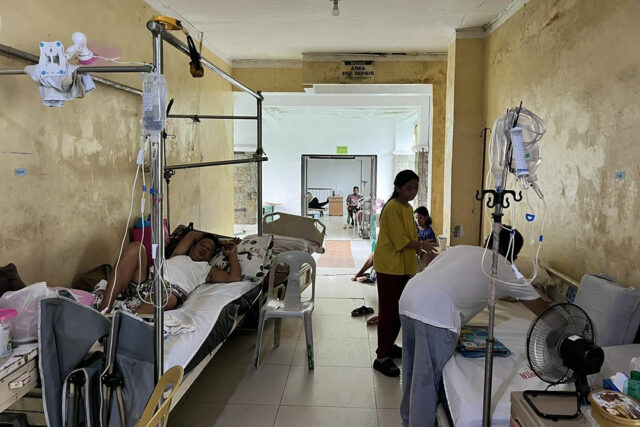
SAMAR HOSPITAL, Oct. 30: Over 200 patients in a 100-bed hospital; excess patients stay in corridors as wards have been full since August — PHOTO TAKEN BY T. TUAZON

In October, three major hospitals in Samar and Leyte asked patients to stop coming to their emergency rooms. North Samar’s Provincial Hospital was “in chaos” (Philippine News Agency, Oct. 27); the Samar Provincial Hospital was “overwhelmed” (Inquirer, Oct. 9), while on Oct. 5, the Regional Medical Center in Tacloban sent an advisory that its emergency room was 193% “over capacity.”

Epidemic? COVID’s return? None of that; there was no disease outbreak, just “an increase in common cases such as diarrhea, measles, respiratory infections, influenza-like illnesses and injuries from vehicular accidents” according to Samar health officials.

Hospital officials were literally begging lower-level hospitals and local health clinics (Rural Health Units in particular) to stop sending patients, asking them to take care of uncomplicated cases.

The East Visayas Medical Center, which President Ferdinand Marcos, Jr. visited in mid-August to look at its Zero Balance Billing program, announced by Oct. 5 that with its 1,100 beds 125% occupied, it could only accept “Level III cases” or those requiring life-saving interventions. It warned that “referred patients may need to remain in the referring ambulances” while attending to patients who came earlier.

At breaking point, the hospitals in Samar and Leyte were asking primary care clinics to provide healthcare for their constituents. That is the way it should be.

Howling in the wind, the primary healthcare system has been on a downward spiral for over a decade, years before the COVID-19 epidemic, which further accelerated the decline of primary care.

FUNDING THE WRONG END OF HEALTHCARE
The Philippine Health Insurance Corp. (PhilHealth) spent P200 billion for hospital-based care and dialysis as of end-September and Department of Health (DoH) reports using 52% (P20.5 billion) of its Medical Assistance to Indigent and Financially Incapacitated Patients Program (MAIFIP) Fund to top up PhilHealth spending, for a total of P220 billion for hospital-based care. Primary care facilities (where 57% of the population goes for healthcare) on the other hand got only P1.3 million in the first six months of 2025. Konsulta/YAKAP clinics, where patients were registered on the average, were paid P510 per registration through First Patient Encounters (FPEs), without having to provide any healthcare.

The Philippines has been neglecting primary care, investing only 4% of current health expenditure for primary care, equivalent to $6 per Filipino, while ASEAN counterpart spending averages $20.

The Universal Health Care (UHC) law specifically directed PhilHealth to craft a comprehensive outpatient benefit package within two years of its enactment. It duly transformed its Tsekap package into the Konsulta package by 2020, allocating P500 per year for every member and beneficiary.

Instead of directly funding primary care in 2,797 government facilities immediately, PhilHealth prioritized registration of its members into Konsulta (now YAKAP) without providing an ounce of care, a tablet of medicine, or a blood test. When the Philippine Statistics Authority conducted a Community Based Monitoring System survey in two provinces in the Samar/Leyte region in 2022, patients were found to be routinely bypassing health centers, going directly to hospitals. These patients reported that less than 10% of their health costs were covered by PhilHealth, making their out-of-pocket costs 90% versus a national average of 44%.

PhilHealth has been seemingly reluctant to roll out the Konsulta package (it would cost P190 billion per year at the expanded rate of P1,700 per Filipino). PhilHealth management instead accumulated large amounts in its reserve as it chose to ration out primary care.

With its reserves spent on expanded and increased hospital benefits, PhilHealth now finds itself strapped for resources after two years of underfunding and non-funding and giving up P60 billion to the National Government. The constitutionality of the transfer is being challenged by a petition at the Supreme Court.

Primary care health services which are starved of funding are deteriorating while the system prioritizes higher levels of care. The absence of preventive public healthcare is now being felt by hospitals where up to 33% of their patients could have been managed at primary care clinics1.

CAN’T DELIVER FULL BENEFITS
The data would suggest that it would be a futile exercise for patients to even seek care from a Konsulta/YAKAP provider when they get sick. In May 2024 a DoH-funded survey2 of 70 UHC implementation sites showed that only 6.1% of 2,797 accredited Konsulta facilities nationwide could deliver the full Konsulta package.

When the Konsulta package was launched in 2020 by PhilHealth, it accredited all 2,797 government facilities, without checking if they could deliver the entire package. After four years of waiting for the local government units (LGUs) to implement the package with DoH assistance and achieving only single digit in terms of percentage of facilities able to deliver the full Konsulta package, the primary care system has failed. Patients are choosing to bypass health clinics/primary care that can only register them and instead go directly to the hospitals for healthcare.

LGUs have not been funding local health systems at the levels required by the UHC law, covering only 9.3% of health expenditure by 2023, barely increasing from 8.9% in 2020. On the other hand, DoH and PhilHealth management were more worried about their agencies’ performance and passively waited for LGUs to catch up.

Moreover, the local health system has been marginalized by attention-seeking national programs which compete with local health service delivery without improving people’s health, such as LAB for all caravans, BUCAS centers, and Purok Kalusugan programs.

HIGH-END HEALTHCARE VS PRIMARY CARE
A poorly advised President delivered a coup de grace of sorts to the health system when he miscommunicated Zero Balance Billing for all government hospitals in his State of the Nation Address last July. It was no coincidence that Samar Provincial Hospital started seeing increasing numbers of patients in August, with over 200 patients occupying its 100-bed capacity facility.

The unraveling of the health system in Leyte/Samar that followed is an example that exposes the extreme vulnerability of the current state of UHC in the Philippines.

Yet the best solution that DoH and PhilHealth can come up with is to ask for more resources to shore up the Zero or No Balance Billing program for national hospitals and probably extend assistance to local hospitals.

Without the benefit of assessing the entire health system, the administration can only offer unsustainable measures like increasing subsidies that cost the most — secondary and tertiary hospitals and specialty medical centers.

But the political leadership does not allocate sufficient resources for primary care, which can reduce higher end healthcare costs. Every new hospital benefit announced by PhilHealth reduces its capacity to fund primary care.

RESCUING THE PHL HEALTH SYSTEM
One can only suggest that the first steps to change course can begin with the current health budget deliberations.

The proposed 2026 PhilHealth General Appropriations budget will only cover P53 billion in premiums of the indirect members. The premiums of all indirect contributors — which are used to fund benefits of all PhilHealth members — are guaranteed by the UHC law. But the proposed 2026 PhilHealth budget will only cover less than a third of reimbursements made by indirect members in 2025, which is expected to exceed P160 billion.

Further, the expansion of the MAIFIP program, an example of abetting multiple funding streams, would result in diminishing PhilHealth’s role to give financial healthcare protection to all Filipinos. Different health funding programs are administratively costly, and they inflate health costs, according to the Philippine Institute for Development Studies-Health Economics and Finance Program team.

PhilHealth’s operations will exceed P300 billion in 2025, overshooting its P286-billion budget. PhilHealth’s 2026 budget, conservatively, should be north of P360 billion. The MAIFIP fund should thus be transferred to cover PhilHealth’s funding gap, particularly in covering reimbursements. With reimbursements soaring to 94% from 2024 to 2025, PhilHealth needs all the resources it can get to cover costs.

The shares of the Philippine Amusement and Gaming Corp. (PAGCOR) and the Philippine Charity Sweepstakes Office (PCSO) for UHC could be used for primary care, separate from the reimbursements for hospital care. The Department of Budget and Management (DBM) must release to PhilHealth P42 billion from the 2023 and 2024 General Appropriations Acts, which the DBM impounded. Another P42 billion, the combined amount for 2025 and 2026 due from PAGCOR and PCSO as mandated by the UHC law, must be allocated to PhilHealth. These amounts can be repurposed to cover the 2026 spending for YAKAP/GAMOT.

Congress can also provide a special provision that will limit benefit expansion in hospital care for the next two years at least, to be lifted only when the comprehensive outpatient benefit package at primary level is largely in place.

These are our urgent proposals to save the Philippine healthcare system.

1 “How to reduce Out of Pocket spending in the Philippines,” PIDS Health Economics and Finance Program

2 Final Report Universal Health Care (UHC) Survey, DoH, June 2024


Juan Antonio Perez III, MD specializes in public health administration, primary healthcare, and has worked with nine Health Secretaries and three NEDA Secretaries since 1992. He was undersecretary for Population and Development and executive director of the country’s Commission on Population and Development up to Sept. 8, 2022 when he retired. He occasionally writes for Action for Economic Reforms.


Pope hosts Hollywood stars at Vatican, laments decline in movie-going

Pope Leo XIV | Screenshot from Vatican Media Livestream

VATICAN CITY — Pope Leo told a group of leading Hollywood actors and filmmakers on Saturday that cinemas were struggling to survive and that more should be done to protect them and preserve the shared experience of watching movies.

Screen stars Cate Blanchett, Monica Bellucci, Chris Pine, and Viggo Mortensen were among those invited to the private Vatican audience, along with award-winning directors Spike Lee, Gus Van Sant, and Sally Potter.

Leo, the first US pope, said cinema was a vital “workshop of hope” at a time of global uncertainty and digital overload.

“Cinemas are experiencing a troubling decline, with many being removed from cities and neighborhoods,” he added. “More than a few people are saying that the art of cinema and the cinematic experience are in danger. I urge institutions not to give up, but to cooperate in affirming the social and cultural value of this activity.”

Box office revenues in many countries remain well below the levels recorded before the COVID-19 pandemic, with multiplexes in the United States and Canada just suffering their worst summer since 1981, excluding the COVID shutdown.

LOGIC OF ALGORITHMS MUST BE RESISTED
Leo said cinema, which marks its 130th anniversary this year, had grown from a play of light and shadow into a form capable of revealing humanity’s deepest questions.

“Cinema is not just moving pictures; it sets hope in motion,” he said, adding that entering a theater was “like crossing a threshold” where the imagination widens and even pain can find new meaning.

A culture shaped by constant digital stimuli risks reducing stories to what algorithms predict will succeed, he said.

“The logic of algorithms tends to repeat what works, but art opens up what is possible,” he said, urging filmmakers to defend “slowness, silence and difference” when they serve the story.

The pope also encouraged artists to confront violence, war, poverty, and loneliness with honesty, saying good cinema “does not exploit pain; it recognizes and explores it.”

Australia’s Cate Blanchett said his call carried weight.

“His Holiness’ words today were a real charge not to shy away from difficult, painful stories,” she told reporters. “He really urged us to go back into our day jobs and inspire people.”

The pope praised not only directors and actors but the vast array of behind-the-scenes workers whose craft makes movies possible, calling filmmaking “a collective endeavor in which no one is self-sufficient.”

At the end of his speech, the long list of invitees met the pope one-by-one, many offering him gifts, including Spike Lee, who gave him a New York Knicks basketball shirt emblazoned with “Pope Leo 14.”

“It was a surprise to me that I even got an invitation,” Mr. Lee told reporters. “I’ve been to Rome many, many times. But (this was) the first time in the Vatican City and the first time meeting the pope. So it was… a great day, a great day.”

Ahead of Saturday’s meeting, the Vatican shared four of the pope’s favorite films: Robert Wise’s family musical The Sound of Music, Frank Capra’s feel-good It’s a Wonderful Life, Robert Redford’s heart-wrenching Ordinary People, and Roberto Benigni’s sentimental World War II drama Life Is Beautiful. — Reuters

Monde Nissin partners with Asia Pacific College to develop industry-ready graduates

Monde Nissin Corp. officially partnered with Asia Pacific College (APC) through a Memorandum of Agreement (MoA) marking a significant step toward stronger collaboration between the academe and the food manufacturing industry.

The partnership establishes Monde Nissin as APC’s first industry partner in the food manufacturing sector, reflecting a shared commitment to nurturing the next generation of Filipino professionals through education, innovation, and real-world learning experiences.

It reinforces Monde Nissin’s ongoing investment in early career development through its flagship programs: MondeXplore Internship Program, which provides students with immersive, hands-on learning across various business functions, guided by industry mentors; Emerging Leaders Program, a six-month intensive track for engineering graduates aimed at developing the next generation of Product Supply leaders; and the Excelerate Program, an 18-month management trainee program designed for high-potential talents in Consumer and Customer Development, equipping them with frontline exposure and strategic leadership skills.

The MoA signing was led by Luz Mercurio, chief people & culture officer of Monde Nissin; and Dr. Ma. Teresita “Tata” Medado, president of Asia Pacific College, alongside leaders from both institutions. The event included a meaningful dialogue on potential future collaborations and a guided plant tour of the Lucky Me! Noodle Factory, where APC representatives gained first-hand insights into Monde Nissin’s operational excellence and world-class manufacturing practices.


SparkUp is BusinessWorld’s multimedia brand created to inform, inspire, and empower the Philippine startups; micro, small and medium enterprises (MSMEs); and future business leaders. This section will be published every other Monday. For pitches and releases about startups, e-mail to bmbeltran@bworldonline.com (cc: abconoza@bworldonline.com). Materials sent become BW property.

LRMC in talks with DoTr for concession fix

PHILIPPINE STAR/EDD GUMBAN

LIGHT RAIL MANILA CORP. (LRMC), the operator of Light Rail Transit Line 1 (LRT-1), said it is gearing up for a financial rebound, citing renewed shareholder support and fresh talks with the Department of Transportation (DoTr) for the rebalancing of its concession agreement.

“LRMC has been encountering problems for the past 10 years, primarily due to some obligations of the government that they were not able to fulfill, then definitely we’re not in a good financial position at the moment. But we’re about to turn the corner,” LRMC President and Chief Executive Officer Enrico R. Benipayo said at the Metro Pacific Investments Corp. (MPIC) briefing in Hong Kong last week.

The LRT-1 operator is now in talks with the DoTr and the Department of Finance (DoF) for some tariff adjustment, Mr. Benipayo said, noting that under its concession agreement, the company is allowed to increase fares by a certain percentage every two years.

“In fairness to this current administration, this is where we had our first tariff increase… The current government, particularly the DoTr and the DoF, is actively in discussion with us to be able to resolve the concession agreement,” he said.

LRMC assumed operations and maintenance of LRT-1 in September 2015 under a P65-billion, 32-year concession agreement with the Light Rail Transit Authority and the DoTr.

Under the agreement, the operator may seek a fare adjustment once every two years. In April, the Transportation department approved LRMC’s petition for fare adjustments, though the new fare matrix remains below the company’s requested rates, resulting in a fare deficit of P2.17 billion.

LRMC is also seeking discussions with the government to rebalance its concession agreement, which would allow the company to extend its current concession period, Mr. Benipayo said.

“The rebalancing is, and in principle they have agreed, like an extension of our concession period, and some other tweaks in the concession agreement so that the project can be restored to its financial position,” he said, noting that the company is also working double time to complete the extension of Cavite Extension Phases 2 and 3.

Earlier this week, MPIC Chairman, President, and Chief Executive Officer Manuel V. Pangilinan said the company is considering selling its stake in LRMC, citing mounting losses as ridership numbers failed to recover from the pandemic impact.

MPIC holds its 35.8% stake in LRMC through its unit, Metro Pacific Light Rail Corp., while Sumitomo Corp. owns 19.2% and Macquarie Investments Holdings (Philippines) Pte. Ltd. holds 10%. LRMC is a joint-venture company of MPIC, AC Infrastructure Holdings Corp. (a unit of Ayala Corp.), Sumitomo, and Macquarie Investments Holdings.

LRMC’s ridership averaged around 450,000 daily passengers in 2019, dropping to 350,000-370,000 in 2023. By November 2024, just before the opening of the LRT-1 Cavite Extension Phase 1, daily ridership was 323,000.

Mr. Benipayo said LRT-1’s ridership has increased to 390,000 daily year to date.

“First, we are working with the government so that they pay our claims. That is the first thing. Second is we are talking to our lenders to refinance our debt, and the third one is we would like to start the discussions with the government to rebalance the concession agreement,” he said.

LRMC is now also in active negotiations with its foreign partners for some value-up initiatives to improve passenger experience, and other operations and maintenance activities to increase its ridership, he said.

MPIC is one of the three key Philippine units of Hong Kong-based First Pacific Co. Ltd., along with Philex Mining Corp. and PLDT Inc. Hastings Holdings, Inc., a unit of MediaQuest Holdings under the PLDT Beneficial Trust Fund, has a majority share in BusinessWorld through the Philippine Star Group, which it controls. — Ashley Erika O. Jose

Trump cuts tariffs on beef, coffee and other foods as inflation concerns mount

REUTERS/PAULO WHITAKER

WASHINGTON — US President Donald Trump rolled back tariffs on more than 200 food products, including coffee, beef, bananas and orange juice, in the face of growing angst among American consumers about the high cost of groceries.

The new exemptions — which took effect retroactively at midnight on Thursday — mark a sharp reversal for Mr. Trump, who has long insisted that the sweeping import duties he imposed earlier this year are not fueling inflation.

“They may in some cases” raise prices, Mr. Trump said of his tariffs when asked about the move aboard Air Force One on Friday evening. But he insisted that overall, the US has “virtually no inflation.”

Democrats have won a string of victories in state and local elections in Virginia, New Jersey and New York City, where growing voter concerns about affordability, including high food prices, were a key topic.

Mr. Trump also told reporters aboard Air Force One that he would move forward with a $2,000 payment to lower- and middle-income Americans that would be funded by tariff revenues next year.

“The tariffs allow us to give a dividend if we want to do that. Now we’re going to do a dividend and we’re also reducing debt,” he said.

The Trump administration announced framework trade deals on Thursday that, once finalized, will eliminate tariffs on certain foods and other imports from Argentina, Ecuador, Guatemala and El Salvador, with US officials eyeing additional agreements before year’s end.

Friday’s list includes products US consumers routinely purchase to feed their families at home, many of which have seen double-digit year-over-year price increases.

It includes over 200 items ranging from oranges, acai berries and paprika to cocoa, chemicals used in food production, fertilizers, and even communion wafers.

The White House, in a fact sheet on the order, said it came on the heels of “significant progress the President has made in securing more reciprocal terms for our bilateral trade relationships.”

It said Mr. Trump decided certain food items could be exempted since they were not grown or processed in the US, and given the conclusion of nine framework deals, two final agreements on reciprocal trade, and two investment deals.

Ground beef, as of the latest available data for September, was nearly 13% more expensive, according to Consumer Price Index data, and steaks cost almost 17% more than a year ago.

Increases for both were the largest in more than three years, dating back to when inflation was nearing its peak under Mr. Trump’s predecessor, Democrat Joe Biden.

Although the US is a major beef producer, a persistent shortage of cattle in recent years has kept beef prices high. Banana prices were about 7% higher, while tomatoes were 1% higher.

Overall costs for food consumed at home were up 2.7% in September. The tariff exemptions won praise from many industry groups, while some expressed disappointment that their products were excluded from the exemptions.

“Today’s action should help consumers, whose morning cup of coffee will hopefully become more affordable, as well as US manufacturers, which utilize many of these products in their supply chains and production lines,” FMI-Food Industry Association President Leslie Sarasin said in a statement.

Distilled Spirits Council President Chris Swonger said that excluding spirits from the European Union and Britain “is yet another blow to the US hospitality industry just as the critical holiday season kicks into high gear.”

“Scotch, Cognac and Irish Whiskey are value-added agricultural products that cannot be produced in the United States,” Mr. Swonger added.

Asked if further changes were planned, Mr. Trump told reporters aboard Air Force One, “I don’t think it’ll be necessary.” “We just did a little bit of a rollback,” he said.

“The prices of coffee were a little bit high, now they’ll be on the low side in a very short period.”

Mr. Trump has upended the global trading system by imposing a 10% base tariff on imports from every country, plus additional specific duties that vary from state to state.

Mr. Trump has focused squarely on the issue of affordability in recent weeks, while insisting that any higher costs were triggered by policies enacted by Biden, and not his own tariff policies.

Consumers have remained frustrated over high grocery prices, which economists say have been fueled in part by import tariffs and could rise further next year as companies start passing on the full brunt of the import duties.

The top Democrat on the House of Representatives Ways and Means Committee, Richard Neal, said the Trump administration was “putting out a fire that they started and claiming it as progress.”

“The Trump administration is finally admitting publicly what we’ve all known from the start: Trump’s Trade War is hiking costs on people,” Mr. Neal said in a statement.

“Since implementing these tariffs, inflation has increased and manufacturing has contracted month after month.” — Reuters