
PSEi member stocks performed — July 15, 2024
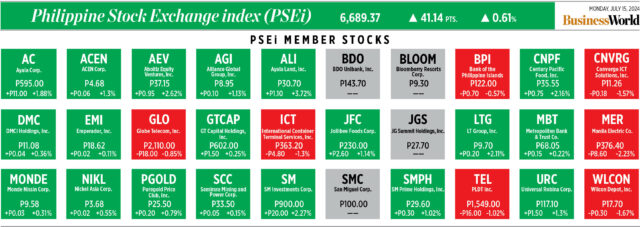
Here’s a quick glance at how PSEi stocks fared on Monday, July 15, 2024.


Here’s a quick glance at how PSEi stocks fared on Monday, July 15, 2024.

THE Bureau of Customs (BoC) said it expects to collect up to P30 billion more than its P939.69-billion official target for the year as it strives to beat its internal “stretch” target.
“We’re very much confident that we will hit the target. In fact, what we’re trying to hit now is the internal target of the Commissioner,” Customs Assistant Commissioner Vincent Philip C. Maronilla told reporters on the sidelines of an event on Monday.
For full-year collections, Mr. Maronilla said the internal target is now “a little less than P1 trillion. If we can reach a trillion, then (that would be) so much better.”
Last week, the BoC reported that its collections in the first six months totaled P456.04 billion, surpassing its P442.62-billion target for the period by 3.03%.
The six-month total represents 48.53% of the Bureau’s full-year official target.
However, the “ghost month” — which discourages superstitious Buddhists and Taoists from embarking on important new ventures — tends to produce weak collections, Mr. Maronilla said.
“Our problem, I think, would start about next month because of the ghost month,” he said.
“But for the past years, we’ve been able to overcome that. So, we’re still confident that we will overcome any challenges that will be faced by the bureau for the month,” Mr. Maronilla said.
Mr. Maronilla also shrugged off risks of the weaker peso on the Bureau’s collections, calling currency factors a “give-and-take situation.”
While a stronger dollar increases the value of exports, businesses may be reluctant to import due to higher costs, he said.
The peso closed at P58.48 to the dollar on Monday, weakening by 10 centavos from its finish on Friday, according to the Bankers Association of the Philippines.
“I don’t think that the increase in the value of the dollar right now and its adverse effect on let’s say, import activities, would affect any projections that we have in reaching our collection target,” he added.
However, the BoC said it still prefers a stronger peso as it “means that we have a stronger economy.”
Separately, goods that violate intellectual property rights remain most-seized items by the BoC, it said.
“That’s a commitment that we have — to maintain our good standing in intellectual property law enforcement. So, these remain the top apprehended imported items,” Mr. Maronilla said.
The BoC is also focused on seizing smuggled agricultural, tobacco, and other excisable products.
In the first half, the BoC has seized around P20 billion worth of smuggled goods, roughly 16.15% lower compared to a year earlier. — Beatriz Marie D. Cruz

By Justine Irish D. Tabile, Reporter
THE Department of Trade and Industry (DTI) said domestic producers must be given preference in government procurement to support their development.
“We need to source products that are available locally, as long as they meet the price, quality, and standards,” Trade Undersecretary Rafaelita M. Aldaba said on Monday on the sidelines of the Tatak Pinoy Act Forum.
“The biggest opportunity for our producers is if the market for their products is the government,” she added.
She said that a lot of products can be locally sourced, with preferential procurement within the scope of the Tatak Pinoy Act.
“Right now, they are using this program called domestic bidder preference… we know that it is still hard to compete with imported products because they have lower prices due to their scale,” she added.
She said that if the government sources locally, the government spending will stimulate more economic activity.
“It will have a lot of spillover effects, and at the same time, the government will also be able to help our industries,” she added.
Aside from the Tatak Pinoy Act, Ms. Aldaba said that the DTI is also awaiting the amendment of the Government Procurement Reform Act, which will make it easier for small and medium enterprises to participate in government bids.
The amendments “will remove the difficult regulations that (deter) local companies, especially small ones,” she added.
In terms of priority products, Ms. Aldaba said that the target is to come up with a draft of the Tatak Pinoy Strategy by December.
“This will be a multi-year strategy … we will identify the products that we will target in terms of contribution to gross domestic product and employment as well as the sectors that we will prioritize,” she said.
According to Trade Secretary Alfredo E. Pascual, one of the top priorities of the Tatak Pinoy Act is the semiconductor and electronics industry.
In particular, he said that the goal is to elevate the industry’s position in the global value chain by refocusing on higher-value activities such as integrated circuit design, research and development (R&D), and electronics manufacturing services.
“To achieve this goal, we must invest in R&D infrastructure, forge partnerships with major foundries globally, cultivate PhD-level competencies, and optimize power and logistics infrastructure,” Mr. Pascual said.
“Hence, one of our major initiatives under Tatak Pinoy is to conduct a feasibility study on establishing a lab-scale wafer fabrication facility in the Philippines,” he added.
He said that the facility will support R&D, prototyping, intellectual property development, and experimentation with new materials and manufacturing processes.
Semiconductor and Electronics Industries in the Philippines Foundation, Inc. President Danilo C. Lachica said that there is a long-term need for a wafer fab but noted its low-priority status under the US Chips Act.
“You can’t really blame them since the low-hanging fruit is expanding the assembly, testing, and packaging, and it’s good for us. It’s also good when they say they’ll triple output,” he said.
“It’s also a natural consequence of building up the wafer fab capacity in the US, because if you produce the wafers, you’re going to have to send those wafers elsewhere to do the assembly test and packaging; hence, the Philippines will benefit directly from that,” he added.
However, he said that the Philippines will eventually need to consider having its own wafer fab capacity.
“I think that there’s a real China threat to Taiwan, and Taiwan is the biggest source of our semiconductor wafers, which are used for our electronics industry,” he said.
“When that impacts the supply of wafers, it’s going to be a major detriment to our industry,” he added.
He added that a wafer fab will increase the complexity of the electronic products that the country exports.
“We import about $20 billion to $30 billion worth of parts; if we can localize most of that, possibly with the help of Tatak Pinoy, that’s going to be a big boost to the economy,” he said.

THE Department of Trade and Industry (DTI) said it is betting on a boost from the Tatak Pinoy Act, which it says will incentivize exporters to focus on products with higher-value content where the Philippines enjoys a competitive advantage.
“We will need to define our priority sectors where we have an advantage that we can pursue,” Trade Secretary Alfredo E. Pascual said on the sidelines of the Tatak Pinoy Act Forum on Monday.
“Our main objective is to create products that will improve our export performance because, if you look at our neighbors, we are lagging,” he added.
Republic Act No. 11981, or the Tatak Pinoy (Proudly Filipino) law, aims to elevate the Philippines’ position in the global value chain by encouraging companies to raise the quality of their products.
Mr. Pascual said products of higher complexity tend to raise a country’s export earnings.
Citing the Atlas Economic Complexity report for 2021, he said that the Philippines was 33rd globally in the complexity index and fourth in Southeast Asia, ahead of Vietnam and Indonesia.
However, he said three years have passed since the report was released, and Indonesia and Vietnam have made significant strides in diversifying into more complex product categories.
“Between 2006 and 2021, our country has only ventured into 30 new export products, contributing $41 to our GDP (gross domestic product) per capita. In contrast, Vietnam has ventured into 41 new products, boosting its GDP per capita by almost $1,500,” he said.
He added that export volume of $74 billion pales in comparison to Indonesia’s $231 billion, Thailand’s $266 billion, and Vietnam’s $355 billion.
“This stark contrast highlights the urgent need for a more robust approach to enhance the global competitiveness of our industries and attract more export-oriented high-tech manufacturing companies to make the Philippines their production hub,” Mr. Pascual said.
Bianca Pearl R. Sykimte, director of the DTI’s Export Marketing Bureau, said that the DTI is “cautiously optimistic” that exports will grow this year due to growth in service exports and through the Tatak Pinoy Act.
In particular, she said exports are still expected to hit the targets set under the Philippine Development Plan (PDP) after information technology and business process management (IT-BPM) dollar receipts surpass overseas Filipino worker (OFW) remittances.
“If you look at our dollar receipts in IT-BPM compared to OFW remittances, I think IT-BPM receipts are already at $35 million, while OFW remittances are around $33 billion. So, services are still doing well,” Ms. Sykimte said.
However, she said that although trade is improving, the 2024 total is still lower than that of 2022, which is reckoned to be the start of the post-pandemic recovery.
“This is one of our considerations, but compared to last year, of course, we are faring better,” she added.
She said the Export Development Council is set to recalibrate the targets contained in the Philippine Export Development Plan (PEDP) by the third quarter.
“It may, of course, affect the succeeding targets since the base will be lowered because even at the start of the implementation of the PEDP, we were not able to achieve the targets,” she added.
Meanwhile, she said that the DTI plans to use the Tatak Pinoy Act to deliver for the PEDP, as most of the projects under the law are related to export development.
The PEDP estimates merchandise and services exports for 2024 at $143.4 billion, much higher than the $107-billion export target set in the PDP.
The Philippine Statistics Authority reported that exports totaled $30.84 billion in the five months to May, up 7.8% from a year earlier. — Justine Irish D. Tabile

THE Department of Agriculture (DA) said that it will extend the ban on red onion imports following the buildup of ample supply in storage facilities.
“As of the moment we do not need to import onions yet… for now until August,” Agriculture Secretary Francisco P. Tiu Laurel, Jr. told reporters on Monday.
Mr. Laurel added that the Agriculture department will review onion import policy monthly.
The national onion inventory was 163,503 metric tons (MT) as of July 5. Monthly consumption of red onion is 17,000 MT, while white onion consumption is estimated at 4,000 MT, according to the Bureau of Plant Industry.
The DA has said that the current volume of red onion is sufficient to meet demand for about eight months, or until February.
He said that an extended import ban may be exploited by traders to manipulate supply and cause prices to rise.
“Ang nakakatakot dyan (What I worry about) is that if we announce an extension, traders might restrict the release of stocks,” he said.
According to DA price monitors in the National Capital Region, a kilogram of red onions sold for between P80 and P150, as of July 12.
Mr. Laurel warned that if traders attempt to manipulate the onion supply, the DA will respond with onion imports to stabilize prices.
The DA initially banned onion imports until the end of July due to increased domestic production.
During the first quarter, onion production was 201.25 thousand MT, according to the Philippine Statistics Authority, up 36.8% from a year earlier.
The DA attributed the production gains during the period to a 40% increase in the land planted to onion. — Adrian H. Halili

THE Bureau of Customs (BoC) said a “goods passport” system is expected to reduce the processing time for the temporary entry and exit of goods to one day.
“Some complain (that it takes) two weeks,” Customs Assistant Commissioner Vincent Philip C. Maronilla told reporters on the sidelines of an event on Monday, noting that importers in that situation are “forced to actually pay the duties and taxes just to be able to have the items released” in time for events like exhibitions. “And then when the goods are re-exported, the refund is another tedious process.”
The ATA Carnet system, so called because it facilitates “admission temporaire,” serves as a “passport” that temporarily allows the entry of goods free of duty and tax within participating countries.
The ATA Carnet aims to streamline and unify customs border crossing regulations and formalities, provided that the goods are returned to its country of origin within the period approved by the receiving country.
ATA Carnet does away with the need for importers to post a bond to cover the temporary entry of their goods.
“What the ATA Carnet actually addresses is the tedious process that we have right now and the burden of the importer or the one who’s going to use the goods having to post a bond,” he said.
Under the new system, the Philippine Chamber of Commerce and Industry (PCCI) will guarantee the firm’s obligation to allow the freer movement of goods.
Goods covered under the system include commercial samples, items for display or use at international exhibitions, trade shows and similar events, and professional equipment, PCCI said.
On the other hand, the “goods passport” does not cover consumables, perishables or disposables, as well as items considered sold, for processing, repair, or to be given away. It also does not cover alcoholic beverages, tobacco and fuel, and unmounted gems or gemstones.
The faster movement of goods under the ATA Carnet will also help cut shipping, handling or port charges, Mr. Maronilla added.
“Key players can now streamline the cross-border business transactions with ease and conserve time and resources while complying with international trade agreements,” PCCI President Enunina V. Mangio said in a speech.
The ATA Carnet will be in force for a year. — Beatriz Marie D. Cruz

EXPORTERS said a weak agriculture sector and tensions with China are serving as a drag on export performance, alongside high-power prices.
The Philippine Exporters Confederation, Inc. (Philexport) said the year began on a positive note, but a slowdown gradually set in.
“During the beginning of the year, (exporters) were very enthusiastic. They raised their targets, but towards the end of the year, they have had to catch up on orders and deliveries. When the first quarter came, things sort of tapered off,” Philexport President Sergio R. Ortiz-Luis, Jr. told reporters on the sidelines of an event.
Exports in March declined 7.3% to $6.13 billion, from a year earlier the weakest reading since the 13% contraction in November.
In the first quarter, exports rose 4.8% to $17.98 billion, the Philippine Statistics Authority reported.
“Slowly but surely, (exports) will increase, but not to the level that we would like to be,” Mr. Ortiz-Luis said, noting that investors are deterred by issues with agriculture as well as the South China Sea dispute.
When asked if the Philippines can still hit its P143.4-billion export target under the Philippine Export Development Plan (PEDP), he said: “Not in the original time frame. It will take quite a while.”
Mr. Ortiz-Luis has said the Philippines may hit its export target in three years.
Under the Philippine Development Plan, exports are expected to hit $107 billion this year, with $61.58 billion in merchandise exports and $45.42 billion in services exports.
Last year, Philippine exports amounted to $103.6 billion, below the $126.8-billion goal set in the PEDP. It also failed to hit the 5% growth target set by the Department of Trade and Industry last year. — Beatriz Marie D. Cruz

THE Department of Public Works and Highways (DPWH) said on Monday that it completed rehabilitation projects involving a road in Iloilo and a bridge in Isabela, which are expected to enhance farmer connectivity with their markets.
The DPWH said it upgraded for P38.7 million a three-kilometer portion of an access road to Barotac Viejo, Iloilo.
The project involved a 6.70-meter-wide paved road with 1.50-meter-wide shoulder on each side, the DPWH said.
The DPWH said part of the road will provide easier access to farming areas in Iloilo.
The DPWH added that it completed the rehabilitation of Lullutan Bridge in Ilagan City, Isabela, for P13.3 million.
The bridge’s rehabilitation is expected to enhance connectivity in the Cagayan Valley, reducing the risk of bridge failure or disruption, the DPWH said.
The DPWH added that public works in Mindanao involving 174.50 kilometers of road development and improvement is moving forward.
It said that detailed engineering design for major projects have been approved, with competitive bidding to proceed shortly. — Ashley Erika O. Jose

THE Department of Agriculture (DA) said most of the rice and corn crop will have been harvested by the time La Niña sets in by October.
“By that time, many parts of the country will have harvested their rice and corn,” Assistant Secretary and Spokesman Arnel V. de Mesa said in a briefing on Monday.
He added that the DA is advising rice and corn farmers to harvest early to minimize damage to their crops.
Last week, the government weather service, known as PAGASA (Philippine Atmospheric, Geophysical and Astronomical Services Administration) said that there was a 70% chance La Niña will set in by October.
The Agriculture department is projecting palay (unmilled rice) production of 20.44 million MT this year.
“We are continually preparing (for La Niña) in our regional offices and here at the central office,” Mr. De Mesa said.
He added that the DA is fast-tracking the construction of drying, post-harvest, and water impounding facilities.
“We are also on standby with our Quick Response Fund, credit, and buffer stock of seed. These are the immediate measures that farmers can get from the DA,” he said.
Mr. De Mesa added that the department has also stocked fertilizer for handing out to calamity-hit farmers. — Adrian H. Halili

THE PESO weakened further on Monday as the dollar was generally stronger on the back of election bets in the United States.
The local unit closed at P58.48 per dollar on Monday, weakening by 10 centavos from its P58.38 finish on Friday, Bankers Association of the Philippines data showed.
The peso opened Monday’s session weaker at P58.43 versus the dollar, which was already its intraday best. Its worst showing was at P58.58 versus the greenback.
Dollars exchanged rose to $1.095 billion on Monday from $944.01 million on Friday.
“The peso weekend against the dollar due to risk aversion following the failed assassination attempt on [Republican presidential candidate and former US President Donald J.] Trump over the weekend,” a trader said in a phone interview.
The local unit dropped as “the gauge of the dollar versus major global currencies corrected slightly higher from one-month lows after some market volatility after the failed assassination attempt versus Trump that could bolster his chances of winning the US presidency later this year,” Rizal Commercial Banking Corp. Chief Economist Michael L. Ricafort noted in a Viber message.
The dollar rose broadly on Monday as trades for a victory by Mr. Trump in the upcoming US elections gathered steam in the wake of an attempted assassination of the former US president, Reuters reported.
Mr. Trump, 78, was holding a campaign rally in Pennsylvania over the weekend when shots rang out, hitting his right ear and leaving his face streaked with blood. His campaign said he was doing well.
Investors reacted by narrowing the odds of a Trump victory come November, which in turn pushed the dollar and US Treasury yields higher on Monday, alongside cryptocurrencies.
The dollar index was little changed at 104.21.
Against the dollar, the euro fell 0.2% to $1.0888, while sterling dipped 0.13% to $1.2973.
Long-dated US bond yields, meanwhile, ticked higher on expectations that a Trump win would see policies that would drive up government debt and stoke inflation.
The benchmark 10-year Treasury yield was last up roughly 3 basis points at 4.2158%.
For Tuesday, the trader expects the peso to move between P58.20 and P58.60 per dollar, while Mr. Ricafort sees it ranging from P58.40 to P58.60. — A.M.C. Sy with Reuters

To quote Winston Churchill, “To improve is to change; to be perfect is to change often.” Since the start of my professional career, I often find myself adjusting to the ever-changing tax rules and regulations. However, any changes in tax laws or rules that provide clarity are always welcome.
One such notable change in the current tax rules is Republic Act No. 11976, or the “Ease of Paying Taxes Act” (EoPT). The new law changed the procedures for claiming tax refunds of excess creditable withholding taxes. To implement the amendatory provisions on tax refund provisions, the Bureau of Internal Revenue (BIR) issued Revenue Regulations (RR) No. 05-2024. The regulations took effect on April 11, and it will affect tax refund claims beginning July 1 onwards.
The new law and regulations also included significant changes with respect to value-added tax refunds and refunds by reason of cessation of business. The focus of this article is on claims for refunds of unutilized excess creditable withholding taxes (CWT) and taxes erroneously or illegally received, or penalties imposed without authority.
RULES PRIOR TO EOPT
Claims for refund of unutilized CWT and taxes erroneously or illegally received, or penalties imposed without authority, must first be filed with the BIR and then on a Petition for Review with the Court of Tax Appeals (CTA). Prior to the EoPT, both administrative and judicial claims had to be filed within two years from the date of payment of the tax or penalty.
The Supreme Court in the case of ACCRA Investment Corp. vs. Court of Appeals (G.R. No. 96322, 1991) clarified that the reckoning of the two-year prescriptive period commences on the date of the filing of the Final Adjusted Income Tax Return for both the administrative and judicial claims for refund. For example, if the taxpayer uses the calendar year, and filed the Final Adjustment Income Tax Return on April 15, 2022, the deadline for filing the claim for refund will be April 15, 2024.
Since both actions have the same deadline and because the BIR claim must be filed first, a common practice is to file a day earlier with the BIR. The CTA claim will then be filed on the last day of the two-year period to beat the deadline.
In one refund case before the Supreme Court (GR No. 231581, 2019), the BIR challenged this practice on grounds of violation of the principle of exhaustion of administrative remedies. The Court ruled that the law only requires that an administrative claim for refund be priorly filed. In other words, as long as the administrative and judicial claims were filed within the two-year prescriptive period, then there was exhaustion of administrative remedy.
NEW RULES UNDER THE EOPT
Under the EoPT Act, amendments to Sections 204 (C) and 209 of the Tax Code were introduced, specifically on the timelines for when to file the administrative claim and judicial claim for refund beginning July 1, 2024.
Section 204 (C) introduced the 180-day period from filing the administrative claim for refund for the BIR to decide on whether to grant or deny in full or in part the claim. On the other hand, Section 229 provides that no suit or proceeding may be filed unless there is a full or partial denial or inaction on the part of the BIR for 180 days from the filing of the administrative claim.
With the implementation of the new rules, administrative claims for refunds can now be decided on their merits and not treated as a mere “requirement” for filing a judicial claim.
Revenue Regulations 05-2024 clarified that in cases of full or partial denial of the claim for refund, the taxpayer may, within 30 days from receipt of the denial, appeal the decision with the CTA.
Further, if the BIR did not act on the administrative claim, the taxpayer has two options under regulations:
1.) Appeal to the CTA within the 30-day period after the expiration of the 180 days required by law to process the claim; or
2.) Forego the judicial remedy and await the final decision of the BIR on the application.
Based on the regulations, if the BIR fails to render a decision within the 180-day period and the taxpayer claimant opts to seek a judicial remedy within 30 days of such a period, the administrative claim for refund is considered moot and will no longer be processed.
However, if the taxpayer wants to file a judicial action, it must be vigilant to do so after the lapse of the 180-day period. If the BIR fails to act on the claim for refund, the taxpayer must file the judicial claim within the 30-day period. Otherwise, the regulations state that the taxpayer is deemed to have forgone the judicial remedy.
To provide a clear comparison, consider our example where the taxpayer operates on a calendar-year basis. If the final adjustment income tax return is filed on April 15, 2024, the administrative claim for a refund must be submitted on or before April 15, 2026.
Under the new rules, the filing of a judicial claim is now dependent on the occurrence of the following situations:
a) There is full or partial denial of the administrative claim before the lapse of 180 days from the filing of the administrative claim; or
b) Inaction for 180 days on the part of the BIR.
In view of the above, suppose the taxpayer files the administrative claim on Aug. 1, 2025; the judicial claim must be filed whichever comes first in the following situations:
a) If the denial of the BIR is issued before the lapse of 180 days from filing the administrative claim, e.g., if the denial was received on Dec. 8, 2025, then the judicial claim must be filed within 30 days from receipt of the denial or on or before Jan. 7, 2026.
b) If, on the other hand, the 180 days lapsed without any decision from the BIR, the judicial claim must be filed within 30 days from the lapse of the 180 days, i.e., on Jan. 28, 2026, then the judicial claim must be filed on Feb. 27, 2026.
With the effectivity of the new rules on July 1, taxpayers who have refund claims for unutilized CWT and taxes erroneously or illegally received or penalties imposed without authority should be aware of the deadlines as mentioned above.
In practice, the whole process of resolving tax refund claims, from filing the administrative claim up to the judicial claim, can take more than five years or even longer. With the implementation of the new rules, the hope is that actions on tax refund claims can be resolved at the administrative level before resorting to the courts. Indeed, these are welcome developments.
Let’s Talk Tax is a weekly newspaper column of P&A Grant Thornton that aims to keep the public informed of various developments in taxation. This article is not intended to be a substitute for competent professional advice.
Lorenzo V. Matibag is a lawyer and manager of the Tax Advisory & Compliance division of P&A Grant Thornton, the Philippine member firm of Grant Thornton International Ltd.

PHILIPPINE SHARES ended higher on Monday, inching closer to the 6,700 mark, as positive sentiment overseas spilled over to the local market and amid growing monetary easing expectations here and abroad.
The Philippine Stock Exchange index (PSEi) rose by 0.61% or 41.14 points to close at 6,689.37 on Monday, while the broader all shares index gained by 0.5% or 18 points to finish at 3,594.22.
This was the PSEi’s best close in over two months or since it finished at 6,700.49 on April 30.
“The local bourse gained… due to the positive spillover from the US markets’ performance last Friday,” Philstocks Financial, Inc. Research Analyst Claire T. Alviar said in a Viber message.
Wall Street closed higher on Friday, with the S&P 500 and the Dow Jones Industrial Average hitting intraday record highs, on bets that the US Federal Reserve will cut interest rates in September, Reuters reported.
The S&P 500 climbed 0.55% to end the session at 5,615.35 points. The Nasdaq gained 0.63% at 18,398.45 points, while Dow Jones Industrial Average rose 0.62% to 40,000.90 points.
Data showed producer prices were slightly hotter-than-expected in June but that did little to change bets on the first rate cut in September. The report follows data showing a surprise fall in US consumer prices on Thursday.
Traders are betting on a 94% chance of a rate cut by September, up from 78% a week prior, according to CME Group’s FedWatch.
Ms. Alviar added that expectations of bets on the Bangko Sentral ng Pilipinas (BSP) monetary easing path also boosted Philippine stocks.
“Philippine shares made a challenge towards the 6,700 level, settling just a few points off, as investors await more data that will fuel expectations of rate cuts for both the BSP and Fed,” Regina Capital Development Corp. Head of Sales Luis A. Limlingan said in a Viber message.
BSP Governor Eli M. Remolona, Jr. last month said the Monetary Board may deliver its first rate cut in over three years at its Aug. 15 review as they expect inflation to continue easing this semester.
The BSP last month kept its policy rate at a 17-year high of 6.5% for a sixth straight meeting.
Majority of sectoral indices closed higher on Monday. Property surged by 1.9% or 49.58 points to 2,651.18; holding firms climbed by 1.73% or 98.89 points to 5,785.36; mining and oil rose by 1.07% or 91.75 points to 8,646.25; and industrials went up by 0.27% or 25.27 points to 9,156.50.
Meanwhile, services fell by 1.07% or 22.15 points to 2,046.62, and financials inched down by 0.08% or 1.65 points to 2,027.42.
Value turnover rose to P5.22 billion on Monday with 460.5 million issues changing hands from the P4.38 billion with 319.13 million shares traded on Friday.
Advancers overwhelmed decliners, 117 against 59, while 52 names closed unchanged.
Net foreign selling stood at P46.18 million on Monday versus the P257.15 million in net buying posted on Friday. — R.M.D. Ochave with Reuters
