Home Blog Page 2978

Netflix-GMA historical drama tackles World War II

DONNING 1940s garb for the biggest Filipino historical series this year are Barbie Forteza, Sanya Lopez, David Licauco, and Alden Richards.

In the upcoming Netflix and GMA show Pulang Araw, they play four friends thrust into the chaos of World War II, a time when Filipinos experienced fleeting joys and harsh realities during the Japanese occupation.

The series will premiere first on Netflix on July 26 and later air on GMA starting July 29 at 8 p.m.

Pulang Araw chronicles the lives of Adelina (Forteza), Teresita (Lopez), Hiroshi (Licauco), and Eduardo (Richards), each with different backgrounds and motivations. The story sees them navigate an intricate web of loyalty, betrayal, and sacrifice amid the backdrop of the war.

While the show has been in the works for 12 years, its release now proves timely with war abrewing in parts of the world and conflicts happening on the sea, according to head writer Suzette Doctolero.

Ngayon siya mas relevant gawin, para makita natin kung bakit ganito ang history ng Pilipinas na lagi nagiging pawn ng mga dambuhalang bansa na naglalaban-laban (It’s relevant now so that we can see through our history why the Philippines is always a pawn of powerful countries),” she said on the sidelines of the July 9 press launch at The Pensinula Manila in Makati City.

Ms. Forteza and Mr. Licauco, who starred in another historical series together before, Maria Clara at Ibarra (2022), once again play a couple whose lives are fraught with tragedy. The former plays the bubbly Filipino vaudeville dancer Adelina dela Cruz and the latter plays reserved Japanese immigrant Hiroshi Tanaka.

Bilang Adelina, naramdaman ko iyong sakit na hindi mo alam kung makikita mo pa pamilya mo, pero kailangan mo pa mag-perform (As Adelina, I felt the pain of not knowing whether I’d see my family again, but still had to perform,” Ms. Forteza said. “The show must go on; that’s the essence of vaudeville.”

“As Hiroshi, I played a Japanese character with a lot of internal conflicts. There’s a battle between the head and the heart, kung pipiliin ang mahal niya na si Adelina, o ang bansa niya (if he would choose his love, Adelina, or his country),” Mr. Licauco added.

Taking on the role of Adelina’s half-brother is Mr. Richards, whose character Eduardo is the son of a Filipino woman and an American soldier. He later finds himself at the helm of a guerilla movement against the Japanese.

He told the press that his role was a heavy yet necessary one, showing how his character fights, both on the battlefield and in Japanese torture camps.

“The freedoms that we have now are because of the people who went through hell in World War II,” he said, adding that he considers this “one of his most important projects.”

In preparation for their roles as vaudeville dancers, Ms. Lopez explained that she and Ms. Forteza had to work hard at their tapdance lessons to honor the legacy of prewar and wartime Philippine entertainment.

Natuto kami kumanta, umarte, at sumayaw nang sabay-sabay (We learned to sing, act, and dance all at the same time),” she said. On her character, Teresita, suffers the fate of a comfort woman, she added: “This show sheds light on our resilience as a people. My character represents women power, how to fight not with a weapon, but with the brain and heart.”

Extensive research was important to bring the show to life. By watching Pulang Araw, Filipinos will get to “discover lesser-known aspects of the national identity,” said veteran and multi-awarded screenwriter Ricky Lee, a consultant on the show.

“It’s important for us to be reminded again on who we are as Filipinos, how we are as Filipinos. This show is definitely a way for us to see that,” he told BusinessWorld after the press event.

Ms. Doctolero explained that, ever since GMA’s first historical drama series, the precolonial 1500s-set Amaya (2011) starring Marian Rivera, there has been a steady market for the genre even among less educated Filipinos.

“The core audience of soap operas are the masses. Alam nila na roots nila ang nasa historical drama (They know that historical dramas portray their roots). It’s emotional for them to see family struggles throughout time, and it’s something that captures the soul of the audience,” she said. — Brontë H. Lacsamana

Peso extends rally before key US inflation report

PHILIPPINE STAR/WALTER BOLLOZOS

THE PESO continued to gain ground against the dollar on Thursday on expectations of slower US consumer inflation in June that would reinforce bets of a September rate cut by the US Federal Reserve.

The local unit closed at P58.305 per dollar on Thursday, strengthening by 1.5 centavos from its P58.32 finish on Wednesday, Bankers Association of the Philippines data showed.

This was a fresh one-month peak for the peso as this was its best finish since its P57.97-a-dollar close on May 28.

The peso opened Thursday’s session stronger at P58.24 per dollar, which was also its best showing intraday. Meanwhile, its lowest point for the session was at P58.34 against the greenback.

Dollars traded went down to $1.13 billion on Thursday from $1.16 billion on Wednesday.

The peso consolidated against the dollar before the release of the June US consumer price index (CPI) report overnight and on “strengthened bets of a Fed cut in September,” a trader said by phone.

“The peso improved for the seventh straight trading day ahead of the latest US CPI data that is expected to ease to 3.1% year-on-year in June 2024,” Rizal Commercial Banking Corp. Chief Economist Michael L. Ricafort said in a Viber message.

The local unit also rose after the recent signals from Fed Chair Jerome H. Powell supported recent market estimates of two rate cuts this year, he added.

The dollar dipped on Wednesday after Mr. Powell indicated that the US central bank is getting closer to cutting interest rates but wants to see further declines in inflation, Reuters reported.

The dollar index, which measures the US currency against six others including the euro and yen, was last down 0.07% at 105.05.

It comes before CPI data on Thursday is expected to show that headline prices eased on an annual basis in June. Economists polled by Reuters expected Thursday’s report to show that headline prices rose 0.1% on the month, while core prices gained 0.2%. That would put annual gains at 3.1% and 3.4%, respectively.

Mr. Powell said on Wednesday he was not ready to conclude that inflation is moving sustainably down to 2% though he has “some confidence of that.”

Traders now have around 73% odds for a rate cut by September, with a second cut also seen likely by December, according to the CME Group’s FedWatch Tool.

For Friday, the peso’s movement against the dollar will largely depend on the US CPI data, the trader said. The trader expects the peso to range from P58.20 and P58.50 versus the greenback on Friday, while Mr. Ricafort sees it moving from P58.20 to P58.40. — AMCS with Reuters

Globe Business taps US firm to combat rising cyber threats

BW FILE PHOTO

GLOBE Business, a unit of Globe Telecom, Inc.,  has partnered with US-based security cloud provider Zscaler, Inc. to enhance data protection for enterprises, the company announced on Thursday.

“We understand the immense challenges businesses face in navigating the evolving cybersecurity landscape amid rapid digital adoption,” Globe Business said in a statement.

Globe Business is the business-to-business arm of listed telecommunications company Globe. 

It provides identity and access management security, which is an essential part of IT security for secured user connections to internet resources and private applications.

It is a provider of uninterrupted monitoring, threat detection, and incident response through its security operations center.

Under this partnership, Globe Business will use Zscaler’s cloud security platform and its security solutions while also delivering comprehensive endpoint, cloud, identity, and data protection, the company said.

“Cybersecurity is a top priority for modern enterprises, and we are excited to partner with Globe Business to deliver our industry-leading cloud security services in the Philippine market,” said Foad Farrokhnia, Zscaler vice-president for Asia-Pacific and Japan’s channel and alliances.

The collaboration between the two companies is expected to transform business through the adoption of cloud and mobility, Globe said. 

“These solutions offer advanced threat prevention, data protection, and secure access for users across any device, location, or network while reducing the cost and complexity of running a secure enterprise-class network,” Globe Business said. 

At the local bourse on Thursday, shares in the company closed P50 or 2.38% higher to end at P2,150 apiece. — Ashley Erika O. Jose

Powell says Fed will cut rates when ready, regardless of political calendar

REUTERS

WASHINGTON — US Federal Reserve Chair Jerome H. Powell said on Wednesday the US central bank will make interest rate decisions “when and as” they are needed, pushing back on a suggestion that a September rate cut could be seen as a political act ahead of the fall presidential election.

“Our undertaking is to make decisions when and as they need to be made, based on the data, the incoming data, the evolving outlook and the balance of risks, and not in consideration of other factors, and that would include political factors,” Mr. Powell said in a hearing before the House Financial Services Committee. “We have a long history of doing that, including during election years… Anything we do will be very well grounded. It’s just not appropriate for us to get into the business of thinking about election cycles at all, one way or the other.”

Mr. Powell was responding to a question during a committee hearing from US Representative Mike Lawler, Republican of New York, about whether a September rate cut, currently given a roughly 70% probability by investors, could be seen as trying to tilt the playing field ahead of the Nov. 5 elections.

The state of the economy, and particularly the surge in housing, food and other costs in recent years, has been a potent issue for Republicans given public sentiment that remains sour given the high price of many items even as inflation itself has slowed. Rate cuts initially expected early this year were pushed back after inflation proved stickier than expected, with the Fed’s monetary policy debate now lined up squarely with the fall campaign.

“Since you made mention of the independence of the Fed, and I know you pride yourself on that independence, do you acknowledge or do members of the (Federal Open Market Committee) acknowledge that a rate cut in September could be viewed as political just 30 to 60 days before an election?” Mr. Lawler asked.

It was the second day in a row that Powell’s semiannual round of congressional hearings, ostensibly to discuss the economy and monetary policy, was infused with detailed discussions of Fed independence — a concept Mr. Powell often preaches, something members of both parties in both chambers of Congress say they support, yet which still became a central talking point as the Fed nears a rate cut decision.

Republicans focused on the conditions that would warrant lower rates and encouraged Mr. Powell to not move until inflation was beaten; Democrats tried to draw him out on issues like proposals by a Republican-aligned group, called Project 2025, to overhaul and potentially weaken the Fed, and cited their concerns about rising unemployment.

KEEPING TO THE PATH
Powell, over his two days of commentary before the Senate and House committees that oversee the central bank, indicated the Fed was edging closer to a rate cut decision, while also insisting that he was not yet ready to declare that inflation had been beaten.

Mr. Powell and other Fed officials have said they will not cut interest rates until they have gained even greater confidence that inflation is headed back to the central bank’s 2% target after a breakout surge during the pandemic.

“I do have some confidence of that,” Mr. Powell said when asked directly if he felt the bar to cutting interest rates had been cleared, but “I am not ready to say that yet.” Recent data, however, has been encouraging, Mr. Powell told lawmakers, and he emphasized that risks to the job market now stand on about equal footing with the risks of high inflation — with the Fed intent on meeting both its price stability and full employment goals.

“There is a path to getting back to full price stability while keeping the unemployment rate low,” Mr. Powell said. “We’re on it. We’re very focused on staying on that path.”

From ongoing growth to a 4.1% unemployment rate and falling inflation, Mr. Powell said the US was enjoying “good numbers.”

After hitting a 40-year high in 2022 the Fed’s preferred measure of inflation, the Personal Consumption Expenditures Price Index, was 2.6% as of May. Mr. Powell reiterated the central bank will need to cut rates before the figure returns fully to 2%, but after the underlying momentum seems likely to take it there.

The Fed next meets on July 30-31. While officials are expected to maintain the benchmark interest rate at the comparatively high 5.25% to 5.5% range approved in July of 2023, further progress on inflation could lead to key changes in their policy statement that pave the way for a September cut.

The next inflation report will be issued on Thursday. Mr. Powell has more public remarks set for Monday at the Economic Club of Washington.

As they did in a Tuesday hearing before the Senate Banking Committee, lawmakers quizzed Powell on a variety of issues beyond monetary policy. Republicans in particular focused on bank regulatory proposals that have drawn opposition from the industry and GOP officials.

His other comments on Wednesday largely tracked the Tuesday hearing in the Senate, which analysts feel showed both increased faith in a continued decline in inflation and a growing sensitivity to the risks of keeping monetary policy too tight for too long and slowing the economy more than necessary.

As he did on Tuesday, Mr. Powell told House members that “more good data” would build the case for the US central bank to cut interest rates. — Reuters

Cinemalaya goes to Ayala Malls Manila Bay for 20th year

Lineup reaches a total of 200 movies

FOR the 20th edition of the Cinemalaya Independent Film Festival, full-length and short feature films in competition will be screened at Ayala Malls Manila Bay in Parañaque City.

With the theme “Cinemalaya Bente: Loob, Lalim, Lakas,” the festival will have 10 full-length films and 10 short features in competition. The festival will run from Aug. 2 to 11. Counting the other exhibition films, retrospectives, and premieres, the festival’s lineup totals 200 films.

“We are going to turn Ayala Malls Manila Bay into a bustling center of creativity and storytelling. We’ve got a brilliant lineup of competing films, as you will soon glimpse in our omnibus trailer. There will also be film premieres, documentaries, shorts, and narratives that will surely impress and inspire,” said film director Laurice Guillen, president of the Cinemalaya Foundation, during a press conference on July 10 at the Manila Metropolitan Theater.

With the rehabilitation of the festival’s regular venue, the Cultural Center of the Philippines (CCP) Main Building, Ayala Malls Manila Bay was chosen for its “spacious interiors capable of welcoming large audiences,” Ms. Guillen told BusinessWorld after the launch.

Chris B. Millado, Cinemalaya’s festival director, added that the early 2000s saw Cinemalaya emerge “as a vessel steered by the mission and the passion of a new breed of filmmakers.”

“The Cinemalaya balangay weathered many storms. During the lockdowns, we found refuge in a virtual host. And as we emerged from the pandemic, we immediately lifted anchor to set sail again,” he said.

This year’s theme of “Loob, Lalim, Lakas” (Inside, Depth, Strength) reflects the festival’s goal to “tackle a whole range of topics and themes,” according to film director Carlitos Siguion-Reyna, Cinemalaya’s competition and monitoring committee chairman.

“There are characters searching for personal meaning and narratives that take on bigger societal issues,” he said.

The 10 full-length films in this year’s competition are:

Alipato at Muog by JL Burgos. An autobiographical documentary of a filmmaker who uncovers the hard truths surrounding the forced disappearance of his older brother.

JL Burgos, whose brother Jonas went missing back in 2007, said it was a “deeply personal experience” that began right after his brother’s abduction.

Naging mahaba ang proseso ng paggawa nito. Ngayon, ito ay oportunidad para mahanap ang aking kapatid, upang mahanap ang katarungan (It was a long process making this film. Now, it’s an opportunity to seek out my brother, to seek justice for what happened to him,” he said at the press conference.

An Errand by Dominic Bekaert and Sarge Lacuesta. In the film, a driver named Moroy travels from Baguio to Manila on an absurd errand for his boss. In the process, his car transforms into an echo chamber of memories.

“As a film director who is half-Filipino and half-French, I have always been fascinated by class divides and how we deal with them as individuals and as societies,” director Dominic Bekaert said.

For him, the relationships in the film offer “a microcosmic view of the broader human experience, where active and passive dynamics continually shape interactions and reveal layers of identity.”

Tumandok by Arlie Sweet Sumagaysay and Richard Jeroui Salvadico.

The two Iloilo-based filmmakers tell the untold saga of the Ati, a Negrito ethnic group living in Boracay, Guimaras, Panay, and Negros islands in the Philippines.

The film was made with the collaboration of Ati people, who share their battle to reclaim ancestral lands in this docu-fiction film.

“What’s special about this is that it’s a community film. We worked with non-professional actors because the Ati people chose to be at the center of it. It was made for them and with them,” said director Arlie Sweet Sumagaysay.

Balota by Kip Oebanda. The film follows a teacher named Emmy (played by Marian Rivera), who is assigned to be an election inspector for her town’s local precinct. Set amid the violence of the 2007 elections, she must protect a ballot box with the last copy of the election results.

Director Kip Oebanda said that the film is pretty much an “unfortunate sequel of Liway,” referring to his Cinemalaya 2018 entry about his childhood spent in a prison camp where his rebel parents were held in the Marcos Martial Law era.

“I thought, how could we help the political process of his country? Along the way I discovered hundreds of stories of electoral violence, corruption, murder, vote buying, which led to this film,” he said.

Gulay Lang Manong (No More than Veggies) by BC Amparado. The film follows a struggling farmer, Pilo Sabado, who joins forces with a local policeman to rescue his grandson Ricky from the cannabis trade. The two must then take down a marijuana cartel.

It is a story that aims to break the stigma and misunderstanding around medical cannabis in the Philippines, according to director BC Amparado.

Set amid the drug war, the film is based on real people whose lives have been deeply affected by cannabis. “It is also a peek into the lives of local vegetable farmers and the struggles they deal with on a regular basis,” Mr. Amparado added.

Kantil (Trench) by Joshua Caesar Medroso. In this science-fiction film, the discovery of a mysterious alien shell in a trench transforms the lives of two star crossed lovers — Paleng and Eliong — and their threatened coastal village in Davao City.

“As someone who had grown up in Purok 12, Tibungco, Davao City, exposed to the plight of impoverished informal settlers living on the coast, this story is very personal and dear to me,” said director Joshua Caesar Medroso.

The film aims to portray the harsh realities of the inhumane displacement of the Filipino poor.

Kono Basho by Jaime Pacena II. The film follows 28-year-old Filipina anthropologist Ella (played by Gabby Padilla), who travels to Japan for her estranged father Emman’s funeral. There, she meets her Japanese half-sister, Reina (played by Arisa Nakano), and the two find solace in shared grief amid a city in recovery.

“This is a deeply personal exploration of loss and rebirth, inspired by my decade-long experience as a visual artist and curator in Japan,” said director Jaime Pacena II.

“It draws inspiration from my research and immersion in a city devastated by the 2011 Great Eastern Japan earthquake and tsunami, incorporating 13 years of my archived photographs and videos,” he added.

Love Child by Jonathan Jurilla. A family drama centered on college sweethearts Ayla and Paolo, this film follows the couple who must navigate the struggles of raising an autistic son.

Love Child is “a profoundly personal story” for director Jonathan Jurilla. “My son, Oyen, was diagnosed with Autism Spectrum Disorder (ASD) at age two. For the past 13 years, my family and I have dedicated ourselves to addressing his condition, which has tested our commitment, stretched our capabilities, and redefined our love,” he said at the press conference.

Mr. Jurilla added that he wants the film to raise awareness about autism.

The Hearing by Lawrence Fajardo and Honee Alipio. The film is about Lucas, a deaf boy from a small fishing village who is sexually abused by an influential priest, and his parents who file a court case against him. The boy is supported by a court sign language interpreter who can speak but is voiceless in her own home.

“Through this film, we want to try to give voice to those who cannot stand up and speak for themselves,” said director Lawrence Fajardo. “Legal language is difficult enough to understand for the average hearing person, so how does one who cannot hear and express themselves understand and be understood as they fight for their rights?” he added.

Wedding Dance by Julius Lumiqued. An adaptation of a short story of the same name by Amador T. Daguio, this film tells of the love between Kalinga couple Awiyao and Lumnay, torn asunder by their patriarchal warrior community.

Director Julius Lumiqued is from the Cordillera region himself and hopes to add his perspective to the story. He said at the press conference, “It is about time that stories are to be shared through the voice of the insiders.

“This is now a story about Cordillerans and by Cordillerans, shared on a bigger stage,” he said.

SHORT FEATURE FILMS
The 10 short feature films in the main competition are:

Abogaybay by P.R. Monencillo Patindol, about brothers on a remote island who await the arrival of the ashes of their mother during the pandemic.

All This Wasted Space by Cris Bringas, which follows a queer woman who must search for a burial token for her mother in their abandoned house in the outskirts of Manila (and, in the process, relive old traumas).

Ambot Wala Ko Kabalo Unsay I-Title Ini by Rey Anthony Villaverde, about Luis and Lorenz, two troubled yet ambitious aspiring filmmakers who embark on a journey to create an independent short film.

Cross My Heart and Hope to Die by Sam Manacsa is centered on Mila, an underpaid office assistant who escapes her dreadful reality with a mysterious caller that turns out not to be what he seems.

I Was Walking on the Streets of Chinatown by Ryan Capili is about a film director returning to his hometown in Binondo to shoot his latest film, only to find it transformed by the relentless passage of time.

Mama by Alexandra Brizuela is a documentary about two mothers, Lydjay and Mary Ann, who must navigate life after losing their children to the war on drugs.

Mariposa by Melanie Faye Tampos, where a young girl named Des reclaims her life after a year of rehabilitation, only to confront her past abusers.

Pamalandong sa Danow (Reflection in the Marsh) by Breech Asher Harani is a documentary which follows childhood friends Remy, Marites, and Ricky, all descendants of the first indigenous settlers of the Agusan Marsh, who must protect and preserve their ancestral land.

Primetime Mother by Sonny Calvento is a satirical comedy about Minda, a 45-year-old mother, who joins a popular and high-paying television game show My Amazing Mama, which is filled with hilarious and demeaning obstacles.

The Red Trails (An Baga sa Dalan) by Mariel Ritchie Jolejole and Roniño Dolim centers on a young boy from Northern Samar who journeys to the mythical city of Biringan to resurrect his parents who died in the Sag-Od massacre.

FILM SCREENINGS
During the festival’s 10-day run, the films in competition and exhibitions will be screened at Cinema 2, Cinema 8, Cinema 9, and Cinema 10. The opening film is Sheron Dayoc’s The Gospel of the Beast while the closing film is a restored version of Lino Brocka’s Bona.

The festival will also have its mainstay sections: Retrospective, featuring the winning films of previous Cinemalaya editions; Best of the Festivals, showcasing the best films from other local festivals; Visions of Asia, featuring award-winning Asian and NETPAC films; Premieres, featuring never-before-screened films; Dokyu, showcasing award-winning documentaries; and Digital Classics, which focuses on newly restored Filipino classic films.

The Gawad CCP Para sa Alternatibong Pelikula at Video, the longest-running independent film competition of its kind in Southeast Asia, will once again showcase films in Short Feature/Narrative, Experimental, Documentary, and Animation categories. They will be screened from Aug. 3 to 6 at Ayala Malls Manila Bay, with the awards ceremony on Aug. 10 at Cinema 2.

The full screening schedules and ticket prices have yet to be announced. For more details, visit the CCP and Cinemalaya websites and social media pages. — Brontë H. Lacsamana


Meralco solar unit energizes solar rooftop project for Japanese firm

MSPECTRUM, Inc., the wholly owned solar subsidiary of Manila Electric Co. (Meralco), has energized the solar rooftop facility of Japanese manufacturer Citizen Finedevice Philippines Corp. in Batangas province.

The solar project has a capacity of 726 kilowatt-peak, which was put up at Citizen Finedevice’s manufacturing facility in Sto. Tomas, the company said in a media release on Thursday.

It is expected to generate approximately 1.055 gigawatt-hours of clean energy annually.

“With this partnership, we commit to providing Citizen Finedevice with the necessary support they will need from us to continue to move forward towards becoming a more sustainable business,” MSpectrum Chief Operating Officer Patrick Henry T. Panlilio said.

Citizen Finedevice Philippines President Tomoya Koyama said that they are seeing their partnership with MSpectrum as “the catalyst of our green energy journey.”

“Our partnership with MSpectrum, has led to significant energy savings, and carbon footprint reductions. Through this partnership, we are now prepared to go even further in our sustainability journey,” he said.

Citizen Finedevice is a manufacturing company focused on the production and sale of precise metal machined components for various gadgets and devices.

MSpectrum’s solar rooftop portfolio of ongoing and operating capacity reached 70 megawatts as of June 2024. Of this, commercial and industrial clients account for 98% of the installed capacity.

In its presence, these are a result of partnerships with major international and local companies. The majority of its solar installations are in Luzon.

Backed by Meralco’s energy expertise and proven safety track record, MSpectrum offers tailor-fit solutions for industrial, commercial, and residential customers through an in-depth understanding of energy consumption behaviors and strategic partnerships with world-class technology partners.

Meralco’s majority owner, Beacon Electric Asset Holdings, Inc., is partly owned by PLDT Inc.

Hastings Holdings, Inc., a unit of PLDT Beneficial Trust Fund subsidiary MediaQuest Holdings, Inc., has an interest in BusinessWorld through the Philippine Star Group, which it controls. — Sheldeen Joy Talavera

The Philippine Economy until 2030: MOTS or Progress?

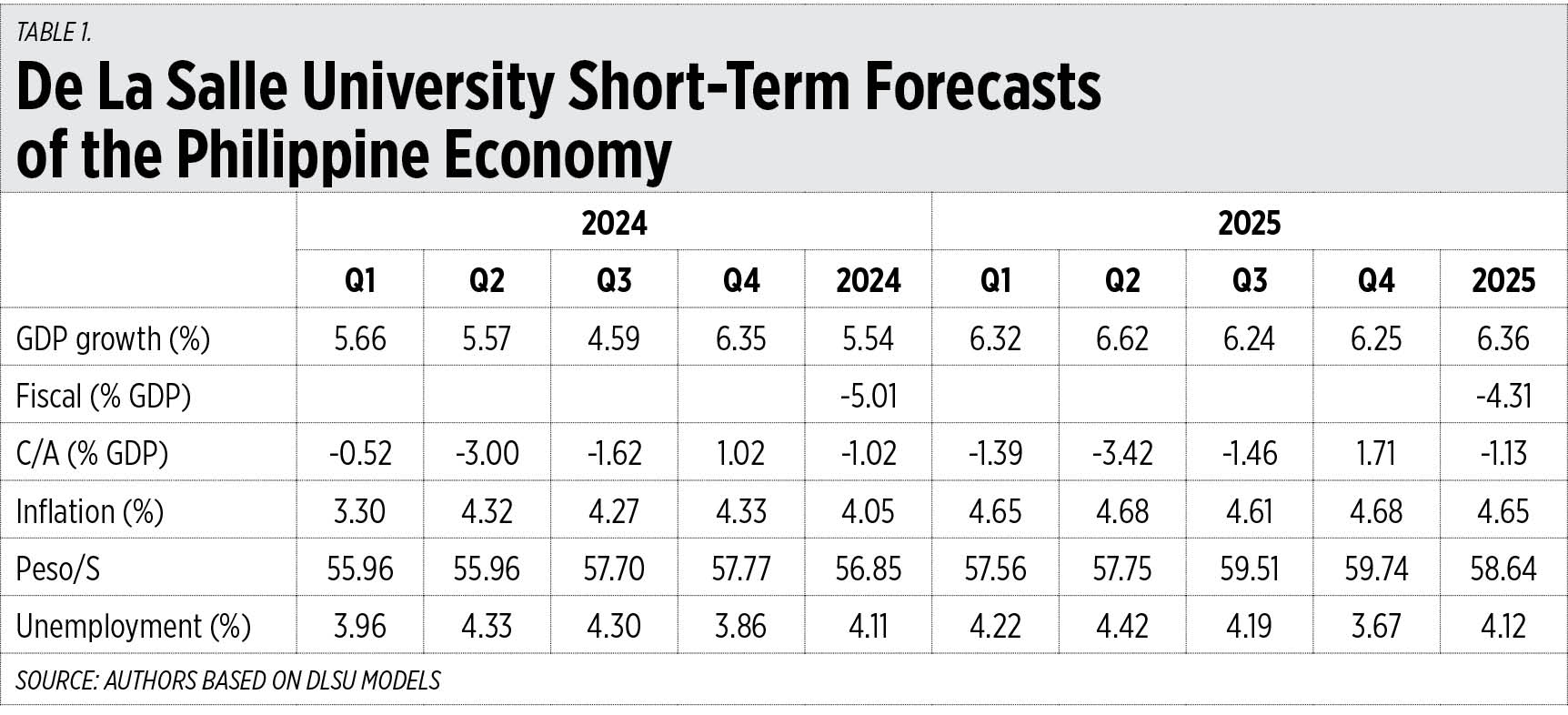
WE RECENTLY PRESENTED our analysis of the Philippine economy until 2030 using the De La Salle forecasting and simulation models. Our assessment tilts toward the moderately optimistic side of the scale, barring unexpected shocks. Growth will continue, wages and income per capita will increase, the very thin middle class is also slowly increasing, and poverty will decrease.

Having said the above, our analysis shows that the Philippines will not do as well as the government keeps saying over and over. This means that the key targets set in the Philippine Development Plan (PDP) 2023-2028 will be attained a few years later, including income per capita which is said will be attained by 2028. The economy will grow, but not at 6.5-8%. It will register an average of 5.5% between now and 2030, with a peak of 6.4% in 2025. Poverty will decline, but will not reach 9% until 2035 (2028 in the PDP), and its hypothetical elimination would take several decades. At the same time, the macroeconomic situation is stable (again, barring shocks), with unemployment declining toward 4% and inflation staying close to the ceiling of the central bank’s target range of 2-4%. We also see the Peso depreciating and reaching P62 per dollar in 2027 and remaining there. The latter is not necessarily bad news as the economy will eventually adjust to this rate; and moreover, while initially imports will become more expensive, exports, and tourism, will become more price competitive.

The picture summarized in previous paragraphs reflects steadiness. The problem is that behind it there is what we call MOTS, or “More Of The Same.” Calls to further liberalize foreign direct investments (FDI) or improve the ease of doing business might be fine but these will not put the economy on a high-speed train. We are in the caboose. We have said it before: the country needs firms that manufacture high-quality products and export them, that is, compete in world markets.

Unless the structure of our economy changes in the direction of industrialization, progress will continue but at today’s pace. The reason? About 50% of our employment is in activities of low productivity, such as agriculture, wholesale and retail trade, and construction. This structure does not change significantly in our baseline scenario forecast until 2030. This is the main reason why gross national income per capita increases slowly and remains below the government’s target: it will reach $5,919 in 2028 against the PDP target of $6,044 to $6,571. Under our baseline scenario, it will take many more years than most think to get to high income or catch up with economies like Malaysia, not to mention with the advanced Western economies. This is probably a chimera.

Moving forward to 2026-2030, growth will peak in 2025 (6.4%) and 2026 (6.2%) but then it will decrease toward 5-5.5% until 2030. Why does this happen? The reason is that it is very difficult to maintain for years a growth rate at potential, which is about 6-6.5%. For the Philippines to grow (actual growth) above this rate, the potential rate will have to increase, and this will happen only with a “different” economy. With the current engines, this is the fastest we can advance, not 7-8%.

Our models allow us to design a hypothetical scenario where we travel faster. In this scenario, the manufacturing employment share increases to about 25% of total employment between now and 2030. This would accelerate growth to 8-10% until 2030 (East Asian style) and would bring gross national income per capita to about $7,406 in 2028 and to $8,777 in 2030. This is the only way.

Of course, in reality, the share of manufacturing will not reach 25%. The manufacturing employment share today is just 8% (and declining), though it is true that the number of workers in the sector is increasing but at a much slower pace than in other sectors (hence the decline of this sector’s share in total employment). Yet, the exercise is meaningful in that a 25% manufacturing employment share was the share that all advanced economies attained in the 20th century. Reaching this share was a necessary precondition to attain high income. Our model is consistent with this assessment.

What can the Philippines manufacture? This is simple: the thousands of products that make a national economy and that today we do not manufacture or do not export competitively (as high-quality products). Instead, we import them: canned processed fruits and vegetables (agriculture); table napkins (textile sector); cutlery (metal sector); glasses (chemical sector); chairs, tables, and beds (furniture sector); or top-of-the-line ball pens, pencils, and erasers. And we do not manufacture the machines that make these products. If Filipino companies cannot manufacture these products competitively, “let’s close the country.” Do not look for funny growth drivers. Artificial intelligence and similar stories? No, that is not what will propel the Philippines today.

We also simulate what would happen if the employment share of Accommodation and Food increased to 15-20% by 2030. This is where most workers in the tourism sector are. Again, this will not happen, but the exercise tells us that income per capita would be lower than in the baseline scenario (at $5,319). Why? It is a low-productivity sector.

There is no choice but to industrialize, however difficult it may be. The Philippines missed its chance in the 1970s, 1980s, and early 1990s; and even today, many government officials and private sector CEOs believe that what the Philippines needs is recipes such as further liberalizing FDI, spending more on infrastructure, or reducing red tape. We do not claim that these are not necessary. What we claim is that these measures will not contribute to significantly change the structure of the economy. They amount to doing MOTS, perhaps somewhat better but no more.

In the case of much-desired FDI, the evidence for most developing countries is that it is detached from the local economy. There is no correlation between the position in the Doing Business ranking and growth. Yet, do not talk to some policymakers about “industrial policy” — measures to propel the manufacturing sector. They make faces. Instead, the focus on “servification” has become a mantra.

Naturally, services do contribute to the economy. The problem is that a significant portion of our services is non-tradable (does not compete in the world economy). Business Processing Outsourcing certainly contributes, but that sector’s share in total employment is small in a county with almost 50 million workers. We do recognize the sector’s contribution from the balance of payments point of view. We do hope this sector moves up the development ladder and enters the activities that pay higher wages.

Tourism could also lend a hand, but the Philippines will — for sure — not accommodate 40 million tourists by 2030. Where will they stay? Not to mention that our island-tourism type is not sophisticated. And even if the share of employment in agriculture declined by a few percentage points and that of tourism increased (as it will happen), the corresponding increase in productivity and wages would only be a fraction of that attained if the employment share that increased was that of manufacturing.

Finally, the other important contributor to maintaining the balance of payment is OFW remittances. That we have almost 2 million workers abroad is a sign of the weakness of the economy. The good news is that we forecast that this number will decrease to 1.4-1.5 million by 2029-2030. This is the result of higher wages at home.

In conclusion: our analysis shows that the Philippine economy will continue improving until 2030. Hence, the glass is half full and we are moderately optimistic. The big question is the direction and speed of the economy in the coming years: where is it going? We argue that unless the structure of the economy changes and manufacturing plays a much more important role (becomes a bigger employer), we will continue being part of the caboose. Either we focus on creating firms that transform our economy (increase productivity and manufacture products that compete in the world economy), or the Philippines will be left behind in the coming decades.


Jesus Felipe is distinguished professor of Economics at De La Salle University. Pedro Pascual is a board-certified economist with Spain’s Ministry of Economy and partner at MC Spencer (Philippines).

Twisters film thrill-packed and science-backed, its stars say

LONDON — Almost 30 years on from the blockbuster Twister, deadly tornadoes and their chasers return to the screen for an updated extreme weather tale.

Twisters is a “current-day chapter” of its 1996 predecessor, its makers say.

It centers on storm expert Kate Carter, played by Daisy Edgar-Jones, and chaser and superstar streamer Tyler Owens (Glen Powell) whose paths cross during a once in a generation tornado outbreak in Oklahoma.

Directed by Minari filmmaker Lee Isaac Chung, in his big-budget action movie debut, Twisters introduces advanced technology and a new generation of adrenaline junkies with a large social media following.

“This is a new chapter. This is just a modern telling of that same community that audiences responded to in ’96,” said Mr. Powell, premiering the film in London on Monday.

“Audiences can expect lots of fun, lots of thrills and just to strap in and go on the ride,” added Ms. Edgar-Jones.

Mr. Powell’s Owens is a former rodeo star and self-titled “tornado wrangler” whose rowdy team courts danger with gusto. Texan Mr. Powell, 35, said both the original movie and the reboot resonated with him personally.

“When I was like nine years old, there was a tornado that went through Jarrell, Texas, and we were on the road to my aunt’s ranch and got kind of stuck in it. It was a really terrifying thing… But we cleaned up after that tornado. It’s one of those things that imprints on you for the rest of your life,” he said.

“This movie’s really about what we do in the face of storms, but also how we pick up after each other in the wake of disaster,” said Mr. Powell. “It’s a thing that affects a lot of people, and not just tornadoes but weather all over the planet. I think this is a universal movie for that reason.”

Twisters, written by Mark L. Smith, is based on consultations with meteorologists, climate scientists, and real-life storm chasers, said Mr. Chung.

“We had people working on the forefront of climate science and also tornado science. We tried to incorporate as much of that into this film as possible to honor what is actually happening and also honor the scientists who are heroes in many ways. If we’re going to look to any solutions, we have to look to the scientists,” he said.

Like Twister, Mr. Chung hopes his follow-up will leave a lasting impact.

“That first film inspired so many people to get into weather science and research. I would love if that would happen with this movie, that we would inspire a new generation of people want to research and get out there and study.”

Twisters will start screening in Philippine cinemas on July 17. It has an MTRCB rating of PG. — Reuters

Asian FX bears ease as US rate cut bets solidify, poll shows

SHORT POSITIONS on most Asian currencies eased, as rising expectations of at least two rate cuts by the US Federal Reserve this year and an easing dollar boosted risk sentiment, a Reuters poll found on Thursday.

Bearish bets on the Singapore dollar and the Thai baht were at the lowest since early January, while those on the Indonesian rupiah eased to their lowest level since mid-March, according to a fortnightly poll of 11 analysts.

Growing expectations of the Fed’s two rate cuts this year after a slew of worse-than-expected economic data was the “main factor” in bearish bets easing, said Poon Panichpibool, a markets strategist at Krung Thai Bank.

Fed Chair Jerome H. Powell has said “more good data” would build the case for the US central bank to cut interest rates.

Investors now await the release of June inflation data from the US, due later on Thursday, which is expected to show inflation cooling and make a case for a September rate cut.

If the market remains certain on the Fed delivering two rate cuts this year, then high-yielding emerging market currencies such as the Indian rupee and the Indonesian rupiah could outperform low-yielding peers, Mr. Panichpibool added.

The Indian rupee, the best performer in the region so far this year, was among the least-shorted foreign exchange (FX) currencies.

Short bets on the Philippine peso was at the lowest level since early April. Philippine central bank governor said last week that it had more scope to cut interest rates at its next meeting in August after annual inflation slowed in June.

The Chinese yuan remained among the most-shorted among Asian currencies.

Data from China, the single biggest trading partner to many emerging Asian countries, showed that consumer price inflation came in below expectations while producer price deflation persisted, pointing to stubbornly weak demand.

“Markets are anticipating further policy support for the economy and the housing sector, which could rejuvenate equity markets and support the RMB (yuan),” analysts at DBS wrote.

Bearish bets on the South Korean won also eased. All responses were received before the Bank of Korea stood pat on its interest rates, saying it was time to prepare for a pivot to rate cuts. — Reuters

Bringing quality, accessible health services to more Filipinos

Photo from MPIC.COM.PH

Quality healthcare is essential for improving life expectancy, enhancing the quality of life, and reducing mortality rates. However, according to the Philippine Statistics Authority (PSA), there are still significant disparities in healthcare access across different regions of the country.

For instance, while urban areas like Metro Manila have a relatively high concentration of hospitals and healthcare providers, rural regions often struggle with a scarcity of medical facilities and professionals.

Manuel “Manny” V. Pangilinan, widely known as MVP, has made significant contributions to infrastructure development, service improvements, and strategic investments aimed at enhancing the accessibility and quality of healthcare for Filipinos.

As a business leader and philanthropist, his initiatives have left a lasting impact on various sectors, particularly in addressing critical infrastructure needs and advancing healthcare services across the country.

Under MVP’s leadership, Metro Pacific Investments Corp. (MPIC) has invested heavily in the healthcare sector, managing some of the country’s top hospitals and enhancing their capabilities and services.

With a mission to deliver integrated quality healthcare services that are accessible and sustainable, MPIC has embarked on initiatives that align with its vision of being the leading and most valued integrated healthcare network in the country.

Since its initial investment in Makati Medical Center in 2007, Metro Pacific Hospital Holdings, Inc. has rapidly emerged as the largest private hospital group in the Philippines, revolutionizing the healthcare landscape in the country.

Rebranded as Metro Pacific Health (MPH) in 2022, it now encompasses 21 reputable hospitals like Makati Medical Center, Cardinal Santos Medical Center, Asian Hospital and Medical Center, Riverside Medical Center, and Davao Doctors Hospital, as well as 23 hospitals, 26 outpatient care centers, two allied health colleges, and a centralized laboratory across the country.

“We rename Metro Pacific Hospitals to Metro Pacific Health — symbolizing not only a wider spectrum of investments in health services, but also our enhanced mission of responding to the most pressing concern of our people,” said the MPH founder and chairman.

The healthcare network’s focus on expanding its network of healthcare facilities is aimed at providing affordable and quality healthcare services to a larger segment of the population.

Metro Pacific Health also emphasized the importance of running hospitals more efficiently to reduce the overall cost of healthcare services. By leveraging collective buying power to procure medicines and supplies at the lowest possible cost, the company aims to streamline operations and pass on the cost benefits to its patients.

Furthermore, the company is committed to expanding its range of services to include complex healthcare procedures within the next three to four years. The forward-looking approach is designed to reduce the need for Filipinos to seek specialized medical treatment overseas, ensuring that such services are readily available within the country.

“Our intention is to expand efficiencies to make our services affordable. That’s an important concern for this group — to make the health services, not only quality health services, but to make services affordable. We will not only provide quality hospital care, but make that accessible to (a) greater number of people,” Mr. Pangilinan said.

According to the MPH chairman, each MPH facility is dedicated to providing top-notch medical care while upholding the renowned Filipino values of hospitality and compassion.

MPH is committed to being “The Heart of Filipino Healthcare,” offering high-quality, compassionate, and patient-centric care. The organization takes pride in delivering expertise and kindness across all its hospitals.

From hospital care to virtual, mobile, and home care, Metro Pacific Health aims to foster healthy lifestyles through wellness-oriented programs and projects. With over 9,000 expert doctors and nearly 17,000 skilled nurses, MPH’s dedication and selfless service, especially during the pandemic, highlight the resilience and camaraderie of Filipino healthcare professionals.

One of the key investments made by MPH has been in the e-health landscape. This investment aims to ensure that, while embracing modernity, the network remains fully focused on the patients in its care delivery.

The healthcare network has been upgrading its partner hospitals’ information systems, implementing electronic medical records, establishing virtual care platforms, and developing dynamic portals.

Currently, MPH acquired the biggest number of beds and the size of the investments in Greater Metro Manila. By 2025, the healthcare network plans to add two more hospitals. The company is also aiming to expand its footprint in regional areas, specifically targeting medium-sized hospitals in those regions.

“We will achieve our vision of making Metro Pacific Health the leading and most valued integrated healthcare network in the Philippines, and one of Asia’s most innovative and trusted healthcare providers,” Mr. Pangilinan said.

Embracing digitalization for accessible healthcare

Photo from freepik / macrovector

MPH has unveiled its blueprint for business growth, which includes modernizing healthcare with state-of-the-art technology in medical science and data. The healthcare network’s approach is expected to improve the end-to-end customer experience and making world-class quality healthcare more accessible to many Filipinos.

Mr. Pangilinan’s vision for improving healthcare accessibility materialized in the form of the mWell mobile application. One of its standout features is teleconsultation, priced at an affordable P399 per session, which includes P20,000 worth of accident insurance.

The application also includes a groundbreaking feature called the mWell Mind Health Score, designed to provide insights into one’s mental well-being.

In a statement, Mr. Pangilinan highlighted the role of digital platforms in enhancing the affordability and reach of healthcare services. He emphasized the need to collaborate with existing healthcare industry stakeholders and serve more Filipinos digitally.

“Digital will expedite the adoption of health services. Make it more affordable, more extensive, so more people can avail of it,” said Mr. Pangilinan.

The impact of these initiatives is reflected in the increasing adoption of digital health services. According to Mordor Intelligence, the telemedicine market size is estimated at US$172.44 billion in 2024, and is expected to reach US$330.26 billion by 2029, growing at a compound annual growth rate of 13.88% during the forecast period of 2024-2029.

Consequently, the mWell app, with its user-friendly interface and affordable services, is poised to contribute significantly to this growth.

“mWell’s mission is to demolish the barriers preventing our countrymen in remote areas from receiving quality healthcare. Our platform is sustainable, future-proof, and fully integrated — allowing us to bring healthcare closer to all Filipinos,” Mr. Pangilinan added. — Mhicole A. Moral

MSMEs at risk of closure even with P35 wage hike

REUTERS

MICRO, small and medium enterprises (MSMEs) are at the greatest risk of closing down after the latest wage increase, an economist said.

“I don’t think P645 (the level wages are at in Metro Manila after the wage order) is enough given that inflation has been going on for several years now. But even this wage increase is not recommended because it will lead to the closure of many micro-, small- and medium-scale enterprises,” Leonardo A. Lanzona, Jr., an Ateneo de Manila economics professor, told BusinessWorld via Messenger chat.

“The overall objective of the government is to nurture MSMEs to grow into large corporations, achieving scale economies and larger profits. The minimum wages contradict this objective,” he added.

According to the Department of Trade and Industry, 99.59% of businesses in the Philippines were MSMEs in 2022.

The Regional Tripartite Wages and Productivity Board-National Capital Region (RTWPB-NCR) on July 1 approved a P35 wage increase for NCR workers, bringing the daily minimum wage for non-agricultural workers to P645. The new wage scale takes effect on July 17.

Labor groups continue to back a legislated across-the-board wage increase. In both chambers of Congress, bills calling for wage hikes of up to P750 are being considered.

The government’s chief economic planner, Secretary Arsenio M. Balisacan, has said the wage hike in the capital region is unlikely to hurt the economy because it will only affect “one-tenth of 1%” of workers.

About 40,000 to 140,000 workers will be affected if small businesses end up shutting down or reducing their employees, Mr. Balisacan added, describing the number as “negligible.”

“The point is that the burden of inflation should not be placed on the shoulders of the private sector. It is the responsibility of [the] government, not the private firms, to give decent wages,” Mr. Lanzona added.

He said that the government must improve productivity and strengthen social protections.

“Improve skills through training programs and create expanded cash transfer programs such as unemployment insurance,” he said.

“Public goods are intended to serve society as a whole. The private sector is not expected to provide since this is beyond their self-interest. Besides, the politicians and society are the ones who benefit most by providing public goods that offer workers decent wages. Hence, by economic principles, they and society should be (the) ones creating these goods,” he added.

Mr. Lanzona added that the new daily minimum wage in the NCR remains inadequate for dealing with inflation.

“It is not enough to cover the elevated prices after several years of inflation. But at the same time, households on average do not rely much on minimum wages since more than 45% of the workers are self-employed. Only a small portion of the households are dependent on minimum wages,” he said.

Inflation in June eased to 3.7% due to an easing in electricity and transport costs.

Federation of Free Workers Vice-President Julius H. Cainglet said it is the government’s responsibility to ensure correct wages are paid.

“If the government makes it affordable and easier to do business, and hold down electricity and other public utility costs, employers will be more able to pay a living wage,” he told BusinessWorld via Viber.

He added that it is also the government’s role to make it easier for workers to unionize.

“If the workers are unionized and they have collective bargaining power there would be no need for government to set minimum wages since workers would be able to bargain for wages and other benefits on their own,” he said. — Chloe Mari A. Hufana

ERC sees delay in resumption of reserve market operations

THE Energy Regulatory Commission (ERC) is seeing a delay in the resumption of the billing and settlement of amounts in the reserve market as the regulator still has to consult the stakeholders on the proposed price cap.

“We have already received many comments. It looks like it will be a long discussion, which may impact the timeline for the resumption of the reserve market because we definitely want the resumption to happen only when we have the offer floor and price cap,” ERC Chairperson and Chief Executive Officer Monalisa C. Dimalanta told reporters on Wednesday.

Ms. Dimalanta said that they have tracked “more than 100 comments from stakeholders”that they need to sort out.

She earlier said that the ERC is eyeing the reserve market to return to full operations on July 26, as it is tied to the billing cycle.

In a draft resolution, the ERC has proposed setting a floor price of P0 per megawatt-hour and a ceiling price of P19 per kilowatt-hour for trading power reserves.

The ERC has called on all interested parties to submit comments on or before July 8, with a public consultation set for July 11.

The reserve market allows the system operator to procure power reserves from the Wholesale Electricity Spot Market (WESM) to meet the reserve requirements of the energy system.

In March, the ERC suspended the operations of the billing and settlement of the price determination methodology for the implementation of the co-optimized energy and reserve market in the WESM.

It said that the Independent Electricity Market Operator of the Philippines reported significant price increases in reserve costs for March compared to February.

The regulatory body ordered the settlement of 30% of the amounts due on the reserve market transactions during the March billing month to allow power generators to partially recover their costs.

Citing simulations, the ERC projected the partial payments to be worth P1.7 billion, which has already been recovered during the June electricity billing.

The reserves traded for the March period were valued at P5.7 billion. 

The full commercial operations of the reserve market commenced in January. — Sheldeen Joy Talavera

ADVERTISEMENT
ADVERTISEMENT