Home Blog Page 2923

JAC Motors Philippines expands dealer network in key cities

JAC Motors Philippines announced on Tuesday the launch of its six new dealer outlets and partnerships with financial institutions to help fuel its expansion in the country.

In a statement, the company said that new dealer outlets will open in Alabang, Calamba, Iloilo, Manila Bay, Pasig, and Quezon Avenue.

“These new dealerships are part of the company’s commitment to bringing innovative and high-quality vehicles closer to Filipino customers, ensuring easier access and better service across the nation,” JAC Motors said.

Aside from the new dealer outlets, the company also forged partnerships with financial institutions, including Banco de Oro, Bank of Commerce, Bank of the Philippine Islands, China Bank Savings, Philippine Savings Bank, Rizal Commercial Banking Corp., and Sterling Bank.

With its partnerships with the banks, JAC Motors customers can now explore the financing options with the partner banks for their purchase of JAC Motors vehicles, the company said.

“We are thrilled to grow our presence with the opening of new dealer outlets. We are also proud to partner with distinguished financial institutions to provide attractive payment options tailored to our buyers’ needs,” said Tonette Lee, brand head of JAC Motors.

As part of its expansion, JAC Motors is also looking at the launch of its 5-seater sports utility vehicle (SUV) JS6 and 7-seater SUV JS8 PRO.

“Each model is designed to meet the diverse needs of Filipino drivers, from compact city driving to off-road adventures,” it said. — Justine Irish D. Tabile

BNPL seen contributing more to digital economy

PIXABAY

THE BUY NOW, PAY LATER (BNPL) market is expected to contribute 6.7% in gross merchandise value (GMV) to the Philippine digital economy this year, financing firm UnaCash said on Tuesday.

“Our latest findings suggest that the Philippines’ BNPL market is experiencing moderate yet stable progress — affirming its growing role in spurring economic growth. We are witnessing a notable shift in consumer behavior where there is a consistent rise in patronage for this mode of financing,” UnaCash Product Head Erwin G. Ocampo said in a statement.

“Amid economic pressures, we also believe that the increasing adoption of BNPL services is reflective of Filipinos’ view of it as a convenient way of managing their spending habits,” he added. “While consumers are still wary of rising commodity prices in 2024 and less optimistic about their finances this year, financing options like BNPL remain great tools for making big-ticket purchases.”

UnaCash’s forecast for BNPL’s GMV contribution for this year is higher than the actual 4.88% in 2023 and 4.19% in 2022, it said. GMV reflects the total value of goods or services sold over a certain period of time through a customer-to-customer exchange site.

“The forecast was made after a comparison of the volume of the country’s BNPL market from 2020 to 2023 to the growth rate of the Philippine digital economy during the same period,” it said.

The Philippine digital economy amounted to P2.05 trillion in 2023, growing by 7.7% from the year-ago level and contributing 8.4% to gross domestic product, government data showed.

However, the annual growth in the digital economy’s gross value added last year slowed from the 9.4% pace in 2022 and 10.7% in 2021.

UnaCash said BNPL’s “positive impact” on the digital economy is primarily seen through the growing use of these services across several transaction channels.

Micro, small, and medium enterprises have benefited from BNPL services as these have become a preferred payment method for both online and offline retailers, “enhancing their competitiveness and contributing to the overall digital economic landscape,” it said.

BNPL also “fosters trust in digital payment methods, where Filipinos perceive this as a “time-tested” financing service and budget management tool,” UnaCash said. “This leads to the further growth in digital payments, which eventually fuels the digital economy.”

“BNPL acts as a crucial tool for e-commerce businesses, increasing average order values and propelling the sector’s growth. The growing landscape for e-commerce is significantly intertwined with the growth of BNPL. Spending in the e-commerce segment is projected to increase nine times by 2026 from 2021,” it added.

Digital payments made up 52.8% of the volume of retail transactions in 2023, latest Bangko Sentral ng Pilipinas (BSP) data showed, up from the 42.1% share in 2022. In terms of value, 55.3% of retail transactions last year were done online, also rising from 40.1% the year prior.

The BSP wanted at least 50% of the volume and value of retail transactions done online by end-2023 under its Digital Payments Transformation Roadmap.

The increase in digital payments was driven by wider use of online transaction channels among individuals and businesses, the central bank said, with the coronavirus pandemic accelerating this shift.

“The need for contactless transactions and the convenience of online payments have led to a surge in their usage but also fostered innovation in the digital payment sector,” the BSP added. — AMCS

PHL broadband speed improves but still trails behind SEA peers, Ookla says

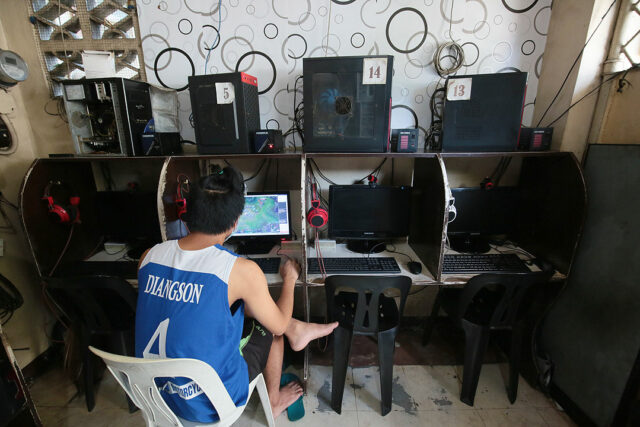
A customer plays a game at a computer shop in Quezon City, Sept. 2, 2020. — PHILIPPINE STAR/ MICHAEL VARCAS

The fixed broadband speed in the Philippines continues to improve but still falls behind its Southeast Asian peers, according to global network testing firm Ookla.

The Philippines’ median fixed download performance improved in the second quarter to 94.42 megabits per second (Mbps), compared with 91.7 Mbps in the same period last year.

Quarter-over-quarter, the country also recorded an improvement, with a 93.77 Mbps median fixed download performance in the first quarter of 2024.

Despite these gains, the Philippines is still lagging behind its neighboring countries, placing third from the bottom of the list.

Singapore ranked first, recording a 284.93 Mbps fixed median download speed in the second quarter, followed by Thailand at 231.01 Mbps, Vietnam at 135 Mbps, and Malaysia at 131.72 Mbps.

Brunei and Indonesia trailed behind the Philippines with speeds of 77.5 Mbps and 31.42 Mbps, respectively.

Additionally, the Philippines saw an increase in median fixed upload speed to 94.13 Mbps in the second quarter, compared with 93.13 Mbps in the same period last year and 93.66 Mbps in the first quarter of 2024.

For the April to June period, Ookla reported that the five areas with the fastest fixed broadband performance are all in Luzon, indicating an unequal distribution of fixed network infrastructure.

Calabarzon logged the fastest fixed median download speed for the second quarter at 99.55 Mbps, while Eastern Visayas recorded the lowest at 38.43 Mbps.

“Given Luzon’s economic significance and high population density, it is where the majority of the country’s investment in high-speed broadband infrastructure is concentrated, especially in the capital, Metro Manila, as well as nearby provinces and central Luzon,” Ookla said.

Meanwhile, mobile internet remains the primary means of connection in the country, with Ookla noting that only 33% of the population has access to fixed broadband.

The global network testing firm also highlighted fixed wireless access and satellite broadband as potential solutions to bridge the digital gap.

Ookla noted that the Philippines’ archipelagic layout may deter internet service providers from investing in fiber deployment, as accessing remote areas can be challenging.

Additionally, Ookla observed that the increasing samples and interest in Starlink’s low-Earth orbit satellite-based connection could make satellite service a feasible home broadband alternative. However, Starlink’s performance in the country is still outpaced by fixed broadband, with a median download speed of 48.14 Mbps compared to 94.42 Mbps. — Ashley Erika O. Jose

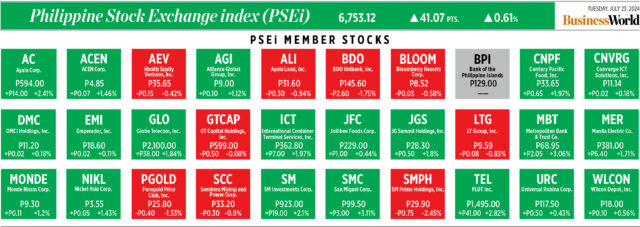
How PSEi member stocks performed — July 23, 2024

Here’s a quick glance at how PSEi stocks fared on Tuesday, July 23, 2024.


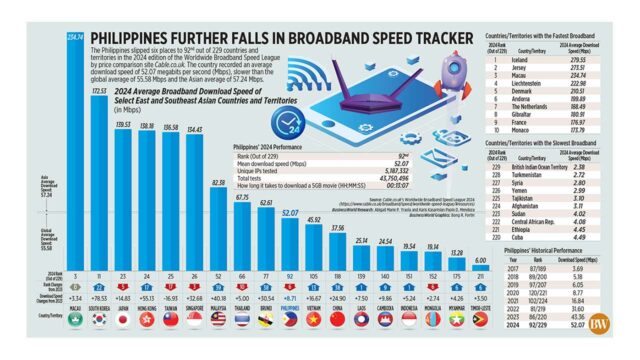
Philippines further falls in broadband speed tracker

The Philippines slipped six places to 92nd out of 229 countries and territories in the 2024 edition of the Worldwide Broadband Speed League by price comparison site Cable.co.uk. The country recorded an average download speed of 52.07 megabits per second (Mbps), slower than the global average of 55.58 Mbps and the Asian average of 57.24 Mbps.

Philippines further falls in broadband speed tracker

NEDA: Q2 GDP ‘close to’ low end of gov’t range

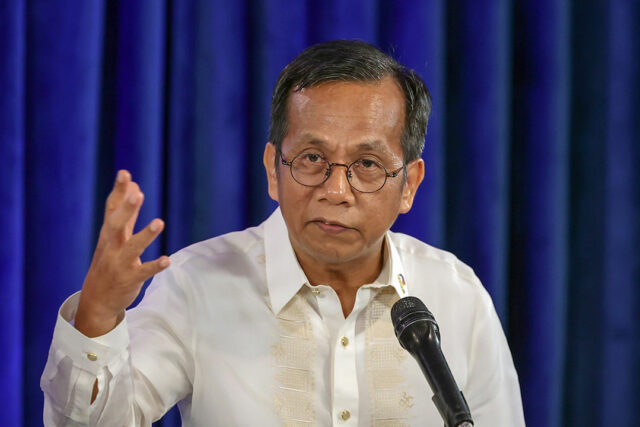
ARSENIO M. BALISACAN — PHILIPPINE STAR/KRIZ JOHN ROSALES

THE economy’s expansion in the second quarter may have been “close to” the lower end of the government’s 6-7% target “at least,” driven by solid remittances and employment, the National Economic and Development Authority (NEDA) said.

“I guess that (growth) is probably close to at least the lower end of the target,” NEDA Secretary Arsenio M. Balisacan told reporters on the sidelines of the post-State of the Nation Address (SONA) forum on Tuesday.

“The remittances are quite good. And then the exports have been not as high (because we) also revised upward the export target for goods and services.”

Cash remittances sent back by overseas Filipino workers in May rose 3.6% year on year to $2.58 billion, the fastest pace in five months, the Bangko Sentral ng Pilipinas reported.

Last month, the Development Budget Coordination Committee upgraded its export growth estimate to 5% this year from 3% previously. The value of exports declined 3.1% year on year to $6.33 billion in May, the Philippine Statistics Authority said.

“The employment numbers are okay as you know. So those are good indications. I think the manufacturing output production indicators are coming out above average. This means the sector is expanding,” he added.

The unemployment rate rose slightly to a four-month high of 4.1% from 4% in April, but the measure of quality jobs was the highest since 2005.

Manufacturing activity in June expanded at its slowest pace in three months amid subdued demand, S&P Global said.

During the forum, Mr. Balisacan cited the need to increase investment in agriculture and infrastructure to address food security.

“We have to massively increase our investments and support the agricultural sector to raise the productivity and incomes of our farmers and enable them to become globally competitive. We (also need to) strengthen their ability to meet rising food demand from our growing economy,” Mr. Balisacan said.

The government’s target income from nontax revenue this year is about P400 billion, Finance Secretary Ralph G. Recto told reporters separately. These will come from dividends, Treasury income, fees and charges, and privatization.

Its target collection from government-owned and -controlled corporations is at P100 billion, he added.

He added that funds withdrawn from government-owned and -controlled corporations (GOCCs) could help boost growth by 0.8 percentage points (ppts), helping at least achieve 6% economic growth this year.

“In the DoF’s analysis, (idle funds) will help grow our economy by more or less 0.8 ppts. This (makes it) easier for us to achieve the 6% or maybe 6.5% growth rate this year,” Mr. Recto said during the post-SONA forum.

This would help create over 600,000 jobs, he said.

Mr. Recto also said the fund transfers are legal, as per consultation with the Commission on Audit, the Governance Commission for GOCCs, and the Office of the Government Corporate Counsel.

“In the 2024 budget, Congress said that the DoF should issue a circular to use these funds that are possibly hibernating or sleeping, and are not being used by GOCCs,” Mr. Recto said.

In Circular 003-2024, the DoF had asked the Philippine Health Insurance Corp. (PhilHealth) to remit unutilized funds worth P89.9 billion to the Treasury.

The Bureau of the Treasury reported that PhilHealth and the Philippine Deposit Insurance Corp. (PDIC) remitted P20 billion and 30 billion in dividends in May, respectively.

Excluding the P89.9 billion, Mr. Recto said PhilHealth has unutilized funds amounting to P500 billion, while the PDIC has P350 billion.

Mr. Recto also allayed concerns that the withdrawal of the funds may worsen the deficit.

Budget analysts flagged the government’s fund transfer order, noting that it may compromise GOCCs’ delivery of vital services. — Beatriz Marie D. Cruz

Agri growth target doable if no big typhoons — DA

THE Department of Agriculture (DA) said its output growth target for this year is achievable if no major typhoons hit the country in the remainder of the year.

The DA had set a 2024 growth goal of between 1% to 2%, accounting for the effects of the El Niño and La Niña weather events.

“With the La Niña, as long as there are no big typhoons, I think we should be able to increase production,” Agriculture Secretary Francisco P. Tiu Laurel, Jr. said in a post-SONA discussion on Tuesday.

In his address to Congress, President Ferdinand R. Marcos, Jr. said that the government continues to focus on farm production through the provision of seed, fertilizer, livestock, boats, and technical and financial assistance.

Mr. Laurel said that the agricultural production target was “not easy” to achieve because of the El Niño and the expected La Niña during the latter part of the year.

“We started El Niño last January then it ended in June, and now we’re coming into La Niña,” he added.

The government weather service, known as PAGASA (Philippine Atmospheric, Geophysical and Astronomical Services Administration), estimates a 70% likelihood of La Niña occurring between August and October.

Last month, PAGASA announced the end of El Niño after the conditions in the tropical Pacific returned to El Niño Southern Oscillation neutral levels, meaning neither El Niño nor La Niña currently is in effect.

He added that production could also be bolstered by the increase of irrigated land following the expansion of coverage by the National Irrigation Administration.

Due to the dry spell caused by El Niño, agricultural production during the first quarter was little changed by 0.05%, according to the Philippine Statistics Authority (PSA).

The PSA is set to release its first half and second quarter agricultural output data on Aug. 7.

The DA estimated agricultural damage due to El Niño at P9.89 billion.

Agriculture accounts for about a tenth of Philippine economic output.

Mr. Laurel downplayed the US Department of Agriculture (USDA) rice import estimate of 4.7 million metric tons (MMT), saying he does not expect imports to go that high.

In a recent report, the USDA increased its forecast for Philippine rice imports at 4.7 MMT for the year, upgrading its earlier estimate of 4.6 MMT.

The USDA said that it had hiked its forecast after first-half imports came in higher than expected.

In the first half, rice imports came in at 2.33 MMT, 25.3% higher than the 1.86 MMT recorded a year earlier, according to the Bureau of Plant Industry.

“I don’t think the lowering of tariffs will really increase imports…The only reason it will increase imports is because of demand, not because of lower tariffs,” he added.

Executive Order No. 62, signed by Mr. Marcos, lowered the tariff on imported rice to 15% from 35% until 2028. The order is aimed at reducing prices of the staple to help tame inflation. — Adrian H. Halili

ASF expected to wind down by yearend with vaccine trials set

REUTERS

THE Department of Agriculture (DA) said on Tuesday that it expects the African Swine Fever (ASF) to wind down ahead of the launch of vaccine trials.

“The ASF issue could gradually be resolved… by the end of the year,” Agriculture Secretary Francisco P. Tiu Laurel, Jr. said in a post-SONA discussion on Tuesday.

President Ferdinand R. Marcos, Jr., in his State of the Nation Address on Monday, said that the government is ready to roll out vaccines against ASF which has decimated the hog herd.

Twenty municipalities across nine provinces had active cases of ASF as of July 12, according to the Bureau of Animal Industry.

The DA has said that the vaccine approved by the Food and Drug Administration was sourced from Vietnam.

“ASF is really a big problem… and one solution to this is (increased) biosecurity. But biosecurity alone is not enough,” Mr. Laurel added.

Another DA program is known as Integrated National Swine Production Initiatives for Recovery and Expansion (INSPIRE) aimed at repopulating farms in ASF-hit areas.

Under the modified INSPIRE program, repopulation will now focus on the construction of multiplier facilities and the use of artificial insemination.

Mr. Laurel said that the DA is ready to implement the vaccine trial by September.

“Hopefully, by September… we will vaccinate (the) red zones and yellow zones,” he added, referring to the classification system for the most intense outbreaks.

The DA has allocated about P350 million to procure ASF vaccines for a government-led trial.

“After six months of the trials, if everything is okay and there are no problems, then I think it will be released for commercial use,” he said.

Asked to comment, Leonardo Q. Montemayor, chairman of the Federation of Free Farmers, said the government should be cautious in using the Vietnam vaccine.

“Very few (1% or less) Vietnamese farmers reportedly use the vaccine,” Mr. Montemayor said via Messenger chat.

Samahang Industriya ng Agrikultura Executive Director Jayson H. Cainglet said that the controlled trials will be fully supervised by the DA, unlike previous vaccine trials.

“We support the earlier announcement of the DA of controlled vaccination trials so there would be strict monitoring of all field trials; unlike the previous trials where the importer had the full control,” he said via Viber.

Mr. Laurel added that the Q fever cases detected recently are limited and easily treatable with available animal medicines.

“Limited areas lang (only) at mukhang madaling gamutin (it seems to be treatable) with the available medicines we have in the Philippines,” he added.

Last month, the DA confirmed the first cases of Q fever, leading to a cull of infected goats.

The BAI had said it detected Q fever in some goats at a government breeding station in Marinduque and a quarantine facility in Pampanga.

The DA said that the culled goats infected by Q fever, which is caused by the Coxiella burnetii bacteria, were imported from the US.

“The findings now, after we talked to the USDA and looked at all the records, it seems that the goats got sick here… but we are still validating,” he said.

Mr. Laurel added that Q fever cases seem to be “isolated” as further tests in another area produced no positive findings.

Q fever is transmissible to humans. Infected people have flu-like symptoms, such as body aches and headaches. — Adrian H. Halili

Fiber backbone, energy projects seen driving growth outside Metro Manila

STOCK PHOTO | Image from Freepik

By Justine Irish D. Tabile, Reporter

THE completion of the government’s national fiber backbone and energy projects will help drive growth in rural areas, the IT and Business Process Association of the Philippines (IBPAP) said.

IBPAP President and Chief Executive Officer Jack Madrid said that the group welcomed President Ferdinand R. Marcos, Jr.’s call to prioritize the strengthening of internet access for more households.

“I think this is very important. Penetration rate and quality of internet access need to be improved. So it is important that he talked about strengthening the power grid and fiber backbone, especially in Visayas and Mindanao,” he told BusinessWorld via telephone. Mr. Madrid said that the energy issues on Panay Island in April had an impact on the industry’s operations in the area.

“As soon as that Cebu-Negros-Panay backbone project is completed, that should help stabilize power stability and prevent outages again in Panay, and that’s important for our industry because much of the growth of our industry will be in the countryside,” he added.

At his third State of the Nation Address (SONA), Mr. Marcos noted the continuous efforts to upgrade capacity and connectivity across the country.

“As part of our internet infrastructure development, phase 1 of the National Fiber Backbone has been completed and operationalized,” he said.

“Phases 2 and 3 have already begun early this year and will be completed by 2026. This fiber backbone will give us sufficient capacity in terms of bandwidth,” he added.

He said that the fiber backbone aims to address the 33% of households still not connected to the internet as of 2022.

“Together with our private sector partners, we will efficiently harness the concept of common towers to provide connectivity to Filipinos who are at the far end of the last mile,” Mr. Marcos said. 

“Expect full government support to ensure the successful completion of this critical project, including policy reforms and streamlined processes,” he added.

Mr. Marcos said that the completion of the Cebu-Negros-Panay backbone project will help stabilize the power situation in the Western and Central Visayas regions and avert the recurrence of power outages there.

Meanwhile, Mr. Madrid said that the completion of the fiber backbone and energy projects will also be important for education, which is also a priority for the information technology and business process management (IT-BPM) industry, with its reliance on human capital.

“We need more talent than we can currently supply, and so education will be the key. We need to teach our children IT at a younger age and help them become more familiar with how to use AI (artificial intelligence) tools,” he said.

“AI has the potential to make the Filipino agents in our industry more efficient and productive in the kind of work that they do … And given that we are a leader in IT-BPM and our agents are one of the most in demand, I think we have a strong potential to become stronger with AI,” he added.

The prominence given by Mr. Marcos to digital infrastructure in his speech attracted approving comment from the European Chamber of Commerce of the Philippines (ECCP).

“The ECCP looks forward to the materialization of the government’s digitalization efforts, including the National Cybersecurity Plan, the ethical development of AI, and the establishment of a National Fiber Backbone,” it said in a statement.

“By prioritizing digital infrastructure, the Philippines can foster a more inclusive digital economy and keep pace with modernization,” it added.

Philippine Chamber of Commerce and Industry Chairman George T. Barcelon said infrastructure will help in driving growth throughout the country.

“These roads, bridges, and airports are basically needed for the growth to be evenly spread out throughout the country. And then, that will also help two key areas: agriculture and tourism,” Mr. Barcelon told BusinessWorld via telephone.

For its part, the American Chamber of Commerce of the Philippines (AmCham) reiterated its call for the passage of the Konektadong Pinoy bill “as it will expand internet connectivity and benefit the many digitalization efforts raised during the President’s speech.”

Aside from addressing the needs of the energy sector, AmCham and ECCP also noted the need to create the Department of Water Resources to address the “country’s long-running water security and supply concerns.”

The ECCP said that the passage of the National Water Resources Act “will ensure that issues and concerns in the sector are handled by a dedicated line agency, providing a better venue for resolving matters relating to water resources.”

Meanwhile, Makati Business Club Executive Director Roberto F. Batungbacal said that although the business group is generally satisfied with the President’s SONA, there are five things they wish the President mentioned during his address to Congress.

“We were hoping he’d talk about the Apprenticeship Bill, enterprise-based education, the Philippine Downstream Natural Gas Industry Act, and Right of Way Act amendments,” Mr. Batungbacal told BusinessWorld via telephone.

PPP Center seeking to increase share of solicited local gov’t projects

PPP.GOV.PH

THE Public-Private Partnership (PPP) Center of the Philippines said it hopes to approve more solicited projects at the local government unit (LGU) level.

“We’re hoping to be able to develop more solicited PPPs. I think the important ones, especially where LGUs are concerned, are solid waste management, bulk water supply, transportation terminals, and as I mentioned, public markets,” PPP Center Executive Director Ma. Cynthia C. Hernandez told BusinessWorld on Tuesday.

She added that those projects are within the jurisdiction of LGUs and cater to the needs of their constituents.

A solicited proposal refers to projects that are identified by the implementing agency from the list of their priority projects, for which bids are invited from the public. An unsolicited proposal is submitted by the private sector without formal solicitation from the government.

Ms. Hernandez said it takes time to approve the projects while feasibility is evaluated.

If a project is deemed unfeasible, the proposers of the project may have to seek alternative financing, like a hybrid arrangement involving borrowing by the government proponent.

Ms. Hernandez noted that there was more freedom for the private sector and the government to agree on feasibility due to the new mechanisms contained in the PPP code.

She added that recovering the investment is also a key consideration.

Projects that involve user fees that the private sector can use to recover the investment are usually approved faster, she said.

Since the approval of the PPP Code in March, Ms. Hernandez noted that the PPP Center has seen an uptick in unsolicited PPP project proposals.

“For unsolicited projects, a lot of them are focused towards LGUs. It’s welcome in the sense that from the National Government perspective, we don’t really have the bandwidth to develop PPP projects in each municipality. And if you think about how local governments are structured, leaders have three years to procure and develop a PPP project and this is too short,” she said.

She added that conglomerates and businessmen can “participate” more in the infrastructure in their locality through unsolicited proposals.

To accommodate this, the PPP center has been ramping up its capacity building for LGUs, Ms. Hernandez said.

Ms. Hernandez noted solicited PPP projects have been making progress, with the recent signing of the technical assistance agreement for the Clark National Food Hub Project with the Clark International Airport Corp. and the Asian Development Bank (ADB), with ADB as the transaction adviser.

“The development of the project is expected to enhance agricultural productivity in the area,” she said.

Ms. Hernandez said that there were 143 total PPP projects as of last week. This would make up one fourth of the total number of Infrastructure Flagship Projects (IFPs) and around half in terms of value.

Analysts, meanwhile, called for a more diverse lineup of PPP projects, particularly railways, to ensure that those being pursued are strategic to the needs of the country as the President affirmed in his address to Congress.

“Rail transport is an important component of our nation’s mobility and should be given the proper attention and focus, but this should be tempered with economic viability,” Nigel Paul C. Villarete, senior adviser on PPP at the technical advisory group Libra Konsult, Inc., said via Viber.

President Ferdinand R. Marcos, Jr. said during his third State of the Nation Address (SONA) on Monday, that infrastructure development is sustained, strategic, and on schedule at the halfway point of his Presidency.

Mr. Villarete said the government must focus on building more rail projects in Luzon and Mindanao, and less so in the Visayas. 

“There are a lot of excellent infrastructure projects that need not be contracted through PPP with the National Government; many of these can be done directly with the local government units,” Mr. Villarete said.  

He said to advance the government’s transportation plans, the Philippines must emphasize the role of local government units especially in PPP projects.

Further, Mr. Marcos highlighted the role of the private sector in achieving the completion of the country’s major transportation and infrastructure project.

During his SONA, Mr. Marcos cited the NAIA PPP project, which is expected to be turned over to the winning proponent by September.

The NAIA PPP project is considered the fastest project to move from submission to investment coordination committee approval to concession agreement signing.

In March, the New NAIA Infrastructure Corp. (formerly SMC SAP & Co. Consortium) signed a P170.6-billion contract to operate, maintain, and upgrade the country’s primary gateway for 25 years.

“The government should limit and identify the bigger and top-grossing airports for PPP and concentrate on those few,” Libra Konsult’s Mr. Villarete said.

This would help free up the government resources for the Civil Aviation Authority of the Philippines (CAAP) to develop smaller airports, he added.

“Infrastructure is a favorite topic, because it is visible, and our country is deficient in it,” Rene S. Santiago, former president of the Transportation Science Society of the Philippines, said in via Viber.

Mr. Santiago disputed Mr. Marcos’ claim that the government’s transportation and infrastructure projects are on track, Mr. Santiago said, adding that the government is lagging.

“Case in point: Cebu BRT (Bus Rapid Transit) is years behind schedule,” he said.

The Transportation department said the launch of the full operations of Cebu BRT line has been pushed back to 2027.

The project was initially scheduled for full operations by the second quarter of 2025 with partial operations. Once completed, the Cebu BRT system is expected to serve up to 160,000 passengers a day.

“We are in the midst of a ‘railway renaissance’. The Metro Manila Subway Project has logged significant accomplishments in its tunneling works… other railway projects, such as the MRT-7 and the North- South Commuter Railway, are likewise progressing,” Mr. Marcos said.

Mr. Santiago said the government’s focus on railway projects only concentrates on highly urbanized areas and leaves behind rural areas.

“Yes, the railway is a renaissance mainly because it gets the biggest share of the investment pie,” he said.

Meanwhile, the Philippines is pursuing programs to strengthen its digital infrastructure and combat cyberthreats.

“We are optimistic about the policy direction of the Marcos administration regarding cyberspace,” Ronald B. Gustilo, national campaigner of Digital Pinoys, said in a Viber message.

He said the government’s implementation of the National Fiber Backbone project will help bring connectivity and telecommunications services to far flung areas.

During the SONA, Mr. Marcos said phase one of the National Fiber Backbone has been completed and started operations. The second and third phases will be completed by 2026.

The “fiber backbone” plan is part of the government’s internet infrastructure development and is projected to provide enough bandwidth capacity.

In June, the Philippines launched the first phase of the National Fiber Backbone, covering 1,245 kilometers. It consists of 28 nodes from Laoag, Ilocos Norte to Quezon City.

“With the policy reforms and streamlining of processes, telecommunication and internet service providers have reached many and may reach more geographically isolated and disadvantaged areas where their services are much more needed so that the online economic opportunities be available to the population residing in these areas,” Mr. Gustilo said.

Sam Jacoba, founding president of the National Association of Data Protection Officers, said Mr. Marcos should compel the Department of Information and Communications Technology (DICT) to “rigorously and vigorously” implement the National Cybersecurity Plan 2023-2028.

Mr. Jacoba also urged the government to revisit the implementation of the Republic Act No. 11934 or the SIM Registration Act to help narrow the digital gap, and combat the rising cyberthreats.

During the SONA, Mr. Marcos said the Philippines will also focus on capacity building for cyber professionals.

“Development of experts who will ensure that the systems used by the government will be prepared in the event of a cyberattack as cybercriminals intend to capitalize (on the growing digitalization),” Digital Pinoy’s Mr. Gustilo said. — Aaron Michael C. Sy and Ashley Erika O. Jose


NGCP says generation needs to keep up with transmission dev’t

PHILSTAR FILE PHOTO

THE National Grid Corp. of the Philippines (NGCP) said the completion of some major transmission projects points to the need for a shift in focus to investing in power generation.

“Attention can now be properly trained at ensuring enough investments in the generation sector to meet increasing demand,” the company said in a statement late Monday.

The Philippines’ main island grids went on red and yellow alert multiple times between April and June, due to forced outages or the operation of power plants below their rated capacity in the face of El Niño and elevated heat. Last week, yellow alerts were raised on the Luzon grid for two days.

A yellow alert is issued when the operating margin is insufficient to meet the transmission grid’s contingency requirements. A red alert will then be raised if the supply-demand balance deteriorates further.

President Ferdinand R. Marcos, Jr. said in his third State of the Nation Address on Monday some transmission projects that were energized and partially energized this year that will accommodate additional power capacity.

“With these systems currently operating at capacity, these major power lines shall contribute to the efficient power exchanges not only between Luzon and the Visayas, but also involving Mindanao,” Mr. Marcos said in his speech.

NGCP, the country’s sole grid operator, welcomed the President’s support, which it took to be “a clear sign that our hard work is recognized as having made a positive impact and is fully aligned with his vision for a strong economy.”

“As we are all working towards ensuring the reliability of the country’s transmission network for a more resilient power industry, we reiterate our call for a more coordinated, resource-adequacy based, and holistic approach to energy planning, that considers the three main links to the energy supply chain: supply, bulk transmission, and retail distribution,” the grid operator said.

In 2024, the NGCP energized the P20.94-billion Mariveles-Hermosa-San Jose 500 kilovolt (kV) transmission line at its full 8,000 megawatts (MW) of capacity.

The grid operator also fully energized the P67.98-billion Cebu-Negros-Panay 230-kV transmission backbone in April, strengthening the link among three major islands in the Visayas.

The P51.3-billion Mindanao-Visayas Interconnection achieved full operational status in January, enabling power sharing between Mindanao and the Visayas with a capacity of up to 450 MW, expandable by another 450 MW.

Last week, the Department of Energy said portions of NGCP’s Cebu-Bohol 230-kV interconnection project have been energized, with full completion expected in December.

NGCP Spokesperson Cynthia P. Alabanza said last week that the company is hoping that the Energy Regulatory Commission (ERC) will issue a decision that ensures fair recovery of its investments in building transmission projects.

ERC Chairperson and Chief Executive Officer Monalisa C. Dimalanta has said that the commission seemed to have demonstrated “clearly” its commitment to “diligently” complete the NGCP rate reset.

Ms. Dimalanta said that the ERC is hoping to complete the rate reset for the fourth regulatory period by the end of the month.

The rate reset process is usually a “forward-looking” exercise that requires the regulated entity to submit forecasted expenditures and proposed projects over a five-year period.

The fourth regulatory period covers 2016 to 2020, while the fifth regulatory period covers 2021 to 2025. — Sheldeen Joy Talavera

Cross-ownership issues need to be tackled in EPIRA review — analysts

REUTERS

A REVIEW of the Republic Act No. 9136 or the Electric Power Industry Reform Act (EPIRA) of 2001 should address concerns about cross-ownership and privatization to enhance competition, analysts said.

“We need to strengthen limitations against cross-ownership to foster competition and fair play and lower electricity prices,” Noel M. Baga, convenor of think tank Center for Energy Research and Policy, said by e-mail.

The think tank’s proposed key changes also include reforming the power procurement process and increasing investment incentives to boost competition.

It has also recommended enhancing the regulatory powers of the Department of Energy and the Energy Regulatory Commission.

EPIRA sought to re-structure the electric power industry by privatizing the generation, transmission, distribution, and supply of power.

Under Section 5 of EPIRA, cross-ownership — the concentration of ownership in two or more related businesses — is only prohibited between a transmission company and any company in generation and distribution.

In his third State of the Nation Address (SONA) on Monday, President Ferdinand R. Marcos, Jr. has called on Congress to review EPIRA “to determine if it is still suitable for our current situation or if it is time to amend it.”

Amendments to EPIRA are included in the list of priority bills that both houses of Congress committed to pass before the current session ends, according to the Legislative-Executive Development Advisory Council.

Advocacy group Partners for Affordable Reliable Energy (PARE) said that reviewing the law would be an opportunity to enhance it “by introducing reforms that would lead to inclusive development.”

“A review of EPIRA is needed to determine what reforms should be pursued to resolve issues such as high electricity bills and consistent power outages,” Nic Satur, Jr., chief advocate officer of PARE, said in a statement before the SONA.

“While EPIRA was envisioned as the solution to end all energy issues back then, that vision has not turned to reality,” he added.

Among its recommendations include prohibiting cross-ownership among distribution utilities and power generation companies “to promote competition in the market.”

“The EPIRA law should be revisited but not just to tweak provisions but to actually review the intrinsic limitations of privatization as the main energy strategy,” IBON Foundation Executive Director Jose Enrique A. Africa said in a Viber message.

Angelo Kairos dela Cruz, executive director of the Institute for Climate and Sustainable Cities, said that amending the law is not “warranted at this time.”

“Instead, the most pressing energy issues faced by Filipinos can be more effectively and swiftly addressed by amending implementing rules and regulations and updating the circulars that implement EPIRA provisions,” he said.

He also renewed the group’s call to abolish the automatic fuel cost pass-through provisions in power contracts, which he said, “have burdened consumers financially for years.”

Under a power purchase agreement between a distribution utility and power producer, fuel costs incurred by the producer are automatically passed on to consumers, with the effect that the volatility of world market price are reflected in local electricity pricing conditions.

“While the ambition to increase renewable energy in the mix, as indicated in the Philippine Energy Plan, looks promising, the continued prevalence of fossil fuel operations can still drive up the cost of electricity and set back true progress,” Mr. Dela Cruz said. — Sheldeen Joy Talavera

ADVERTISEMENT
ADVERTISEMENT