Home Blog Page 288

PLDT Enterprise expands satellite connectivity via Starlink

STOCK PHOTO | Image by Hunter Masters from Unsplash

PLDT INC. said its corporate arm PLDT Enterprise is strengthening its presence in satellite-enabled connectivity by leveraging Starlink services, following its accreditation as an authorized reseller for both public and private sectors.

“Within a year of deployment, Starlink has reached customers across the public sector, agriculture, banking, and other key industries — underscoring the accelerating adoption of satellite connectivity as a practical, enterprise-grade solution, particularly in underserved locations,” PLDT Senior Vice-President and Enterprise Business Head Patricio S. Pineda III said in a statement on Sunday.

PLDT Enterprise said its service is being used by government agencies and enterprise customers, supporting mission-critical operations and providing digital connectivity for key sectors such as education, healthcare, and disaster response.

Since becoming an authorized Starlink reseller, the PLDT unit has integrated Starlink’s low-earth-orbit (LEO) satellite technology into its portfolio of enterprise-grade internet solutions.

“We have been delivering it as part of a fully managed, end-to-end connectivity ecosystem across the PLDT Enterprise Business Group — integrating fiber, wireless, managed SD-WAN, cybersecurity, data centers, and cloud solutions — allowing businesses to achieve resilience and scale through a single, trusted partner,” Mr. Pineda said.

The company said Starlink connectivity can now be deployed not only as primary access in remote locations but also as backup for critical operations, as LEO satellites provide standalone service capabilities.

According to a global network intelligence and connectivity insights firm, the Philippines is now the sixth-largest market for Starlink.

The 2025 Global Satellite Broadband Performance Report by Ookla noted that since 2019, SpaceX has launched 10,790 satellites, serving 9.2 million satellite internet customers globally. Starlink’s largest markets are the United States, Mexico, Indonesia, Brazil, and Canada, with the US accounting for 22.5% of customers and the Philippines 4.2%.

Hastings Holdings, Inc., a unit of PLDT Beneficial Trust Fund subsidiary MediaQuest Holdings, Inc., has a majority stake in BusinessWorld through the Philippine Star Group, which it controls. — Ashley Erika O. Jose

High-value crop export drive to require scaled-up output

PHILSTAR FILE PHOTO

By Vonn Andrei E. Villamiel

INCREASED PRODUCTION and the development of higher-quality varieties are critical to expanding high-value crop exports, as the Philippines signaled plans to diversify its agricultural export portfolio, analysts said.

“We should scale up new planting so we can have more opportunities to go to other markets abroad. The government should produce quality seedlings of export-oriented commodities to achieve higher productivity and quality of produce,” Former Agriculture Secretary William D. Dar told BusinessWorld via Viber.

He said an increase in production volume and quality is needed to make Philippine agricultural products more globally competitive.

In a statement last week, the Department of Agriculture (DA) said it is seeking to broaden the country’s export base by promoting 10 additional high-value crops, — asparagus, avocado, cacao, calamansi, coffee, dragon fruit, durian, okra, pomelo, and rambutan.

The Philippine Statistics Authority, citing preliminary data, said several of the identified crops are already present in overseas markets, although export values remain relatively small and are concentrated in a few destinations.

Calamansi and calamansi products posted the highest export value among the 10 crops at $11.76 million in 2025, with China as the top market. Durian followed with $8.82 million, also largely shipped to China.

Coffee and coffee products exports in 2025 amounted to $7.51 million, with the US, Taiwan, and Canada being the major markets.

Exports of chocolate and chocolate preparations hit $6.53 million in 2025, with major markets including Indonesia, Japan, Thailand, and Malaysia. Okra exports were valued at $3.75 million, primarily going to Japan, while avocado exports amounted to $2.44 million, with South Korea and Japan as leading destinations.

Mr. Dar said crops with an established export base, such as durian and avocado, stand to benefit the most from aggressive promotion, provided that supply is increased.

Former Agriculture Undersecretary Fermin D. Adriano, however, cautioned that some of the crops identified by the DA might face challenges.

“Asparagus requires temperate weather. We also need a better avocado variety that has little stemmy root inside,” he told BusinessWorld via Viber.

Mr. Adriano added that calamansi may be less convenient for consumers in some markets compared with lemon-derived products, while rambutan has limited export prospects, judging by the export performance of top producer Thailand.

He identified ube (purple yam) and pili nuts as other potential export crops. In 2025, ube and ube preparations recorded exports worth $1.65 million, mainly to the US, while pili exports were valued at $36,000, with shipments largely limited to Saudi Arabia.

Mr. Adriano also raised concerns over funding and institutional support, saying that about 70% of the DA’s budget is allocated to rice, limiting resources for export-oriented crops.

He cited the lack of a clear engagement strategy with the private sector and questioned whether current research and development efforts adequately support varietal improvement and productivity in high-value crops.

Philip C. Young, Agriculture assistant secretary for export development, told BusinessWorld that the DA will consolidate the management of export-oriented high-value crops under a single office, which he will head.

Crops to be covered by the new office include the 10 identified by the DA for export promotion. At present, initiatives for all high-value crops are under the High-Value Crops Development Program.

Mr. Young said DA officials are scheduled to meet this month to finalize the functions, organizational structure, personnel, and budget requirements of the proposed office.

“It’s under organization, that new office, but we are already preparing some framework and program for the commodities,” he said by phone.

New York Fashion Week spotlights American brands that have bucked luxury slowdown

MODELS present creations from the Ralph Lauren Spring 2026 collection during New York Fashion Week in New York City, Sept. 10, 2025. — REUTERS FILE PHOTO/ANGELINA KATSANIS

NEW YORK — New York Fashion Week (NYFW) will kick off the month-long fashion show season on Wednesday, at a time when some US labels are finding new popularity even as the luxury industry struggles with a global slowdown.

Among the closely watched catwalk shows will be Ralph Lauren and Coach, both of whom have bucked the trend and are enjoying strong demand, with preppy styles in and some shoppers opting for more affordable handbags after sharp price hikes at the likes of Chanel and Dior.

Efforts to reform NYFW are underway after the event suffered from a decline in sponsorship from big brands, with some large labels opting to stage shows outside the usual calendar.

“It is our goal to make it easier for designers to be able to show a collection and not have to worry about where do we get the funds,” said Imad Izemrane, co-founder and chief executive officer of N4XT Experiences, which has been working on improving NYFW. Changes already implemented in September included setting up a central venue for shows to avoid visitors crisscrossing the city and getting stuck in traffic.

Ralph Lauren’s show takes place on Tuesday at the Jack Shainman Gallery, ahead of the official start of NYFW on Wednesday when designer Rachel Scott will show her debut collection for Proenza Schouler.

Among the other names on the agenda are Carolina Herrera and Michael Kors, while young Romanian designer Lorena Pipenco will close the week with her brand Pipenco’s debut show. Overall some 60 labels will host catwalk shows or designer presentations at NYFW, which runs from Feb. 11 to 16. — Reuters

How minimum wages compared across regions in January

(After accounting for inflation)

In January, inflation-adjusted wages were 21.5% to 27% lower than the current daily minimum wages across the regions in the country. Meanwhile, in peso terms, real wages were lower by around P91.16 to P149.05 from the current daily minimum wages set by the Regional Tripartite Wages and Productivity Board.

Nissan Zeal

A Nissan Z is parked on the pitlane at Clark International Speedway. — PHOTO BY KAP MACEDA AGUILA

Brand celebrates legacy, community with first-ever festival in PHL

By Joyce Reyes-Aguila

NISSAN PHILIPPINES, INC. (NPI) pulled all the stops for its brand enthusiasts with the staging of the country’s first Nissan Festival. Over 1,700 fans, car club members, and visitors gathered at the Clark International Speedway last Feb. 1 to celebrate their passion for everything the marque stands for.

Nissan Philippines President Masao Tsutsumi described the event as a “great milestone” where Nissan fans had the chance “to drive, see, and touch the cars which are really the inspiration and heart of Nissan. This event will increase their affinity to the brand and will be an opportunity for them to (reaffirm) their love for Nissan.”

The Nissan Festival, pillared on the theme “Driven by Passion, Powered by Legacy,” featured a parade of 50 vehicles from various car clubs and 10 heritage vehicles that showcased iconic Nissan nameplates from the past and present. Nissan Philippines also flew in Hiroshi Tamura, considered the godfather/father of the GT-R. “I’ve said it in the past and still believe that the GT-R is a car that represents the essence of Nissan DNA. Our passion toward creating exciting products and our willingness to take on extreme challenges have been represented in this car,” he expressed in a past interview for Nissan’s global website.

Three lucky festival participants experienced the track through a ride-along session with the legendary Mr. Tamura, a product specialist who had also been once involved with the iconic Nissan Maxima/Cefiro model earlier in his career.

In a press conference, Mr. Tamura, now retired from Nissan but still eagerly functioning as a brand ambassador, recalled how the Hakosuka (a combination of the Japanese words for “box” and “skyline”) GT-R, launched in 1969, inspired him to design the vehicle’s future models. “The first-ever (car) racing motor was screaming,” he recalled to members of the press and content creators. “(It was driven by) Mr. Kunimitsu Takahashi, super legendary driver, who won the race. It served as an inspiration for (and an experience that) imprinted on me when I was 10 years old. That’s Nissan’s first invitation for me (to be with the brand) and create a GT-R.”

The afternoon session at Nissan Festival was highlighted by driving exhibitions headlined by Nissan brand ambassador Matteo Guidicelli, motorsports celebrity Marlon Stockinger, F4 Motul racer and brand ambassador Iñigo Anton, and drifter Ashley Sison.

Mr. Tsutsumi confirmed that Nissan Philippines will be “bringing many new models to the Philippines” with “many new technologies and advanced powertrains. All of these are to further strengthen our confidence and presence in the Philippines. I would really like every Nissan fan here in the Philippines to be excited and be proud Nissan owners and drivers.”

In response to a question from “Velocity” on what segments he forecasts will be strong for the brand in 2026, the executive teased that the brand “can create demand generation in a new segment with (its) model launches this year.” According to Mr. Tsutsumi, Nissan Philippines will launch all its new vehicles at the Philippine International Motor Show (PIMS) from June 4 to 7 at the World Trade Center in Pasay City.

Following a dip in pickup sales last year because of the Capital Markets Efficiency Promotion Act (CMEPA) which effectively restored the excise tax to the segment, the president expressed confidence that the segment will “show recovery sooner or later as it is very much a necessary segment in Filipino life, so demand should come.”

He added, “Nissan struggled (last) year because a lot of our business comes from pickup trucks, and sales were impacted.” The brand’s pickup model, the Nissan Navara, had the second-highest sales for the brand locally last year, after the Nissan Terra and followed by the Livina and Urvan, according to the executive.

Meanwhile, In an exclusive interview with “Velocity,” NPI Product Marketing Assistant General Manager Sherwin Kuan revealed that the brand’s to-be- launched vehicles will include “several electrified models because that’s what the market is looking for. It’s going to be a mix — not just BEVs (battery electric vehicles). Filipinos are so open now to owning one (of the electrified options). They’re able to realize the advantages of having a hybrid vehicle or BEV. We hope the Nissan customers from before will really consider these for their next car.”

With the success of the first-ever Nissan Festival, Mr. Kuan reaffirms the value of community for Nissan Philippines. “We want to continue reconnecting with our past customers, and we want to keep building our brand toward the future.”

Debt yields decline on within-target inflation

YIELDS on government securities (GS) traded at the secondary market closed mostly lower last week as players continued to bet on a rate cut by the Bangko Sentral ng Pilipinas (BSP) this month, with inflation staying within target in January despite a slight uptick.

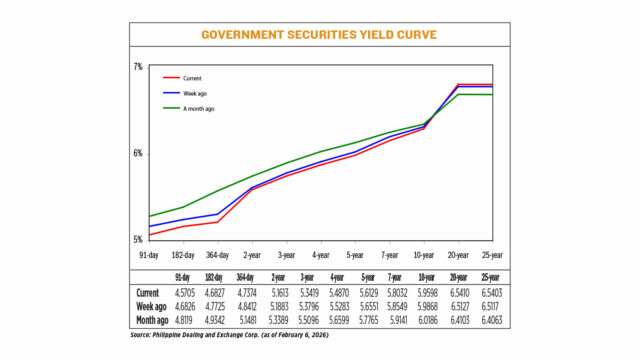
GS yields, which move opposite to prices, declined by an average of 4.32 basis points (bps) week on week, based on the PHP Bloomberg Valuation Service Reference Rates as of Feb. 6 published on the Philippine Dealing System’s website.

At the short end, yields ended lower across all tenors, with the 91-, 182-, and 364-day Treasury bills (T-bills) declining by 11.21 bps, 8.98 bps, and 10.38 bps week on week to fetch 4.5705%, 4.6827%, and 4.7374%, respectively.

At the belly, rates of the two-, three-, four-, five-, and seven-year Treasury bonds (T-bonds) likewise dropped by 2.7 bps (to 5.1613%), 3.77 bps (5.3419%), 4.13 bps (5.487%), 4.22 bps (5.6129%), and 5.17 bps (5.8032%), respectively.

Meanwhile, the long end was mixed, as yields on the 20- and 25-year debt inched up by 2.83 bps to 6.541% and 2.86 bps to 6.5403%, respectively, while the rate of the 10-year tenor dropped by 2.7 bps to 5.9598%.

GS volume traded decreased to P46.61 billion on Friday from P118.3 billion a week prior.

“Philippine GS yields moved lower week on week as January inflation, while slightly higher at 2%, remained well within the BSP’s target and did not materially change the policy outlook,” the first bond trader said.

“Combined with a softer growth backdrop, this kept demand strong, particularly at the short to belly of the curve, as investors continued to look for safe-haven placements.”

The second bond trader said the faster-than-expected inflation print caused yields to tick higher last week, but these increases weren’t enough to fully reverse the gains from the market’s rally following the earlier release of weak gross domestic product (GDP) growth data.

Philippine headline inflation accelerated to 2% in January from 1.8% in December, but slowed from the 2.9% in the same month last year. This was the fastest in 11 months or since 2.1% in February 2025.

It was also higher than the 1.8% median forecast from a BusinessWorld poll of 18 economists, but was within the BSP’s 1.4%-2.2% estimate for the month.

The central bank said in a statement that inflation remains benign and reiterated that their monetary easing cycle could end soon, with further cuts to be limited and data-dependent.

BSP Governor Eli M. Remolona, Jr. earlier said a cut is possible at the Monetary Board’s Feb. 19 meeting if they see the need to support domestic demand.

Philippine GDP growth slowed to a five-year low of 4.4% last year, missing the government’s 5.5%-6.5% target amid the fallout from a corruption scandal that affected both public and private spending.

The Monetary Board has reduced benchmark rates by 200 bps since August 2024, bringing the policy rate to 4.5%.

“Markets were also defensive ahead of the jumbo 10-year issuance on Feb. 18. Pricing the new 10-year bond would be key to where the yield curve will shift in the coming weeks,” the second trader said.

The Bureau of the Treasury announced on Friday that it will auction off new 10-year benchmark bonds, through which it wants to raise at least P30 billion. The offer also has an exchange offer component.

A rate-setting auction is scheduled for Feb. 18, with the offer period set to run until Feb. 20, unless adjusted by the Treasury. The bonds will be issued on Feb. 23.

For this week, the second trader said the yield curve will remain well supported, especially at the belly, amid strong liquidity.

“Markets will monitor data outside of the US like the US payroll numbers to be released on Feb. 11. Given no significant data releases locally, local bonds would likely trade in sympathy to US bond yield movements.”

“Looking ahead, yields are expected to stay supported, with market focus on BSP guidance, and global developments, including US rate expectations, while the announced 10-year supply is largely seen as already priced in,” the first trader added. — Heather Caitlin P. Mañago

How to get the regular Juan and Juana to wear Pinoy tela

A BLOUSE from the DoST-PTRI Kawayarn (a play between the Tagalog word for bamboo, “kawayan” and “yarn”) exhibit, Sept. 2024.

HOW TO GET Philippine Tropical Fabrics into the mainstream was one of the major topics during the 2026 National Textile Convention (TELACon).

One of these ways is to mandate its use in law, and this is already a requirement for government workers. Republic Act No. 9242, otherwise known as the Philippine Tropical Fabrics (PTF) Law, prescribes the use of PTFs for uniforms.

But what most people don’t know is that besides uniforms the law also covers “and for the purposes which require the use of fabrics in government offices and functions.”

Julius Leaño, Jr., director of DoST-PTRI (Department of Science and Technology – Philippine Textile Research Institute), said during the Jan. 29 talk at the Philippine International Convention Center, “Mainstreaming PTF, Government Uniforms and Beyond,” that the use of PTFs covers everything that has cloth: from table linens to upholstery. “Anything that’s textile-based in any government office must be made of PTF.” 

The law defines PTFs as fabrics containing natural fibers produced, spun, woven, or knitted and finished in the Philippines. At least 5% of the textile fibers used must be produced in the Philippines, the most popular being abaca, pineapple, banana, silk, and bamboo.

Mr. Leaño said that there is some confusion and overlap between using PTFs and indigenous textiles, such as the handloom-woven products by various groups around the country. “They may be used as accents,” he said, though using handloom woven products does not necessarily mean that they are compliant with the law. Thus a circular from the Civil Service Commission in 2024 revised the dress code for government offices to use traditional Filipiniana dress on Mondays — this is when those handwoven products can be used — but for the rest of the week, more standard fabrics incorporating the aforementioned fibers can be used.

He said that a report from the Civil Service Commission says that 48% of government offices are in compliance with RA 9242 — however, PTRI’s own report says that only 2% are actually compliant. But “once the private sector involvement [in manufacturing these fabrics] comes in, 98% [compliance will come] in a blink of an eye,” he says.

PIÑA CAMOUFLAGE?
Using PTF goes beyond the civil servants’ polo barong though — coming soon will be camouflage uniforms for the army.

Charmaine Diaz is the founder and chief executive officer of CKDiaz Worldwide Enterprise, a company that makes government uniforms as well as uniforms for the army, and they are working to comply with the law for the latter. She said that the rollout of camouflage uniforms incorporating PTF for the Philippine Armed Forces may begin next year.

It took some time to develop them due to the unique specifications and testing that army uniforms have to go through. They learned that fabric made with abaca proved durable, while pineapple fiber had antibacterial properties, doing away with the extra cost of antibacterial coatings and finishing. However, they are still limited by a lack of a standard for battle dress attire.

Matthew “Chuck” Lazaro, vice-president and director of Asia Textile Mills Inc., which produces and processes these natural plant fibers, said that affordability is one of the roadblocks to these fabrics hitting the mainstream. But while clothes made with PTF may be more expensive than mass-produced Chinese garments, he and Kingsmen Corp. (another clothing manufacturer) President Kristine Racho-Orobia reiterate that they’re still cheaper than other imported brands — and that the public might as well spend that money at home.

Mr. Lazaro said that they can actually supply more fiber, with 80,000 tons of pineapple fiber available. However, it remains expensive because of other costs including labor, and he thinks farm automation might speed up and reduce the costs of production.

HINDI NA MAKATI
Ms. Racho-Orobia tackled one issue that the regular customer may consider before wearing Philippine fabrics. “Hindi naman makati eh (it’s not itchy),” she said, referring to the stereotype that these fabrics can be uncomfortable. “Nowadays, with the way we treat it right now, hindi na siya makati (it’s no longer itchy),” Mr. Lazaro agreed.

Ms. Racho-Orobia, wearing a white blouse made of pineapple fiber, said that she will begin to boast of the fabric’s make, attaching the word “Philippine” to describe it — in the same way she used to say, “Egyptian cotton” or “French lace.”

On the issue of affordability, she said that one can make up a capsule wardrobe, and veer away from the overconsumption of fast fashion. “You don’t need to buy a lot of clothes,” she said.

Just good ones. — Joseph L. Garcia

Who minds the economy?

STOCK PHOTO | Image by Jcomp from Freepik

Ano ba talaga, Kuya?*

Economy Secretary Arsenio M. Balisacan sadly shook his head and said the economy is not doing well. “In 2025, the economy expanded by 4.4%, much weaker than the 5.7% growth in 2024. This was the weakest pace in five years or when GDP declined by 9.5% in 2020. Excluding the pandemic, it was the slowest growth since the 3.9% expansion in 2011. The full-year average also fell below the Development Budget Coordination Committee’s (DBCC) 5.5%-6.5% goal” (bworldonline.com, Jan. 30).

“It’s not a disaster,” Finance Secretary Frederick Go said in a speech at a recent life insurers association event (business.inquirer.net, Jan. 31). “The global average of GDP growth… is only 2.9%. The ASEAN average is 3.8%. We’re growing at 4.4%, so it’s not the end of the world.”

Still, the 4.4% GDP growth is the slowest pace since 2011, excluding the peak pandemic years — and marked the third consecutive year that the Marcos administration has fallen short of its growth target.

The weak growth had largely been expected, resulting from the flood control corruption scandal that froze government spending.

“We’ve met with the Department of Budget and Management, and we’ve met with the top spenders among the agencies. The DoF (Department of Finance) has cleared the amount of money that we’re making available to the government for its expenditures.” The top five spending agencies, according to Go, are the Departments of Public Works and Highways, Education, Health, Agriculture, and Transportation (Ibid.)

The Marcos administration is now targeting economic growth of 5-6% in 2026, 5.5-6.5% in 2027, and 6-7% in 2028. (All of these goals had been revised downward.) Go is banking on controlled inflation, as well as growth in remittances and exports, as key drivers of economic expansion this year.

Private sector analysts also expect the Philippine economy to fall short of its 6% growth potential this year, with any meaningful rebound hinging on the government’s ability to restore confidence after that sweeping corruption scandal rattled businesses and consumers.

Except this: “What we have learned from experience is that in episodes of an anti-corruption drive, good or bad, it doesn’t last long,” Alvin Arogo, first vice-president and chief economist at the Philippine National Bank said. “The growth drag from anti-corruption efforts tends to be temporary, as public sentiment eventually shifts back toward prioritizing economic expansion” (Ibid.). Forgive and forget?

In April 2023, Rajiv Biswas, Asia-Pacific Chief Economist, S&P Global Market Intelligence, was raving about the Philippine economy. “The Philippines economy grew at a pace of 7.6% in 2022, the fastest rate of economic growth recorded by the Philippines since 1976. With strong growth forecast over the medium-term outlook, the size of Philippines GDP measured in US Dollar nominal terms is set to reach USD one trillion by 2033.

“This will make the Philippines one of the largest emerging markets in the Asia-Pacific as well as a leading emerging market globally. Average annual GDP per person has also risen dramatically over the past two decades, from below $1,000 per person in 2000 to $3,500 by 2022 and is projected to rise above $6,000 per person by 2030” (spglobal.com, April 24, 2023).

Indeed, World Bank open data presented good GDP scores for the Philippines for the five years since COVID: -9.5% in 2020; 5.7% in 2021; 7.6% in 2022; 5.5% in 2023; and 5.7% in 2024. In its bi-annual Global Economic Prospects report, the World Bank said the Philippine gross domestic product (GDP) is expected to expand by 5.3% in 2026 and 5.4% in 2027 (bworldonline.com, Jan. 15). Projections are still unchanged as of now.

Note that in January 2025, the Department of Finance was happy that “the Philippine economy has maintained a steady gross domestic product (GDP) growth of 5.6% in 2024 — the second fastest in ASEAN — despite multiple challenges. The outlook for 2025 also remains bullish, fueled by lower inflation and higher consumption and investments… the Philippines currently ranks as the 8th fastest-growing economy last year 2024 compared to the 46 countries that have released their fourth-quarter GDP data (dof.gov.ph, Jan. 30).

“The P6.326-trillion national budget for 2025 is the government’s most powerful tool to counter risks and deliver the biggest growth and economic benefits to Filipinos. President Ferdinand R. Marcos, Jr. continues to lead meetings to identify gaps in the appropriations of National Government agencies, ensuring that funds are used effectively for maximum impact,” the DoF boasted then. In January 2025, no budget shenanigans had been revealed yet, no flood control scams unearthed yet!

President Ferdinand R. Marcos, Jr. on Jan. 5, signed the P6.793-trillion national budget for Fiscal Year 2026, sustaining the momentum in education reform, health protection, food security, social security, and job creation, the Presidential Communications Office (PCO) announced. During the signing ceremony at Malacañang Palace, Mr. Marcos assured the public that the 2026 GAA, or Republic Act No. 12314, was appropriately aligned with the government’s medium- and long-term development plans and is focused on uplifting the lives of Filipinos. Controversial “unprogrammed appropriations” are reportedly still tucked in the 2026 budget, as these were in the P6.793-trillion national budget for 2025. The unprogrammed appropriations are being linked to the corruption connected to flood control projects revealed in the second half of 2025. Acting Budget Secretary Rolando Toledo said he is opposed to scrapping unprogrammed appropriations from the 2027 national budget, which the agency has already begun preparing.

But it is wrong to hold back on government spending, according to Solita Monsod, who was the Minister of Economic Planning, and later Secretary of Socio-economic Planning and concurrent Director of the National Economic and Development Authority (NEDA) from 1986 to 1989, during the term of President Corazon Aquino. In a podcast on Feb. 2 on YouTube, Ms. Monsod explained: “Why did public construction funding go down? It was not because of the investigation. It was because the Department of Public Works [and Highways or DPWH] and [other agencies] with infrastructure programs in the government became scared to sign vouchers because they may also be implicated. They were like in suspended animation. But that is something that the government could have prevented.

“It’s not the scandal that caused the freeze in public construction funding. It was the government who froze public construction. That may not show corruption, but that certainly shows inefficiency,” she said, criticizing Mr. Balisacan’s pronouncement that the slowdown in public infrastructure spending was necessary to restore the public’s trust in the government.

The slow-down failed to restore the trust of Filipinos in the executive branch, including the DPWH, as well as the House of Representatives and Senate, whose members allegedly benefited from kickbacks from the flood control projects. Ms. Monsod said the investigation has also failed to put the “big fishes” in the corruption saga behind bars, with only one high-ranking official — former Senator Ramon “Bong” Revilla, Jr. — and several officials of the DPWH incarcerated months after Mr. Marcos’ order to jail all personalities implicated in the flood control mess (inquirer.net, Feb. 2).

Ms. Monsod laments that the real tragedy is not corruption, but confusion. Citizens, left in the dark, are easy to manipulate. “Without a basic understanding of economics, para tayong dumadaan sa buhay na may isang kamay na nakatali sa likod (it is like we are going through life with one hand tied behind our back)” she said. “Economics, sa pinakaugat nito, ay tungkol sa decision-making, pagpili (At its root, economics is about decision-making and choice). And if we don’t know how to make informed choices, life becomes much harder than it needs to be, and there’s a greater chance of failure.”

We, the people, have to know, and to understand the technicalities of socioeconomics and its impacts.

The problem is, “What are they telling us? And more importantly, what are they not telling us?” Ms. Monsod asks. According to DepDev, the Philippine economy closed 2025 with growth of 4.4%, missing the government’s growth target for the third straight year. Ms. Monsod pointed out that in 2025, GDP growth projections were revised by government thrice before yearend: from 6.5% to 8%; from 6% to 7%; and then in December 2025, from 5.5% to 6.5%. And then we ended with 4.4%?

“In the last 50 years, I have seen the same problems occur again and again: krisis sa bigas, kakulangan sa (rice crisis, lack of) decent jobs, bureaucratic corruption, problema sa utang (debt problems), presidential corruption, legislative corruption. Iba lang ang pangalan ng mga nagko-cause sa problemang ito. Pero sa totoo lang, ngayon, pare-pareho rin ang mga pangalan, (The names of those causing the problems change. But in reality, now, all the names are the same)” she said in her podcast.

While faces change, systemic problems persist. Political dynasties offer solutions without evidence or data. “The result? Nalilito ang taong bayan (Filipinos are confused). And when people are confused, they are so easy to manipulate,” Ms. Monsod said. “These leaders, they’re not serving the people. They’re serving themselves.

“Citizens must question and engage,” she encourages. “I learned early on, it’s better to be a fool some of the time, than a fool all of the time.”

*What is it really, Brother?


Amelia H. C. Ylagan is a doctor of Business Administration from the University of the Philippines.

ahcylagan@yahoo.com

SEC proposes annual governance training for directors, officers

SEC.GOV.PH

THE SECURITIES and Exchange Commission (SEC) has released a draft memorandum circular for public comment on corporate governance training for listed firms, public companies, registered issuers, and accredited training providers.

Issued on Feb. 5, the draft circular is open for comments until the end of the month and requires all directors and key officers of covered entities to attend at least one corporate governance training per year.

First-time directors and key officers must undergo initial training covering topics such as OECD governance principles, ASEAN Scorecard, SEC code, ESG (environmental, social, and governance) reporting, board duties, minority protection, financial oversight, compliance, ethics, illegal practices (e.g., insider trading, conflicts), liabilities, confidentiality, and competition law.

Subsequent sessions may delve deeper into these areas and be tailored to each company’s strategy, regulatory environment, and training needs.

Training may be conducted onsite, online, or in hybrid format either by SEC-accredited corporate governance institutional training providers (CG‑ITPs) or through in‑house programs, provided all programs are accredited by the SEC.

Institutions seeking CG‑ITP accreditation must be SEC-registered, demonstrate a track record in training, show sound financials and governance practices, and pay a P50,000 processing fee. Accreditation would be valid for five years, with a lower renewal fee for those in good standing.

Resource speakers must also be accredited, paying a P2,000 fee and meeting minimum qualifications, including relevant expertise, no pending fraud or governance violations, and attendance at least once per year at an SEC governance forum or roundtable.

Companies conducting in-house training must apply for accreditation for each program, show that content covers mandatory topics, maintain systems to document and store training records, pay P10,000 per program and P5,000 per speaker needing accreditation.

Both providers and companies must submit pre-training notices (program details, speakers, materials) and post-training reports (attendance, evaluations, certificates, documentation or recordings) and retain records for five years in an SEC-accessible online repository. Companies must also disclose directors’ and officers’ training in their Annual Corporate Governance Report or Integrated ACGR.

Limited exemptions are allowed, including for SEC-accredited speakers who maintain accreditation and conduct at least one accredited training annually, or for directors and officers attending qualifying foreign governance programs disclosed in governance reports and on company websites. Certain speakers, such as incumbent directors or officers speaking at their own company’s in-house training, incumbent and recently retired senior government officials, and foreign experts, are exempt from SEC accreditation.

Non-compliance may incur escalating fines for late filings, use of non-accredited speakers, failure to attend required training, misrepresentation, or refusal to allow SEC observers during training, with repeated violations potentially resulting in suspension or revocation of accreditation.

The circular would repeal earlier SEC memoranda on corporate governance training, the commission said. — Alexandria Grace C. Magno

Grab Philippines awards scholarships to new batch of STEM, business students

Grab Philippines officially welcomed its fourth batch of GrabScholars, awarding full four-year scholarships to a fresh cohort of STEM (Science, Technology, Engineering, and Mathematics), Business, and Sustainability students.

Along with tuition coverage at renowned institutions like Mapua University and the Cebu Institute of Technology University, the scholars also receive a monthly stipend, a brand-new laptop, and other school essentials.

The new cohort — Harvey Blaize Ramirez, Reign Quiñones, Lloeby Xyra Semana, Dainty Jurzhail Balde, Wrench Maxenne Singcol, and Chrislyn Bacalso — brings the program’s total number of existing full college scholars to 23.

Grab Philippines Managing Director Ronald Roda emphasized that investing in these students is an investment in the country’s tech capabilities. “The world is moving at breakneck speed, particularly with innovations in tech and AI. To better prepare our country towards important advancements, we need young Filipinos who aspire to be the next shapers of the STEM space,” Mr. Roda said. “GrabScholar is about ensuring Filipinos are empowered to be the builders and leaders of tomorrow’s tech landscape.”

The GrabScholar program is a cornerstone of the GrabForGood agenda, the superapp’s social impact initiative aimed at promoting socioeconomic mobility of communities in Southeast Asia.

Apart from full college scholarships, Grab said GrabScholar also extends one-time bursaries to more than 300 underprivileged elementary and high school students to help cover school-related needs. The financial assistance reaches up to P2,500, typically released through GrabPay as reimbursement for eligible expenses such as books, uniforms, and school supplies.


SparkUp is BusinessWorld’s multimedia brand created to inform, inspire, and empower the Philippine startups; micro, small and medium enterprises (MSMEs); and future business leaders. This section will be published every other Monday. For pitches and releases about startups, e-mail to bmbeltran@bworldonline.com (cc: abconoza@bworldonline.com). Materials sent become BW property.

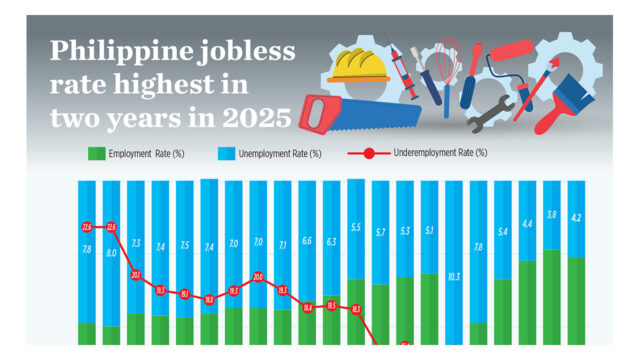
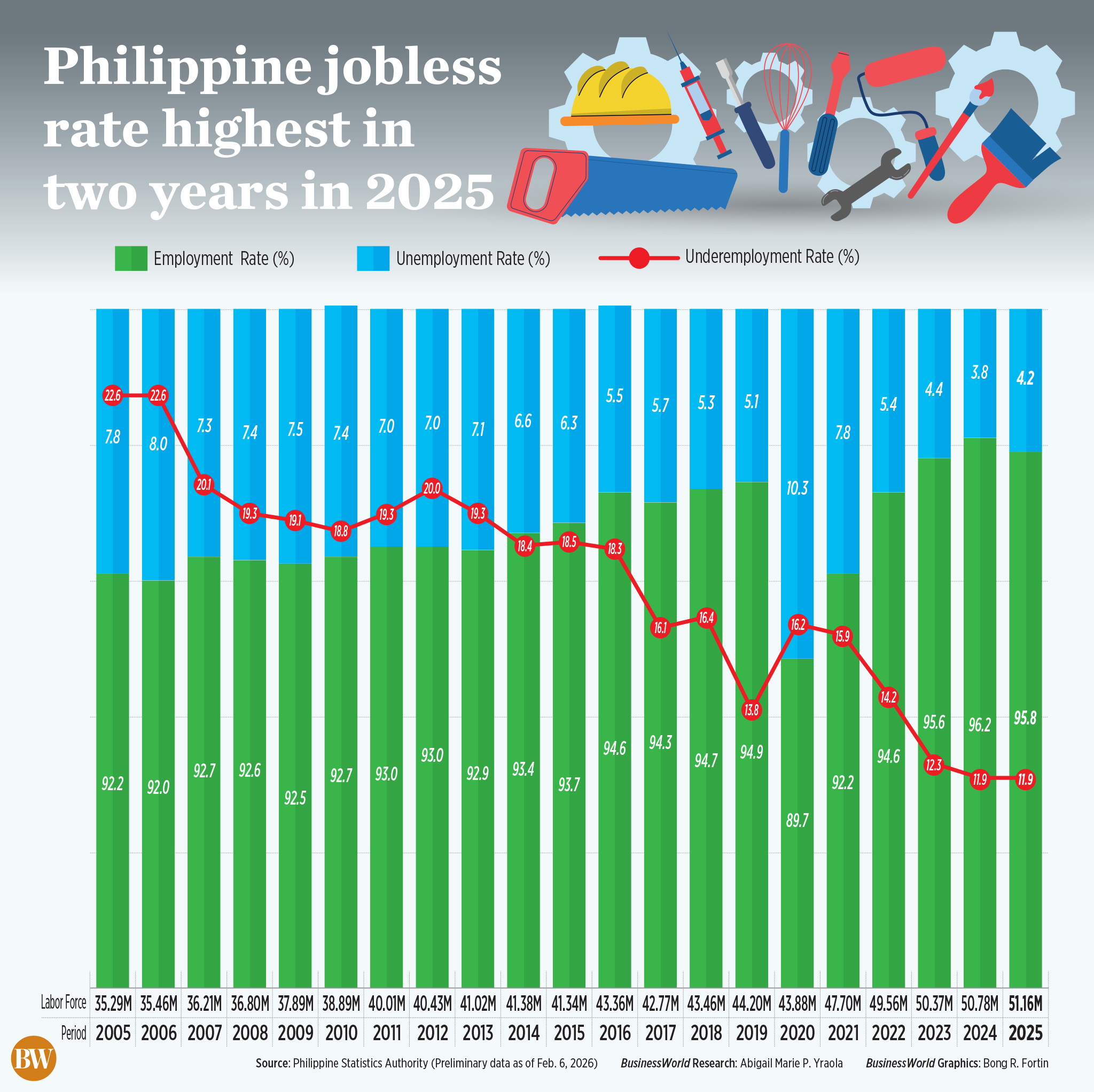
Philippine jobless rate highest in two years in 2025

THE COUNTRY’s unemployment rate rose to 4.4% in December amid a sharp contraction in construction jobs, bringing the full-year average to a two-year high of 4.2%, data from the Philippine Statistics Authority (PSA) showed. Read the full story.

Village-based feed program to tap co-op agribusinesses

REUTERS

THE Department of Agriculture (DA) said it is launching a village-based feed supply program, which aims to boost corn and livestock production, cut feed costs, and improve rural incomes through cooperative-led agribusiness.

The Village-Type Feed Complete Chain Project (VFCCP), authorized by DA Memorandum Circular No. 2, aims to establish localized, self-sustaining feed production within rural communities.

The VFCCP will equip organized farmer groups with the infrastructure, machinery, and technical capacity necessary to produce high-quality corn- and forage-based livestock feed.

“This is about fixing the weakest link in livestock production — feed — by putting control back in the hands of farmers. When communities can grow, process, and mill their own feed, we lower costs, raise productivity, and make our food system more resilient,” Agriculture Secretary Francisco P. Tiu Laurel, Jr. was quoted as saying in a statement.

The DA said the limited availability of affordable, quality, and consistent feed drives up production costs, reduces productivity, and causes frequent feeding disruptions, particularly among smallholder raisers.

Under the VFCCP, the DA will set aside a maximum budget of P40 million for each viable project, depending on the approved components and readiness of the recipient.

The DA said initial funding will be charged against the National Livestock Program, funded by the General Appropriations Act.

According to the circular, VFCCP will support the development of up to 25 hectares of corn and forage production areas, managed collectively by an accredited cooperative or association.

“The program integrates climate-resilient technologies such as solar-powered irrigation systems, biomass dryers, and mechanized forage production to ensure year-round feed availability and reduce reliance on imported inputs,” the DA added.

According to DA estimates, a VFCCP enterprise could generate average annual revenue of about P38.9 million against operating costs of roughly P30.7 million, yielding an estimated annual net cash flow of P8.2 million. — Vonn Andrei E. Villamiel