

Home Blog Page 2873

Style (08/05/24)


Ariana Grande: Swarovski’s new ambassador

SWAROVSKI is joining forces with singer Ariana Grande as its new ambassador and face of the brand. This partnership unites two icons of pop culture and will be launched with a Holiday Campaign in 2024. The Grammy-winning singer, songwriter, and actress (who is playing Glinda for the movie version of the musical Wicked) is among the world’s best-selling artists and is also an advocate for inclusivity and empowerment. Ms. Grande said: “I am thrilled to be Swarovski’s Brand Ambassador. It’s an honor to represent a house that shares my passion for creativity, pushes the boundaries beyond the world of jewelry and promotes values of unapologetic self-expression.” Giovanna Engelbert, Swarovski Global Creative Director, said: “Ariana’s charisma and positive energy resonate with Swarovski’s essence of bringing joy to the world and I am thrilled that she is joining us as Brand Ambassador.”


Longchamp emphasizes longevity

LONGCHAMP aims to establish responsible practices in the fashion industry and has expressed a desire to reduce its environmental impact. Adrien Cassegrain, Longchamp’s Director of Transformation, said, “Our foremost responsibility? Ensuring the longevity of our products.” The brand’s true DNA lies in its leathers, sourced from tanneries certified by the Leather Working Group. In 2023, 79% of the leathers used by Longchamp attained the Gold distinction, the highest level of certification, ensuring stringent environmental and social standards. Longchamp goes a step further by embracing more environmentally conscious materials. Since 2019, the brand has introduced various product ranges crafted from recycled materials. The Le Pliage bag, revamped with a canvas woven from recycled fibers, demonstrates this evolution. This transition has slashed the carbon footprint of each Le Pliage bag by nearly 20%. Examples of this eco-conscious strategy in the new FW 2024 collection are included in ready-to-wear, with the kimono jacket in recycled polyester and the line of sneakers crafted entirely from recycled materials. The Maison not only produces durable items but also repurposes end-of-roll materials to create new pieces. “This approach has long been part of our ethos,” said Mr. Cassegrain. “We develop products using old materials; this anti-waste stance is simply common sense.” Bags from the Re-Play collection align with this logic, such as this season’s Cabas Longchamp from the Re-Play line (a new bag crafted from end-of-roll nylon from previous Le Pliage collections). Some models from the Epure line also follow the logic of creating something new from old stocks by reusing cowhide leather from previous seasons. Initiatives aimed at sustainability extend beyond production. The brand is committed to ensuring that each product can be repaired, thereby extending its lifespan. Longchamp’s repair service, handling nearly 60,000 products annually, embodies this commitment to a circular economy.


Givenchy releases new fragrances

THE PERFUME Irresistible, created in 2020, has a new companion with Givenchy Irresistible Eau de Parfum Very Floral. The Essential Laboratoire Monique Rémy rose — a signature ingredient in the Irresistible fragrances — is combined, for the first time, with a Centifolia rose absolute from Grasse. This signature duo with intense, textured facets blends perfectly with a white flower bouquet — a debut accord in Irresistible compositions. The latter notes of a Madagascar ylang-ylang heart and an Indian Sambac jasmine absolute. Eau de Parfum Very Floral Irresistible contains notes of a French blackcurrant bud absolute and the freshness of a coconut water accord. Its woody, vibrant cashmeran base notes and pure Virginia cedar heart mingle with ambrette seed absolute, revealing a deep, naturally musky trail. Givenchy Irresistible Eau de Parfum Very Floral is available in 35 ml (P5,950), 50  ml (P8,250) and 80ml (P9,650) formats. For the men, Givenchy is launching Gentleman Society Eau de Parfum Extrême. It bears Givenchy fragrances’ olfactory signature: the duality of a flower-wood pairing reinvented by master perfumer Karine Dubreuil. The top notes open on a new spiced and aromatic scent: peppermint essence fuses with clary sage, contrasting with nutmeg. The heart accord of the original Gentleman Society Eau de Parfum (narcissus absolute, iris concrete, and a quartet of vetivers) garners texture thanks to an unexpected Ethiopian coffee absolute. This coffee note seems to be frosted thanks to the fragrance’s peppermint top notes. Organic cedar from the Himalayas and sandalwood from Australia — already present in the Eau de Parfum — are heightened by Indonesian patchouli essence and the base notes of vanilla absolute. Givenchy Gentleman Society Eau de Parfum Extrême is available in 60 ml (P6,950) and 100 ml (P8,950) formats. Givenchy Fragrances is exclusively distributed by Rustan Marketing Corp. and is available at Rustan’s, select The SM Stores, The Landmark, LOOK, Robinsons Place Manila; and online at Rustans.com.

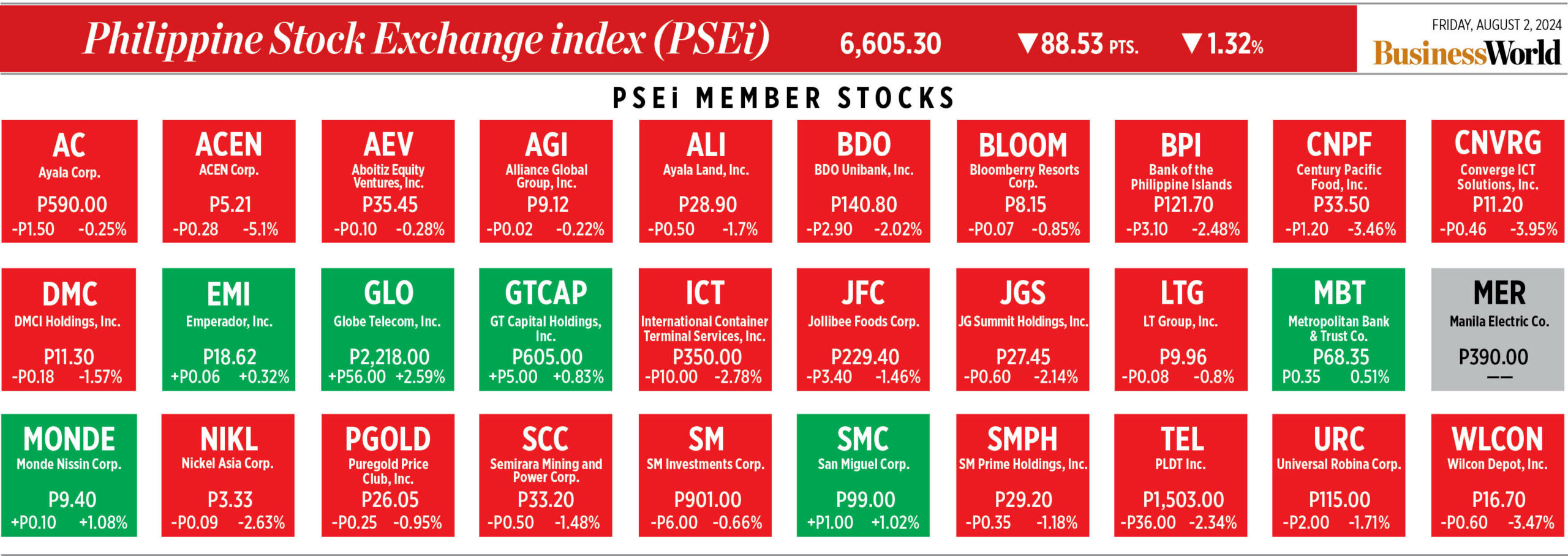
How PSEi member stocks performed — August 2, 2024

Here’s a quick glance at how PSEi stocks fared on Friday, August 2, 2024.


Peso may strengthen, return to P57 level on weak US jobs data

THE PESO may continue to strengthen and return to the P57 level against the dollar this week following a weak US jobs report and before the release of July Philippine inflation data.

The local unit ended at P58.08 per dollar on Friday, strengthening by 25.3 centavos from its P58.333 finish on Thursday, Bankers Association of the Philippines data showed.

This was the peso’s best finish in more than two months or since its P57.97-per-dollar close on May 28.

Week on week, the peso likewise strengthened by 27 centavos from its P58.35 close on July 26.

“Asian currencies strengthened against the dollar, driven by growing dovish sentiment towards the US Federal Reserve’s monetary policy. This shift in market expectations follows the release of weak US economic data, prompting investors to price in additional rate cuts from the Fed. The currency pair experienced significant selling pressure as a result,” Security Bank Corp. Chief Economist Robert Dan J. Roces said in a Viber message.

The peso was also supported by the Japanese yen’s continued appreciation against the dollar after the Bank of Japan unexpectedly hiked rates at its meeting last week, Rizal Commercial Banking Corp. Chief Economist Michael L. Ricafort said in a Viber message.

The dollar slipped on Friday as investors fretted US payrolls data could be weak after an unexpected slump in manufacturing raised concerns about a slowdown in the world’s largest economy and lifted traditional safe-haven currencies, Reuters reported.

The yen firmed, pushing the dollar down 0.2% to 149.04, building on gains in the wake of a Bank of Japan decision to raise rates and strengthening as far as 148.51 overnight for the first time since mid-March.

The dollar slipped 0.3% against a basket of other major currencies to trade at 104.06.

Released after Asian trade, Friday’s US jobs report showed job growth slowed more than expected in July and unemployment increased to 4.3%, pointing to possible weakness in the labor market and greater vulnerability to recession.

Markets were already rattled by downbeat earnings updates from Amazon and Intel and Thursday’s softer-than-expected US factory activity survey in addition to the monthly US nonfarm payrolls report, which showed job growth slumped to 114,000 new hires in July from 179,000 in June.

The data raised expectations of multiple rate cuts by the Federal Reserve this year, which just last week opted to keep rates unchanged.

The Fed has kept benchmark borrowing costs at a 23-year high of 5.25%-5.5% for a year, and some analysts believe the world’s most influential central bank may have kept monetary policy tight for too long, risking a recession.

Money markets on Friday rushed to price a 70% chance of the Fed, which was already widely expected to cut rates from September, implementing a jumbo 50 basis points cut next month to insure against a downturn.

For this week, Mr. Roces said the US jobs report will be the main driver of foreign exchange trading.

“This crucial economic indicator is likely to provide further insights into the US labor market’s health and could potentially reinforce or challenge current market expectations regarding the Fed’s future policy decisions,” he said.

The release of July Philippine inflation data will also affect the peso’s movement against the dollar this week, Mr. Ricafort added.

A BusinessWorld poll of 15 analysts last week yielded a median estimate of 4% for the consumer price index in July. This matches the lower end of the Bangko Sentral ng Pilipinas’ (BSP) forecast for the month.

If realized, July inflation would be faster than 3.7% in June but slower than 4.7% a year earlier.

It would also mark the eighth straight month that inflation settled within the BSP’s 2-4% annual target.

The Philippine Statistics Authority is set to release inflation data on Tuesday (Aug. 6).

Mr. Ricafort expects the peso to move between P57.80 and P58.30 per dollar this week. — A.M.C. Sy with Reuters

Stocks to rise as market awaits BSP, Fed easing

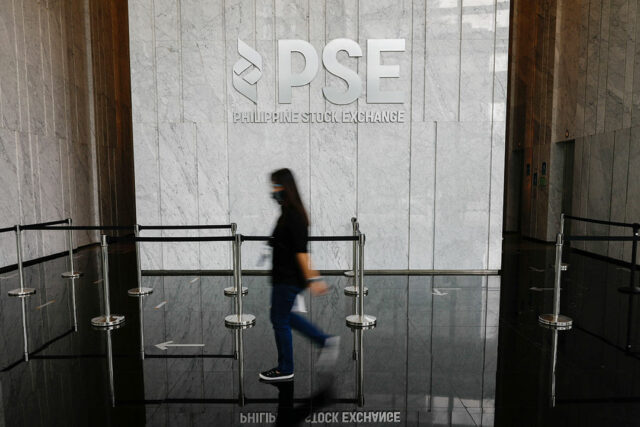
The lobby of the Philippine Stock Exchange in Taguig City, Sept. 30, 2020. — REUTERS

PHILIPPINE SHARES are expected to climb this week amid growing expectations of benchmark interest rate cuts from both the Bangko Sentral ng Pilipinas (BSP) and the US Federal Reserve.

On Friday, the bellwether Philippine Stock Exchange index (PSEi) fell by 1.32% or 88.53 points to end at 6,605.30, while the broader all shares index retreated by 0.88% or 32.28 points to finish at 3,596.90.

Week on week, the PSEi dropped by 1.79% or 120.71 points from its 6,726.01 close on July 26.

“The local market extended its decline to a second week, shedding 1.79% after failing to take its 6,700-6,800 resistance range,” Philstocks Financial, Inc. Senior Research Analyst Japhet Louis O. Tantiangco said in a Viber message.

“On a positive note, the market remains above its 50-day and 200-day exponential moving averages. Trading remains tepid, however, as many are still on the sidelines,” he added.

For this week, Philippine stocks may rise on bargain hunting amid expectations of lower borrowing costs, Mr. Tantiangco said.

“Growing hopes of monetary easing in the Philippines and the United States soon following recent dovish cues from both the BSP and the Federal Reserve may help the market climb this week,” he said. “However, the recession fears in the US, if it lingers this week, are seen as a downside risk to the local bourse.”

BSP Governor Eli M. Remolona, Jr. last week said that they could cut benchmark rates by 25 basis points (bps) at their Aug. 15 meeting, and by another 25 bps later in the year.

The BSP has kept its policy rate at a 17-year high of 6.5% since October 2023.

Meanwhile, employers added just 114,000 jobs in July, the US Labor department reported, and the unemployment rate rose to 4.3%, from 4.1% in June, marking an unexpected deterioration in a labor market that had held up surprisingly well during the US Federal Reserve’s aggressive rate-hike campaign in 2022 and 2023, Reuters reported.

The data prompted traders to pile into bets that the Fed will deliver a half-percentage-point rate cut at its Sept. 17-18 meeting, and drive borrowing costs down further from there, with the policy rate expected to end 2024 in the 4%-4.25% range.

“Investors may also take cues from our upcoming macroeconomic data including the July inflation rate, June labor force survey, and second-quarter gross domestic product. Investors are also expected to continue monitoring corporate results,” Mr. Tantiangco said.

“Philippine inflation to be released on Aug. 6 is expected to pick up in July from 3.7% in June, largely due to massive damage by Typhoon Carina, though offset by lower tariffs that effectively provided a 20% discounted on imported rice,” Rizal Commercial Banking Corp. Chief Economist Michael L. Ricafort said in an e-mail.

For its part, online brokerage 2TradeAsia.com said in a market note that the PSEi’s immediate support is at 6,600-6,650 and resistance is at 6,900. — Revin Mikhael D. Ochave with Reuters

PEZA targets Middle East investors

REUTERS

THE Philippine Economic Zone Authority (PEZA) said that it is hoping to attract Middle Eastern investors involved in the agribusiness, logistics, and economic zone (ecozone) development businesses.

In a statement over the weekend, PEZA said the new approach was the result of a meeting with the Foreign Trade Service Corps (FTSC) Middle East Team officers last month to discuss possible collaboration.

“The diversification of the Middle East away from oil to agriculture and manufacturing presents an opportunity for the Philippines to position itself as an attractive destination for more Gulf investors,” PEZA said.

“Among the sectors to be prioritized by PEZA and FTSC are agribusiness, logistics, and ecozone development,” it added.

According to PEZA Director General Tereso O. Panga, 15 Middle Eastern companies are currently registered with the investment promotion agency.

“These generated more than P600 million in investments and over 5,500 direct jobs,” he told BusinessWorld via Viber.

The Department of Trade and Industry (DTI) has said that negotiations are underway for the country’s first free trade agreement (FTA) with a Middle Eastern country — the United Arab Emirates (UAE).

Expected to be concluded by October, the Philippines-UAE Comprehensive Economic Partnership Agreement is expected to provide the Philippines access to other Gulf Cooperation Council states.

The Philippines and the UAE have concluded the first two rounds of negotiations for the FTA, while the third and fourth rounds are expected to start this month and in October, respectively.

Aside from the FTSC Middle East Team, PEZA also met with trade officers based in California, South Korea, Taipei, New York, and Toronto.

PEZA expects investment pledges of between P200 billion and P250 billion this year, with first-half approvals at P45.48 billion. 

According to Mr. Panga, PEZA did not hold a board meeting last month and is scheduled to meet on Aug. 7. — Justine Irish D. Tabile

Final El Niño agri damage estimate at P15.3 billion

REUTERS

FARM DAMAGE caused by El Niño was P15.3 billion, according to the final estimate issued by the Department of Agriculture (DA).

In its final farm damage bulletin, the DA said El Niño had affected 333,195 farmers and fisherfolk, resulting in crop losses amounting to 784,344 metric tons (MT).

The DA added that affected farmland spanned 270,855 hectares, with 68% or 184,182 hectares deemed recoverable.

Damage to the rice crop amounted to P5.93 billion, or 38.8% of the total. Lost volume was 330,717 MT, across 109,481 hectares of farmland.

The DA said that the most affected provinces were Palawan, Iloilo, Camarines Sur, and Occidental Mindoro.

Damage to corn totaled 327,310 MT, valued at P5.94 billion. This made up 38.84% of the overall damage caused by El Niño.

The DA said most of the damage and losses to corn and rice were to plants in the reproductive and mature stages.

It added that volume losses for high value crops amounted to 112,681 MT across 270,885 hectares of farmland. The losses were valued at P3.27 billion, or 21.35% of the total.

Damage to livestock and poultry was P37.97 million, affecting 25,547 animals including chicken, cattle, carabao, duck, goat, horse, sheep, and swine.

El Niño’s impact on fisheries totaled P53.44 million, with lost volume at 11,217 MT, affecting 2,679 fisherfolk.

In June the government weather service, known as PAGASA (Philippine Atmospheric, Geophysical and Astronomical Services Administration), announced the end of El Niño after conditions in the tropical Pacific returned to El Niño Southern Oscillation neutral levels, meaning neither El Niño nor La Niña was in effect. — Adrian H. Halili

SEIPI warns of investor flight over BoC tracking

PHILSTAR FILE PHOTO

By Justine Irish D. Tabile, Reporter

THE electronics industry said that the Bureau of Customs’ (BoC) Electronic Tracking of Containerized Cargo (E-TRACC) System is an unnecessary burden on chipmakers and may lead to their divestment from the Philippines.

Semiconductor and Electronics Industries in the Philippines Foundation, Inc. (SEIPI) President Danilo C. Lachica told reporters last week that the tracking system is an additional cost being borne by companies.

“It’s really redundant, and when we met with the BoC last week, they were saying that it would mean revenue losses if they stopped implementing it,” Mr. Lachica said.

“But I told them they would lose more revenue if the companies leave the country,” he added.

Launched through a memorandum circular in 2020, the E-TRACC System enables real-time monitoring of inland movements of containerized goods using a global positioning system (GPS)-enabled tracking device.

The system is designed to ensure that goods reach their intended destinations, and features an alarm should cargoes be diverted or tampered with.

“Our logistics providers have GPS systems, so they are already tracking them, and secondly, and I have told them this, in the 50 years of the electronics industry, there has been no incidence of smuggling,” he added.

He said that the E-TRACC system easily adds P1 million to P2 million a month in logistics costs.

“Logistics costs are already high, and then you’ll have to add P1-2 million a month; of course they will leave, and that is where the real revenue loss is,” he said.

“Because their headquarters ask them why they are spending this much in the Philippines, whereas in their operations in other countries they don’t have that kind of cost. So, what will happen is they will scale down their operations here,” he added.

He was reluctant to recommend an exemption for the industry because it might be seen as favoritism, but instead proposed a regulatory impact assessment via the Anti-Red Tape Authority.

Higher budgets urged for agri, health, public works

SIEMENS-HEALTHINEERS.COM

THE GOVERNMENT must increase funding for agriculture, health and public works to back up its commitments to support these sectors, analysts said.

Federation of Free Farmers National Manager Raul Q. Montemayor said the lower proposed budget for agriculture contradicts the government’s promise to support farming.

“The increase for DA (Department of Agriculture) is much smaller than what had been requested and what is needed to support the sector. It also runs counter to many previous pronouncements from the President and legislators that they will give budget priority to food security and support farmers,” he said via Viber.

Under next year’s proposed P6.352-trillion budget, the DA and its various agencies, as well as the Department of Agrarian Reform were allocated P211.3 billion, down 4.7% from the P221.7 billion allocated this year.

Next year’s funding for the National Irrigation Authority declined to P42.57 billion from P70.22 billion this year.

Legislators need to increase funding for post-harvest facilities like dryers and storage facilities, marketing infrastructure, crop insurance, risk mitigating measures, and data and information systems, Mr. Montemayor said. 

United Broiler Raisers Association President Elias Jose M. Inciong said budgetary support is necessary to implement the Agriculture and Fisheries Modernization Act. These include the establishment of an information network and quarantine system for agriculture and fisheries.

The budget of the Department of Health, which includes the Philippine Health Insurance Corp. (PhilHealth), was also cut by 3.5% to P297.6 billion. 

PhilHealth’s budget for next year increased by 21% to P74.43 billion.

Private Hospitals Association of the Philippines, Inc. President Jose Rene D. de Grano said PhilHealth would need even more to increase the government’s contribution to patients’ medical bills.

“PhilHealth only covers around 14-15% of patients’ hospital bills… the rest are out-of-pocket (payments),” he said via phone.

Budgetary support to government hospitals decreased: the National Kidney and Transplant Institute is set to receive P1.49 billion in 2025, down from this year’s P1.63 billion, and the Lung Center of the Philippines could get P711.34 million next year, against P791.11 billion this year.

Other specialist healthcare institutions that received budget cuts are the Philippine Heart Center (P2.21 billion for 2025 from P2.41 billion this year), Philippine Children’s Medical Center (P1.4 billion next year from P1.96 billion), and the Philippine Institute of Traditional and Alternative Health Care (P154.73 million from P173.85 million).

The Department of Public Works and Highways’ budget was also slashed to P900 billion from this P997.9 billion in this year’s General Appropriations Act.

Nigel Paul C. Villarete, senior adviser on public-private partnership at Libra Konsult, Inc., cited the need for a higher public works budget to bolster economic growth.

“Since infrastructure plays a bigger part in economic development, I hope Congress would give the sector the annual increase it deserves, at least, approximating the overall budget increase rate of 10% over this year’s,” he said in a Viber message.

The government hopes to spend 5-6% of gross domestic product on infrastructure each year.

The budget of the Department of Social Welfare and Development declined by 7% to P230.1 billion next year.

Starting this week, members of the Cabinet are set to defend their agencies’ respective budgets before Congressional panels. — Beatriz Marie D. Cruz

Agencies face queries on how spending will spread wealth

PHILSTAR FILE PHOTO

THE House of Representatives will ask government agencies defending their budgets this week to demonstrate how they plan to spread prosperity beyond a few favored segments of the economy, Speaker and Leyte Rep. Ferdinand Martin G. Romualdez said on Sunday.

“Our economic expansion, projected by multilateral financial institutions at between 5.9-6.2% next year, should be felt by our people, especially the poor, in terms of more job and income opportunities, more affordable food on their tables and lower consumer prices,” Mr. Romualdez said in a statement.

Congress is set to begin its deliberations on the proposed P6.352-trillion national budget for 2025 today, Monday, with economic managers first on deck.

The Development Budget Coordination Committee (DBCC) will brief the House on how the macroeconomic assumptions for next year influenced the drafting of the 2025 budget.

Legislators are also set to ask Budget Secretary Amenah F. Pangandaman, Finance Secretary Ralph G. Recto, Socioeconomic Planning Secretary Arsenio M. Balisacan, and Central Bank Governor Eli M. Remolona, Jr. how the proposed budget will work to spur economic growth next year, he added.

The Department of Budget and Management (DBM) last week handed over the 2025 National Expenditures Program (NEP) to the House, proposing to spend the equivalent of 22.1% of gross domestic product (GDP). If borne out, the NEP would be 10.1% higher than the P5.768-trillion budget this year.

The Philippines is expected to surpass the growth of most of its neighbors despite external economic headwinds, the DBCC said in June, setting its gross domestic product growth projection at 6.5-7.5%. 

“There is a need to explain how the proposed budget could support economic growth amid concerns by Filipinos that the expansion only benefits the rich, the big companies, and stock and financial market investors,” Mr. Romualdez said.

“If (the) majority of our people do not feel our economic expansion, they should at least see it in terms of the proper use of the national budget for social services, education, health, infrastructure, and direct financial assistance to the poor and other vulnerable sectors,” he added.

In a statement last week, think tank IBON Foundation said that the proposed budget puts the needs of businesses ahead of ordinary Filipinos despite the administration’s claims that it is focusing government resources towards addressing joblessness and poverty.

“Despite the Marcos administration’s claims, the proposed budget spends less on the needs and welfare of the majority of Filipinos while increasing spending on debt service, and infrastructure that disproportionately benefits those already better-off,” it said.

The 2025 proposed budget for the Department of Social Welfare and Development (DSWD) was slashed by 7.2% to P230.1 billion.

Health spending — including funding for the Department of Health (DoH) and the Philippine Health Insurance Corp. (PhilHealth), will receive P297.6 billion of next year’s proposed budget, down 3.5% from this year’s allocation.

Debt service is expected to account for P2.1 trillion in 2025, up 9.1%, according to a document from the DBM.

Infrastructure outlays are expected to dip 0.26% to P1.506 trillion next year.

Going before Congress will be officials from the Philippine Gaming and Amusement Corp. (PAGCOR) and the Philippine Charity Sweepstakes Office (PCSO), who are expected to brief the House appropriations committee on their proposed budgets on Tuesday. They will be followed by the Department of Environment and Natural Resources (DENR) and the Department of Human Settlements and Urban Development (DHSUD) on Wednesday.

On Thursday will be the turn of the Department of Energy (DoE), the Energy Regulatory Commission (ERC), and the Commission on Higher Education’s (CHED).

The House appropriations panel will conduct budget deliberations until Sept. 9, after which the NEP will be hammered out to become the draft General Appropriations Act for plenary action.

The House is seeking to approve the proposed budget in September to give the Senate ample time to deliberate, Majority Leader and Zamboanga City Rep. Manuel Jose M. Dalipe said at a briefing last week. — Kenneth Christiane L. Basilio

June WESM prices fall on decreased demand

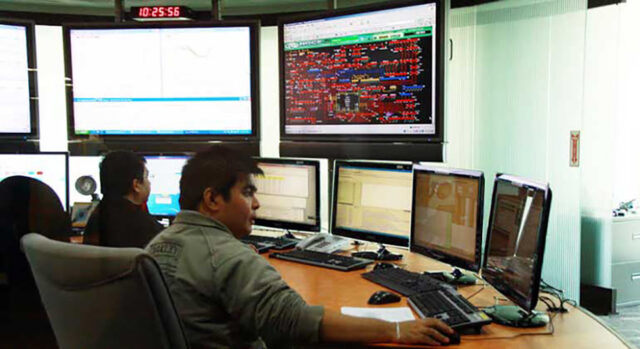
BW FILE PHOTO

ELECTRICITY spot prices dropped in June, with a decline in power demand offsetting any impact on prices of lower supply, according to the Independent Electricity Market Operator of the Philippines (IEMOP), citing preliminary data.

IEMOP reported that the average power price at the Wholesale Electricity Spot Market (WESM) system-wide fell 3% month on month to P5.97 per kilowatt-hour (kWh) in June.

Supply fell 3.9% to 18,867 megawatts (MW), while demand fell 4.9% to 13,989 MW.

For Luzon, the average WESM price fell 0.9% to P5.92 per kWh compared to May.

The sub-grid’s power supply declined 3.8% to 13,340 MW while the demand dropped 4.9% to 10,142 MW.

Spot prices on the Visayas fell 12.4% month on month to P7.50 per kWh.

Supply fell 9.3% to 2,105 MW. Demand decreased 5.4% to 1,894 MW.

Mindanao spot prices rose 1.3% month on month to P4.67 per kWh.

Supply fell 1% to 3,421 MW while demand declined 4.5% to 1,952 MW.

“The supply-demand scenario in Mindanao (was affected by) some baseload plants that (had) undergone outages. This resulted in a minimal increase in price,” the IEMOP said.

IEMOP operates the WESM, where energy companies can buy power when their long-term contracted power supply is insufficient for customer needs.

Last week, the Energy Regulatory Commission lifted the suspension on settlement in the reserve market.

It ordered the IEMOP to recalculate the resulting reserve trading amounts for the billing periods February and March. It also ordered the IEMOP to adjust the value for the remaining 70% for the March billing month.

The reserve market allows the system operator to procure power reserves from the WESM to meet the reserve requirements of the energy system. — Sheldeen Joy Talavera

How AI can sustain business continuity

IN BRIEF:

• AI transforms business continuity management by enabling proactive risk assessment, dynamic planning, and adaptive response strategies, ensuring organizations are better prepared for disruptions.

• AI enhances incident and crisis management with early-warning systems, intelligent data protection, and effective communication tools, improving disaster preparedness and response.

• AI-driven simulations and continuous learning from exercises and real events refine BCM plans, while organizations must navigate challenges like resource requirements, data reliability, and ethical decision-making.

Artificial intelligence (AI) is transforming the way we innovate — empowering machines to perform tasks that typically require human intelligence. It focuses on emulating human behavior and performance, from simple task automation to complex problem-solving and decision-making.

As businesses continue to navigate an increasingly volatile landscape, the traditional, reactive approaches to continuity and crisis management no longer suffice. AI can help redefine organizational resilience by enabling companies to anticipate disruptions and fortify their operations against them.

To adapt, businesses are increasingly turning to AI to transform their approach to Business Continuity Management (BCM). This article examines how AI’s capabilities improve BCM strategies and foster a proactive approach to organizational resilience.

THE ROLE OF AI IN BCM
AI’s role in BCM goes beyond redefining business continuity procedures. It transforms the way organizations plan, detect, respond, and withstand business disruptions.

RISK ASSESSMENT, IMPACT ANALYSIS, PLANNING
AI can be used to analyze large volumes of data to identify risks within an organization. It can also predict potential disruptions by analyzing patterns from past incidents. These capabilities reshape how organizations can prepare for unprecedented events and turn reactive measures into proactive strategies.

AI can also be used in conducting Business Impact Analysis (BIA) and can streamline the identification of critical business functions, products and services, and the impact assessments of disruptions. It helps ensure that recovery efforts include interdependency requirements that are aligned with the criticality and recovery objectives of business functions, products, and services.

AI can also assist in developing dynamic and adaptive disaster response plans by leveraging its acquired knowledge on various disaster scenarios and predicting their potential impacts on business operations. AI can further keep businesses abreast of regulatory shifts and ensures that BCM strategies are aligned with the latest mandates through automated compliance monitoring and reporting.

INCIDENT AND CRISIS MANAGEMENT
The detection of threats or system failures becomes faster and precise with the use of AI-enhanced monitoring systems. The early-warning capability of such monitoring systems is critical for managing incidents before they escalate into large-scale business disruptions or crises. In fact, the Philippines, being one of the most disaster-prone countries in the world, has been incorporating AI and advanced technologies for monitoring seismic activity, volcanic eruptions, tsunamis, and typhoons for better disaster preparedness.

Aside from detection, AI ensures availability of data through intelligent backup and recovery systems — safeguarding data integrity and facilitating swift restoration in the event of disruptions. AI-driven communication tools are also vital during a crisis where effective and timely communication is crucial. They provide stakeholders with immediate and accurate information when it is most needed.

SIMULATIONS AND CONTINUOUS IMPROVEMENT
AI-driven simulations can train employees on emergency and response procedures as well as enrich the decision-making capabilities of Crisis Management Teams to help them prepare for real-world incidents and business disruptions.

This capability parallels organizations in civil aviation that use AI in flight simulators where various flight conditions, system failures, and weather scenarios are simulated to train pilots in handling different situations. Similarly, military organizations also use AI in combat simulations and war games to create realistic training scenarios.

Last, AI does not just respond to incidents — it learns from them. By analyzing BCM exercises and real events, AI provides actionable insights for refining continuity plans, ensuring that each iteration is stronger than the last. AI can help transform business continuity from reactive recovery to proactive preparedness, redefining organizational resilience.

CHALLENGES OF AI-DRIVEN BCM
While AI offers significant advantages for BCM, it also presents several challenges that organizations must navigate.

Resource requirements. AI systems require substantial funding for resources, such as technology, infrastructure and, ultimately, skilled talent. The use of AI needs specialized skills and knowledge to develop, manage, and interpret AI systems. Yet these times, the number of professionals in the field of AI is still limited.

Reliability of data. AI systems require significant volume of high-quality data to work effectively, as insufficient or poor-quality data may result in inaccurate predictions. The AI systems may also inherit biases or result in unfair outcomes if data will not be managed properly.

Decision-making capability. As AI systems are highly complex and lack transparency in their decision-making processes, organizations may find it difficult to understand and trust the recommendations made by AI. The extent to which decision-making should be automated and whether AI-driven decisions align with the organization’s values and ethical standards are also some of the factors that organizations should consider.

MAXIMIZING AI TO ACHIEVE RESILIENCE
To harness AI’s full potential in BCM and overcome challenges, organizations must facilitate thorough planning, stakeholder engagement, continuous monitoring, and the improvement of AI systems. Integration with existing systems is one of the key factors to ensure a holistic approach in enhancing every area of BCM. Moreover, it is essential to have subject matter experts in AI who can interpret and manage AI-generated intelligence to bridge the gap between data and decision-making.

AI is not just complementary to BCM — it’s a transformative initiative that is redefining the very essence of organizational resilience. As organizations start to embrace this AI-driven future, the ones who skillfully integrate AI systems into their business continuity strategies will not only survive disruptions but thrive in their aftermath.

This article is for general information only and is not a substitute for professional advice where the facts and circumstances warrant. The views and opinion expressed above are those of the authors and do not necessarily represent the views of SGV & Co.


Philip B. Casanova is a technology consulting principal and  Ma. Airra S. Hernandez is a technology consulting manager, both from SGV & Co.

Q2 2024 GDP growth forecast

PHILIPPINE ECONOMIC GROWTH likely picked up in the second quarter as higher government spending may have offset the impact of El Niño on agriculture, analysts said. Read the full story.

Q2 2024 GDP growth forecast

ADVERTISEMENT
ADVERTISEMENT