Home Blog Page 2824

MacroAsia earnings more than tripled in Q2

AIRCRAFT MAINTENANCE service provider MacroAsia Corp. more than tripled its second-quarter (Q2) attributable net income to P431.67 million, up from P134.7 million a year ago, mainly driven by increased revenue and growth across its business units.

For the second quarter, MacroAsia’s combined revenue surged by 32.8% to P2.55 billion, compared with P1.92 billion previously, the company’s financial statement showed.

This second-quarter revenue represents MacroAsia’s highest quarterly top line, the company said, adding that the revenue growth was driven by strong performance across all its business units.

Lufthansa Technik Philippines, the company’s aircraft maintenance, repair, and overhaul associate, generated quarterly income of P529.33 million, with MacroAsia’s 49% share amounting to P290.24 million, the company said in a media release.

Lufthansa Technik is planning an expansion in Clark, Pampanga, to address the increasing demand for heavy repair services for wide-body aircraft from its clients.

For the first half of the year, the company’s attributable net income more than doubled to P691.59 million, compared with P285.77 million in the same period last year.

Gross revenue expanded to P4.77 billion, up by 28.6% for the January-to-June period, compared with P3.71 billion in the same period last year.

Broken down, ground handling and aviation revenue increased to P2.19 billion, marking a 47% rise from P1.49 billion previously. In-flight and other catering revenue also grew to P2.15 billion, compared with P1.88 billion last year.

Additionally, water distribution revenue reached P327.1 million, connectivity and technology services revenue was P43.6 million, aviation training fees amounted to P36.3 million, and administrative fees totaled P26.9 million.

For the first half, gross expenses rose by 22.4% to P4.04 billion, compared with P3.3 billion in the previous year.

Additionally, MacroAsia stated that its food segment is expanding its facility outside the airport. The five-year-old facility in Muntinlupa City is now reaching full capacity due to increasing clients.

At the local bourse on Wednesday, shares in the company gained 51 centavos or 11.62% to end at P4.90 apiece. — Ashley Erika O. Jose

Chelsea Logistics swings to profit with P67.54 million Q2 net income

CHELSEA Logistics and Infrastructure Holdings Corp. recorded an attributable net income of P67.54 million for the second quarter, turning around from a net loss of P106.83 million previously, driven by higher revenues for the period.

“The strong results and sequential and year-on-year improvements in the second quarter of 2024 demonstrate our commitment to executing our strategic priorities,” Chelsea Logistics President and Chief Executive Officer Chryss Alfonsus V. Damuy told the stock exchange on Wednesday.

For the second quarter, the company reported gross revenue of P2.2 billion, climbing by 17.6% from P1.87 billion in the same period last year.

Chelsea Logistics registered gross expenses of P1.87 billion for the April-to-June period, higher by 11.3% from P1.68 billion a year ago.

For the first half of the year, the company narrowed its attributable net loss to P80.63 million from P430.87 million in the same period last year.

Year to date, Chelsea Logistics generated gross revenue of P3.98 billion, expanding by 11.2% from P3.58 billion in the first half of 2023.

Chelsea Logistics attributed its higher revenues to robust growth in its passage, chartering, tugboats, and logistics segments.

“The passage segment benefited from increased passenger volume, while the Tugboats and Chartering segments saw higher utilization rates,” Chelsea Logistics said.

The company said that its logistics segment continued to recover, driven by growing demand for door-to-door services, especially in air and land freight segments.

In 2023, the company trimmed its net loss to P1.14 billion, improving from a P2.53-billion loss in the prior year.

In its annual report, Chelsea Logistics’ gross revenue reached P7.05 billion, up by 9.6% from P6.43 billion in 2022. — Ashley Erika O. Jose

Century Properties income jumps 87%, driven by affordable housing

LISTED Century Properties Group, Inc. (CPG) recorded an 87% increase in its second-quarter attributable net income to P664.16 million from P354.31 million last year, led by its affordable housing segment.

Revenues during the second quarter dropped by 5.1% to P3.58 billion from P3.77 billion a year ago, CPG said in a regulatory filing on Wednesday.

For the first half, CPG grew its attributable net income by 64% to P1.07 billion from P656.3 million last year.

Revenues rose by 6% to P7.16 billion from P6.74 billion last year, while earnings before interest, taxes, depreciation, and amortization (EBITDA) increased by 45% to P2.11 billion.

“The substantial growth in CPG’s EBITDA and our bottom line far outpaced the incremental increase in our top line due to the convergence of several strategic moves put in place by the company,” CPG Chief Finance Officer Ponciano S. Carreon, Jr. said.

“Without losing sight of the premium residences that our customers and market expect from an established ‘Century Brand,’ we were bullish in favor of the robust real needs of our fellow Filipinos for affordable and quality homes, bringing in the much-needed high-margin, high-velocity products…,” he added.

CPG’s First-Home Residential (PHirst) platform accounted for P4.4 billion or 61% of total revenue, led by continued strong sales take-up and on-track development and construction activities.

The premium residential segment contributed P1.9 billion or 26%, the commercial leasing business accounted for P0.65 billion or 9%, and the property management arm made up the remaining 4% or P0.26 billion.

CPG’s First Home brand is launching five new projects in 2024. The company introduced PHirst Sights Calauan and PHirst Park Homes Calamba West in Laguna earlier in the year.

The second development in San Pablo, Laguna, is set for the third quarter, while additional projects in Batangas and Bulacan are planned for the fourth quarter.

“These developments will span 85 hectares with over 8,000 units valued at P18.5 billion,” CPG said.

Meanwhile, CPG President and Chief Executive Officer Marco R. Antonio said the company is optimistic that it will be able to sustain or exceed its growth trajectory amid “positive domestic macroeconomic indicators and the government’s implementation of sound economic and business-friendly policies.”

“The strong demand for residential properties in both the affordable, mid-market, and healthy premium niche markets, which are now the focus of our group, continues to inspire us to deliver fresh new concepts that are relevant to our market’s needs and desires, and that will create more value for all our stakeholders,” he said.

On Wednesday, CPG shares fell by 1.49% or P0.005 to P0.33 apiece. — Revin Mikhael D. Ochave

When stars align

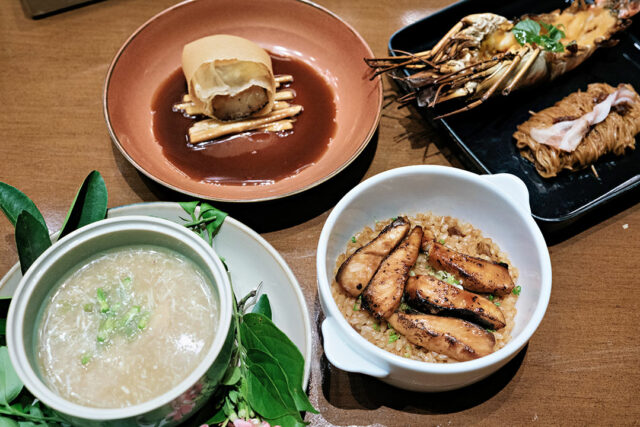
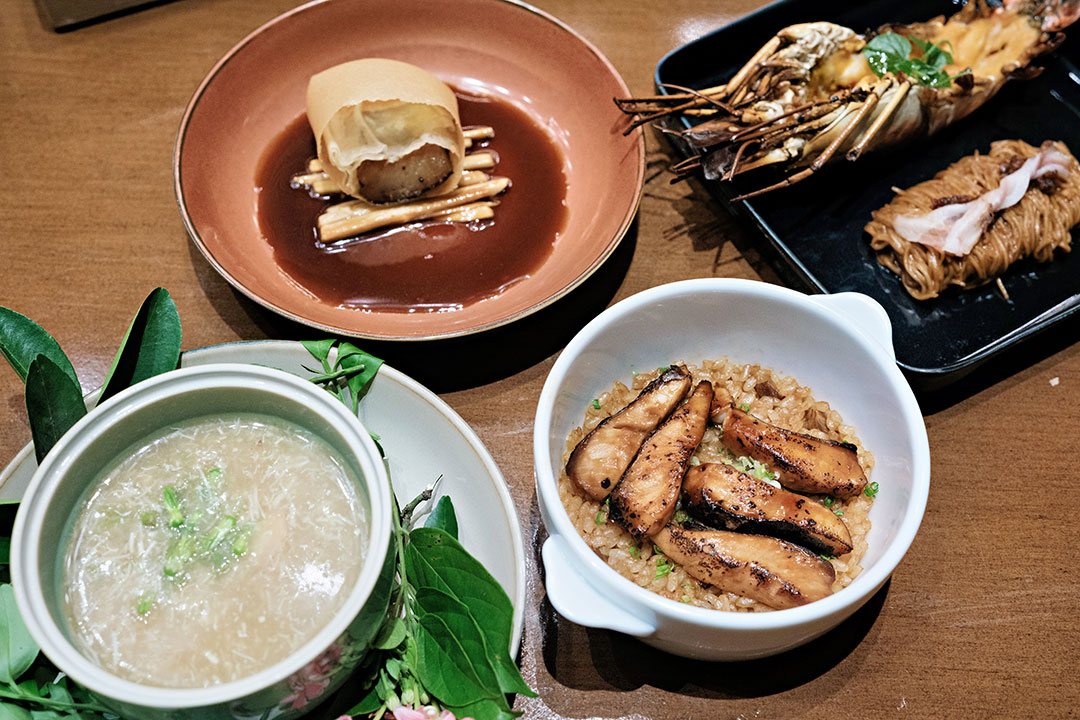
MAIN DISHES (clockwise from top left): Sea Cucumber Spring Roll; Bulacan River Prawn, Etag Xo; Pomfret Fish Pares, with Abalone Sauce Rice; and White Pepper Virgin Mud Crab Thick Soup.

HKTB presents a four-hands dinner in the run-up to HK’s Wine & Dine Fest

TWO culinary stars from Hong Kong (HK) and Manila joined forces for a dinner at the top floor the Grand Hyatt Manila, making for a dinner that was truly unique.

Chefs and restaurateurs Margarita Forés and Vicky Cheng cooked together for a dinner — When Stars Align: A Four Hands Dinner and Culinary Showcase — on Aug. 7 that showcased unique ingredients from Hong Kong and the Philippines. Ms. Forés is the restaurateur behind the Cibo chain of Italian restaurants (among others such as Grace Park and Lusso), and Asia’s Best Female chef of 2016. Mr. Cheng, meanwhile, is behind Vea (with one Michelin star) and Wing (No. 5 on Asia’s 50 Best Restaurants in 2024) in Hong Kong.

The Forés-Cheng dinner was a prelude to Hong Kong’s Wine & Dine Festival in October, which will see over 300 participating merchants. The annual celebration attracts food and wine enthusiasts from around the world and showcases Hong Kong’s food scene and its reputation as a dining destination.

Liew Chian Jia, the Hong Kong Tourism Board’s (HKTB) Regional Director of Southeast Asia, said in a speech before the dishes started coming out of the kitchen that in the first half of 2024, they received 500,000 Filipino tourists. “We put this very special showcase together to showcase the culinary scene of the Philippines together with Hong Kong. Really, it’s to celebrate the special bond between the Philippines and Hong Kong,” she said.

COLLABORATIVE MENU
Dinner began with “snacks,” actually quite a veritable spread, starting with Mr. Cheng’s hand-pulled noodles and a mala chili sauce, topped with something we’d never seen before: a transparent, crystal-clear century egg. This was accompanied by bowls of smoked eggplant, ukoy (shrimp fritters), and banana heart salad (taken from a childhood recipe from Ms. Forés home with her Araneta forebears). All these were served in bright celadon bowls. The noodles were perfectly sharp and spicy, contrasting with the surprisingly mild century egg, while the smoked eggplant was perfectly earthy. Ms. Forés’ ukoy, battered shrimp on top of a blue marlin kilawin (raw fish dressed in citrus and vinegar), had a subtle, sparkling brilliance, most definitely contributed by the delicate fish. The banana heart salad provided a sweet, unexpected ending.

The soup course — courtesty of Mr Cheng — was a White Pepper Virgin Mud Crab soup, with slabs of fat still floating in it. This was perfumed with tonkin jasmine (requested by Mr. Cheng and obtained by Ms. Forés from the Ilocos), providing green delicacy to the already-delicate and creamy soup. The next course was a solo piece by Ms. Forés’ — a large Bulacan river prawn with Hong Kong noodles (brought over by Mr. Cheng in his luggage), and the Cordilleran smoked meat etag. It was an interesting game of contrasts: the prawn was wild and creamy, while the noodles were fiery and earthy.

Mr. Cheng urged us to eat the next course, a Sea Cucumber Spring Roll, with our hands — it was deliciously smoky, but very messy.

After the brilliance of the preceding dishes, the Pomfret Fish Pares with Abalone sauce rice was a bit of a letdown, showing off mild, timid flavors, but wÍe guess everybody needs a little break from all the spectacle of the preceding courses. Desserts were an ube (purple yam) gelato with snow gum and osmanthus flowers, and mochi filled with Cebu mango.

“I went [to Hong Kong] for the first time when I was eight,” said Ms. Forés. “When I lived there and worked there in 1982, that was the first time, actually, that I started to cook in a kitchen, a few years before going to Italy. That’s because Hong Kong is so inspiring.” — JL Garcia

Megawide sees 30% drop in Q2 profit to P258.66 million

SAAVEDRA-LED infrastructure conglomerate Megawide Construction Corp. recorded a 30% drop in its attributable net income for the second quarter (Q2) to P258.66 million, compared with P370.28 million last year.

Second-quarter revenue fell by 8.7% to P6.21 billion, compared with P6.8 billion a year ago, Megawide said in a regulatory filing on Wednesday.

For the first half, Megawide said its net income rose by 21% to P438 million, driven by its construction and real estate businesses.

The company posted P11.4 billion in first-half revenue, up by 2% from P11.16 billion last year, led by the construction segment and the initial contribution of the real estate business.

Consolidated earnings before interest, taxes, depreciation, and amortization (EBITDA) rose by 24% to P2.6 billion, compared with P2.1 billion a year ago.

“Construction has been a significant growth driver for the economy during the period as the government continued to push for infrastructure development, complemented by a more normalized operating landscape,” Megawide Chairman and Chief Executive Officer Edgar B. Saavedra said.

“This benefited our integrated operations, which sustained a strong start to the year and is expected to be a key engine for Megawide’s value creation mode,” he added.

For the first half, construction revenue fell by 0.6% to P10.9 billion, compared with P10.97 billion last year, and accounted for 95% of total revenue.

The company had P8.9 billion worth of new projects during the period, including affiliate Megawide Construction Corp. – Citicore Construction, Inc., representing several locations of Citicore’s solar power plants; Contract Package-104 of the Metro Manila Subway System Project; and PH1 World Developers, Inc.’s Modan Lofts Ortigas Hills residential condominium project in Taytay, Rizal.

Megawide’s order book is worth P48 billion as of end-June, equivalent to two to three years’ worth of revenue.

The manufacturing business, consisting of the pre-cast and construction solutions segment, saw a 150% increase in revenue to P1.9 billion and contributed 17% to overall revenue.

“Our PCS business is expected to be a strong contributor moving forward, especially with higher margins associated with it and significant economies of scale potential. We believe that the growing appreciation and application of our PCS products in infrastructure, residential, and commercial developments will accelerate the unit’s income generation and boost its share in our construction business,” Mr. Saavedra said.

Real estate revenue reached P311.1 million, equivalent to 3% of total revenue, led by ongoing projects My Enso Lofts and The Hive. Newly launched projects such as Modan Lofts Ortigas Hills and Southscapes in Trece Martires contributed more than half of the P1.5 billion in sales registered during the period.

Revenue from landport operations rose by 7.4% to P205.2 million, equivalent to 2% of total revenue, led by the office towers and commercial spaces business. Foot traffic reached a record of 156,000 monthly average for June, while spending per passenger reached P34.

Occupancy in the commercial segment reached 84%, while the take-up of office towers hit 37%, which included government offices, transport services, and travel agencies as new tenants.

On Wednesday, Megawide shares were unchanged at P2.68 apiece. — Revin Mikhael D. Ochave

Your favorite wine regions will feel the heat

FREEPIK

By David Fickling

WHAT’S the first industry to fall victim to climate change? There’s a decent argument that it already happened — more than 600 years ago.

When the Norman Conquest in 1066 installed a French feudal aristocracy in the British Isles, the invaders brought with them a love of winemaking. Those skills flourished in the conditions of the Medieval Warm Period, a patch of unusually high temperatures from about 950 to 1250 that allowed vineyards to spread across the well-drained chalk soils of southern England. The mild conditions gave way to a frigid period known as the Little Ice Age, however, which held sway until the 19th century. As the climate cooled, English viticulture collapsed.

That should be a worrying example if you’re a winemaker. Grape vines are notoriously sensitive to the smallest changes in landscape and climate. Those with a skilled palate (I’m not one of them) can supposedly sense the subtlest of environmental effects in a bottle of wine — whether the winter that preceded the vintage was warm or cold, the harvest wet or dry, the grapes grown on a slope facing to the north or the south.

It doesn’t take much imagination to see how a warming climate could play havoc with this. Own a semiconductor factory, and your climate exposures will occur on the macro scale. Will bigger rainstorms flood the site, and will hotter summers push up my bill for air conditioning? A vintner, on the other hand, has to think about micro issues. Will a few extra warm nights or blazing days in growing season throw off the delicate balance of sugar and water formation in developing bunches? And will that make the resulting bottles less fragrant or complex than they otherwise would be?

For winemakers in Europe, a fresh climate headache is looming in the geographic indications they’ve used to defend their art. For the best part of a century, European agricultural producers have built a complex system of intellectual property around the idea that particular types of food and drink are regionally distinctive, and have names that must be protected under copyright law. There’s even a line on geographical indications in the Treaty of Versailles, the document that formally ended World War I.

Recognition of geographic indications is a basic hurdle for any nation wanting to strike a trade deal with the European Union and gain access to the world’s second-biggest market. It’s why makers of sparkling wine in most of the world can’t call their product Champagne, and why Australian and Canadian producers of fortified white wine these days label their bottles as “Apera,” because only those from the Jerez region of Spain can call themselves Sherry. Fully 1,646 of the 1,658 geographic indications for wine listed on the European Union’s (EU) eAmbrosia register are for EU countries. Of the rest, five are in the United Kingdom, four in China, two are in the United States (the Napa Valley and Willamette Valley) and one in Brazil.

Adding such geographic limits might have seemed like a good idea during the stable climate of the 20th century, but in the more disordered era into which we’re now moving it’s a risk. Many geographic indications assign a specific grape variety for a specific region. Barolo, arguably Italy’s most revered wine style, must be grown only with Nebbiolo grapes in a handful of communities among the misty mountains of Piedmont. As a warming planet makes the climate of northern Italy more like regions further south where Nebbiolo can’t flourish, the rigidity of Barolo’s geographic indication risks driving it into extinction.

Researchers in Europe recently analyzed 1,085 wine geographic indications across the continent to work out which were most at risk from a warming climate. What they found should worry viticulturalists: a swath of country is highly vulnerable to the effects of climate change, and has little natural capacity to adapt.

“Strong yield decreases were projected for northern Italy, central Spain, Greece, and Bulgaria,” they wrote, “and decreased suitability for Spain, parts of France, central and northern Italy, and large parts of eastern Europe.” In Burgundy, regions known for the Pinot Noir grape may become unable to grow the variety. The geographic indication system needs to be rethought to allow winegrowers to switch their practices as the climate warms, they argued.

That shouldn’t be impossible. Champagne, grown at the northern limit of wine cultivation and traditionally seen as the product of a difficult environment, is conventionally made from just three grape varieties: Pinot Noir, Chardonnay, and Meunier. But there are four other less celebrated varieties* that can be added to the blend, and may provide a way of preserving the wine’s characteristics even as the climate of Champagne starts to more closely resemble that of southern France. A further variety, known as Voltis, has been selectively bred as part of a deliberate effort to prepare for the effects of a warmer climate.

For many wine regions, that’s going to be a wrenching shift. What makes European wine unique is the marriage of a particular grape and viticultural practice with a particular region’s soil, climate, and intangibles. That sort of thinking is going to have to change as the planet warms. If Europe’s winemakers don’t want to experience the fate of medieval English vineyards, they’ll need to adapt before they’re wiped out. — Bloomberg Opinion

*The varieties are Arbane, Petit Meslier, Pinot Gris, and Pinot Blanc. They’re often regarded as more difficult to work with in Champagne.


Bloomberry Resorts’ Q2 income down 61% on weak VIP segment, higher costs

RAZON-LED Bloomberry Resorts Corp. recorded a 61% decline in its second-quarter (Q2) net income to P1.3 billion from P3.4 billion last year due to higher costs and weak VIP segment performance.

Gross gaming revenue (GGR) in the second quarter fell by 4% to P14.5 billion from P15.1 billion a year ago due to “continued weakness in the VIP segment,” Bloomberry Resorts said in a regulatory filing on Wednesday.

Second-quarter total GGR at Solaire Resort Entertainment City shrank by 12% to P13.3 billion due to lower VIP rolling chip and mass table drop volumes, which was partly offset by growth in electronic gaming machine (EGM) coin-in and GGR.

Solaire Resort North logged 37 operating days in the second quarter and recorded total GGR of P1.1 billion from its mass table games and EGM businesses. Non-gaming revenue reached P213 million.

Pre-operating expenses of Solaire Resort North amounted to P764.1 million and P73.8 million in the second quarters of 2024 and 2023, respectively.

Jeju Sun Hotel & Casino in Korea generated P35.7 million worth of GGR in the second quarter, up by 660% from P4.7 million in 2023. Non-gaming revenue rose by 45% to P125.5 million.

For the first half, Bloomberry Resorts reported a 38% drop in net income to P4 billion from P6.4 billion a year ago.

Excluding the impact of gains from the disposal of an asset and the liquidation of a subsidiary, net income would have decreased by 58% in the second quarter of 2024 and by 35% in the first six months.

Consolidated GGR fell by 6% to P29.2 billion from P31.2 billion last year. Nongaming revenue increased by 11% to P4.6 billion.

“In the second quarter and first half of 2024, our mass gaming revenues across two properties increased year over year despite the very high base set in the first half of 2023. However, continued weakness in the VIP segment as well as pre-operating and operating expenses at Solaire Resort North resulted in a decline in consolidated earnings before interest, taxes, depreciation, and amortization (EBITDA) and net income,” Bloomberry Chairman and Chief Executive Officer Enrique K. Razon, Jr. said.

He said that Bloomberry Resorts is expecting a boost from the ramping up of operations at Solaire Resort North, which was opened on May 25.

“Despite our weaker consolidated year-over-year performance, I am pleased to report that Solaire Resort North recorded positive EBITDA of P250 million in its first 37 days of operations. We are in the early stages of the property’s ramp-up and are happy with the pace, especially as we compare it to the ramp of Solaire in Entertainment City over 11 years ago,” Mr. Razon said.

“As revenues at our second property grow, we anticipate further synergies and positive operating leverage to contribute to our group’s profitability in the coming quarters,” he added.

On Wednesday, Bloomberry Resorts shares dropped by 5.84% or 45 centavos to P7.25 per share. — Revin Mikhael D. Ochave 

Surprises at a Spanish food fest

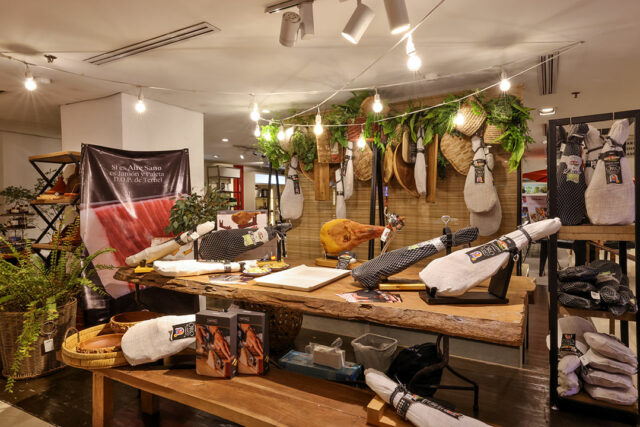
SPANISH restaurants dot the city, thanks to our colonial connection with Spain, and few people can deny knowing about paella, gambas, jamon and all that. Still, the Casa Española food festival at Rustan’s Makati can bring a few surprises to the tongue.

At an opening to the festival on July 30, guests were taken around to view the Spanish crockery, uniquely Spanish kitchen implements (how many people actually need a jamon stand? Lots, going by the sales during the day), but especially food imported from Spain.

Highlights include the cans of higado de bacalao (cod liver), which sounds remarkably unpleasant, but was the best surprise of the evening, melding together creamy and salty flavors in a can that costs about P250 (sold out that evening; ladies were filling baskets to the brim). Another thing to look forward to is the jamon de Teruel.

The fair was organized by Tantoco scion Rica Lopez de Jesus, who told BusinessWorld about the ham. Delightfully salty and with a fatty goodness, she said, “This is in-between,” noting that it occupies a space between jamon serrano and the more special jamon iberico de bellota. “It’s about as good as a bellota,” she said, but with a lower price. It is, of course, available in Rustan’s.

“We want everyone to be able to serve Spanish food in an easy way,” she said. This explained delicacies like Cortijode Sartanejas sauces, Naturel sustainable olive oil, Almoharin figs from Good Fig, and luxury canned seafood from Ubago. But then, there were also paelleras from Garcima, artisanal ceramic cookware from Graupera, and kitchen gadgets from Nerthus.

Casa Española and all its trimmings are available at Rustan’s Makati’s fourth floor until Aug. 31. Meanwhile, the East Cafe at Rustan’s Makati is also serving Spanish treats until Aug. 31, including Crispy Croquetas Ricas (soft Hainanese Chicken Croquetas with Ginger Aioli), garlicky Gambas with Angulas, slow cooked Iberico Shoulder with Korean Barbecue Glaze, and Iberico Burger Loco Moco Don. — JL Garcia

Alliance Global reports slight decline in Q2 net income

ANDREW L. TAN-LED holding company Alliance Global Group, Inc. (AGI) said its second-quarter (Q2) attributable net income declined by 0.04% to P4.569 billion from P4.567 billion a year ago.

Revenue for the second quarter rose by 16.5% to P56.85 billion from P48.81 billion in 2023, AGI said in a stock exchange disclosure late Wednesday.

“Higher interest cost and foreign currency losses constricted profits during the period,” AGI said.

For the first half, AGI recorded a 5% decline in its attributable net profit to P8.79 billion from P9.25 billion last year.

First-half consolidated revenue surged by 8.4% to P107.5 billion from P99.1 billion a year ago.

“The Alliance Global Group mustered a strong recovery in the second quarter of the year despite the generally sluggish global economy, as well as the challenges brought about by elevated inflation, interest rates, and an unstable currency,” AGI President and Chief Executive Officer Kevin Andrew L. Tan said.

“Our performance mirrored the underlying strength of our brands and all our businesses as the Group continued to invest in future capacity expansions and execute our strategies as planned. We also focused on implementing enhancements and innovations of our aspirational products and services to address changes in market preferences,” he added.

On the real estate business, Megaworld Corp. posted a 9% increase in its first-half attributable net income to P8.6 billion from P7.9 billion last year.

First-half revenue rose by 22% to P39.1 billion, driven by the accelerated improvement in residential project completion. Real estate sales increased by 30% to P24.8 billion.

On the liquor business, Emperador, Inc. recorded a 19.2% drop in its first-half attributable net profit to P3.8 billion from P4.7 billion last year. Revenue shrank by 8% to P28.6 billion.

Sales in the second quarter were driven by the recovery in demand for both its brandy and whisky products, particularly in the Asia Pacific region, Latin America, and travel retail.

On the leisure and tourism business, Travellers International Hotel Group, Inc. said its second-quarter attributable income rose by 38-fold to P423 million compared with the previous quarter. Second-quarter gross revenues increased by 17% quarter-on-quarter to P10.9 billion.

In the first half, attributable net income of Travellers International stood at P434 million on gross revenues of P20.1 billion.

Golden Arches Development Corp. saw an 11% increase in its first-half attributable net income to P1.1 billion as total revenue increased by 14% to P23 billion, led by ongoing product enhancements and promotions.

As of end-June, Golden Arches has 755 McDonald’s Philippines stores nationwide.

“We believe that we are in the best position to take advantage of emerging opportunities as the economy continues to recover,” Mr. Tan said.

On Wednesday, AGI shares rose by 0.34% or three centavos to P8.85 per share. — Revin Mikhael D. Ochave

Yields on term deposits slip before BSP review

BW FILE PHOTO

YIELDS on term deposits inched lower on Wednesday as the offer went undersubscribed ahead of the Bangko Sentral ng Pilipinas (BSP) monetary policy meeting.

The BSP’s term deposit facility (TDF) fetched bids amounting to P105.851 billion on Wednesday, well below the P160 billion on the auction block and the P179.018 billion for a P180-billion offer seen a week ago.

Broken down, tenders for the eight-day term deposits reached just P40.096 billion, lower than the P80 billion auctioned off by the central bank and the P90.542 billion in bids seen the previous week.

Banks asked for yields ranging from 6.4875% to 6.5215%, wider than the 6.495% to 6.52% band seen a week ago. This caused the average rate of the one-week deposits to drop by 0.36 basis point (bp) to 6.5119% from 6.5155% previously.

The one-week tenor was adjusted from the usual seven-day maturity as its settlement date was moved to Aug. 22 due to the Ninoy Aquino Day holiday on Aug. 21, the BSP said.

Meanwhile, bids for the 14-day term deposits amounted to P65.755 billion on Wednesday, also below the P80-billion offering and as well as the P88.476 billion in tenders for the P100-billion offer on Aug. 7.

Accepted rates for the two-week tenor were from 6.47% to 6.57%, also wider than the 6.53% to 6.57% margin seen a week ago. With this, the average rate for the term deposits declined by 0.83 bp to 6.544% from 6.5523% logged in the prior auction.

The BSP has not auctioned off 28-day term deposits for more than three years to give way to its weekly offerings of securities with the same tenor.

The term deposits and the 28-day bills are used by the central bank to mop up excess liquidity in the financial system and to better guide market rates.

Term deposit yields slipped ahead of the BSP’s rate-setting meeting on Thursday amid recent signals from the central bank governor on potentially keeping rates steady, Rizal Commercial Banking Corp. Chief Economist Michael L. Ricafort said in a Viber message.

The Monetary Board will hold its third-to-the-last policy review for the year today (Aug. 15).

A BusinessWorld poll showed that nine out of 16 analysts surveyed expect a 25-bp cut, which would bring the target reverse repurchase (RRP) rate to 6.25% from the current over 17-year high of 6.5%.

BSP Governor Eli M. Remolona, Jr. on Tuesday told reporters that there is “more room to stay tight” amid the stronger-than-expected gross domestic product growth seen last quarter.

The Philippine economy grew by 6.3% in the second quarter, its fastest expansion in five quarters or since the 6.4% in the first quarter of 2023.

Mr. Remolona also said that the BSP will have room to ease rates once inflation is back within their 2-4% annual target band.

Headline inflation accelerated to 4.4% in July, the fastest in nine months. It also ended seven straight months of inflation settling within the central bank’s target. — Luisa Maria Jacinta C. Jocson

Dining In/Out (08/15/24)


Shake Shack Philippines debuts Veggie Shack

LAUNCHING on Aug. 15 is the Veggie Shack (P400), a limited-time veggie burger from Shake Shack made from a proprietary blend of 11 plant-based ingredients including mushrooms, sweet potatoes, carrots, farro, and quinoa, seared and served with American cheese, pickles, crispy onions and ShackSauce all on a toasted non-GMO potato bun. Visit your nearest Shake Shack or head to shakeshack.ph for orders and updates.


HeyBo celebrates first anniversary in PHL

THIS August, HeyBo celebrates its first year in the Philippines. HeyBo, created by the same team behind SaladStop! in Singapore, is known for its grain bowls. To mark this first-year milestone, HeyBo announced the upcoming opening of its second store at One Ayala in Makati City. At the heart of HeyBo’s popularity is the Build-Your-Bo! option, where diners can create a bowl that’s uniquely theirs. Customers can start with a base, add a protein, select three sides, garnish it up, pick a dip, and top it off with a sauce. Whether it’s the zest of Spiced Black Beans with tangy Tomato Salad or the crunch of Oriental Cabbage Salad with savory Grilled Mushrooms, each bowl promises a blend of flavors. For a quick snack, HeyBo introduces its baos. These include the Mexican Bao, featuring a zesty Mexican vegan patty, and the Chicken Bao, made with a tender and savory chicken patty. In celebration of their first anniversary, HeyBo is offering a week of exclusive promotions. From Aug. 14-18, diners can enjoy a special treat with every Build-Your-Bo! order for dine-in, takeaway, and delivery. For in-store orders, customers get a freebie for each day: a P100 gift card, a free combo upgrade (Sweet Potato Fries or Chips n’ Dip), free soda, free ice cream, and a free bao respectively. For delivery orders, customers can get a free combo upgrade (Sweet Potato Fries or Chips n’ Dip) for the full duration of the promo.


Discovery Primea presents Beijing X Manila dinners

DISCOVERY Primea will be holding the “Elements of Flavor at Flame: Beijing X Manila,” a culinary event that brings together the best of French and Asian cuisines. This exclusive experience will be held on Aug. 29, 30, and 31, at Flame Restaurant. Discovery Primea’s Executive Chef Luis Chikiamco joins hands with William Mahi, the Chef de Cuisine at the Michelin-starred Jing Restaurant at The Peninsula Beijing. Together, they present a seven-course dinner that marries the elegance of French culinary techniques with the vibrant, diverse flavors of contemporary Asian cuisine. There will be three seating time options on the three days: 6, 7:30, and 8 p.m. The dinner costs P8,500++ per person, with a P4,000++ charge on top for a wine pairing. The menu will include Gillardeau Oysters and Wagyu Beef Tartare, Jade Abalone, Brittany Langoustine, Chilean Sea Bass, French Farmed Pigeon, and A4 Sendai Wagyu Short Rib. For reservations, call Flame at 7955-8888 or e-mail primea.restaurants@discovery.com.ph.


Singapore flavors at Kaokee

Kaokee, a new restaurant offering goodies a la Singapore, has opened two branches — at Belamy House on Jupiter St. in Makati City, and at Corner House at P. Guevarra corner Recto in San Juan City. Kaokee brings a taste of Singapore’s hawker centers to Manila. Its menu features Hainanese Chicken, Roast Hokkien Chicken, Claypot Rice, Singaporean “meat bone tea” or Bak Kut Teh, and Laksa. Kaokee also serves a traditional breakfast of Kaya Toast paired with Kopi, available iced, hot, O, butter, and mocha. Kaokee is the latest offering from the Mc Wilson Corp., the group behind Gringo, Tatatito, Honeybon, and Tokyo Bubble Tea. For updates and more information, follow kaokeeph on Facebook and kaokee.ph on Instagram.


Buy 2 Get 1 Free siopao on National Siopao Day

TO CELEBRATE National Siopao Day, Chowking is offering the Buy 2 Get 1 Free promo on all its siopao varieties, including the Chunky Asado Siopao and the Bola-Bola Siopao Supreme. The promotion starts exclusively on the Chowking Delivery website and app from Aug. 16-17 and will be available in all stores on Aug. 18 via dine-in, takeout, drive-through, and delivery. For more information, visit www.facebook.com/ChowkingPH (Facebook) and @ChowkingPH (Instagram).

Lower revenues lead to 5.1% decline in D.M. Wenceslao’s Q2 income

D.M. WENCESLAO and Associates, Inc. (DMW) saw its attributable net income decline by 5.1% to P367.47 million for the second quarter (Q2) from a profit of P387.29 million last year due to lower revenues for the period.

In a stock exchange disclosure, the company’s gross revenue contracted to P926.32 million for the April-to-June period, lower by 5.2% compared with the P977.04 million a year ago, its financial statement showed.

Its combined expense, however, declined to P383.41 million for the second quarter from P494.83 million.

For the first half, DMW’s attributable net income climbed to P918.18 million, 0.6% higher than the P912.95 million last year due to lower gross expenses for the first six months.

“Our performance in the first half of 2024 highlights the stability and robust foundation of our business model,” said DMW Chief Executive Officer Delfin Angelo C. Wenceslao.

The listed property developer generated gross revenue of P1.89 billion, significantly lower than last year’s P2.1 billion revenue.

DMW’s gross expense for the January-to-June period dropped by 24.2% to P733.65 million compared with the P967.51 million expense from a year ago.

“Our best-in-class anchor locators — including top logistics multinationals, one of the country’s largest malls, major grocery warehouse chains, and the Philippines’ leading healthcare institution — ensure stable, long-term income streams. These partnerships, which extend up to 50 years, offer not only high margins but also significant growth opportunities through percentage-based sales collections,” Mr. Wenceslao said.

The company also attributed its earnings growth for the first semester to its strong leasing operations.

DMW said commercial building revenues posted P669 million due to a higher gross leasable area of 235,846 square meters (sq.m.) in the first half compared with the 162,351 sq.m. last year.

“This growth was fueled by robust leasing activities across the whole portfolio, with marquee logistics and traditional tenants accounting for the majority of commercial occupancy,”the property developer said.

Land rentals rose to P689 million, fueled by lease expansion, while residential revenues were P235 million, it said.

At the local bourse on Wednesday, shares in the company closed 18 centavos or 3.28% lower at P5.31 per share. — Ashley Erika O. Jose

ADVERTISEMENT
ADVERTISEMENT