Home Blog Page 2645

Four Russian grain regions in state of emergency due to heavy rains

REUTERS

MOSCOW — Russia’s vast Krasnoyarsk region declared a state of emergency Thursday due to heavy rains killing winter crops during sprouting time, bringing the total number of Siberian grain-producing regions under emergency conditions to four.

Earlier in September, a state of emergency was announced in the Tomsk, Novosibirsk, and Kemerovo regions. Together, the four regions accounted for about 5% of last year’s grain harvest in Russia, the world’s largest wheat exporter.

Declaring a state of emergency can allow farmers to claim compensation.

“Due to the abundance of rain and excessive soil moisture, farmers’ crops have suffered as the sprouting is taking place,” said Sergei Ponomarenko, first vice-governor of the Krasnoyarsk region, in a statement.

Mr. Ponomarenko estimated the affected area at more than 17,000 hectares, with preliminary financial damage exceeding 280 million roubles ($3 million).

The resulting winter crop losses will affect next year’s harvest.

Over a dozen Russian grain-producing regions have been hit by extreme weather, from early spring frosts to drought in recent months. The bad weather has affected an area of more than 1.1 million hectares, officials said.

Despite the losses, Russia has maintained its official grain harvest forecast at 132 million metric tons, a 10% drop compared to last year, and its export forecast at 60 million tons.  Reuters

Change: The journey, not the destination

The SM Cares Program for Women advocates for breastfeeding and encouraging the public to create safe and welcoming spaces for mothers to breastfeed their babies wherever they may be.

The 22nd International CEO Conference of the Management Association of the Philippines (MAP), “Business in Five Movements:  Wisdom, Passion, and Inspiration Across Multiple Generations” on Sept. 10, concerned itself with rapidly happening changes in the business environment today.

Challenges that businesses face today are identified to be political (the leaders in government and society, and the collective political thought); governance (honesty and integrity in government and in business); reforms and legislation (changing laws, practices, and the new technology); the market (supply/demand and competition); and adjusting to a multi-generational world.

At the conference, it was emphasized that the generation groups, which have some 15 years difference from each other, complicated the strategies and decisions in doing business — because of the marked divergence of needs and wants across the generations, and their different preferences and choices.

There are now six generations:

• The Silent Generation, those born from 1928 to 1945, and who are 79 to 96 years old today;

• Baby Boomers, born between 1946-1964 who are now ages 60-78;

Gen X, born between 1965-1980 who are now 44- 59;

• Millennials/Gen Y, who were born between 1981-1996 and who are now 28-43;

• Gen Z, who were born between 1997-2012 and who are now 12- 27; and,

• Gen Alpha, those born after 2012 (children)

How to go about making changes in this situation? The MAP proposes that business orchestrates its “symphony” in five movements: Movement of Legacy; of Resilience; of Transformation; of Mission; and of Innovation. 

“Tailoring strategies, products and services to meet the  diverse needs and preferences of each generation while embracing technological advancements and social trends will be keys to success across industries,” it was stressed.

Sandeep Uppal, president and CEO, Hongkong and Shanghai Bank (HSBC) Philippines, warned that “change without focus is not good.  What is more important than change is preservation.” He pointed out that HSBC has been in the Philippines since 1875 when it started operations in Binondo on sugar exports. Almost 150 years, and the bank holds fast to its driving strategy to “deliver sustainable outcomes for customers, communities and people.”  Change framework principles are 1.) initiate the right change, with a clear design demonstrating value; 2.) plan, deliver and imbed change effectively to defined standards; and, 3.) ensure agreed outcomes and value are delivered.  But always, the driving strategy (the mission-vision) is the anchor.

“There is always the debate between evolution and revolution,” Mr. Uppal said.  Go slow on change.  Stop, look, and listen before you jump, he must be meaning to say.  At the break in the conference, an inquisitive business writer asked Mr. Uppal if his exhortations on prudence and caution come from HSBC’s being British, and the British being known to be characteristically sedate and composed, as in the wartime British slogan “Keep calm, and carry on!” Mr. Uppal only laughed in reply. Business culture will follow native culture.  After all, organizations are made of men, and not of machines. And culture can change, down the generations. 

Well, it can be safely said, as it is generally observed, that the younger generations, Generations X, Y (millennials) and Z are more adventurous and not too calm about all the exciting changes in life and our environment. They are eager for new things, new ways. Like new technology. Even Gen Alpha (children 11 years old and below) can already be expert users of gadgets with interactive games and videos (hopefully controlled and monitored by parents for content).

“Generative Artificial Intelligence is the 21st century ‘power play.’  It is sparking a surge of innovation akin to the advent of electricity,” declared Scott Likens, Global AI and Innovation Technology Leader, Price Waterhouse Coopers (PwC) USA, at the MAP Conference. “Technology isn’t just advancing; it is accelerating at an unprecedented rate.  Example: AI computing speed is doubling every 3.5 months,” Mr. Likens said.

In PwC’s Global CEO Survey 2024, 70% of CEOs expect Artificial Intelligence (AI) to significantly change their business models. About 58% expect Generative AI, advanced robotics, and cloning to improve the quality of their companies’ products and services, and thereby increase profits in the next 12 months.  For 70% of CEOs, there is the confidence that in the next three years, technologies will have significantly changed and improved production, delivery, marketing, and administration in their company, but that will have also increased competitive intensity in the industry.

These are some of the emerging technologies that impact business and its publics:

• Artificial Intelligence (AI)

• Internet of Things (IoT)

• Blockchain

• Augmented reality

• Advanced robotics

• Quantum computing

• Neuromorphic computing

But there are risks in adopting the new technologies.  There are cybersecurity risks, misinformation, legal liabilities and reportorial risks from biases or faulty conclusions that may be generated by AI.  There’s identity theft, scamming, fake news.  Can technology be trusted?

There are questions and doubts: Will the advanced technologies hurt humanity and the environment? Is AI really useful for business for doing what labor does, as human jobs are made redundant by machines? A question was asked from the floor, at the MAP conference: Will lawyers lose their reason for being, when documents and legal arguments can now be generated by AI? Who claims the intellectual property and psychic income from creativity when the user just pressed a button?

Gonzalo Varela, a World Bank economist, agreed that the new technologies affect occupations. He talked about the catching-up that the Philippines must do to jump up to upper-middle income status amidst global shifts which include technical disruptions, geopolitical protectionism, and climate change. He said there is still some way to get ready for these challenges, as he particularly lamented that “the Philippines ranks 65th out of 174, in terms of AI readiness, a laggard in the region.”

Is it all about catching up for the country, and urgent changes in the ways of doing business? As the philosopher Ralph Waldo Emerson famously said, “Life is a journey, not a destination.” In the rush to “do as the big boys (the developed countries) do,” a small developing country like the Philippines might miss the psychological learning curve that would validate the decision to have embarked on the decided changes for perceived improvements and development.  It would be very much like giving a two-year old child an iPad to play with and watch videos on. The child has been deprived of the slow but sure learning, and the discipline, found from playing with alphabet blocks and catching balls.

Isn’t it sad that many children and young adults now cannot do manual arithmetic computations and cursive writing (script or longhand)?  (BusinessWorld, Dec. 20, 2023)? And yet they have smart phones that can contact people, answer questions, send messages, find things and places — and of course do arithmetic and other computations! Thus, speaking of generations and generation gaps, the magic of technology has created a culture shift in the younger generations that has made them adventurous for quick gratification.  The “instant” generation.

It would be unfair and unfeeling for leaders of industry and government to be sucked into the excitement of changes in the global playing field with little consideration for the timing and capability of society to absorb the costs and effects of these changes on them.  Go slow on changes, as Mr. Uppal of HSBC said, early on. “Deliver change safely. Deliver sustainable outcomes for our customers, communities, and people.”

Change is a journey.  It is not a destination.


Amelia H. C. Ylagan is a doctor of Business Administration from the University of the Philippines.

ahcylagan@yahoo.com

Style (09/23/24)


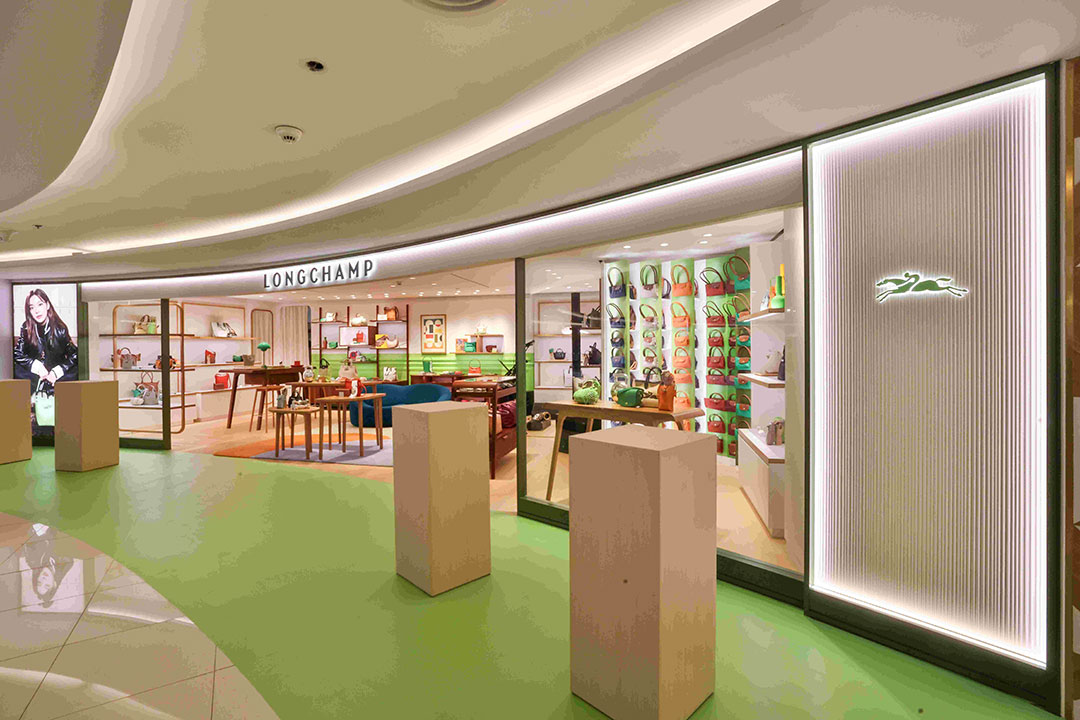
Longchamp reintroduces Le Roseau

THE SIMPLE TOTE with a metal bamboo-shaped closure by Longchamp, Le Roseau, was famous in the 1990s, and has been in constant demand ever since. Every generation has fallen to the appeal of its sleek, simple lines and its strong character. It looks chic when carried in the hand, and more casual when slung over the shoulder. In addition to new shapes, Le Roseau is now interpreted in a color palette that goes from timeless neutrals — clay, paper, and chestnut — to vibrant hues like bright green, celadon, and orange. Longchamp is available at Rustan’s.


Montblanc introduces new gizmos in new pen

MONTBLANC has developed a new fountain pen filling mechanism that allows for easy filling through the writing instrument’s barrel with one simple push. Featured in the Meisterstück Traveller Limited Edition 1924, the innovation comes as Montblanc marks the 100th anniversary of the Meisterstück pen. The Traveller mechanism draws ink into double tanks through the cone instead of the nib. The twin tanks increase the ink reservoir capacity for twice as long as a conventional Meisterstück. The design of the limited centenary edition — a Meisterstück 149 model — upholds the esthetic standards of its antecedents. A coral-colored resin and signature gold-coated fittings refer to the original color palette of the earliest Montblanc writing instruments. The signature gold-coated cap top is crowned with the Montblanc emblem in mother-of-pearl, inspired by the artwork on the original Meisterstück packaging. In celebration of the 100th anniversary, the number “100” is engraved beneath the years “1924” and “2024” on the commemorative solid Au 750 gold nib. A novel cleaning tool can also be attached to the barrel of the pen via an adapter after removing the cone in order to thoroughly clean the writing instrument. Housed inside an elegant black leather box, the limited edition set includes the Montblanc Meisterstück Traveller Limited Edition 1924, the new ink adapter, two ink bottles featuring black and blue ink, a cleaning tool and a cone adapter, as well as a black leather pen pouch inspired by early Montblanc leather accessories from the Maison’s archive. Montblanc Meisterstück Traveller Limited Edition 1924 will be available starting October at selected Montblanc boutiques worldwide. Montblanc is available in the Philippines at Rustan’s Makati, Rustan’s Shangri-La, Rustan’s Cebu, Greenbelt 5, and Solaire Resort Entertainment City.


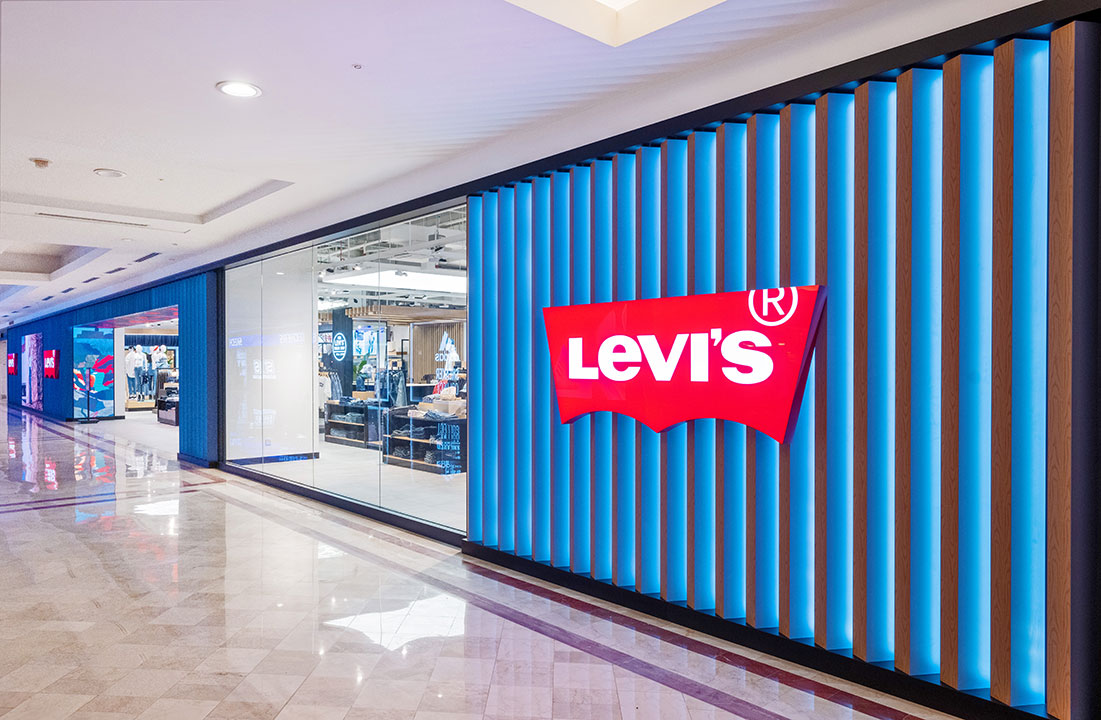
Levi’s opens biggest Southeast Asia store in Malaysia

LEVI STRAUSS & Co. (LS&Co.) announced the reopening of its expanded Levi’s store at Suria KLCC, one of Malaysia’s premier shopping destinations. It is the largest Levi’s store in Southeast Asia at 393 sq.m. and marks another milestone in LS&Co.’s expansion within the region, as the global apparel company doubles down on delivering elevated retail experiences to denim fans worldwide. The denim lifestyle apparel brand opened a 364 sq.m. store in CentralWorld, Bangkok, Thailand earlier in the year, and more recently expanded its store footage in Mid Valley Megamall, Kuala Lumpur. “Our ambition is to become a $10-billion company and a world-class retailer, and our international business will play an integral role in helping us to achieve this,” Nuholt Huisamen, Managing Director, East Asia-Pacific, for Levi Strauss & Co., was quoted as saying in a press release. The Suria KLCC store houses an extensive product range, including premium collections such as the Levi’s Vintage Clothing, Made in Japan, as well as climate-relevant Performance Cool ranges. The Levi’s Tailor Shop is located at the heart of the Suria KLCC store. Levi’s Suria KLCC opened to the public on Sept. 9, and is located at Lots 346 and 346A, Level 3 of the Suria KLCC shopping mall in Kuala Lumpur City Center.

Gov’t debt yields rally following Fed, RRR cuts

YIELDS on government debt rallied across the board last week after the US Federal Reserve kicked off its long-awaited easing cycle with a jumbo cut.

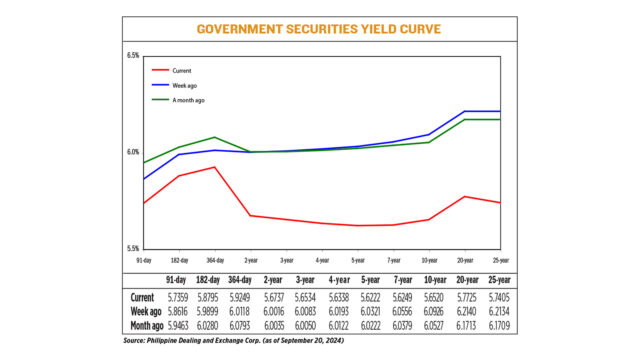
Debt yields, which move opposite to prices, went down by an average of 32.61 basis points (bps) week on week at the secondary market, data from the PHP Bloomberg Valuation Service Reference Rates as of Sept. 20 published on the Philippine Dealing System’s website showed.

Rates went down across all tenors last week. At the short end, yields on the 91-, 182-, and 364-day Treasury bills (T-bills) dropped by 12.57 bps (to 5.7359%), 11.04 bps (5.8795%), and 8.69 bps (5.9249%), respectively.

At the belly, the rates of the two-, three-, four-, five-, and seven-year Treasury bonds (T-bond) fell by 32.79 bps (to 5.6737%), 35.49 bps (5.6354%), 38.55 bps (5.6338%), 40.99 bps (5.6222%), and 43.07 bps (5.6249%), respectively.

Lastly, at the long end, the 10-, 20-, and 25-year T-bonds declined 44.06 bps, 44.15 bps, and 47.29 bps to fetch 5.652%, 5.7725%, and 5.7405%, respectively.

The volume of government securities (GS) traded jumped to P113.58 billion on Friday from P50.29 billion on Sept. 13.

The week-on-week decline in GS yields was driven by the Fed’s policy decision, as well as the cut in domestic banks’ reserve requirement ratios (RRR) announced by the Bangko Sentral ng Pilipinas (BSP) on Friday, Jonathan L. Ravelas, senior adviser at Reyes Tacandong & Co., said in a Viber message.

“Prior to the week, domestic market participants were expecting the US Federal Reserve to deliver a 25-bp rate cut in its policy meeting. However, as subtle market indications that the US central bank is actually considering to reduce policy rates more aggressively, domestic yields followed suit, with yields falling by at least 25 bps over the week,” a bond trader said in an e-mail.

“Local market participants were firmly awaiting on the US Federal Reserve decision over the week. While most market players already expect the BSP to continue reducing domestic policy rates for the rest of the year, this massive cut from the Fed would provide more leeway for the BSP to consider loosening monetary settings more aggressively. as evidenced by the recent announcement of the 250-bp cut in reserve requirement ratio for universal banks,” the trader added.

The US central bank on Wednesday kicked off an anticipated series of interest rate cuts with a larger-than-usual half-percentage-point reduction that Federal Reserve Chair Jerome H. Powell said was meant to show policy makers’ commitment to sustaining a low unemployment rate now that inflation has eased, Reuters reported.

“We made a good strong start and I am very pleased that we did,” Mr. Powell said at a press conference after the Fed, noting its increased confidence that the country’s bout with high inflation was over, reduced its benchmark policy rate by 50 bps to the 4.75%-5% range. “The logic of this both from an economic standpoint and from a risk management standpoint was clear.”

In addition to approving the half-percentage-point cut on Wednesday, Fed policy makers projected the benchmark interest rate would fall by another half of a percentage point by the end of this year, a full percentage point next year, and half of a percentage point in 2026, though they cautioned that the outlook that far into the future is necessarily uncertain.

The move marks a significant pivot in US monetary policy and a recognition of the Fed’s growing comfort with inflation continuing to ease to its target. It is currently about half a percentage point above it.

The Fed had kept its policy rate in the 5.25%-5.5% range since last July, when it ended an 18-month rate-hike campaign that was meant to control a surge in inflation, which soared in 2022 to a 40-year high.

Mr. Powell declined to declare victory on that front, but he did say inflation is now near the Fed’s 2% goal, and labor conditions are consistent with the central bank’s other goal of maximum employment.

Rate futures traders moved to price in even more easing than projected by the Fed, with the policy rate now expected to be in the 4%-4.25% range by end of this year.

Analysts have said that the start of the Fed’s easing cycle gives the BSP more room to cut benchmark interest rates further.

The Monetary Board on Aug. 15 reduced its policy rate by 25 bps to 6.25% from the over 17-year high of 6.5%, which marked its first cut in nearly four years.

BSP Governor Eli M. Remolona, Jr. has said that the central bank can deliver another 25-bp cut in the fourth quarter. The Monetary Board’s remaining meetings this year are scheduled for Oct. 17 and Dec. 19.

Meanwhile, the BSP on Friday said it will reduce the RRR for universal and commercial banks and nonbank financial institutions with quasi-banking functions by 250 bps to 7% effective on Oct. 25.

It will also cut the RRR for digital banks by 200 bps to 4%, while the ratio for thrift lenders will be reduced by 100 bps to 1%. Rural and cooperative banks’ RRR will likewise go down by 100 bps to 0%.

“The magnitude of future BSP rate cuts will depend mainly on Philippine inflation readings in the coming months. However, the BSP has also previously acknowledged that they are willing to consider a measured approach in cutting more aggressively if Philippine economic performance showed significant downside risks,” the bond trader said.

For this week, the trader said GS yields may continue to go down.

“Yields could potentially decline further [this] week amid expectations of a further softening in the US personal consumption expenditure (PCE) inflation for August, which is the primary inflation gauge of the Federal Reserve,” the trader said. August US PCE price index data will be released on Sept. 27 (Friday).

Mr. Ravelas added that he expects GS rates to move sideways to down in the near term. — K.K.P.D. Mendoza with Reuters

PLDT shares dip after $3-M settlement approval

PLDT Inc. shares fell last week following a United States court’s approval of its $3-million lawsuit settlement.

The telecommunications company ranked 12th in value turnover, with P1.02 billion worth of 815,890 shares traded from Sept. 16 to 20, data from the Philippine Stock Exchange showed.

PLDT shares closed at P1,450 on Friday, down from P1,462 on Sept. 13. Year to date, the stock had increased by 13.4%.

Claire T. Alviar, a research associate at Philstocks Financial, Inc., said that PLDT’s trading last week was impacted by its settlement of a class-action lawsuit with investors.

“We view the settlement of this case as a positive development for PLDT, as the unresolved issue may have caused hesitation among investors who likely prefer a resolution before committing to invest,” Ms. Alviar said in an e-mail.

She noted that PLDT’s stock declined week on week, slightly recovering later but still failing to post overall gains.

“The recent settlement news may have clarified some uncertainty regarding potential litigation risks, leading some to connect the case decision with the possibility of adding PLDT to their portfolios,” Alexandra G. Yatco, equity analyst at Regina Capital Development Corp., said in a Viber message.

Prior to the settlement, the company discovered in 2022 a P48-billion discrepancy or about 12.7% in its P379-billion capital expenditure in the past four years since 2019.

This prompted a US shareholder to file a securities class-action lawsuit against PLDT, accusing the firm of violations of Federal Securities Law, citing its disclosures that indicated a budget overrun of P48 billion during the period.

Moreover, Ms. Yatco noted that PLDT became one of the most actively traded stocks last week after the US Federal Reserve’s policy rate cut.

“Since lower rates benefit capital-intensive sectors such as the telecommunications segment, traders may have been encouraged to invest in their outlook on PLDT’s profitability,” she said.

In a Reuters report, the US Federal Reserve cut interest rates by half of a percentage point, kicking off what is expected to be a steady easing of monetary policy with a larger-than-usual reduction in borrowing costs that followed growing unease about the health of the job market.

In the second quarter, PLDT reported a 9% year-on-year decrease in its attributable net income to P8.59 billion from P9.44 billion. Meanwhile, its consolidated revenue rose by 3.3% to P53.36 billion from P51.68 billion.

For the first half of the year, its attributable net income decreased by 0.2% to P18.41 billion from P18.45 billion while consolidated revenues for the period increased by 3.4% to P107.58 billion from P104.04 billion.

Ms. Alviar anticipates year-on-year improvement in the bottom line for the second half, potentially driving full-year earnings growth to at least single digits.

“As of writing, PLDT’s support and resistance are at the 1,430 and 1,490 levels, respectively. After several consecutive days of closing with red candles, the stock is attempting to climb as buying pressure aims to surpass selling pressure, further narrowing the gap. A sideways shuffle is estimated for the upcoming days, as traders continue to monitor PLDT’s profitability.” Ms. Yatco said.

“PLDT’s primary trend (long term) remains in an uptrend, though it is currently experiencing a correction. It is at the support level of P1,440-1,450 range, with the second support pegged at P1,375. The current resistance stands at P1,550. If it fails to stay above the P1,440, we’re expecting a trend reversal, from uptrend to sideways movement,” Ms. Alviar said. — Charles Worren E. Laureta

Fuerza eléctrica

A row of new Porsche Taycans await to depart from Sevilla. — PHOTO BY KAP MACEDA AGUILA

We drive the extensively refreshed Porsche Taycan in Spain

THERE’S NOTHING quite like experiencing launch control on the new Porsche Taycan Turbo. When you release the brake pedal while flooring the throttle, you are catapulted — nay, rocketed forward — nailed to the seatback as the vehicle rapidly acquires pace. You don’t even have enough time to thank God for the headrest that cradles your skull and keeps you from getting whiplash.

You could very well say I left my senses behind me as the battery electric sports car sprinted from a standstill to 100kph in less than three seconds. The official rate, says Porsche, is 2.4 seconds — a hefty 0.4 second quicker than the Taycan it replaces. And on the Porsche Turbo GT with Weissach Package that I’m blessed to be muscling around the track, it’s an even sprightlier 2.1 seconds. The maximum power on this beauty is downright beastly: 760kW or 1,019hp (making it the most powerful series-production Porsche of all time). And this yin-yang quality extends to the silent powertrain and tight chassis that lull you into thinking you are not speeding.

Even if the tarmac of the beautiful Circuito Monteblanco in La Palma del Condado, Spain was a bit wet on account of a spate of showers, the specialized Pirellis on the Taycan kept it steady and planted at speed. The proving ground is a surely worthy experience and showcase of what makes the Taycan so different, so improved from its predecessor. Though a midcycle refresh, the new Taycan is already head and shoulders above the one it replaces — in one aspect, most literally.

Let’s get to that one first. Cognizant of the difficulty of getting into sports cars (ah, the problems we have), Porsche has made tweaks so that when you unlock the vehicle to get in, the vehicle will rise up to make ingress a bit easier; same thing when you are disembarking from it.

There are definitely touches like this here and there that will make even existing Taycan owners take another look — and even consider upgrading.

Among the plethora of niceties, none are more important than bumps in power, range, acceleration, stability, and even charging times.

At the track’s media lounge, I spoke exclusively to Porsche’s spokesperson for the Panamera and Taycan lines, Mayk Wienkötter. I asked for the highlights of this significant rehash. “First of all, we have a bigger battery,” he replied. “That helps, of course, but we really retouched and reworked every part of the car. Everything has been made more efficient. We have a new rear motor, we have new pulse inverter. We even have tires and wheels that are more aerodynamic, and therefore more efficient. And this all adds up. It’s a lot of the little things that we implemented into the new Taycan, and these help to increase the range by up to 35%.”

The previous evening, Porsche held a presentation at the impressive Pabellón de la Navegación for attendees of its New Taycan International Media Drive. This museum in Seville is “devoted to seas and oceans,” underscoring the significance of Seville (or Sevilla) as a fluvial city.

Porsche Taycan Electric Powertrain Director Klaus Rechberger helped to establish context as to what the Stuttgart-headquartered brand prioritized in the new Taycan in terms of share in development cost. Leading the, well, charge is work on efficiency (29%), performance (25%), design and charging (16% each), infotainment (11%), and comfort (3%). It should be no surprise that massive gains were realized in the major areas of spending.

Aside from shaving milliseconds off its standstill-to-100kph time (in the case of the base Taycan, it’s now 4.8 seconds from 5.4 ticks), range has grown significantly. By WLTP standards, the new Taycan can realize up to 678 kilometers on a fully charged battery — up by 35% versus the 503 kilometers of its predecessor. The Taycan Turbo S musters 630 kilometers versus the 467 kilometers (plus 34%) of the older version. The aforementioned batteries have been swapped for higher-capacity ones — 300kW from 240kw in the new Taycan 2WD; 700kW from 560kW in the new Taycan Turbo S. Drilling down further, the improved range reflects breakthroughs in four areas of improvement: battery capacity, increased drivetrain efficiency, optimized drive and recuperation strategy, and optimization of the whole vehicle (mass, aerodynamics, rolling resistance).

The battery gets new cell chemistry to promise high energy density and performance. Aside from enhanced capacity (plus 12%), it accepts greater maximum charge current (plus 20%), boasts a lower starting temperature for fast charging (now at 15 degrees Centigrade from 35 degrees), higher maximum current for launch control (plus 20%), lower weight (less 9kg), and greater energy density (plus 13%).

Looking back, the Taycan, when it was first rolled out to the market in 2019, was probably a bit of a gamble for Porsche, particularly in view of purists who believe in the sanctity of the internal combustion engine (ICE). I posed this very question to Mr. Wienkötter.

“It’s very simple,” he began. “The Taycan is a true Porsche. It looks like a Porsche, drives like a Porsche, handles like a Porsche. It even smells like a Porsche. If you look at the seating position, for instance, it’s very similar to the 911, although it’s a four-seater and a four-door version.”

Insisted the executive: “Everything feels very much Porsche, and that was really crucial for us to create — despite the drivetrain — a car that really resonates with the existing Porsche customers, that they feel at home when they get into the car. The steering feel will be the same, the way the car turns, and the acceleration feel, it should be very similar, and that’s what we achieved with the Taycan, and that’s why it’s such a great success.”

Mr. Wienkötter added that Porsche has produced “almost 150,000” units of the model. If you take into account that it is, after all, a luxury vehicle — and a BEV at that — then it “tells the success story of the Taycan from day one.”

Still, Porsche designers and engineers were cognizant of the misgivings drivers and pundits had about the original vehicle — mainly pertaining to comparatively limited range and efficiency. “We felt that the efficiency needed to be improved, even the performance. So now, the car is quicker, charges more quickly, and goes further. The whole package is now even more complete,” declared the executive.

As for the demographic of Taycan buyers, Mr. Wienkötter reported, “We’ve seen it all. So, 50% are existing customers, 50% are new to the brand, and we even saw some people buy their very first EV through Porsche. So the mix is really, really diverse, which is also, again, part of the success, because the car resonates with so many people from so many different target groups, that it appeals to so many different people.”

This attractiveness for various buyer profiles is also manifested in the diversity of choices in the Taycan — carried over into the refreshed version. There are a staggering 14 different Taycan models — broken down into the three main body types: the sports sedan, the Cross Turismo, and Sport Turismo.

“If a model is not performing, there would be no reason to continue it in through the next generation. We didn’t lose a single model. You can really choose by budget, by design, or by power. It’s really your choice,” concluded Mr. Wienkötter.

A stint on the track was a welcome one to test the limits of the electric vehicle that is truly a Porsche. Incidentally, the Taycan Turbo GT with Weissach Package posted the fastest-ever time for an electric series-production car at the Laguna Seca and the Nürburgring Nordschleife — additionally becoming the fastest four-door of any powertrain type to make a round of the latter.

However, making our way to and from La Palma del Condado and Sevilla was something else. Flying past verdant meadows freshly kissed by rain, beautifully undulating roads in the countryside, and even blissfully feeding livestock, the new Porsche Taycan felt compliant and at home, almost blending into the scenery even as it rushed past in a blur. There was a whole lot of silence as well, almost like the Taycan was respectful and mindful not to disturb the peaceful, living tableau of this slice of paradise.

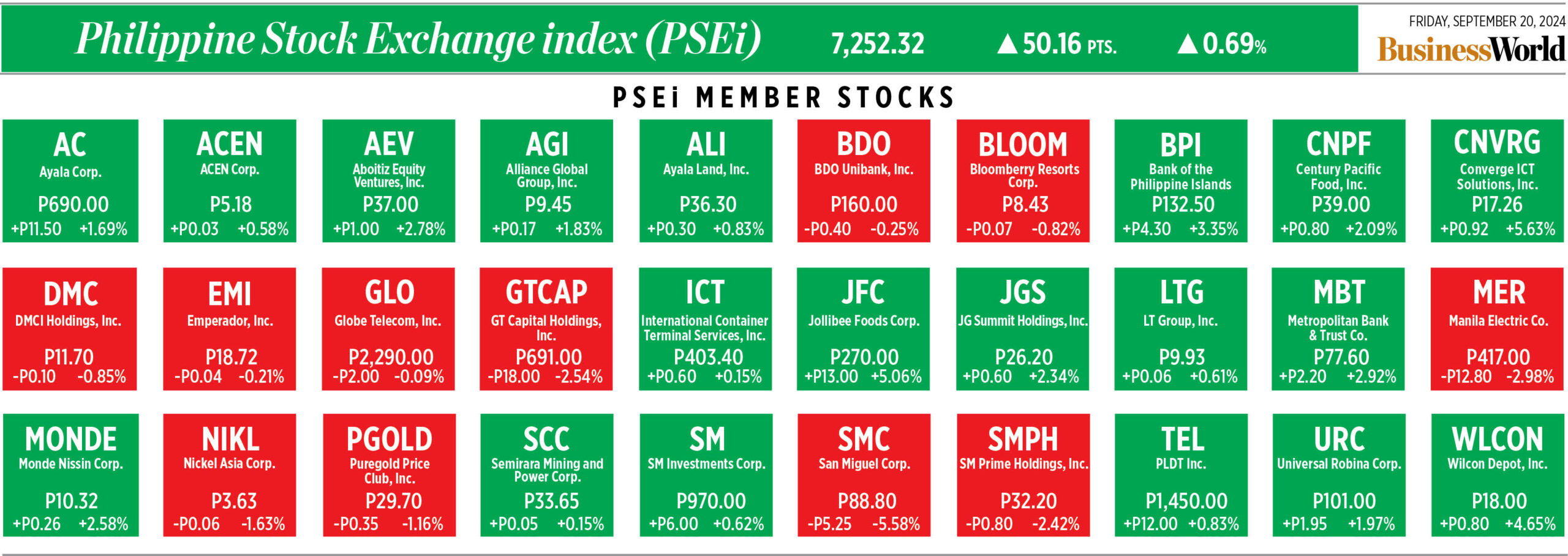
How PSEi member stocks performed — September 20, 2024

Here’s a quick glance at how PSEi stocks fared on Friday, September 20, 2024.


PHL shares may rally as Fed cut boosts sentiment

BW FILE PHOTO

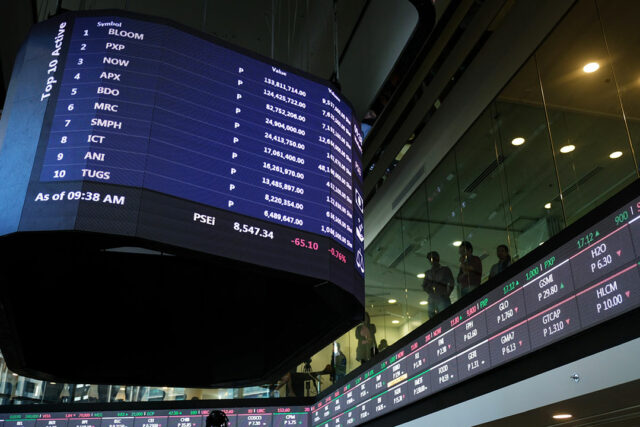
PHILIPPINE SHARES may continue to climb this week amid positive market sentiment following the US Federal Reserve’s decision to start its rate cut cycle.

On Friday, the bellwether Philippine Stock Exchange index (PSEi) rose by 0.69% or 50.16 points to end at 7,252.32, while the broader all shares index went up by 0.61% or 23.94 points to close at 3,895.62.

Friday’s close was the PSEi’s best finish in more than two years or since it ended at 7,288.07 on March 7, 2022.

Week on week, the benchmark index surged by 3.27% or 229.47 points from its 7,022.85 close on Sept. 13, climbing for a third consecutive week.

“The Fed officially started its easing cycle with a supersized rate cut, sending global markets into a buying frenzy,” online brokerage firm 2TradeAsia.com said in a market note.

“The local market has been showing bullish momentum, rising for three straight weeks, with the latest one getting it past the 7,150 resistance level,” Philstocks Financial, Inc. Senior Research Analyst Japhet Louis O. Tantiangco said in a Viber message.

The Fed last week cut its policy rate by 50 basis points (bps) to 4.75%-5%, marking its first easing move since March 2020.

Interest rate futures contracts now price in about a 30% chance that the Fed will deliver a second cut of the same size in November, Reuters reported. The market-based probability of a quarter-point rate cut in November is now about 70%, up from around 65% before the data.

For this week, Mr. Tantiangco said the Philippine stock market could extend its rally, although profit taking could ensue.

“The market may still end this week on a positive note as the dovish monetary policy outlook of the Bangko Sentral ng Pilipinas (BSP) and the Fed may continue to uphold optimism,” he said.

He placed the PSEi’s support at 7,150 and resistance at 7,400.

Analysts have said the start of the Fed’s easing cycle gives the BSP more space to cut its own benchmark interest rates further.

The Monetary Board on Aug. 15 reduced its policy rate by 25 bps to 6.25% from the over 17-year high of 6.5%. BSP Governor Eli M. Remolona, Jr. has said the central bank may deliver another 25-bp cut in the fourth quarter. The Monetary Board’s remaining meetings this year are scheduled for Oct. 17 and Dec. 19.

For his part, Rizal Commercial Banking Corp. Chief Economist Michael L. Ricafort put the market’s immediate support at 7,000 and resistance at 7,338.66-7,552.20.

“Mostly weaker US economic data recently could increase the odds of future Fed rate cuts in the coming months that could be matched locally,” Mr. Ricafort said in an e-mail.

2TradeAsia.com placed the PSEi’s immediate support at 7,100 and resistance at 7,500. “The local bourse has successfully hit the 7,200 level for the first time since 2022, this time backed by a clearer path towards lower rates up to 2026, tame inflation, and more grounded forward valuations.” — R.M.D. Ochave with Reuters

Peso may move sideways vs dollar as market awaits PCE price index data

PHILSTAR FILE PHOTO

THE PESO could trade sideways against the dollar this week as the market awaits the release of the August US personal consumption expenditure (PCE) price index data for hints on the Federal Reserve’s next policy move.

The local unit closed at P55.69 per dollar on Friday, weakening by eight centavos from its P55.61 finish on Thursday, Bankers Association of the Philippines data showed.

Still, week on week, the peso surged by 30.5 centavos from its P55.995 finish on Sept. 13.

The peso weakened against the dollar on Friday after the Bangko Sentral ng Pilipinas (BSP) announced a surprise cut in banks’ reverse requirement ratios (RRR), Rizal Commercial Banking Corp. Chief Economist Michael L. Ricafort said in a Viber message.

The BSP on Friday said it will reduce the RRR for universal and commercial banks and nonbank financial institutions with quasi-banking functions by 250 basis points (bps) to 7% effective on Oct. 25.

It will also cut the RRR for digital banks by 200 bps to 4%, while the ratio for thrift lenders will be reduced by 100 bps to 1%. Rural and cooperative banks’ RRR will likewise go down by 100 bps to 0%.

“The US dollar gained some strength due to positive US jobs data, but the dollar-peso pair traded with caution amid a broader risk-on rally. This trend was influenced by offshore central bank decisions and the BSP’s announcement of an RRR cut. The Indonesian rupiah outperformed other Asian currencies, while the Chinese yuan benefited from a stronger reference rate set by the People’s Bank of China,” Security Bank Corp. Chief Economist Robert Dan J. Roces added in a Viber message.

The dollar strengthened against the yen on Friday, hitting its highest level in two weeks, after the Bank of Japan (BoJ) left interest rates unchanged and indicated that it was not in a hurry to hike them again, Reuters reported.

The BoJ could afford to spend time eyeing the fallout from global economic uncertainties, Governor Kazuo Ueda said in a press conference following the central bank’s move, adding that its monetary policy decision will be based on “economic, price and financial developments.” The BoJ kept rates steady at 0.25%, a move that was widely expected.

The dollar rose as high as 144.50 yen, reaching its highest level since early September. It was last up 0.92% at 143.92.

The dollar has traded in a choppy fashion since the Fed kicked off its monetary policy easing cycle. The US dollar index, which measures the greenback against major currencies, gained slightly to 100.75 and just above a one-year low.

Markets imply nearly a 49% chance the Fed will deliver another 50-bp rate cut in November and have priced in 74.8 bps of cuts by the end of this year. The Fed’s policy rate is expected by the end of 2025 to be at 2.85%, which is now thought to be the Fed’s estimate of the neutral rate.

For this week, Mr. Roces said the US PCE data, the Fed’s preferred inflation gauge, will be the main driver of foreign exchange trading. August US PCE price index data will be released on Sept. 27 (Friday).

Investors are looking for data to support expectations that the economy is navigating a “soft landing,” during which inflation moderates without badly hurting growth.

Mr. Ricafort sees the peso ranging from P55.60 to P55.80 per dollar on Monday. — AMCS with Reuters

Rules currently favor imports in 2-wheel EV market, Honda says

GLOBAL.HONDA

HONDA Philippines, Inc. said imports are currently a better option than local production in the two-wheel electric vehicle (EV) market, based on the rules now in place.

“The Philippine regulations call for zero duty, which is good for imports. So it is better to import because if we invest in production, that will cost more than importing. So that’s why we are now choosing to import,” Sayaka Arai, president of Honda Philippines, told reporters last week.

The company produces EV motorcycles in China, Indonesia, India, and Thailand.

“However, if the government’s laws and regulations change to benefit investment in local production, we want to consider producing this kind of electric motorcycle for the domestic market,” she added.

On June 20, President Ferdinand R. Marcos, Jr. signed Executive Order (EO) 62, which expanded the reduced Most Favored Nation tariff rates to other battery EVs, hybrid EVs (HEVs), plug-in hybrid EVs (PHEVs), and certain parts and components.

EO 62 also covered e-motorcycles, e-bicycles, nickel metal hydride accumulator batteries, e-tricycles and quadricycles, HEVs, and PHEV jeepneys or buses.

Ms. Arai said Indonesia provides incentives to manufacturers if they meet product localization targets.

“If the localization ratio is higher than that range, the company can get the incentive (when selling) electric vehicles,” she added.

A high level of localization will push manufacturers towards local production.

“That means more supply needs to be available in the country, which also means more employment in the country,” she said.

“That is accelerating the industrial wave in Indonesia for EVs,” she added.

She noted that EVs in the Philippines are still in the early stages of development following the adoption of the zero-import duty policy.

“The Philippines is only at the starting level for electric motorcycles. It’s just importing and expanding the market,” she said.

“But for the future, we would like to ask the government to consider the incentives for domestic manufacturing,” she added.

She said that the motorcycle market is around six million units in Indonesia; the Philippine one is two million.

Last week, Honda unveiled its first battery-powered motorcycle, the EM1 e: which has a suggested retail price of P155,400.

“Because the EV market is just at the starting level, we are targeting not so big numbers like 1,000 or 2,000 units,” she said.

In the previous financial year, Honda produced 750,000 motorcycles in its factory. Honda’s financial year runs from April to March.

“Two years before that, that was just 200,000. So our production is really increasing,” she said.

She added that the main driver for the increasing production is the Honda’s Click125 model, which is popular in the Philippines, and is being exported to New Zealand. — Justine Irish D. Tabile

FPIP Batangas commercial center expected to open by early 2026

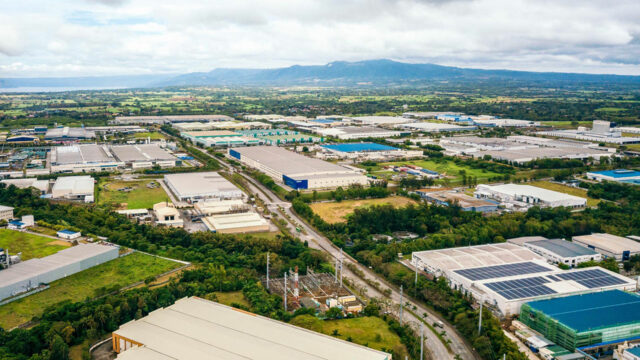
FIRST PHILIPPINE Industrial Park is a joint venture between the local conglomerate First Philippine Holdings and the Japanese conglomerate Sumitomo Corp. — FPIP.COM

FIRST PHILIPPINE Industrial Park (FPIP) is building a three-story mixed-use hub in Santo Tomas, Batangas, which is expected to boost employment at the economic zone from the current staffing level of over 70,000.

FPIP Plaza will offer 15,000 square meters of space for retailers, restaurants, service centers, corporate offices, and government offices upon completion.

Targeted for launch by the first quarter of 2026, FPIP’s development partners are construction firm First Balfour and architectural firm Aidea.

FPIP Chief Commercial Officer and First Balfour Deputy Chief Operating Officer Jose Valentin A. Pantangco said that the plaza is meant to serve as a gathering place for the surrounding barangays.

“It will continue to support the mission of FPIP — to create jobs, strengthen industry, and modernize the two cities of Sto. Tomas and Tanauan, and make Batangas the prime industrial corridor of the Philippines,” Mr. Pantangco said in a statement over the weekend.

Batangas Rep. Ma. Theresa V. Collantes welcomed the project and said it will help boost business within the province.

“I can already see the impending growth of the local economy, the creation of even more work opportunities, the flourishing of surrounding businesses, the placement of more investment, and the strengthening of the position of FPIP and its partners,” Ms. Collantes said.

FPIP is a Philippine Economic Zone Authority-registered economic zone that hosts over 150 locators, which include Collins Aerospace, the Philippine Manufacturing Co. unit of Murata, Inc., and Dyson.

The construction of the mixed-use project officially broke ground on Sept. 10, First Balfour said in a statement. — Justine Irish D. Tabile

PHL climate financing hits record $3.13B in 2023

PHILIPPINE STAR/ MICHAEL VARCAS

THE PHILIPPINES obtained a record $3.13 billion (P174.23 billion) from multilateral lenders to fund projects aimed at mitigating the effects of climate change, the European Investment Bank (EIB) said.

The 2023 total was 7.67% higher than the $2.91 billion obtained in 2022, according to the EIB’s 2023 Joint Report on Multilateral Development Banks’ (MDB) Climate Finance.

Among 126 countries, the Philippines was 11th highest recipient of climate finance, behind France ($7.38 billion), Spain ($6.98 billion), Italy ($6.67 billion), India ($6.5 billion), Poland ($5.81 billion), and Germany ($5.66 billion).

Also ahead of the Philippines were Turkey ($5.3 billion), Indonesia ($3.88 billion), Bangladesh ($3.72 billion), and Brazil ($3.61 billion).

Rizal Commercial Banking Corp. Chief Economist Michael L. Ricafort said this was “consistent with the fact that the Philippines has always been one of the hardest hit by calamity damage worldwide, including those related to climate change or extreme weather conditions.”

“(The) level of assistance to the country is commensurate to this fact, especially related to increasing preparedness of the country to face these climate-change related calamities to mitigate loss to property and lives,” he said via Viber.

For the 16th straight year, the Philippines was ranked the most disaster-prone country in the world with a risk score of 46.91, according to the 2023 World Risk Index.

In 2023, multilateral development banks (MDBs) allocated $125 billion for climate mitigation and adaptation projects worldwide, almost double their commitment to allocate $65 billion yearly until 2025.

The European Union received the highest climate financing from MDBs last year at $46.31 billion, followed by Sub-Saharan Africa ($17.24 billion), and East Asia and the Pacific ($11.12 billion), according to the report.

“We welcome the fact that MDBs provided record climate finance last year — every dollar of which makes a difference in helping to cut carbon emissions or preparing people and infrastructure for the worst impacts of climate change, much of which we must recognize is already baked in,” Bruno Carrasco, director general for Sustainable Development and Climate Change at the Asian Development Bank, said in a statement.

Despite this, Mr. Carrasco noted the still “large financing gap, and ADB will continue to work closely with other MDBs — and in its own right — to get as much financing as possible to our developing member countries.”

Low and middle-income countries, which include the Philippines, received $74.4 billion in 2023. Some 67% or $50 billion was allocated to climate change mitigation, while 33% or $24.7 billion was for adaptation.

Meanwhile, high-income economies obtained $50.3 billion from MDBs, with 94% or $47.3 billion going to mitigation projects and 6% or $3 billion going to adaptation projects.

The joint report combined climate funding extended by the EIB, ADB, African Development Bank (AfDB), Asian Infrastructure Investment Bank (AIIB), Council of Europe Development Bank (CEB), European Bank for Reconstruction and Development (EBRD), the EIB, Inter-American Development Bank (IDB), Islamic Development Bank (IsDB), New Development Bank (NDB) and the World Bank Group (WBG). — Beatriz Marie D. Cruz

ADVERTISEMENT
ADVERTISEMENT