Home Blog Page 2582

BIR expecting H2 revenue boost from vaping industry

CDC-UNSPLASH

THE Bureau of Internal Revenue (BIR) expects to hit its collection target this year, citing encouraging signs of compliance by the vaping industry and the new withholding tax on online sellers.

“(On) what we’re doing in the second semester, I hope that the imposition (of withholding tax) and strict monitoring of vape products, as well as our crackdown on the illicit cigarette trade, will be enough,” BIR Commissioner Romeo D. Lumagui, Jr. told reporters on the sidelines of an event on Tuesday.

The BIR, which accounts for 70% of government revenue, missed its collection target for the first half, generating P1.36 trillion, below the P1.403-trillion goal set for the bureau.

Starting June 1, the BIR ordered all vape manufacturers to mark their products with revenue stamps to ensure tax compliance.

“We’ve seen an increase in the number of registered vape products and an increase in collections since we started implementing the stamps on vape products,” Mr. Lumagui said.

The BIR expects to collect P3.055 trillion this year.

Mr. Lumagui also said that the recently imposed withholding tax on online sellers will help increase the BIR’s collections in the next six months.

He said that the 90-day extension in complying with the withholding tax delayed the revenue expected to be generated from this tax.

“For us, it’s okay that we were not able to collect immediately. At least we gave our taxpayers a chance to comply with the new system,” Mr. Lumagui said.

In April, the BIR extended the transition period for online sellers to adjust to the withholding tax by another 90 days, or until July 14, at the private sector’s request.

Under BIR regulations, a withholding tax of 1% will be imposed on one-half of the gross remittances of e-marketplace operators and digital financial service providers to the sellers or merchants of the goods and services carried on their platforms.

For their part, online sellers must also register with the BIR to ensure compliance with the new system.

Those covered by the regulation include electronic marketplaces for online shopping, food delivery platforms, platforms to book lodging accommodations, and other similar online marketplaces.

On the other hand, digital financial service providers were given until Oct. 12 to transition to the withholding tax.

The tax will not be imposed if the annual total gross remittances to an online seller for the past taxable year does not exceed P500,000; if the cumulative gross remittances to an online seller in a taxable year does not exceed P500,000, or if the seller is duly exempt from or subject to a lower income tax rate pursuant to any existing law or treaty.

The BIR has yet to estimate how much revenue will be generated from the withholding tax.

To ensure that a withholding tax is also collected from online sellers based overseas, they will have to register in the Philippines as online merchants, BIR said.

Unregistered foreign online sellers will be levied a final withholding tax at a higher rate than the usual withholding tax, BIR said.

Mr. Lumagui also clarified that the withholding tax should not push up prices on online selling platforms.

“This is not like a VAT or value-added tax that is imposed or added to the prices of products. This is just a tax (which advances) income tax,” he said.

Finance Undersecretary Renato E. Reside, Jr. told reporters separately that imposing the withholding tax would help bring the Philippine tax system in line with that of other countries. — Beatriz Marie D. Cruz

Meat costs expected to rise due to high global prices, peso weakness

PHILSTAR FILE PHOTO

THE Meat Importers and Traders Association (MITA) said the price of imported meat could rise due to high international prices and a weak peso.

“We are already seeing the stocks of some major players thinning out,” MITA President Emeritus Jesus C. Cham said via Viber.

The peso closed at P58.295 against the dollar on Wednesday, according to the Bankers Association of the Philippines.

Mr. Cham added that the recent signing of Executive Order (EO) No. 62, which cut import tariffs on major food items, could provide predictably for the meat import market.

“Unless the producers manage to overturn it,” he added.

EO 62, signed by President Ferdinand R. Marcos, Jr. extended low tariffs on pork and mechanically deboned chicken meat until 2028.

The tariff for pork was kept at 15% for shipments within the minimum access volume and 25% for those exceeding the quota. On the other hand, the rate for mechanically deboned chicken was retained at 5%.

According to the Bureau of Animal Industry, meat imports rose 10% during the five months to May, totaling 524.68 million kilograms.

Mr. Cham said shipments of major meats rose year on year despite the delayed release of quotas for pork and chicken.

“While we expect the quota to be finalized this month, only a few months remain to fully utilize,” he added.

He said that the heightened price of domestically grown pork and chicken may have driven consumers to cheaper imported variant.

“This suggests that the high price of local pork and poultry continue to make imported meat competitive and attractive. The high price of domestically grown meat could be attributed to decreased production and higher costs due to the El Niño,” Mr. Cham said.

According to the Department of Agriculture, a kilogram of domestically grown whole chicken in Metro Manila sold for between P190 and P250 per kilogram. On the other hand, pork belly (liempo) sold for between P350 and P410 per kilo, while pork shoulder (kasim) fetched P300-P380 per kilo.

Pork and chicken were the top meat imports during the six months at 253.55 million kilos and 181.23 million kilos, respectively.

Mr. Cham added that due to the rise in prices, beef is also emerging as an alternative.

“The high price of pork and poultry may have narrowed the gap against beef, making it easier to shift consumption from the former to the latter,” he said. — Adrian H. Halili

Feasibility study for cable car project expected in one year

REUTERS

THE Department of Transportation (DoTr) said the feasibility study for the Philippines’ first cable car project will be completed in a year, and added that the auction is expected to go the solicited route.

“It will be solicited. We are now working on the planning… The feasibility study needs to be completed first; it will take a year,” Transportation Secretary Jaime J. Bautista told reporters on the sidelines of a briefing on Wednesday.

The DoTr should team up with the private sector for the cable car project, transport experts said, adding that the project should be positioned as a tourism booster rather than a solution to road congestion.

“Solicited public–private partnerships (PPP) will always be a better choice for the government since they offer a level playing field for all bidders… The solicited route would be the best option. A cable car requires very extensive land right-of-way (RoW) acquisition,” Nigel Paul C. Villarete, senior adviser on PPP at the technical advisory group Libra Konsult, Inc., said via Viber.

Last week, the DoTr said the cable car system is expected to begin operations by 2028.

Metro Pacific Investments Corp. (MPIC) Chairman, President, and Chief Executive Officer Manuel V. Pangilinan said the company has no immediate plans to participate in such an auction but said the cable car system is probably feasible.

“From a technical point of view, I think it can be done. I think it is an interesting concept. There’s a Malaysian group that approached (us) about that. It looks interesting. I think the technology is there,” Mr. Pangilinan told BusinessWorld recently.

Last year, MPIC entered a partnership with Malaysian infrastructure firm Hartasuma Sdn Bhd. to explore innovative rail services and infrastructure.

The collaboration between the two companies aimed to explore various transportation modes like cable systems for both tourism and urban transport.

“Most mass transport projects pass over existing roads for most of their length, but cable cars are designed to bypass the road network so most of their length will be over RoW, which needs to be acquired. That’s a lot of land acquisition and private proponents would shy away from that,” Mr. Villarete said.

He said the solicited route is better for the project since the government will take primary responsibility for RoW acquisition.

Transportation Undersecretary Timothy John R. Batan has disclosed that the cable car route will connect the Taytay station of Metro Rail Transit Line 4 (MRT-4) to Antipolo City.

MRT-4 will cover 12.7 kilometers from Epifanio de los Santos Avenue (EDSA) Ortigas Ave. junction to Taytay, Rizal.

The cable project was deemed viable in a pre-feasibility study conducted by the Asian Development Bank (ADB), the DoTr said. Bidding for the project is expected to commence by 2026.

While the cable car system is being put forward as a possible solution to worsening road congestion, Mr. Villarete said the cable car system will not do much to address traffic problems.

“It might be very attractive and will surely help in tourism, but a cable car’s capacity is almost the same as cars on ordinary roads. It won’t contribute much to easing congestion,” Mr. Villarete said.

Enrico P. Villanueva, a senior lecturer at the University of the Philippines Los Baños Economics Department, said the cable car system, if done well, could become a “tourist magnet,” especially for domestic travelers.

However, former president of the Transportation Science Society of the Philippines Rene S. Santiago has expressed doubts about the project.

“Selling dreams that won’t see the light of day,” he said in a message, citing the previous administration’s proposals for cable car systems in other parts of the country.

Libra Konsult’s Mr. Villarete said the government must ensure RoW acquisition for the project to ensure timely completion.

“The right-of-way acquisition is still problematic. It might be up there in the air, but the government still needs to secure the RoW below it either by land acquisition, rental, or owner’s permission/agreement,” he added.

He said RoW for cable car projects is deemed challenging if the project traverses a built-up area.

“Cable cars are not built to evade right-of-way difficulties because they still requires RoW. I do not think everyone will agree to have a cable car above their homes,” he said.

The government’s infrastructure projects have been hampered by RoW issues, delaying their completion.

A 2016 law authorizes the government to acquire real property needed for RoW or for any National Government infrastructure project through donation, negotiated sale, expropriation, or any other mode of acquisition. — Ashley Erika O. Jose

Gov’t urged to focus on industry, agri development instead of FDI

REUTERS

NON-GOVERNMENT organizations said the government must refocus its efforts on developing domestic industry and raising agricultural output instead of pursuing foreign direct investment (FDI) and relying on food imports.

Discussing his preferred government initiatives ahead of the President’s address to Congress next week, Rene E. Ofreneo, Freedom from Debt Coalition president and professor emeritus at the University of the Philippines School of Labor and Industrial Relations, said: “We are in the era of import liberalization which made us forget to fix our agriculture, manufacturing, and give our farmers the capacity to boost production.”

He was speaking at a news conference in Quezon City.

President Ferdinand R. Marcos, Jr. is set to deliver his third State of the Nation Address before Congress on July 22.

Senator Cynthia A. Villar has called on the Department of Agriculture (DA) to more efficiently use the P30 billion in national rice development funds, and called for a halt to the procurement of hybrid seed, which she said is expensive and has failed to boost rice output.

She filed Senate Bill No. 2601, which seeks to extend the Rice Competitiveness Enhancement Fund to support farm mechanization and the supply of seed and fertilizer.

The RCEF, a component of the Rice Tariffication Law passed in 2019, is set to expire by the end of this year. The law deregulated rice imports, allowing private parties to import rice, originally charging them a 35% tariff on grain brought in from Southeast Asia. The tariff has been lowered to 15% regardless of source country.

The Federation of Free Farmers and Samahang Industriya ng Agrikultura have opposed the lowering of rice tariffs to 15%, saying that such a move threatens farmers’ livelihoods.

Leodegario Q. de Guzman, chairman of the Bukluran ng Manggagawang Pilipino, said at the same event that the government needs to boost the competitiveness of domestic products. — John Victor D. Ordoñez

JICA tapped to help draft PUV dev’t plan

Commuters line up at the Main Avenue station of the EDSA bus carousel in Quezon City, July 18, 2022. — PHILIPPINE STAR/MIGUEL DE GUZMAN


The Department of Transportation (DoTr) and the Japan International Cooperation Agency (JICA) have agreed to draft a plan to develop the public utility vehicle (PUV) system in Metro Manila and surrounding areas.

The technical cooperation project for capacity building among PUV operators will be completed in 2027, Transportation Secretary Jaime J. Bautista said.

The plan ”intends to improve the interim modality of transport systems while enhancing the capacity of road-based public transport operators in terms of fleet products,” Mr. Bautista said.

Once completed, the capacity building plan will include manuals for route planning, management, and evaluation; guidelines for the design of PUV stops and intermodal hubs; and service plans for route planning and training .

The DoTr added that the plan will also address improving facilities and service level monitoring to persuade commuters to rely less on private vehicles.

The program hopes to strengthen DoTr’s current road projects such as the Public Transport Modernization Program (PTMP) the EDSA Busway, and the EDSA greenways projects. — Ashley Erika O. Jose

Modernizing property valuation

Whether you are an individual looking to purchase a house, an entrepreneur about to lease a place for your next business venture, or a corporation considering acquiring equipment, it is important to ensure that you are getting a fair deal on your target property.

At present, there are three bases for the valuation of real property for tax purposes: (1) the Bureau of Internal Revenue’s (BIR) Schedule of Zonal Values (SZVs), (2) Local Government Units’ (LGU) Schedule of Market Values (SMVs), and (3) the market values from the highest selling price from recent sales of property in the vicinity, whichever is higher. This rule is usually the root of disagreement between taxpayers and the government.

Based on studies conducted by the Department of Finance (DoF), SMVs are significantly lower than the values from private valuation. In 2021, data shows that 60% of SMVs and 38% of SZVs are outdated, or were not revised in the last three years. Because of this, legislators found an opportunity for a potential incremental revenue of P30.5 billion from the Real Estate sector by updating the SMVs and reflecting current market conditions.

With such considerations, Republic Act (RA) No. 12001, or the Real Property Valuation and Assessment Reform Act (RPVARA) was signed on June 13 and took effect on July 3.

This new law aims to set strict rules on updating the SMVs every three years and depoliticizing valuation through the establishment of the Real Property Valuation Service (RPVS) and Real Property Valuation Unit (RPVU) under the Bureau of Local Government Finance (BLGF); to create a single valuation base for real property taxation and benchmark for other purposes (e.g., right-of-way acquisition, expropriation and lease); and to promote transparency through a Real Property Information System (RPIS) that will ensure that everyone has access to accurate property valuations, reducing discrepancies and confusion.

STRICT REGULAR UPDATING OF SMVS
The LGUs will be required to update their SMVs, in accordance with the latest Philippine Valuation Standards (PVS), within two years from the effectivity of the RPVARA, and conduct general revisions of property assessments and classifications every three years thereafter.

The BLGF, through the RPVS, is to review the PVS every three years to ensure they align with globally accepted principles and definitions in real property valuation, with due consideration for the prevailing economic conditions. As a result, this refreshed system will create a more reliable basis of valuation for taxpayers that minimizes overpricing on the side of the buyer or lessee in terms of sale and leasing of real property, among other real estate transactions.

SINGLE VALUATION BASE FOR REAL PROPERTY TAXATION
The approved SMVs will be the basis for determining real property-related taxes of national and local governments, and used by all appraisers and assessors in the LGUs and other stakeholders in the appraisal/valuation of land, buildings, machinery and other real property, whether taxable or exempt.

In every BLGF regional office, there is to be a counterpart for the RPVS; every LGU, on the other hand, will create an RPVU under the Office of the Local Assessor. As such, the SMVs approved by the BLGF will be the basis for the LGU’s real property assessments, enabling taxpayers to easily determine their Real Property Tax (RPT) due, as well as transfer taxes (e.g., Capital Gains Tax, Value-Added Tax, Documentary Stamp Tax). This repeals previous rules on property valuation referring to the BIR’s SZV, the LGU’s SMV, and the recent selling price of property sold within an area, whichever is higher.

AUTOMATION OF RPT ADMINISTRATION
To maintain efficient RPT administration, the BLGF is to develop and maintain an up-to-date electronic database (the RPIS) on the sale, exchange, lease, mortgage, donation, transfer of property, and all other real property transactions and declarations, as well as the cost of construction or renovation of buildings and other structures, and the price of machinery and equipment.

The RPIS is to have mechanisms for the electronic submission of necessary documents and information by concerned National Government offices or instrumentalities and LGUs, subject to the provisions of the Data Privacy Act. The RPIS may also be accessed by the private sector to seek data on the latest real property valuation. Through this automated and transparent system, the government and the private sector would have easy access to updated SMVs any time, resulting in more efficient real estate transactions.

In order to transition to this new regime, taxpayers are given a chance to avail of a real property tax amnesty (one-time or installment payment). The SZVs and existing SMVs will continue to be in force until repealed by BLGF-approved SMVs within two years from the effectivity of the RPVARA. Further, any increase in Real Property Tax in the first year of approved SMVs is limited to 6% of properties assessed prior to the effective date of the RPVARA.

Pending the implementing guidelines of this law, I hope there will be a systematic approach to ensuring that values will consistently be up to date. Similar to AMLA’s registration procedure, the BLGF could require registration to the RPIS of all LGUs, real estate professionals, engineers, architects, and other stakeholders who are sources of information on real estate transactions.

Meanwhile, on the compliance side, while not required under the law, along with the automation of the RPT administration, the implementing rules could also require LGUs to offer online payment options for easy settlement of RPT dues by taxpayers.

Going by the model of the Inland Revenue Authority of Singapore (IRAS), the RPIS could also be developed to provide comprehensive information on real property taxation and a user-friendly feature that allows taxpayers to inquire about their specific property’s valuation.

With the establishment of the RPVU, newly fledged Real Estate Appraisers have the opportunity to be part of the administration’s historic initiative and contribute their expertise to improve the valuation system.

Indeed, the RPVARA has opened doors for the LGUs to increase their revenue, which, hopefully, could be effectively used for the benefit of our fellow citizens through their current and prospective social projects.

The views or opinions expressed in this article are solely those of the author and do not necessarily represent those of Isla Lipana & Co. The content is for general information purposes only, and should not be used as a substitute for specific advice.


Lois Ann Caroline Sarajan is an assistant manager at the Tax department of Isla Lipana & Co., the Philippine member firm of the PricewaterhouseCoopers global network.

lois.ann.caroline.sarajan@pwc.com

Philippines, China agree to establish new phone lines to handle sea dispute

FILE PHOTO of BRP Sierra Madre taken March 29, 2014. — REUTERS

By John Victor D. Ordoñez, Reporter

THE PHILIPPINES and China have agreed to set up new lines of communication to improve their handling of sea disputes, according to Manila’s Foreign Affairs department, as ties sour over clashes between their coast guards in the South China Sea.

The parties have yet to finalize the guidelines on these communication channels, Philippine Foreign Affairs spokesperson Ma. Teresita C. Daza told BusinessWorld in a WhatsApp message on Wednesday.

She said top diplomats from Beijing and Manila started working on the improved communication lines during a bilateral consultation mechanism in Manila on July 2.

Both countries resumed talks to ease tensions in the South China Sea after accusing each other of raising tensions in disputed shoals and reefs in the waterway, including an incident where a Filipino navy sailor lost his thumb.

The bilateral consultation mechanism is a format to specifically address South China Sea issues.

The two countries have traded barbs over jurisdiction in the contested South China Sea as the Philippines, emboldened by support of defense ally the United States, challenges China’s presence around strategic features within Manila’s exclusive economic zone (EEZ).

Three communication channels would be set up for maritime issues, Reuters reported, citing an unnamed Philippine diplomat.

The first channel will be used by “representatives to be designated by their leaders,” and the second by their Foreign Ministries at the ministerial or vice-ministerial level, or their representatives.

The third will involve their coast guards, “which will be set up once the corresponding memorandum of understanding between the coast guards is concluded, according to a document.

The Department of Foreign Affairs (DFA) said Philippine Foreign Affairs Undersecretary Ma. Theresa P. Lazaro and Chinese Vice Foreign Minister Chen Xiaodong had a frank and constructive discussion on the South China Sea situation.

“Experience with hotlines to Beijing has been highly discouraging, as attempts by the Philippines and other countries have frequently resulted in unanswered calls,” Raymond M. Powell, a fellow at Stanford University’s Gordian Knot Center for National Security Innovation, said in an X message.

“The utility of this ‘upgraded’ line will depend entirely on whether the office at the far end is empowered and expected to actually answer the phone during a crisis,” he added.

NOT A ‘GAME CHANGER’
The Chinese Embassy in Manila did not immediately reply to a Viber message seeking comment.

The Philippines and Japan on July 8 signed a pact that eases entry of equipment and troops for combat training, saying they want stability in the region amid growing tensions with China.

“While Manila’s acknowledgment of this plan illustrates its continued commitment to dialogue, it has no reason to expect it to be a game changer for the West Philippine Sea,” Don McLain Gill, who teaches international relations at De La Salle University, said in a Facebook Messenger chat.

Philippine Defense Secretary Gilberto Eduardo C. Teodoro, Jr. earlier said China has yet to prove a “level of good faith” to engage in defense talks.

He earlier told senators that there won’t be any talks until “fundamental processes” are settled.

“In the past, Beijing ignored and took hotline diplomacy for granted,” Chester B. Cabalza, founding president of Manila-based International Development and Security Cooperation, said in a Facebook Messenger chat. “Manila should be firm to get this done better.”

The Philippines last month accused China’s coast guard of intentionally ramming and deliberately puncturing navy boats and seizing weapons to disrupt a resupply mission to troops stationed on a vessel grounded at the Second Thomas shoal, seriously injuring a Filipino sailor.

China said the Philippine vessel had illegally intruded on its territory and “deliberately and dangerously” approached a Chinese ship, resulting in a slight collision.

The agreement on communication channels is not the first, with the two sides having set up a line between their maritime offices before.

They agreed during the recent bilateral meeting on the need to “restore trust” and “rebuild confidence” to better manage disputes.

The Philippine resupply missions, often accompanied by media, have riled China, which sees Second Thomas Shoal as part of its territory, despite being 1,300 km off its mainland and within Manila’s EEZ.

Beijing maintains it has sovereignty over most of the South China Sea based on its old maps and has deployed hundreds of coast guard vessels deep into Southeast Asia to assert its claims, disrupting offshore energy and fishing activities of its neighbors including Malaysia and Vietnam.

China has refused to recognize a 2016 international arbitral ruling that voided its claims for being illegal.

The United States has backed the Philippines over the clashes, condemning what it calls Chinese aggression, while underlining its “ironclad” commitment to a 1951 Mutual Defense Treaty under which it must defend its former colony if attacked.

China has accused the United States of interference. — with Reuters

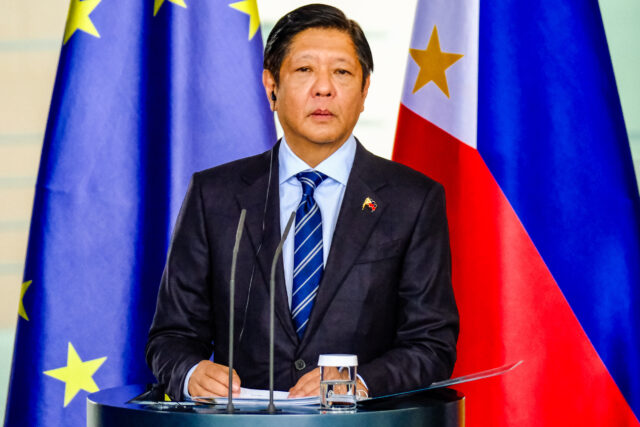
Marcos approval and trust ratings dip in poll

PRESIDENT FERDINAND R. MARCOS, JR. — PPA POOL

PHILIPPINE President Ferdinand R. Marcos, Jr.’s performance and trust ratings dropped in the latest Pulse Asia Research, Inc. poll, released as he completes his second year in office.

His approval rating fell by two points to 53% in June from 55% in March, while his trust rating dipped by 5 points to 52%, the pollster said in a statement on Wednesday.

The biggest drop in his approval rating was seen in Luzon areas outside Metro Manila, with a 9-point decline to 57%. His rating in Mindanao also fell by two points to 38%.

But his rating rose by 14 points in Metro Manila to 61%, and by two points in the Visayas to 56%.

The President’s approval rating dropped by 13 points among Class ABC to 49%, and by 3 points to 53% among Class D. He got a 4-point increase among Class E to 52%.

Meanwhile, his trust ratings fell by 9 points to 58% in Luzon areas outside Metro Manila, and by 3 points to 35% in Mindanao. He kept his score at 54% in the Visayas and increased it by 4 points to 59% in the National Capital Region (NCR).

Pulse Asia said an important development during the June poll was Vice-President Sara Duterte-Carpio’s resignation from the Marcos Cabinet.

Another was the June 17 standoff at Second Thomas Shoal in the South China Sea in which Chinese forces used bladed weapons against Philippine forces trying to resupply Manila’s Navy outpost there.

Also a major issue during the poll period was Senator Francis Joseph G. Escudero’s takeover of the Senate leadership.

Citing a June poll, Pulse Asia said last week that inflation was still the top concern of most Filipinos. It was followed by wages at 44%, poverty at 32%, jobs at 30% and corruption at 22%.

Inflation slowed to 3.7% in June, from 3.9% in May and 5.4% a year ago.

Meanwhile, the Pulse Asia poll showed that the Vice-President’s approval rating increased by two points to 69%, while her trust rating was unchanged at 71%.

Her approval ratings rose by 16, 12, and three points in the Visayas, Metro Manila and Mindanao. For the rest of Luzon, her approval and trust ratings fell by seven points and six points, respectively.

Her trust ratings increased in NCR and the Visayas and unchanged in Mindanao. — Kyle Aristophere T. Atienza

China’s ‘monster’ ship still at Sabina Shoal — PCG

PHILIPPINE COAST GUARD PHOTO

THE CHINESE Coast Guard’s (CCG) biggest ship has never left Sabina Shoal in the South Sea since July 3, according to the Philippine Coast Guard (PCG).

It was still anchored at the shoal as of Wednesday morning and was just half-a-kilometer away from the PCG’s BRP Teresa Magbanua, spokesman Jay Tristan Tarriela told a news briefing.

“We have reported since last week that we monitored the presence of the CCG monster ship inside Escoda Shoal, anchored at a distance around 600 yards away from BRP Teresa Magbanua,” he said.

“I would like to confirm that as of 7:30 a.m., the last image that I got from our Coast Guard personnel, the CCG monster ship remains to be inside Escoda Shoal. It never departed and is still anchored there,” he added.

Mr. Tarriela’s report went against that of Philippine Navy spokesman Roy Vincent Trinidad, who on Tuesday said the Chinese ship had left the shoal. He added that the China Coast Guard had not sent a replacement.

The shoal is about 140 kilometers off the Philippine province of Palawan and within the country’s 200-nautical-mile exclusive economic zone (EEZ).

The 97-meter BRP Teresa Magbanua, the PCG’s largest vessel, has been stationed at the shoal since April amid China’s reclamation activities and the presence of its maritime militia vessels there.

The PCG vessel has been challenging the Chinese ship’s presence in the area since July 3.

Mr. Tarriela said the PCG had spotted another Chinese Coast Guard ship near Lubang Island, which is just 40 kilometers west of Calatagan, Batangas province south of Manila.

The ship was moving toward Palawan province, he added.

The Philippines last week marked the anniversary of a 2016 arbitral ruling that voided China’s expansive claims in the South China Sea, with statements of support from various countries. 

PCG’s Mr. Tarriela earlier this month said Manila had used Canada’s “dark vessel” technology in detecting China’s 12,000-ton ship.

Mr. Trinidad on Tuesday said they had detected four China Coast Guard vessels at Second Thomas Shoal, which is about 67 kilometers west of Sabina.

Also on Wednesday, senators and congressmen in a bicameral conference committee approved a bill that seeks to set up three Philippine maritime zones and territories in the South China Sea, according to the Senate Public Relations and Information Bureau.

Senate Majority Floor Leader Francis N. Tolentino and Senate Minority Leader Aquilino Martin D. Pimentel III led the Senate contingent to reconcile disagreeing provisions of the Senate and House bills, it said in a statement.

“The joint meeting of the bill’s authors and champions from the House and Senate today also clarified the extent of our internal waters and archipelagic waters, aligning its definitions with our Constitution and the United Nations Convention on the Law of the Sea,” Negros Occidental Rep. Jose Francisco B. Benitez, who represented the House in the meeting, said in a separate statement.

He said the measure would protect the country’s internal waters from illegal foreign entry.

Under the bill, the Philippines can impose a fine of as much as $1 million (P58 million) on foreign actors who build artificial islands, conduct marine research and destroy the Philippine marine environment inside maritime zones.

“The passage of this law will strengthen our assertion of maritime entitlements over the West Philippine Sea, which is part of our exclusive economic zone,” Mr. Benitez said, referring to areas of the South China Sea within the Philippines’ EEZ. — Kyle Aristophere T. Atienza and John Victor D. Ordoñez

Maguindanao under calamity state

COTABATO CITY — The provincial board of Maguindanao del Sur on Tuesday placed the province under a state of calamity after rampaging floods swept through 17 of its 24 towns following heavy rains.

The floods forced more than 72,000 families to flee, the police, army and the province’s disaster agency said in separate reports on Wednesday.

Maguindanao del Sur is part of the Bangsamoro Autonomous Region in Muslim Mindanao, apart from Maguindanao del Norte, Lanao del Sur, Basilan, Sulu and Tawi-Tawi.

Many of the villages in the 17 flooded Maguindanao del Sur towns are close to rivers and swamps that connect to the 220,000-hectare Ligasawan Delta, a catch basin for more than a dozen waterways.

“We are moving around to extend relief services to affected residents,” Ameer Jehad A. Ambolodto, chief of Maguindanao del Sur’s disaster office, told reporters. — John Felix M. Unson

Bohol to get power from Cebu

NGCP.PH

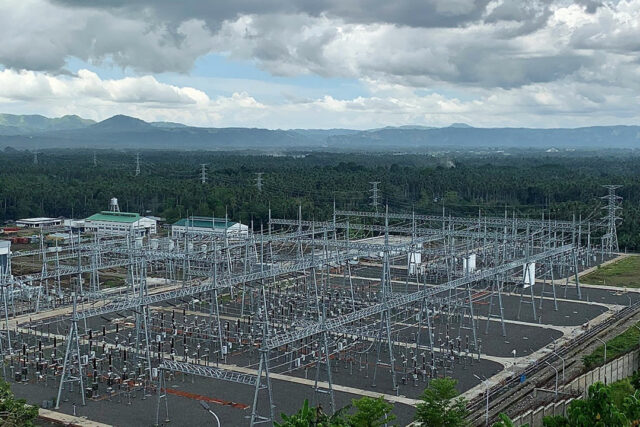
THE NATIONAL Grid Corp. of the Philippines (NGCP) has partially energized a transmission project that will allow the Cebu grid to transfer 600 megawatts (MW) of power to Bohol, according to the Energy department.

Dumanjug-Corella kilovolt (kV) Line 1 and Dumanjug 70 megavolt-amps reactive have been energized, connecting Cebu to Bohol, the agency said in a statement late Tuesday.

It said the Cebu-Bohol 230-kV interconnection project “will significantly boost supply in the Bohol grid by providing direct access to bulk generations from Cebu, in addition to the existing Leyte-Bohol submarine cable.”

“This milestone is also crucial for Bohol, where electricity demand has been increasing with the influx of tourists in the province known for its signature attractions, white-sand beach areas and dive spots,” it added. — Sheldeen Joy Talavera

Return of PhilHealth funds sought

PNA/JOAN BONDOC

THE NATIONAL Government should return almost P90 billion in surplus funds that the Philippine Health Insurance Corp. (PhilHealth) remitted to the Treasury, a congressman said on Wednesday.

The money should instead be used to improve the coverage of benefit packages for members of the state insurer, Party-list Rep. France L. Castro said in a statement.

She said the fund transfer violates the Universal Healthcare Act, which mandates PhilHealth to enhance its health benefit package and coverage using excess funds.

“This immoral transfer of funds is a direct assault on the health rights of Filipinos,” Ms. Castro said. “We demand that the Marcos administration immediately return these funds to PhilHealth, where they rightfully belong and should be used for the benefit of its members.” — Kenneth Christiane L. Basilio