Home Blog Page 2549

Limited-edition Mitsubishi Mirage G4 Black Series now available

This new variant of the Mitsubishi’s popular Mirage G4 sedan is priced at P909,000. — PHOTO FROM MITSUBISHI MOTORS PHILIPPINES CORP.

MITSUBISHI MOTORS Philippines Corp. (MMPC) has introduced a limited edition of its popular Mitsubishi Mirage G4 sedan, called the Mirage G4 Black Series. In a release, MMPC said, “style indeed meets substance in the limited release that takes after Mirage G4’s current design,” but with embellishments and enhancements.

The Mirage G4 Black Series comes in a new White Solid exterior color to highlight its black accents — such as black side door mirrors and 15-inch black-painted alloy wheels. While retaining the model’s signature headlamps and Dynamic Shield, the Mirage G4 Black Series now gets red lines on its front grille for a sportier look.

Inside, the sedan receives a scuff plate and an armrest console, in addition to illumination for its center console and footwells. The Mirage G4 Black Series is priced at P909,000. For more information, contact a dealer through https://www.mitsubishi-motors.com.ph/cars/mirage-g4.

CIMB Bank PH sees faster profit growth as it rolls out more products

CIMB BANK Philippines, Inc. (CIMB Bank PH) expects faster net income growth next year as it plans to expand its offerings for underserved sectors.

“We continue to be growing quite aggressively, even for next year. Both from the top line and bottom line… [Our] profit will grow at a higher rate. Profit will grow even more,” CIMB Bank PH Chief Executive Officer Vijay Manoharan told BusinessWorld.

Mr. Manoharan earlier said the bank expects to post “higher than single digit” net income growth this year.

“Right now, it’s above single digits already. So, very much on track,” he said.

The lender’s customer base has reached 8.5 million depositors and about 3.5 million borrowing relationships, he said last week. The bank also aims to disburse P75 billion in loans this year and to reach a total deposit cash-in level of P500 billion.

The digital-only commercial bank’s profit growth in 2025 will be driven by expectations of faster loan and deposit expansion on the back of the new products it plans to launch, Mr. Manoharan said.

“It’s another 40% to 50% growth (for loans and deposits). So, every year we will tend to grow 30% to 50% year over year.”

CIMB Bank PH will launch credit and insurance products for overseas Filipino workers (OFWs) in the first half of 2025, he added.

The lender last week launched CIMB Kababayan, which will allow OFWs to open an account via the CIMB app using an international SIM card. The savings account has no opening and maintaining balance and offers a high interest rate of 15% per annum. It aims to onboard half a million depositors in the next two years through CIMB Kababayan.

CIMB Bank PH will also introduce offerings for small and medium enterprises in the first quarter of 2025, Mr. Manoharan said.

“That’ll be savings, borrowings, payments, and insurance,” Mr. Manoharan said. “We want to address their needs, provide them capital, give them access to credit, and help them save.” — Aaron Michael C. Sy

PNOC: Three firms keen on Mabini port repurposing

STOCK PHOTO | Image by Nicholas Doherty from Unsplash

STATE-RUN Philippine National Oil Co. (PNOC) announced that at least three firms are considering investing in the repurposing of its Mabini, Batangas port into an offshore wind integration port.

PNOC President Oliver B. Butalid said the company is looking at deciding early next year but noted that “there can [be] unforeseen delays.”

“The ones who are considering investing in the project are investment funds that already have investments in offshore wind in other countries,” he told BusinessWorld in a Viber message.

PNOC manages the Energy Supply Base (ESB), a private commercial port spanning 19.2 hectares.

The port was initially under PNOC Exploration Corp. but was officially transferred to PNOC in 2018.

The ESB port anticipates being the first ready for use, supporting gigawatts (GW) worth of potential offshore wind projects, as part of the government’s goal to operate offshore wind turbines by 2028.

“PNOC was willing to allocate funds for the port repurposing if we would operate it ourselves. But because of the compressed timetable, it may be wiser to get an experienced entity to fund, design, and operate the port,” Mr. Butalid said.

The Department of Energy (DoE) earlier said that the Philippine Ports Authority has initiated crafting the detailed engineering designs and taking the immediate steps to repurpose three priority ports.

It has identified the Port of Currimao in Ilocos Norte, the Port of Batangas in Sta. Clara, Batangas City, and the Port of Jose Panganiban in Camarines Norte, given their proximity to high-potential offshore wind energy service contracts.

A total of 92 offshore wind energy service contracts were already awarded to 38 renewable energy developers with a total potential capacity of 66.10 GW.

The DoE previously announced its plan to hold a green energy auction specific to offshore wind in the middle of 2025.

The Philippines’ offshore wind resources hold an estimated potential of 178 GW, according to the World Bank’s 2022 Offshore Wind Roadmap for the Philippines. — Sheldeen Joy Talavera

Pia Wurtzbach is Skechers’ PHL first brand ambassador

PIA WURTZBACH, Miss Universe 2015, has officially been named as Skechers’ first-ever brand ambassador in the Philippines, as announced on Oct. 10. This partnership with the global lifestyle and performance shoe brand emphasizes Skechers’ Hands-Free Slip-ins technology which combines style and convenience in footwear.

“Skechers [is] a brand that brings together both style and comfort, like no other,” Ms. Wurtzbach said in her opening statement during the launch at a mall in Quezon City.

With the tagline #COMFORTablyBeautiful — a play on her iconic phrase “confidently beautiful” — Skechers’ Hands-Free Slip-ins technology promises users the ability to effortlessly slip their shoes on and off, providing convenience, particularly for those who are always on-the-go.

During the launch, five participants from varied backgrounds were challenged to slip their Skechers shoes on and off hands-free as many times as possible within 20 seconds. The winner was an elderly woman who successfully slipped the shoes on and off nine times, while the other participants achieved between three to seven repetitions.

Apart from Skechers’ promise of convenience, style, and comfort, Ms. Wurtzbach emphasized that the brand has enhanced her everyday performance, as her lifestyle is also always on the go.

“Whether I’m on a runway, hitting the gym, or just doing a mount climbing. Skechers has made me feel confidently stylish, comfortably beautiful, comfortably Skechers in every step of the way,” Ms. Wurtzbach said.

For Suzette Pasustento, country manager of Skechers Philippines, Pia Wurtzbach embodies the spirit of both the country and the brand’s culture. “Pia’s influence across many areas along with her dedication to an active lifestyle aligns with our brand’s diverse ethos. We look forward to working with Pia to inspire others to take that first step with Skechers and realize their full potential,” Ms. Pasustento said in a statement.

On a side note, Ms. Wurtzbach recently made history by becoming the first Filipina to grace the L’Oreal Paris Runway show last September.

Strutting alongside her on the runway were international A-list stars such as Kendall Jenner, Cara Delevingne, Alia Bhatt, and Eva Longoria, among others.

In 2022, she also made her way to the finish line of the New York City Marathon.

Even after nearly a decade since she was crowned Miss Universe, Pia Wurtzbach continues to bring honor to the Philippines, leaving a significant impact in every endeavor she undertakes. — Edg Adrian Eva

The undying dynasties

Midterm elections are scheduled for May 12, 2025. Each voter will select 12 senators, a district representative, a party-list representative, and local officials in each province, city, and municipality. The filing of certificates of candidacy (CoC) by hopeful candidates for the open elective posts was done from Oct. 1 to 8.

The Commission on Elections (Comelec) reported that it received a total of 43,033 applications for candidacy for the senatorial, district representation, party-list, and local government positions in next year’s midterm elections (thediplomat.com, Oct. 11).

A total of 18,271 positions are up for grabs in the national and local elections next year, according to the Comelec (newsinfo.inquirer.net, Sept. 2). That means only 42.45% of candidates will win in the midterm elections, and 24,262 or 57.54% of the candidates will lose — so their campaign expenses, time and effort spent were for nothing. Big gamble, high stakes. But the risk must be worth it for the winners.

“It’s not good for democracy. When elections and democracy are influenced so much by money and money politics, voters will have limited choices,” former Comelec commissioner Luie Tito Guia told the Philippine Center for Investigative Journalism (pcij.org, Oct. 16).  Yet that’s the way the game is played, the PCIJ points out.

The Villar family’s campaign expenses for Senatorial seats from 2001 to 2022 were as follows, according to the PCIJ:  Manuel Villar, Jr. (2001) P38.5 million; Manuel Villar, Jr. (2007) P84.5 million; Cynthia Villar (2013) P133.9 million; Mark Villar (2022) P131.8 million.  Daughter Camille Villar is an early advertising spender among the senatorial aspirants in the May 2025 elections.

These campaign expenditures are based on the Statement of Contributions and Expenses (SOCE), a self-reported accounting of campaign donors and expenses that candidates file after the elections. The SOCEs only cover spending during the official 90-day campaign period, which starts in the month of February. These figures cited above do not yet include advertising and promotional expenses before February, amounts which can reach billions of pesos individually for the candidates.

In the 2022 elections, “former public works secretary and senatorial candidate Mark Villar and re-electionist Senator Joel Villanueva both breached the P2-billion mark, making them the biggest ad spenders on mainstream media so far. On top of their solo ads, Villar and Villanueva also appeared in shared ads” (rappler.com, May 7, 2022).

“A political dynasty that already has four members elected in the Senate are the Estradas. Former President Estrada served as senator from 1987 to 1992 before he was elected vice-president in 1992 and president in 1998. His wife and two sons later became senators, too,” the PCIJ pointed out.

Election campaign expenses: Luisa “Loi” Ejercito (2001) P45.9 million; JV Ejercito (2022) P165.79 million; Jinggoy Estrada (2022) P174.25 million.

The Villars and the Estradas are not the only political dynasties to have at least two members in the Senate at the same time.  Incumbent Senators Alan and Pia Cayetano are siblings. Pia is seeking reelection. Two siblings of neophyte senator Raffy Tulfo are also aiming for Senate seats next year. There will be three Tulfos in the Senate at the same time if they both win, the PCIJ warns.

Dr. Cielito Habito, director general of the National Economic and Development Authority (NEDA) and concurrently Socio-economic Planning secretary in the Fidel Ramos administration (1992-1998) decried in an opinion piece in the Philippine Daily Inquirer (Aug. 13) that, “almost 80% of our lawmakers now belong to dynasties. Disturbingly, even sectoral representatives are also increasingly dynastic, defying the intended aim of party-list representation to make representation in Congress more inclusive.

“From 62% [dynastic legislators] in the 8th Congress (1987-1992), it rose to 66% by the 12th Congress (1998-2001), and further to 75% in the 14th Congress — jokingly described then as a ‘Montessori Congress’ for the unusually large number of young legislators who were offspring of their predecessors. But even more glaring is the current 19th Congress, where husbands and wives, parents and sons or daughters, and siblings have won seats together,” he wrote.

In local elective positions, data show governors with at least one relative in office having grown from a 41% share in 1988 to 80% in 2019.  Vice-governors’ fat dynasty share had risen from 18% to 68% in the same period. For mayors, it grew from 26% to 53%.

To compare: for the same period, wrote Mr. Habito in his Inquirer piece, the dynasties in their legislatures were “6% in the United States, 10% in Argentina and Greece, 22% in Ireland, 24% in India, 33% in Japan, 40% in Mexico, and 42% in Thailand — all far below us.”

There are two types of political dynasties, thin and fat, according to the PCIJ: A thin dynasty is one in which a political clan is able to control one elected position over time. A fat dynasty is one in which a political clan holds multiple government positions simultaneously.

According to Prof. Ronald Mendoza, “Clearly, political clans have found a way around term limits, by fielding more family members in power — giving rise to more fat political dynasties” (Mindanews, July 13, 2022).   There is significant evidence to suggest that Philippine political dynasties use their political dominance over their respective regions to enrich themselves, using methods such as graft or outright bribery of legislators. These kinds of situations arise as conflicts of interests — political dynasties often hold significant economic power in a province — and their interests are overrepresented due to dynastic politics (GMA News Online, October 2012).

The collective cautiousness about political dynasties came with the wresting from the “Conjugal Dictatorship” of Ferdinand and Imelda Marcos (1965-1986) at the EDSA People Power Revolution on Feb. 25, 1986. Article II Section 26 of the 1987 Constitution prohibits political dynasties: “The State shall guarantee equal access to opportunities for public service, and prohibit political dynasties as may be defined by law.”

But Congress has failed to pass an enabling law against dynasties over the past 37 years. “This is not a surprise since both the House of Representatives and the Senate are dominated by political dynasties. It is almost impossible to convince legislators to pass a law that will make many of them ineligible to run for public office, political observers say” (the diplomat.com, July 23).

As at 2021, at least 45 bills passed in the last 17 years, not one has passed third reading. Moreso, majority of these bills are left pending in appropriate committees where they were assigned to (Gacayan, Clyde Ben (2021): repository.wvsu.edu.ph).

In his dissertation, “No time runs against families? Gains and losses in regulating political dynasties in the Philippines,” Gacayan illustrates that the victory of the Marcos-Duterte tandem in the (2022) polls is an epitome of the continuing dominance of political dynasties — where dynasties are not only deeply entrenched but also capable of self-perpetuation amidst good governance reforms (Ibid.)

He echoes what other political scientists claim, that political dynasties themselves are not only electoral concerns but are wicked problems that have undermined the quality of democracy linked to deeper poverty and underdevelopment. Gacayan concludes that while it seems that no time runs against families in the last 35 years, there is a silver lining if one is able to look at the progress made in progressive legislation, judicial activism, and by further educating the electorate (Ibid.).

On March 19 this year, a group of lawyers filed a petition for mandamus with the Supreme Court for it to order the Senate and the House of Representatives to pass a law that will define and prohibit political dynasties. The petitioners cited the testimony of the late Father Joaquin Bernas, S.J., who was among the framers of the 1987 Constitution: “The establishment of political dynasties is an effective way of monopolizing and perpetuating power. Hence, is commanded to prohibit political state dynasties” (rappler.com, March 20).

On July 12, the Manila Times published a headline news report: “The Supreme Court said Thursday it will move to compel Congress to pass a law defining political dynasties, which are prohibited by the Constitution.” This news was false, the Supreme Court said. The high court cannot compel Congress to pass laws as it would violate the principle of separation of powers among the three branches of government (verafiles.org, July 17).

Enter Robinhood for his “hero” moment! True to his name, ex-movie idol Robinhood “Robin” Padilla filed Senate Bill (SB) 2730/Anti-Dynasty Bill on July 15. Under Padilla’s bill, “no spouse or person related within the fourth degree of consanguinity or affinity, whether legitimate or illegitimate, full or half blood, to an incumbent elective official seeking re-election, shall be allowed to hold or run for any elective office in the same city and/or province, or any party list in the same election” (inquirer.net/cebudailynews, Oct. 13).

But did not Robinhood just recently endorse Senators Ronald “Bato” dela Rosa and Christopher “Bong” Go when they formalized their reelection bids on Oct. 3, as they filed their certificates of candidacy? They were joined by actor Phillip Salvador, who is also seeking a Senate seat. All three (Dela Rosa, Go, and Salvador) are running under the Partido Demokratikong Pilipino (PDP), chaired by former president Rodrigo Duterte. Senator Robinhood Padilla is president of PDP.

All in the family! Like in Mafia organizations, political dynasties are made up of family, friends, and supporters.

Such are the undying dynasties in our captive democracy.


Amelia H. C. Ylagan is a doctor of Business Administration from the University of the Philippines.

ahcylagan@yahoo.com

Indonesia free meals in spotlight as Prabowo takes over

REUTERS

SUKABUMI, Indonesia — Indonesian sixth-grader Shakila Fitriyani, a day laborer’s daughter who dreams of becoming a doctor, says she is keener to go to school these days because she is served a free lunch.

“I am happy to receive the nutritious meal, milk and fruit,” Shakila said, speaking in her small tiled-roof and bamboo-screened home in the green highlands of West Java. “This has made me eager, going to school.”

Since January, the 11-year-old has been among thousands of students receiving a mid-day meal — consisting, for example, of rice with a spiced, hard-boiled egg, stir-fried vegetables and a box of milk, along with a slice of melon.

They are part of a pilot program in the province aiming to deliver on a campaign promise by incoming president Prabowo Subianto, an endeavor costing $28 million to supply meals to 83 million children and pregnant women nationwide.

But the effort has drawn criticism from investors and rating agencies questioning how it could be funded without hurting Indonesia’s recent hard-won reputation for fiscal prudence, while logistics offers a challenge in the sprawling archipelago.

Mr. Prabowo, who will take office Sunday from incumbent Joko Widodo, says the program is essential to fight the stunting of growth that afflicts 21.5% of children under five and can be delivered within the limits of fiscal prudence.

To allay budget concerns, Mr. Prabowo has limited the first year’s expenditure to 71 trillion rupiah ($4.6 billion) so as to keep the annual fiscal deficit under a legislated ceiling of 3% of gross domestic product (GDP).

But Eliza Mardian, an economist with think-tank the Center of Reform on Economics, said the budget might not be enough, particularly as milk, which Indonesia imports, is expensive.

“With our tight fiscal condition, there is potential for budget swelling and this will lead to additional debt,” she said. “This will be a fiscal burden for us going forward.”

If the program requires more imports of food, she warned it could also worsen the external balance of payments for Indonesia, already a major importer of wheat, rice, soybeans, beef, and dairy products.

On the other hand, Mr. Prabowo calls the program one of the main drivers of economic growth, eventually set to add an estimated 2.5 million jobs and spur demand for local produce. The president-elect has pledged to accelerate GDP growth to 8% from 5% now.

To ensure the wider meals campaign rolls out by January, Mr. Prabowo, now the defense minister, asked Mr. Widodo’s administration in August to set up a new National Nutrition Agency, headed by Dadan Hindayana, the chief of his meals program.

In the beginning, three million students will receive meals, with the number expected to double by April and reach 15 million by July, Mr. Dadan told reporters this month, with at least 5,000 kitchens to be set up across the country.

They are likely to be modeled on dozens of pilot kitchens that tested the concept for months. Since the start of this year, one kitchen in the West Java town of Sukabumi has employed about 50 people as cooks, food suppliers, drivers, and dish washers to make 3,300 meals for 20 schools every day.

Activity begins before dawn, as fresh meals are made to a menu designed monthly by a certified nutritionist to maximize use of locally sourced ingredients, said kitchen manager Pahmi Idris, on a budget of 15,000 rupiah a meal.

School employees are helping to track how the meals affect the height and weight of the students, who usually sit cross-legged on the floor to eat out of segmented metal trays.

But the pilot showed an early task for the program would be to convince children to eat vegetables, Mr. Pahmi said, as these, uneaten, formed the bulk of wasted food.

“We know that children don’t like vegetables,” Mr. Pahmi said. “We need to educate them more about eating vegetables.”

Indonesia’s diverse communities and varied geography could also make it challenging to set up kitchens nationally, said analyst Izzudin Al Farras Adha of the Jakarta-based Institute for Development of Economics and Finance.

Experts have also said that better food for school-age children comes too late to resolve stunting, which requires complex remedies from improved sanitation and hygiene to better nutrition for mothers.

But the program’s benefits were real, said Sukabumi residents. Roby Nurdin, a supplier of fruit and vegetables, said the kitchen operation had doubled his income and benefited farmers. And more students are turning out for class, said Lastri Samtiawati, a teacher in Shakila’s school, which gets its meals from the Sukabumi kitchen.

“Students are more active,” she added. “I now understand the direct impact of good nutrition for children.” — Reuters

Mazda extends hybrid battery warranty to 5 years

Mazda CX-60 HEV — PHOTO FROM MAZDA PHILIPPINES

MAZDA PHILIPPINES recently announced that it is extending the warranty of the high-voltage lithium-ion battery installed in the Mazda HEV range. The 24V and 48V lithium-ion batteries in the Mazda3 HEV, Mazda CX-30 HEV, Mazda CX-60 HEV, and Mazda CX-90 HEV will be under warranty for five years (lengthened from the original three years).

The warranty, added the company, “applies to all units sold by Mazda Philippines since their respective introductions in the Philippine market starting in October 2021 with the Mazda3 HEV and CX-30 HEV.” This is said to underscore the “dedication to quality, reliability, and customer satisfaction,” and reinforce the Mazda Philippines commitment to provide “premium quality hybrid technology and exceptional customer services,” said Mazda Philippines President Steven Tan.

“Owners of these models will now benefit from comprehensive coverage for their hybrid battery systems, ensuring added peace of mind,” he stressed.

Mazda HEV batteries are positioned as a state-of-the-art power supply, and are designed with longevity in mind. They boast advanced temperature management systems, automatically optimizing the battery’s performance depending on the driving condition. This prevents excessive heat which can negatively impact battery life and efficiency. The battery also has its own dedicated power control module (PCM), which ensures that the battery is constantly monitored and protected. The PCM manages the charging and discharging of the battery, maintaining the right balance to prevent overcharging or depletion, extending battery life.

The 24V and 48V lithium-ion batteries are an integral part of the Mazda HEV system. Working with the Skyactiv engine technology, they provide exceptional driving performance with reduced fuel consumption. The system also reduces tailpipe emissions by switching off the combustion engine at low speeds or when the vehicle is idle.

Regenerative braking captures energy usually wasted during deceleration, storing it in the battery. The Mazda HEV system can then intelligently deploy the stored energy either to provide an electric boost during acceleration or to reduce reliance on the internal combustion engine. In addition to the warranty, Mazda owners get a three-year bumper-to-bumper warranty and a five-year/100,000-km free PMS — ”the longest such program in the industry,” said the firm.

For any questions or concerns regarding the warranty extension for the Mazda HEV battery, Mazda owners are encouraged to contact any of the following Mazda 3S dealerships: Mazda C-5 Pasig, Mazda Quezon Avenue, Mazda Makati, Mazda Alabang, Mazda Sta. Rosa, Mazda Pulilan, Mazda Pampanga, Mazda Dagupan, Mazda Cabanatuan, Mazda Tarlac, Mazda Cebu, Mazda Iloilo, Mazda Bacolod, Mazda Cagayan De Oro, and Mazda Davao.

D&L secures LEED Gold for Quezon City building

D&L President and CEO Alvin D. Lao — DNL.COM.PH

LISTED D&L Industries, Inc. has obtained a Leadership in Energy and Environmental Design (LEED) Gold certification for its head office in Quezon City as part of the company’s sustainability efforts.

The LEED Gold certification was given for the operations and maintenance of the LBL Building, the company’s head office in Quezon City, D&L said in an e-mailed statement over the weekend.

The LEED v4.1 O+M certification, awarded by green building consulting firm Barone International, provides a framework for green buildings that offer environmental, social, and governance benefits.

“As we strive to embody sustainability, we continue to look at ways on how to improve our operations and minimize our environmental footprint. We believe that getting a LEED certification for our facilities is a great way to ensure that our operations adhere to global best practices when it comes to sustainability,” D&L President and Chief Executive Officer (ceo) Alvin D. Lao said.

The LEED v4.1 O+M rating system needs a 12-month performance monitoring and evaluation of key environmental aspects such as greenhouse gas emissions, energy efficiency, water efficiency, ozone protection, location and transportation, waste management, environmental impact, and indoor environment quality.

The results of the evaluation showed that the building surpassed both global and local average scores for energy efficiency, waste management, and indoor air quality.

The building also uses zero ozone depletion potential refrigerant for its air conditioning system.

“With the operational improvements put in place during the course of the monitoring and evaluation process, the building was able to generate an exceptional reduction in greenhouse gases and a 40% average savings from baseline as far as water efficiency is concerned,” D&L said.

In March, D&L secured a LEED v4 Gold certification for the central hub of its production plant in Batangas province. The central hub houses the central command center of the plant, which monitors all key environmental elements.

D&L is engaged in product customization and specialization for the food, chemicals, plastics, and consumer products original design manufacturer industries.

Its principal business activities include manufacturing of customized food ingredients, specialty raw materials for plastics, and oleochemicals for personal and home care use. — Revin Mikhael D. Ochave

Yields end mixed on US economic data

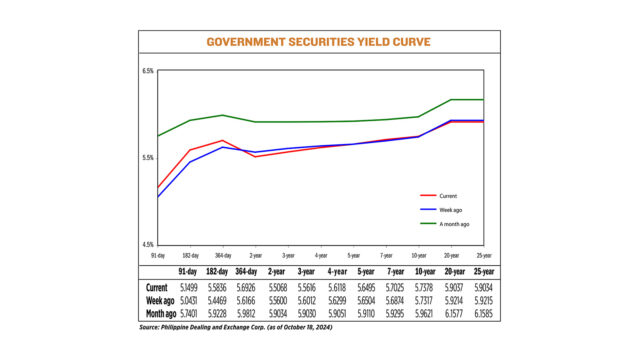
YIELDS on government securities (GS) ended mixed last week following the release of data that caused US benchmark rates to rise and after the Bangko Sentral ng Pilipinas (BSP) continued its easing cycle with a 25-basis-point (bp) rate cut.

GS yields, which move opposite to prices, went down by an average of 1.76 bps week on week, data from the Bloomberg Valuation Service Reference Rates as of Oct. 18 published on the Philippine Dealing System’s website showed.

Rates at the short end of the curve went up, with the 91-, 182-, and 364-day Treasury bills (T-bills) jumping by 10.68 bps (to 5.1499%), 13.67 bps (5.5836%), and 7.6 bps (5.6926%), respectively.

On the other hand, yields at the belly mostly went down. The two, three-, four-, and five-year Treasury bonds (T-bonds) saw their rates fall by 5.32 bps (to 5.5068%), 3.96 bps (5.5616%), 1.81 bps (5.6118%), and 0.09 bp (5.6495%), respectively. Meanwhile, the seven-year debt inched up by 1.51 bps to yield 5.7025%.

At the long end, the rate of the 10-year T-bond inched up by 0.61 bp to 5.7378%, while yields on the 20- and 25-year papers went down by 1.77 bps and 1.81 bps to 5.9037% and 5.9034%, respectively.

The BSP’s policy decision was mostly already priced in by the market and had a minimal effect on GS yield movements, the first bond trader said in a Viber message.

“Better-than-expected US economic data drove US yields higher, prompting further defensiveness in the local market,” the trader said.

“Yields seem to be range-bound at the moment as US yields remain elevated and continue to put external pressure on market sentiment. However, local fundamentals remain intact as the BSP is expected to continue its easing cycle while inflation is expected to remain benign for the rest of the year,” the trader added.

The second trader said in a Viber message that GS yields were mostly trading well below the BSP’s policy rate prior to Wednesday’s Monetary Board meeting, so there was no more room for a further drop.

US retail sales increased solidly in September likely as lower gasoline prices gave consumers more money to spend at restaurants and bars, supporting the view that the economy maintained a strong growth pace in the third quarter, Reuters reported.

The slightly stronger-than-expected rise in sales reported by the Commerce department on Thursday also reflected sharp increases in receipts at clothing store outlets as well as miscellaneous store retailers. Consumers boosted online purchases and spent more at health and personal care stores.

Spending and the overall economy are being underpinned by solid income growth, ample savings as well as strong household balance sheets. Though labor market momentum has slowed, layoffs remain historically low, supporting wage gains.

Signs of the economy’s resilience likely will not discourage the Federal Reserve from cutting interest rates again next month, but will cement expectations for a smaller 25-basis-point reduction in borrowing costs.

Retail sales rose 0.4% last month after an unrevised 0.1% gain in August, the Commerce Department’s Census Bureau said. Economists polled by Reuters had forecast retail sales, which are mostly goods and are not adjusted for inflation, would rise 0.3%. Estimates ranged from no change to an increase of 0.8%.

Retail sales advanced 1.7% on a year-on-year basis in September. Gasoline prices dropped by about 12 cents per gallon between August and September, data from the US Energy Information Administration showed.

On Thursday, US Treasury yields gained ground after the retail sales data suggested the US economy is on solid footing, but left the Fed with enough room to move forward on a slower path to lower rates.

The yield on benchmark US 10-year notes rose 7.7 bps to 4.093% from 4.016% late on Wednesday.

The 30-year bond yield rose 9.3 bps to 4.3924% from 4.299% late on Wednesday.

The 2-year note yield, which typically moves in step with interest rate expectations, rose 4.3 bps to 3.978% from 3.935% late on Wednesday.

Meanwhile, the BSP on Wednesday cut benchmark interest rates by 25 bps amid manageable inflation, bringing its policy rate to 6%.

The Monetary Board has now lowered borrowing costs by a total of 50 bps since it began its easing cycle in August with a 25-bp cut.

BSP Governor Eli M. Remolona, Jr. said they could deliver a 25-bp cut at the Monetary Board’s last meeting for the year on Dec. 19, which would bring the policy rate to 5.75% by end-2024. He added that a 50-bp reduction in December would be “too aggressive a cut” and would only be possible in a hard-landing scenario.

For 2025, Mr. Remolona said they could slash borrowing costs by 100 bps.

The second trader said the BSP chief’s dovish comments could result in “softer buying interest as this dampens the prospect of more aggressive rate cuts.”

For this week, GS yields may continue to rise, the first trader said.

“We could see a slight upward bias in terms of yields [this] week, though we expect the market to remain range-bound with local fundamentals remaining strong and the BSP’s 250-bp reserve requirement ratio (RRR) cut becoming effective at the end of next week,” the first trader said.

The BSP will reduce the RRR for universal and commercial banks and nonbank financial institutions with quasi-banking functions by 250 bps to 7% from 9.5% effective on Oct. 25.

It will also cut the RRR for digital banks by 200 bps to 4%, while the ratio for thrift lenders will be reduced by 100 bps to 1%. Rural and cooperative banks’ RRR will likewise go down by 100 bps to 0%.

“Yields will be supported by less bond issuances but may face upward pressure, especially those with tenors of seven years and longer,” the second trader added. — Karis Kasarinlan Paolo D. Mendoza with Reuters

Style (10/21/24)


Robinsons unveils offers, discounts for men this Oct.

ROBINSONS DEPARTMENT STORE is treating male shoppers this October with its “Men’s Super Sale,” offering discounts of up to 70% off on select men’s items until Oct. 31. Shoppers spending a minimum of P3,000 in the Men’s section have the chance to win one of 28 prizes, including items like a PlayStation 5 and designer watches. Also, every Friday in October, from 6 to 7 p.m., Robinsons will host a “Happy Hour Promo,” where shoppers can receive a free six-pack of San Miguel Beer with a minimum purchase of P1,500 from the Men’s section. For more information, visit Robinsons Department Store social media pages.


Newport World Resorts kicks off VANS footwear sale

NEWPORT WORLD RESORTS is set to launch an exclusive VANS footwear sale for Epic Rewards members from Oct. 25 to 31 at the Grove in Newport Mall. Members will have access to VANS’ fresh releases and enjoy discounts of up to 50% on select styles. Sneaker enthusiasts can elevate their holiday wardrobe in style, while non-members can sign up for free to unlock these offers. Visit https://www.newportworldresorts.com/ for more information.


Banana Republic launches fall collection

BANANA REPUBLIC is introducing its fall collection this October, showcasing the timeless charm of a sweater, featuring materials like brushed cashmere, buttery leather, and Italian wool. One of the highlights of the collection is the Women’s BR Classics, which offer thoughtfully designed classics, crafted from luxurious materials for versatile styling. For men, dress shirts serve as wardrobe staples, and Banana Republic offers a range of layering options that make dressing for business or leisure straightforward. The collection also includes polos, suits, chinos, and sweaters, providing an opportunity to enhance men’s wardrobes with tailored clothing. For more information, visit Banana Republic’s social media pages.


Penshoppe introduces BINI as newest endorsers

Philippine lifestyle brand Penshoppe officially introduced the P-pop sensation BINI as its newest endorsers on Oct. 16, at The Fifth in Rockwell. The event marked the start of Penshoppe’s latest campaign, “Be Your Own Icon,” which celebrates individuality and self-expression. “As BINI embodies confidence, ambition, and youthful energy, the P-Pop group’s image aligns perfectly with Penshoppe’s vision of empowering other individuals to embrace their unique identities,” said in a statement. The launch also served to unveil Penshoppe’s Q4 Iconic Collection, “a line of elevated pieces designed for individuals who want to make a statement with their style.” For more information, visit Penshoppe’s social media pages.


New Balance unveils ‘Run Your Way’ campaign

GLOBAL athletic leader New Balance launched the latest installment of its “Run Your Way” campaign, celebrating the individuality of runners everywhere. This initiative emphasizes that running is not confined to a single approach — whether for fitness, fun, or mental wellness, there’s no right way to run. “‘Run Your Way’ seeks to dismantle the barriers that often intimidate newcomers and seasoned runners alike, encouraging a culture free from comparison. It promotes the idea that running should be a personal journey, emphasizing joy and self-expression rather than conformity,” said in a statement. With the campaign, New Balance features products designed to empower runners at all levels, making each running experience truly unique.  Visit www.newbalance.com, for more information.

Social participation to achieve healthcare for all

THE PHILIPPINE PATIENTS CONGRESS held on Aug. 29-30 at the Asian Development Bank. — FACEBOOK.COM/1VOICEPAPO

During the 77th World Health Assembly in Geneva this year, Member States endorsed the Resolution on Social Participation for Universal Health Coverage (UHC). The resolution recognizes the importance of regular and meaningful social participation to ensure the accountability and legitimacy of strengthening health systems and universal health coverage efforts anchored on a primary healthcare approach.

Social participation, as defined by the World Health Organization (WHO), means empowering people, communities, and civil society through inclusive participation in decision-making processes that affect health across the policy cycle and at all levels of the system.

The resolution recalls and builds on related intergovernmental agreements that assert the importance of social participation, including participatory and inclusive health governance for UHC enshrined in the Political Declaration on the High-Level Meeting for UHC 2023; empowering people and communities as part of a primary healthcare approach in the Declaration of Astana 2018; Sustainable Development Goal (SDG) target 16.7 for responsive, inclusive, participatory and representative decision-making at all levels (2015); and  public, community and civil society participation for health equity in the Rio Political Declaration on Social Determinants of Health 2011.

“Today, in light of this important resolution, we are starting a larger dialogue between government, the private sector and civil society in order to work hand in hand for universal healthcare,” said Karen Alparce Villanueva, president of the Philippine Alliance of Patient Organizations (PAPO), in her welcome remarks during the first-ever Philippine Patients Congress.

Held recently at the Asian Development Bank (ADB) in Mandaluyong City, the groundbreaking congress brought together 300 patient advocates, caregivers, representatives  from government and the academe, healthcare professionals, and leaders from the private sector from across the country who shared insights, experiences, and best practices in a spirit of collaboration and a united call to action.

The first Philippine Patients Congress was organized by PAPO in collaboration with ADB, the Philippine Health Insurance Corp. (PhilHealth), the Japan Fund for Prosperous and Resilient Asia and the Pacific (JFPR), and the Pharmaceutical and Healthcare Association of the Philippines (PHAP).

Through the congress, PAPO, a coalition of patient organizations in the country advocating for universal access to healthcare, aims to strengthen patient advocacy in the country and participate meaningfully in co-owning and co-creating solutions to achieve Health for All. The coalition also seeks to open avenues for further partnership and capacity building based on the lessons from the congress.

If people are empowered to fully partner for health, the resources, intelligence, and capacities of our health systems will exponentially increase, explained Ms. Villanueva. Challenges — such as access to healthcare services, widening social inequalities, demographic changes, and healthcare worker shortages — that are overwhelming the health system can be overcome only if everyone is mobilized, complementary in their knowledge and interdependent in their actions, she stressed.

The PAPO head lauded the WHO resolution as an important step forward. First, it outlines clear government responsibilities to ensure that social participation is adequately resourced with stable public funding and designed in a way that influences health-related policies and system change. The resolution holds governments accountable for nurturing a fair playing field, reducing power differences, and making room for everyone.

Second, the resolution makes social participation a core function within health systems, rather than a set of ad hoc initiatives. This global perspective is important to reshape health systems, nurture trust and long-term relationships with communities, and build alliances across health sectors. There should be equal partnership between policy makers and patients, healthcare professionals, healthcare providers, industry and communities.

Third, it offers powerful mechanisms to influence governments because they endorsed the resolution. Governments have a political imperative to act and must show progress every two years. The resolution supports national implementation through technical guidance, examples of global practice, and a common evidence base. To translate this at the country level, strong and capable leadership is needed.

“We need more patient leaders to invest their time and energy towards social participation; the government to support the funding and the mechanisms to institutionalize the participation of communities in health decision-making processes; and the private sector to share models of innovation and futures thinking. After all, health is created by people, communities, and civil society,” said Ms. Villanueva.

She described the Philippine Patients Congress as civil society extending its hand to work with the different sectors in owning and co-creating some of the solutions to the immense challenges of universal healthcare.

“We need to share not just challenges but also success stories and solutions, learn from each other and gain understanding from our diversities, build coalitions and develop the next generation of leaders who have the passion and expertise, so no one is left behind,” Ms. Villanueva said.


Teodoro B. Padilla is the executive director of Pharmaceutical and Healthcare Association of the Philippines which represents the biopharmaceutical medicines and vaccines industry in the country. Its members are in the forefront of research and development efforts for COVID-19 and other diseases that  affect Filipinos.

Madrid cancels sheep herding spectacle to avoid spread of bluetongue disease

REUTERS

MADRID — The Madrid regional government on Thursday canceled the traditional annual herding of flocks of sheep through the center of the Spanish capital scheduled for Sunday as a preventative measure against a new variant of the bluetongue disease.

Bluetongue, spread by insects, can be deadly for domestic ruminants such as sheep, cattle and goats. The disease is present in various areas of Spain.

A new variant, BTV3 (bluetongue virus serotype 3), has been circulating in the Netherlands, northern Belgium and western Germany since last year, and has recently appeared in southwest Spain, Agriculture Ministry data show.

Although no cases of the new variant were spotted in the Madrid region, authorities canceled the crossing as a precaution.

“We are in an area where we have to limit the concentration and movement of livestock,” a spokesperson for the agriculture department of the Madrid regional government told Reuters.

Once a year, sheep take to the streets of Madrid as part of the annual “Fiesta de la Trashumancia” event, recognizing the traditional routes used to herd livestock.

The eight-century tradition disappeared in the 19th century but was revived three decades ago, delighting locals and tourists alike.

Shepherds are allowed to herd their livestock towards southerly pastures for the winter through some of the busiest areas of the city, such as the Puerta del Sol square.

Several countries including France and the Netherlands have implemented vaccinations campaigns against the new variant. — Reuters