Home Blog Page 2534

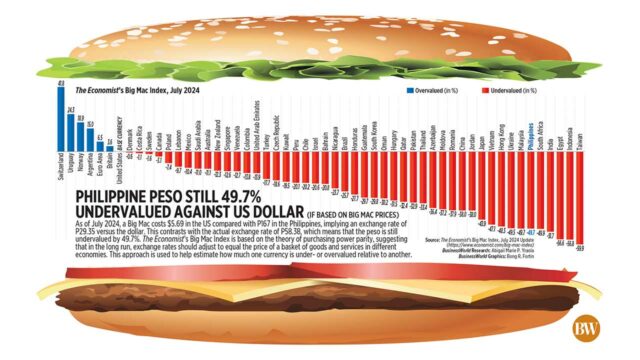
Philippine peso still 49.7% undervalued against US dollar

(If based on Big Mac prices)

As of July 2024, a Big Mac costs $5.69 in the US compared with P167 in the Philippines, implying an exchange rate of P29.35 versus the dollar. This contrasts with the actual exchange rate of P58.38, which means that the peso is still undervalued by 49.7%. The Economist’s Big Mac Index is based on the theory of purchasing power parity, suggesting that in the long run, exchange rates should adjust to equal the price of a basket of goods and services in different economies. This approach is used to help estimate how much one currency is under- or overvalued relative to another.

Philippine peso still 49.7% undervalued against US dollar

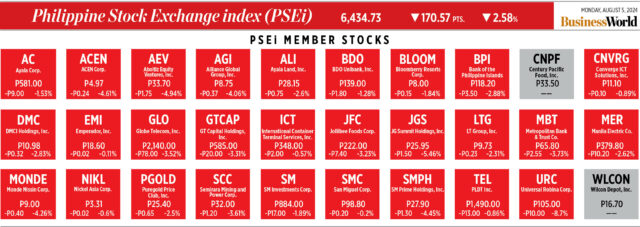
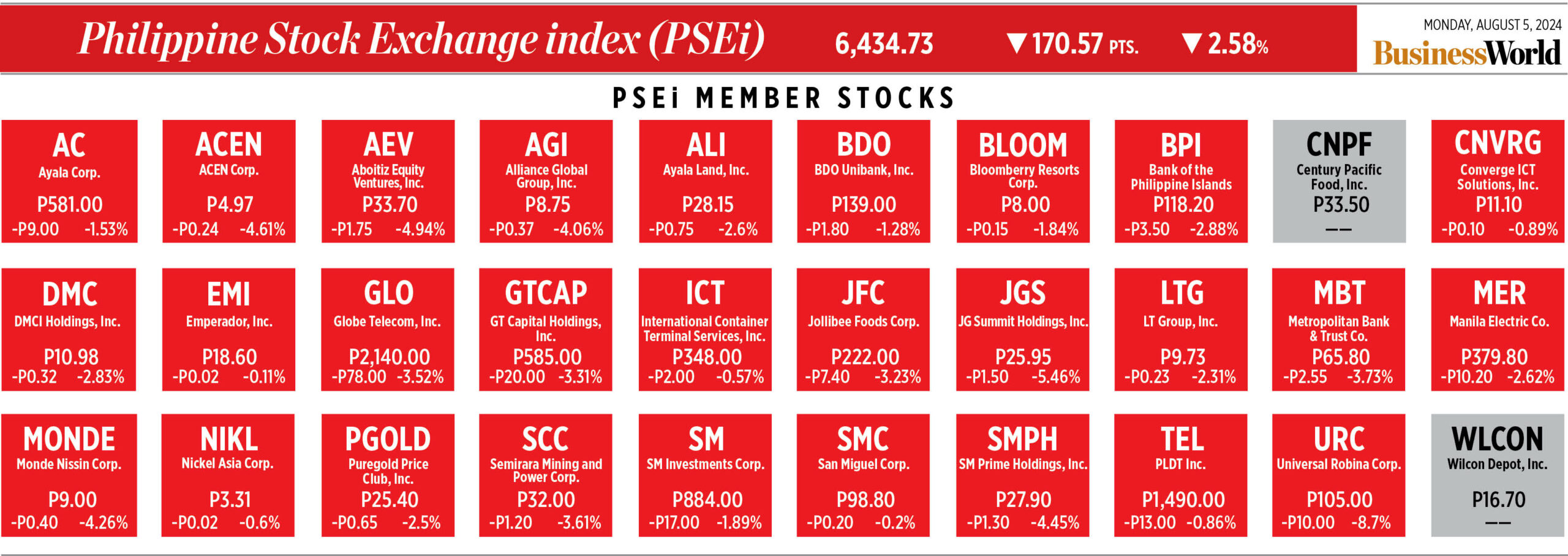
How PSEi member stocks performed — August 5, 2024

Here’s a quick glance at how PSEi stocks fared on Monday, August 5, 2024.


Charges vs Lotilla have potential to drive investors away, PCCI says 

RAPHAEL P.M. LOTILLA — ONENEWS.PH

THE Philippine Chamber of Commerce and Industry (PCCI) said it is concerned about the broader damage that may result from the allegations against Energy Secretary Raphael P.M. Lotilla, threatening the momentum being built up in developing the energy industry.

“We are competing against other countries in the region in enticing foreign direct investment (FDI) to come to our shores; let us not create an air of uncertainty that could dissuade these investments,” the PCCI said in a statement on Monday.

“We recognize the excellent work that Mr. Lotilla is doing. We support the direction he is taking to achieve energy security and affordability for the country, the two key components to bring in investments, expand domestic enterprises, and enhance our productivity and competitiveness,” it added.

Criminal and administrative complaints were filed by the Power for People Coalition (P4P) against Mr. Lotilla for endorsing the Aboitiz-owned Therma Visayas, Inc. Unit 3 expansion in Cebu.

In a statement last month, P4P said that Mr. Lotilla’s endorsement of the project violates the moratorium on greenfield coal-fired power projects declared by the previous administration.

The PCCI noted that the moratorium does not cover existing coal-fired power generation facilities, coal-fired power projects classified as committed, existing power plant complexes with firm expansion plans, or projects that have made significant progress.

“We endorse the holistic energy solution as presented by the Department of Energy, where coal remains an important component for economic growth while waiting for clean, reliable, and affordable baseload technologies,” it said.

“Given that the Philippines is not a major carbon emitter and that it is not a wealthy country, a more pragmatic approach towards climate change needs to be emphasized, focusing our limited resources towards climate adaptation. Let us avoid being distracted by western policies that may be appropriate for their country contexts but not ours,” it added.

The PCCI said that the Philippines should learn from the Panay power outages, the dry-season red and yellow alerts, and Typhoon Carina that downed electricity poles. It called for a focus on energy security to keep factories open and to keep people at work.

“Insecurity of supply causes harm that can affect the lives of consumers and businesses and ultimately hinders our country’s resilience and march toward progress,” it said.

“In light of increasingly inclement weather, we must also be mindful to invest in the greater resilience of our energy systems, of which coal, gas, and other technologies can provide us greater security against high winds and strong rains,” it added. — Justine Irish D. Tabile

Farmers question TESDA capacity to train farmers

ATI.DA.GOV.PH

FARMERS said on Monday that the government needs to allocate more money from the farmer training budget of the Rice Competitiveness Enhancement Fund (RCEF) to specialist agencies run by the Department of Agriculture (DA).

In a statement, the Federation of Free Farmers (FFF) cited the large share of the training funds that go to the Technical Education and Skills Development Authority (TESDA), and questioned TESDA’s capacity to conduct such training.

RCEF provides funding of P1 billion a year to agricultural training programs, with 70% going to TESDA. The remainder is equally shared by the Agricultural Training Institute (ATI), the Philippine Rice Research Institute and the Philippine Center for Postharvest Development and Mechanization.

“The funds should be used to upgrade the training and extension programs of these DA agencies, in line with the DA’s overall strategy and objective to improve farmer productivity and competitiveness,” FFF National Manager Raul Q. Montemayor said.

The Rice Tariffication Law, or Republic Act No. 11203, funds RCEF from rice import tariffs. The law liberalized rice imports but made importers pay an initial 35% tariff on Southeast Asian grain.

The government, via Executive Order No. 62, has since slashed rice tariffs to 15% on grain from all countries until 2028.

Mr. Montemayor added that TESDA does not have the mandate to provide agricultural training to farmers.

The FFF said that TESDA’s primary function is to distribute scholarship vouchers to trainees in farmer field schools and learning sites which are accredited by the ATI.

The group added that some training centers given scholarship slots by TESDA have reported low levels of farmer enrolment.

“Part of the training fund should also be invested in facilities and systems that will enable concerned DA agencies to sustain their activities even after RCEF,” Mr. Montemayor said. — Adrian H. Halili

Next DTI Secretary urged to focus on steering investment to MSMEs

THE NEXT Trade Secretary should focus on driving investment to micro, small and medium enterprises (MSMEs), a business group said on Monday.

“Investors must invest in our country, especially in MSMEs,” Federation of Filipino Chinese Chambers of Commerce & Industry, Inc. (FFCCCII) President Cecilio K. Pedro said during a briefing in Quezon City on Monday.

“The keys here [are] the small and medium industries. They are scattered everywhere, especially in the provinces and far-flung areas… we need MSMEs,” he added.

MSMEs account for 99.59% of businesses in the Philippines, according to the Department of Trade and Industry (DTI).

Mr. Pedro said the Philippines is competing with its Southeast Asian neighbors for investment, and cited the need to address high energy and labor costs that may drive away investors.

The government must help investors by making doing business easy and reducing power costs.

Mr. Pedro said the Philippines must play to its strengths, such as the English-speaking workforce.

Of the acting Trade Secretary, Ma. Cristina A. Roque, Mr. Pedro said: “I look forward to (dealing with her) because she’s a former Undersecretary, she knows well what we need as far as trade is concerned.”

President Ferdinand R. Marcos, Jr. announced Ms. Roque’s appointment in an acting capacity last week after the resignation of her predecessor, Alfredo E. Pascual.

She was the Undersecretary overseeing MSMEs before taking on her new role.

At the same briefing, Senator Maria Imelda Josefa Remedios R. Marcos said Ms. Roque must move forward with more free trade agreements (FTAs).

“(We need more) free trade agreements; we are always uncompetitive that is why markets don’t want to open in the Philippines,” she said.

The Philippines’ sole bilateral FTA is with Japan, but it has FTAs with the Association of Southeast Asian Nations (ASEAN) and the Philippines-European Free Trade Association (EFTA) free trade agreement. EFTA’s members are Iceland, Liechtenstein, Norway, and Switzerland.

It also has the Regional Comprehensive Economic Partnership with 14 Asia-Pacific countries.

The Philippines, under ASEAN, also has preferential trade agreements with China, Hong Kong, India, Japan, South Korea, Australia, and New Zealand. — Chloe Mari A. Hufana

SGV to help senior high instructors get accounting teaching credentials

SGV.PH

SGV & CO. said its SGV Academy has taken on partners to help Senior High School (SHS) instructors obtain teaching credentials for business, finance, and accounting.

SGV Academy said SGV & Co. signed a memorandum of agreement with Junior Achievement Philippines, Inc., and the National Association of Certified Public Accountants in Education to upgrade teaching qualifications at the Senior High School (SHS) level.

In a statement on Monday, SGV & Co. said the partnership covers the SHS Accounting Teachers Micro Credentialization program, in order to reverse the decline in enrolment in SHS accounting and business courses.

“Under the agreement, SGV’s objective is to support the development of accounting professionals and help ensure that the program’s curriculum is relevant and applicable to industry practices,” the firm said.

Through the partnership, SGV will assist the organizations in evaluating and validating the supplementary lessons, providing training for teachers, and mentoring students in the program, among others.

“This tripartite agreement is aligned with SGV’s purpose of nurturing leaders and enabling businesses for a better Philippines,” SGV said.

The SGV Academy gives the professional services firm an avenue to collaborate with educational institutions on developing courses tailored to meet the industry needs.

It currently focuses on accounting and business, law, and engineering education. — Justine Irish D. Tabile

El Niño crop damage within acceptable parameters — DA

A dry field is seen in Bulalacao in Oriental Mindoro, which has been placed under a state of calamity due to the severe damage caused by the El Niño weather phenomenon. — PHILIPPINE STAR/EDD GUMBAN

THE Department of Agriculture (DA) said crop damage due to El Niño fell within the DA’s projections.

“Most of the affected crops were only partially damaged,” Agriculture Assistant Secretary and Spokesperson Arnel V. de Mesa added in a briefing on Monday.

In its final El Niño bulletin, the DA reported that overall crop damage was P15.3 billion, with lost volume tallied at 784,344 metric tons (MT).

According to the report, partially damaged crops with a chance for recovery accounted for 68% of the affected farmland of 270,855 hectares.

Mr. De Mesa added that only a third of the rice damage was classified as a total writeoff.

“Most of the damage was partial and recoverable. Those suffering total damage was about one-third corresponding with the loss estimates given by the Philippine Statistics Authority (PSA),” he said.

He added that the PSA had projected the lost rice crop due to El Niño at between 100,000 and 200,000 MT.

“We will have to wait for the final report from the PSA,” he said.

The DA is projecting palay (unmilled rice) production this year of 20.44 million MT (MMT) against 2023 production of 20.05 MMT.

As of the first half, palay production declined 5% year on year to 8.53 MMT.

“We are still hopeful of hitting the production target, because a 5% drop is still within the threshold projected for El Niño,” Mr. De Mesa said.

The DA had projected there would be a 10% drop in rice production due to El Niño.

El Niño began in June, with below-normal rainfall bringing drought and dry conditions throughout the country.

Last month, the government weather service, known as PAGASA (Philippine Atmospheric, Geophysical and Astronomical Services Administration), declared the end of El Niño though dry spells persisted in parts of the country. — Adrian H. Halili

Gov’t to forego P9.2B in H2 on lowered rice tariffs

PHILIPPINE STAR/KRIZ JOHN ROSALES

THE GOVERNMENT will forego P9.2 billion worth of revenue in the second half after lowering the tariff on imported rice, the Department of Finance (DoF) said.

“If we did not reduce the rice tariff, the collection for the July to December would be P17.3 billion, with the reduction equivalent to P9.2 billion,” Finance Secretary Ralph G. Recto told the House Committee on Appropriations on Monday.

In June, President Ferdinand R. Marcos, Jr. cut the tariff on imported rice to 15% from 35% previously, with the new rate in force until 2028.

For 2025, the government stands to forego P19.8 billion in revenue due to the reduced tariffs, and will end up collecting P20.3 billion.

The DoF projected rice tariffs collections of P25.5 billion in 2026, foregoing P20.9 billion.

Republic Act No. 11203 or the Rice Tariffication Law deregulated rice imports, and allowed private entities to import rice, though they initially had to pay a 35% tariff on Southeast Asian grain prior to the tariff cut to 15%, which was imposed as an inflation-containment measure.

The law also established the Rice Competitiveness Enhancement Fund (RCEF), which provides P10 billion a year to modernize the rice industry, with RCEF supported by tariff revenue.

Last week, the National Economic and Development Authority said it is working with the Department of Agriculture on a new tariff adjustment system for rice.

Meanwhile, Budget Secretary Amenah F. Pangandaman said P12.7 billion in leftover cash assistance from the RCEF in 2022 has been fully distributed to farmers. — Beatriz Marie D. Cruz

HSBC joins China pitches for PHL green projects

THE Board of Investments (BoI) said it and HSBC Group unit HSBC Philippines have pitched potential Chinese investors on Philippine “green” technology projects. 

In a statement on Monday, the BoI said it delivered a presentation on Philippine initiatives to promote sustainability in a webinar involving Chinese companies.

The BoI extended an invitation to Chinese firms to invest in renewable energy, electric vehicles, and green metal processing.

“The government is working closely with industry partners to deliberately build an ecosystem that would enable businesses to not only remain viable but also achieve their sustainable goals. Investments are therefore promoted across the supply chain,” BoI Executive Director for Industry Development Services Ma. Corazon Halili-Dichosa said.

HSBC Philippines Chief Executive Officer Sandeep Uppal said the Philippines’ competitive advantage is its growing economy, population, and economic reforms.

“Having been in the country since 1875, HSBC Philippines officials have witnessed enormous, world-class opportunities existing in the Philippines compared to when they started,” Mr. Uppal said.

BoI Executive Director for investment promotion services Evariste M. Cagatan also noted the government’s efforts to create a business-friendly climate and incentives available to investors.

Citing Bloomberg’s New Energy Finance Climatescope 2023, Ms. Cagatan said that the Philippines was among the top four emerging markets for renewable energy.

“(This is) mainly due to our green energy auctions, feed-in-tariffs, net metering schemes, and tax incentives,” Ms. Cagatan added. — Justine Irish D. Tabile

IFC, EU outline support for PHL green transition

THE International Finance Corp. (IFC) said it is working with the European Union (EU) to aid the Philippines’ “green” transition.

In a statement, the IFC said it allocated P308 million to participate in the Green Economy Programme for the Philippines (GEPP) until 2028, part of the EU’s new Global Gateway Initiative.

It will focus on adopting plastics recycling and waste management, decarbonization-related investments, “greening” supply chains, and accelerating the country’s energy transition.

The government is aiming to increase the share of renewable energy in the country’s power mix to 35% by 2030 and 50% by 2040.

“The private sector plays a pivotal role in the collective journey towards a sustainable and prosperous future, and the EU is pleased to partner with IFC to promote green growth in the Philippines,” EU Ambassador to the Philippines Luc Véron was quoted as saying in the statement.

“Our engagement in the country’s green transformation underscores our dedication to global climate action and sustainable development, which is aligned with the European Green Deal.”

The GEPP was launched in March by the EU and the Department of Environment and Natural Resources to improve waste management, promote a circular economy transition, bolster the use of renewables in the energy mix, and promote technology to improve energy efficiency.

“IFC is deeply committed to supporting the Philippines’ private sector in its ambitions to transition to a low-carbon future,” IFC Country Manager for the Philippines Jean-Marc Arbogast said. “Our partnership with the EU is a testament to our collective commitment to fostering resilient, green, and inclusive growth that benefits all Filipinos.” — Beatriz Marie D. Cruz

Underspending best addressed via early procurement, DBM says

BW FILE PHOTO

THE Department of Budget and Management (DBM) is seeking to address government underspending by maximizing the opportunities for early procurement, Budget Secretary Amenah F. Pangandaman said on Monday.

Speaking in Congress during a budget hearing, Ms. Pangandaman said: “We have measures that could resolve the problem of underspending… These include the early release of allotments through the General Appropriations Act… which means that as early as Jan. 1, allotment orders are released so departments and agencies can implement their projects.”

“Because we have passed the New Government Procurement Act… at the submission of the National Expenditure Program, departments can now conduct early procurement activities short of award,” she added.

The government has a spending target of P5.754 trillion this year. The government has spent P2.257 trillion or 39.22% of the target as of the end of May.

The DBM is set to launch a pilot program to roll out modernized procurement this year, Ms. Pangandaman said, focused on common-use supplies needed by all agencies.

At the same hearing, National Economic and Development Authority (NEDA) Secretary Arsenio M. Balisacan said that an increase in cash grants to the poorest Filipinos will kick in starting 2026.

NEDA had recommended an increase of about P100 per cash benefit for the Pantawid Pamilyang Pilipino Program (4Ps), noting that the increases are needed to offset the effect of inflation on purchasing power. 

“We have produced a study and adjustment of the grant for inflation to ensure that purchasing power of the grant when it was created would remain the same,” he said.

“All in all, it’s an increase from P2,850 to P3,550, and that takes care of the inflation adjustment,” he added.

A total of P114.2 billion was proposed by the executive branch to implement 4PS in 2025, according to a summary from the DBM.

Speaker and Leyte Rep. Ferdinand Martin G. Romualdez said in his opening speech before the budget hearing that budget allocations should be sustainable and strategic in order to produce economic benefits that are felt by ordinary people.

“To harness (the budget’s) full potential, we must adhere to three fundamental principles: fiscal discipline, strategic allocation, and operational efficiency,” he added.

The DBM last week submitted to the House of Representatives its proposed budget for 2025, proposing increased allocations to education, infrastructure, and defense.

The P6.352-trillion budget is equivalent to 22.1% of gross domestic product, and 10.1% higher than the P5.768-trillion budget this year.

Deputy Speaker and Quezon Rep. David C. Suarez told BusinessWorld that the proposed budget should seek to boost the quality of education to keep the Philippines regionally competitive.

“I’m very biased towards human development, so I want to see how the education funds will be utilized, especially with how our children have been performing compared to (the rest of) ASEAN,” he said.

The government is seeking to strengthen early childhood education, according to Mr. Balisacan’s presentation. Pupils need to have access to learning resources to improve the quality of education, it added. — Kenneth Christiane L. Basilio

Tax refunds for dissolving companies

Have you ever purchased something and ended up paying too much for it, only to find out that the retailer won’t refund the difference? How do you feel about being stuck with the extra cost? Thankfully, that is not the case for taxpayers with excess creditable withholding taxes (CWT). The Tax Code provides remedies to recover such unutilized tax credits. This article will focus on how companies that are dissolving or ceasing operations can recover their excess CWTs.

The Bureau of Internal Revenue is committed to improving the tax refund process. Given the withholding tax rules in the Philippines, it is not uncommon for some corporations to accumulate excess creditable withholding tax. While the option to refund the excess CWTs can be exercised annually, most taxpayers opt to carry forward their excess CWTs in the hope of being able to fully utilize their CWTs without the tedious and sometimes costly refund process. However, when the corporation decides to close its business and undergo the dissolution process, it may be left with significant excess CWTs. Part of the action items in deciding to dissolve the corporation is an evaluation of how the corporation can recover the excess taxes.

Fortunately, several BIR issuances have provided rules specific to the refund of excess CWTs for dissolving corporations.

Section 5(B) of Revenue Regulations (RR) No. 5-2024 provides that in cases of dissolution or cessation of business, wherein carry-over of the excess income tax credit is no longer an option, the taxpayer is to file an application for refund of any unutilized income tax credit. This exempts the taxpayer from the irrevocability rule under Section 76 of the Tax Code.

The BIR has two years from the date of the dissolution or cessation of business to decide on the claim for refund. The two-year period starts with the submission of the Application for Registration Information Update/Correction/Cancellation (BIR Form No. 1905) together with the complete documentary requirements.

The approved refund, if any, is to be released only after the completion of the mandatory audit of all internal revenue tax liabilities covering the immediate preceding year, the short period return, and the full settlement of all tax liabilities.

On July 3, the BIR issued Revenue Memorandum Order (RMO) No. 25-2024 and Revenue Memorandum Circular (RMC) No. 75-2024 to set the guidelines, policies, procedures, and requirements in the processing of claims for tax credit or refund of excess/unutilized CWT. Discussed below are the salient provisions of the issuances.

ENHANCEMENTS THAT TAXPAYERS CAN TAKE ADVANTAGE OF
Annex A.2 of RMO 25-2024 lists the documentary requirements for taxpayers undergoing dissolution or cessation of business. Only applications with completed documentary requirements will be accepted by the BIR.

The required documents are: (a) application for tax credit/refund; (b) Attorney for registration information update/ correction/cancellation; (c) all Audited Financial Statements (AFS) with notes tracing back from the taxable period where the excess income tax commenced, if the AFS was not submitted to BIR eAFS; (d) all Certificates of Creditable Tax Withheld at Source (BIR Form No. 2307) or Withholding Tax Remittance Return for Onerous Transfer of Real Property Other Than Capital Asset (BIR Form No. 1606); (e) Board Resolution for the Shortening of the Corporate Term; (f) hard and soft copies (in MS Excel format) of Summary of Revenue/Income declared for all applicable Income Tax Returns (ITR) and the corresponding taxes withheld per BIR Form No. 2307/1606; (g) original copy of the duly notarized Taxpayer’s Attestations; (h) original copy of Notarized Secretary’s Certificate or Special Power of Attorney  for the authorized representative/s.

The list of requirements notably does not include tax returns or information that has already been filed with the BIR. Based on the RMO, it is now the assigned RO’s responsibility to secure/print copies of the documents from the records/database of the BIR. If the document or information are with another BIR office, that office must furnish the requesting processing office the requested document within 15 days from receipt of such a request. This is a huge improvement that can expedite the process, as the taxpayer need not spend time and effort submitting such voluminous documents.

However, despite the above, RMC No. 75-2024, states that the books of account and accounting records are to be presented by the taxpayer-claimant upon written request of the assigned Revenue Officers (ROs). Failure to present the books of account and accounting records relevant to the claims may be grounds for denial of the application for TCC/refund.

Additionally, the same RMC requires the taxpayer-claimant to fully cooperate and ensure the availability of all documents that may be requested by the assigned RO. Failure to cooperate or submit the requested documents may result in the full or partial denial of the claims.

The taxpayer claiming the income tax credit/refund must prove the authenticity and veracity of BIR Form No. 2307 or BIR Form No. 1606, whichever is applicable. This is without prejudice to the BIR establishing whether the withholding tax payments, which are the source of the claimed creditable taxes, have been declared and included in the Alphabetical List of Payees filed by the taxpayer-claimant’s respective withholding agents, and that the aforementioned withholding agents have also remitted the corresponding amounts to the government.

The RMO provided specific rules for the BIR to verify CWT claims from prior years. However, if any of the taxable years covered have been subject to audit of all internal revenue taxes, verification as to whether or not the taxes withheld are included as part of the gross income declared in the AITR of the taxpayer-claimant where the corresponding income is reported may no longer be necessary for the taxable year covered by the LOA.

The assigned RO needs only to attach printouts of the result of the audit, copies of the LOA, or the result of the audit and/or termination letter, if any.

For processing the claim for refund under Section 76(C) for dissolving taxpayers, the eLA or TVN, whichever is applicable, will be issued to authorize the mandatory audit of all internal revenue tax liabilities. The audit will cover the immediately preceding year and the short period return.

WHAT STILL NEEDS TO BE DONE
While there have been significant issuances released by the BIR to expedite the refund process, the BIR may still consider some further improvements to the system. 

The BIR can consider creating a separate division for the processing of refunds and imposing different Key Performance Indicators (KPIs) for this group. Right now, the most important focus of all BIR personnel is the collection of taxes, and every refund is anathema to them.

If the refund division’s KPI is focused on the expeditious processing of refunds, the refund system may become more reliable for the taxpayer. Taxpayers can now expect that their claims for refunds are processed properly and in a timely manner.

I am optimistic that the continuous actions of the BIR in issuing rules and regulations to expedite and streamline the refund process will restore taxpayers’ faith in the tax refund process. It will go a long way in encouraging businesses and attracting foreign investors to the Philippines.

Let’s Talk Tax is a weekly newspaper column of P&A Grant Thornton that aims to keep the public informed of various developments in taxation. This article is not intended to be a substitute for competent professional advice.


Charisse A. Datiles is a senior-in-charge of the Tax Advisory & Compliance division of P&A Grant Thornton, the Philippine member firm of Grant Thornton International Ltd.

pagrantthornton@ph.gt.com