Home Blog Page 252

Filinvest Land board OKs P11.57-B bond sale

FILINVESTLAND.COM

FILINVEST LAND, INC.’S board has approved the issuance of as much as P11.57 billion in fixed-rate peso bonds, the third tranche under its P35-billion shelf registration program with the Securities and Exchange Commission.

The bonds, with maturities of up to 10 years, will refinance existing debt and fund capital expenditures across the property developer’s residential, retail and mixed-use developments, the company said in a statement on Monday.

The planned issuance comes amid improving liquidity in local markets and rising investor appetite for high-quality corporate credits. Demand for established developers with diversified portfolios remains resilient despite broader economic uncertainties.

“This bond issuance allows us to further strengthen our capital structure while funding projects that directly support our growth priorities,” Filinvest Land President and Chief Executive Officer Tristan Las Marias said in a disclosure to the Philippine Stock Exchange (PSE). “We remain focused on disciplined expansion, operational efficiency and delivering long-term value to our stakeholders.”

This year, the company plans to launch residential projects targeting mid-market buyers and horizontal communities in provincial growth corridors, including walk-up condominium projects and township expansions in San Rafael, Bulacan and Leganes, Iloilo.

Developments in San Pedro, Laguna and Tanauan, Batangas are also part of its pipeline, the company said.

In its retail and mixed-use portfolio, Filinvest Land intends to continue investing in asset enhancements and regional mall expansions to improve tenant mix, foot traffic, and integration with surrounding townships. The strategy reflects a shift toward community-focused lifestyle hubs that combine retail, leisure and work spaces.

The developer operates a nationwide platform encompassing residential communities, townships, office developments, malls and industrial parks. Its diversified footprint positions it to benefit from urban expansion, industrial decentralization and sustained housing demand in high-growth regional markets.

Filinvest Land is a unit of Filinvest Development Corp. (FDC) and holds a 20% stake in Filinvest Alabang, the developer of Filinvest City, South Metro Manila’s 244-hectare central business district and home to Festival Mall.

The company is also developing two townships in the Clark Freeport Special Economic Zone: the 288-hectare Filinvest New Clark City and 201-hectare Filinvest Mimosa+ Leisure City, the latter in partnership with FDC.

Final terms and timetable for the bond offer will be disclosed upon regulatory clearance, the company said.

The issuance is part of a broader trend among Philippine developers tapping fixed-income markets to support growth and manage leverage, amid easing liquidity and renewed investor confidence in corporate bonds.

In March last year, the company raised P12 billion from the second tranche of its shelf-registered bonds, which supported its retail and industrial expansions.

Meanwhile, Filinvest Land’s attributable net income last year rose 0.17% to P4.17 billion from a year earlier. Revenue grew 5.5% to P24.5 billion, based on the company’s financial statement submitted to the PSE.

Retail leasing revenue rose 10% to P2.78 billion, as occupancy improved to 80% from 72%.

Real estate revenue went up 6% to P16.27 billion, supported by P15.92 billion in residential revenue and P357 million in industrial lot sales, the company said.

Filinvest Land shares rose 1.23% to P0.82 each on the PSE. — Alexandria Grace C. Magno and Sheldeen Joy Talavera

MPIC shelves Light Rail Manila Corp. exit plan

THE LRT-1 — LRMC.PH

METRO PACIFIC Investments Corp. (MPIC) will keep its stake in Light Rail Manila Corp. (LRMC) after the government began settling billions of pesos in obligations to the private operator of Light Rail Transit Line 1 (LRT-1), easing concerns over mounting losses.

LRMC President and Chief Executive Officer Enrico R. Benipayo said MPIC Chairman Manuel V. Pangilinan (MVP) has decided to maintain the conglomerate’s holdings in the company.

“Yes, MVP will maintain the status quo [in LRMC],” he told reporters on the sidelines of LRMC’s 10th anniversary on Thursday. “He is happy with the actions of the government.”

The decision follows moves by the Light Rail Transit Authority (LRTA) to secure a P3-billion loan from Land Bank of the Philippines to partially settle about P4 billion in obligations to LRMC. Of that amount, about P3 billion represents fare deficit payments owed to the concessionaire.

LRTA earlier said it has paid P926 million to LRMC.

Mr. Pangilinan earlier said MPIC was considering divesting its stake, citing continuing losses and ridership that had yet to fully recover to pre-pandemic levels.

“We are really happy that they are listening to us and they are trying to solve whatever issues we have,” Mr. Benipayo said.

LRMC took over operations and maintenance of LRT-1 in September 2015 under a P65-billion, 32-year concession agreement with LRTA and the Department of Transportation. Under the deal, the operator may petition for fare adjustments every two years.

In April 2025, the Transportation department approved LRMC’s fare hike petition, but the implemented rates were lower than what the company sought, resulting in a fare deficit of about P2.17 billion.

Ridership has improved alongside system upgrades and the opening of the Cavite Extension Phase 1 in 2024, which added five stations to the line.

Mr. Benipayo said average daily ridership has reached about 440,000 passengers, close to pre-pandemic levels of roughly 450,000 in 2019. He expects the line to average 450,000 daily riders by year-end.

Daily ridership had fallen to 350,000 to 370,000 in 2023, and stood at 323,000 in November 2024 before the Cavite extension opened.

MPIC holds a 35.8% stake in LRMC through Metro Pacific Light Rail Corp. Other shareholders include Sumitomo Corp. and Macquarie Investments Holdings (Philippines) Pte. Ltd. LRMC is a joint venture of MPIC, AC Infrastructure Holdings Corp., Sumitomo and Macquarie.

MPIC is one of the three key Philippine units of Hong Kong-based First Pacific Co. Ltd., along with Philex Mining Corp. and PLDT Inc. Hastings Holdings, Inc., a unit of MediaQuest Holdings under the PLDT Beneficial Trust Fund, holds a majority share in BusinessWorld through the Philippine Star Group. — Ashley Erika O. Jose

BYD’s DENZA bets on rising EV demand in Philippines

BYD’S DENZA D9 — DENZA.COM

BYD CO. LTD.’S brand DENZA is entering the Philippine market this week, betting that accelerating electric vehicle (EV) adoption in Southeast Asia will extend to one of the region’s smaller but growing car markets.

“There is faster and growing adoption of new energy vehicles in the Philippines,” Adam Hu, country head of BYD and DENZA Philippines, told reporters on Monday. “The same scenario is also happening in other Southeast Asian countries.”

The Philippines remains a relatively small EV market compared with regional peers such as Thailand and Indonesia, but automakers are stepping up launches amid government incentives and rising consumer interest in fuel-efficient vehicles.

BYD’s Philippine sales climbed to more than 26,000 units in 2025 from fewer than 5,000 vehicles in 2024, he said, reflecting stronger demand for electric and hybrid models.

DENZA, positioned as BYD’s premium marque, will formally launch in the Philippines on Friday, expanding the Chinese carmaker’s footprint into the country’s higher-end electric vehicle segment.

For its debut, DENZA will introduce the Denza D9, a luxury multipurpose vehicle. Two sport utility vehicle models are also lined up for release, possibly by March, as the company broadens its product offering.

“DENZA has a wide product lineup,” Mr. Hu said. “It covers SUVs (sport utility vehicles), MPVs (multipurpose vehicles), sedans and even sports cars.”

He added that more models would be introduced gradually to capture a wider range of customers.

The brand will initially open four dealerships in Alabang, Makati, Cebu and Greenhills in San Juan City. Mr. Hu said the rollout is designed to support brand-building and service standards rather than chase aggressive sales targets in its first year.

“This year is quite important for us to establish the brand image, to have the service quality built-in,” he said. “It’s not a year we should focus on sales numbers. We should focus on the service.”

Still, infrastructure remains a key hurdle for broader EV adoption in the Philippines. Mr. Hu cited limited charging facilities as the biggest risk to growth, particularly given the country’s geography of more than 7,000 islands, complicating the development of a nationwide charging network.

“With new energy vehicles vastly growing, the limited charging infrastructure will cause anxiety for our customers,” he said.

Private conglomerates including Ayala Corp. and SM Investments Corp. are helping expand charging networks, Mr. Hu noted.

BYD is also open to partnering with local companies and deploying its in-house charging technologies to accelerate infrastructure development, he added. — Vonn Andrei E. Villamiel

BTr upsizes Treasury bill award as yields drop across all tenors

BW FILE PHOTO

THE GOVERNMENT increased the volume of Treasury bills (T-bills) it awarded on Monday as yields continued to decline after the Bangko Sentral ng Pilipinas (BSP) reduced borrowing costs again last week and signaled it has room to cut further.

The Bureau of the Treasury (BTr) raised P37.8 billion via the T-bills it auctioned off, higher than the P27-billion plan as the offering was over thrice oversubscribed, with total tenders reaching P96.82 billion. However, this was below the P142.15 billion in bids recorded last week.

The Auction Committee doubled its acceptance of noncompetitive bids for all tenors to P7.2 billion each as it saw strong demand and as average yields were lower than those seen during the previous week’s auction and at the secondary market, the Treasury said in a statement.

Broken down, the government awarded P12.6 billion in 91-day T-bills, above the P9-billion plan, as demand for the tenor reached P36.35 billion. The three-month paper fetched an average rate of 4.24%, down by 11 basis points (bps) from 4.35% last week. Bids accepted had yields ranging from 4.204% to 4.264%.

The Treasury also borrowed P12.6 billion via the 182-day debt versus the P9-billion program as tenders hit P35.26 billion. The average rate of the six-month T-bill was at 4.357%, dropping by 7.6 bps from 4.433% previously. Tenders awarded carried rates from 4.288% to 4.4%.

Lastly, the BTr raised P12.6 billion from the 364-day securities, more than the P9-billion plan as bids totaled P25.21 billion. The one-year paper’s average yield was at 4.501%, inching down by 1.1 bps from 4.512% last week. Accepted bids had rates from 4.44% to 4.57%.

At the secondary market before Monday’s auction, the 91-, 182-, and 364-day T-bills were quoted at 4.4319%, 4.5437%, and 4.5946%, respectively, based on PHP Bloomberg Valuation Service Reference Rates data provided by the Treasury.

The government fully awarded its T-bill offer as yields were lower for the seventh straight week after the BSP cut rates again and gave “less hawkish” policy signals, Rizal Commercial Banking Corp. Chief Economist Michael L. Ricafort said in a Viber message.

Last week, the BSP cut the target reverse repurchase rate by 25 bps for the sixth straight meeting to 4.25%, the lowest in over three years.

It has now trimmed borrowing costs by a cumulative 225 bps since it began its easing cycle in August 2024.

BSP Governor Eli M. Remolona, Jr. said the central bank’s policy path has become “less certain” as investor confidence has become a main concern, adding that the outlook for monetary policy easing would depend on how soon sentiment will recover. “We see confidence will return very soon, in a few months. If we’re right, then we won’t need further cuts.”

The BTr hiked its award again as yields continued to go down week on week despite lower tenders, a trader said in a text message.

“The fall in yields is diminished compared to previous weeks. Similarly, the demand for the T-bills seems to be dwindling as well. This is likely due to the success and high demand for the recent new issuance of the 10-year FXTN 10-74 in last week’s jumbo auction,” the trader added.

The government raised a total of P297.94 billion from its offering of new 10-year fixed-rate Treasury notes (FXTN), made up of P235 billion in new money and P62.94 billion via the switch program, the BTr said on Friday.

This was well above the initial P30-billion offer. The benchmark bonds fetched at a coupon rate of 5.925%.

On Tuesday, the government is targeting to raise up to P40 billion from a dual-tenor Treasury bond (T-bond) offering. Broken down, it could borrow between P15 billion and P25 billion via reissued seven-year papers with a remaining life of two years and five months, and between P10 billion and P20 billion through reissued 25-year debt with a remaining life of 23 years and 11 months.

The Treasury aims to raise P308 billion from the domestic market this month, or P108 billion via T-bills and up to P200 billion through T-bonds.

The government borrows from local and foreign sources to help fund its budget deficit, which is capped at P1.647 trillion or 5.3% of gross domestic product this year. — A.M.C. Sy

Before the storm, beyond the quake

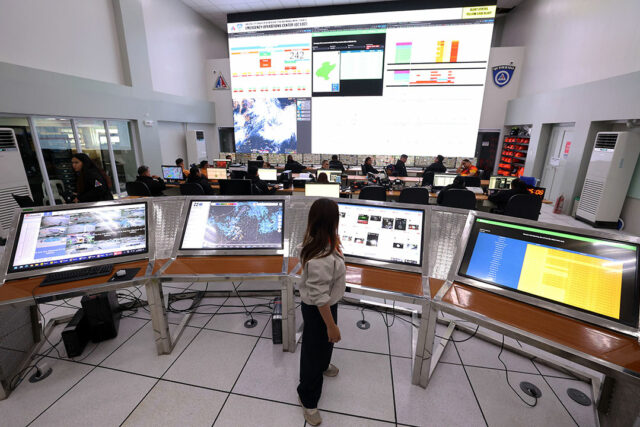
INSIDE the Quezon City-Disaster Risk Reduction and Management Office. — PHILIPPINE STAR/MIGUEL DE GUZMAN

Let’s not unite only when lives are lost. Let’s stand together before any disaster strikes, so our solidarity is not born of tragedy, but rooted in compassion, hope, peace, and humanity.

We gather not merely to mark a date on the calendar but to awaken a deeper consciousness… one that transcends policy, transcends protocol, and reaches into the very soul of our shared humanity. In the Philippines, where the earth trembles with unsettling frequency, the skies roar with cyclonic rage, and the seas rise with a quiet unrelenting menace, disaster is not a distant abstraction. It is a visceral truth etched into the memory of every community, every family, every child who has clung to hope amid the deluge.

We are a nation cradled by beauty and besieged by peril. Our archipelago, a tapestry of islands kissed by sun and sea, is also a crucible of vulnerability. We are visited by no fewer than 20 tropical cyclones each year, many of which leave behind trails of devastation that defy comprehension. Our rivers swell, our mountains weep, our coastlines erode. And beneath our feet, the earth itself stirs, reminding us that tectonic fury is never far from reach.

In recent days, we have witnessed a disturbing uptick in seismic activity. A series of earthquakes, some subtle, others shattering, have rippled across our islands, fracturing homes, toppling schools, and shaking the very foundations of our communities. From Mindanao to Luzon, the tremors have not only cracked concrete but exposed the fragility of our preparedness. These are not isolated incidents. They are warnings. They are wake-up calls. And they demand a response rooted not in fear but in foresight.

Yet in the face of such relentless adversity, the Filipino spirit does not falter. It rises.

But let us not romanticize resilience. Let us not glorify survival as though it were a badge of honor earned through suffering. The truth is more sobering: we endure because we must, not because we should have to. And therein lies the moral imperative. We must not wait for lives to be lost, for homes to be shattered, for futures to be buried beneath rubble and ruin. We must act before the tempest, before the tremor, before the tide. We must invest not in reaction but in readiness, not in response but in resilience.

It is a grave injustice that the most vulnerable among us are often the least prepared, not by choice but by circumstance. In remote provinces, evacuation centers are few and far between. In urban enclaves, informal settlers cling to precarious dwellings that offer no protection from wind, water, or seismic shock. In schools, children rehearse drills that may never be enough. And in the corridors of power, budgets are debated while time slips away. This is not a logistical oversight, it is a profound failure of empathy.

To reduce disaster risk is to affirm the sanctity of life. It is to declare, unequivocally, that no child should drown in floodwaters, no elder should perish in landslides, no family should be crushed beneath collapsing walls. It is to recognize that preparedness is not a privilege; it is a right. And it is to understand that resilience is not built in the aftermath. It is cultivated in the quiet moments before the storm, before the quake, before the flood.

In the Philippines, we have seen both the agony of neglect and the triumph of foresight. We have witnessed communities transformed by early warning systems, by climate-smart agriculture, by community-led mapping of hazards and vulnerabilities. We have seen youth rise as champions of preparedness, armed not with fear but with knowledge. We have seen mothers organize neighborhood brigades, fathers retrofit homes with salvaged materials, teachers turn classrooms into sanctuaries. These are not isolated acts. They are testaments to what is possible when solidarity precedes tragedy.

And yet, these stories remain too few, too fragile, too reliant on the will of the few rather than the collective commitment of the many. We must not allow resilience to be the exception. We must institutionalize what works. We must scale up what saves. We must fund what protects. The call to “Fund Resilience, Not Disasters” championed by the United Nations Office for Disaster Risk Reduction (UNDRR) is not a slogan. It is a summons, a moral imperative. It urges us to reorient our priorities, to reimagine our budgets, and to redefine what it truly means to care.

Let us not be seduced by the spectacle of response… the helicopters, the relief packs, the photo ops. Let us instead be moved by the quiet dignity of prevention, the reinforced school, the elevated home, the trained volunteer. Let us celebrate not the heroism of rescue but the wisdom of readiness. For every life saved before the storm or the quake is a triumph that no headline can capture.

In this moment of reflection, let us also confront the deeper truths that disasters reveal. They expose inequality. They magnify neglect. They lay bare the fault lines not just of geology but of governance. And they remind us that resilience is not solely technical, it is profoundly human. It is about relationships, about trust, about the invisible threads that bind us to one another.

We must build those threads with intention. We must weave a fabric of foresight that stretches across sectors, across regions, across generations. We must empower local governments not just with mandates but with means. We must equip schools not just with drills but with dignity. We must engage communities not just as beneficiaries but as co-creators of their own safety.

And we must do so with urgency. The climate crisis is no longer a distant threat, it is a present danger. Rising seas, intensifying storms, shifting rainfall patterns, and a surge in seismic activity all conspire to make our vulnerabilities more acute. The Philippines, with its unique geography and socioeconomic realities, stands at the frontline of this existential challenge. We cannot afford complacency. We cannot afford delay.

But we can afford hope. We can afford compassion. We can afford the audacity to believe that a different future is possible… one where disaster risk reduction is not an afterthought but a cornerstone of development… one where resilience is not reactive but proactive… one where solidarity is not born of tragedy but is rooted in peace, foresight, and shared humanity.

Let this be the moment we choose to act not because we were forced to but because we were called to. Let it be the moment we honor the memory of those we have lost by protecting those we still have. Let it be the moment we declare, with conviction and clarity, that the Filipino people deserve more than survival, they deserve safety, dignity, and peace.

And let us carry this message not just in our speeches but in our budgets, our classrooms, our communities, our hearts. Let us be the architects of a nation where resilience is not the exception but the norm, where every family, regardless of income or location, can face the future not with fear but with faith.

For in the end, disaster risk reduction is not about statistics. It is about stories. It is about lives. It is about love. And it begins now.


Glenn S. Banaguas is a member of the Education and the Environment Committees of the Management Association of the Philippines. A UN Laureate and world-renowned science diplomat, he is widely known as the Father of Asian Science Diplomacy and the Guru of Resiliency and Sustainability, with expertise in environmental stewardship, climate change adaptation and mitigation, and disaster risk management.

map@map.org.ph

glenn.banaguas@gmail.com

To see is to laugh

By Joseph L. Garcia, Senior Reporter

THERE’S a problem with GB Labrador’s jokes: for you to really get them, you just have to be there. One can get a chance to “be there” when Mr. Labrador goes live on March 14 for Beta Days, his hour-long comedy special at the Arete Hyundai Hall in the Ateneo de Manila University campus. Beta Days will be recorded for future streaming purposes.

When you try to tell Mr. Labrador’s jokes yourself to your friends, they fall flat. You don’t have his voice, which can go several pitches higher or lower, contrasting with his tall frame. You won’t have his tone; the slight flickers that change his expression rapidly between sentences — or maybe, you’re just not funny enough. But he is.

As an example: we went to one of his shows on Feb. 20, with some members of the comedy production house he founded in 2013, Comedy Manila. A fundraiser at Mow’s in Quezon City, he roasted the very cause for which the show was raising funds, did a skit about a possession care of Santa Claus himself, joked about growing up in a private school with delinquents, talked about missing his hair (and the strands going to heaven before he does), then he picked up his guitar.

With his guitar, he sang songs about blowjobs and anal sex (and modified the song for a couple of male friends in the audience). Right on theme, surprisingly (he has a talent for winding long yarns then surprising the audience with a joke dropped several spiels before), he found a couple in the audience who worked for the government. After singing about the incompetence of their bosses, he asked one of them (in song) about the rumored sexuality of a certain political figure, careful not to mention the name. He asked the couple three times, the man only answering in the affirmative at the last. To screams from the audience, Mr. Labrador took his hands off his guitar and said, “Aaand that’s my set.”

See how he can do it and I can’t?

ORIGINS
Mr. Labrador, the founder of Comedy Manila and a co-host of the country’s top comedy podcast The Kool Pals (he shares the platform with four other comedians, namely James Caraan, Nonong Ballinan, Ryan Rems Sarita, and Muman Reyes), began his funny career working in one of the funniest places on earth: the human resources (HR) departments of telecommunications companies.

“Most of my jokes are based on experiences from work,” he told BusinessWorld backstage.

Seriously though, after his time in HR, he pivoted to comedy by writing for television, in comedies directed to adults and children (in his set, he recalled a story about being reprimanded by the Movie and Television Review and Classification Board for an inappropriate joke for children — about male pattern baldness — and seeing the whole writing team trying not to laugh as their jokes were read back to them in a deadpan voice).

“In stand-up, there are no restrictions,” he said in a mix of English and Filipino, describing the differences of writing jokes for TV and the stage. “With TV, there are restrictions. It’s a test of creativity and a challenge as a writer.

May jokes na for TV lang rin talaga (there are jokes that are just for TV), not for the stage. It’s a nice workout sa utak (for the mind).”

He wrote for TV for more than seven years, before quitting his day job and focusing on comedy. “I wore the same shirt all the time,” he said about living frugally after making the decision, saying that his sisters used to send him clothes after seeing him onstage wearing the same shirt over and over (to be fair, it sported a print saying “Comedy Manila,” so it was promotional material). “Big support from the family is what you need if you’re going to quit your day job and follow your dreams,” he said.

“When I say you have to do comedy full-time, you’re not really doing stand-up full-time. You’re doing comedy full-time. Anything related to comedy, you do, to get to those gigs,” he said.

He spoke about the difference in the scene now, compared to when he founded Comedy Manila in 2013. “I noticed that everyone was doing very well, and already had longer sets, and deserved a bigger stage,” he said about his initial roster, which included Red Ollero and Victor Anastacio, among others, themselves already big names in comedy (some have pivoted to hosting).

He emphasized that Comedy Manila is not a comedy group (which implies exclusivity) but a comedy production house (which would promote and produce shows for the comedians, should they be deemed fit). “The goal (then) was to build the scene, wherein every comedian will have a following, and then the audiences will grow,” he explained.

“We have so many comedians now. As you noticed when we did our show, people now from different demographics watched: young, old,” he said. “Now, no one’s afraid to watch in front,” he notes, citing the old Filipino predilection for insult — instead of observational — comedy (they focus on the latter).

Speaking about how going digital has changed their scene (especially since the pandemic), he said, “Being 46 years old, online is quite a challenge for me to utilize. It takes a lot of time and effort. Unlike the younger comedians, they’re used to it.

“Comedy Manila has been doing well because of word-of-mouth. With online content, it will help bring in more people to the shows, which I like. But putting content online, I always warn and tell comedians not to put jokes that might get them in trouble or be misinterpreted. No censorship on the stage, but online, be careful,” he said.

“The virality, you’ll get a lot of likes, but it doesn’t automatically translate to ticket sales,” he observed. “It’s something that we should study more.”

WHAT’S SO FUNNY?
When we say Comedy Manila, one begins to think about the things that should be funny about this city, and this country. “It’s very colorful. Everything is colorful,” Mr. Labrador said about what makes Manila so comedic. “How we react is sometimes overboard. We focus on the wrong things, frequently, as a society.”

We told him about how his jokes don’t always land right when they’re told secondhand, or seen through a screen (except on his podcasts, where he shines unscripted). “It’s a good thing. That’s what I believe every comedian is working on. That they’re unique enough, and their material is so personal that no one can do their jokes except themselves. The emotions involved are only theirs — or mine — that when I tell the joke, no one can actually do it the same way I do. I am in that state that I’ve experienced: that I am now telling the audience.”

While he may have started writing jokes in his head when he was in HR, he doesn’t recall always being that funny. “To my friends only. I was more of an audience to the kind of classmates I had. Sila ’yung maloko (now they were funny),” he said. “Good boy ako noon eh (I was a good boy back then).”

We have an idea about what it takes to make it in stand-up: you write your jokes, you go on open mics, wait to get noticed by audiences, then maybe get your own show. That’s work. What nobody talks about is: can you work hard to be funny?

“You can. But I believe to be able to go beyond the level of what you can study, there has to be a natural funny bone in you,” said Mr. Labrador.

“I believe it’s innate. It is natural in you to share something that will make someone laugh. Even if it’s not in front of a big audience,” he said. “I long for those fun times with my friends, when I’d get to make them laugh,” he said, saying that he took his guitar-playing sketch from just roasting his own friends through song. “It is in you, that you really love to make people laugh.”

Catch GB Labrador live in Beta Days on March 14, at Ateneo’s Arete Hyundai Hall. Tickets are on sale at P1,500 each at www.comedymanila.ph.


SEC fines Myloan over unfair collection tactics

BW FILE PHOTO

THE SECURITIES and Exchange Commission (SEC) has fined Myloan Lending Investors, Inc. P50,000 for unfair and abusive debt collection practices, warning the company against further violations.

In a statement on Monday, the SEC said its Financing and Lending Companies Department found Myloan administratively liable for a second breach of Memorandum Circular No. 18, which sets standards for debt collection conduct.

The case stemmed from a borrower’s complaint alleging that the lender’s collection agents used shaming language, threatened to contact emergency contacts and employers, and repeatedly reached out to third parties over delayed payments.

Under SEC memo, lenders are barred from using or threatening violence, employing insulting or profane language or contacting people listed in a borrower’s contact directory, except guarantors or co-makers.

“These are not neutral reminders. They are coercive communications designed to pressure payment through humiliation and reputational exposure,” the SEC said in its order.

The regulator added that while delinquency may justify reasonable collection efforts, it “does not justify abuse,” rejecting the use of harassment or threats of third-party exposure as collection tools.

Alongside the fine, the SEC warned Myloan that further infractions could lead to heavier penalties, including the possible suspension or revocation of its certificate of authority.

The Financing and Lending Companies Department also ordered the borrower to settle outstanding obligations under the loan agreement, without prejudice to any restructuring or settlement both parties may reach.

Myloan Lending did not immediately reply to an e-mail seeking comment. — Alexandria Grace C. Magno

PNB’s 2025 net profit climbs 20%

PHILSTAR FILE PHOTO

PHILIPPINE NATIONAL Bank’s (PNB) net income jumped by 20% in 2025 as its consumer business posted strong growth.

The bank’s attributable net profit rose to P25.26 billion last year from P21.05 billion in 2024, it said in a disclosure to the stock exchange on Monday.

This translated to a return on equity of 11.09%, up from 10.39% a year prior, and a return on assets of 1.93%, higher than 1.72% in 2024.

“The sustained earnings growth was driven by the solid performance of its core businesses, strong balance sheet management, prudent cost management, and continued operational efficiency,” PNB said.

Net interest income rose by 6.51% to P52.55 billion last year from P49.34 billion in 2024.

This came as its interest income went up to P69.68 billion from P67.46 billion, while interest expense decreased to P17.13 billion last year from P18.12 billion in 2024.

As a result, net interest margin improved to 4.51% from 4.5%.

PNB’s net service fees and commission income increased by 5.81% to P5.83 billion from P5.51 billion.

Other operating income, which includes trading, investment, and foreign exchange gains, surged by 40.24% to P6.9 billion from P4.92 billion.

This brought the bank’s total operating income last year to P65.28 billion, up by 9.2% from P59.78 billion in 2024.

“Fee-generating businesses including deposits, loans, credit cards, trust operations, and bancassurance, and other non-interest earnings provided solid support to the bank’s performance for 2025, which is a reflection of the bank’s strengthened vigor towards expanding its revenue capabilities. Together, these gains underscore PNB’s expanding franchise and the growing confidence of our customers across all segments,” PNB Chief Financial Officer Francis B. Albalate said.

Meanwhile, the bank’s total operating expenses went up by 6.14% to P31.45 billion last year from P29.63 billion in 2024.

Its cost efficiency ratio improved to 48.17% from 49.57%.

PNB set aside loan loss provisions amounting to P1.66 billion last year, down from P3.87 billion in 2024.

Its nonperforming loan (NPL) coverage ratio edged down to 82.34% from 84.84%.

Meanwhile, the bank’s gross NPL ratio declined to 4.72% last year from 5.68%, showing improved asset quality.

“This reflects the effectiveness of the bank’s NPL stabilization strategy which includes tighter portfolio reviews, the use of dynamic risk-scoring and monitoring models. Active engagement with the bank’s corporate and commercial clients allowed for timely intervention and more effective account resolution,” it said.

Total loans and receivables were at P740.02 billion at end-2025, growing from P636.82 billion in 2024.

PNB said consumer loans posted the “biggest” increase at 27%, while its corporate and commercial portfolio grew by 13%.

“The sustained growth momentum in lending activities was supported by healthy asset yields and a low funding cost base,” it said.

Deposits grew to P1.06 trillion at end-2025 from P971.67 billion the year prior.

As a result, the bank’s net loan-to-deposit ratio rose to 68.58% from 64.43%.

PNB’s assets stood at P1.37 trillion last year, up by 9.32% from P1.26 trillion in 2024.

Total equity was at P240.28 billion, rising from P216.63 billion the year prior.

Capital adequacy ratio was at 20.12%, edging up from 20.1% in 2024, while common equity Tier 1 ratio rose to 19.31% from 19.21%.

“After completing the modernization of our core banking system and ATM (automated teller machine) switch, we significantly enhanced our customer acquisition efforts and expanded our ability to capitalize on market opportunities,” PNB President and Chief Executive Officer Edwin R. Bautista said.

“For digital banking, our digital app user base increased by 26%, a testament to the growing trust of the bank’s customers as we continue to enhance and upgrade our digital capabilities. During the year, the bank made significant investments to improve operational efficiency and elevate customer experience by upskilling more than 1,000 employees with competencies in digital-age banking, ethical AI (artificial intelligence) utilization, data protection, and agile methodologies — further strengthening organizational readiness for future growth.”

PNB’s shares rose by P1.55 or 2.44% to close at P64.95 apiece on Monday. — AMCS

A just and lasting peace in Ukraine is in the interest of all of us

UNSPLASH-INSTAGRAM.COM/ALBOVSKY

Today, Russia’s full-scale war of aggression against Ukraine is sadly entering its fifth year. The United Nations and its members have condemned Russia’s full-scale invasion of Ukraine, reinforcing the principles of international law and the UN Charter. Through resolutions in the General Assembly, an overwhelming majority of countries globally, including the Philippines, have denounced Russia’s actions, reaffirming Ukraine’s sovereignty and territorial integrity within its internationally recognized borders.

The consequences of this aggression are global and felt far beyond Europe, also in South East Asia. Economically, the war has disrupted food and energy supplies and contributed to higher inflation worldwide. It came on top of an already fragile global situation following the COVID-19 pandemic. Politically, the price is no lower. Russian aggression against Ukraine undermined the international order and eroded trust in international institutions. It has forced States to prioritize their security and has increased uncertainty within the international system. It turned attention and resources away from global public efforts such as cooperation on trade, development, and climate change. The sooner this war ends with a just and lasting peace, the sooner global attention and resources can be refocused. Predictability and stability in international relations are essential public goods, especially in a world facing multiple, overlapping crises.

The core principles enshrined in the UN Charter — sovereignty, territorial integrity, and the peaceful settlement of disputes — are universal commitments, not Western or European concepts. They are under strain in Ukraine and elsewhere, and respect for them is essential for the security of all states, large and small alike. How this war of aggression ends will further shape the future standing of these principles, already under immense tests elsewhere. If aggression is rewarded or normalized, sovereignty and territorial integrity risk becoming negotiable, weakening international stability far beyond Europe. If Russia can change borders by force, others will be tempted to try that, too.

A just and lasting peace in Ukraine is therefore critical to reaffirm the global value of these principles and to uphold the right of every sovereign nation to exist and make its own choices. Accountability for the suffering and destruction caused will also be essential, both for justice and to reinforce respect for international law.

2026 must be the year the aggression on Ukraine comes to an end. Russia has intensified its aggression lately, with indiscriminate attacks on critical infrastructure which causes tremendous suffering of civilian populations. However, Ukrainians continue to show incredible resilience while facing constant brutality. They certainly deserve peace.

The European Union will continue to support Ukraine for as long as necessary. The EU and its Member States are Ukraine’s leading supporters, providing extensive political, financial, and military assistance. A just and lasting peace in Ukraine can help restore predictability and international order in the modern world. This is why we urgently need it.


Signed by the Heads of Mission of the European Union, Belgium, Bulgaria, the Czech Republic, Denmark, Germany, Ireland, Greece, Spain, France, Croatia, Italy, Cyprus, Lithuania, Luxembourg, Netherlands, Austria, Poland, Romania, Slovenia, Slovakia, Finland, and Sweden.

One Battle After Another wins big at Britain’s BAFTA film awards

One Battle After Another (2025)

LONDON — Dark comedy One Battle After Another was the big winner at Britain’s top movie awards on Sunday, picking up six BAFTAs including best film and best director for Paul Thomas Anderson.

It beat home favorite, the tearjerker Hamnet, and vampire thriller Sinners, which has a record number of Oscar nominations, in the big two categories in the ceremony, where Prince William and Princess Kate were guests of honor.

“We have a line from Nina Simone that we stole in our film. She says ‘I know what freedom is, it’s no fear,’” Mr. Anderson said.

“So let’s keep making things without fear, it’s a good idea.”

Mr. Anderson also picked up the award for best adapted screenplay, while Sean Penn beat his co-star Benicio del Toro among others for best supporting actor.

The critical hit also won best cinematography and best editing to total six prizes.

Sinners, which has 16 Oscar nods, won best original screenplay for writer and director Ryan Coogler, best supporting actress for Wunmi Mosaku, and best original score.

SURPRISE IN BEST ACTOR CATEGORY
The biggest surprise was Robert Aramayo beating Timothée Chalamet, Leonardo DiCaprio, Michael B. Jordan, Ethan Hawke, and Jesse Plemons to win best actor for his acclaimed performance as Tourette syndrome campaigner John Davidson in I Swear.

He accepted the award — his second of the evening after picking up the rising star prize — in tears, saying “I absolutely can’t believe it.”

Asked before the ceremony what it would mean to him to win, Mr. Aramayo told Reuters: “I haven’t even engaged with that thought to be honest with you, I just feel really, really lucky to be on that list of names.”

Favorite Jessie Buckley won best actress for playing Agnes, the wife of William Shakespeare, in Hamnet, based on the novel by Maggie O’Farrell and directed by previous Oscar winner Chloé Zhao.

The film also won outstanding British film, but it lost out on the two major awards, including best film, where its home advantage had made it a favorite.

The awards, hosted by Alan Cumming, were the first joint engagement for William and Kate since William’s uncle Andrew Mountbatten-Windsor was arrested on Thursday.

William, president of the film academy, presented the BAFTA Fellowship to Donna Langley, studio head at NBCUniversal. — Reuters


And the 2026 BAFTA winners are…

LONDON — The 2026 BAFTA Film Awards, Britain’s top movie honors, were handed out at a ceremony in London on Sunday, with One Battle After Another winning the top prize of the night, best film.

Below is a list of winners in the key categories.

Best Film One Battle After Another

Outstanding British Film Hamnet

Director – Paul Thomas Anderson, One Battle After Another

Leading Actor – Robert Aramayo, I Swear

Leading Actress – Jessie Buckley, Hamnet

Supporting Actor – Sean Penn, One Battle After Another

Supporting Actress – Wunmi Mosaku, Sinners

Original Screenplay Sinners

Adapted ScreenplayOne Battle After Another

Film Not in English Language Sentimental Value

Animated Film Zootropolis 2 (titled Zootopia 2 in the US and some other countries)

DocumentaryMr. Nobody Against Putin

Original Score Sinners

EE Rising Star – Robert Aramayo

Triconti wins grid nod for P303-B wind projects

BUHAWIND.COM.PH

A CONSORTIUM led by Triconti ECC Renewables Corp. has secured approval to connect 1,650 megawatts (MW) of planned offshore wind capacity to the Philippine grid, clearing a key hurdle ahead of a government auction for renewable energy contracts.

In a statement on Monday, the group, which includes Liechtenstein-based Seawind Asia AG and Swiss firm Stream Invest Holdings AG, said it obtained grid connection agreements for three offshore wind projects with a combined investment value of about P303 billion.

The projects covered by the approvals are the 450-MW Frontera Bay offshore wind farm and the 600-MW Guimaras Strait and 600-MW Guimaras Strait II projects.

A grid connection agreement, issued by the National Grid Corp. of the Philippines, sets out the technical and commercial terms for linking a power facility to the transmission network. Securing the agreements signals the projects’ readiness for integration into the grid once completed.

The consortium is preparing to join the government’s fifth round of the Green Energy Auction (GEA-5), which is dedicated to offshore wind projects.

The auction lets developers compete to supply renewable power at the lowest price in exchange for long-term fixed-rate contracts.

Theo C. Sunico, Triconti’s director for regulatory and markets, said the grid approvals send “a strong signal to investors and project developers.”

“It shows the Philippine government’s commitment to support the offshore wind industry and highlights the real value that international partnerships can bring to the country’s green energy transition,” he said.

The Philippines has been stepping up efforts to attract offshore wind investments as it seeks to diversify its energy mix and reduce reliance on imported fossil fuels.

Offshore wind projects, however, require substantial capital and long development timelines, with grid access considered one of the critical milestones before financial close.

Triconti ECC Renewables is part of the Triconti Windkraft Group, a Filipino-Swiss joint venture with a development pipeline of more than 4 gigawatts of onshore and offshore wind projects nationwide.

Seawind focuses on offshore wind development and construction, while Stream Invest backs wind and solar ventures in growth markets.

The consortium said it would intensify development work to ensure successful participation in GEA-5 and advance the projects toward realization.

If awarded contracts under the auction, the projects would rank among the biggest offshore wind developments in the country, potentially reshaping the Philippines’ renewable energy landscape and bolstering its long-term energy security goals. — Sheldeen Joy Talavera

Peso surges to five-month high on tariff ruling

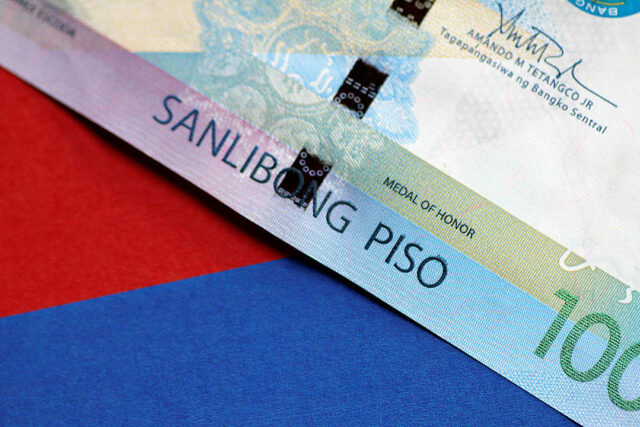
A Philippines peso note is seen in this picture illustration on June 2, 2017. — REUTERS

THE PESO surged to a five-month high against the dollar on Monday after the US Supreme Court ruled that the reciprocal tariffs imposed by President Donald J. Trump on their trading partners were unconstitutional.

The local unit jumped by 57.5 centavos to close at P57.575 versus the greenback from its P58.15 finish on Friday, data from the Bankers Association of the Philippines showed.

This was the peso’s strongest finish in five months or since it closed at P57.461 per dollar on Sept. 24, 2025.

The local currency opened Monday’s trading session stronger at P57.95 against the dollar. It surged to a high of P57.53, while its weakest showing was at just P57.999 against the greenback.

Dollars traded rose to $1.716 billion from $1.368 billion on Friday.

“The dollar-peso traded lower on broad dollar weakness following the Supreme Court’s ruling on Trump’s tariff and renewed worries on fiscal policy and tariff concerns,” a trader said in a phone interview.

The peso jumped as the decision led to gains in emerging-market stocks and currencies, Rizal Commercial Banking Corp. Chief Economist Michael L. Ricafort said in a Viber message.

For Tuesday, the trader said the peso could move between P57.30 and P57.70 per dollar, while Mr. Ricafort expects it to range from P57.45 to P57.70.

Emerging Asian currencies strengthened on Monday as uncertainty over US trade policy kept the dollar under pressure, while regional equities moved higher, spearheaded by gains in South Korea and Taiwan, Reuters reported.

MSCI’s emerging market currency index climbed 0.24%, hovering just below its record peak hit on Feb. 12.

The dollar index weakened after Mr. Trump unveiled a blanket 15% import levy in response to a US Supreme Court ruling against his sweeping tariffs.

A 15% global tariff rate would be a modest relief for India and ASEAN economies like Malaysia, Thailand, Indonesia, the Philippines and Vietnam, according to analysts at Barclays, though the levy would be higher for Singapore with a present rate of 10%.

The Singapore dollar edged up 0.2% and the South Korean won, Thai baht and Taiwanese dollar all gained over 0.3%.

The narrative in Asian emerging markets has shifted from tariff fears to competitiveness, with supply chains viewed as more diversified than in 2018 and economies tied to artificial intelligence (AI) hardware, capital goods and advanced manufacturing viewed as better positioned than pure export plays, said Billy Leung, investment strategist at Global X ETFs Australia.

Regional equities advanced, with Taiwan’s benchmark touching a record high of 34,212.38 points before closing 0.5% higher.

South Korea’s KOSPI index, another key beneficiary of advancements in AI, gained 0.7%. The benchmark rose 2.1% earlier in the day, to hit a record high.

Indonesian stocks rose 1.4% after the Indonesia Stock Exchange late on Friday unveiled a series of capital market reforms, following a January warning from MSCI that the country risked a downgrade to frontier status by as early as May.

Thailand equities rose as much as 1.5%, clocking their highest since mid-October 2024. Equities in the Philippines advanced 1% while Singapore and Malaysia stocks rose 0.2% and 0.3% respectively. — A.M.C. Sy with Reuters

ADVERTISEMENT
ADVERTISEMENT