Home Blog Page 2482

PLDT, Smart boost LTE capacity, add sites in Mindanao

PLDT INC. has secured a P2-billion social loan from HSBC Philippines to expand its fiber network. — BW FILE PHOTO

PLDT Inc., through its wireless unit Smart Communications, Inc., continues its long-term evolution (LTE) technology capacity expansion efforts in the country, the Pangilinan-led telecommunications company said on Monday.

“This reinforces our commitment to deliver the best possible experience to our customers in Davao City and across the country, connecting families, enabling businesses of all sizes, and powering the country’s overall digitalization thrust,” PLDT and Smart First Vice-President and Deputy Network Head Roderick S. Santiago said in a statement.

In 2024 alone, PLDT added new sites and expanded LTE capacity in Davao City and other cities and provinces in Mindanao such as General Santos, Tagum, Koronadal, and Digos; and Bukidnon and Polomolok in South Cotabato.

PLDT said its continued investments in network expansion are part of its ambition to help bridge the digital divide while also bringing connectivity and advancing the country’s digitization efforts.

Last week, PLDT announced that it had secured a P2-billion social loan from HSBC Philippines to expand its fiber network.

The company said proceeds from the loan would be allocated for its fiber network infrastructure expansion to reach the country’s fourth to sixth class municipalities, including those considered as geographically isolated and disadvantaged areas.

At the stock exchange on Monday, shares in PLDT shed P3, or 0.2%, to close at P1,462 apiece.

Hastings Holdings, Inc., a unit of PLDT Beneficial Trust Fund subsidiary MediaQuest Holdings, Inc., has a majority stake in BusinessWorld through the Philippine Star Group, which it controls. — Ashley Erika O. Jose

Gokongwei group bets big on Cebu with NUSTAR Hotel expansions

By Aubrey Rose A. Inosante, Reporter

THE GOKONGWEI GROUP is banking on Cebu’s booming gaming industry and tourism with its ultra-luxury NUSTAR Hotel, set to open in December as part of a P30-billion investment package.

“The P30 billion, a big chunk of that is for the construction,” Katrina Mae L. de Jesus, assistant vice-president of resort marketing and business development and brand marketing at NUSTAR Resorts and Casino, told BusinessWorld on Saturday.

The NUSTAR hotel is set to soft open by December to “start and build upon the holiday market and then carry on from there,” Roel Constantino, general manager for hotels, told reporters.

This will add 223 hotel rooms and another 383 rooms from the Grand Summit Hotel, which is set to open by 2027. These additional capacities will drive the room count to nearly a thousand, making it the biggest hotel complex in Cebu.

Mr. Constantino said the upcoming NUSTAR hotel foresees the market to be more international. The rooms are larger, starting at 52 square meters (sq.m.).

Currently, Fili Hotel has 379 rooms and houses the casino and NUSTAR Mall.

Ms. De Jesus said Fili Hotel is currently at a 70-80% occupancy rate as some amenities are yet to be operational.

“It’s the grand ballroom that helped. There were lots of events. I think that’s what contributed to the occupancy,” she said.

The core conference area, called the New South Convention Center, is an aggregate of the three ballrooms and the in-between function-spaces, spanning a 19,000-sq.m. capacity. The grand ballroom opened in June 2023.

VIP GAMING SPACE EXPANSION EYED
Trevor Hammond, senior vice- president of gaming and integrated resorts operations, said there is quite a large segment of very important persons (VIPs) that like to play in private salons, which allows an opportunity to expand in the future.

“There is a lot of opportunity to grow. I think we’ve allocated three floors in NUSTAR — the fifth, sixth, and seventh floors — for any possible expansion that we would need for any private gaming rooms for the junket operators,” he said.

He said on level two, the property has eight VIP gaming rooms where the junket operators conduct their business.

Mr. Hammond said that VIP and mass gaming each contribute about 50% to the gross gaming revenue.

“I would say Koreans run about 40%, and some Chinese run about the other 40%, and then local about 20%,” Mr. Hammond said, referring to the share of the VIP market.

Low-cost carrier Cebu Pacific in 2022 launched daily flights to Seoul from Cebu City, which helped boost their Korean market, according to Mr. Hammond.

Meanwhile, for the mass market, source markets are mostly locals followed by Koreans.

“Koreans are a good market for us because their average play is higher. They’ve got a shorter period of play, so they don’t spread it out over a long period. They just come and hit it,” he said.

Mr. Hammond also noted that with the success of NUSTAR, the firm is looking into the idea of spreading its gaming footprint across the Philippines, potentially Luzon.

“We’re constantly looking around. It would be another license. Licensed for specific two regions and two properties,” he said.

“Luzon is where the critical mass is. Clark is a good opportunity there. That’s an area that’s growing,” Mr. Hammond added.

NUSTAR recently launched its official online gaming platform, Play Maxx.

Mr. Hammond also expects online gaming to contribute 20% to 30% to the revenue; however, physical casinos are still the preferred and main driver.

Ahead of the holidays, NUSTAR held its Christmas Lighting event and launched its improved rewards program that features tiered memberships that vary from star, sky, sun, zodiac, and universe.

The soon-to-be-launched NUSTAR Rewards app allows users to book hotels and restaurant reservations, redeem rewards, participate in draws, and more, Alan Teo, chief operating officer of NUSTAR, said.

NUSTAR Resort and Casino is a five-star integrated resort developed by Universal Hotels and Resorts, Inc. (UHRI).

UHRI is a privately owned company by the Gokongwei group and is the estate owner and operator of NUSTAR in Cebu. Robinsons Land Corp. is a partner of UHRI in the hotel management and operations and the mall management and operations of NUSTAR Resort Cebu.

The relationship between storms and a strong energy infrastructure

Last week, Severe Tropical Storm (STS) “Trami” (local name “Kristine”) dumped a huge volume of rainwater, knocked down many trees, electrical posts, and cables, and caused power blackouts or fluctuations in many provinces in the Visayas and Luzon.

From different press statements I gathered, here are what several agencies and utilities have done to help.

The Department of Energy (DoE): Its Task Force on Energy Resiliency (TFER) monitored and helped coordinate the energy sector which mobilized many resources to restore power across affected areas in Luzon. Teams of linemen, engineers, and technical personnel from electric cooperatives, the National Power Corp. (in off-grid areas), the National Grid Corp. of the Philippines (NGCP), Meralco and other private distribution utilities worked tirelessly to restore electricity in these areas. This includes the simultaneous clearing of debris, repairing of downed power lines, and rebuilding of damaged substations.
The NGCP: It has an Integrated Action Plan to respond to typhoons and other natural calamities, annual Blackout Drills to prepare for major system disturbances, an Overall Command Center during critical periods, emergency restoration systems (ERS), spare equipment including transmission line hardware, and choppers, ready for rapid deployment when needed.

The Manila Electric Co. (Meralco): As of Oct. 24, nearly 600,000 Meralco customers suffered from power interruptions as the storm badly affected parts or the whole of its franchise area in the provinces of Batangas, Cavite, Laguna, Quezon, Rizal, Bulacan, and Metro Manila. Non-stop work led to the restoration of power by Oct. 27. Meralco Vice-President and Head of Corporate Communications Joe R. Zaldarriaga humbly thanked their customers “for their patience and understanding. Our crews and personnel will not stop until power service has been fully restored to the remaining affected customers.”

GLOBAL COOLING AND DISASTER PREPARATIONS
The bulk of our disaster preparations are focused on “man-made” global warming and climate change. The main narrative is that the Earth is warming in a manner that some have described as unprecedented, unequivocal, and catastrophic, and which is leading to rising sea levels (as the ice in Greenland and the Antarctica is melting fast) and the flooding of low-lying cities and places.

I do not believe this is true.

Planet Earth is 4.6 billion years old and there have been many episodes of global warming that follow global cooling. For instance, prior to the Modern or 20th century warming, there was the Medieval Warm Period (followed by the Little Ice Age), and before that there was the Roman Warm Period.

What is actually happening is not the rise of sea levels but the rise of water levels in rivers, lakes, and creeks due to annual flooding. There has been more rain and thus floods, not less. And this is what we should prepare for more.

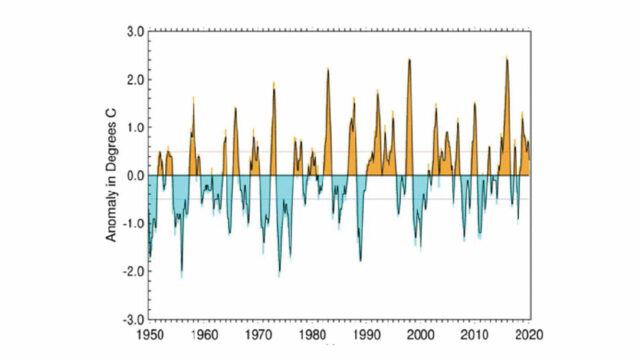
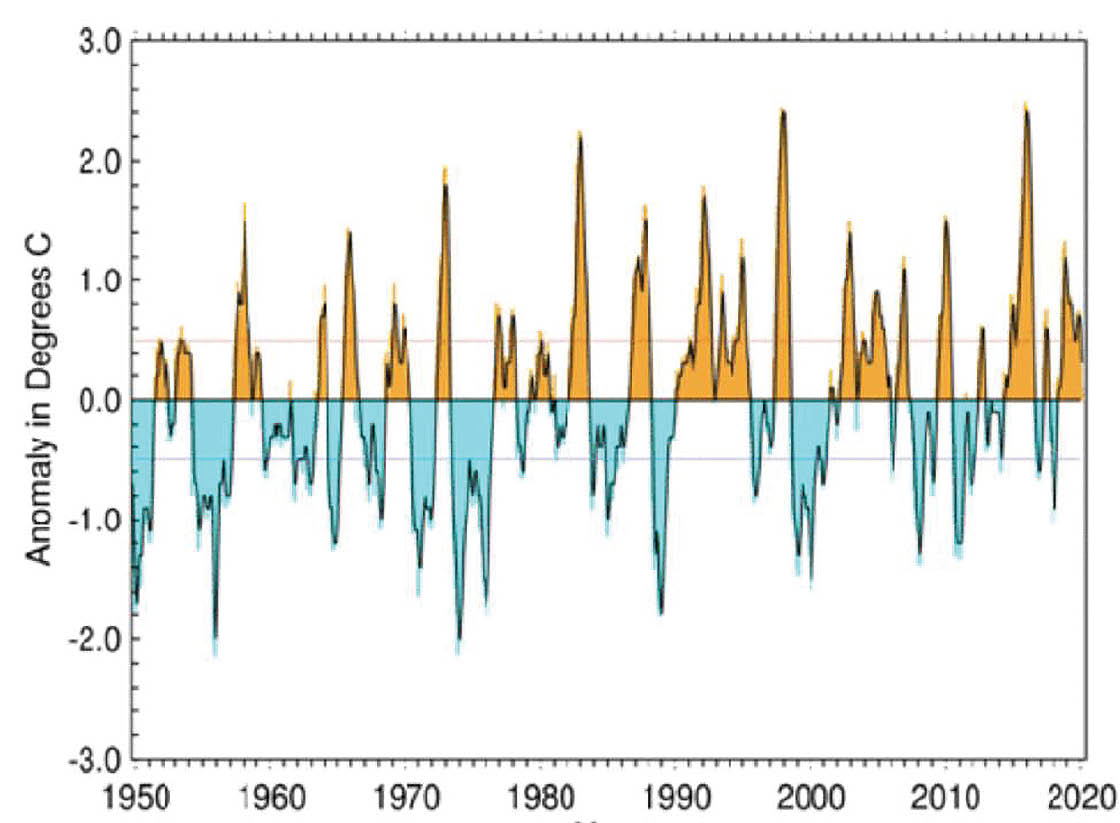
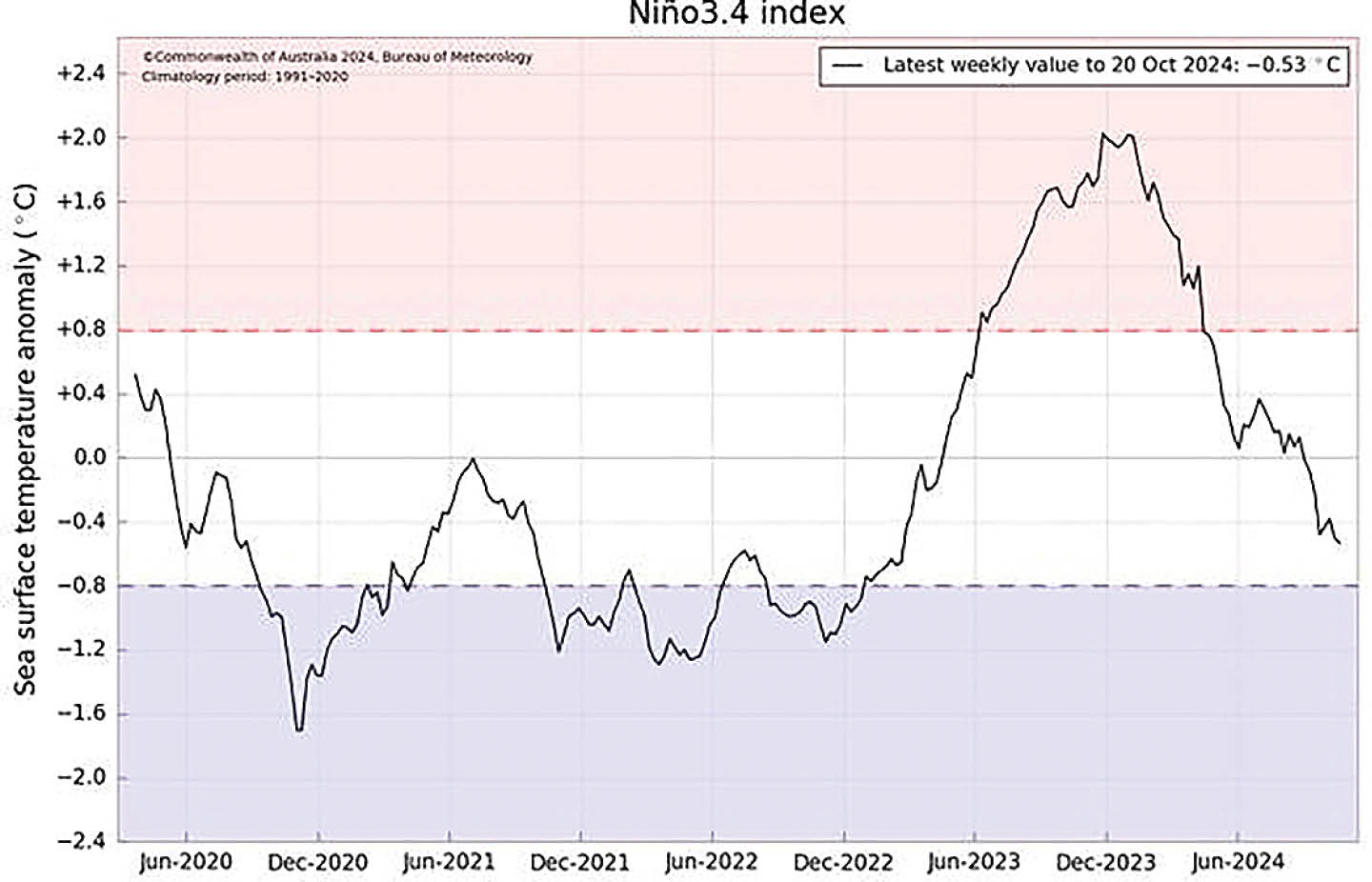
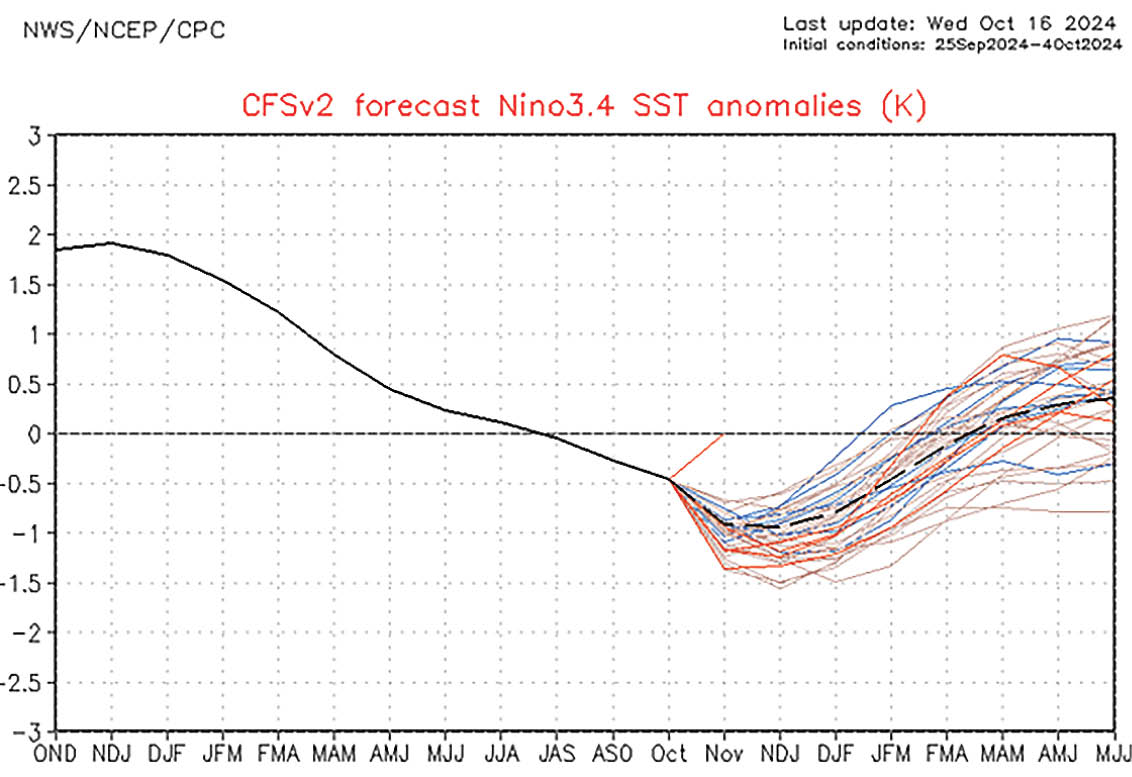
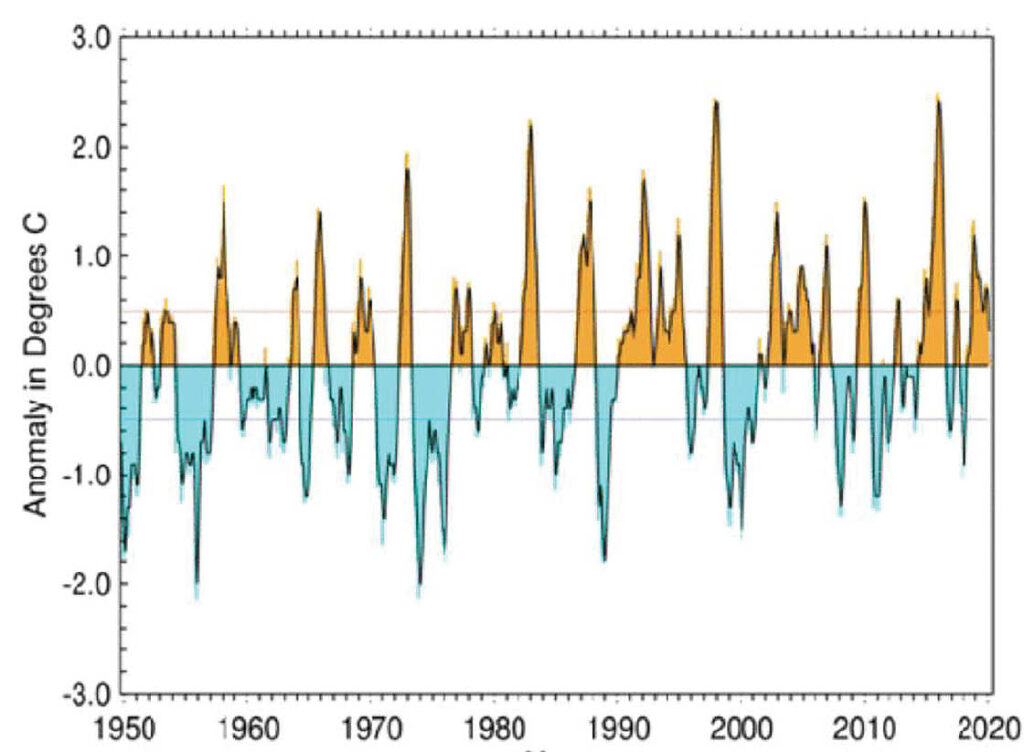
If we look at the history of El Niño (which is the result of a sea surface temperature or SST anomaly/variance of 0.50°C or warmer) and La Niña (an SST variance of -0.50°C or colder), the 1950s to ’70s had more periods of La Niña, while the 1990s and 2000s had more periods of El Niño. Then early this decade there was a prolonged, triple-dip La Niña, followed by a big El Niño and now we are back to La Niña, with projections that it will last until the middle of 2025. All this is official data from the US National Oceanic and Atmospheric Administration (NOAA) and the Australian Bureau of Meteorology or BoM (see the accompanying chart).

From 2020 to 2022 in the Philippines, we had three years of no summer or dry season — it rained throughout all 12 months, as reflected in the triple-dip La Niña of those years. After the bad El Niño which ran from June 2023 to May this year, it has entered a neutral phase (an SST variance between +0.50 C to -0.50 C) with heavy rain since around June, and now we are entering La Niña again.

So we anticipate prolonged rains for the rest of this year until early next year. We expect more rain and flooding, not less, with possibly another year without summer in 2025 and beyond.

What to do in these periods of prolonged rain and flooding, this global cooling trend? Here are some measures we can consider.

1. Regular, annual dredging of rivers, creeks, and lakes. Make them deeper so they can hold more rainwater and thus minimize flooding.

2. Build more dams, weirs, man-made lakes, and other water catchments. Open-pit mining can help — the mined-out areas should not be covered with soil and planted with trees but instead be left as they are to become artificial lakes.

3. Our energy infrastructure should have endless capital expenditure (capex) upgrades. We should have redundancy in system reserves like substations and peaking plants which are unencumbered by price controls.

4. The Energy Regulatory Commission (ERC) should expedite the approval of necessary capex upgrades. All regulated entities — private distribution utilities like Meralco, electric cooperatives, and the NGCP — need ERC approval for their capex projects. The delay in the approval of important projects (especially those damaged by typhoons and floods, earthquakes, and volcanic eruptions), plus the business uncertainty of regulatory reset mechanisms, adversely affect supply, distribution, and transmission systems’ efficiency.

In the case of the NGCP, it has 115 pending capex applications worth more than P600 billion, of which seven have been completed. Under the Energy Virtual One-Stop Shop (EVOSS) law, regulatory approvals should be issued within 270 days. The NGCP says they have already infused P340 billion in capex since 2009 and they will infuse more.

And then there is a recent Supreme Court ruling that limits the NGCP’s ability to procure the right of way (ROW) for projects that are not ERC approved.

Our climate policies and energy regulation policies need a reboot. There will be strong storms again because those are part of nature, part of the natural climate cycle of warming and cooling. But the inconvenience and economic damage of those storms need not be repeated if we prepare for global cooling and have a strong energy infrastructure via regular and large capex projects that get faster regulatory approval.


Bienvenido S. Oplas, Jr. is the president of Bienvenido S. Oplas, Jr. Research Consultancy Services, and Minimal Government Thinkers. He is an international fellow of the Tholos Foundation.

minimalgovernment@gmail.com

Maya Bank’s loan disbursements reach P67 billion at end-Sept.

MAYA BANK, Inc. has disbursed P67 billion in loans thus far as of September, driven by its artificial intelligence (AI)-powered credit assessment process, it said on Monday,

“AI is transforming how we approach banking. It’s not just about making credit accessible — it’s allowing us to understand people’s financial behaviors better and therefore offer solutions that fit their lives,” Maya Group Chief Technology Officer Alfred Lo said in a statement.

“Maya… is using artificial intelligence to expand access to credit, especially for Filipinos often overlooked by traditional lenders… Maya’s AI-driven model provides real-time, personalized credit assessments, revolutionizing how Filipinos access loans and financial services,” the digital bank added.

It said its AI-powered credit risk assessment model allows it to process up to 50,000 loan applications daily, with most of its borrowers receiving loan approval and their funds within hours and all via its mobile app.

“Maya distinguishes itself by using AI to assess creditworthiness based on users’ transaction history, app usage, and even minor transactions like bill payments or grocery purchases,” it said.

“The bank’s use of predictive modeling ensures that loans align with individual risk profiles, emphasizing both accessibility and sustainable lending.”

This monitoring, part of its risk management mechanism, allows it to target borrowers with the capacity to pay, adjusting credit limits to reduce the likelihood of default.

“By leveraging AI models that quickly adapt to credit behavior, the bank has cut default rates by over 50% compared to when it launched its lending services in 2022,” Maya added.

Its AI model has also helped in fraud detection, as it identifies fraudulent loan applications and prevents unauthorized fund drawdowns.

The digital bank previously said it expects to breakeven by this year and be profitable by 2025.

Maya Bank is owned by Voyager Innovations, Inc. PLDT Inc. is Voyager’s main shareholder. Hastings Holdings, Inc., a unit of PLDT Beneficial Trust Fund subsidiary MediaQuest Holdings, Inc., has a majority stake in BusinessWorld through the Philippine Star Group, which it controls.

It is one of the six Bangko Sentral ng Pilipinas-licensed digital lenders in the country, with the others being Tonik Digital Bank, Inc., GoTyme Bank, Overseas Filipino Bank, UNObank, and UnionDigital Bank. — AMCS

Venice expands tourist entry fee system to include more days

REUTERS

ROME — Venice is going to broaden its tourist entry fee system in 2025, almost doubling the number of days visitors will have to pay to see the lagoon city, and hiking the price for last-minute arrivals, officials said on Thursday.

In a world first, the Italian destination introduced a 5 charge in April for daytrippers arriving on particularly congested days, hoping the levy would help thin the crowds.

The initial scheme, which was watched closely by other global tourist hotspots, covered 29 days over a four-month period. This will be lifted to 54 days next year, over the same April-July window.

The charge will stay at 5 ($5.40) for those booking ahead of time, but will rise to 10 for anyone reserving within four days of their planned trip. As before, people with hotel and guest house reservations will be exempt.

“Venice has gone from being the city most exposed to and criticized for the phenomenon of overtourism, to being the city that is reacting to this phenomenon the earliest and most proactively on the global stage,” said Simone Venturini, the city councilor responsible for tourism and social cohesion.

He told a news conference the system was still in an experimental phase. He said places popular with tourists, including Japan’s historic city Kyoto and the Spanish island Formentera, had been in touch to ask about the scheme.

Critics have said the payment system failed to slow the flow of tourists, but Mayor Luigi Brugnaro said it was too soon to judge, with precise data only available this year.

He added that Venice did not want to shoo people away, but rather encourage visitors to rethink their dates.

“We are not against it (tourism). We just believe it can somehow be spread out,” he said, warning that the city would hand out fines in 2025 for people without a pass — something it had threatened to do in 2024, but did not.

In all, 485,062 people paid for a day pass this year, raising 2.25 million. This covered just some of the costs of the system, Mr. Brugnaro said, and was not aimed at raking in cash for the city coffers. — Reuters

NBC, PCMC in radio asset transfer talks

WIKIPEDIA.ORG

NATION Broadcasting Corp. (NBC) has entered into a blocktime and content licensing agreements with Philippine Collective Media Corp. (PCMC) for its FM frequency 92.3 in Manila and other regional stations.

NBC is in discussions for the transfer of its radio assets to PCMC, pending regulatory approvals and other commercial terms, the company said in a statement on Monday.

It added that it is also launching True Network, the company’s multi-platform strategy to bring its news, public service, and entertainment programs to broadcast radio.

NBC, operated by Pangilinan-led TV5 Network, Inc., said its True FM programs operating under the 92.3 MHz frequency will be transferred to PCMC.

“We will support the momentum that we have built for True FM and develop new audiences on TV, podcasts, and digital,” NBC General Manager Raul M. Dela Cruz said.

This is part of the company’s strategy to launch its pay television channel, True TV, which is set to air on Channel 19 for Cignal TV subscribers starting Nov. 4, NBC said.

MediaQuest Holdings, Inc. acquired NBC in 1998. It was the first network outside of Metro Manila to broadcast on a 24-hour basis and the first company to launch FM stations in Visayas and Mindanao.

“We likewise confirm that PCMC entered into blocktime and content licensing agreements with Nation Broadcasting Corp. for FM Frequency 92.3 in Manila and other regional radio stations,” Prime Media Holdings, Inc. said in a stock exchange disclosure.

NBC said True FM’s programs like Wanted sa Radyo, Ted Failon and DJ Chacha, Sana Lourd, Heart 2 Heart, Cristy FerMinute, Bangon Bayan with Mon, Frontline Pilipinas, Shoutout!, Match Made, Dr. Love, and Sagot Kita, will now air on 105.9 in Metro Manila; 106.7 in Davao; 101.9 in Cebu; 101.5 in Cagayan De Oro; 99.9 in Ormoc; and 104.7 in Tacloban.

Manolito A. Manalo-led Prime Media, through its parent company RYM Business Management Corp., executed an agreement with Golden Peregrine Holdings, Inc., the parent company of PCMC, for a share-for-share swap transaction.

Under this transaction, shareholders in Golden Peregrine will transfer their shares in the company for shares of stock of Prime Media.

“This transaction has not yet been completed as the parties are awaiting approval of the Securities and Exchange Commission in relation to several amendments of the Articles of Incorporation of the Company as a condition precedent to closing,” Prime Media said, noting that its operations have not yet been consolidated with the operations of PCMC.

Broadcast firm PCMC started its operations in Tacloban in 2009 after being founded by Leyte Rep. Ferdinand Martin G. Romualdez.

Prime Media also announced last week that it was seeking P531 million via private placements to fund its expansion plans. It said that its board of directors had approved private placements from Valiant Consolidated Resources, Inc. and Cymac Holdings Corp.

Further, Prime Media’s board of directors also approved the request of PCMC to borrow P531 million in loans.

PCMC is the operator of PRTV and other radio stations under the Favorite Music Radio brand across the country.

Hastings Holdings, Inc., a unit of PLDT Beneficial Trust Fund subsidiary MediaQuest, has a majority stake in BusinessWorld through the Philippine Star Group, which it controls. — Ashley Erika O. Jose

Rate cutting to stoke retail spending 

End-year vacancy figures as of the end of Q3 — COLLIERS

MALL OPERATORS continue to refresh retail spaces, and we see this trend across the Philippines as developers entice more mall goers and encourage them to stay longer and spend more. Colliers believes that the traditionally strong fourth quarter is an opportune time for retailers and mall operators to ramp up their refurbishment and redevelopment strategies. We see greater physical mall space absorption moving forward as foreign brands continue to open shop in the Philippines while existing brands continue to expand within and outside Metro Manila.

Colliers believes that mall operators and retailers need to cash in on the festive season and seize greater spending across the country. With continued mall space take-up from local and foreign brands, mall operators should take the lead in ensuring that retail spaces are more immersive and experiential while proactively taking into account the tenants’ size and fit out requirements. Meanwhile, mall operators should also look at the viability of featuring coworking facilities and work with their tenants to amplify their brick and click (omnichannel) strategies.

Interest rate cuts should positively influence retail spending across the Philippines. With the release of holiday bonuses and the inflow of more remittances from Filipinos working abroad, we see a more dynamic retail sector for the Philippines for the remainder of the year. A ramped up omnichannel promotion strategy should complement developers’ brisk expansion thrust.

SEIZING HOLIDAY-INDUCED SPENDING
Colliers believes that fourth quarter is historically a strong period for retail spending due to increased inflow of remittances from Filipinos working abroad and release of holiday bonuses of private and public sector employees. Colliers believes that mall operators and retailers need to cash in on the festive season and seize greater spending across the country. With inflation also starting to ease, Colliers believes that the holiday season is a right time to ramp up marketing initiatives and take advantage of Filipinos’ greater disposable incomes.

AMPLIFY OMNICHANNEL STRATEGIES
Mall operators and retailers should continue to capture Filipinos’ rising propensity to spend whether online or offline. While brick-and-mortar retail centers remain attractive especially among Filipinos that utilize malls as de facto public spaces, consumers remain to be drawn to online shopping due to discount vouchers and seasonal promos offered by online shopping platforms and their retail partners. Retailers should sustain Filipino shoppers’ interest by amplifying their brick-and-click strategies. While developers continue to entice greater consumer traffic by introducing trade fairs, bazaars, and other programs within their activity centers and offering “instagrammable” retail areas, online platforms should continue to pique consumers’ e-commerce interest by improving check out process of their e-commerce sites and partnering with retailers and logistics providers by offering vouchers as well as discounted shipping rates and expedited deliveries. Colliers believes that an effective omnichannel strategy is important in expediting the retail sector’s recovery. This is crucial especially as the impacts of interest rate cuts are likely to kick in by 2025. The right mix of online and offline retail promotion strategy also plays a central role in boosting the retail interest of OFW remittance-receiving households. Cash remittances from overseas Filipinos reached a record high $33.5 billion in 2023 and is projected to reach $34.5 billion by end-2024, covering about a tenth of the Philippine economy.

EXPLORE THE VIABILITY OF HOUSING CO-WORKING SPACES
The results of our Q2 2024 Survey Report reveal that 40% of our respondents said that malls are viable locations for flexible workspaces followed by hotels (20%), and cafes and restaurants (19%). Flexible workspace operators may also consider taking up space in transit-oriented retail developments to attract more consumer traffic. Previously, Colliers highlighted that a number of developers are already offering flexible workspaces, exploring the feasibility of these facilities within their retail spaces.

VACANCY IMPROVES
In Q3 2024, vacancies across malls in Metro Manila improved to 15.1% from 15.5% in Q1 2024 due to significant take-up from retailers. This despite the ongoing redevelopments of some regional and super-regional malls. By end-2024, we expect vacancies to marginally rise to 15.3% due to new supply, with the rise in vacancies partly tamed by retailers’ aggressive absorption of physical mall space in time for the holiday season. In the first nine months of 2024, the central bank reduced interest rates by 50 basis points (bps), with the key policy rate now at 6%. In our view, further policy rate cuts should help prop up demand in the retail sector. Economic analysts are optimistic that the central bank will likely continue cutting interest rates in 2025 with the policy rate eventually settling into the 4.5% to 5% range.


Joey Roi Bondoc is the director and head of Research at Colliers Philippines.

joey.bondoc@colliers.com

Phil Lesh, bassist and founder of Grateful Dead, age 84

PHIL LESH — INSTAGRAM.COM/PHILLESH

PHIL LESH, a founding member of the Grateful Dead whose nuanced bass playing made him an architect of the band’s otherworldly sound, died on Friday at age 84, his Instagram account said.

Tributes poured in from the music world and New York’s Empire State Building said it would illuminate the skyscraper in tie-dye colors to honor a member of the psychedelic band known for lengthy improvisations in its live shows, which drew dedicated “Dead Head” fans known for traveling from concert to concert.

The Instagram post said he died peacefully, surrounded by family.

Rolling Stone magazine ranked Mr. Lesh as the 11th greatest bass player of all time, though he also sang lead and backing vocals. Many fans considered him as influential as the band’s front man, Jerry Garcia, who died in 1995.

“His idea — ‘play bass and lead at the same time,’ his notes darting in and around the melody — became as recognizable a part of the Dead’s sound as Garcia’s guitar,” Rolling Stone said.

“Phil was more than a revolutionary, groundbreaking bass player — he transformed how I thought about music as a teenager,” Trey Anastasio, the lead guitarist of Phish, wrote on Instagram.

Formed in California in 1965, the Dead came to prominence during the 1967 Summer of Love in San Francisco, a counterculture movement that embraced peace, love and hallucinogenic drugs.

But the Dead’s music endured much longer than that as a mixture of rock, folk, country, and jazz.

After Mr. Garcia’s death, longtime players Bob Weir, Bill Kreutzmann, and Mickey Hart formed various lineups under the name Dead & Co., while Mr. Lesh opted instead to create Phil Lesh and Friends, which played until 2023.

Philip Chapman Lesh was born on March 15, 1940, in Berkeley, California, and began playing classical violin before switching to “cool jazz” big-band trumpet, his official Dead biography said.

He later studied with experimental Italian composer Luciano Berio before his friend Mr. Garcia told him in 1965 that he was the new bass player for the Warlocks, Mr. Garcia’s band that was a precursor to the Grateful Dead.

Mr. Lesh responded, “Why not?”

Mr. Lesh is survived by his wife, Jill Lesh, and their two sons, Grahame and Brian. — Reuters

What does China want from the next US president?

During a Taiwan National Day speech on Oct. 10, Taiwanese president Lai Ching-te said that Taipei was determined to defend Taiwan’s sovereignty against “annexation and encroachment,” and emphasized that “China has no right to represent Taiwan.”

China’s response was swift. Less than a week after Lai’s provocative speech, a record 153 Chinese war planes swarmed and surrounded Taiwan during a Chinese military exercise over 24 hours. Beijing’s intention was simple: issue Taipei a “stern warning” for what China considers a “separatist act.”

Beijing sees the island as a “sacred and inseparable part of China’s territory” that must return to the fold. The Taiwanese president sees things differently. Currently, the self-governing island has a different political system, and few Taiwanese are in favor of reunification with China.

Though Washington doesn’t have diplomatic relations with Taipei officially, it does have regular communication through back channels and a strong economic relationship. The island is a key US trading partner and is a major supplier of semiconductors which are critical to the production of computers and other technologies. It also sells arms to Taiwan, although this has reduced significantly under Joe Biden.

China has not ruled out taking Taiwan by force, and if it does, the US might come to the self-ruling island’s defense as indicated by Washington in the past.

But Xi will be hoping the outcome of the 2024 US presidential election might bring a leader that would have a different attitude to Taiwan as well as helping China resolve its economic storm, which has resulted in a rising number of protests. So, between an outspoken Donald Trump and a seemingly even-tempered Kamala Harris, does Beijing have a favorite? And do either of them offer Xi anything new?

TAIWAN AND XI’S LEGITIMACY
Aside from Mao Zedong, the founder of the People’s Republic of China, Xi is the only sitting Chinese head of state without term limits and whose political ideology is enshrined in the Chinese constitution.

Xi could potentially prove his place in history by resolving China’s economic crisis. However, Beijing’s increasing isolation from the west due to its support of Russia’s Ukraine conquest makes this doubly hard.

Like it or not, Xi might have to ramp up whatever agenda Beijing has for Taiwan. If he could make sufficient progress towards unification, he may be hailed as one of the greats of the Chinese Communist Party, which would consolidate his status within the party, and distract from the nation’s economic woes.

Unlike Harris, who appears to take alliances and partnerships seriously, Trump questions the benefits of many alliances forged by the US. In fact, the few times that he spoke about Taiwan centers on how the island state has taken America’s semiconductor business, and should pay more to the US for its defense.

So, would Trump come to Taiwan’s aid if China does invade Taiwan? Given the importance of semiconductors to electronics and AI, he just might. But Trump also has a reputation as a “dealmaker-in-chief,” so he might just cut a deal with Beijing, which erodes Taiwan’s independence. And that is likely to worry Taipei.

THE RUSSIA DILEMMA
As Russia’s “partner of no limits,” China has been supplying Russia with technology that fuels Russia’s war machinery against Ukraine. But this has strained Sino-Western relations and earned Beijing trade and import restrictions, which hampers China’s economic recovery.

China could halt its aid to Russia to avoid western scrutiny, but that is not likely. Beijing needs a strong Russia to be a viable ally in its battle against a US-led world order, and to avoid being the focus of the west if Russia falters amid its conquest in Ukraine.

While Harris backs Kyiv and sees the war as a strategic and moral issue, Trump has criticized US aid to Ukraine. He also believes that Kyiv should provide concessions to Russia to end the war that Putin started in February 2022.

A future Trump administration might strengthen Russia by withdrawing support for Ukraine and lifting sanctions against Russia. And a more robust Russia is good news for Beijing.

US ECONOMIC HOSTILITY
So, at first glance, Trump and Harris’ approaches towards China are different. Trump’s return to the White House could also intensify the trade war that he started in 2018, as tariffs on Chinese goods could go to as high as 60%. This might hasten the economic decoupling between the US and China.

Harris, on the other hand, wishes to “de-risk” China. This approach seeks to maintain US global interest while engaging with the east Asian economic behemoth. In such a scenario, Beijing might prefer a Harris presidency as it leaves room for negotiation.

However, Harris has relatively little foreign policy experience, and is expected to pick up where Joe Biden left off. This means the tariffs and technological restrictions that China faced under a Biden administration could stay under her presidency.

Another factor is Tesla founder Elon Musk, who is an ardent supporter of Trump, and may take a top job within a Trump administration.

How much influence the tech multi-billionaire actually has over Trump is uncertain. However, it’s worth noting that Musk has substantial business dealings in China, and might seek to lean on Trump if the former president’s policies harms Tesla’s interests.

With many of these factors unclear at the moment, Beijing will be hoping for a US leader who is more interested in economic wins than protecting Taiwan, and one that Xi can negotiate with to warm up relations between the two countries.

THE CONVERSATION VIA REUTERS CONNECT


Chee Meng Tan is an assistant professor of Business Economics at the University of Nottingham.

CIBI appoints Arellano as president, CEO

CIBI Information, Inc. President and CEO Pia L. Arellano — CIBI INFORMATION, INC.

CREDIT BUREAU CIBI Information, Inc. has appointed Pia L. Arellano as its new president and chief executive officer (CEO), it announced on Monday.

“CIBI Information, Inc., the country’s first and only local credit bureau, is pleased to announce the appointment of Pia Arellano as its new President & Chief Executive Officer. A seasoned and highly accomplished leader who has delivered profit and growth for companies in highly competitive and evolving industries, Pia is set to lead CIBI into an exciting new chapter of expansion and innovation,” it said in a statement.

“Her arrival marks a significant moment for CIBI, as the company strengthens its position as a leader in credit solutions, identity verification, and fraud prevention… Pia is a results-driven CEO with an entrepreneurial mindset. Her leadership values are anchored on passion coupled with compassion, integrity and excellence,” CIBI added.

Ms. Arellano has almost 30 years of experience across several industries, including banking and financial services, payments, remittance, and telecommunications, CIBI said.

She was previously president and CEO of TransUnion Philippines. She also served as head of sales and senior director for the Philippines and Guam at Visa, among other leadership roles.

Ms. Arellano graduated cum laude with a BS Economics degree from the University of the Philippines.

“I am deeply honored to be leading CIBI — a company with a long and rich history as the country’s first credit bureau, deeply rooted in supporting our country’s financial infrastructure. We remain staunchly committed to being a key driver of nation-building and I look forward to collaborating with our customers, stakeholders and partners in achieving this vision,” she was quoted as saying.

“We are delighted to have Pia lead CIBI at this exciting stage. Her strong business acumen and deep relationships across key industries will be crucial in driving our strategic vision. We look forward to achieving new heights under Pia’s leadership, solidifying CIBI’s role as a catalyst for financial inclusion and economic growth,” CIBI Chairman Francis Estrada said.

Brahmal Vasudevan, founder and CEO of private equity firm Creador, a key stakeholder of CIBI, said Ms. Arellano’s expertise in the credit bureau and financial services sector makes her “the ideal leader to drive and accelerate CIBI’s transformative growth journey.”

“As shareholders, we are excited about the new opportunities ahead for CIBI to bring cutting-edge credit risk analytics and identity solutions to financial institutions, businesses and consumers in the Philippines. We are confident that under Pia’s leadership, CIBI will play an even more pivotal role in shaping the financial landscape and driving inclusive economic progress for the country,” Mr. Vasudevan said. — B.M.D. Cruz

Lower sales, soft demand drag Wilcon Depot’s net income

BW FILE PHOTO

WILCON Depot, Inc. recorded a 33.1% decline in its third-quarter net income to P608 million from P907.98 million a year ago.

July to September net sales dropped by 3.3% to P8.5 billion from P8.79 billion last year, the listed home improvement and finishing construction supplies retailer said in a statement to the stock exchange on Monday.

For the first nine months, Wilcon saw a 22.3% decrease in net income to P2.12 billion from P2.73 billion last year.

Net sales shrank by 1% to P25.68 billion from P25.94 billion in 2023.

Sales from depot stores fell by 1.5% to P24.65 billion, while sales from the Do-It-Wilcon smaller format branches rose by 34.3% to P738 million.

Major institutional accounts sales and project sales dropped by 20.3% to P294 million.

Operating expenses, including lease-related interest expense, rose by 8.7% to P7.64 billion due to expansion-related expenses such as trucking, depreciation and amortization, manpower, rent, and utilities.

Wilcon President and Chief Executive Officer Lorraine Belo-Cincochan said the weaker performance was caused by the persistent softness of demand for major home improvement and finishing construction supplies as well as delayed construction projects due to bad weather.

She added that expansion-related expenses have hampered the company’s net income.

“While expansion-related expenses have been the major drag on net income, we still believe that we have to be well-positioned to capture more market share as customer preference even for planned purchases has been trending toward convenience and accessibility especially since the pandemic,” she said.

Ms. Belo-Cincochan said the company is expecting to open its 100th branch before yearend.

Wilcon currently has 98 stores. Three depots opened in the third quarter, one in Visayas, one in Northern Luzon, and one in Southern Luzon.

“As always, we remain customer-focused and constantly improving our service delivery, taking advantage of technology to consistently give excellent value to our customers throughout the country,” Ms. Belo-Cincochan said.

On Monday, Wilcon stocks rose by 1.11% or 18 centavos to P16.4 per share. — Revin Mikhael D. Ochave

How PSEi member stocks performed — October 28, 2024

Here’s a quick glance at how PSEi stocks fared on Monday, October 28, 2024.


ADVERTISEMENT
ADVERTISEMENT