Home Blog Page 245

GlobalSource: Rate cut a ‘wake-up call’ to Malacañang, Congress
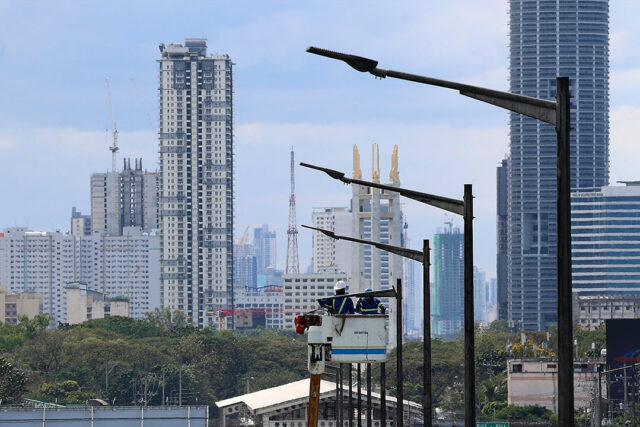
WORKERS are seen repairing streetlights along Commonwealth Avenue, Quezon CIty, Feb. 9, 2026. — PHILIPPINE STAR/MIGUEL DE GUZMAN

THE BANGKO SENTRAL ng Pilipinas’ (BSP) recent policy rate reductions may fall short in boosting the economy amid slow monetary policy transmission and persistent structural issues that hinder growth, GlobalSource Partners said.

In a commentary published late on Monday, GlobalSource Principal Advisor Diwa C. Guinigundo said the Philippine economy now needs structural reforms, stronger fiscal coordination and restored confidence beyond just an accommodative monetary policy.

“Despite substantial cumulative rate reductions, economic momentum has yet to respond decisively,” said Mr. Guinigundo, who was also a former deputy governor at the BSP.

“Private consumption remains soft, business confidence weak and tentative, and investment activity highly uneven.”

In 2025, the country’s gross domestic product (GDP) grew by 4.4% — the slowest since the pandemic — after GDP expanded by 3% in the fourth quarter.

This came amid the flood control corruption scandal, wherein some Public Works officials, lawmakers and private contractors allegedly received kickbacks from some infrastructure projects.

The scandal dampened consumer and business confidence, and dragged household consumption, investments and government spending.

This pushed the Philippine central bank to extend its easing cycle as it sought to spur domestic demand and boost the sluggish economy.

Last week, the BSP delivered its sixth straight 25-basis-point (bp) cut, marking the third one prompted by growth concerns from the flood mess. This brought the key policy rate to an over three-year low of 4.25%.

The BSP has now slashed benchmark borrowing costs by a cumulative 225 bps since it began easing in August 2024.

“The recent rate cut therefore reflects both accommodation and caution, a wake-up call to Malacañang and Congress. It signals support for the economy, while recognizing diminishing returns from further easing in the absence of complementary reforms,” Mr. Guinigundo said.

“Ultimately, sustainable growth will depend not only on calibrated monetary action but also on structural improvements, fiscal coordination, and renewed confidence in the broader economic environment.”

Mr. Guinigundo said the Monetary Board could have been more cautious by holding steady at its Feb. 19 meeting, especially as inflation is expected to rise until 2027.

“In addition, a pause could have been more circumspect: inflation forecasts for 2026 and 2027 during the last policy meeting of the Monetary Board were admitted to have escalated but not disclosed. This is indicative of mounting price pressures and upside risks, a call to a more calibrated monetary stance,” he added.

The BSP had said that it now sees headline inflation potentially breaching the midpoint of its 2%-4% target by the second half to average 3.6% this year, versus its 3.2% estimate previously.

It then expects inflation to ease to 3.2% in 2027, which is still a tad faster than its earlier projection of 3%.

REALITY OF MONETARY POLICY
Mr. Guinigundo also noted that the local banking sector has tightened its credit standards in response to the economic slowdown, even as the BSP has been accommodative for over a year.

This, he said, has created more lags in monetary policy transmission.

“Banks have acted pro-cyclically: even as the BSP adopted a substantially accommodative stance, many institutions tightened their credit standards, reflecting heightened risk aversion and balance sheet caution,” Mr. Guinigundo said. “Such tightening dampens loan growth precisely when credit support is most needed, muting the intended stimulus of lower policy rates.”

BSP data showed that bank lending growth was at a near-two-year low of 9.2% at end-December. December 2025 also marked the first time since April 2024 that bank lending grew at a single-digit pace.

“This dynamic underscores a central reality — monetary policy cannot compel risk-taking or override structural constraints,” Mr. Guinigundo said.

“Logistics inefficiencies, supply bottlenecks, regulatory uncertainty, and external vulnerabilities continue to weigh on growth. Interest rate adjustments alone cannot resolve these deeper impediments,” he added.

Following the Feb. 19 meeting, BSP Governor Eli M. Remolona, Jr. left the door open to supporting economic growth through monetary policy, provided that inflation remains in check as part of the central bank’s price stability mandate.

However, he noted that the policy path ahead is now less certain as he acknowledged that monetary policy easing may be insufficient to stimulate the economy.

Further support would have to come from the fiscal side, the central bank chief added.

Meanwhile, SM Investments Corp. Group Economist Robert Dan J. Roces said inflation will likely settle within the central bank’s target band until next year.

He added that the BSP “may or may not cut” further, with future policy decisions hinging on upcoming economic data.

“Well, the BSP already said that we’re nearing the end of the easing cycle. So, that says a lot,” Mr. Roces told reporters on the sidelines of the Makati Business Club 2026 Business-Government Forum on Tuesday held in Makati City.

“Because, I think with inflation managed and growth kind of recovering, the policy will matter more,” he added. “But again, it has to be measured. So, they will have to be more data-dependent.” — Katherine K. Chan with inputs from Vonn Andrei E. Villamiel


ASEAN to discuss unified stand on US tariffs

A 3D-printed miniature model depicting U.S. President Donald Trump depicting US flag and word “tariffs” in this illustration taken, April 17, 2025. — REUTERS

By Justine Irish D. Tabile, Senior Reporter

THE PHILIPPINES is eyeing to lead the regional discussions to come up with a unified stance on the US reciprocal tariffs through its Association of Southeast Asian Nations (ASEAN) chairship, the Department of Trade and Industry (DTI) said.

Trade Secretary Ma. Cristina A. Roque said that the US tariffs will be among the topics that the trade ministers will discuss next month.

The ASEAN senior economic ministers will hold a retreat in Manila on March 13.

“We haven’t spoken with the other members of ASEAN because for now we are really focused on the ASEAN chairship,” Ms. Roque told reporters on the sidelines of the ASEAN Editors and Economic Opinion Leaders Forum on Tuesday.

Over the weekend, US President Donald J. Trump announced that he will be imposing a new 15% duty on US imports starting Feb. 24.

However, Reuters reported on Tuesday that the US imposed an additional 10% tariff on all goods not covered by exemptions, citing a notice issued by US Customs and Border Protection said.

The Financial Times quoted a White House official saying the increase up to 15% would come later. Reuters could not immediately confirm this.

Mr. Trump’s new tariff policy comes after the US Supreme Court ruled that he had exceeded his authority when he imposed the reciprocal tariffs.

The ruling had invalidated the tariffs imposed by the Trump administration on China, Japan, South Korea, Taiwan and ASEAN economies. Most Philippine-made goods had faced a 19% US tariff.

Finance Secretary Frederick D. Go said that the Philippines is still in a good spot, despite the US tariff developments, as the country continues to dialogue with counterparts in the US.

“So, we continue to engage with them. As I always say, so far, the majority of our semiconductors are exempted, and the majority of our key agricultural exports are exempted,” he said on the sidelines of the event.

“So, I’d say we are in a good spot, but of course we will continue to engage with our counterparts there, which is the US Trade Representative,” he added.

Sought for comment, Philippine Exporters Confederation, Inc. President Sergio R. Ortiz-Luis, Jr. said that a collective response from ASEAN will be good not only for the Philippines but for the region as a whole. 

“That would be nice because that is where the collective call for exemptions on agricultural products and for the tariff on electronics to be put on hold,” he told BusinessWorld in a phone interview.

“If we can negotiate, regionally, the exemptions, that is also better. So, we should not stop talking to them,” he added.

However, Mr. Ortiz-Luis said that exporters are still in the dark about whether or not the new US tariff will be imposed on the Philippines.

While the country already agreed to a 19% reciprocal tariff, there was no final deal that was signed.

Reuters reported that Mr. Trump had earlier warned countries that if they backed away from signed trade deals with the US, they may be slapped with the higher duties.

“Some people are saying that those who agreed to tariffs higher than the 15%, which include us as we agreed to 19%, will not be covered by the 15% tariff,” he said.

“And on exemptions, it will be better if the exemptions are kept; so much the better, but nobody knows if Trump will remove the exemption,” he added.

If the exemptions are removed, especially on semiconductors and some electronic products, Mr. Ortiz-Luis said that electronics companies might move to other markets that are more competitive.

“At 10% we are still okay, but at 15%, we don’t already know what the supply chain will do. Until it is very clear, we should not stop talking with them,” he added.

Meanwhile, Ms. Roque said the talks with US counterparts have been continuous despite recent developments, but discussions on exemptions have not yet started.

“We have not spoken about that, but of course once there are changes, we will discuss, and then definitely we will give out a statement. But for now, we are just still in talks,” she said.

She said that the department is still hopeful of seeing $116 billion to $120 billion in total exports this year, aligned with the target set under the Philippine Development Plan.

Meanwhile, Mr. Go said that what the US reciprocal tariffs revealed is the need for the Philippines to find new markets.

“We have to create new markets for the Philippines to trade with, to sell to, which is why the activities being engaged in by the economic team and by DTI, like signing more and more economic partnership agreements and free trade agreements, are really important for our industries to be able to grow,” he added.

Qatar-based JTA eyes hotel, hospital, and tech city investments in Philippines

DENNIS H. UY’S proposed Silicon Valley-type Tech City will rise on a 117-hectare land between Mexico and Angeles, Pampanga. — FREEPIK

QATAR-BASED investment firm JTA International Investment Holding, which has subsidiaries in energy, tourism, and technology, is planning major projects in the Philippines, including a 60% stake in tycoon Dennis H. Uy’s $2-billion tech city project in Pampanga, two hotels in Cebu, and a tertiary hospital outside Metro Manila.

“We had a meeting with Mr. Dennis Uy last night, and they’re very interested to partner with JTA,” JTA Holding Philippines Country Representative Juan Vito C. Genson told reporters on the sidelines of a briefing on Tuesday.

The proposed Silicon Valley-type Tech City will rise on a 117-hectare land between Mexico and Angeles, Pampanga.

“If you ask the people from Dubai, they have Burj Khalifa, the tallest tower in the world. We want to have some unique projects in the Philippines, like the first tech city in Asia, or the tallest tower in Asia,” JTA Founder and Chief Executive Officer Amir Ali Salemi said during the briefing.

The holding firm is also considering investments in two five-star hotels in Cebu, valued at approximately $1 billion (about P57.81 billion).

These projects include a hotel with a condominium and resort development, and another hotel with a resort and casino.

It is additionally looking to invest about $300 million (P17.34 billion) in a tertiary hospital outside Metro Manila.

While the projects are estimated to have a total value of $3 billion, Mr. Salemi noted that all are still under negotiation and the amounts have yet to be finalized.

Former Philippine Chamber of Commerce and Industry President Enunina V. Mangio said JTA aims to start a project by the fourth quarter of 2026.

However, Mr. Salemi said the investment timeline would depend on how quickly JTA can secure local partners for the projects.

Other firms and state agencies have submitted potential projects to JTA, Ms. Mangio added.

Possible projects presented to JTA include an international port in Digos, Davao, Department of Energy solar energy projects, and a public-private partnership for an international airport in General Santos City.

“Those are the things that they’ve explored,” Ms. Mangio said. “They see some really positive possibility for their investment; they’re coming back any time in March.”

Despite ongoing macroeconomic risks, Mr. Salemi said the Philippines remains an attractive investment destination.

He cited a young and skilled workforce, improving infrastructure, and pro-business economic reforms.

“In the Middle East, we have many challenges, and we know how we can work and invest amid these challenges. So, we don’t have any problem to invest here,” Mr. Salemi said.

JTA has subsidiary companies in energy, civil, innovation and technology, tourism, transportation, health, and agriculture and food security. — Beatriz Marie D. Cruz

Maynilad profit rises 19% to P15.2B on tariff adjustments and stable billed connections

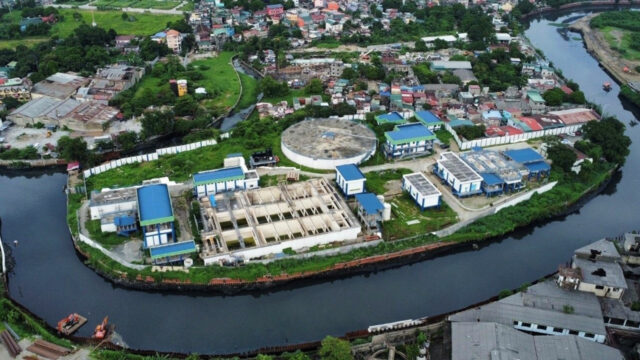
MAYNILAD’S SEWAGE treatment plant in Marulas, Valenzuela — MAYNILADWATER.COM.PH

MAYNILAD WATER Services, Inc. reported net income of P15.2 billion for 2025, up 19% from a year earlier, supported by higher revenues from increased tariffs and stable billed water connections.

Revenues rose 9.4% to P36.6 billion from P33.5 billion in the previous year, on the back of higher tariffs and stable billed connections, the company said in a statement on Tuesday. The company has yet to release its full report for the period.

Earnings before interest, taxes, depreciation, and amortization (EBITDA) increased 14.9% to P25.3 billion from P22 billion, with the margin improving to 69%.

Maynilad President and Chief Executive Officer Ramoncito S. Fernandez said that 2025 was the company’s best year, marked by strong consolidated financial performance and service improvements.

“We remain focused on disciplined capital allocation, operational efficiency, and long-term value creation while fulfilling our service obligations,” he said.

Mr. Fernandez said the water utility is relying on billed volume growth, higher tariffs, and continued efficiency efforts to support its operations this year.

Beyond financial performance, Maynilad is also focused on service, with non-revenue water (NRW) averaging 34.9%, a 5-percentage-point improvement from 2024. This enabled the recovery of approximately 256 million liters per day of water, according to the company.

NRW refers to water that is produced but not billed due to leaks, theft, or other losses.

Mr. Fernandez said during a briefing that the company plans to spend up to P6 billion a year until NRW reaches 20%, the international standard.

“Our business plan is directed towards achieving the level of 20%,” he said.

For 2026, the company has earmarked P30 billion for capital expenditure on water and wastewater projects.

Maynilad made its stock market debut in November last year, raising P34.34 billion from the offering — the second-largest initial public offering (IPO) in the Philippine Stock Exchange’s history.

While it has already raised capital, the company said that funding from the IPO is still insufficient to cover all planned spending.

“That’s how big our investment is in the concession,” Maynilad Chief Finance Officer Ricardo F. Delos Reyes said.

Maynilad serves as the primary provider of water and wastewater services in the West Zone, covering 11 cities in Metro Manila, three with partial coverage, as well as parts of Cavite province.

Shares in the company rose 5.31% to close at P21.80 apiece.

Metro Pacific Investments Corp., Maynilad’s majority shareholder, is one of three Philippine subsidiaries of Hong Kong-based First Pacific Co. Ltd., along with Philex Mining Corp. and PLDT Inc.

Hastings Holdings, Inc., a unit of MediaQuest Holdings, Inc., which is a subsidiary of the PLDT Beneficial Trust Fund, has an interest in BusinessWorld through the Philippine Star Group. — Sheldeen Joy Talavera

Exploring Filipino art in 5 exhibits

ANOTHER VIEW as We Travel Across (Wawa, 2025), 2025 by Nicole Tee.

COMING from a successful run at the recently concluded ALT ART festival, West Gallery has gone on to open five exhibitions simultaneously at its Quezon City space, continuing its exploration of Filipino art.

In one room, painted landscapes and collaged canvases hang together, presenting different facets of Carina Santos’ body of work. In another, the walls are adorned with postcards by 28 artists depicting varying sceneries to immerse in, curated by Nicole Tee, who in turn has her own exhibit where she makes use of thread to add texture to foliage in photos and recall the grandeur of nature.

Eunice Sanchez’s ink-on-canvas images speak to fragments of memory, of mental pictures taken during a search for meaning. Further into the gallery, one can find a mixed-media installation by Luigi Singson that evokes a feed of images of demarcated spaces.

SCAPES AND GAPS
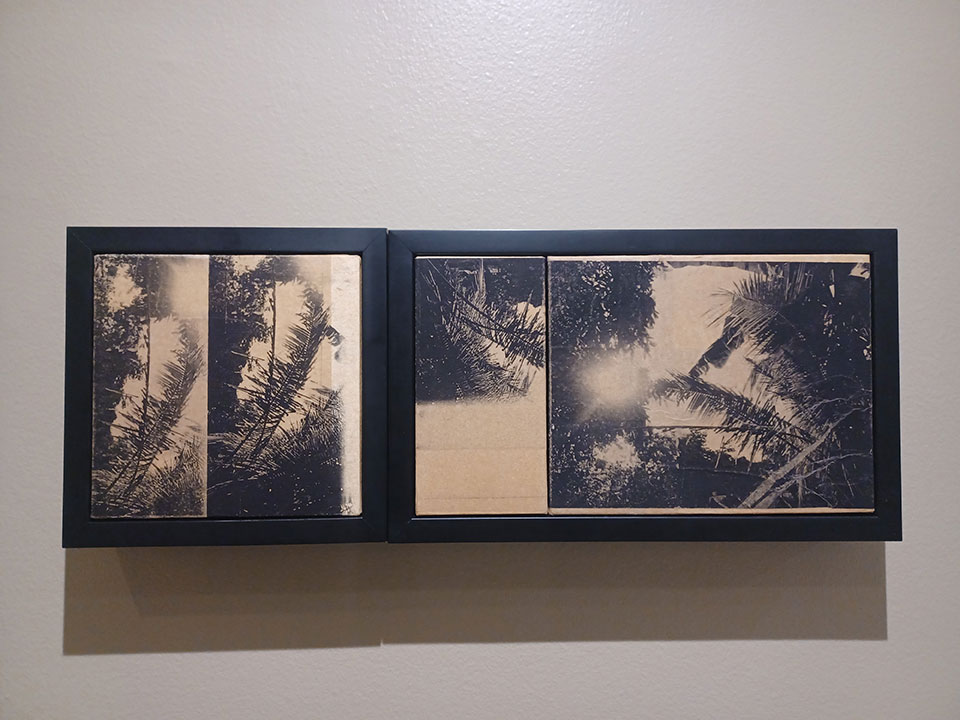
While Nicole Tee’s exhibition, to feel small, harkens to the immensity of nature, and the detail in her work can be quite grounding. With thread and photo transfer on linen, the textures become a striking highlight, inspired by rock climbing trips and hikes to and from crags.

The scenes portrayed appear animated in a way, with green thread mimicking thick foliage amid the imposing character of rock. Tactile to the eyes, the works draw viewers to step closer.

Meanwhile, Eunice Sanchez’s landscapes in Coming To This stand out in a disjointed, fragmented manner, more non-linear as a recollection of the artist’s journey.

The works were the result of when Ms. Sanchez fed her curiosity about the apparition of a “dancing sun” that her mother — then pregnant with her — saw in Agoo, La Union, in 1993. In 2023, she decided to climb the same hill.

“To put it simply, the body of work is my way of mapping out the experience,” she told BusinessWorld in a message. “I think after reaching the space, and after feeling the nothingness, that’s when I decided I want it to become a show.”

Around two years later, the memories of the trip were fully manifested, the forests and the ascent depicted in monochrome tones using ink and mulberry, some on canvas and some on Fabriano paper. A few of the works have red and white thread stitched through them, hinting at the gaps in time, space, and memory.

Such gaps are bridged in Wish You Were Here, a curatorial project by Ms. Tee, where 28 participating artists contributed postcards showing various landscapes.

For these artists, coming from different generations and different places, the postcards represent an age-old way of keeping in touch, of transporting someone into your own inner world. At West Gallery, they provide a fun sense of community, mapping out an experience of exploration across artistic perspectives.

In collaboration with the West Gallery Shop, the postcards can be purchased on their own as pieces, or as facsimiles to be kept or shared.

MORE MIXED-MEDIA
Carina Santos has been developing her “pour paintings” for a long time, utilizing abstractions in shape and texture to convey shifting environments.

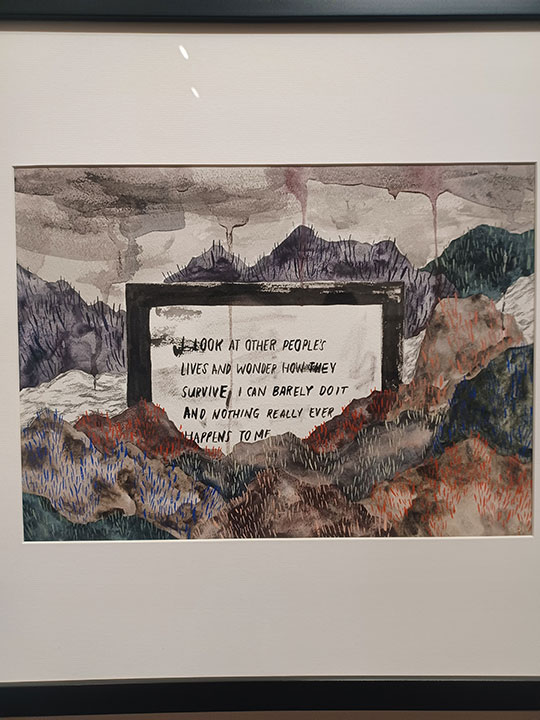
Other Versions offers context to her work. Viewers can see her paintings alongside other modes, like collaged offcuts of canvases, long knitted textiles, and watercolor landscapes that incorporate billboards and signage.

“Sewing, knitting, and illustration often sit on a different tier to more so-called ‘serious’ pursuits of art,” she explains in her artist’s statement. “By showing these pieces alongside one another, the hope is that there is added contextual richness to my body of work, but more importantly, a leveling out of what art is or isn’t, what it can or cannot be.”

In Squared Lives by Luigi Singson, there is a similar presentation of varying images, this time through a single, mixed-media installation.

The vertical rectangular structure contains vistas of high-rise and densely populated districts, juxtaposed with scenes of indoor spaces, inviting viewers to reflect on the confines of an urbanized and digitalized society. Compounding this is the bottom half of the installation, seemingly held up by Jenga-like bricks.

“My view of the city is that everyone tries to get away with something, little by little. It’s still standing, but once the last brick is removed, everything could fall down. I incorporate that a lot in my works,” Mr. Singson told BusinessWorld at the exhibit’s opening.

“Social media is how we go about our connections, so that’s why the format of squares is a lot like what you see when you scroll through your feed,” he added.

As for the plaster squares, appearing a bit like stained-glass windows, they are “pieces of way-finding, like a map or guide when going to physical places.” Half-hidden on the floor inside the installation is a piece of debris from the demolished Capitol Theater in Escolta, again speaking to the tensions in an urban, individualized society.

“I think, like many artists, wala ka munang idea sa kung anong ilalagay mo (you initially have no idea what to put in),” said Mr. Singson, on the process of putting together a work. “In the end, mapapag-connect mo naman lahat (you’re able to connect everything).”

The exhibits Wish You Were Here, Coming To This, to feel small, Squared Lives, and Other Versions are on view until March 21 at West Gallery, located at 48 West Ave., Quezon City. — Brontë H. Lacsamana

An enthralling stage adaptation of a film

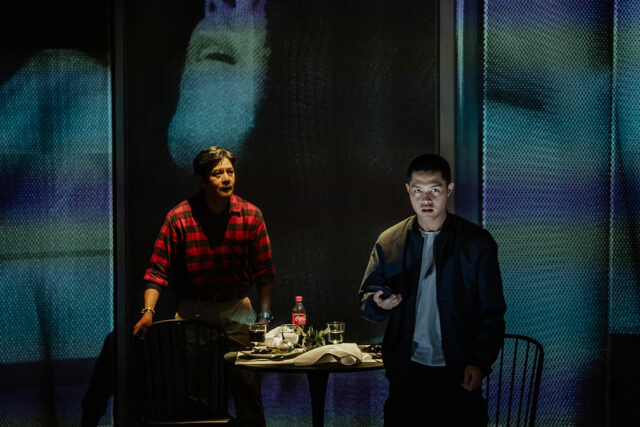
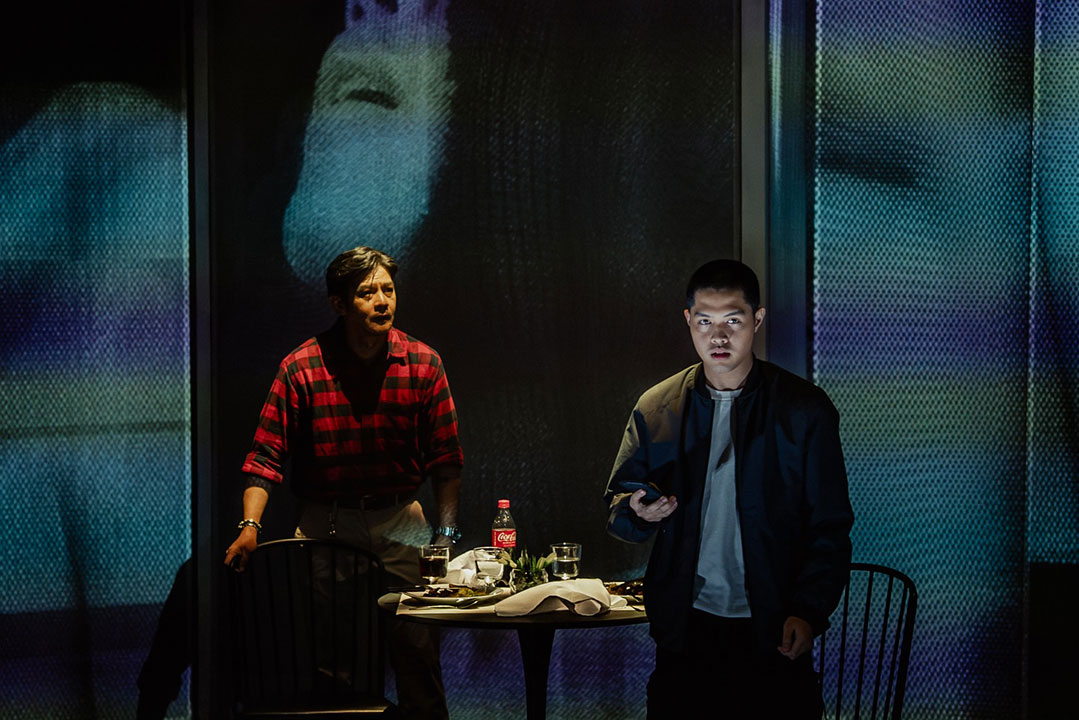
ROMNICK SARMENTA (left) and Elijah Canlas in About Us But Not About Us.

How to expound on toxic relationship dynamics

By Brontë H. Lacsamana, Reporter

Theater Review
About Us But Not About Us
Directed by Tuxqs Rutaquio
Presented by IdeaFirst Live!

IN 2023, a tense, thrilling drama consisting of two men talking in a restaurant took the first (and only) Summer Metro Manila Film Festival by storm. Eventually, the movie found its way onto Prime Video, and now it has gradually gained attention through its stage adaptation.

About Us But Not About Us, written and directed by Jun Robles Lana, is a film that keeps the audience at the edge of their seats as Romnick Sarmenta and Elijah Canlas act their butts off. They earned much praise in their roles as a literature professor and his student, slowly revealing their secrets over the course of a lunch conversation, and IdeaFirst Live!’s reshaping of the narrative for the stage allows the same two actors to do that again — and more.

At first, it seems Tuxqs Rutaquio directs the stage version to play out just like the film, which is mainly powered by the two leads’ emotionally complex performances. Sarmenta’s Eric displays sophisticated charm and kindness, which mask the burden of unresolved conflicts, while Canlas’ Lance embodies the youthful restlessness that makes him an intriguing (and later volatile) force.

Setting the play apart is the set design, with the texture of crumpled paper serving as a backdrop and referencing stories and literature as the anchoring point of the characters, and translucent sliding doors that allow you to see behind them. Their use is particularly potent during flashbacks, the main addition to the play that the film does not have.

In those flashbacks is a deceased character, acclaimed novelist and Eric’s husband Marcus, who only haunted the film’s narrative. Onstage he is given life by an actor, played alternately by Epy Quizon and Andoy Ranay. The show that BusinessWorld got to watch had Ranay in the role, and he was superb as he inhabited all the dramatic and comedic tics of an older, often-disdainful, seasoned writer and professor.

It is in this character that one can make the case for the play being superior to the film, as it adds depth to the relationship dynamics, now fully reflecting the flaws of all three men instead of just two. Ranoy’s performance leaves no room for imagination, as he’s able to make you laugh, cry, fear for the other characters, or feel pity for what he goes through. Every line lands well, and his demeanor and physicality match that of the haughty mentor (to Lance) and older partner (to Eric), which make for essential power-play dynamics, so it’s interesting to wonder how Quizon’s take might be different.

The standout scene in terms of acting is a particularly harrowing one between Eric and Marcus, which Sarmenta and Ranay execute perfectly. It starts out as an impassioned argument between a married couple and devolves into one of the most painful mudslinging of unspoken truths ever put to stage. It’s the type of scene that has audiences holding their breath as everything unfolds, especially for those who have experienced strained, long-term toxic relationships firsthand.

With that said, About Us But Not About Us (both the film and play) truly shines in the twists and turns that come as the initial teacher and student unravel threads of the past in their conversation. What I liked about the film is that it left a lot to your imagination, with Sarmenta and Canlas mimicking, and sometimes outright transforming into, the “ghost” character of Marcus through their acting. Seeing an actor like Ranay actually play the character onstage removes that unique thrill, but adds a striking emotional layer.

Robles Lana’s story is exciting in either form, tackling notions of trauma, fidelity, ambition, and legacy head-on, with gay characters right at the center. By retaining the film’s pandemic timeframe, the reality of social distancing adds another barrier in the story that works for it quite well. Even the choice of having the play run for an hour and 45 minutes without an intermission elevates the work, as it leaves no room for the tension to let up, except for a few silent or comedic moments.

Ultimately, Sarmenta and Canlas did a great job revisiting their roles and building on the chemistry they established onscreen four years ago. The addition of Ranay (or Quizon) fleshes out the intricate web of lies and insecurities even more. Perhaps my only advice for anyone going into this would be to get good seats — center allows you to see all of the actors’ faces clearly, and the closer the better so you can catch their micro-expressions. This would be the limitation of theater as compared to film. These guys act so well, but there are no close-ups here.

While it’s executed entirely in English (whereas the film uses Taglish), both versions fall into the same curious idiosyncrasies. Its glimpse into the self-important literature scene in the Philippines comes across as exaggerated for the sake of the narrative, and its look into the traumas of each character make the tumble down the abyss of their unending secrets and mistakes a bit too bleak. These people and their disconnection from the real world are maddening in parts, but it is perhaps the only way this story will work, by isolating them in their own little bubble of toxic power dynamics.

About Us But Not About Us remains one of the most thrilling, nuanced portrayals of queer love in the Philippines. It has an abundance of twists, turns, and thrills, seemingly to no end, but it successfully tells hard truths about human connection and its lasting scars through a visceral theater experience.

About Us But Not About Us runs until March 8 at Power Mac Center’s Spotlight Blackbox Theater in Ayala Malls Circuit, Makati. Tickets are available via Ticket2Me.

Unicapital lowers PSEi year-end forecast to 6,800 on slower infrastructure spending and corruption

PHILIPPINE STAR/KRIZ JOHN ROSALES

LOCAL brokerage Unicapital Securities, Inc. has lowered its year-end forecast for the Philippine Stock Exchange index (PSEi) to 6,800 from 7,100, citing slower infrastructure spending and a corruption scandal.

Research Head Wendy B. Estacio-Cruz said during a briefing on Tuesday that the PSEi target was lowered because the forecast assumes 10% growth in the earnings of listed companies, while stock valuations have fallen to around 10.5 times earnings from the previous 12 times.

“The factors that really dragged it were, number one, the corruption scandal. So, we still think that this infrastructure spending will take time to recover and probably might see some impact on the second half of the year,” she said.

Philippine government spending on infrastructure fell for a fifth straight month in November, highlighting how a widening corruption investigation has weighed on public works implementation and fiscal momentum.

State disbursements for infrastructure and other capital outlays dropped 45.2% to P48 billion from a year earlier, according to data released by the Department of Budget and Management (DBM) on Jan. 31. Spending also declined 27.2% from October.

“The next one is monetary policy. We’re seeing a pause after the 25 basis points (bps), but that’s our house view,” Ms. Cruz noted. “We’re seeing a pause for at least two more meetings, and probably we’ll see another 25 bps fade away in the latter part of the year.”

And then last is the geopolitical tensions and U.S. tariffs,” she added.

Despite this, Unicapital Securities maintained an optimistic outlook on the market’s resilience and gradual recovery.

“Our strategy for 2026 is defensive yet opportunistic,” Ms. Cruz said. “We are prioritizing balance sheet strength and earnings visibility while maintaining selective exposure to structural growth themes. This allows investors to remain resilient while participating in the country’s medium-term recovery.”

Ms. Cruz noted that despite recent moderate growth, the country’s macroeconomic foundation remains solid, entering 2026 with fiscal support and measured monetary accommodation to bolster domestic demand.

“So for this year, we’re expecting the PSEi to re-rate to 10.5x price-to-earnings and that translates to around 6,800, assuming 10% growth in earnings per share (EPS),” she said.

Ms. Cruz added that further Bangko Sentral ng Pilipinas (BSP) policy rate cuts anticipated in 2026 should spur earnings growth by reducing funding costs and bolstering household spending, particularly in consumer-facing and interest-rate-sensitive sectors.

“So there is a lot of transparency and monitoring as well as some auditing for this year in order to make sure that the funds are really allocated to or designated to the government’s projects. So, aside from the infrastructure spending, we think that monetary policy of the BSP will be the key driver or catalyst for our economic recovery,” she said.

The BSP’s policy-setting Monetary Board slashed benchmark borrowing costs by 25 bps for a sixth straight meeting, bringing its key rate to an over three-year low of 4.25%.

It has now reduced interest rates by a total of 225 bps since the easing cycle began in August 2024.

BSP Governor Eli M. Remolona, Jr. said in his earlier statement that future easing will largely depend on how quickly confidence recovers, as weak sentiment has affected demand and widened the output gap.

“We’re now in a situation where it’s more conditional on what happens to confidence and growth,” he said in a briefing.

Unicapital Securities forecasts 5.2% gross domestic product growth in 2026, driven by resumed public infrastructure spending, improved policy execution, and governance reforms aimed at restoring investor confidence.

Key downside risks remain, including a sustained high-interest-rate environment and escalating geopolitical tensions, which could dampen investor risk appetite and disrupt global trade and supply chains, according to Unicapital Securities.

Ms. Cruz said that greater policy clarity and consistent execution will be essential for sustaining market confidence in 2026.

She noted that with infrastructure momentum returning and macroeconomic conditions stabilizing, the Philippines is well-positioned to strengthen its fundamentals and support the next phase of long-term growth.

On Tuesday, the main PSE index rose 0.91% or 59.47 points to 6,547.98, while the broader all shares index went up 0.63% or 22.86 points to 3,614.47. — Alexandria Grace C. Magno

Treasury raises P35 billion via dual-tenor bonds

BW FILE PHOTO

THE GOVERNMENT fully awarded the dual-tenor Treasury bonds (T-bonds) it offered on Tuesday as the issues fetched mixed yields, with escalating tensions between the United States and Iran reducing appetite for longer-dated securities.

The Bureau of the Treasury (BTr) raised a combined P35 billion via its dual-tranche T-bond offer, within its goal to raise up to P40 billion through the auction, as total bids for both tenors reached P66.717 billion.

Broken down, the Treasury borrowed the programmed P25 billion via the reissued seven-year bonds, with total bids reaching P46.256 billion, almost double the amount on offer.

This brought the total outstanding volume for the bond series to P365.6 billion.

The bonds, which have a remaining life of two years and five months, were awarded at an average rate of 5.296%. Accepted yields ranged from 5.265% to 5.308%.

The average rate of the reissued papers was down by 2.8 basis points (bps) from the 5.324% fetched for the series’ last award on Jan. 27, but was 154.6 bps above the 3.75% coupon for the issue.

This also matched the yield fetched for the same bond series at the secondary market before Tuesday’s auction but was 5.5 bps lower than the 5.351% quoted for the three-year bond, the benchmark tenor closest to the remaining life of the issue, based on PHP Bloomberg Valuation Service (BVAL) Reference Rates data provided by the BTr.

Meanwhile, the government raised P10 billion as planned from the reissued 25-year T-bonds it auctioned off as total bids for the tenor reached P20.191 billion.

This brought the outstanding volume for the series to P115.1 billion.

The notes, which have a remaining life of 23 years and 11 months, were awarded at an average rate of 6.577%. Accepted yields ranged from 6.5% to 6.6%.

The average rate of the issue rose by 6.7 bps from the 6.51% fetched for the series’ last award on Oct. 21, 2025 and was also 20.2 bps above its 6.375% coupon.

This was likewise 7.7 bps higher than the 6.5% seen for the same bond series but 0.5 bp below the 6.582% quoted for the 25-year bond at the secondary market before Tuesday’s auction, PHP BVAL Reference Rates data showed.

The 25-year bonds fetched higher yields as players are hesitant about locking in their cash in longer tenors due to growing tensions between the US and Iran, Rizal Commercial Banking Corp. Chief Economist Michael L. Ricafort said in a Viber message.

Iran and the US will hold a third round of nuclear talks on Thursday in Geneva, Oman’s Foreign Minister Badr Albusaidi said on Sunday, Reuters reported.

The United States wants Iran to give up its nuclear program, but Iran has adamantly refused, and denied it is trying to develop an atomic weapon.

The State Department is pulling out non-essential government personnel and their families from the US embassy in Beirut, a senior State Department official said on Monday, amid growing concerns about the risk of a military conflict with Iran. US President Donald J. Trump said in a social media post on Monday that it would be a “very bad day” for Iran if it does not make a deal.

“The BTr did not award up to P40 billion, which means they are not looking aggressive in awarding bids, especially with the recent successful benchmark issuance and rate cut,” a trader said in a text message.

The government raised a total of P297.94 billion from its offering of new 10-year fixed-rate Treasury notes (FXTN), made up of P235 billion in new money and P62.94 billion via the switch program, the BTr said on Friday. This was well above the initial P30-billion offer. The benchmark bonds fetched a coupon rate of 5.925%.

Meanwhile, the BSP’s policy-setting Monetary Board lowered benchmark interest rates by 25 bps for a sixth straight meeting to bring the policy rate to 4.25%. This brought total reductions since August 2024 to 225 bps.

BSP Governor Eli M. Remolona, Jr. said future easing will largely depend on how soon confidence will recover, as weak sentiment has affected demand, making the output gap bigger.

On Friday, he said that with inflation under control, they have room to help stimulate domestic demand, although they face a “large element of uncertainty.”

Tuesday’s auction was the last for the month. The government raised P553.24 billion from the domestic market in February, above the P308-billion plan, as it increased its awards at all its Treasury bill (T-bill) auctions and with the new FXTNs leading to above-program bond issuances.

For March, the BTr is targeting to raise P248 billion from the domestic market, or P108 billion in T-bills and P140 billion in T-bonds.

The government borrows from local and foreign sources to help fund its budget deficit, which is capped at P1.647 trillion or 5.3% of gross domestic product this year. — Aaron Michael C. Sy with Reuters

Arts & Culture (02/25/26)


Rock opera ballet Tales of the Manuvu returns

ALICE REYES Dance Philippines (ARDP), in collaboration with the University of the Philippines (UP), the National Commission for Culture and the Arts, and the Cultural Center of the Philippines, will be restaging Tales of the Manuvu this month and next. Premiered in 1977, this production is the first Filipino rock opera ballet, weaving indigenous mythology with rock and pop music. There will be performances at the University Theater, UP Diliman, on Feb. 27 and 28, followed by a limited run at the Proscenium Theater in Rockwell, Makati, on March 28 and 29. It was born from the creative synergy of legendary Filipino artists: National Artist Alice Reyes’ direction and choreography; National Artist Bienvenido Lumbera’s libretto; and OPM icon Dero Pedero’s score, with additional music by the rock band Afterbirth. Admission to the UP performances are free, though registration is required via Eventbrite: https://www.eventbrite.com/e/tales-of-the-manuvu-tickets-198241577896. The Proscenium shows have different price ranges: P2,500 to P5,000 for the March 28 fundraising gala; and P1,800 to P3,000 for the regular performance on March 29.


Roderick Hall Memorial Lecture features Marie Silva Vallejo

THE AUTHOR of Beyond Dauntless: The Continuing Fight, Marie Silva Vallejo, will be shedding new light on her World War II-set story in a lecture this March. The book follows the courageous service of the 1st and 2nd Filipino Infantry Regiments, US Army, and the clandestine 1st Reconnaissance Battalion, whose covert submarine insertions, intelligence work, and coordination with Filipino guerrilla fighters fortified resistance efforts across the islands and proved instrumental in enabling the Allied forces’ decisive return and ultimate victory in the Philippines. The lecture will take place on March 7, from 4 to 6 p.m., at the Ayala Museum. Regular tickets cost P300, while the prices for seniors/PWD and students are P210 and P150, respectively.


Silverlens holds Villa, Aguinaldo, and Sabado exhibits

ONGOING at Silverlens are two new exhibitions: the late Carlos Villa’s Lying + Flying, and Raised by Mountains, a two-man exhibition by Leonardo Aguinaldo and John Frank Sabado. Lying + Flying features 1980s-era body prints on large, unstretched canvas paintings that make the artist’s body both subject and instrument. Through it, years after his death, Villa still stands in the room. In Raised by Mountains, the artists examine what it is like being raised in the mountains through portraits. For Sabado, the subjects are people who have shaped his sense of communality from childhood. For Aguinaldo, the figures are situated in a changing world and the way they would like to be seen in it. Both artists situate their practice around cultural migrations within the Cordillera Region and its neighbors, both finding origins in the Baguio Arts Guild. The two exhibits run until March 28 at the Silverlens Gallery, 2263 Don Chino Roces Ave. Ext., Makati City.


FEU Theater Guild’s BANGAW opens in March

AS PART of its 92nd Season, the FEU Theater Guild shall present BANGAW, a reimagination of William Golding’s Lord of the Flies, beginning March 5. Written by Gold Villar-Lim, with music by Vince Lim, and directed by PETA Senior Artist-Teacher and FTG Artistic Director Dudz Teraña, the production explores the meaning of survival through a distinctly Filipino lens. It will run at the FEU Center for the Arts Studio from March 5 to April 25, with performances at 6:30 p.m. Ticket prices are P100 for FEU students, P200 for students from outside FEU, P500 for regular guests, and P700 for VIP guests.


Material Instincts opens at The M

THE EXHIBITION Material Instincts, ongoing at the Metropolitan Museum of Manila, aims to expand the conversation on contemporary painting through a focused exploration of materiality and process. Curated by Bambina Olivares, the exhibition brings together the works of Olivia d’Aboville, Marionne Contreras, Monica Delgado, and Michelle Pérez. United by their distinct approaches to abstraction, the four Filipino artists examine the meaning and possibilities of painting through their deft manipulation of chosen media, ranging from textile to yarn and cloth to paint. It is on view until April 30 at the Metropolitan Museum of Manila, BGC, Taguig.


Gab Pangilinan is Mary Magdalene in touring show

THE OLIVIER Award-winning production of Tim Rice and Andrew Lloyd Webber’s celebrated musical Jesus Christ Superstar, which will visit Manila at The Theatre at Solaire from May 2 to 31 for its international tour, has announced that its cast will include Manila-based Filipina actress and singer Gab Pangilinan in the role of Mary Magdalene. She will be joining the principal cast members from previous UK, North America, and Australian tours of the production, including Luke Street (Jesus), Javon King (Judas), Ethan Hardy Benson (Pilate), Grant Hodges (Caiaphas), and Kodiak Thompson (Annas).

Population decline: Greatest threat to humanity

STOCK PHOTO | Image by Pressfoto from Freepik

(Part 3)

The Philippines is well positioned to avoid the worst consequences of population decline and ageing.  It is still a young country today with a median age of 26. Together with many African countries and almost alone in the Indo-Pacific region, it is enjoying a demographic dividend, which is rapidly narrowing in its ASEAN neighbors, Indonesia and Vietnam. It has to make sure that ageing is contained in the next two decades by preventing fertility from dropping to levels much below the 2.1 babies per fertile woman. Current fertility today is around 1.9 to two babies per woman, already slightly below replacement. To avoid the “ageing before becoming rich” trap — which has already ensnared both Thailand and China — the Philippines needs a proactive demographic and economic strategy.

Some obvious economic strategies that can encourage married couples to have at least three children each are enumerated below:

• Because the traditional desire for children is inherent to a Catholic culture, married couples at the lower-income levels should be granted financial support for every child born. These financial incentives can take several forms. They can actually involve direct cash payments for every child born or there can be subsidies for the hospitalization and the initial feeding of the infants for the first 1,000 days of their existence as has already been implemented successfully in the province of Quezon and elsewhere.

• The Government should actively promote partnership with the private sector in the socialized housing program mandated by law. Affordable housing is key to family formation. The law should be strictly enforced, especially in regions where there is a significant increase in job opportunities because of the proliferation of industrial zones, as in the case of Southern Tagalog and Central Luzon. Childcare facilities should be subsidized in these regions that are densely populated like export-processing zones and other industrial areas that are increasingly attracting factories that sell to the domestic market. Tax credits or subsidies for each child should be offered, following the examples of France and Singapore.

• All birth control messaging, especially from the State, should stop. What should be promoted is a family-friendly culture rather than excessive population control messaging. In fact, as is already happening in China, artificial contraceptives should be heavily taxed. The goal (which should be part of the AmBisyon 2040 vision) is to make it economically and socially easier (maginhawa) to raise two to three children.

As population growth slows, there should be serious efforts to support the productivity increase of human resources. Among educational reforms should be greater emphasis on the STEM track in basic education, the promotion of digital literacy, and a shift to technical or vocation training away from purely academic programs in college. Both public and private resources should be mobilized to promote nutrition and health among children, especially in early childhood to prevent stunting and malnutrition. Filipino students perform poorly in international achievement tests because a good number of them have had their brains damage in early childhood because of undernourishment and malnutrition. There should be continuing efforts to upskill, reskill, or retool the teachers in basic education, especially in digital learning tools.

On a personal note, at the age of 87, I can state with all humility that I am still as productive as an educator as when I started teaching at the age of 18. My mother, who lived up to 102, continued to provide her children, grandchildren, and great-grandchildren, with a very attractive home environment. Not all those who are ageing must stop working. We should gradually raise the retirement age (now 60 for the private sector and 65 for government). We should encourage part-time or flexible work for seniors, especially equipping them with all the digital tools to do much of their intellectual and professional work online. Manual workers should be provided by the TESDA-supervised schools with opportunities for reskilling and upskilling. In consonance with Filipino culture, we should promote community-based elderly care rather than the institutional care that is prevalent in Western societies. We should take a close look at Japan’s model of “active ageing.”

As we face more and more labor shortages in the future, we should invest more in the technology of what is called the Industrial Revolution 4.0 (Artificial Intelligence, Robotics, Internet of Things and Data Analytics). These are especially useful in increasing the productivity of service workers who account for 60% of our labor force and in which productivity has been the lowest. Many household chores, in which a large part of our service workers has been employed, can be replaced by robots. The same can be said of those in the hospitality sector, except for those at the forefront where humans still are desirable (especially with the soft skills of Filipinos).

The Philippines (together with India) will continue to have a competitive advantage in the BPO-IT sector even as the industry migrates to more knowledge-intensive work such as animation, legal documentation, and medical transcription as call centers are increasingly operated by AI. It is encouraging to see industry associations related to these sectors invest in the upskilling, reskilling, and retooling of their workers so that they can migrate to more knowledge-intensive work.

The ageing problem will victimize most intensely the highly developed industrial countries like Japan, South Korea, Italy, Spain, and Germany. Thus there will continue to be a high demand for Filipino service workers like caregivers, nurses, hospitality workers, IT personnel, and teachers. Philippine service workers will continue to be in great demand abroad. It is highly unlikely that we can completely stop the so-called brain drain, i.e., Filipinos becoming overseas workers. One way of mitigating the impact of the outward migration of Filipinos is to create incentives for the return of OFWs through tax breaks and the support of local business. There should be a policy to encourage temporary rather than permanent migration. There should be a continuing effort to match our educational programs with the demands of the domestic market.

There is an urgent need to strengthen pension and health systems as early as possible. Before our elderly population explodes, there should already be efforts to reform and expand PhilHealth and universal healthcare coverage. Both SSS and GSIS should  also be reformed to ensure long-term solvency. Promote the development of private pension plans and encourage savings for retirement.

The Department of Economy, Planning, and Development (DEPDev) and the Philippine Statistics Authority (PSA) should regularly monitor and plan for fertility trends, ageing rates, and labor force projections. The data should be linked to AmBisyon Natin 2040, which envisions a “matatag, maginhawa, at panatag na buhay para sa lahat (stable, comfortable, and secure life for all).”

(To be continued.)


Bernardo M. Villegas has a Ph.D. in Economics from Harvard, is professor emeritus at the University of Asia and the Pacific, and a visiting professor at the IESE Business School in Barcelona, Spain. He was a member of the 1986 Constitutional Commission.

bernardo.villegas@uap.asia

Peso slides vs dollar on fresh tariff concerns

PHILIPPINE STAR/WALTER BOLLOZOS

THE PESO weakened versus the dollar on Tuesday after US President Donald J. Trump imposed temporary tariffs after the US Supreme Court struck down his “reciprocal” levies, bringing renewed uncertainty to markets.

The local unit fell by 18 centavos to close at P57.755 against the greenback from its P57.575 finish on Monday, data from the Bankers Association of the Philippines showed.

The currency opened Tuesday’s trading session weaker at P57.66 per dollar. Its intraday high was at P57.645, while its weakest showing was at P57.82 versus the greenback.

Dollars traded went down to $1.358 billion from $1.716 billion on Monday.

“The dollar-peso traded higher on risk-off sentiment after President Trump reimposed tariffs on trading partners despite the US Supreme Court ruling and amid market caution ahead of Trump’s state of the nation address as players expect him to comment on Iran and tariffs,” a trader said by phone.

The peso was also dragged by higher global crude oil prices on Wednesday due to heightening tensions between the US and Iran, Rizal Commercial Banking Corp. Chief Economist Michael L. Ricafort said in a Viber message.

For Wednesday, the trader sees the peso moving between P57.50 and P57.85 per dollar, while Mr. Ricafort expects it to range from P57.65 to P57.90.

The yen weakened on Tuesday as markets weighed the fallout on global trade from renewed turbulence over Mr. Trump’s tariff regime, Reuters reported.

The dollar clawed back losses as China and Japan reopened following holidays and Mr. Trump warned countries against retreating from recent trade deals after the Supreme Court struck down his emergency tariffs.

Washington’s latest tariff threats are clouding the outlook for global trade. The Supreme Court ruled on Friday that Trump’s use of a 1977 emergency law to impose tariffs exceeded his authority, but hours later the president invoked a different law and imposed a new levy on all imports.

The yen weakened 0.3% to ¥155.05 per dollar. The dollar index, which measures the greenback against a basket of currencies, rose 0.12% to 97.81.

The euro barely budged, down just 0.04% at $1.1779, while sterling was little changed at $1.3486.

Mr. Trump said on Saturday he would raise a temporary tariff from 10% to 15% on US imports from all countries, the maximum level allowed under the law. On Monday, he took to social media to say that countries that “play games” in the wake of the Supreme Court’s ruling would be hit with even higher duties.

Traders are also focused on rising geopolitical tensions.

The State Department is pulling out non-essential government personnel and their eligible family members from the US embassy in Beirut, a senior State Department official said on Monday, amid growing concerns about the risk of a military conflict with Iran — A.M.C. Sy with Reuters

Tollways, airports, and data centers could shape next REITs, analysts say

FROM LEFT: Arjay L. Balinbin, corporate and property editor, BusinessWorld; John Tristan Guillermo D. Reyes, president/director, BDO Securities Corp.; Jesus Mariano P. Ocampo, president and chief operating officer, Investment & Capital Corp. of the Philippines; Japhet O. Tantiangco, research manager, Philstocks Financial, Inc.; and Alessandra Araullo, chief investment officer, ATRAM Group. — PHILIPPINE STAR/RUSSELL PALMA

TOLLWAYS, airports, and data centers could shape the next generation of real estate investment trusts (REITs) in the Philippines, analysts said, as the Securities and Exchange Commission (SEC) has broadened eligible assets beyond traditional properties.

“If you’re going to look at the expanded definition of REIT-able assets, if there’s one thing that it does is it makes the REITs become a better representative of the general economy,” Philstocks Financial, Inc. Research Manager Japhet Louis O. Tantiangco said during a panel discussion at the BusinessWorld Insights Stock Market Outlook 2026 on Feb. 23.

“With the expanded definition, we will have more REITs available which represent different industries, so it’s a better representation of the general economy. And with this, investors will have more options to choose from,” he added.

SEC Memorandum Circular (MC) No. 1, Series of 2026, clarifies that income-generating real estate now includes assets with regular or predictable cash flows such as leases, rentals, tolls, user fees, ticket sales, parking, and storage fees. Covered assets include toll roads, railways, airports, ports, information and communications technology and energy infrastructure, data centers, parking facilities, malls, warehouses, fixtures, and real rights such as usufructs, easements, and leases.

“I think over time you will see new REITs coming up that are more infra-themed rather than traditional-themed property REITs,” said Jesus Mariano P. Ocampo, president and chief operating officer of Investment & Capital Corp. of the Philippines (ICCP).

“We’re very happy that the Securities and Exchange Commission recognized this by specifically stating tollways as maybe a new REIT class to come out,” he added.

The SEC said the amendments are aligned with the objectives of the REIT Act by expanding eligible income-generating assets and allowing unlisted special purpose vehicles (SPVs) and incorporated joint ventures (JVs), consistent with global practices.

Alessandra P. Araullo, chief investment officer at ATRAM Trust Corp., highlighted the two key changes — the wider range of eligible REIT assets and a two-year reinvestment window — as providing a larger pool of potential deals and supporting an asset-light model for developers.

“[The two major changes] I think are very favorable in the sense that sponsors are not rushed to deploy just for the sake of meeting that deadline. And really for investors, the combined effect is both a larger pipeline of potential REIT assets and also better-quality injunctions,” Ms. Araullo said.

“And I think in the end it makes for a structurally stronger development model for the asset-light approach that a lot of the integrated developers have been moving towards,” she added.

The SEC extended the reinvestment period for REIT sponsors or promoters to two years from one, starting from the receipt of proceeds from the sale of REIT shares or income-generating real estate. Reinvestment options include equity investments, loans, debt purchases, or repayments related to real estate or infrastructure projects in the Philippines.

REITs investing through unlisted SPVs or JVs must ensure these entities distribute at least 90% of distributable income to the REIT and other shareholders before the REIT pays dividends. Noncompliance constitutes a breach of the REIT’s 90% dividend payout requirement.

John Tristan Guillermo D. Reyes, president of BDO Securities Corp., explained the implications from both the issuer’s and the sponsor’s perspective.

“It would allow the sponsor more options for capital recycling. And on the investor’s part, aside from generating yields from the traditional assets like malls, offices, you have infra, data centers that would diversify the revenue stream and would support dividend growth over the long term,” he said.

Analysts identified tollways as prime candidates for quick adoption of the expanded definitions, citing reliable daily toll revenues. Airports and seaports could follow.

“Tollways would be natural. But maybe I’ll also mention airports, seaports with the new concessions granted by the government,” Mr. Ocampo said.

“Maybe the government should [also] consider, the concession grantees should look at the options of going public as one of the reasons. If you’re wanting to promote new issuers to come to market, maybe that could be something to consider,” he added.

“Because concessions grant a particular group, for lack of a better term, a monopoly. Maybe sharing that monopoly is something that may democratize the group.”

Telecommunications-related properties also emerged as potential candidates, driven by investor interest in artificial intelligence (AI)-linked infrastructure.

“We know that in the Philippines, the telecommunications sector is our best proxy variable for the trend right now, which is artificial intelligence. And so once they are introduced in the market, there could be glamor with respect to the investors because this is the trend right now,” Mr. Tantiangco said.

“Investors are going to look at where I can get closest to the global trend right now, which is AI. So, if we see telecommunications sector-connected leads, then there’s a possibility that a lot of investors are going to go into it,” he added.

Ms. Araullo stressed the importance of examining the income stream within REITs to assess value.

“And at the end of the day, the value of REITs comes from the income stream. So, for me, the devil is in the details,” she said.

In addition to expanding asset eligibility, the revised rules redefine public shareholders to promote broader ownership and stronger governance.

Investors with vested interests or influence — including sponsors, promoters, affiliates, and key officers — are excluded from the public float count. Public shareholders are defined as those without “substantial influence,” considered as direct or indirect ownership of 10% or more of REIT shares. The exclusion also covers investors with less than 10% ownership who can influence management or operations, including immediate family members of directors, officers, or principal shareholders living in the same household.

The Philippines currently has eight listed REITs across office, hotel, mall, land, renewable energy, and infrastructure segments. These include AREIT, Inc., DDMP REIT, Inc., Filinvest REIT Corp., RL Commercial REIT, Inc., MREIT, Inc., VistaREIT, Inc., Citicore Energy REIT Corp., and Premier Island Power REIT Corp. — A.G.C. Magno

ADVERTISEMENT
ADVERTISEMENT