Home Blog Page 2445

IT summit positions Davao City as IT-BPM hub

DAVAO CITY — An official of the Department of Information Communications Technology 11 (DICT 11) bared on Monday that the upcoming Information Technology (IT) summit in Davao City aims to position the city as a hub for the Information Technology and Business Process Management (IT-BPM) industry in the Davao Region.

Slated from November 6 to 9 at the SM Lanang Premier’s SMX Convention Center, the Regional IT Summit Expo will gather CEOs of IT-BPM firms, stakeholders, and local chief executives of the local government units (LGUs) in the region.

DICT 11 Information Technology Officer Engr. Albert Gabriel said the summit also aims to enhance the knowledge of other provinces in the region on how they can contribute to the IT industry.

“Since Davao City is the center of excellence for the IT industry, this program aims to address the stakeholders’ needs for the IT-BPM industry,” Mr. Gabriel said during the Kapehan sa Dabaw at SM City Davao.

Mr. Gabriel said that the summit will be highlighted with a learning session for opportunities related to the ICT industry and development. It will also emphasize the importance of the IT-BPM industry in the whole region.

He said the summit will put into the spotlight the Philippine Skills Framework, which aims to align the gap between the academe and the industry on what skills they need for the industry to develop ICT skills based on manpower.

DICT 11 has a partnership with ICT Davao for the ICT roadmap targeting to achieve 150 full-time employees for the IT-BPM by 2028.

“At the same time, we will be also showcasing… what is the infrastructure… needed by the local government unit or a certain city… to allow them to give a location for IT-BPM industry,” Mr. Gabriel said.

“We are looking at the contributions of technology not just in one industry but all other industries as well. That is why it’s convergent innovation and we are targeting sectors not just purely from ICT but also creatives. What’s unique about this summit is we’ve invited mostly participants from the industry and stakeholders in the academe. We have allotted a day for the academe to share on what’s the update in the academe industry,” said lawyer Ryan Lee Mesias, executive director of ICT Davao. — Maya M. Padillo
BARMM’s Regional Plan of Action for Children launched

PHILSTAR FILE PHOTO

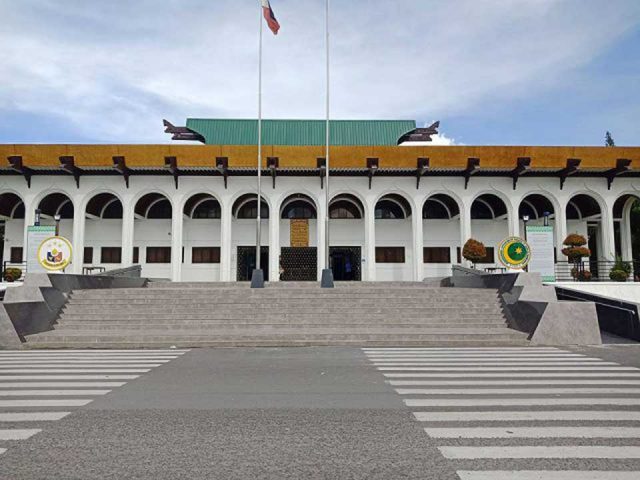
COTABATO CITY — The Bangsamoro government launched the Regional Plan of Action for Children (RPAC), a framework for more comprehensive child welfare programs in areas devastated by decades of secessionist strife, in a symbolic rite on Monday.

Minister Raissa H. Jajurie told reporters then that the RPAC provides social workers in the Bangsamoro Autonomous Region in Muslim Mindanao (BARMM) and cooperating communities with adequate child welfare and rights protection insights as guides in intensifying programs for children across the autonomous region.

Ms. Jajurie officiated the launch alongside officials of the Ministry of Social Services and Development in BARMM on Monday, which also fell on the celebration of the National Children’s Month.

BARMM covers three cities and five provinces, where several towns have just started reeling off from poverty and underdevelopment caused by a drawn-out Moro uprising for self-governance that waned only after the national government had forged separate peace compacts with the Moro National Liberation Front and the Moro Islamic Liberation Front.

Bangsamoro Labor Minister Muslimin G. Sema, as well as officials of non-government humanitarian entities and the International Labour Organization, said on Tuesday that they will support the implementation of the RPAC. — John Felix M. Unson

Poll hotspots in CAR to be determined

PHILIPPINE STAR/ MIGUEL DE GUZMAN

BAGUIO CITY — Regional election officials in the highland region still have to determine which areas will become hotspots in the coming elections.

There was already a directive to election officials to identify locations possible to be dangerous to election officers, Cordillera Regional Election Officer Julius D. Torres said Tuesday.

This enables them to employ measures to ensure that the election process will go smoothly.

He further explained that they should be ready because of the possibility that some teachers will back out from serving in the polls.

During the 2023 Barangay and Sangguniang Kabataan Elections (BSKE), many teachers refused to serve Board of Election Tellers (BET), especially in some barangays in Abra who feared for their lives amid several election-related violence prior to the actual polling.

In Kalinga, some teachers also declined serving in the BSKE not because of safety concerns but out of “delicadeza” as some of them were related to the candidates.

Mr. Torres admitted they are anticipating that Abra would become dangerous because of earlier violent incidents in the past several weeks, though most have been not related to politics.

He said in such scenarios where teachers will refuse to serve, the assistance of the Philippine National Police (PNP) will be sought and deploy some of their personnel to man polling precincts in hotspots.

Comelec Cordillera Assistant Regional Director Vanessa Roncal said that they will also ask the help of the PNP and the Armed Forces of the Philippines not just to be alternative or replacement election officers, but also for security in all the polling places. — Artemio A. Dumlao

Drug trader yields in anti-narcotics raid in Ifugao

LOREN BISER-UNSPLASH

BAGUIO CITY — Philippine Drug Enforcement Agency (PDEA) aided by Lamut policemen and provincial police intelligence operatives caught a drug trader and over P10,000 worth of crystal meth (shabu) on Tuesday morning.

The 44-year-old drug trader was caught inside his own home with the shabu, said Roselle Sarmiento, spokesperson of the PDEA-Cordillera.

He will face charges for violation of Republic Act 9165 or the Comprehensive Dangerous Drugs Act of 2002, added Ms. Sarmiento.

Meanwhile, former PDEA Chief Information Officer, Director III Derrick Arnold C. Carreon took over the helm as Regional Director of the PDEA-Cordillera starting Monday. — Artemio A. Dumlao

Stocks back above 7,200 after within-target inflation

REUTERS

PHILIPPINE SHARES rebounded to the 7,200 level on Tuesday as October inflation remained within the central bank’s annual target.

The benchmark Philippine Stock Exchange index (PSEi) rose by 1.7% or 121.84 points to close at 7,257.94 on Tuesday, while the broader all shares index increased by 1.05% or 41.85 points to end at 3,993.51.

“The local market bounced back this Tuesday as inflation remained near the lower end of the government’s 2-4% target,” Philstocks Financial, Inc. Senior Research Analyst Japhet Louis O. Tantiangco said in a Viber message.

“Philippine shares made a huge comeback as the October consumer price index came in within expectations as at 2.3%,” Regina Capital Development Corp. Head of Sales Luis A. Limlingan said in a Viber message.

Headline inflation picked up to 2.3% in October from 1.9% in September, the Philippine Statistics Authority reported on Tuesday.

Still, this was slower than the 4.9% print in the same month last year. This was also within the Bangko Sentral ng Pilipinas’ (BSP) 2%-2.8% forecast for the month and a tad below the 2.4% median estimate in a BusinessWorld poll of 11 analysts.

For the first 10 months, the consumer price index averaged 3.3%, well within the BSP’s 2-4% target for the year but above its 3.1% baseline forecast.

“Wall Street slipped Monday as investors eyed the upcoming US presidential election and a potential US Federal Reserve rate cut. The 10-year Treasury yield fell to 4.3%, signaling a shift to safe assets ahead of election day,” Mr. Limlingan added.

US stock indexes were trading flat to lower on Monday, as investors braced for a pivotal week for global markets in which Americans will elect a new president and the Federal Reserve is likely to cut its benchmark policy rate, Reuters reported.

Choppy trading is likely in the wait for the election outcome and due to a lack of clarity on the policy implications. Investors, meanwhile, remained largely sure of a 25-basis-point rate cut by the Fed in its November meeting, whose decision is expected on Thursday.

Back home, all sectoral indices closed higher on Tuesday. Property gained by 3.37% or 93.03 points to end at 2,849; financials climbed by 1.73% or 40.04 points to 2,351.13; industrials surged by 1.44% or 142.33 points to 9,970.31; services went up by 0.64% or 14.22 points to 2,204.98; holding firms increased by 0.63% or 38.42 points to 6,135.48; and mining and oil rose by 0.01% or 1.57 points to 8,488.76.

Value turnover increased to P4.97 billion on Tuesday with 1.03 billion shares changing hands from the P4.65 billion with 588.45 million issues traded on Monday.

Advancers outnumbered decliners, 115 versus 89, while 52 names were unchanged.

Net foreign selling dropped to P58.2 million on Tuesday from P777.98 million on Monday. — R.M.D. Ochave with Reuters

Peso inches up as market eyes US elections

BW FILE PHOTO

THE PESO inched up against the dollar on Tuesday as the market remained cautious ahead of the US election result.

The local unit closed at P58.315 per dollar on Tuesday, strengthening by 2.5 centavos from its P58.34 finish on Monday, Bankers Association of the Philippines data showed.

The peso opened Tuesday’s session weaker at P58.43 against the dollar. Its intraday best was at P58.30, while it dropped to as low as P58.455 versus the greenback during the session.

Dollars exchanged went down to $1.15 billion on Tuesday from $1.18 billion on Monday.

“The dollar-peso saw mostly sideways trading ahead of the results of the US presidential elections,” a trader said by phone.

The dollar softened on Tuesday as traders squared positions ahead of what is expected to be a close US presidential election, while options volatility soared after recent polls dented some market bets on a victory for Republican Donald Trump, Reuters reported.

Democrat Kamala Harris has also experienced improving odds on election gambling sites and had a slight lead on PredictIt overnight, although Polymarket continued to show Mr. Trump as favorite.

In recent weeks, financial markets and some betting platforms had leaned strongly in favor of a win for Mr. Trump, whose tariff and immigration policies are considered inflationary by analysts, leading to a rise in US Treasury yields and gains for the dollar.

The US currency took a knock on Monday after a weekend opinion poll showed Ms. Harris with a surprise lead in Iowa, a traditional Republican stronghold. Overall, polls continue to show a tight race.

With hours to go until the first results were set to emerge overnight, the dollar was mostly flat against a basket of currencies.

Complicating the picture even more for traders this week is the Federal Reserve’s policy meeting on Thursday, at which the US central bank is expected to cut interest rates by a quarter point.

The peso was also supported by data released on Tuesday showing that inflation remained within the central bank’s target last month, Rizal Commercial Banking Corp. Chief Economist Michael L. Ricafort said in a Viber message.

Headline inflation picked up to 2.3% in October from 1.9% in September, the Philippine Statistics Authority reported on Tuesday.

Still, this was slower than the 4.9% print in the same month last year. This was also within the Bangko Sentral ng Pilipinas’ (BSP) 2%-2.8% forecast for the month and a tad below the 2.4% median estimate in a BusinessWorld poll of 11 analysts.

For the first 10 months, the consumer price index averaged 3.3%, well within the BSP’s 2-4% target for the year but above its 3.1% baseline forecast.

For Wednesday, the trader sees the peso moving between P58.10 and P58.50 per dollar, while Mr. Ricafort said it could range from P58.20 to P58.40. — A.M.C. Sy with Reuters

Fiber backbone phases 2, 3 seen completed by mid-2025

ETHERNET cable wires are connected to an internet router modem in this illustration photo taken on April 17, 2024. — JAAP ARRIENS/NURPHOTO VIA REUTERS CONNECT

THE Department of Information and Communications Technology (DICT) said it expects the second and third phases of the National Fiber Backbone to be running by 2025.

“It is being laid out and we are anticipating that Phase 2 and Phase 3 will be up and running in the middle of next year,” Secretary Ivan John E. Uy told reporters on Tuesday.

Phase 1 of the National Fiber backbone project is a high-speed connection between Laoag, Ilocos Norte and Quezon City.

The second and third phases will cover Southern Luzon and parts of the Visayas and Mindanao, Mr. Uy said.

President Ferdinand R. Marcos, Jr. said during his third State of the Nation Address that the government will continue upgrading nationwide connectivity. 

Last month, the World Bank said it approved a $287.24-million loan to help fund Philippine infrastructure projects improving broadband connectivity. 

“With that approval, we will get funding for the remaining phases, that is phase 4, 5, and 6. That will cover mostly Mindanao and connect to the Visayas,” he said.

The backbone could be completed by 2027 instead of 2028, Mr. Uy said.

The loan will only fund part of the backbone with much of the connectivity projects for Mindanao likely supported by the national budget, he said.

The Laoag to Quezon City phase runs for 1,245 kilometers with 28 nodes. It has an initial 600 gigabits per second optical spectrum capacity that will serve the government and at least 14 provinces, and two National Government data centers, the DICT has reported. — Ashley Erika O. Jose

FTA with US urgently needed — chip industry

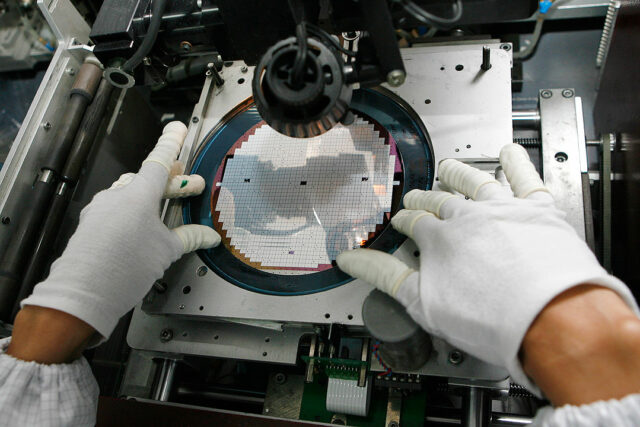
A worker operates the die attach machine at a semiconductor manufacturing plant in Manila, Dec. 10, 2008. — REUTERS

THE PHILIPPINES will need a free trade agreement (FTA) with the US to sustain the electronics and manufacturing services (EMS) business, the semiconductor industry association said.

On the sidelines of a briefing on a report of the Center for Strategic and International Studies, Semiconductor and Electronics Industries in the Philippines Foundation, Inc. (SEIPI) President Danilo C. Lachica said the need for an FTA is urgent.

“We have actually lost some opportunities in the US because of the absence of an FTA. There is such a thing called the TAA (Trade Agreements Act) and this is more on the EMS side,” Mr. Lachica told reporters on Monday.

“When companies want to export to the US and they are not TAA compliant, then they can’t export,” he added.

He said that since last year, the industry has lost two customers for EMS exports.

“Easily, this is about $5 million to $10 million (worth of lost business) so far … These could further increase if the issues on trade agreement accreditation are not resolved,” he added.

The US Trade Agreements Act limits the countries of origin for products sold through General Services Administration (GSA) schedule contracts to the US or compliant countries.

Thus Philippines, in the absence of an FTA with the US, is not on the list of countries eligible for Federal procurement.

Mr. Lachica said the only way to resolve this issue is to conclude an FTA with the US.

“You cannot circumvent the law. So we have to work on the FTA,” he added, noting that the Indo-Pacific Economic Framework for Prosperity will not solve the problem.

According to the GSA, the TAA-compliant countries in the region are South Korea, Singapore, Laos, and Cambodia.

The Philippine Statistics Authority reported that exports of electronic products amounted to $27.45 billion in the first eight months.

Although year-to-date electronic product exports still show a 1% increase from last year, SEIPI projects a 10% contraction by the end of the year. — Justine Irish D. Tabile

Sweden eyes PHL mining, health tie-ups

REUTERS

THE Swedish government has expressed interest in collaborating with the Philippines in mining, health, transportation, digitalization, and defense, the Board of Investments (BoI) said.

In a statement on Tuesday, the BoI said Trade Undersecretary and BoI Managing Head Ceferino S. Rodolfo recently met with Håkan Jevrell, Sweden’s State secretary to the Minister for International Development Cooperation and Foreign Trade.

“The two officials discussed priority areas in trade and investments with the aim of establishing a platform for the two economies to discuss and exchange information on mutually identified priority areas through a Joint Economic Commission,” the BoI said.

During the meeting, Mr. Jevrell said that Sweden’s particular interest lies in introducing sustainable approaches to the above-named industries.

“Sweden is advanced in terms of technology transfer through partnering with the local ecosystem. A Swedish company, Ericsson, is the leading innovator for connectivity,” Mr. Jevrell said.

He said that Sweden has a strong interest in being further developing the Philippine mining industry.

“At this stage, the relationship with the Philippines (will involve) how to do sustainable mining with appropriate solutions, and Swedish companies are ready to be part of the Philippines’ mining journey with less impact on the environment,” he added.

On healthcare, Mr. Rodolfo cited the need for digitalization in the industry, adding that the Philippines aims to foster “an active pharmaceutical industry.”

Mr. Jevrell said Sweden is also open to supporting the Philippines in integrating renewables into the grid, citing Sweden’s own experience in overcoming the challenges of being an archipelagic country.

“Companies like ABB have strong interest in working more with the Philippines in this area,” he added. — Justine Irish D. Tabile

IPOPHL cuts green-tech application fees, expedites approvals

THE Intellectual Property Office of the Philippines (IPOPHL) said its Green Technology Incentive Program will offer reduced registration fees and accelerated approval for intellectual property (IP) that mitigates environmental impacts and conserves natural resources.

“IPOPHL hopes to make a contribution to encourage an innovation climate that doesn’t just consider the return of investment but also the costs of what we do to our environment and natural resources, especially when they cost jobs, incomes, homes, and lives,” IPOPHL Director General Rowel S. Barba said in a statement on Tuesday.

Starting this month, IPOPHL will start accepting applications for patents, utility models (UMs), and industrial designs (IDs) for such green technologies. The program will run until November 2025, subject to a quota of 30 inventions, 60 UMs, and 60 IDs.

“We will launch it and implement it for an initial one-year period; after one year, we will assess and (decide on an extension),” IPOPHL Assistant Director Cristina P. de Guzman said in a briefing on Tuesday.

Qualified applicants will be entitled to an application fee reduction of P6,600 and faster processing.

Approved applications for inventions may opt to avail of up to a P6,600 reduction in early public fees or up to a P4,200 reduction in substantive examination fees.

Meanwhile, UM and ID registrants can enjoy up to a P960 reduction in second publication fees.

According to Ms. De Guzman, applications for inventions have an average turnaround time of four years, while the average turnaround time for UMs and IDs is 12 months and 3 months, respectively.

“But under this program, you can save up to one year for the application period (for inventions), plus when the application goes through the substantive examination, it will be prioritized,” she said.

For UMs and IDs, she said assuming complete applications, a positive examination may be scheduled for as early as two months and five days, respectively.

“We just need to wait for the publication period of one month because that’s the law. We need to (subject) applications to possible opposition or adverse information,” she said.

“Right after that, we can issue the registration certificate,” she added.

IPOPHL Deputy Director General Ann Claire C. Cabochan said that the new incentive program aims to promote the development of green and sustainable technologies through the IP system.

“By encouraging the search for sustainable solutions, this program will ensure that the Philippines will be empowered to address issues related to climate change, food security, and the environment while also aiming for a low-carbon future,” Ms. Cabochan said.

“These issues are of paramount concern, given how climate change is impacting agriculture as well as our food security,” she added.

She said that IPOPHL believes that IP protection will encourage investors, startups, and business owners to come up with green and sustainable solutions that will address the challenges faced by the country. — Justine Irish D. Tabile

Ban on poultry products from Michigan lifted

REUTERS

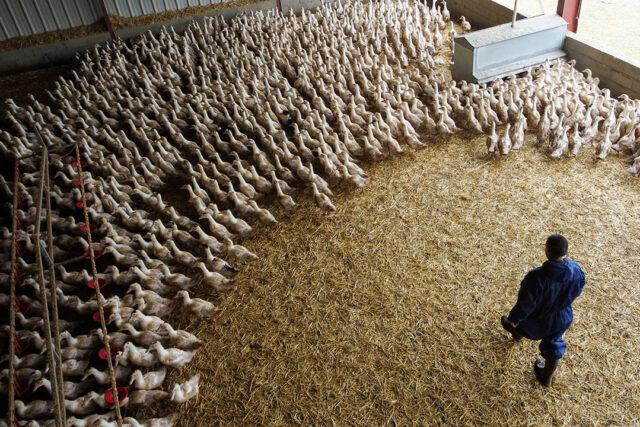
THE Department of Agriculture (DA) has lifted a ban on poultry imports from Michigan, following the resolution of reported cases of High Pathogenicity Avian Influenza (HPAI) in the US state.

In a memorandum order issued by the DA on Monday, Agriculture Secretary Francisco P. Tiu Laurel, Jr. said the ban was lifted after US veterinary authorities reported to the World Organisation for Animal Health the resolution of all HPAI cases in Michigan.

“No new cases have been reported after July 12,” the DA.

In June, the DA imposed a temporary import ban on domestic and wild birds and their products after receiving reports of the avian flu outbreak in Michigan. The ban covered poultry meat, day-old chicks, eggs, and semen.

The US has an HPAI regionalization arrangement with the Philippines, allowing for state-wide trade restrictions instead of blanket bans on products from the entire US in the event of an outbreak.

According to Mr. Laurel, the lifting of the ban will take effect immediately but noted “that all import transactions must adhere to all DA rules and regulations pertaining to agricultural food imports.”

In the eight months to August, the Philippines imported 130.81 million kilograms of meat from the US, with chicken, duck, and turkey products accounting for 89.58 million kilograms, or 68.48% of the total. — Justine Irish D. Tabile

Oct. spot prices rise in wholesale market

BW FILE PHOTO

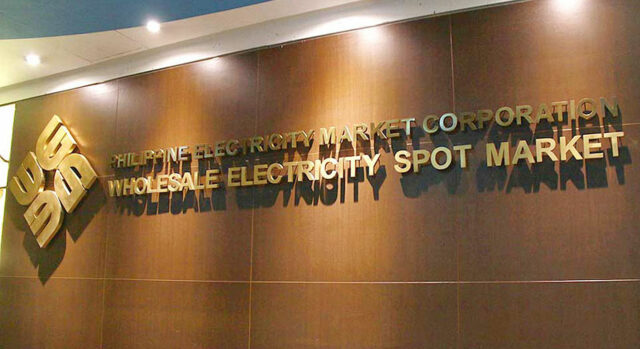
ELECTRICITY prices at the Wholesale Electricity Spot Market (WESM) rose in October due to an increase in demand with the approach of the year-end holidays, the Independent Electricity Market Operator of the Philippines (IEMOP) said.

The national average, however, masked much higher rises in spot prices for the smaller Visayas and Mindanao markets.

At a virtual briefing on Tuesday, Chris Warren C. Manalo, assistant manager for market simulation and analysis trading operations at IEMOP, said that demand increased slightly while supply declined due to a number of planned and forced plant outages.

According to preliminary data from IEMOP, WESM prices rose 13.1% month on month to P4.39 per kilowatt-hour (kWh).

“This increase is attributed to a minimal rise in system demand, driven by activities for the upcoming Christmas season,” the operator said.

The operator said available power declined 2.2% to 19,897 megawatts (MW). Demand during the period rose 2% to 13,972 MW.

In Luzon, spot prices rose 2.4% month on month to P3.89 per kWh.

Supply on the grid fell 2.4% to 13,979 MW. Demand, on the other hand, rose 1.7% to 9,915 MW.

The average electricity rate in the Visayas jumped 30.1% to P5.93 per kWh.

Supply increased 5.2% to 2,510 MW. Demand during the period rose 2.5% to 2,003 MW.

Mindanao WESM prices rose 49.3% from a month earlier to P5.20 per kWh.

Supply dropped 6.2% to 3,408 MW, while demand rose 2.8% to 2,054 MW.

“Lower WESM average price is expected with a stable supply and improved demand situation as the colder months approach,” IEMOP said.

IEMOP operates the WESM, where energy companies can buy power when their long-term contracted power supply is insufficient for customer needs. — Sheldeen Joy Talavera

ADVERTISEMENT
ADVERTISEMENT