Home Blog Page 2444

Alternergy directs P2.9B to wind, solar projects

PHILSTAR FILE PHOTO

ALTERNERGY Holdings Corp. (ALTER) has injected capital amounting to P2.9 billion as of September to finance the ongoing construction of its two wind power projects and a solar power project.

Broken down, a total of P1.5 billion has been infused into Alternergy Tanay Wind Corp. for the 128-megawatt (MW) Tanay Wind Power Project in Rizal province and P1.1 billion into Alabat Wind Power Corp. for the 64-MW Alabat Wind Power Project in Quezon province, the company said in a statement on Monday.

For the 28-megawatt-peak Hermosa Solar Power Project in Bataan, a total of P342 million has been infused into Solana Solar Alpha, Inc.

Alternergy owns 100% of the three companies created as special purpose vehicles for the said projects.

“With the capital infusion so far, ALTER is keen to ensure timely completion of the three projects,” Alternergy President Gerry P. Magbanua said.

The Tanay and Alabat Wind Power Projects are expected to be completed by the end of 2025, based on the committed delivery date under the government’s green energy auction program last year.

The Hermosa Solar Power Project is slated for completion by the second quarter of 2025.

The initial equity infusions for the three projects as of September partly came from the use of proceeds from the initial public offering and the P2-billion green finance loan secured from BDO Unibank, Inc.

Mr. Magbanua said that additional funds from its project lenders under the signed omnibus loan and security agreement are expected to flow immediately following drawdowns.

The Tanay Wind Power Project secured P8 billion in syndicate project finance from the Bank of the Philippine Islands and Security Bank Corp.

The Alabat Wind Power Project, on the other hand, obtained P5.3 billion in project finance from Rizal Commercial Banking Corp.

The three projects are part of Alternergy’s target to reach 500 MW of generating capacity by 2026 as it continues to beef up its pipeline of projects beyond the target.

At the local bourse on Monday, shares in the company closed at P0.94 apiece. — Sheldeen Joy Talavera

IMI trims losses on rightsizing, lower expenses

GLOBAL-IMI.COM

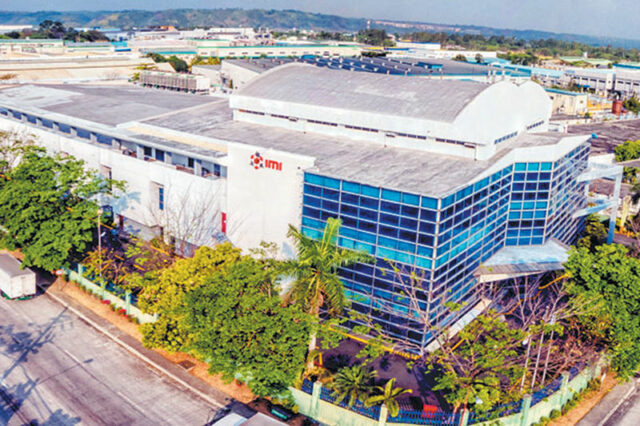
LISTED Integrated Micro-Electronics, Inc. (IMI) trimmed its attributable net loss for the third quarter to $467,000 from $1.6 million a year ago, following rightsizing efforts and lower operating expenses.

Revenue from July to September dropped by 19.2% to $275.21 million from $340.75 million last year, IMI said in a statement to the stock exchange on Monday.

Operating expenses fell by 26.9% to $21.75 million from $29.74 million in 2023.

IMI also reduced its nine-month attributable net loss by 89.2% to $9.24 million from $85.26 million a year ago, which included restructuring expenses and other non-operational one-offs.

“While securing order demand remains a challenge, we have managed to mitigate the impact of the headwinds we face. Through targeted rightsizing initiatives, we have been able to reduce core fixed overhead and selling, general, and administrative expenses, which will result in approximately a $25 million annualized reduction for the year,” IMI Chief Executive Officer Louis Sylvester Hughes said.

Revenue for the January to September period went down by 18.6% to $841.02 million from $1.03 billion in 2023 due to rightsizing efforts and lower utilization.

The company’s operating expenses also decreased by 9.5% to $73.48 million from $81.16 million a year ago.

“The automotive market’s continued uncertainty, coupled with industrial customers’ rightsizing of inventory levels, has led to reduced ordering patterns and pushouts of new product ramp-ups. These have resulted in lower utilization across multiple IMI sites, affecting profitability for the company,” IMI said.

VIA optronics AG, in which IMI has a 50% stake, saw a 37% decline in revenue to $83 million as of September due to a weaker laptop business, loss of orders from some automotive customers, and the bankruptcy of another customer in the mobility camera segment.

IMI said VIA is implementing restructuring initiatives to boost profitability. In April, VIA notified the New York Stock Exchange of the planned voluntary delisting of its American depositary shares.

“By operating more efficiently with a flatter, leaner support structure, we are positioning ourselves to enhance profitability as customer ordering patterns normalize. Furthermore, we are increasingly more selective of the projects we pursue, focusing on businesses that align with our core competencies,” Mr. Hughes said.

“IMI is actively exploring all opportunities to address the issues we face from non-core activities. Our prolific sales team is also actively looking to grow our industrial segment and bring better balance to the portfolio concentration within our business,” he added.

IMI produces electronics for the automotive, industrial, power electronics, communications, and medical industries.

On Monday, IMI declined by 1.74% or three centavos to P1.69 apiece. — Revin Mikhael D. Ochave

A hub for the art of collectibles

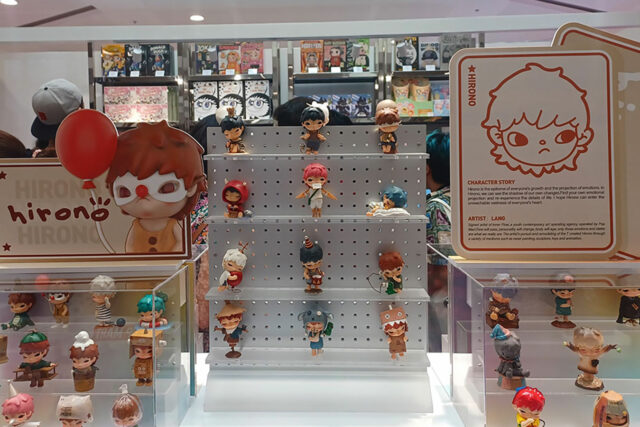
A DISPLAY for Hironos, an iconic Pop Mart designer toy character. — BRONTË H. LACSAMANA

Pop Mart opens pop-up store in the Philippines

TRENDING designer toy characters, now viral online among Filipinos, led to Pop Mart opening a pop-up store at SM Mall of Asia, Pasay City. The company behind the dolls and figurines of Molly, Crybaby, Hirino, Dimoo, Peach Riot, and the recently popular Labubu, among others, hopes to take advantage of the demand with the brand-new store.

Jeremy Lee, Pop Mart’s Southeast Asia market director, said that there is definitely a boom in these collectibles in the region. In the Philippines, certain influencers — the likes of actresses Heart Evangelista and Kathryn Bernardo, and TV host Vice Ganda — to name a few have popularized the designer toys, particularly Labubu.

“More than just a company that makes toys, Pop Mart is an innovator that sits at the intersection of art, culture, and entertainment,” Mr. Lee told the press at the pop-up’s launch on Oct. 31.

“These are designed for all age groups and personalities alike,” he added.

Actress Marian Rivera, another celebrity who is credited with the toys’ rise in popularity, graced the opening. Unboxing, showing off, and trading Labubus serve as “a precious bonding activity” for her and her daughter Zia, according to Ms. Rivera.

Nangongolekta ako dati pero Sanrio, mga Hello Kitty. Bumalik lang ako ngayon para something new (I used to collect but they were items from Sanrio, like Hello Kitty. I returned to the habit because there’s something new now),” she said.

Online community marketplace Carousell found that keyword searches for Labubu and related items in the Philippines saw an uptick over the past few months. It stated in a press release that “Labubu surged to become the top keyword search in October, climbing from rank 74 in July,” going on to say that “Keyword searches for Labubu and related items started increasing in July 2024; over 24X increase comparing June vs. October 2024.”

It is not just the number of searches that has been increasing. The number of Labubu-related listings “have been increasing since July this year and continue to grow in October, with an increase of over 21 times when comparing June to October.”

Pop Mart, which began as a variety store in Beijing in 2010, now has over 500 stores in over 30 countries and regions. They also manage and represent artists from all over the world, populating their roster of characters.

The company’s first official pop-up store in the Philippines, at SM Mall of Asia, opened in November. It will run for three months as part of “a key step in Pop Mart’s expansion across Southeast Asia, following overwhelmingly positive feedback from fans in the region.”

As Southeast Asia market director, Mr. Lee told the press that “it is vital” to bring more branches in the region in the upcoming year.

But working with local artists will take time, he said.

“At some point in time, yes, we will collaborate with Filipino artists as well,” he added, “But it will take time. It takes time to look out for potential artists and study the local art scene.”

The pop-up branch features a life-sized statue of Hirono Mime Devilry, designed to serve as an interactive photo spot for fans who visit the store.

Mr. Lee said that, following the opening of the pop-up, Filipinos can expect a full, official physical store to open as early as 2025.

“It’s coming very, very soon!” he said. — Brontë H. Lacsamana

T-bill yields mostly higher before inflation data

BW FILE PHOTO

THE GOVERNMENT made a full award of the Treasury bills (T-bills) it offered on Monday amid strong demand and even as rates mostly went up on expectations of faster October inflation.

The Bureau of the Treasury (BTr) raised P20 billion as planned from the T-bills it auctioned off on Monday as total bids reached P69.87 billion, more than thrice as much as the amount on offer and higher than the P56.046 billion in tenders seen the previous week.

Broken down, the Treasury borrowed P6.5 billion as programmed from the 91-day T-bills as tenders for the tenor reached P19.155 billion. The three-month paper was quoted at an average rate of 5.605%, 1.9 basis points (bps) higher than the 5.586% recorded last week, with bids ranging from 5.598% to 5.648%.

The government also made a full P6.5-billion award of the 182-day securities, with bids reaching P26.065 billion. The average rate of the six-month T-bill stood at 5.735%, down by 1.7 bps from the 5.752% fetched last week, with accepted bid yields at 5.724% to 5.76%

Lastly, the Treasury raised P7 billion as planned via the 364-day debt papers as demand for the tenor totaled P24.65 billion. The average rate of the one-year debt went up by 3.5 bps to 5.786% from the 5.751% quoted last week, with accepted rates ranging from 5.75% to 5.795%.

At the secondary market before the auction, the 91-, 182-, and 364-day T-bills were quoted at 5.3267%, 5.7955%, and 5.8008%, respectively, based on PHP Bloomberg Valuation Service Reference Rates data provided by the Treasury.

T-bill rates ended mostly higher to track the slight week-on-week increase in secondary market yields on expectations that headline inflation accelerated last month, Rizal Commercial Banking Corp. Chief Economist Michael L. Ricafort said in a Viber message.

Philippine inflation likely picked up in October amid higher prices of food and fuel, analysts said last week.

A BusinessWorld poll of 11 analysts yielded a median estimate of 2.4% for the October  consumer price index (CPI), within the Bangko Sentral ng Pilipinas’ (BSP) 2-2.8% forecast for the month.

If realized, October inflation would be faster than the 1.9% in September. Still, this would be slower than the 4.9% in the same month a year ago and fall within the BSP’s 2-4% annual target.

The Philippine Statistics Authority will release October CPI data on Tuesday (Nov. 5).

“The demand for the 182-day tenor was the highest at P26.065 billion, which partly led to the slightly lower auction yield, as some investors lock in relatively higher yields amid market expectations of future US Federal Reserve rate cuts that could be matched locally,” Mr. Ricafort added.

He said the T-bill offer also attracted strong demand following the cut in banks’ reserve requirement ratios (RRR), which freed up about P400 billion in liquidity.

The BSP has reduced the RRR for universal and commercial banks and nonbank financial institutions with quasi-banking functions by 250 bps to 7% from 9.5% effective on Oct. 25.

It also slashed the RRR for digital banks by 200 bps to 4%, while the ratio for thrift lenders was reduced by 100 bps to 1%. Rural and cooperative banks’ RRR was brought down by 100 bps to 0%.

Traders of futures that settle to the Fed’s policy rate instead moved to price in about a 99% chance that the central bank on Nov. 7 would cut its policy rate by a quarter of a percentage point to the 4.5%-4.75% range, compared with 92% before the release of the jobs data, Reuters reported. They see about an 83% chance that the policy rate will be in the 4.25%-4.5% range by the end of this year, compared with 69% earlier.

Fed policy makers will begin their next two-day policy meeting a day after the US presidential election on Tuesday, and though the result is not expected to directly factor into their decision two days later, many analysts see election uncertainty as an added temporary weight on the labor market in October that could be reversed in coming months.

Financial markets currently see the Fed lowering its policy rate to the 3.50%-3.75% range by September of next year.

Meanwhile, the BSP has so far lowered benchmark borrowing costs by a total of 50 bps since it began its easing cycle in August, bringing its policy rate to 6%.

BSP Governor Eli M. Remolona, Jr. has signaled a possible 25-bp cut at the Monetary Board’s policy meeting on Dec. 19, which is its last review for the year.

T-bill rates moved mostly sideways from the previous week due to a lack of catalysts, a trader said in a text message.

The BTr is looking to borrow P90 billion from the domestic market this month, or P60 billion via T-bills and P30 billion through Treasury bonds.

The government borrows from local and foreign sources to help fund its budget deficit, which is capped at P1.48 trillion or 5.6% of gross domestic product this year. — A.M.C. Sy with Reuters

DITO CME board OKs Summit Telco’s potential investment

BW FILE PHOTO

DITO CME Holdings Corp.’s board of directors has approved potential investment from Summit Telco Corp. Pte. Ltd., the listed holding company of DITO Telecommunity Corp. said.

In a stock exchange disclosure on Monday, DITO CME said it had executed a subscription framework agreement for Summit Telco, an existing shareholder of DITO CME, to subscribe to up to nine billion primary common shares, pending execution of subscription agreements.

“The implementation of Summit Telco’s potential investment under the Subscription Framework Agreement, along with other equity-raising efforts, forms part of the Company’s business plan to improve its equity positions as previously disclosed,” the company said.

With this, the company said its board of directors also authorized DITO CME Chairman Dennis A. Uy and President Donald Patrick L. Lim to fix, negotiate, and finalize the terms of the investment.

Its top executives were also authorized to negotiate and finalize the final amounts, timing, and tranches of the subscription and sign necessary agreements for the investments, DITO CME said.

In 2023, Summit Telco’s wholly owned unit Summit Telco Holdings Corp. entered into a subscription with DITO CME for P3.3 billion, allowing the issuance of 3.3 billion common shares to the company priced at P1 each.

Summit Telco accounts for 8.14% of DITO CME’s outstanding shares, with Summit Telco Holdings accounting for 16.89% of shares and Udenna Corp. holding 54.77% of DITO CME’s outstanding shares.

In August, the company announced its plan to raise up to P40.26 billion through funding from private investors over the coming five years to improve its financial standing and support its growth.

At the stock exchange on Monday, shares in DITO CME gained 13 centavos or 7.34% to end at P1.90 apiece. — Ashley Erika O. Jose

Greatest hits albums, once a must purchase, have lost their mojo

LOOKING at the roster of top-selling records, you could easily think greatest hits albums are doing better than ever. As of September, two dozen had made it onto the music industry’s list of the 200 bestsellers this year, compared with only 10 in 2010.

In reality, the cultural and economic might of collections like the Eagles’ Their Greatest Hits (1971-1975), the all-time bestseller in the US, has declined dramatically in recent years. Purchases have tumbled as streaming replaced CDs and digital purchases as the primary way people consume music. These once-mainstream releases are now viewed primarily as a novelty item — designed for superfans and their vinyl or CD collections, often with dressy packaging and a price that can top $100.

These records are for “someone who wants to own a product and support an artist in a different way than in streaming,” said Michael Kachko, a senior vice-president at BMG, whose artists include Mötley Crüe and Jelly Roll. “This is your starting point.”

For decades, listeners stocked their shelves with greatest hits albums as a cost-effective way to acquire the best of an artist’s music in one purchase. They became so prevalent that, even today, two of the 10 best-selling albums in the US are greatest hits compilations. In addition to the Eagles’ collection, Billy Joel’s Greatest Hits Volume I & Volume II ranks among the most-purchased ever.

At the music industry’s peak, from 1994 to 2000, compilations could sell millions of copies. Garth Brooks, for example, sold 5.49 million copies of 1994’s The Hits in its first year, according to Luminate, the data company behind the Billboard charts. The Beatles’ 1, from 2000, sold 7.69 million in 12 months, and record companies like Universal Music Group NV and Sony Music Entertainment came to rely on such compilations for revenue and profit, particularly as people transitioned their vinyl and cassette collections to the burgeoning CD format.

“The CD era, with the format coming in, gave us all a shot in the arm,” said Sig Sigworth, president of Craft Recordings, which is part of closely held Concord. Craft’s catalog includes Bush and Alice in Chains.

Now, however, fans no longer need to buy such albums to cherry-pick hits. Streaming services like Spotify Technology SA create playlists or auto-play a group’s most popular tracks. The result is that purchases of compilation albums last year in the US, based on ones appearing in the top 200 list, fell to 1.3 million, down from a recent peak of 3.7 million in 2011, according to Luminate.

In 2019, Tom Petty & The Heartbreakers sold just 78,000 copies (digital and physical) of The Best of Everything (The Definitive Career Spanning Hits Collection 1976-2016), which it released that year. The Weeknd’s The Highlights, the artist’s second compilation, sold 94,000 copies in 2021, when it was issued, according to Luminate.

The appearance of greatest hits albums on the Billboard 200 today is essentially the result of a bookkeeping decision by Billboard that makes the collections appear to be selling better than they really are.

When a listener streams a song from a group, like the Eagles’ “Take It to the Limit,” it counts toward whatever Eagles album had the most physical sales that week. Especially with older artists, that’s usually going to be a greatest hits compilation, since the record industry pushes those so hard to customers of vinyl and CDs.

As a result of the streaming’s popularity, the music industry is rethinking how it markets such albums. Where greatest hits collections once converted casual listeners into avid fans, labels now view them as a prong in a broader strategy. Releasing a greatest hits album in 2024 might help an artist promote other efforts and businesses, like a book, biopic, new single, or tour. Having an older artist’s compilation suddenly pop up on the Billboard 200 helps that effort.

Sony Music, for example, released a greatest hits collection of sorts — Evergreens: Celebrating Six Decades on Columbia Records — featuring Barbra Streisand’s favorite songs, leading up to her memoir release in 2023.

That also means a greater focus on physical products, like vinyl and boxed sets, trying to hype them as collector’s items.

“A lot of greatest hits on the physical side are signed off by the band,” BMG’s Mr. Kachko said. “A lot of streaming playlists are made by algorithms.”

Labels also might use a greatest hits record to promote a new song and market albums to superfans at higher prices. Universal reissued The Beatles’ Red and Blue albums last year to include their last song together,Now and Then,” and new mixes. The six-record vinyl boxed set costs $174.98. A four-LP Aerosmith set costs $150, while Abba’s four-LP collection, The Singles: The First Fifty Years, sells for $140.

“In the ’80s and ’90s, [we were] trying to reach that casual consumer that literally spent $20 a year on music,” said Richard Story, president of Sony’s commercial music group. “Now, because everything is accessible on streaming services, you are serving the fans.” — Bloomberg

Beyond Bytes and Budgets: Breaking barriers to transformative digitalization

RAWPIXEL.COM/FREEPIK

Transformative digitalization has been the buzz words in business operations these past years. With all the expert knowledge and successful cases, why do some businesses still seem to hit brick walls? By now, most companies should already have successful digitalized business processes and focus on AI technology and data analytics, but companies still need help in achieving successful transformative digitalization.

IDENTIFYING COMMON DIGITAL TRANSFORMATION BARRIERS
The Management Association of the Philippines (MAP) Next-Generation (NextGen) Committee Chair, Cliff Eala (a behavioral strategist and tech entrepreneur), points out that common factors leading to digital transformation failures are overshot budgets, missed objectives, and a timeline that falls off the table.

He identifies that it is less about technology and more about people — “People should be at the center of a transformation effort. Transformative approaches face the challenges of adapting to different skills, mental models, and perceptions of a multi-generational workforce.”

Widespread digitalization can boost economic progress and increase human creativity. Still, we must make it work for fairness, shared prosperity, well-being, and the environment while managing cybersecurity, digital skills training, and forced obsolescence.

Our 5th MAP NextGen Conference 2024 is more than just another event. It’s a crucial platform focusing on the cornerstone to driving successful transformative digitalization — PEOPLE. The Conference addresses the barriers and shares strategies for a successful digital transformation.

INSPIRING KEYNOTES AND FIRESIDE CHATS
Our opening keynote speaker will be Philippine Airlines (PAL) President and COO Stanley Ng. Captain Stan is the perfect speaker to inspire and energize the audience as he is a NextGen executive (he is under 50 years old) with two decades of aviation experience leading Asia’s oldest commercial airline. He is PAL’s youngest president and is leading the airline after a tumultuous period for the industry due to COVID-19. Captain Stan’s insights will be valuable information that attendees can learn from.

We will further hear captivating stories and valuable insights from two fireside chats. The first fireside chat, moderated by Vladimir Manual, founder of Tealth, will be about the aspirations and challenges of the digital transformation journeys of Bayad Center President Lawrence Ferrer, Konsulta MD CEO Susana Beatrix Latay, and an inspiring chronicle by Melanie Malaya about how Parañaque improved its revenues and its services to its constituents through the digital transformation of its business permit applications and renewals.

The second fireside chat, moderated by the multi-talented RJ Ledesma of Mercato Centrale Philippines, will discuss the elusive fairy-tale of data monetization. Dr. Erika Legarda, AIM Associate Professor for the Aboitiz Chair in Data Science; Xavier Marzan of Embiggen Ventures; and Melecio Valerio from Maya will be sharing in the discussion. We hope the audience can discover transformative changes and digital strategies to achieve their organization’s success.

Red tape is one of Philippine businesses’ most frustrating barriers to sustainable success. Secretary Ernesto Perez, Director-General of the Anti-Red Tape Authority (ARTA), will be our closing keynote speaker to give us hope that we are not alone in the fight against red tape. We will have an exciting conversation, moderated by Kaye Celera, about the NextGen government, fighting red tape and corruption through successful digital transformation projects and plans.

CONNECTING WITH THE NEXTGEN BUSINESS COMMUNITY
The 4th SGV-MAP NextGen CEO Transformative Leadership Program winner will come from a pool of young executives. We will hear about the transformative projects these young leaders implement in their organizations.

Learning from other businesspeople’s experiences, failures, and successes can save you from the tuition fee that different companies have to spend discovering what works.

This year, we decided to increase the time spent on the speed networking activity, giving participants more time to connect. Participants can expand their networks on their LinkedIn profiles. LinkedIn is becoming more popular in the Philippines for networking, recruiting, learning, and keeping in touch professionally.

Enrich your mind with the keynote speeches and fireside chats on journeys, aspirations, and challenges in the field. Empower yourself to drive transformative digitalization. Be inspired and join us on Nov. 8, from 2 to 9 p.m., at the Shangri-La the Fort. See you soon!


Deliza G. Ridoloso is co-vice chair of the MAP NextGen Committee and president of Pacific Sun Solutions, Inc.

map@map.org.ph

ridoloso@pacificsun.ph

Asia-Pacific banks’ ratings to remain stable

CREDIT RATINGS of Asia-Pacific banks are seen to remain stable until next year, S&P Global Ratings said, in line with its steady outlook for most sovereigns in the region.

“Most sovereign ratings across Asia-Pacific are on a stable outlook, which, in part, underpins our view of continuing rating stability for systemically important banks,” it said in a report.

“Most systemically important banks in Asia-Pacific currently benefit from modest rating uplift because of government support. Recent positive rating actions for some regional financial institutions stem from improved sovereign outlooks in select Asia-Pacific countries.”

The Philippines currently holds a “BBB+” rating with a “stable” outlook from the debt watcher.

S&P Global included the Bank of the Philippine Islands (BPI) in its list of top 60 Asia-Pacific banks, noting its “BBB+” rating with a “stable” outlook, as well as its “strong” business position and “strong” capital and earnings.

It said the region’s financial institutions are likely to see rating stability well into 2025 “despite heightened uncertainty affecting operating conditions.”

“Banks are balancing a range of risks of varying intensity, including potential spillover from tensions in the Middle East, property market woes in numerous jurisdictions, and the overarching risk of an economic hard landing,” S&P Global said.

“Our base case, however, is that most banks will contend with these risks into the new year. About 91% of bank ratings are on stable outlook,” it added.

The credit rater said this outlook stems from its expectation that governments in Asia-Pacific would provide support to their systematically important private banks “in the unlikely event it is needed.”

“Our view on government support in Asia-Pacific differs from that on Western Europe and the US. In our view, bailout, rather than bail-in, is the more likely resolution tool for the unlikely event of a banking crisis affecting Asia-Pacific,” it added.

RATE CUTS TO BOOST LENDING
Meanwhile, S&P Global said in a separate report said that interest rate cuts are seen to boost loan growth in the Philippines.

Latest data from the central bank showed outstanding loans of universal and commercial banks rose by 10.7% year on year to P12.25 trillion in August, the fastest in 20 months.

The Bangko Sentral ng Pilipinas kicked off its easing cycle in August and has delivered 50 basis points in rate cuts since then. It has also signaled further rate cuts moving forward.

In its Asia-Pacific Banking Country Snapshots report, S&P Global said banks maintain good capital buffers and that credit losses will stay near pre-pandemic levels.

“We estimate that major banks in advanced Asia-Pacific economies can comfortably absorb a hypothetical additional 200 basis points in credit losses on commercial real estate exposures.”

It said the risk of a fallout in property markets remains high.

Data from the BSP showed the exposure of Philippine banks and trust entities to the property sector declined to 19.92% at end-June. This was also the lowest real estate exposure ratio recorded in four and a half years or since the 19.84% seen as of December 2019.

Return on assets has also peaked and will gradually decline, S&P Global added. — Luisa Maria Jacinta C. Jocson

Cagelco II clarifies refund balance as P20 million

PHILIPPINE STAR/MICHAEL VARCAS

THE Cagayan II Electric Cooperative, Inc. (Cagelco II) said the outstanding refund balance to its member-consumers as of March was P20 million.

This clarification came after Energy Regulatory Commission (ERC) Chairperson Monalisa C. Dimalanta said in July that the refund balance amounted to P20 billion.

In a letter from the ERC dated Aug. 6, signed by Ms. Dimalanta and provided by Cagelco II to BusinessWorld on Monday, the company had an outstanding balance of P20.42 million as of March.

This was part of the P27.27-million refund directed by the ERC after approving, with modifications, Cagelco II’s filings for over/under recoveries from January 2011 to December 2016, totaling P37.78 million.

“The Commission has verified Cagelco II’s submission and compliance with the decision. As of March 2024, the outstanding balance to be refunded was P20 million and not P20 billion,” Ms. Dimalanta said.

As of June, Cagelco II is implementing its refund process and has a remaining balance of around P10.25 million for refund to its member-consumers.

Cagelco II, one of two electric cooperatives in Cagayan, covers the northern municipalities of Aparri, Camalaniugan, Lallo, Abulug, Ballesteros, Gattaran, Allacapan, Lasam, Sta. Ana, and Gonzaga.

The areas also include Buguey, Sta. Teresita, Sta. Praxedes, Sanchez Mira, Pamplona, Claveria, and parts of Sto. Niño. It also provides electricity services to the lone districts of the municipality of Apayao. — Sheldeen Joy Talavera

Walt Disney forms business unit to coordinate use of AI, augmented reality

WALT DISNEY is forming a new unit to coordinate the company’s use of emerging technologies such as artificial intelligence (AI) and mixed reality, as the media giant explores applications across its film, television, and theme park divisions.

The newly formed Office of Technology Enablement will be led by Jamie Voris, who spearheaded development of Disney’s app for the Apple Vision Pro mixed reality device, according to an e-mail seen on Friday by Reuters.

“The pace and scope of the advances in AI and XR (extended reality) are profound and will continue to impact consumer experiences, creative endeavors and our businesses for years to come — making it critical that Disney explore the exciting opportunities and navigate the potential risks,” Disney Entertainment Co-Chairman Alan Bergman wrote.

“The creation of this group underscores our dedication to doing that.”

Mr. Bergman noted the unit will focus on fast-moving areas of technology, such as AI and mixed reality, which blends the physical and digital worlds. It will not centralize work on these projects, but rather, ensure the various projects around the company fit with its broader strategy.

Reuters first reported Disney had formed a task force to study artificial intelligence and how it could be applied across the entertainment conglomerate.

Various divisions within Disney are exploring applications for augmented reality, which places digital elements into the real world, virtual reality (VR), which immerses the user in a simulated environment, and mixed reality which combines both.

Disney has been building expertise across the organization to capitalize on the emerging technology.

For example, Kyle Laughlin, a Disney veteran with a background in augmented and virtual reality and artificial intelligence, returned to the company in March as senior vice-president of research and development for Walt Disney Imagineering, the creative force behind Disney’s theme park attractions. He briefly left Disney in 2019 to lead Amazon’s Alexa Gadgets division.

As Meta and Snap unveiled a new generation of lightweight glasses that provide consumers a fashionable alternative to bulky VR goggles, Disney has been quietly assembling a team focused on how best to harness the technology to bring new experiences to the company’s theme parks and consumers’ homes, the sources say.

Tech companies have sold about 1.7 million AR/VR headsets so far this year, data from market research firm IDC showed. Meta is still the clear market leader, with a 60.5% market share, but is starting to face pressure in the space from competitors like Sony, Apple, and ByteDance. — Reuters

Accused turned the tables

FORMER PRESIDENT RODRIGO R. DUTERTE — PHILIPPINE STAR/JESSE BUSTOS

“Turn the tables” is an idiomatic expression that means to make something happen that is the opposite of what is supposed to happen. That was what happened in the Senate inquiry into the War on Illegal Drugs. The tables were turned. The accused grilled the accusers and dressed them down.

BACKGROUND
During the Quad committee* hearings in the House of Representatives, resource persons implicated former president Rodrigo Duterte, Senator Ronald “Bato” dela Rosa, and Senator Christoher “Bong” Go in the alleged extra-judicial killings that happened during the war on drug. Resource persons Police Col. Jovie Espenido and retired Lt. Col. Royina Garma alleged that Duterte, when he was mayor of Davao City and subsequently when he was president, ordered police to gun down drug pushers and users. Ms. Garma also said Duterte created a reward system for police officers who killed drug lords and drug addicts, the amounts ranging from P10,000 to P1 million. The money was supposed to have flowed from Go.

Another Quad committee resource person, self-confessed drug lord Kerwin Espinosa, said Dela Rosa ordered him to implicate former senator Leila de Lima in the illegal drug trade, warning that he and members of his family would suffer the same fate as his father, Rolando Espinosa, who was killed by a Criminal Investigation and Detection Group team in his jail cell.

Dela Rosa was the Philippine National Police chief at the height of Duterte’s war on drugs, while Go was his special assistant. They denied the claims made before the Quad committee. In reaction, Dela Rosa proposed that the Senate Committee on Public Order and Dangerous Drugs, which he chairs, conduct its own investigation on the drug war.

But Senate President Francis Escudero rejected Dela Rosa’s proposal and designated the Committee on Accountability of Public Officers and Investigations (the Blue Ribbon committee) to conduct the inquiry. He appointed Senate Minority Leader Koko Pimentel as chairman of the subcommittee as the Blue Ribbon committee chairperson, Senator Pia Cayetano, is supposed to be busy with her reelection bid. The campaign period for senator does not start until Feb. 11, 2025. It should be noted that Duterte ran for president in 2016 as the nominee of PDP-Laban, of which Koko Pimentel was national president.

Dela Rosa dismissed calls for him and Go to go on leave to avoid a “conflict of interest,” insisting that he needs to attend the hearings. He assured his fellow senators that he would entertain questions from them to clarify the accusations made against him and to share what he knows about the drug campaign. Go also made known his intention to attend the hearing, both as a member of the Blue Ribbon sub-committee and as a resource person.

The sub-committee opened its probe last Monday, with Blue Ribbon committee members Dela Rosa, Go, Mark Villar, Robin Padilla, Risa Hontiveros, ex officio members Senate President pro tempore Jinggoy Estrada and Majority Floor Leader Francis Tolentino in attendance. Senator Joel Villanueva, who is not a member of the Blue Ribbon committee but who claimed to have been asked to sit as the vice-chair of the subcommittee, was also there.

Among the resource persons in attendance were former president Duterte, former Human Rights Commission (HRC) chairperson/secretary of Justice/senator De Lima, Human Rights lawyer Chel Diokno, drug war victim Kian’s uncle Randy de los Santos, the spiritual adviser of families of drug war victims SVD priest Flavie Villanueva, and several retired police generals who were prominently involved in the war against illegal drugs.

THE CHARADE
In his 13-minute opening statement, Duterte said, “My mandate as president of the republic was to protect the country and the Filipino people. Do not question my policies, because I offer no apologies, no excuses. I did what I had to do, and whether you believe it or not, I did it for my country.” He told the police when confronting criminals, “Repel the aggression only in self-defense. Do not make orphans of your children and widows of your wives.”
He added that drug-related crimes are on the rise again. “Every day, you can read about children being raped, people getting killed and robbed. And just recently, a drug den was raided within the Malacañang complex. This clearly manifests that the purveyors of this menace are back in business.”

He then pontificated:

“The war on illegal drugs is not about killing people. It is about protecting the innocent and the defenseless.

“I have always viewed people addicted to illegal drugs as victims and patients requiring medical help and not as criminals. That is why… I had a drug rehabilitation facility constructed in Davao City manned by Davao City government doctors, psychiatrists, nurses and health workers, among others, to look after the complete rehabilitation of those addicted to illegal drugs.

“I believe then and I still believe now that rehabilitation and not fear of death or incarceration to be the key to the return of the addicted individuals back to the mainstream of a just and forgiving society.”

Pimentel then asked Randy de los Santos to give his statement. He denied that his nephew Kian and Kian’s father were involved in the drug trade. Instead of allowing all resource persons to deliver their opening statements one after another, Pimentel, on the insistence of Dela Rosa, opened the floor to comments and questions from senators. Dela Rosa justified Kian and his father being suspected as sources of illegal drugs because a pusher said the De los Santos store was a drop-off/pick-up point for drugs and because Kian’s father looked like a drug addict, what with his teeth all gone.

And that is how the inquiry proceeded — resource person delivering his or her statement, the senators questioning him or her right after the statement. Dela Rosa faulted drug war widow Christina Gonzales for not reporting the involvement of policemen in the drug trade, He castigated Fr. Villanueva for “propagandizing” the death toll of police anti-illegal drug operations instead of filing cases against policemen accused of killing drug suspects. He disputed Diokno’s claim that to lower rank police officers “neutralize” means “kill.”

Pimentel then asked De Lima to make her presentation. She said the drug menace can be destroyed without destroying lives. Estrada, with an inquisitorial tone, a magisterial glare, and an admonishing index finger, grilled her, asking why when she was CHR chairperson and subsequently as Secretary of Justice she didn’t file cases against Duterte, why she focused on Davao when during the Noynoy Aquino administration there were also extra-judicial killings. Before yielding the floor, Estrada said, “I may be mistaken for defending the former president. I am not defending him.”

For him to make that disclaimer, he must have realized that he appeared and sounded like Duterte’s defender. Yes, he was unmistakably defending Duterte.

Then Pimentel allowed the senators to question Duterte. First to do so was Estrada. With a naughty smile, he asked Duterte an irrelevant and puerile question, drawing from Hontiveros a rebuke. He turned serious, asking questions that enabled Duterte to belie the damning revelations given before the Lower House’s Quad committee. But Estrada could not help being juvenile.  He asked Duterte if he courted Garma.

In the hearing of the Senate Committee on Women, Children, Family Relations and Gender Equality, he asked resource person Sual Mayor Liseldo Calugay if he had a romantic relationship with Bamban Mayor Alice Guo. Estrada should be called “The Senate Inquirer into the Private Affairs of Public Officials.”

The denial segment of the charade having been completed, Duterte went into a long monologue on the necessity and benefits of his war on drugs, the senators in rapt attention, except for the only lady among them. Hontiveros kept on interrupting Duterte’s ramblings, taking exception to his assertions and objecting to his vulgar language.

Not even Joel Villanueva, son of an evangelist, was scandalized by the expletives gushing profusely out of the mouth of the former president. In fact, he was so humbled by the presence of Duterte that he had to ask Pimentel if he could ask the former president a question. In the case of the Alice Guo inquiry, where he was also not a committee member, he just interjected at will, to the annoyance of committee chairperson Hontiveros.

Energized by the reverence and indulgence displayed by the male senators and by the cheers from the gallery, Duterte continued his narration of his principles, beliefs, the circumstances that led to his declaring war against illegal drugs, and what he had done to rid his country of the drug menace. He served notice to the committee that he was good up to 4 o’clock the following morning because he had a lot more to say.

But when his recitation of his past actions included self-incriminating admissions, his loyal supporters in the committee decided to suspend the hearing. They had to prevail upon their patron to call it a day. The tables had been turned, at least for that day.

There might not be another day, though, as Bato dela Rosa and Bong Go must have realized their scheme backfired.

*The Quad committee is composed of four committees in the House: the Committees on Dangerous Drugs, Public Order and Safety, Human Rights, and Public Accounts.


Oscar P. Lagman, Jr. has been a keen observer of Philippine politics since the 1950s.

PSBank books P4-B net profit as of September

PHILSTAR FILE PHOTO

PHILIPPINE Savings Bank (PSBank), the thrift arm of Metropolitan Bank & Trust Co. (Metrobank), saw its net income grow by 19% year on year to P4 billion in the first nine months, it said on Monday.

“The bank’s solid financial performance was driven by higher operating income and better asset quality,” PSBank said in a disclosure to the stock exchange.

Its financial statement was unavailable as of press time.

“We remain well-positioned to serve the growing needs of our customers as we approach the final stretch of 2024. PSBank is gearing up for a more favorable interest rate environment, which is seen to further boost consumer loan demand,” PSBank President Jose Vicente L. Alde said.

The Bangko Sentral ng Pilipinas (BSP) has so far slashed benchmark interest rates by a total of 50 basis points (bps) since it kicked off its easing cycle in August, bringing its policy rate to 6%.

BSP Governor Eli M. Remolona, Jr. has signaled a possible 25-bp cut at the Monetary Board’s policy meeting on Dec. 19, which is its last review for the year.

PSBank’s core revenues, which include net interest income and service fees and commissions, went up by 4% year on year to P10.52 billion in the nine-month period.

Meanwhile, its operating expenses increased by 4% to P6.91 billion.

The bank’s gross loans expanded by 12% to P138 billion at end-September, which it attributed to growth in its auto, mortgage, and business loans.

“Asset quality improved as gross nonperforming loans ratio dropped to 2.8% from 3.4% a year ago,” it added.

On the funding side, deposits with the bank stood at P167 billion as of September.

PSBank had P219 billion in assets and P43 billion in capital funds at end-September.

Its capital adequacy ratio was at 24.2% and its common equity Tier 1 ratio stood at 23% in the period, both well above the central bank’s minimum requirements.

Its parent Metrobank’s attributable net profit stood at P12.124 billion in the three months ended September, up 11.35% from P10.888 billion in the same period last year

This brought its net income for the first nine months to a record P35.729 billion, up by 12.4% year on year from P31.786 billion.

Metrobank’s shares went down by 50 centavos or 0.66% to end at P75.50 each on Monday.

Shares in PSBank likewise declined by 50 centavos or 0.82% to close at P60.50 apiece. — BVR